
Archived decisions

SUSTAINABLE MODES OF TRAVEL STRATEGY
1. Introduction
Hampshire is one of the largest shire counties in England. It covers an area of over 3,680 km2, has a population of 1.3 million, over 500,000 households and a road network of over 9,500 km. The car remains the dominant mode of transport in Hampshire and will probably remain so for the foreseeable future. It accounts for almost 70% of journeys to work and a slightly higher percentage of all journeys. Traffic is growing at approximately 2% per year on motorways and 1% per year on local roads.
This sustainable modes of travel strategy is being developed in response to the Educations and Inspections Act 2006. Every school day in Hampshire around 187,000 children and young people travel to the 600 school and 17 sixth form colleges. Nationally, over the past decade, the proportion of journeys to school by car has nearly doubled and the average length of the journey to school for secondary pupils has increased by well over a third. As a result the number of journeys made by walking and cycling has fallen. There are a number of reasons for this including rising car ownership, a wider choice of schools, inadequate bus services, a lack of suitable cycling or walking routes and increased fears about road safety and personal safety.
The Education and Inspections Act 2006
The Education and Inspections Act 2006 places a duty on local councils to promote the use of sustainable transport on the home to school journey. (Sustainable modes of travel are defined as those that the local council considers may improve the physical well-being of those who use them, the environmental well-being of all or part of the local authority's area, or a combination of the two). The duty applies to children and young people of sixth form age and below. It includes not only to those who live in the County but also to those who live outside Hampshire who travel into the area to receive education or training.
Aim of the Strategy
The overall aim of the strategy will be to increase the numbers of pupils travelling to school by more sustainable modes of transport and reduce dependence on the private car. It will set out the County Council's approach to the implementation of local solutions that encourage and support more sustainable school travel patterns. This will be achieved through a partnership approach with the Children's Services and Environment Departments working together with schools and colleges, parents and governors, the police, Road Safety Councils, Primary Health Care Trust and local transport providers to ensure we share the same vision and commitment to improve the health, well-being and educational attainment of our children and young people.
It is proposed that a home to school travel and transport steering group is established to ensure close cross-department working on the delivery of the EIA 2006. This group, consisting of senior officers, will liaise on a regular basis with the Executive Member for Environment and the Executive Member for Children's Services (Education).
The strategy will be subject to consultation and debate before the final version is adopted. All Hampshire schools and colleges and other partners will be invited to take part in the strategy's development and contribute to the resulting action plan.
Vision
Transport vision |
Shared priority |
|
We want to achieve... |
...a transport strategy that enhances quality of life by connecting people, communities, services and amenities. |
Accessibility |
We will do this... |
...by the effective provision, coordination and management of transport networks for all modes of transport and for all transport users, minimising delays and disruption. |
Congestion |
We want to minimise |
...the number of casualties and fatalities caused by the operation of the transport networks, with a particular emphasis on the safety of vulnerable groups. |
Safety |
We want to protect... |
...the people, communities and environments that are adversely affected by poor air quality, where transport can be a significant causal factor |
Air Quality |
Objectives
The development of the strategy will be coordinated by the Smarter Choices Team, which incorporates the School Travel Planning Team and forms part of the Highways and Transport Policy Group of the Environment Department. It is intended that the strategy will include measures that meet the following objectives:
· To reduce the impact of the school journey on local congestion by increasing the proportion of journeys by walking, cycling, public transport and car sharing;
· To promote practical opportunities (through learning) for young people to determine changes to their own travel habits, including arrangements that will support sustainable school transport, through the provision of road safety training, cycle training, walking, buses, car share schemes, and park and stride schemes;
· To provide map based travel information for every school and college for choice advisors, parents and schools; showing how schools are served by: bus (including school transport provided by the County Council), footways, cycle routes, roads and associated features such as crossing points and patrols, traffic calming measures and speed limits;
· To contribute to the targeted 50% reduction in fatal and serious child casualties occurring on the Hampshire road network by 2010, from their average level over the years 1994-98;
· To contribute to local and national Government health targets through improved children's health, and
· To increase awareness of the safety, health, environmental and economic implications of transport and travel.
2. School Travel National and Local Context
Home to School Transport Provision
Children (under 16) attending their catchment area school, or a nearer one, are transported there if they live more than three miles from their school, if over eight years old. For children under eight years, they have to live over two miles from school. Parents need to complete application forms in order that entitlement to free transport can be assessed and arrangements made. Some assistance is also given to children attending denominational schools.
Students (over 16) from households on income support or income-related jobseekers' allowance may also apply for assistance.
Provision is also made for children with a statement of Special Educational Needs. These may take the form of physical disabilities or severe behavioural or learning difficulties.
Contact details:
Operations Team (mainstream children) Special Needs Team
Telephone: Telephone:
01962 845327 01962 846924
Email: Email:
[email protected] [email protected]
Address: Address:
Passenger Transport Group, Ashburton Court West, The Castle Passenger Transport Group, Ashburton Court West, The Castle
Winchester, SO23 8UD Winchester, SO23 8UD
School Travel Plans
For the past six years the County Council has provided advice and support to schools developing school travel plans. The overall aim is to enable school journeys to be made in a safer, healthier and more environmentally sustainable way through the identification and provision, where possible, of new transport facilities. At the same time to ensure that those travelling to and from school are aware of the impacts of the travel choices they make.
Benefits - children and young people who take more exercise are more likely to learn better when they are at school or college. The reducing level of exercise has contributed to childhood obesity which often leads to obese adults and associated health risks. Children develop travel preferences when they are at primary school. Many would like to cycle to secondary school rather than go by car. We want to work with schools, parents and their communities to reverse the trend of car use, and provide healthier, more environmentally friendly travel choices.
Targets - it is the County Council's intention to meet the national target of all schools to have an approved travel plan in place by the end of March 2010. The Council is developing new targets for the reduction of pupils travelling to school by car alone.
Progress to date - in August 2007 57% of schools (340 of 600) in Hampshire had an approved travel plan and a further 33% (195) are in the process of developing a travel plan.
Safer Routes to Schools - during the process of developing a travel plan, schools receive advice from a Safer Routes to Schools (SRtS) engineer regarding the feasibility of any physical measures the schools wish to include in their action plan. Once a travel plan has been approved, schools are then able to bid for funding from the SRtS budget. The County Council currently faces a number of challenges in managing demand for infrastructure measures.
Taking into account building new schools - where the provision of new or extended school and other educational facilities is proposed a travel plan must be submitted along with the planning application. The Sustainable School Travel Strategy will be integrated within the planning and implementation process of any major capital or restructuring scheme. Appropriate senior officers from the Environment, Children's Services and Property, Business and Regulatory Services Departments work closely on the development of such facilities.
Contact details:
School Travel Planning Team
Telephone:
01962 846924
Email:
Address:
Smarter Choices Team, Room 415, Ashburton Court West, The Castle, Winchester, SO23 8UD
Children and young people's plan - the strategy will be consistent with the five priorities of the Children and Young People's Plan, to:
· Be Healthy
· Stay Safe
· Enjoy & Achieve
· Make a Positive Contribution
· Achieve Economic Well-Being.
Extended schools - the strategy will have due regard to the extended schools initiative.
"An extended school is a school that recognises that it cannot work alone in helping children and young people to achieve their potential, and therefore decides to work in partnership with others who have an interest in outcomes for children. In doing so it not only meets the needs of the school but shares in meeting the wider needs of the community" - Department of Children Schools and Families (DCSF) 2004 (formerly the Department for Education and Skills (DfES).
"Extended Schools provide a range of services and activities, often beyond the school day, to help meet the needs of children, their families and the wider community". DCSF Prospectus 2005.
The core extended services which all children should be able to access by 2010:
· high quality 8am-6pm childcare provided on the school-site or through other local providers;
· a varied menu of activities, including study support - such as homework clubs, sports, music, tuition, arts and crafts, visits to museums, business and enterprise activities;
· parenting support - including information sessions and family learning activities;
· wider activities helping to re-engage pupils in school and learning; and
· swift and easy access to a wide range of specialist support services.
The DCSF has set targets expecting the core offer to be available at half of all primary schools and one-third of all secondary schools by 2008. Increasingly the phrase 'extended services in and around schools' has begun to be used alongside 'extended schools' with the importance of engaging with children, parents and communities in planning of extended services being highlighted in order to respond to actual local need. Schools are equally expected to work with existing service providers in communities so as not to destabilise existing provision.
The extended schools initiative is primarily about 'raising standards' in terms of learner motivation, aspiration, achievement and behaviour, and access to support services. It is also about meeting Government targets in key services such as childcare, adult learning, healthy schools, community well-being and supporting the 'Every Child Matters' agenda.
The 14-19 Agenda - the strategy will be consistent with the 14-19 Agenda.
Education and training are essential for the social and economic well-being of Hampshire. The County Council and the Learning and Skills Council, through a joint approach to planning and policy development, wish to raise participation and attainment by young people across the 14-19 phase. The County Council and the Learning and Skills Council acknowledge that the development of coherent, high quality and effective education and training opportunities is a shared responsibility. Both parties recognise the wider partnership that is needed with a range of other agencies, in order to promote the interests and needs of learners of all ages, and respond to the skills needs of employers in the local economy.
3. Current Travel Patterns
The chart below shows the baseline for school travel trends for 5 to 16 year olds taken from the 2007 school census and a survey of 50% of those schools without a school travel plan. A total sample of 117,000 children. It can be seen that currently just over half of the pupils travel to Hampshire schools by sustainable modes, with approximately one-third travelling by car alone; 0.2% (239 children) travelled by train.
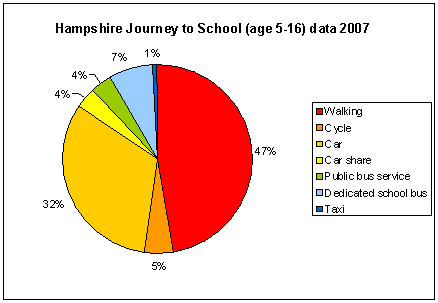
(Source - 2007 school census and Hampshire's own surveys of half
the schools without a school travel plan, a total sample of 418 schools)
Hampshire has higher levels of car use than the national average, which, despite the large number of rural schools in Hampshire, still provides an opportunity for decreasing car use and increasing other modes. When asked how they would prefer to travel to school, a high number of children said they wished to walk or cycle, indicating unmet demand. The graph below shows the changes in how pupils in the 5 to16 age range travelled to school from 2003 to 2006.
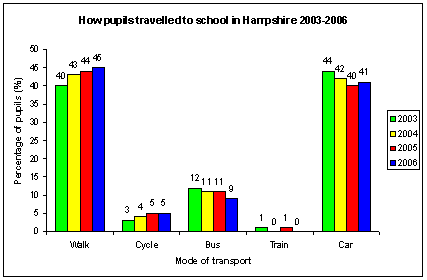
(Source - Hampshire's annual hands-up school travel survey)
The graph below shows Hampshire's performance 2003 to 2005 in influencing the mode chosen to travel for the journey to and from school in comparison with the national picture and that in the South East region of England.
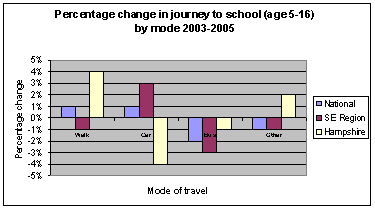
(Source - Hampshire's annual hands-up school travel survey and the national travel survey conducted by the Department for Transport (DfT))
4. An Assessment of the Travel and Transport Needs of Young People
An assessment of the accessibility needs and problems of the area will be carried out through a review of School Travel Plans produced to date. This will inform the development of the strategy and maximise the benefits of school travel plans in helping to identify priorities for expenditure and enhance mobility.
5. Summary of the Audit of Sustainable Travel and Transport Infrastructure
The County Council intends to conduct audits of sustainable travel and transport infrastructure that may be used when travelling to and from, or between schools and institutions. Once these audits have been completed, this section will outline how the County Council intends to develop infrastructure so that it better meets the needs of children and young people in Hampshire.
6. Key Objectives of the Strategy and Associated Targets
This section will indicate how improvements will help deliver other objectives, including environmental improvements and road safety. Objectives will be agreed to address the issues identified from the needs analysis (section 4) and gaps identified through the audits (section 5).
7. Area-wide Initiatives Supporting the Promotion of Sustainable Travel and Transport
The Local Transport Plan - The overarching strategy for Hampshire County Council's Local Transport Plan is to tackle transport problems through policies to "reduce, manage and invest". The "reduce" element of this strategy includes tackling problems of congestion by measures to reduce the need to travel, reduce the distance travelled and reduce the amount of travel by single occupancy private car. These measures are generally low cost and usually do not involve additional transport capacity or infrastructure.
The emphasis is on enabling individuals to make `smarter' choices about the way in which they travel - one of the options being not to travel at all. `Smarter travel choices' encompasses a range of measures, including travel planning (school and workplace), personalised journey planning, awareness campaigns, car clubs, car sharing, teleworking and home shopping.
Aims and Objectives
It is proposed that the overall aim of the smarter choices strategy should be to secure: "A county where a greater proportion of journeys are made in a safer, healthier, more efficient and more environmentally friendly way."
To achieve this, the strategy aims to:
· Ensure that individuals and organisations understand the implications of the travel choices they make and feel empowered to make informed travel choices.
· Enable journeys to be made in a safer, healthier, more efficient and more environmentally friendly way through the identification and provision of new travel and transport measures.
· Reduce the need to travel and the distance travelled, by influencing non-transport decisions that can have an impact on travel choices.
Home to School pilot projects
The County Council has launched a new home to school transport three-year pilot scheme with the aim of encouraging more pupils out of their parents' cars to help reduce school run congestion, reduce pollution and increase independence. There are four elements making up the School Transport Initiative:
· Yellow school buses - in the Basingstoke area
· Walking and cycling initiatives - in the Farnborough area
· Home to school travel services - in the Waterside area
· Scheduled bus services - in the Eastleigh area
Three yellow buses are used by pupils from Kempshott Infant and Junior Schools, Park View Infant and Junior School and Aldworth Science College in Basingstoke. During the school day, the buses can be used by young people for other purposes, such as school trips.
8. Action Plan - Delivery of the Strategy
· Publish draft strategy setting out intentions August 2007
· Develop a detailed action plan with responsibilities September 2007
· Set up project team September/October 2007
· Start needs assessment, infrastructure audit and collate data October 2007
· Complete mapping pilot at a selection of secondary and primary schools November 2007
· Start main infrastructure audits December 2007
· Develop strategy March-June 2008
· Review progress July 2008
· Publish revised strategy August 2008
9. Barriers to Implementation
This section will include details of any barriers to implementation of remedial measures and implementation of the strategy.
10. Financial Implications
The DCSF has made an allocation of £94,012 for the development of the strategy in the financial year 2007/08. This is expected to continue for the next five years. The DCSF/DfT currently provides £165,000 bursary for the employment of School Travel Plan advisers, this funding has been extended to the end of March 2010. Additional funding sources will be explored further as the strategy develops.
The development of the strategy will include setting up a small project team to conduct the sustainable travel and transport infrastructure audits, develop the strategy and promote sustainable travel and transport modes.
11. Monitoring and Evaluation of Targets
A system of monitoring and evaluation will be established; measuring the performance of the strategy against the mode targets set using data from the annual school census, locally collected information and suitable comparator shire councils.
12. Strategy Review
The strategy will be reviewed annually and published on the County Council's web-site, Hanstweb, by 31 August each year.
1438/ACW
August 2007