
Archived decisions
A New Cultural Strategy for Hampshire
Background
Enjoying Hampshire - helping people make the most of living in and visiting Hampshire1 was adopted by the County Council as a core strategic document in 2003. Since then it has underpinned the development of the Council's cultural, sporting and recreational services and guided its approach to its growing cultural partnerships with other local authorities, government agencies and cultural institutions.
The strategy defined a set of unifying principles for the development of the Council's cultural services:
Stewardship - conserving and caring for the cultural heritage
Equality of access to cultural services
Increasing and broadening participation in cultural activities
Promoting inclusiveness in service provision
Supporting learning at all levels
Securing economic benefits from cultural activity
Valuing local distinctiveness and sense of place.
The strategy went on to create a vision for Hampshire in which the County Council and its partners would:
Support the preservation, conservation, development and promotion of Hampshire's cultural heritage
Enable forward looking, innovative and creative cultures to flourish in the county
Encourage affordable easy access to high quality cultural activities and facilities for all
Facilitate the recognition and understanding of the history of Hampshire and its people, in the context of United Kingdom, European and world history
Ensure that learning opportunities offered by cultural facilities and activities of Hampshire are fully utilised
Promote and encourage the sharing of the cultures of minority groups within the county, and
Ensure that cultural activity plays an increasing role in the economy of the county in a sustainable way.
No specific timetable was set for the review of the effectiveness and continuing relevance of the strategy, but during 2006 a limited series of consultations took place with a view to updating and revising the strategy. However, significant developments during the year at both the national and local level required further analysis and assimilation.
During 2006 the County Council undertook a review and revision of its corporate strategy. Clear priorities and specific targets have been set for the remaining life of the current Council and a corporate business plan has been developed to support delivery of these objectives.
In the autumn of 2006 the government published Strong and Prosperous Communities1 its White Paper on the future of local government. This set out far reaching and ambitious proposals for the reform of the relationship between central and local government. More details have been added as the enacting legislation passes through the various Parliamentary stages. The central concept is the revitalising of Local Strategic Partnerships, led by local authorities, with responsibilities for producing new Sustainable Community Strategies delivered through Local Area Agreements negotiated with government. Existing performance management regimes (Comprehensive Performance Assessments etc.) would b replaced by a scaled down regulatory regime that would concentrate on the capacity of Local Strategic Partnerships to deliver against the agreed priorities.
At the same time, the County Council has been examining with other local authorities in the county how the existing two tier system of local administration (three tier in parished areas) could be improved. These discussions have been given added impetus with the publication of the Local Government White Paper. The "constitutional conversation" has explored the possibility of instituting a Hampshire Senate supported by a number of formally constituted county wide strategic partnerships on key themes, including culture.
The revision of the Cultural Strategy for Hampshire was originally seen as a largely technical exercise. With these significant new developments, we have come to the conclusion that a more fundamental reassessment is necessary in consultation with the County Council's cultural partners.
The County Council is publishing this consultation document as a first contribution to the debate about the future strategic direction for culture in the county. At this stage, we have not reached any definite conclusions and the discussion document does not make any detailed proposals. The intention is to stimulate discussion of key concepts and to develop a complete understanding of the context for and influences on a new cultural strategy relevant to current needs.
The document is laid out in two main parts. The first of these is concerned with the understanding of key concepts. It proceeds from a consideration of various definitions of culture, through a survey of new concepts of cultural value to a suggestion that there may be a place in a new strategy to explore the notion of "cultural entitlement". The second part relates to the specific factors affecting the future cultural life of Hampshire. A brief sketch of the special quality of Hampshire's cultural geography is followed by an exposition of a range of demographic, social and economic factors that will affect the cultural life of the county over the coming years.
_
What is culture?
Culture is a difficult word.
For some people, culture is the essence of life -
"Culture may even be described simply as that which makes life worth living"
(T S Eliot, poet Notes Towards a Definition of Culture)
But culture can easily provoke negative reactions -
"Whenever I hear the word culture, I reach for my pistol"
(Attributed to Hermann Goering, Nazi politician)
According to Matthew Arnold, the 19th century English poet, critic and educationalist, culture is "contact with the best that has been thought and said in the world". It is "properly described as the love of perfection; it is the study of perfection". The prevailing 19th and early 20th century understanding of culture as being concerned with aesthetics and refinement of thought and artistic expression still has a powerful resonance. But this notion of "high culture" makes many people uncomfortable, resistant or downright hostile and is readily satirised. W S Gilbert, Arnold's younger contemporary, famously parodied the pretentiousness that can surround this concept of culture -
"If you're anxious for to shine in the high æsthetic line as a man of culture rare,
You must get up all the germs of the transcendental terms, and plant them ev'rywhere.
You must lie upon the daisies and discourse in novel phrases of your complicated state of mind,
The meaning doesn't matter if it's only idle chatter of a transcendental kind.
And ev'ry one will say,
As you walk your mystic way,
"If this young man expresses himself in terms too deep for me,
Why, what a very singularly deep young man this deep young man must be!""
(Bunthorne, the poet, in Gilbert and Sullivan's Patience)
Over the last half century the "high culture" concept has been supplemented if not displaced by an equally powerful understanding coming out of sociology, anthropology and cultural studies. This roots the idea of culture in the everyday experience of people going about their lives.
"I use the term culture to refer collectively to a society and its way of life or in reference to human culture as a whole... Culture involves at least three components: what people think, what they do, and the material products they produce. Thus, mental processes, beliefs, knowledge, and values are parts of culture."
(John H Bodley, American cultural anthropologist)
So we find that modern dictionary definitions of culture embrace the traditional "high culture" concept and a newer and broader understanding of what culture is all about -
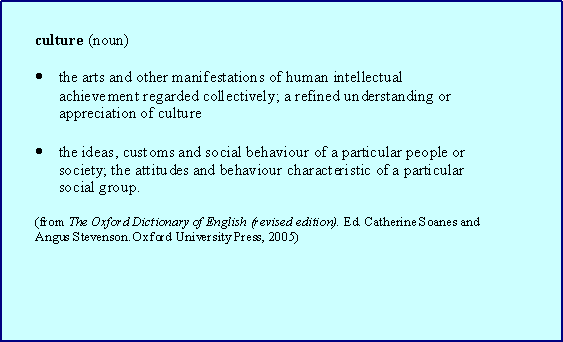
There is also a bureaucratic definition of culture used in Britain to identify the activities and institutions that currently fall within the competence of the Secretary of State for Culture, Media and Sport in England (different approaches are taken by the devolved administrations in Scotland, Wales and Northern Ireland). The "culture" part of the title refers specifically to the arts, architecture and design, museums and galleries, libraries, archives and the built and historic environment. But the ministerial portfolio also includes broadcasting and the creative industries, sport, tourism, gambling and horse racing, the national lottery and the licensing of alcohol and entertainment venues. All of these fall within a broader social definition of culture. And why stop there? Surely culture can also cover the natural environment and our use of the land and natural resources. It also influences our attitudes to education, health and well-being and sharpens our sense of individual and community identity. So the notion of culture strays across administrative boundaries in Whitehall, county halls and civic offices to pervade all aspects of public service. In this way, culture becomes the concern of all public servants, not just the cultural professionals.
But what stance should we take on this in Hampshire? If culture is to be understood in its broadest and most general sense, it can include any or all of the foregoing ideas and the ramifications will be profound and far-reaching.
But we can be clear about a number of things:
· Culture means something to everyone
· Culture is always changing
· Culture is inclusive not exclusive.
Culture is a difficult word. Because of this difficulty, the language we use can be confusing, obscure or completely impenetrable, particularly when we talk about the value of culture. But the idea of value has to be at the heart of any discussion about how public bodies use their resources. This issue is taken up in the next section of this document.
How do we value culture?
It isn't easy! Our individual responses to cultural stimuli and the benefits we get from them are personal and unique. People get something from looking at a Constable landscape or a Caro sculpture, but precisely what are those benefits and how do you place an objective value on them? How can you put a value on what a village community gets out of a show by the Strange Face Theatre Company or a Shoo Shoo Baby gig? How do you value the life-changing experience a struggling teenager has through a Creative Hampshire workshop? And these experiences aren't unique to the arts. People get personal benefit out of contact with museum and archive collections, through taking part in and watching sport, through their contact with the natural environment. What price these benefits? What price culture? [needs illustrations from Hampshire]
Nobody has a definitive answer to these questions, but our understanding of the value created by cultural experiences has been advanced considerably by the work of John Holden and his colleagues at the think tank Demos. He argues2that we should recognise three fundamental types of cultural value:
Intrinsic - the set of values that relate to our individual intellectual, emotional and spiritual experience of culture; because of their individual nature these values are almost impossible to measure and compare [links to vignettes to illustrate]
Instrumental - the set of values that relates to the social and economic effects of cultural experiences; frequent but imperfect attempts are made to measure this value in terms of outputs, outcomes and impacts [links to vignettes to illustrate]
Institutional - the value attaching to cultural institutions; this value is akin to the accounting concept of goodwill and is most clearly expressed where people say that an institution (a library, an art gallery etc.) has a value to them or their community even though they do not use it themselves [links to vignettes to illustrate]
Holden has gone on to explore how these different types of value are used in conversations between the public, government (politicians and public servants) and cultural practitioners (individuals and institutions) about cultural issues3 His view is that, because of an increasing need to justify public expenditure in terms of measurable outputs and outcomes, too much emphasis is given to a dialogue that is couched almost exclusively in the language of instrumentalism. Thus the instrumental value of culture has come to dominate discussions and negotiations between politicians and public servants at national, regional and local levels, cultural institutions and cultural practitioners. The real but intangible benefit that comes directly from people's individual cultural experiences and the public "goods" created by cultural institutions is undervalued or ignored. Cultural policy becomes a closed conversation among "experts".
So, although the value people get from cultural experiences is direct, personal and unique, it is instrumental value that has become, almost exclusively, the currency of debates about public policy and, most critically, about the public funding of culture.
John Holden's stimulating arguments on cultural value are part of a general concern about the value created by public services. Concepts of "public value" have been explored and extended through research undertaken by the Work Foundation for a group of sponsors including the DCMS, Home Office, BBC, Metropolitan Police, London Borough of Lewisham and the Capita Group. The final report on this work4offers a framework for understanding public value and how public services and institutions should use this to increase the impact of what they do. This is rooted in the practice of an improved dialogue with people as citizens, rather than merely as consumers of services - an idea that is at the heart of John Holden's work on cultural value. It is argued that this is the most productive way of re-establishing an appropriate balance between intrinsic, instrumental and institutional considerations.
These new conceptual understandings of cultural value and public value provided by John Holden and the Work Foundation are all very well and help to cut through the fog, but how much do we know about whether people in Hampshire value cultural experiences and use cultural facilities? And, if so, what do they think about the quality of what is on offer in the county?
The best and most comprehensive picture we have comes from surveys of Hampshire residents carried out by the polling organisation Ipsos MORI for the County Council [reference to separate block of text describing MORI survey methods and questions]
[Key points from MORI - high use, high regard, growing expectations?]
While these results are interesting and provide some sort of "benchmark" for certain aspects of culture in Hampshire, they do not offer much of a guide for future action. But we do get occasional glimpses of important currents in the attitudes and behaviour of people that demand responses from public authorities in the county. Here are two examples -
[reference to separate block of text describing Define report and listing its conclusions]
[reference to separate block of text describing Gosport DC research with young people]
One strong conclusion from our analysis of Hampshire's cultural landscape is that we do not have available to us enough of this type of high quality research designed specifically to help strategic thinking and guide policies. There is a critical need to develop and refine of our research and intelligence capability- at the moment we are flying without radar!
Is there such a thing as a "cultural entitlement"?
The idea that there are fundamental human rights relating to culture and cultural expression is enshrined in various international conventions -
United Nations Universal Declaration of Human Rights (1948)
Everyone, as a member of society, has the right to social security and is entitled to realisation, through national effort and international cooperation and in accordance with the organisation and resources of each State, of the economic, social and cultural rights indispensable for his dignity and the free development of his personality.
(Article 22)
Everyone has the right freely to participate in the cultural life of the community, to enjoy the arts and to share in scientific advancement and its benefits.
(Article 27(1))
United Nations Convention on the Rights of the Child (1989)
States Parties recognise the right of the child to rest and leisure, to engage in play and recreational activities appropriate to the age of the child and to participate freely in cultural life and the arts.
(Article 31(1))
States Parties shall respect and promote the right of the child to participate fully in cultural and artistic life and shall encourage the provision of appropriate and equal opportunities for cultural, artistic, recreational and leisure activity.
(Article 31(2))
Some countries (Sweden and Finland for example) have given these rights a constitutional and legal basis. In Britain, there is no comparable legal status for cultural rights, although the Scottish Executive has considered and consulted on the possibility of placing cultural rights and entitlements on a statutory footing5 In England, the Department for Media, Culture and Sport five year plan6for the period 2005 to 2010 makes a number of commitments to the public, including -
We will persuade more people (especially those at risk of social exclusion) to participate in culture, sport and physical activity by publicising the benefits and improving facilities.
We will make sure that everyone - particularly people from those groups who have not taken up opportunities in the past - has the option to take part in our rich cultural life.
We will improve sporting opportunities for children. We will also build a comprehensive offer to them on culture.
There is clearly a growing recognition that people in this country should expect to enjoy a rich and fulfilling cultural life. But does this amount to an entitlement, in the same way that people expect to be entitled to for example, education, health care or fire and rescue services?
We believe that it is legitimate to think in terms of an entitlement. But we are wary of a "top down" approach that leaves definition of this entitlement in the hands of narrow sectoral interests and cultural "experts".
Our view is that any idea of a cultural entitlement for Hampshire should be rooted in an understanding of what Hampshire people want and need. But we have to accept that it will be difficult to generalise about these wants and needs and be prepared to work within a context that recognises the diversity of Hampshire's people and places.
It is vital that local authorities, cultural agencies and cultural organisations pool their knowledge and find new ways of tapping into the aspirations and experiences of people in Hampshire. There is a clear link here to the conclusions reached in our consideration of the value of culture about the need for better market intelligence and more effective engagement with people as citizens. But this goes further in calling on all cultural bodies and institutions to focus their attention on their conversations with people about the place of culture in their lives as individuals and in their communal lives.
What's so special about Hampshire?
"Most writers claim for their `copy-hold' that it is the choicest bit of our choice Homeland. This is a praiseworthy attitude. But not on this account, nor with any desire to cast aspersions on my fellow writers do I assert that Hampshire is the most perfect of English counties, and the most representative corner of England!"
(D H Moutray Read, Highways and Byways in Hampshire)
That was the appreciation of a Hampshire by a popular topographical writer in the early 1900s and many people in Hampshire today share that view! But what makes Hampshire such a special place?
Hampshire lies at the heart of central southern England - a geographical fact that has influenced much of the history and culture of the county. Its borders stretch from Havant in the east to include the New Forest in the west; from the shores of the Solent in the south to within twenty miles of London in the north. One of the largest counties in England, it has a population of over 1.2 million people in the administrative county alone. Taking into account the cities of Portsmouth and Southampton, 1.7 million people live within Hampshire's borders.
The landscape of Hampshire is rich, varied and steeped in history. Its distinctive character has been shaped by centuries of human activity. The chalk uplands were cleared of forest in prehistoric times and have been grazed by sheep for millennia. The ancient woodland and lowland heath of the New Forest has survived through its appropriation to the Crown as a Royal hunting reserve - William Rufus met his untimely death hunting in the New Forest. The river valleys have been settled and farmed since Saxon times - the clear waters of Hampshire's chalk streams are internationally renowned for angling. The sheltered harbours of the Solent were the cradle of the British Navy - they are now a mecca for yachtsmen from across the world. With one National Park, one proposed National Park and four Areas of Outstanding Natural Beauty, Hampshire's landscape is exceptional by any standards.
Local materials - thatch, wood, flint, cob and locally made bricks - are blended in varying combinations in the vernacular architecture of the county and give Hampshire's villages and towns their unique character. Other materials, such as stone, had to be brought the county and so were reserved for churches, castles and great houses of which there are many fine examples. Winchester's Cathedral and the Great Hall, Highclere Castle and the Vyne, to name but a few, are gems of Hampshire's architectural heritage. Today, outstanding contemporary architecture is making its mark on the built environment of the county.
Historically, Hampshire's life and culture has been shaped by many factors. In the tenth and eleventh centuries, for example, Winchester Cathedral was in the mainstream of the political and cultural life of medieval Europe. Portsmouth, seventy five miles from London and a hundred miles from France, has played a major part in naval history and Southampton has been a gateway to Britain since Roman times. Aldershot is known as "the home of the British Army" and nearby Farnborough saw the pioneering of aviation in this country. History has bequeathed to Hampshire a unique legacy of castles, fortifications, historic ships, museum collections and archives.
Hampshire is, and has always been, a cosmopolitan and multi-racial society, at least in its cities and major towns. Because of its maritime and military history, the indigenous culture of Hampshire has absorbed many external influences through the comings and goings of people from across the world. Throughout the 20th century international conflict, new political alliances and the retreat from Empire have brought many willing and unwilling migrants to the county. Many have settled, adding something of their native cultures to the rich mix. Hampshire's diverse cultures are thriving in the early years of the 21st century. Attitudes are dynamic and forward looking. Creativity and innovation are flourishing.
Energy at the local level, excellence and diversity are the three key characteristics that define cultural opportunities in Hampshire today. This is underpinned by solid foundations developed over many years through investment by local authorities, government agencies and the private and voluntary sectors.
Local authorities provide local libraries, museums, leisure centres, schools, theatres, small scale arts centres, playgrounds, etc. These facilities are backed up by an extensive network of community centres and village halls providing venues for events such as the County Council's `Hog the Limelight' rural touring arts programme. The County Council provides opportunities for countryside recreation through its management of country parks, countryside sites, footpaths, bridleways and cycle ways.
There is a strong infrastructure for sport and physical recreation provided through leisure centres, schools and voluntary sports groups, which offer opportunities at all levels of experience. Calshot Activities Centre plays a fundamental role in developing talent in a range of sports, notably sailing, as well as offering the only indoor velodrome in the south of England. Many of the UK's best known sailors are based around the Solent.
Hampshire is home to a wealth of artists, craftspeople, writers and musicians providing a reservoir of talent and a base for cultural and creative industries, including media production, publishing and design. Venues such as ArtSway provide a nationally recognised focus for creative work. The Anvil in Basingstoke presents internationally known orchestras, entertainers and musicians as well as a wide variety of local talent in a top rank purpose built concert hall.
The county's museum and archive services collect, preserve, interpret and present the material evidence of Hampshire's culture, history and environment, including contemporary material. These collections provide a fundamental platform for learning and research at all levels from individual enthusiasms, through curriculum based learning in schools to advanced scholarship. The network of museums across Hampshire gives people access to their history and the Hampshire Record Office, which also houses the Wessex Film and Sound Archive, is nationally recognised as a centre of excellence as well as being used extensively by local people.
Hampshire's culture is a unique and precious commodity. The care of the cultural heritage and the cultivation of new means of cultural expression that are relevant to the people of Hampshire today and in the future must be a concern of the County Council and its partners in the public, private and voluntary sectors.
[Hampshire A to Z]
But things are changing
Hampshire is a special place, but it can't stand still. There is a wide range of pressures, trends and influences that will affect the cultural life of the county over the coming years and decades.
Changing population
The latest projections for the administrative county of Hampshire suggest that the population will grow to over 1.3 million by the middle of the third decade of this century - an increase of approximately 8.5%. This growth will not be evenly distributed across the county. The districts of Gosport, Hart, Test Valley and Winchester are all expected to experience significantly higher growth than the average for the county. Basingstoke and Deane's population is expected to grow by 20% over this period. In contrast, the overall populations of Havant and New Forest districts are expected to remain static or show a small decline.
These projections are based on current plans for housing growth and do not take account of the government's latest proposals for accelerating the house building programme in the South East of England.
At the same time, the population will be ageing. Over the next two decades there will be a very significant reduction of the proportion of the population in the 0 to 15 age group. By contrast the proportion of over 65s will increase dramatically. Currently around 26% of the population is of pensionable age. By 2025 this will have risen to 38%. By 2025 over half of the people living in the New Forest will be over 65. Well over 40% of the people living in Havant and Fareham will be pensioners.
These major demographic changes, compounded by migration between Hampshire and other parts of the UK and, increasingly, other countries, will have a far reaching impact on the cultural life of the county and the demand for cultural facilities and services. Our ability to predict these changes is in its infancy.
Social and economic change
Hampshire and its culture is not immune to external influence. Proximity to London has always had a strong influence on the life of the county. London has been an important market for Hampshire's farmers and growers for centuries. Now, large numbers of people commute to jobs in the capital on a daily basis. This gravitational pull is unlikely to diminish. It means that many people look to London for culture and leisure. Cultural institutions and services in Hampshire exist in an economy where there is strong competition from the metropolitan region. To compete, local cultural producers must trade on their distinctiveness and high quality.
And Hampshire feels the effect of wider social and economic trends. Globalisation of culture and economic activity brings strong new influences on the life of Hampshire people. National and international media and the internet open up new channels for the exchange of ideas. Many cultural commentators have warned of the "homogenisation" of culture and the loss of local identity. This is linked to fears about the loss of social cohesion, the fragmentation of communities and the collapse of civic values.
Economic change is having an effect on the nature of employment. The development of a post industrial "knowledge economy" has put a premium on new skills based on information and creativity. The emergence of an "hour glass economy" where jobs are concentrated at the higher and lower ends of the skill and knowledge spectrum again emphasises the need for a different approach to education and learning. Cultural services have a major role to play in developing these new life skills.
The level of funding of public services will have a continuing impact on cultural provision in the county. Government priorities in education, health and housing increase the pressure on local authorities and other public bodies to concentrate their finite resources in these areas. Cultural services must continue to demonstrate their instrumental value and that they are a vital component in delivering wider social outcomes for learning, health, wellbeing and social cohesion.