
Archived decisions
Hampshire County CouncilHealth Overview and Scrutiny Committee Item 4 25 September 2007 Inquiries Received and Action Taken Report of the Chief Executive |
Contact: Denise Holden ext. 7338
e-mail: [email protected]
1. Summary and Purpose
1.1. This report provides Members with information about the issues brought to the attention of the Committee and the response to these referrals. It sets out the inquiries received, the source of this inquiry and any action taken. Where appropriate comments have been included and copies of briefings or other information attached.
1.2. The approach adopted provides the route through which Patient and Public Involvement Forums (P&PIFs) and other partner organisations (Hampshire district councils, NHS organisations, voluntary and independent sector providers and organisations that are representative of social care service users and carers) can raise issues with the Committee.
1.3. Where inquiries raised with the Committee are already subject to monitoring or other performance management activities the action taken will be focused on the local resolution of inquiries through appropriate sign-posting to the agency best placed to respond.
1.4. Where an issue cannot be satisfactorily resolved between the parties concerned then the Committee can consider options for further action.
1.5. New issues raised with the Committee, and those that are subject to on-going reporting are set out in Table One of this report.
1.6. The recommendations included in this report support the Corporate Strategy aim of maximising wellbeing through the overview and scrutiny of health services in the Hampshire County Council area.
Table One: Inquiries Received and Action Taken
Topic/inquiry |
Source |
Action Taken |
Comment |
Access to NHS dental services |
Chairman/Committee members |
Members have requested and up-date on the provision of NHS dental services in Hampshire. Access to these services has been highlighted as a concern previously by the Committee and a number of areas under specific pressure were identified. Members will wish to understand the impact of the new dental contact on access and the way in which the PCT intends to take forward its responsibility for the provision of these services. |
Hampshire PCT will present this information to members. |
Recommendation: Members confirm any further information required and timeframes for the next report to the Committee | |||
The future of Moorgreen Hospital |
Southampton City PCT |
Southampton City PCT is currently considering how services at Moorgreen can be developed to provide a facility for people living in the area. |
|
Recommendation: The Committee receives an up-date on progress with the development of the business case and the bid for additional funding as soon as it is available. | |||
Aldershot Health Centre Redevelopment |
Committee members |
The Hampshire PCT update on this work is attached at Appendix One. |
|
Recommendation: Members identify any additional information required | |||
Progress with Andover War Memorial Hospital |
County Councillor |
WEHT has confirmed its commitment to upgrading and extending services at the Hospital. There is not final design agreed yet. |
|
Recommendation: the Committee notes the response of WEHT and confirms any additional information required. | |||
Proposals to close beds at Countess Mountbatten Hospice |
Chairman, Safe and Healthy People Select Committee |
The letter to SUHT and the response received is attached at Appendices Two and Three respectively. The Chairman has written subsequently to the Trust confirm his expectation that Members are provided with an update on progress at the meeting on 12 October. |
|
Recommendation: Members highlight any additional issues to be raised with SUHT following the meeting on 12 October. | |||
Childhood Immunisation Rates |
HAT Chairman |
Further to the request from Members at the last meeting the Director of Public Health has reviewed the data on immunisation rates to ascertain if it is possible to present this by District/Borough. She has confirmed that this data cannot be broken down beyond the former PCT boundaries |
|
Recommendation: Members note the response of the Director of Public Health and are provided with the next report in March 2008. | |||
Community Hospitals |
Chairman |
The PCT is continuing to explore options for services at this hospital with local stakeholders Milford Hospital. Proposals for taking forward are expected in the next few months The business case for the development of Oakhaven Hospital is progressing and will be shared with members at the November meeting. |
Additional information on the consultation conducted in 2004 has been requested |
Recommendation: Members receive proposals for the future configuration of services at Milford War Memorial Hospital when these are received | |||
Hampshire PCT Performance |
Committee Members |
A summary of PCT performance against key target areas is attached at Appendix Four. |
|
Recommendation: Members note the performance report from the PCT | |||
Health services for people who are homeless or without a fixed place of residence |
Committee Vice Chairman/Trinity House |
Changes in the support provide to a local voluntary organisation have been raised with the PCT. The PCT will provide a verbal update on the arrangements to provide appropriate support to this specific group of people and confirmation of the commissioning arrangements for providing these services across Hampshire |
|
Recommendations: Members identify any additional information required
| |||
Changes to Briarwood Adult Mental Health Unit at Cove in Hampshire County Council |
Hampshire P&PIF |
Further to feedback from the Committee last April the Trust has confirmed that has taken steps to ensure that there is good communication with the HOSC when service changes are being considered and provided information of work undertaken with service users to support the new arrangements. This is attached at Appendix Five. |
Additional information provided by the Trust is available through the scrutiny office. |
Recommendation: Members note the response from the Trust | |||
Ambulance Response Times |
Committee Member |
Further to reports of staff shortages impacting on response times the Trust has been requested to provide the HOSC with an explanation of the reasons for this position and the action being taken. Additional information will be provided to members at the meeting. |
|
Recommendation: Members agree any additional information to be provided. | |||
LINks |
Chairman |
The Department of Health has published the guidance and the expected contracting arrangements for LINKs. A summary of both documents is attached at Appendix Six. No information has been provided about levels of funding. HCC has set up a meeting with key stakeholders to explore what form this may take in the County on 2 October. |
|
Recommendation: Members are apprised of the outcome of the meeting on 2 October at their next meeting | |||
Section 100 D - Local Government Act 1972 - background papers
The following documents disclose facts or matters on which this report, or an important part of it, is based and has been relied upon to a material extent in the preparation of this report.
NB the list excludes:
1. Published works
2. Documents that disclose exempt or confidential information as defined in the Act.
HAMPSHIRE PRIMARY CARE TRUST
ALDERSHOT CENTRE FOR HEALTH UPDATE
SEPTEMBER 2007
CONSTRUCTION PROGRESS
The structural concrete work for the new Hospital is complete and the internal partition walling continues on all four floors so individual rooms are beginning to take shape. The external works are progressing around the perimeter of the building. The windows have begun to be installed and the roof sheeting to the main roof is complete. The pre-cast elements of the decked car park are complete.
The building contractor is reporting that they are two weeks behind construction programme due to the heavy rains which have resulted in water ingress spoiling wall partitioning, as the building is not yet watertight. However, they have made great progress in other areas and the building is still on target for a completion date at the end of February 2008.
There is then planned a specialist fit out period for areas such as dental, audiology and X-ray and a commissioning period to install the IT and telephone systems ready to be fully operational by the beginning of June 2008.
CLINICAL SPECIFICATION FOR ACFH
Run by Hampshire Primary Care Trust (PCT) and the Army, the ACfH will contain 700 rooms to house the large array of treatments and services that will be based there.
Doctors and dentists, clinicians and counsellors for civilian patients, to Army doctors, a 20 bed Medical Reception Station, standing medical board, psychiatrists and offices for the military will be on site. It will also have a pharmacy, making it a truly all-inclusive one-stop shop for health care, and the largest of its kind in the UK, possibly Europe.
Despite the NHS and Army jointly using the site, soldiers' confidentiality and safety will not be compromised, as civilians and every day patients will not be able to access military areas.
For the first time, a health centre will be able to offer sophisticated diagnostics, without the need to visit hospital. For example, it will no longer be necessary to visit Frimley Park Hospital for a CT scan; you can just visit ACfH instead.
Minor Injuries Unit
In 2003 the business case for Aldershot Centre for Health was approved by Blackwater Valley and Hart PCT and Hampshire and Isle of Wight Strategic Health Authority. The business case stated that "the new centre will also contain space for a Minor Injuries/Illnesses Unit although it is important to note that the funding required to operate the unit has not been identified within the PCT's current Local Delivery Plan.
Should the PCT be able to identify funding in the 2006-2009 LDP, the unit will have the potential to contribute to maintaining low waiting times in the main A&E department at Frimley Park and supporting the access targets for primary care."
What is an MIU?
Minor Injuries Units (MIU) are led by specially trained Emergency Nurse Practitioners who are as experienced as many doctors in dealing with minor injuries. They are skilled in assessing patients and providing a wide range of advice and treatments. They are trained to know when a specialist is needed and, if necessary, can refer a patient to their GP.
What can an MIU do?
For adults and children aged three years and over (though often this will be for children aged five years and over), an MIU is able to treat:
· Sprains and strains
· Broken bones
· Wound infections
· Minor cuts, burns and scalds
· Minor head injuries
· Insect and animal bites
· Minor eye injuries
· Injuries to back, shoulder and chest
· Remove foreign bodies from ears, noses, etc
· Remove splinters
· Dress minor wounds, cuts and grazes
An MIU is NOT equipped to treat;
· - Children under the age of three
· - Chest pain
· - Breathing difficulties
· - Major injuries
· - Problems usually dealt with by a GP
· - Stomach pains
· - Women's problems
· - Pregnancy problems
· - Allergic reactions
· - Overdoses
· - Alcohol related problems
· - Mental health problems
· - Conditions likely to require hospital admission
What does a GP surgery do?
All practices in the local area offer services for patients who have suffered an open wound in the last 48 hours.
Subsequent to the approval of the business case, the PCT has maintained its position on the case for the provision of a Minor Injuries Unit [MIU], namely that whilst there remains space in the centre for an MIU, there are no plans to provide one in this stage of the development.
In recognition of the recent calls for an MIU, the PCT has commenced work with GPs and other clinicians in the Practice Based Commissioning locality group of Rushmoor (which includes Aldershot). The locality benefits from the provision of an excellent Out of Hours provider (North Hampshire Urgent Care Service with bases in Frimley Park Hospital and Basingstoke and North Hampshire Foundation Trust Hospitals). The PCT is actively engaged with the Practice Based Commissioners to explore the options for further improvement and integration of Primary Care Services in the Aldershot area with Hampshire County Council and community services.
A number of issues have been made clear as part of these discussions:
· There has been a reiteration that Hampshire PCT has not been `holding back' funding for a Minor Injuries Unit. The PCT's money is fully committed and extra services (including an MIU) at Aldershot can only be funded by making savings elsewhere;
· under the current commissioning framework, Hampshire PCT does not pay for A&E attendances for its patients attending hospitals in Surrey (namely Frimley Park Hospital Foundation Trust and Royal Surrey County Hospital). Therefore, the production of a robust business plan to divert patients from A&E to either primary care urgent care centres or minor injury units within Hampshire presents a challenge. Under the current commissioning arrangements the host PCT (namely Surrey), is funded for all A&E patients' attendances irrespective of the PCT area in which the patient lives;
· decisions about emergency and urgent care services for the people of Aldershot and surrounding areas are not just for Hampshire PCT to make. They need to be taken in conjunction with local GPs, Surrey Primary Care Trust and Frimley Park NHS Foundation Trust. A description of the range of services available is set out below:
Service |
Site |
Distance from Hospital Hill, Aldershot GU11 1PB (Source - The AA) |
Opening hours |
A&E Department |
Frimley Park Hospital |
7.65 miles |
24 hours |
A&E Department |
Royal Surrey County Hospital, Guildford |
9.90 miles |
24 hours |
A&E Department |
Basingstoke and North Hampshire Hospital |
18.14 miles |
24 hours |
A&E Department |
Queen Alexandra Hospital, Portsmouth |
40.63 miles |
24 hours |
Walk-in Centre |
Woking Community Hospital |
12.28 miles |
7am to 10pm, Monday to Friday 9am to 7pm, Saturday, Sunday and Bank Holidays |
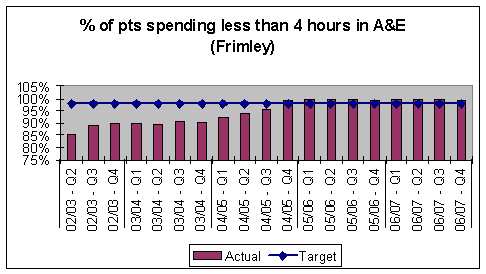
The waiting times for the Accident and Emergency Department at Frimley Park Hospital improved significantly from April 2002 to March 2005. This improvement has been sustained for the last two financial years.
The local Primary Care Centre is co-located with the Accident and Emergency Department at Frimley Park Hospital. It sees people with urgent problems who cannot wait until the next time the GP practice is open.
The centre is accessed by appointments made by the Out of Hours telephone system or by attending and waiting to be seen. It is open from 6.30pm to 8.00am Monday to Thursday and 6.30pm Friday evening to 8.00am Monday morning (Tuesday morning if the Monday is a Bank Holiday).
Its location means it can refer patients with problems outside its remit to the Accident and Emergency Department directly.
NEXT STEPS
Further work will be progressed with the Practice based Commissioning locality over the coming months. Work is also underway with representatives from the local Council and meetings and site visits have been organised with local MPs.
HOSC letter to Southampton University Trust Re: Countess Mountbatten Hospice
Dear Mark
Countess Mountbatten Hospice
I am writing further to our Committee meeting yesterday at which we were apprised of potential changes to the level of services provided at the Countess Mountbatten Hospice. Concerns about the scale of the changes, and the immanence with which they could be implemented were raised by the Friends of the Hospice. Hampshire PCT and Southampton City PCT were present and commented that they were looking to provide more rather than less services for this group of patients, in line with our recent review of Care at the End of Life.
In order that we can ensure that members have a complete picture of any plans relating to the Hospice I would be grateful if you could provide us wit the following information:
· Details of any plans to change the current levels of services at the Hospice and timeframes for taking these forward
· Comparative costs of a bed at the Hospice and at the DGH (indicative day rate will be sufficient)
· Any financial recovery programmes to be taken forward in relation to the Hospice or other palliative car eservices currently provided by SHUT
Members were extremely concerned at reports that SUHT was planning to close 10 of the 25 beds at the Hospice and were clear that, should this be the case, we would regard it as a substantial service change. We would also wish to be clear about the stakeholder/service user engagement and involvement in shaping such proposals.
It would be helpful if we could have this information by 28 August so that I can circulate this to members.
Additionally we are holding a day to look at progress with the Care at the End of Life Review on the 12 October and will wish to consider this is matter as part of our discussions. Could you please therefore confirm who will attend this event on behalf of SUHT.
SUHT response Re: Countess Mountbatten Hospice
Thank you for your letter of the 25th July, which outlines concerns raised by the Friends of CMH concerning our funding issues for this service. The issues we have are:
· The income we receive for this work is substantially less than the operating costs of the service by £1.9m
· Local PCTs wish to invest long-term in the service but have limited resources this year to do so
· The Trust has challenging financial targets to meet the pay back its historic debt (£23m).
We are now working constructively with Hampshire and Southampton City PCTs, to find a solution to these matters. I have included the Friends of CMH in these discussions and they were present when we met with these parties last week. I personally chaired this meeting, given the importance I attach to this and the outcomes were:
· To ensure a full understanding of all the issues for 2007/08 concerning funding and the solutions, which include Southampton University Hospitals NHS Trust (SUHT) making a £490,000 contribution to the funding gap and the Friends of CMH contributing. Local PCTs will be considering any support for 2007/08. We will determine this by August 2007.
This may or may not resolve the funding issues and I would suggest I keep you appraised of this.
· A fuller medium term plan is put in place by September 2007, which considers the funding plans for 2008/09 and 2009/10 with the parties concerned.
Given that events have moved on, I would kindly suggest that your request is deferred, since the reasons for you requesting the data, may not need to be used. The issue of service change I do appreciate and we could discuss this if it ever is needed, balanced against our needs to meet our service and financial duties.
Hampshire PCT: SUMMARY OF KEY PERFORMANCE ISSUES, JULY 2007
Diabetic Retinopathy Screening
A detailed project plan has been agreed and implementation has commenced. This will ensure coverage of diabetic screening across the entire PCT. The plan will increase capacity in the former New Forest locality and establish a new service in the North, provided by Salisbury Healthcare NHS Foundation Trust. Although the planned service will deliver the required quality standards, there is a considerable lead in time, with a planned `go-live' of 1st December 2007 for the service in the North. For this reason, there is a significant risk that the PCT will not meet its
March 2008 target.
Smoking Quitters
Although formal data is not yet available, early indications are that the first quarter of 2007-08 has produced similar results to last year, and as such the PCT is already behind its trajectory to meet the March 2008 target of 9,554 quitters. This is despite the well publicised new smoke free legislation that commenced in July. The PCT has recently appointed a Head of Service for Smoking Cessation which will offer strategic and operational leadership to the service's Business Plan for 2007-08. Performance against this plan, and against trajectory, is being reviewed regularly by the Turnaround & Performance group, with contingency plans presented to the group in September 2007.
18 weeks - Diagnostic Waiting Times
The number of long waiters (13+ weeks) continued to rise in May, although a number of under performing services reported improvements. It remains a considerable concern to see such minimal progress against the 4 week milestone due in March 2008. The Contracting team are urgently investigating specific areas of poor performance. Activity levels to deliver a 4 week wait have been agreed with all local providers. On a more positive note, there is now a robust recovery plan for audiology services in the South East which gives the Commissioning Team assurance that it will make the required improvements in performance.
Infection Control - MRSA
Winchester and Eastleigh Healthcare Trust, by virtue of their target of one case per month, and PHT both missed their May 2007 target for the number of reported MRSA cases. Reporting of Clostridium Difficile is still under development, but a source of data is now secured (HPA), and provider specific targets have been sought. Arrangements for the continued management of infection control by the PCT for commissioned services are still in development.
Choose and Book
A marginal improvement in performance seen with the PCT achieving 33% of appointments booked using C&B. There are still considerable barriers to achievement of The Choose & Book project plan's maximum of 60% by March 2008. Corrective actions have been identified and solutions to these set out in the recovery plan, although it is acknowledged that the March 2008 target of 90% will not be met.
Community Matrons [Care Services Performance Report]
Although some staff are in place, there is still a considerable way to go toward meeting the March 2008 target of 50 WTE. Care Services have an action plan that sets out the service specification and its commissioning model, with a completion date of March 2008. The delivery of this plan is being continually monitored through the Performance and Turnaround Group.
Appendix Five: Surrey & Borders Partnership NHS Trust- Response to HOSC request for information about the way in which service users views were obtained during the Briarwood Consultation.
BRIEFING PAPER RE: BRIARWOOD REDESIGN CONSULTATION
This paper outlines the processes used as part of the Briarwood redesign to ensure that people (particularly service users) were involved in the modernisation of the services.
People who use the Service and Carer Involvement in Briarwood Redesign Steering Group
A person who uses the service and carer representative were involved in the monthly steering group meetings, which met to plan and agree the model for the new Briarwood service. The representatives were often tasked with getting feedback and providing the steering group with service users/carers views.
The carer representative sat on the interview panel for the appointments of staff in to the new service.
Feedback from people who use the service about the existing Briarwood Service
A questionnaire for all current residents and day clients was devised, administered and collated by someone who used services, supported by Judi Paige (Mental Health User Development Worker). The questionnaire was based on the "Developing Recovery Enhancing Environments Measure (DREEM)" Ridgway & Press, 2004, and was administered prior to the consultation as part of the research for the new service. Feedback from people with mental health needs was used to shape the model that was then proposed in the consultation.
Audit of Briarwood Day Service
An audit was carried out by the Occupational Therapists in the Summer of 2006 to measure the benefits of day attendance at Briarwood. This audit took the form of a questionnaire, and got feedback from current day clients. This feedback informed the new model of service.
Feedback from Other Professionals
The Occupational Therapists conducted a questionnaire on fellow colleagues in other services (i.e. CMHT's, acute in-patient units) to get feedback about the quality of service being provided by Briarwood, and their recommendations for change. This feedback was used to inform the new model of service.
Involvement with the LIT
The Briarwood model was discussed at great length in the Surrey Heath & North East Hampshire LIT, even prior to consultation. People who use services present at the LIT took the consultation to other groups they belong to (i.e. Branches, Buzz Group) for discussion and feedback. This was discussed at the LIT.
Following the consultation, feedback was given at the LIT and changes were made to some parts of the proposal. Nick Buchanan (Mental Health Commission from Hampshire PCT) was supportive of the amendments from the consultation and the changes to the new service (copy of Consultation Outcome Report was provided to him).
Consultation Briefing
During the first week of consultation, staff at Briarwood met with the people using Briarwood to explain the proposed changes and get feedback. The Community Meeting each week continued to discuss the model and answered questions as they arose.
Carer Support Workers within each of the 3 Community Mental Health Team's served by Briarwood were asked to discuss the consultation with individual carers or at Carer Support Groups (as appropriate).
Training for Service Users Around the New Approach
As part of the new service, residents and day clients have been encouraged to attend some training around:
· Recovery Approach
· Wellness Recovery Action Plan (WRAP)
· Service user Involvement
This training is being provided by an independent company, Raise!, and is scheduled for 6, 10, 13th September 2007 in Aldershot.
Implementation Date
Changes to the service have been implemented from 1 August 2007.
Lee Houghton
Service Manager 29 August 2007
Appendix Six: Preparing for LINks: Except for Democratic Health Network Summary
Two documents have been published by the DoH:
1. Planning your Local Involvement Network sets out what local communities need to prepare for LINks including:
· actions that local authorities need to take
· who should be involved
· resources required
· different models for the operation of LINks
2. Provides information for local authorities on procuring a host organisation to establish and support a LINk including:
· the procurement process
· services hosts will be required to provide
· Processes for establishing LINks.
LINks
A LINk will be established within each area that is served by a local authority with responsibility for social services. This means that there will be 150 LINks. Each LINk will be made up of volunteer "members", i.e. a person or group that makes a commitment to take part in LINks' activities on a regular bases and volunteer "participants", i.e. a person, group or organisation that wants to influence the work of LINks , even though they may not participate on a regular basis. The roles of LINks apply to both health and social care services. They will differ from Patient Forums in that they will be attached to an area, rather than to an individual NHS institution. The roles of LINks will include:
· promoting and supporting the involvement of people in the commissioning, provision and scrutiny of local health and social care services
· obtaining the views of people about their need for, and experiences of, local health and social care services
· enabling people to monitor and review the commissioning and provision of care services
· raising the concerns of local people with those responsible for commissioning, providing, managing and scrutinising services.
The Department of Health has been at pains to emphasise that the structures and ways of working LINks are intended to be flexible, broad and inclusive and that they may differ from area to area. Methods of involvement used by LINks may vary from providing information, through consultation and participation to "co-production" in which some groups may want to design and deliver services on a user-led model (the "expert patient" approach being cited as one model of this kind).
Local authority departments and a LINk may agree to pool information or work together to gather the views of local people about particular health and social care services.
The details of the powers of LINks will be provided in future regulations. The DH has said that they are likely to be consulted on shortly.
Host organisations
Each LINk will be supported by a host organisation that is contracted to undertake this role by the relevant local authority. The role of the host may be considerably different during the set-up period while recruiting a group to establish the LINk. The host's long-term role is to provide support that enables LINk members and participants to maximise their involvement.
The DH is currently scoping the needs of an IT infrastructure for LINks to be overseen by the host organisations. The guidance also makes clear that the hosts should assist the LINks in communicating with other participants and networks, making effective use of the media and accounting to the local community on how it is using the resources invested in LINks.
Procurement/commissioning of host organisations by local authorities
Funding will be provided to the local authority by the DH in the form of a specific grant to carry out the procurement/commissioning of host organisations. The allocation will comprise a baseline amount for all authorities, to ensure all areas are able to put a contract in place as well as covering their costs, with the remainder of the funds allocated by the relative needs funding formula.
Each host will be contracted to provide support for an initial period of three years, and will be performance managed against the contract by the local authority. It is suggested that the LINk and local authority develop a process of joint performance management. Local authorities will be expected, in conjunction with local people, to develop performance indicators for host organisations. Further guidance will be published by the DH once Royal Assent has been received for the Local Government and Public Involvement in Health Bill.
The DH guidance recommends that local authorities and interested stakeholders begin to engage with local groups and interested individuals now to identify a working model for the LINk and to prepare for the procurement process.
The second guidance document which is specifically about the procurement process is in two parts.
1. A specification of the basic requirements that the Department of Health expects of a host organisation, with the caveat that this specification is a starting point and will need to be integrated with local authorities' own style of commissioning and standard documentation. Host organisations will be expected to:
· undertake the initial set-up of the LINk
· work with LINk participants to facilitate the establishment of the LINk's arrangements for managing and deciding on its activities
· hold the finances of the LINk
· facilitate the correspondence and communication activities of the LINk
· ensure data management and record-keeping of LINk information
· provide advice and support to the LINk
· have a strong commitment to forming strategic partnerships and effective working relationships with other organisations, and support the LINk in developing such partnerships
· support the LINk in the development and promotion of its priorities, work plan and activities
· build networks to support recruitment to the LINk
· provide an appropriate and non-discriminatory service
· operate within agreed contractual performance frameworks
· report back to the local authority on its activities and finances on a six-monthly basis
2. A set of criteria that local authorities can use to advertise for a host organisation (again with an indication that these should serve as a starting point only). The criteria are indicate that each prospective host organization should:
· provide specified information about itself
· demonstrate its experience and expertise
· demonstrate its knowledge of health and social care and community networks in the area
· show experience and capacity for community engagement and involvement
· show how it will recruit LINks members and build capacity
· show how it will manage conflicts of interest
· show a flexible approach to delivery
· demonstrate active commitment to equal opportunities and human rights
· have appropriate recruitment and employment procedures
· provide an annual report and accounts
· provide information on its proposed working methods and the added value it can bring.
Given the skill, knowledge and experience required of host organisations, the guidance indicates that it is likely that they will be chiefly be drawn from local non-profit organisations which are well versed in community engagement, involvement and networking and have links to a wide range of organisations and communities.
The role of overview and scrutiny committees
It should be emphasised that it is the local authority (i.e. its executive function), not the health overview and scrutiny committee (OSC) that is being given the role of procuring the host organisation. However, the guidance states that the overview and scrutiny committee has a role in scrutinising how the contracting process was undertaken, and ensuring that best value is achieved. The guidance recommends that relevant OSCs look at how much money authorities are spending on LINks and the value they receive for the funding available. However, it will not be an OSC's role to challenge tendering processes, nor to act as an appeal authority should an organisation fail to win a contract.
Overview and scrutiny committees may also commission LINks to undertake work on their behalf, for example to consult people on their views on issues that they plan to scrutinise.
Establishing a LINk
The guidance refers to the experience of the group of "Early Adopters" set up by the Commission for Patient and Public Involvement in Health (CPPIH). It suggests the following steps in setting up a LINk.
· Set up a working group of interested stakeholders which may include individuals and representatives of groups
· Establish channels of communication with potential members and participants e.g. through an interactive website
· Map population diversity and need
· Develop a working model for the LINk
· Identify principles for involvement with the LINk
· Consider different models of membership and participation
· Identify other networks and groups which may participate in, support or be influenced by the LINk.
The DH claims that LINks differ from previous systems as they are based on broad networks rather than on small specialist groups, involving representatives from organisations as well as individuals, and addressing issues across health and social care rather than focusing on individual organisations or services. Experience already exists of developing participative and inclusive "networks of networks" that enable people to link into new initiatives without duplicating their efforts. Where such networks of networks already exist, the guidance states that LINks should seek to build on their work. It is likely that LINks will develop over a period of time and that in some areas a LINk may be established quickly, whereas in other areas it may take longer to engage with local individuals and groups.
Different models which LINks might use to structure themselves and organise their work are discussed in the guidance, with a proviso that LINks may wish to pursue other models in the longer term. Models discussed in the guidance include:
· a hub approach, with participants and members agreeing to the LINk core functions and electing or appointing a hub to implement governance arrangements and to "manage" the work of the LINk.
· a model based on a flexible structure where the host organisation co-ordinates the work that comes out of periodic citizens' meetings and there is no central hub of members. LINk participants and members take part in task groups that end when the task ends.
· a model based on a LINk steering group with a cyclical approach to developing the work programme and to developing and learning from good practice, based on input from voluntary and community sector and other groups.
It is pointed out in the guidance that some local organisations, Patient Forums and interested participants are already considering the possibility of LINks developing into social enterprises, co-operatives or other types of stand-alone organisations over time. Over time, LINks may develop their roles, for example to take on work commissioned by other organisations.
Appendix A of the first guidance document contains a summary of actions for developing an effective LINk.
Governance arrangements for LINks
The membership of LINks may decide their own governance structures, but each should be able to:
· agree overall priorities and work plan using consultation
· establish principles for LINk participation
· create and review governance arrangements and monitor adherence to the governance framework
· decide where, when, how and by whom the LINk's powers should be used
· sign off external reports
· promote the LINk and its activities, including via an annual report
· contribute to the performance management of the host by the local authority
· ensure that equality and human rights principles are integral to the LINk's work.
Core issues to be addressed with the governance framework include:
· a code of conduct for participants
· a process for implementing visiting powers
· dealing with complaints
· dealing with conflicts of interest
· the use of resources
· the use of influence in working with stakeholders
· communication
· achieving an equitable balance between individuals and organisational participants
· dealing with Criminal Records Bureau checks.
Further suggestions are given as to how some of these elements could be addressed.
Carrying out LINk roles
It is suggested in the guidance that LINks may want to set priorities in the first year that are highly visible or relatively easy to bring to a conclusion. The guidance indicates that, in looking a particular service issue, LINks will first be expected to contact the commissioner of the service.
According to the guidance, an effective LINk will be in a good position to provide data and evidence to Local Strategic Partnerships (LSPs) about whether the Local Area Agreement (LAA) targets relating to health and social care are being met and to contribute to the joint PCT/local authority strategic needs assessments that will be required under the Local Government and Public Involvement in Health Bill.
To enable joint working between LINks and others, it may be necessary to establish processes for "payment in kind", pooling budgets or sharing resources.
Accountability
Accountability will need to be demonstrated:
· by the host to the local authority through performance monitoring arrangements
· by the host to the LINk
· by the LINk to local people and organisations
· by LINks to the Secretary of State for Health through an annual report.
The guidance sets out various indicators that can be used to measure the performance of LINks.