
Archived decisions
Review of Transport in the Community
Written evidence from the Environment Department, Hampshire County Council
Executive Summary
Hampshire is a large and diverse county with disparate travel and accessibility needs. The Passenger Transport Group brings together passenger and community transport, mainstream home to school transport, special education needs transport and its own contracts and finance section. The group is an enabler, or catalyst, rather than an operator and works in partnership with commercial operators to leverage additional investment and with these and over 100 voluntary organisations to achieve delivery.
Against a background of financial pressures and necessarily limited budgets we are combining prudent use of resources with innovative means both to identify unmet need and achieve the delivery of services. We see the opportunity to do more and to be more radical, but nonetheless, in the face of challenging times, we are achieving success as evidenced by rising passenger numbers in bus, rail and community transport.
1. Introduction
1.1 This written evidence is presented by the Passenger Transport Group of the Environment Department of Hampshire County Council to the Environment and Transportation Policy Review Committee for its scrutiny review into transport in the community.
1.2 We welcome the opportunity for a debate about transport in the community. Good transport can enhance the quality of life of Hampshire's residents and visitors and enhance prosperity for the business community. Many of us enjoy a level of mobility that was previously only possible for the very rich. However, a proportion of households in Hampshire still find transport to be a significant problem, particularly if they do not own a car and if they live in a relatively isolated area.
1.3 As more people own cars, there are fewer people who rely on public transport to access essential services. This can lead to falling passenger numbers, which reduces the profitability of bus services and increases the need for the County Council to provide financial subsidies to bus operators. Against this, a buoyant economy can boost demand for all forms of travel and the County Council has developed successful partnerships in bus and rail which have resulted in improved services and increased passengers for public transport.
1.4 The County Council has successfully developed Quality Bus Partnerships (QBPs) across Hampshire, including the ground-breaking Blackwater Valley QBP, involving three major bus groups and partner authorities. Improvements to information, infrastructure, vehicles and timetables through QBPs have led to passenger rises of up to 35% and these now account for 27% of journeys in the county, helping bus use in Hampshire increase in contrast to historic decline and many other parts of the country.
1.5 Hampshire has been recognised as a leading authority in Community Transport helping deliver accessibility beyond the reach of public transport through a range of ongoing initiatives.
1.6 The County Council devotes a considerable amount of effort and resource into identification of travel needs and promotion of existing passenger transport services. We are also looking for radical new ways to improve public transport systems, including the acclaimed Solent Transport strategy, (now called Transport for South Hampshire (TfSH)), the pioneering Solent Travelcard, txt4times, school bus pilots and new proposals for rural transport pilots. These combine the sensible and prudent management of existing resources with the investigation of cutting-edge approaches to public and community transport.
2. Context
2.1 Hampshire is a large and diverse county, relatively affluent with pockets of deprivation and above average car ownership, journey to work length and elderly population. Only 10% of the county is classified as urban yet this is home to 87% of the population. The most common form of transport in Hampshire is the private car, which accounts for around 70% of journeys. Road traffic is forecast to grow by 40% by 2026 and 20% of peak time journeys are associated with the school run providing both challenge and opportunity for conventional passenger transport. However, not all households or family members have access to a car. Over 20% of households in some districts have no access to a car, this rises to 42% across the county once the main breadwinner has taken the car to work. For these people, public transport, most commonly the bus, can play a vital part in their normal daily lives. 63% of Hampshire bus users are female, 29% are under 25 and 28% are over 65.
2.2 Public Transport
Looking first at the bus, the bus is key to wellbeing and social inclusion. People rely on County Council funded bus services in 16 of the 20 most deprived wards in Hampshire including the top 4. The County Council helps to combat rural isolation by subsidising 45 rural services with a further 33 serving rural areas as part of interurban routes. In total, there are 310 bus services in Hampshire provided by 30 operators using 700 buses which cover 34 million kilometres and carry 27 million passenger journeys a year. They serve 11 bus stations and over 8,500 bus stops. The County Council financially supports 200 of these bus services at a cost of around £6 million per annum. This is in part in response to the authority's duty under the 1985 Transport Act to identify gaps in the commercial network and let contracts where socially necessary or to cater for unmet need.
2.3 About 5 million bus journeys a year are made on bus services funded by the County Council. These services are not commercially viable, but are provided to get people to work, education and shopping, especially from Hampshire's more rural locations. In percentage terms, the County Council funds around 28% of Hampshire's bus services, accounting for 1 in 6 journeys, with the remaining 72% operated as commercial ventures by privately owned bus companies. On the busiest of these commercial services, Hampshire has been very successful in partnership working with commercial bus operators through the QBP mechanism. Considerable private investment has been leveraged in, in the form of new accessible buses and increased frequencies. This together with improved information and infrastructure has led to impressive passenger growth with the result that QBP routes now cater for 27% of bus journeys in Hampshire. In addition, there are 15 Cango demand responsive services, operating in four areas of Hampshire and 17 car share/taxi share schemes. The new County Council funded Havant bus station opened in 2006, at a cost of £1.8 million, and over 600 bus stops have been upgraded across the county.
2.4 Every day, bus services subsidised by the County Council take approximately
· 7,000 people shopping
· 4,000 people to leisure/social activities or medical appointments
· 3,000 people to work
· 2,000 people to education
2.5 The County Council's Passenger Transport Group organises all home to school transport (HTST) and Special Education Needs transport through a Service Level Agreement with the Children's Services Department. This has benefits for both departments, for example by combining HTST passengers with local bus needs, typically purchasing season tickets which help support a local bus service, either commercial or subsidised, at a lower cost than dedicated school transport or coordinating provision where dedicated transport is required.
2.6 The County Council also co-ordinates the Hampshire Farepass scheme, which offers free local bus travel for the over 60s and disabled people. 100,000 people have taken up the offer of their free pass and bus travel amongst the over 60s is rising significantly. From April 2008, the free passes can be used on all local buses nationwide.
2.7 The County Council is an effective advocate and active partner in the development of rail services with the opening of a new station, Chandler's Ford, and the recent successful campaign against the downgrading of services there, turning this to the positive outcome of the new service to Salisbury. Partnership has also led to a range of improvements to stations across the county which benefits from growing rail usage.
2.8 Information
As part of our statutory duty to promote public transport, we:
· Print and distribute about 600,000 Travel guides each year, many door to door
· Provide an online and telephone public transport journey planning service called Traveline, in partnership with local authority and operator partners in the South West. The service receives 900,000 hits a week on the website and 600,000 telephone calls a year.
· Publish `Getting About Guides' to help people who find it difficult to use conventional public transport.
· Produce and distribute Community Transport News across the sector locally
· Provide high quality Passenger Transport and BusIT websites.
· Have launched the innovative txt4times service for mobile phones.
2.9 Community and Demand Responsive Transport
2.10 Hampshire has a very active Community Transport sector. The definition of community transport is quite broad. It generally means transport provided by the voluntary and community sector but not necessarily using volunteers. This includes:
_ Over 100 voluntary organisations, mostly voluntary care groups, provide car transport delivering over 100,000 passenger trips per annum. The majority of these journeys are health related
_ Over 450 minibuses are owned and operated by voluntary organisations, local schools and colleges and in some cases may be available for other groups to hire or borrow
_ District wide community transport schemes operate in each district council area providing a pool of `group hire' accessible minibuses which offer affordable transport to local groups.
_ Three community bus schemes - where timetabled local bus services in rural communities are operated and driven entirely by volunteers - operate in Whitchurch, Meon Valley and Broughton and Mottisfont
_ Wheels to Work schemes - where mopeds are loaned to young people so they can gain access to employment or training opportunities operate in the New Forest and Test Valley.
· Dial-a-Ride - provides door to door transport specifically for older and disabled people who cannot use conventional buses in all districts with the exception of Hart, Havant and the New Forest. Schemes provide over 86,000 passenger trips per year
· Call and Go - similar to Dial-a-Ride but aimed not only at older and disabled people but also those people who do not have access to their own transport or a suitable bus service. Services operate in Hart, Havant and the New Forest. In total these three services provide around 24,000 passenger trips per year.
2.11 Many of these services are provided independent of the County Council. Therefore any significant changes in this area will only be achieved through partnership working and mutual consent. Many of the voluntary organisations value the fact that they are voluntary and strongly defend their right to provide their service in their own way.
2.12 A list of the above schemes by district council area can be found in Appendix This provides some broad information on each service including area covered, criteria for use, type of service, whether volunteer or paid drivers are used and where funding is received from the County Council.
2.13 Hampshire has a long history of working in collaboration with the community transport sector to provide funding, support and guidance and has long been recognised as a leading shire council, often being held up as an example of good practice nationally in terms of its approach and innovation. More specifically we:
· Provide ongoing revenue support to dial-a-ride, Call and Go and district wide community transport schemes
· Provide capital grants for minibuses and since 2001 have supported the purchase of 47 new and existing minibuses
· Offer a small grants scheme to support the work of voluntary car schemes and community bus schemes
· Provide technical advice and information, through a specialist team within the Passenger Transport Group to support organising, investigating, setting up or operating community transport services to ensure that these are provided in the most efficient manner whilst meeting all the necessary legal and safety requirements.
· Work with other intermediary agencies, particularly the Hampshire Care Group Advisory Service which supports the work of over 100 voluntary care groups in Hampshire
· Provide training opportunities for schemes by developing and operating schemes like MiDAS (Minibus Driver Awareness Scheme) which is now nationally recognised
· Operate a minibus register that encourages community groups to share minibuses
· Operate a Travel Centre which handles over 75,000 calls and arranges 50,000 journeys a year
2.14 Funding
Funding for all these services - local bus, rail, home to school and community transport - comes from several sources:
· The County Council's own funds
· Rural Bus Subsidy Grant from Government
· Developer funding
· Some District Councils
2.15 In recent years, the costs of operating buses has increased by 8-9% nationally each year which can mean a 40% rise at the start of a 4 year contract. Hampshire has developed an Area Review process which, together with careful tender management, has held cost rises within the 2.5-3% budget rise available without undue loss of service. Community Transport schemes can face difficulties in recruiting sufficient volunteers creating pressure to employ staff with consequent cost implications.
2.16 Performance
PTG has responsibility for a number of Best Value Performance Indicators, BVPIs:
· BVPI 102 - Number of passengers boarding buses in Hampshire. A significant increase in passenger numbers has been achieved in 2006/07.
· BVPI 103 - Satisfaction with local public transport information. A major increase in satisfaction was achieved in 2006 after a targeted marketing campaign.
· BVPI 104 - Satisfaction with local bus services. Measured in winter 2006/07.
2.17 There are also a number of targets in LTP2 relating to public transport:
· Public transport patronage all modes - bus, rail and ferry combined
· Bus punctuality
3. Hampshire County Council's approach
3.1 Our vision, contained in the Local Transport Plan and accompanying documents, Bus Strategy, Information Strategy, Community and Demand Responsive Transport Strategy and Rail and Ferry Strategies, is to establish an inclusive and integrated transport system that sustains and enhances the economic vitality and cultural and economic diversity of Hampshire. In order to meet the wider vision for the County Council and the Environment Department's goal that "Within a decade Hampshire will prosper without risking our Environment", a number of objectives for passenger transport have been defined:
· Maximise the use of passenger transport.
· Ensure social inclusion through conventional and innovative services.
· Develop partnerships to deliver this vision.
· Maximise opportunities for school travel to contribute to the bus network
through innovative Home to School Transport.
· Develop the synergy with social services and health transport provision.
· Implement the outcomes of the Passenger Transport Area Reviews.
· Ensure value for money.
· Ensure that consultation with stakeholders is effective and continuing.
· To increase accessibility
· To widen travel choice
3.2 How will we achieve our objectives?
· Provision of suitable passenger transport services.
· Attract more people to passenger transport through Quality Bus Partnerships with private sector partners.
· Bus service reliability will be improved through Punctuality Improvement Partnerships with private sector operators.
· Carry out improvements to public transport interchanges, bus and rail stations.
· Improve passenger transport infrastructure and services for people with physical or sensory impairments.
· Provision of home to school transport for mainstream and Special Educational Needs children on behalf of Children's Services under a Service Level Agreement.
· Management and development of the subsidised passenger transport network.
· Provision and development of Community Transport services, increase the amount of transport provision on behalf of Adult Services.
· Provision of passenger transport publicity, information and marketing. Includes the delivery of the Traveline web, telephone and text messaging based journey planning service.
· Ongoing transport contract management - CRB checks, conditions of contract, tender documentation.
· Develop and implement new bus subsidy criteria.
· Initiate and trial new methods of procurement to ensure best value, e.g. bulk purchase of taxi contracts.
· Review the structure of the Passenger Transport Group to seek efficiencies and follow best practice.
· Transport for South Hampshire: play a leading role in the management and development of TfSH, including the implementation of public transport studies and subsequent schemes.
· Deliver innovative 'Rural Pilot' schemes, investigating alternative ways of providing services and information to maximise accessibility in rural areas.
4. Value for Money
How robust is the process of achieving value for money?
4.1 Due to the rapidly increasing cost of running buses, we are operating under financial pressures (fuel, wages and insurance are rising at 8% each year) and the increasing pressures on the bus subsidy budget, we have been looking at how we can make our funds go further. District by district, we have sought to best match service provision with people's needs, within affordable funding levels. We have called this process `Area Reviews'.
4.2 We are always seeking new ways of funding bus services, such as using contributions made by developers towards local transport, working with district councils and by entering Government funding competitions such as `Kickstart' the `Rural Bus Challenge', the Rural Transport Partnership Scheme and the Parish Council Transport Scheme. Developer funding has successfully been used to fund new passenger transport infrastructure and to provide new bus services. Government Challenge Funds have lead to the introduction of the award winning Cango services, whilst Kickstart funding has provided new buses and more frequent services in Aldershot, Farnborough and Yateley.
How do the commissioning processes (tendering, contracting, service level agreements and grant making) assure value for money?
4.3 The 2006 Audit of The Passenger Transport Group reviewed the budgetary control systems in place for the Passenger Transport Section and concluded that there was an appropriate framework of control that was operating in practice to ensure that budgets are effectively set and monitored throughout the year. No value for money opportunities were identified during the review.
4.4 Value for money on subsidised conventional bus services is usually measured by the County Council, along with many other authorities, by subsidy paid per passenger journey, a useful basic yardstick. Shortly after deregulation in 1986, a benchmark figure of £2.50 was adopted and generally the support for each conventional bus service in Hampshire is not allowed to exceed this. Members will recall a study into developing a new Bus Subsidy Criteria agreement which was considered by a Scrutiny Panel earlier in the year. Work is still progressing on this.
4.5 Contracts for conventional bus services currently cost the County Council some £6.0m per year; the County Council also spends some £1.2m of Rural Bus Subsidy Grant to the same end. This substantial expenditure is now slightly below the average for all comparable authorities (county councils and unitary authorities in England). Expenditure on bus support per resident in Hampshire is £4.30 compared to £8.70 in Surrey and £3.38 in Kent.
4.6 An important aspect of value for money is the lack of competition for most public bus contracts. In many parts of the County, it is only the threat of competition, not actual competition, which keeps tender prices down. Generally, competitive tenders for bus contracts are limited to south-east Hampshire, broadly the area from Southampton to Havant inclusive, and parts of north-east Hampshire.
4.7 This reflects the specialised nature of the market. Although any coach operator could also operate bus services, most prefer not to. Bus operation requires more disciplined drivers and accounting for cash, for example, and causes significant additional administration. Smaller tender areas are being considered to attract new contenders for contract work.
4.8 Whilst the County Council has, up to now, not followed certain other authorities in operating its own buses and coaches, this could be reconsidered, in order to improve competitiveness, for both local bus contracts and home to school transport. The recent experimental provision of new yellow school buses on new routes in Basingstoke has attracted bus operator First to operate in Stagecoach 'territory' and it is possible that further interventions in other areas might be worthwhile.
4.9 Service level agreements and grants have been the usual means of securing community transport services up to now and for monitoring the effectiveness and value for money aspects of these services. However, the County Council is currently consulting with the voluntary sector on how these services might be provided in the future. It seems very likely that any future support to Community Transport services will come either through grants or contracts as opposed to service agreements, and that in most cases where contracts apply, this is likely to be secured through a competitive process.
4.10 The final decision as to which services fall into which category within the sector will be made at the end of the consultative period with the sector, which finishes 20 August 2007. Following this, the challenge will be to develop a framework which ensures that services are provided and supported in a way which enables the County Council to comply with EU competition law and the County Council's own standing orders.
Do arrangements for performance-managing subsidised transport ensure sufficiently thorough oversight of value over time?
4.11 Contracts for conventional bus services normally run for four years. Each renewal prompts a thorough review of the supported services and their value for money. In addition, data is provided by operators throughout the life of the contract. In practice, the value for money of most contracts let four years previously is usually found to be sound, given the historic long-term decline in bus passengers and current growth in operating costs.
How does public opinion feed into service monitoring and review?
4.12 The County Council sought to appoint a volunteer public transport representative in every parish around 1986. Currently, around half of the parishes have active transport representatives. In unparished areas, the County Council generally relies on district councils to funnel comments about bus services to the Passenger Transport Group.
4.13 Public opinion surveys are carried out in connection with BVPI monitoring.
4.14 The passenger transport area review process has sought to engage with the widest range of stakeholders and representatives across Hampshire
4.15 Transport Forums provide a regular opportunity to identify travel needs.
4.16 The Passenger Transport Group website and regular series of local publications seek to encourage comments from passengers and others about all aspects of passenger transport for consideration as the opportunity arises.
5. Progress in identifying gaps
What is the current level of knowledge about the gap between identified need and current provision in relation to meeting community needs such as:
· Healthcare
· Employment
· Education and training
· Shopping and leisure
5.1 During the preparation of the County Council's second local transport plan, a thorough analysis was undertaken of accessibility to these four destinations. A summary of this analysis is given below:
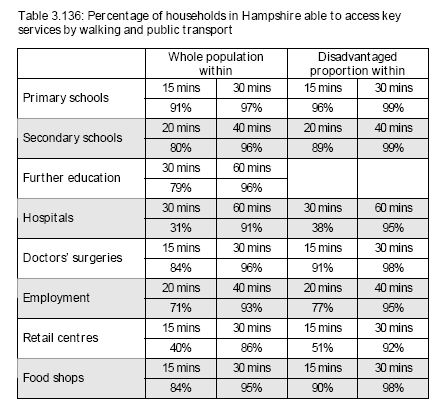
5.2 County Council officers are working to extend this research, which currently does not include community transport services. The accessibility pilots are providing a considerable amount of information about accessibility to these destinations within their respective survey areas.
5.3 The process of using Accession software to identify travel supply gaps overlaid with social and demographic data about age, income and car ownership has provided an invaluable basis for the Area Reviews. Proactive engagement with stakeholders has helped identify unmet needs and aspirations. Modelling work developed through the Area Review process helps to identify areas for the focus of further attention.
5.4 Local Area Agreements. Passenger Transport plays an important role in the LAA theme on Accessibility and the Coordination of Transport, including:
· Assessing the effectiveness of scheduled passenger transport services,
community transport and other modes in meeting accessibility needs
· Developing proposals for enhancing these services in order to improve
accessibility.
How well established is the process for assessing community needs.
5.5 Until recently, the County Council assessed community needs on a case by case basis. Some 70% of bus services are provided by private sector bus operators on a commercial basis whilst the County Council supports services to meet social need. The County Council works with the voluntary sector to fill gaps in services that can not economically be provided by conventional bus services.
5.6 In recent years, the County Council has started to develop a number of new mechanisms for assessing community needs. These are innovative approaches which the County Council has developed in the absence of any standardised approach or Government guidance. These include:
5.7 Area Reviews
To reflect changing travel patterns and demand for services, Hampshire County Council has undertaken a series of district by district passenger transport reviews across the county designed to help provide passenger transport services which best match the changing needs of residents, visitors and the business community whilst at the same time ensuring that where funding is needed, this is affordable within the context of available budget provision.
5.8 The Rural Transport Pilots
The County Council is currently developing and implementing plans for five rural transport pilots in Hampshire. The approach recognises the challenges which the authority faces in improving access in the more rural areas of Hampshire and that a `one size fits all' approach will not be the answer in the future. Consequently, five very different approaches are being trialled through these pilots. The pilots include:
· A "hub and spoke" approach in the New Forest. This would involve realigning the existing transport services so that conventional bus services link directly with the larger settlements and provide for through journeys to destinations further away. Smaller vehicles and demand responsive transport would then provide links to the nearest local settlement and onward connections. This would enable bus services to concentrate on what they do best - regular services for numbers of passengers - while smaller vehicles respond to local travel needs.
· An "individual transport brokerage" scheme in the Test Valley. People who were unsure about how to make a local journey could telephone a local travel broker. The broker would in the first instance provide information about any local bus or rail services which could be used or if more appropriate a local community transport service. If none of these options was suitable then transport could be arranged through either a volunteer driver or taxi with a subsidy being provided if required. Journeys would initially be restricted to local retail and health destinations. The data on journeys provided would eventually be used to identify opportunities for re-planning the transport network.
· A "coordination" pilot in East Hampshire. This would consist of a desktop exercise to establish travel patterns by mapping the journeys provided over two set seven day periods by a range of different agencies and operators. The pilot would seek to identify whether or not these services could have been provided more effectively given the total resource available and if so to identify any barriers which may need to be overcome in order to promote more effective coordination in the future.
· An "information" pilot in Winchester District. Working with the local community, information would be produced and distributed to help people access key services. This would identify those services which are available locally, those which are brought to the community and those services which are available to take people to specific facilities beyond the local area. In the case of the latter, personalised journey information would be provided. The local community would also be encouraged to maintain and distribute the information which could also be promoted on a local website.
· An extension of the Wheels to Work scheme which currently operates in the New Forest and Test Valley. There are plans to begin to merge these schemes into one scheme and to then begin to develop a countywide scheme by extending the facility to East Hampshire and Winchester.
5.9 The Innovation Forum of the Local Government Association has shown particular interest in these pilots and is keen to adopt them as national demonstration projects. It seems very likely that the County Council will receive some funding towards the management costs of these pilots.
5.10 The Accessibility Pilots
The County Council is carrying out a number of accessibility pilots to assess the difficulties that residents experience in accessing key services, such as healthcare, food shops and education. The first four of these pilots are:
· Access to Winchester Hospital from Andover
· Access to a wide range of services from Whitehill, Bordon and Lindford
· Access to rural healthcare in the New Forest
· Access to rural post offices in Basingstoke and Deane
5.11 Access to Winchester Hospital
This pilot was chosen in response to a decision by the Primary Care Trust (PCT) to change the type of treatments undertaken at Andover and Winchester hospitals. This required residents in the Andover area to travel to the Winchester hospital for some operations that had previously been undertaken at Andover. A number of patients had complained about poor public transport services between Andover and Winchester.
5.12 The study has found that for more than half of Andover residents a public transport journey to the hospital takes more than an hour each way. Residents in the villages outside Andover can be faced with a journey of more than 90 minutes which may involve several changes of bus and train. For example, a typical journey from one of the Andover villages might involve two bus journeys and two rail journeys.
5.13 Perhaps because of this, the majority of patients and visitors (78%) come to Winchester hospital by car - either as the main driver or by getting a lift from friends and family.
5.14 Accessibility to the hospital can be particularly difficult for the elderly, who are less likely to own a car and more likely to encounter physical difficulties on journeys that involve walking or changing mode.
5.15 The study is now investigating ways to improve accessibility, including revised information.
5.16 Access to services from Whitehill, Bordon and Lindford
This pilot was chosen because initial assessments suggested that this area suffered from poor accessibility to a wide range of services. The communities of Whitehill, Bordon and Lindford have a limited range of local services in relation to the number of residents. This means that they need to travel to one of several larger towns to access hospitals, further education and larger shops.
5.17 However, public transport links to some towns are relatively poor. There is no rail station, though there is a rail-link bus, and bus services for certain journeys are infrequent and journeys often lengthy. An additional complication is that there are several nearby towns that residents need to use for different services, including Basingstoke, Guildford, Farnham, Haslemere, Alton and Petersfield. This means that the bus network is stretched by having to serve several different destinations instead of just one "parent town".
5.18 The longer term solution for the area would be to attract more facilities and services so that there is a reduced need to travel. In the short term, improvements to public transport would help to improve accessibility, but may be difficult to finance because of the relatively small numbers of people making any particular journey.
5.19 Access to rural healthcare in the New Forest and Access to rural post offices in Basingstoke and Deane
These pilots are currently at the preparatory stage.
5.20 Emerging trends
The accessibility work is beginning to show clear trends. Hampshire has higher levels of car ownership than the national average. People with access to a car generally have good levels of accessibility to a wide range of services and destinations.
5.21 Public transport accessibility is generally reasonable or good to those services which are available locally or in the nearest town. Accessibility to services is also generally good in urban areas, although some areas are beginning to suffer from increased levels of congestion and parking difficulties.
5.22 With a few exceptions, most rural communities have reasonable levels of access by public transport to their nearest town. This allows people to access the majority of services which may not be available locally, such as banks, libraries, employment and more specialised shops.
5.23 The most severe accessibility problems are encountered when people need to travel to a destination which is not in their nearest town. This includes some journeys to hospitals, further education, prisons, and administrative centres. These journeys can be difficult because not all Hampshire towns are well linked to each other by public transport and bus services are usually best suited to local journeys.
What partnership working is taking place in relation to responding to gaps, particularly when these are cross boundary?
5.24 Extensive partnership working has been a feature of the area reviews, accessibility pilots and the Solent Transport partnership. Each accessibility pilot is directed by a local steering group involving a wide range of stakeholders. The Solent Transport Partnership is widely acclaimed as a model of cross-boundary partnership working.
5.25 On a more local basis, we also work with local communities, Parish Councils and providers to identify current gaps in provision and to identify ways of responding to local needs.
Are there particular population groups, whether age specific, disability specific or economic groupings such as job seekers and young people in training, for whom addressing gaps is problematic?
5.26 The County Council's research has identified a number of population groups who can experience transport problems. These include:
· Elderly people who do not have access to a car, or who do not feel comfortable driving, for example at night.
· Young people
· People who cannot afford access to a car, including the unemployed
· People in single-car households who are not the main driver and who do not have access to a car for all of the day.
· People with mobility impairment who find it difficult to use public transport
· People living in relatively isolated communities with limited local facilities.
5.27 Experience from the accessibility pilots suggests that the vast majority of the population are able to access the services they need, whether by public transport, their own car or by lifts from friends and family. The widening Community Transport provision, greater use of easy access buses through QBP work, improved stop and interchange infrastructure and enhanced information provision, and Wheels to Work for young people and rural transport pilots are together helping to improve access for many of these groups or identify the methods which will achieve this.
6. More effective use of passenger transport services
6.1 Capital Investment in public transport improvements through the Local Transport Plan
We invest capital funding in the passenger transport network, usually through partnership agreements with commercial bus, rail or ferry operators. This investment acts as a lever to bring private sector funding to Hampshire. Works include accessibility improvements, new bus stations and bus and rail station improvements, ferry refurbishment and terminal facilities, better information, including real time information, the Traveline journey planning service, Community Transport vehicle grants, encouraging more collaborative work and building capacity in the Community Transport sector, bus priority measures and marketing schemes.
6.2 Rail Services
We work closely with the rail industry to obtain the best possible rail service for Hampshire's residents, visitors and business community. We are an effective lobbying body and statutory consultee on timetabling matters, and particularly when working in partnership with district councils and neighbouring City Councils have achieved numerous positive outcomes from the rail industry, such as the extension of the Chandler's Ford rail service to Salisbury. The Group also leads the Solent Transport Rail Group, a partnership of all stakeholders that is driving forward improvements to the rail network in south Hampshire to cope with the planned new housing.
6.3 Ferries
Hampshire's local ferry services are generally not commercially viable so the County Council provides financial support for the Hythe to Southampton, and the Hayling Island to Portsmouth ferry services in conjunction with the two City Councils. Without this subsidy, ferries would operate a more limited service, resulting in reduced accessibility for residents of the New Forest and Hayling Island. This subsidy also plays a role in reducing congestion on major routes, as both ferry services avoid the need for much longer journeys by road.
6.4 Better Facilities for Passengers
We bring a lot of private sector investment to the public transport network through our partnerships with bus and train operators. We co-ordinate our funding with operators on the county's busiest bus routes to achieve a step change in the quality of the county's most well used bus services through the QBP mechanism. Improvements include new environmentally-friendly buses, more frequent and reliable services, bus lanes, new bus station facilities, bus shelters and electronic information. The improved services have encouraged many more people to use buses in Hampshire, particularly in urban areas.
6.5 Rail Investment
We work closely with train companies to provide new facilities at rail stations, such as CCTV, Help Points, waiting rooms, cycle parking and bus interchanges. We also actively lobby the rail industry to achieve the best possible levels of service for Hampshire's residents, and we work proactively with the rail industry to develop new stations, such as Chandler's Ford and currently at Chineham.
6.6 txt4times - Text messaging of bus times through Traveline
Every bus stop in Hampshire has a unique code number which is available on the Passenger Transport website. A programme is underway to display this at all stops. When you type the your bus stop code as a text message in your mobile phone - and send it to Traveline (84268), you will instantly receive a text message showing the next three departures from your stop. This recently launched service is seeing substantial growth.
6.7 The Home to School Transport Pilots
In addition to those listed above, the County Council is investigating a number of innovative approaches to passenger transport. Reducing school run congestion and improving pupil health and independence are key aims of a new home to school transport initiative.
6.8 There are four main elements that make up the School Travel Initiative. These are:
· Yellow school buses - in the Basingstoke area
· Home to school transport services - in the Waterside area
· Scheduled bus services - in the Eastleigh area
· Walking and Cycling - in the Farnborough area
6.9 In Basingstoke, three new specially designed yellow school buses with regular drivers and the latest safety measures have started operating on a new network of routes.
6.10 The Eastleigh and Waterside schemes are being marketed under the BusIT brand and offer a standard daily ticket price, discount vouchers and links to a dedicated BusIT website. Over 1,700 BusIT packs have been issued and over a thousand journeys a week are being made by schoolchildren using BusIT.
6.11 In Farnborough, a school road show has introduced pupils to the latest bikes now on the market and the range of safety and information material the County Council can supply.
6.12 The schemes are intended to help reduce school run congestion and change the attitudes and behaviour of parents and pupils by giving them the opportunity to get fit, reduce pollution and increase independence.
6.13 Building capacity and co-coordinating Community Transport services
The County Council is always looking for ways to make more effective use of Community Transport services in Hampshire by building capacity and promoting a more effective co-ordination and utilisation of existing resources and services. It has sought to achieve this in the following ways:
· Reviewing the Basingstoke Community Transport and Dial-a-Ride services which currently operate independently to assess the increased effectiveness which could be gained by a consolidation of these services.
· Bringing together under one organisation, the Dial-a-Ride, Call & Go and group hire minibus facilities which operate across Hart and Rushmoor under one organisation.
· Investigating the feasibility of setting up a Community Transport Scheme across Fareham and Gosport.
· Piloting a minibus brokerage scheme in the New Forest
· Scheduling some demand responsive schemes through the Travel Centre in Winchester to gain some economies of scale, including individual transport for Adult and Children's Services.
· Developing and promoting good practice guides for organisations operating car schemes.
· Promoting MiDAS and the Minibus Register to encourage the inter-lending of minibuses.
· Supporting the Community Transport sector by co-ordinating and supporting volunteer driver recruitment campaigns and publicity
6.14 Transport for South Hampshire (Solent Transport)
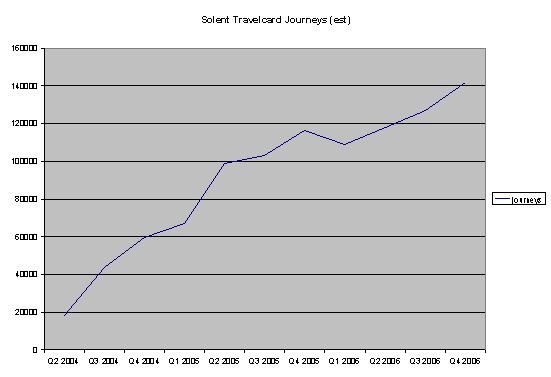
By working closely with operators within the Solent Transport partnership, the unique Solent Travelcard was introduced in 2004. This introduced a commercial ticket that offers, for a single price, a day's or week's travel on any of the bus services run by the 13 operators across the Solent area. Such a ticket has never been available before. It has grown in popularity since its introduction and achieved a record 400,000 journeys per year in 2006.
6.15 The Travelcard is aimed at overcoming the complexity faced by motorists when contemplating making the switch to public transport. A simple ticket, valid on any bus, removes an area of uncertainty and makes the choice less daunting.
6.16 Plans are underway to extend it to railway journeys and thus offer a true multi-modal Travelcard.
6.17 By working closely with the Partnership for Urban South Hampshire, the Solent Transport partners have identified a number of investment needs to support the implementation of the South East Plan to 2026. This includes the development of high quality bus and rail services with premium interchanges that are comfortable, secure and user friendly. It will also be supported by measures to encourage greater usage of public transport, through closer working with employers, schools and neighbourhoods.
6.18 The successful Solent Transport partnership that has flourished for nearly five years is to be transformed from a voluntary alliance of operators and authorities to a formal deliver agency with powers to raise and spend money. This body, Transport for South Hampshire, will have executive powers and will develop the plans to invest in South Hampshire to improve its transport network alongside the economic growth and housing expansion planned for the coming twenty years. Early work involves technical studies to progress the list of transport schemes requiring support from central government and funding from third parties.
6.19 Transport for South Hampshire will offer real power for the local authorities and transport operators, to make a strong case for the quality of life and mobility of businesses and residents of the sub-region.
6.20 The provision of passenger transport services is made complicated by the large number of different organisations involved and the statutory limitations on cooperative working. The County Council is trying to maximise the use of resources by innovative approaches such as the Solent Transport Partnership and the rural bus pilots.
How do current methods of coordinating services work?
6.21 The majority of services, some 70%, are provided commercially by a range of different operators. People are often unaware that the County Council has no control over the frequency, fares or vehicles used or the routes operated by these services. Although the competition authorities limit the ability of commercial operators to work with each other, the County Council has set national precedents with the 13 operator Solent Travelcard and the Blackwater Valley QBP involving three major bus groups. The County Council produces and distributes 11 comprehensive local travel guides to make changing between services easy and supports the Traveline website as well as infrastructure investment in interchanges such as Havant bus station and local rail stations. Where the County Council supports services it seeks to link buses with rail stations and ferry services.
6.22 Many organisations which provide transport in the voluntary sector, e.g. voluntary car share schemes, operate independently of the County Council and therefore set their own operating area conditions and criteria. Any changes to existing ways of working will only be achieved through partnership working.
6.23 The area review process and the accessibility and rural transport pilots seek to remove barriers between different modes of transport, whether commercially provided or financially supported, and between the established public transport and Community Transport sectors.
6.24 Non-emergency health transport has been identified as an area where resource and operational efficiency could be achieved by integration with our other community and special needs transport provision. This is not an area over which the Passenger Transport Group has control so any support to achieve this would be valuable.
6.25 The overarching aim is to maximise wellbeing and enhance the quality of place for all members of the community through access to the widest range of services by creating awareness of what is available locally, to reduce the need to travel, by providing comprehensive information of the travel opportunities available, and by seeking to identify unmet needs and the best way that they can be met.
Could the current approach to coordinating services to reduce the number of empty seats, duplicated routes and vehicle under-use be improved, and how?
6.26 The area review process seeks to match resources to demand with innovative delivery where appropriate. Recognising that this can be a particular issue in rural areas, the County Council has proposed five rural transport pilots to trial different methods of better coordinating services in New Forest and Test Valley, increasing vehicle utilisation in East Hampshire, improving information in Winchester and extending youth travel schemes to East Hampshire and Winchester.
6.27 We believe that these approaches could help to improve coordination and cost effectiveness, by reducing the number of empty seats and duplicated routes. The pilots entail an element of risk. It is not clear yet which will be most effective or how the public will react to these new ideas. However, we believe that we have a duty to try innovative approaches like these in an effort to maintain and improve transport in the community.
What additional steps could be taken, Hampshire wide, to improve effectiveness?
6.28 Effective use of resources so as to best meet the needs of the community is at the heart of all we do and this paper has sought to demonstrate the range of innovative ideas combined with traditional good housekeeping that are employed. In many areas, Hampshire has been a national pioneer of forward thinking across the whole ambit of public and community transport. This is reflected in growing passenger numbers on both bus and rail and rising patronage on community transport schemes. This outcome is being achieved against a background of substantially rising cost within an inflation-limited budget in a largely rural county which has high car ownership. We are alert to best practice initiatives elsewhere and achieve what we do through a growing number of effective partnerships with a wide range of stakeholders. Our main recommendations for improvement have already been set out - the Solent Transport partnership, the accessibility pilots, the rural bus pilots and the school travel project. In addition, we are exploring opportunities to improve the information available to the public about public transport services such as txt4times and the BusIT website.
6.29 Given the trend for greater car ownership, we recognise that there are areas where growth in bus usage can be achieved and areas where non-conventional transport has a growing role to play. Further Travelcard schemes, greater application of modern technology such as real time information, smart bus priority measures and Smartcard tickets are underway or being closely studied. New rail stations possibilities such as Chineham, and partnerships such as the new Three Rivers Partnership show the way ahead in rail whilst experience from the A3 bus priority corridor provide first hand experience of Bus Rapid Transit which may have further application in Hampshire.
6.30 We see opportunities to expand the voluntary sector, including encouraging the newly retired to provide lifts for more elderly neighbours. We also recognise the limitations of this sector and the need to provide support.
6.31 We recognise that this is a continuing process as travel patterns change and needs and aspirations evolve so that effectiveness will be measured by how these needs are best met over time. The Passenger Transport Group, which brings together passenger and community transport, home to school transport, transport for special education needs with the benefit of its own contracts and finance section, is well placed to make the best use of necessarily limited resources in meeting evolving travel and accessibility needs.
16 July 2007