
Archived decisions
Hampshire Minerals Plan - Preferred Options
Briefing Paper for Cabinet and County Council
1. What is the Hampshire Minerals Plan?
¬ A planning document, part of the Hampshire Minerals and Waste Development Framework.
¬ Being produced jointly by Hampshire CC in partnership with Portsmouth and Southampton City Councils and the New Forest National Park Authority.
¬ It will contain `site allocations' to deliver the recently adopted Hampshire Minerals and Waste Core Strategy.
2. What is the `preferred options' consultation?
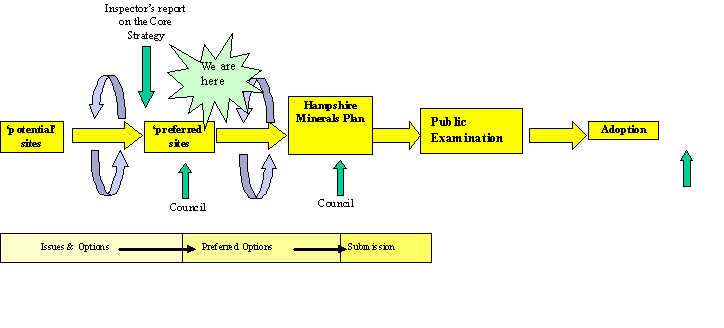
¬ The first `formal' public consultation stage in the plan-making process.
¬ This stage has been preceded by approximately three years ongoing work with stakeholders and informal consultation.
¬ Before the Hampshire Minerals Plan is finalised there will be a further `formal' consultation opportunity, followed by a Public Examination in front of a Planning Inspector
3. How does `preferred options' link ultimately into the adoption of the Hampshire Minerals Plan?
¬ Early stages - first `formal' consultation.
¬ Doesn't formally commit the County Council to policy - things may change due to consultation.
2003 2007 Oct 2008 Spring 2009 Dec 2009
Council
4. Why do we have to plan for minerals?
¬ Hampshire County Council - along with Portsmouth and Southampton City Councils and the New Forest National Park Authority - is a Mineral Planning Authority and as such has a duty to plan for minerals.
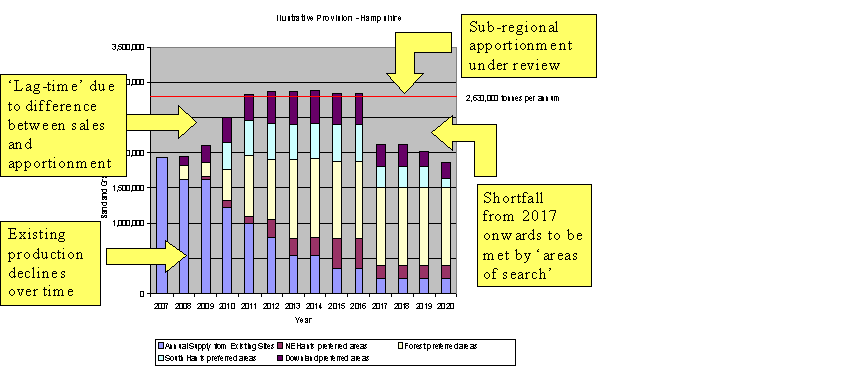
¬ Hampshire has an apportionment set by the South East Plan to plan for the supply 2.63 million tonnes a year of land-won sand and gravel - this apportionment already takes account of the contribution of dredged and recycled materials to meet requirements. We are also obliged to plan for the supply of 1.7 million tonnes a year of recycled and secondary aggregates.
5. Where are minerals produced in Hampshire and what movements take place?
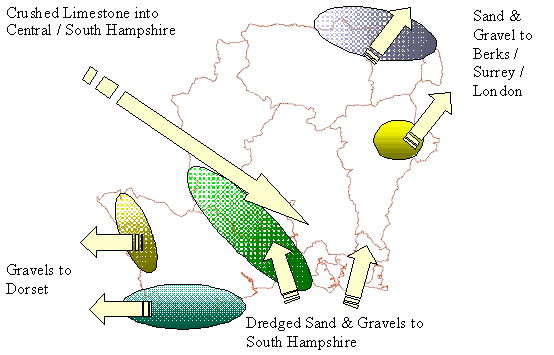
¬ Minerals can only be dug where geology permits, in 2005, 1.6 million tonnes of sand and gravel was produced by Hampshire's quarries.
¬ In 2005, known imports equated to about 2.4 million tonnes of which 1.6 million tonnes was dredged sand and gravel and 800,000 tonnes was crushed rock brought in by rail and ship. There is also some evidence of limestone being brought into south west Hampshire by road.
6. What does the Core Strategy require?
¬ The Core Strategy sets the context for the Hampshire Minerals Plan including:
o Proposals for sites, preferred areas and areas of search to provide 2.63 million tonnes a year of sand and gravel, 5.3 million tonnes of landfill, 1.7 million tonnes a year of aggregate recycling, plus wharves and rail depots, brick-making clay, chalk and oil and gas.
o Plans and proposals showing areas where mineral extraction and landfill are preferred, areas where mineral resources are safeguarded from development and where consultation on development proposals should take place.
7. The sub-regional apportionment is being reviewed - how will this affect things?
¬ The review is being conducted by the Regional Assembly and is unlikely to be completed until late 2009. It may eventually result in a decreased apportionment for Hampshire, although not in time to influence the Hampshire Minerals Plan.
¬ Accordingly, a `release mechanism' has been included in the proposals to prevent over provision of sites.
8. How will `provision' for sand and gravel be made?
¬ Provision will be made by a combination of declining production from existing sites and increasing production from `new' proposals.
¬ There will be a lag-time at the start pending new proposals coming on stream.
¬ There will be a `shortfall' at the end of the plan period to be met from within `areas of search' in north east and south Hampshire and the central belt.
9. What is being proposed for soft sand?
10. What is being proposed for sharp sand and gravel?
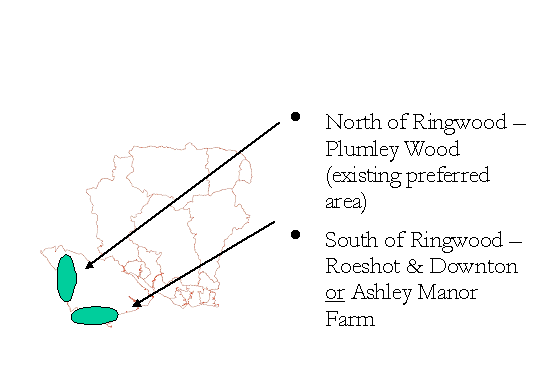
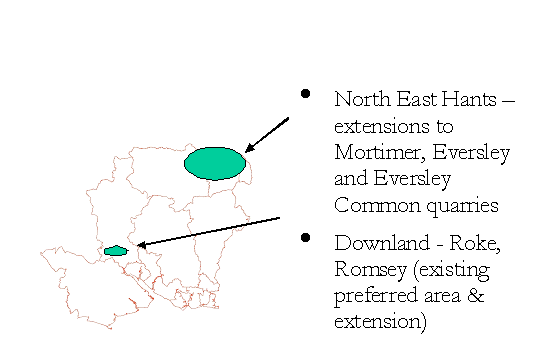
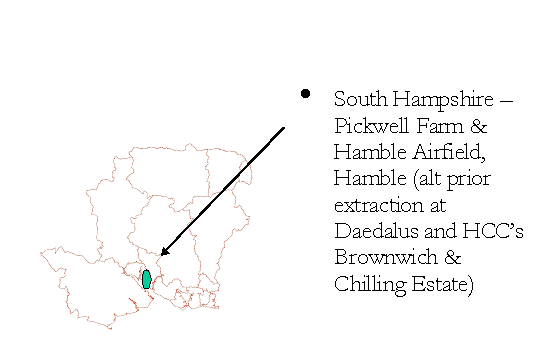
13. What are the `areas of search' for the Strategic Reserve 2017 - 2020 period?
¬ Areas, without specific detailed knowledge, but where planning permission for sites could be granted to meet a shortfall in supply.
¬ Not required in the Forest area as sufficient production from proposals in that area.
¬ Release mechanism to prevent over provision.
¬ Unconstrained areas of land >12 Ha (sharp sand and gravel) and >2 Ha (soft sand), with buffers around buildings, rivers, roads etc...
14. Why will the Hampshire Minerals Plan include landfill and what is being proposed?
¬ The Core Strategy includes a much reduced landfill requirements of approx 10% although some landfill is needed.
¬ Landfill is included in the Hampshire Mineral Plan as it is used to restore a small number of mineral voids.
¬ Landfill is not easy in Hampshire due to geology - in the longer term beyond 2020 we need to consider `zero' landfill.
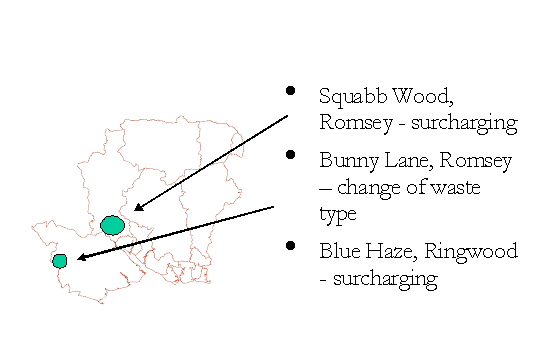
15. What about other minerals, aggregate recycling, wharves and rail depots etc...?
¬ Three `areas of search' around Michelmersh for brick-making clay.
¬ No new proposals for chalk or oil and gas.
¬ Removal of `safeguarded' status for Tipner Wharf in Portsmouth - to allow regeneration if capacity can be met elsewhere. Expansion of other wharves at Marchwood and Portsmouth.
¬ New `strategic' aggregate recycling proposals next to Alton sewage works and at Segensworth.
¬ Discussion but no proposals about `new' aggregate rail depots at Basingstoke, Micheldever and Segensworth.