|
|
|
|
|
|
1 |
Summary |
|
|
1.1 |
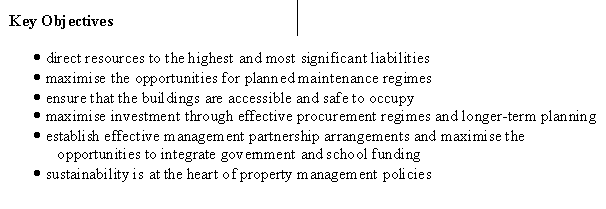
The strategy and key objectives for the current year relating to the built estate were confirmed by the Panel at its meeting in March and approved by the Executive Member for Policy and Resources on 5 April 2007. The purpose of this report is to review progress against the strategy and provide an overview of the issues that are emerging and discussed in more detail in the reports that follow. The objectives of the strategy, identified in Appendix 1, provide the framework against which the revenue, capital and NDS funds are determined. Significant progress continues to be made against all the objectives in the strategy. |
|
|
1.2 |
The review and updating of the Strategy for the Built Estate ensures that resources are targeted at key areas and enhances the quality and safety of the Council's built estate. |
|
Recommendation That the Buildings, Land and Procurement Panel advises the Executive Member for Policy and Resources that approval be given to the progress made against the Strategy for the Built Estate. |
2 |
Strategy and planning |
|
|
2.1 |
Over the course of the remainder of the financial year regular reports will be prepared around landlord's key activities and programmes of work and procurement and property reviews, which taken together over many years, will ensure that the key objectives relating to the built estate are achieved. The challenge of balancing the distribution of resources across an increasing number of workstreams remains, including: · health and safety priorities identified through the corporate risk assessment · contributions to major capital programmes and projects · the growth of work for the South East Centre of Excellence (SECE) · meeting sustainability objectives, particularly those relating to reducing energy consumption · implementing the outcomes of the Strategic Property Review · the need to address outstanding maintenance liabilities in both the education and non-education estate at a time of declining budgets · procurement and value for money initiatives · delivering the new SLA to schools |
|
|
2.2 |
The approach to maximising progress in each of the above areas is summarised below and considered in more detail in some of the reports later on the agenda and at later meetings. |
|
|
3 |
Programme Management |
|
|
3.1 |
The detailed budget distribution for 2007/08 was approved by the Executive Member for Policy and Resources on 5 April 2007. The report later on the agenda dealing with budget issues identifies the financial pressures on the budgets and the continuation of pressures in the non-schools estate. This year's allocation, together with indicative allocations to 2009/10, are given in the table below: Capital Repairs 16,588 18,643 16,690 (nb this is (including DSG) before the proposed re-profiling in 2007/08 Revenue Maintenance 15,302 15,302 15,302 NDS Condition 16,639 8,116 8,116 Devolved Capital 21,723 21,723 21,723 (Schools ) |
|
Revenue |
|
|
3.2 |
The bulk of the budget, over 60%, is committed to planned engineering servicing and maintenance and forms the most significant part of the Service Level Agreement with schools. Less than 30% is spent on reactive maintenance such as roof leaks and vandalism. The continuation of major capital programmes such as the SCOLA re-cladding is having the impact of reducing maintenance liabilities, specifically external redecoration and repairs, where it is estimated that annual redecoration and repair costs have reduced by around £1m. This area of work also generates the highest satisfaction ratings from schools. |
|
|
3.3 |
The implementation of NDS Condition Work (some £92.8million so far) is aimed exclusively at permanent school buildings with the largest liabilities. The investment in major repairs and replacements has had a positive impact on recurring maintenance costs and the appearance of school buildings. Inspite of the recent unprecedented levels of funding however, maintenance liabilities continue to rise due to the increasing cost of work and the continuing deterioration of buildings, particularly those of SCOLA construction. Beyond this year there is no certainty that NDS funding will continue, and the position will not be confirmed until after the Government's Comprehensive Spending Review. |
|
|
3.4 |
NDS funding has been allocated towards the following types of work: * NDS Investment Priority Area £'000 SCOLA recladding 19,926 Flat roofing/window replacement 20,494 Boilers mechanical system replacements 11,116 Fire precautions/electrical safety 8,848 External works and drainage 2,124 External redecoration 10,668 General building, engineering and structural repairs 12,141 Other work including temporary classroom replacement and contingencies 7,443 * excludes fee provision |
|
|
3.5 |
As demonstrated in the above table, the impact of NDS funding is significant by dealing directly with many of the most significant liabilities along with wide coverage across school sites. However, as already noted, with resources for schools forecast to reduce, it will remain important to plan programmes over longer timescales and continue to work with schools through the SLA on the integration of their priorities and devolved funding. |
|
|
4. |
Policy Management and Improvement |
|
|
4.1 |
Procurement Initiatives |
|
|
4.1.1 |
The Panel continues to receive regular progress reports on procurement initiatives and a detailed report covering current activities, proposals for a number of procurement developments in 2007/8 and beyond, and the arrangements for a Shared Services Agreement with Reading Borough Council is included later on the agenda. This is the first of its type with another local authority. |
|
|
4.1.2 |
The SECE Major Framework for Major Schemes is now the preferred procurement route for all County Council major projects. Across all participating authorities over £1billion of construction work has been identified for possible development through the framework of which £618m is currently proceeding. Projects cover a wide cross section including Building Schools for the Future (BSF) One School Pathfinder schemes, Leisure Centres, Civic Offices and Library projects. |
|
|
|
4.1.3 |
As mentioned in the BLPP report in March 2007 work is ongoing to establish Tier 2 and Tier 3 frameworks based around clusters of authorities. The OJEU tender process for the Tier 2 Framework for the Hampshire cluster has been concluded and subject to formalising the arrangements the framework will be live during October 2007. |
|
|
4.1.4 |
Following a request from Reading Borough Council (RBC) for the County Council to provide design services for a major programme of work (11 projects with an approximate value of £20m) the Council is currently finalising an agreement under the terms of Section 113 of the Local Government Act 1972. This enables a local authority to discharge the functions of another through joint working. It is anticipated that this agreement could become the model for future shared services. |
|
|
5 |
Programme Management - Capital Repairs |
5.1 |
As reported previously the other key objective which is monitored on a regular basis is the funding available for the spending on non-schools buildings. There is no supplementary funding available to County Council buildings in the shape of NDS which is available for schools. It remains a serious concern that liabilities in this sector of the Estate continue to grow at a rate significantly faster than effective repair strategies can be funded. This remains the major budget issue for this and future years. |
6 |
Policy Management Improvement |
6.1 |
Strategic Property Review of Office Accommodation |
|
|
6.1.1 |
The Council's office space has been acquired on an ad-hoc basis over many years to support the changing requirements for around 5,000 office-based staff. A significant proportion of the existing buildings are inefficient and not fit for purpose by today's standards. There is a very strong business case for the rationalisation of office accommodation including the need to generate efficiencies, reducing the number of offices, increasing occupation and to support new ways of working and organisational change. |
6.1.2. |
Over the summer two alternative models, one developed by MACE and the other internally, have been reviewed with the broad principals being presented to CMT on 19 September. The importance of this work is that it sets out a direction of travel for a corporate solution for a significant redirection in office accommodation and its costs, improved working environments and better utilisation of buildings. The next key stage is for departments to consider how services can be designed within the corporate framework. A detailed report is being prepared for Cabinet, which will also be reported to BLAPP as part of the major projects review. |
|
|
6.2 |
Facilities Management |
|
|
6.2.1 |
At the same time work has commenced on the development of its Facilities Management Workstream (as part of the wider review of Support Services) to establish the potential benefits of different approaches to FM provision. It is anticipated that an interim report will be available later this year and a final options appraisal in early spring 2008, to tie in with the programme for Ashburton Court.
|
|
|
6.3 |
Major Land Disposals |
|
|
6.3.1 |
The Cabinet has agreed that the Director of Property, Business & Regulatory Services bring forward, in the context of the South East Plan, proposals for shaping future development on Council land and to make the necessary arrangements with potential partners to facilitate this work to come on stream at the end of 2009/10, when current forecasts of receipts will decline. This probably remains alongside preparing for `Building Schools for the Future' the most significant asset management work in the portfolio. Further detailed reports and a Business Plan of the required resources are being prepared.
|
LINK(S) TO CORPORATE STRATEGY |
|
|
Yes |
No |
|
Hampshire safer and more secure for all |
|
_ |
|
Maximising well-being |
_ |
|
|
Enhancing our quality of place |
|
_ |
|
The following documents disclose facts or matters on which this report, or an important part of it, is based and has been relied upon to a material extent in the preparation of this report.
2 Documents which disclose exempt or confidential information as defined in the Act
........................
........................