
Archived decisions
Priority C Update: Accessibility and the coordination of transport
Progress on pilot studies and emerging results
1. Introduction
1.1 This paper gives an update on Local Area Agreement theme C - accessibility and the coordination of transport. In particular, it provides information on the extent to which Hampshire residents suffer a reduced quality of life because of poor transport accessibility.
2. Background
2.1 In February 2003, the Social Exclusion Unit of the Cabinet Office published its report: "Making the connections: Final Report on Transport and Social Exclusion". This report found that there was a significant link between poor transport and social exclusion. The main findings of this report (for the UK as a whole) were that:
· Two out of five jobseekers say that transport is a barrier to getting a job
· 6% of 16-24 year olds turn down training or further education opportunities because of problems with transport
· 31% of people without access to a car have difficulties travelling to their local hospital, compared to 17% of people with a car.
· Each year, over 1.4 million people in the UK miss, turn down or do not seek medical help because of transport problems.
· 16% of people without cars find access to supermarkets difficult
· Children from the lowest social class are five times more likely to die in road accidents than those from the highest social class.
· More than a quarter of child pedestrian casualties happen in the most deprived 10% of wards.
2.2 In response to this report, the Department for Transport asked local authorities to develop accessibility strategies as part of their second Local Transport Plans, which were published in July 2005. In particular, local authorities were asked to concentrate on accessibility to four key services: healthcare, employment, education and food shopping. The Department for Transport asked local authorities to use a software tool, called Accession, which measures accessibility in terms of the time taken to travel to different services using public transport.
2.3 Hampshire County Council's approach to accessibility goes considerably beyond the Government's requirements. It considers accessibility to a wide range of services, including (but not limited to) the four key areas specified by the Government. In addition to considering the time taken to travel to destination, the County Council and its LAA partners also take into account other factors, such as the design of the service, opening hours and cost. Facilities for pedestrians are considered in addition to public transport services. The Hampshire approach also includes measures to bring services to the customer, as well as improvements to allow the customer to travel to the service.
2.4 In order to trial this approach, four geographical pilots have been launched:
· Access to Winchester hospital from Northern Test Valley (the Andover area);
· Access to a wide range of services from Whitehill, Bordon and Lindford;
· Access to healthcare in the New Forest;
· Access to rural post offices in Basingstoke and Deane.
2.5 These pilots have been chosen to examine sample problems and solutions in a different contexts - they are not intended to cover all accessibility problems in the County.
2.6 Good progress has been made on the first two pilots. The second two pilots are due to start shortly, subject to the availability of officer and stakeholder time and capacity.
3. Access to Winchester hospital from Northern Test Valley - problems
3.1 This pilot was chosen to complement a PCT decision to move some procedures from Andover to Winchester hospital. This has meant that residents in the Northern Test Valley now have to travel to Winchester for some treatments that previously were carried out at Andover hospital.
3.2 The pilot has found that public transport journeys from Andover to Winchester hospital are particularly difficult. One of the Government's accessibility yardsticks is that residents should be able to get to their nearest large hospital by public transport in less than one hour. Only 13% of the households in the survey area can travel to Winchester hospital in this time:
Public transport journey time |
Number of households |
% |
Less than one hour |
3,174 |
13 |
60-90 minutes |
16,708 |
68 |
More than 90 minutes / no accessibility |
4,846 |
20 |
3.3 This means that 88% of residents (21,544 households) cannot access Winchester hospital by public transport in less than one hour. This is because there are few direct buses and no direct rail services between Andover and Winchester. Most public transport journeys involve two or more changes of bus and train. For example, a journey from one of the outlying villages can involve two buses and two rail journeys. It is also difficult for members of the public to get information about multi-part journeys and the range of community transport services which are available.
3.4 People using public transport are generally not happy with the journey experience. 64% of bus users reported difficulties with their journey to the hospital. By contrast, only 20% of car drivers experienced travel difficulties - mostly parking difficulties. People who arrived by bus are nine times more likely to miss an appointment or be late than someone who arrived by car.
3.5 Taxi journeys are relatively unpopular. Cost is a significant factor, with anecdotal evidence of return journeys costing more than £60.
3.6 Most people travel to the hospital by car. A survey conducted as part of the pilot established how people travelled to the hospital:
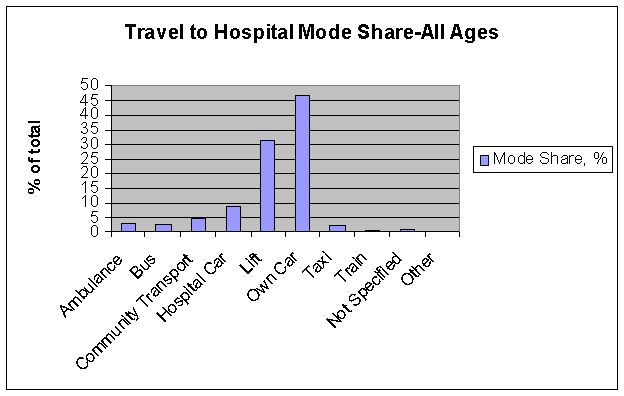
3.7 This shows that 47% of patients use their own car and a further 31% arrange a lift with friends and family. An additional 5% of journeys are made by community transport, mostly by volunteer cars arranged by neighbourcare groups or organisations such as the British Red Cross. Conventional public transport (bus and rail) accounts for fewer than 5% of journeys.
3.8 Accessibility problems are particularly acute for the elderly. On average, older people visit hospitals more frequently than any other age group, but have lower levels of access to a car. More than 50% of the patients in the pilot survey were over 60. More than 70% of adults under 70 travel by their own car, compared with only 30% of the over 70s. The survey found that some elderly car owners did not want to drive to the hospital because of concerns about night-time driving.
3.9 It is possible that accessibility problems may worsen in the future. Community transport schemes are suffering from capacity problems due to a shortage of volunteer drivers. There are similar capacity problems with hospital car schemes and ambulance travel. The organisers of non-commercial transport schemes (community transport and hospital car) are often reluctant to advertise their services because they would struggle to cope with additional demand.
3.10 The PCT are also considering extending hospital opening times, understandably to make most effective use of their buildings and equipment. However, it is likely that public transport services will not be able to meet journey needs for earlier or later appointment times.
3.11 The pilot has not found evidence that people are missing out on healthcare because of poor transport links. The 2003 Cabinet Office report estimated that nationally some 1.4 million people every year do not take up healthcare because of poor transport. The GP and hospital stakeholders involved in this study do not believe that significant numbers of people are missing out on healthcare because of travel difficulties between Andover and Winchester. Their advice is that patients almost always decide that their health is sufficiently important to make the trip, no matter how difficult it may be.
3.12 The pilot study has confirmed that there is poor public transport accessibility between Andover and Winchester. Public transport journeys are very difficult with several changes needed. Taxis are prohibitively expensive for many people.
3.13 These accessibility problems affect a small proportion of the community. The majority will be able to travel by car, either by driving themselves or by securing a lift from friends and family. People with severe transport difficulties, including mobility impairments and ill health, may also be able to secure hospital transport (ambulance or hospital car). Community transport schemes will also provide a door to door service for some, although there are capacity problems caused by driver shortages and not everyone will be eligible.
3.14 According to the patient survey undertaken in the pilot, around 5% of patients and visitors to the hospital from the northern Test Valley area travel by bus, rail or taxi. This represents around 1,200 households in the study area who face very difficult journeys to Winchester hospital.
Winchester hospital - actions and targets
3.15 The local stakeholder steering group have endorsed a range of possible measures to improve accessibility to the hospital. Many of these are relatively radical ideas which needed further investigation, such as the possibility of introducing a coordinated taxi share scheme and of increasing the capacity of community transport schemes. It is not yet clear whether these schemes will be feasible or what costs or impacts they will have.
3.16 Based on these measures, and subject to the outcome of the further research, the steering group has proposed three performance indicators:
· To reduce the number of missed or late appointments where transport is the main cause from 3.2% to 2.5% by 2009;
· To increase the proportion of residents who can access Winchester hospital within 60 minutes using a non-car mode (precise target to be specified);
· To decrease the proportion of bus journeys where difficulties are encountered from 64% to 50% by 2009.
3.17 Two measures have been proposed which have the potential to make substantial improvements to accessibility: an Andover-Winchester shuttle bus coupled with enhanced public transport information. A shuttle bus could run at regular intervals from Andover hospital via Andover bus station to Winchester via the Royal County hospital. Although this would not provide a door to door service for many people, it would significantly reduce journey times. The service may also be attractive for other journeys to Winchester, including:
· Shopping
· Employment
· Further education
· Prison visiting
3.18 With the existing bus services, around 13% of households in Northern Test Valley can get to Winchester hospital in less than an hour. A direct shuttle bus could increase this to 75% of households. This would be a substantial improvement in accessibility, which could be greater than the improvements achieved in other Local Area Agreements. If a shuttle bus could be introduced, it would improve accessibility for all residents and would allow a more ambitious performance target to be set.
3.19 The shuttle bus may even tempt some existing car drivers to switch, since it would avoid the need to queue for parking and the bus fare would be cheaper than the parking charges. It is possible that some people may choose to park in Andover (where parking charges are lower) and use the bus to travel to the hospital.
3.20 The cost implications of a shuttle bus need to be carefully considered in discussions with bus operators. We also need to explore the potential for cost sharing amongst the partners. If a shuttle bus is introduced, the intention is that it would be coupled with a programme to provide enhanced public transport information, by written media, the internet, telephone and local radio.
4. Whitehill, Bordon and Lindford - evidence
4.1 This pilot was chosen because of perceived accessibility difficulties to a wide range of services from the area of Whitehill, Bordon and Lindford in East Hampshire. This area is unusual in that it has a relatively high number of houses, but limited local facilities. Accessibility to surrounding towns is therefore more important than for many other parts of Hampshire.
4.2 The study found that there is a reasonable level of accessibility to local services, such as food shops, dentists, post offices, primary schools and GP surgeries. The area also has a library, a chemist and a leisure centre. These services can be reached by nearly all residents within 30 minutes.
4.3 However, there is much poorer access to other services which are not available locally, including:
· Employment and training
· Some hospital treatments
· Some non-food shops (the area has only basic shops)
· Leisure facilities and entertainment
· Rail stations
4.4 An analysis of journeys to work shows that a relatively small proportion of residents work locally (33.8%):
Journeys to work from the study area (population census 2001)
Workplace destination |
Proportion of journeys |
Surrey |
34.0% |
Local/ rest of East Hampshire |
33.8% |
Rushmoor |
7.8% |
Greater London |
5.3% |
West Sussex |
3.2% |
Berkshire |
2.6% |
Basingstoke |
2.1% |
Winchester |
1.6% |
Portsmouth |
1.0% |
Other destinations |
8.6% |
4.5 Residents also need to travel outside the study area for some hospital treatments. A survey of residents found that only a small proportion of hospital appointments were made to the local Chase community hospital in Bordon:
Hospitals visited (resident questionnaire 2007)
Hospital |
Proportion of visits |
Chase Community hospital, Bordon |
6.7% |
Basingstoke |
39.8% |
Frimley Green |
9.9% |
Guildford |
40.7% |
QA Portsmouth |
2.9% |
4.6 The area does not have a rail station, making it one of the largest settlements in Hampshire not to have easy access to the rail network. The majority of residents who want to access the rail network use Liphook station (66.9%), on the mainline from Portsmouth to London Waterloo via Guildford. A further 13% of trips are made to Liss, Haslemere and Petersfield stations which are on the same line.
Railway stations visited (residents questionnaire 2007)
Station |
Proportion of visits |
Liphook |
66.9% |
Farnham |
12.3% |
Haslemere |
7.3% |
Alton |
5.8% |
Liss |
4.2% |
Petersfield |
1.7% |
Bentley |
1.7% |
4.7 Comments from residents also highlighted the lack of facilities for young people and the lack of many types of shops. Residents clearly rely on access to neighbouring towns for many of their needs.
4.8 Public transport accessibility is generally poor to the larger of the towns that are close to the study area and very poor to the most common hospitals (Guildford and Basingstoke). There is reasonable access to the smaller towns of Alton and Farnham (Surrey).
Journey times from central Bordon to selected destinations
(Source: Traveline)
Destination |
Quickest public transport journey |
Guildford town centre |
1 hour 5 minutes |
Guildford Royal Surrey hospital |
1 hour 22 minutes |
Basingstoke town centre |
1 hour 45 minutes |
North Hampshire hospital, Basingstoke |
2 hours 11 minutes |
Alton |
30 minutes |
Petersfield |
57 minutes |
Farnham |
25 minutes |
Liphook rail station |
22 minutes |
QA Portsmouth hospital |
1 hour 44 minutes |
4.9 Some of these destinations are harder to reach for early or late journeys. Young people in particular find it difficult to return from evening leisure activities and early hospital appointments can be problematic.
4.10 A full accession audit is being conducted of hospital access. This is expected to show that no residents from the study area can travel by public transport to the two most frequently used hospitals (Guildford and Basingstoke) is less than ninety minutes. The Government's benchmark is one hour. This probably means that the study area has one of the worst levels of public transport access to hospital of any part of Hampshire (excluding remote small settlements and isolated rural houses).
4.11 There is a high level of car ownership in the study area. Both the 2001 Census and a residents questionnaire survey found that around 6% of households do not have access to a car. The majority (86%) of residents always have access to a car (ie they are an owner/ driver). A further 8% sometimes have access to a car, which usually means that they live in a household with a car that they can borrow from time to time.
4.12 This is level of car ownership/ availability is very high - across Hampshire as a whole around 15.7% of households do not have a car. In Gosport and Havant, 24.7% and 21.4% of households respectively do not have a car.
4.13 The high level of car ownership means that car trips are the dominant mode of transport for residents in the study area. Over 79% of trips to work and hospital are made by car. Car is used for around 70% of journeys to rail stations and shopping centres.
4.14 By contrast, there is a high level of walking to very local facilities. 48.8% of journeys to local shops were made on foot. Walking also accounted for around 40% of journeys to primary schools, parks/ recreation grounds, libraries and post offices.
4.15 Bus journeys are popular for trips to further education, with 39.1% of journeys being made by bus. 17% of journeys to rail stations are made by bus and 11.3% of journeys to secondary schools. Only 1% of the survey travelled to hospital by bus.
Whitehill, Bordon and Lindford - conclusions
4.16 Whitehill, Bordon and Lindford have limited local facilities and poor public transport connections to nearby towns. Around 6% of residents (approximately 900 people) do not have access to a car and could therefore be said to suffer from a degree of social exclusion. There is a further group of people who have only occasional access to a car and will depend on others in their household for lifts. Excluding young children, this group consists of around 8% of the population (around 1,200 people).
4.17 One of the principal difficulties that the study area faces is that it has limited local facilities and there is no natural "parent town". Popular destinations include Basingstoke, Guildford, Petersfield, Alton and Farnham. This means that the public transport network is stretched as it tries to provide access to several different towns. The lack of a rail station adds to the general poor connectivity to the rest of the transport network.
4.18 The relatively small number of public transport users means that there is unlikely to be enough patronage to justify an expansion of bus services. There is virtually no prospect of Government funding for a new rail line. This suggests that the solutions to poor accessibility in this area could include the following:
· In the long term, locating more services in the area to reduce the need to travel;
· Providing enhanced bus links (possibly a shuttle bus) to just one of the nearby towns.
· Enhancing links to a transport hub for onward journeys (either a small town such as Alton or Farnham or a rail station).
· Encouraging the community transport and voluntary sector to provide more volunteer car services, and taking advantage of the high level of car ownership.
4.19 None of these solutions is particularly easy is or quick to implement. Although the area is due to grow, its population of around 16,000 makes it a relatively small town and not an attractive location for strategic services and larger shops. Enhancing bus services to one large town or transport hub would probably mean unpopular reductions services to other destinations. The community transport sector relies heavily on volunteers and is currently suffering from problems of capacity.
4.20 Further work is needed on the feasibility of these measures before a realistic performance target could be set.
5. Conclusions
5.1 The work to date has shown that there are accessibility problems for a small section of the community. There are several areas of Hampshire where public transport links are particularly poor, especially to strategic destinations such as hospitals. From the pilots, we know that very few residents of Northern Test Valley or Whitehill, Bordon, Lindford can access some hospitals within the Government's target time of one hour. This situation is also likely to be similar in other rural areas, such as the New Forest. A pilot study is shortly to start into access to healthcare in the New Forest.
5.2 Increasing levels of car ownership help residents to avoid the problems of limited public transport. In general, people living in rural areas tend to own more cars. For example, in the pilot area of Whitehill, Bordon and Lindford, around 6% of households do not have a car, which is much lower than the Hampshire average of 15.7%.
5.3 Further statistical analysis is being undertaken on the relationship between car ownership and poor public transport. Based on evidence from the two pilots, it seems likely that around 5-10% of residents in rural areas do not have a car and also have poor public transport accessibility to some services. These are people who will face journey times to hospitals in excess of the Government's target of one hour.
5.4 These people undoubtedly have unpleasant and long journeys and there is evidence of occasional missed or late appointments. However, the pilot studies have not discovered significant evidence that some people are not getting access to services. Some essential journeys are difficult, but they are being made. It is possible that further research will discover more
5.5 Using traditional measures, it is unlikely that the LAA stakeholders will be able to make dramatic changes to the overall level of accessibility within the county. However, the possibility of using shuttle buses between larger towns offers the possibility of substantial improvements. If the shuttle buses prove to be feasible, it would be reasonable for the LAA theme to adopt considerably more stretching performance targets than at present.
Iain Reeve
Lead, LAA Priority C