
Archived decisions
Agenda Item 4
Report to the
Transport for South Hampshire Joint Committee
Date: 16 October 2007
Joint report by: Director of Environment, Hampshire County Council,
Head of Planning Services, Portsmouth City Council and Head of Planning and Sustainability, Southampton City Council
Written by: Peter Murnaghan, Hampshire County Council
Subject: Governance Arrangements
Purpose of the Report
To advise members of the Joint Committee of the implications of the Agreement that has been signed by the three principal authorities which provides for the Governance of the Transport for South Hampshire partnership.
Recommendations
1. That the Agreement and Key Objectives of Transport for South Hampshire be noted.
2. That Lead Authorities be appointed to deal with Legal, Financial and Technical matters, in accordance with Clause 12 of the Agreement.
Introduction
1. The establishment of the Transport for South Hampshire (TfSH) Joint Committee involves a new, formal relationship between the principal authorities, Hampshire County Council, Portsmouth and Southampton City Councils. The new corporate body so formed will be empowered to let contracts, collect and disburse funding, commission research, influence, advise and lobby Government, and develop and deliver transport schemes in line with its approved Business Plan.
2. To guide the work of the Joint Committee, an Agreement has been approved for signature by the three councils, a copy of which will be available for inspection at the meeting.
The Agreement
3. The Agreement provides for the establishment and operation of the Joint Committee. Particular attention is drawn to the Appendices, which are attached.
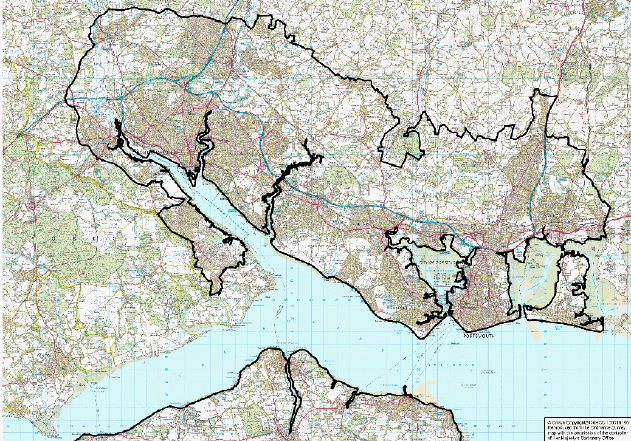
· Appendix 1 shows the map of the TfSH area, which corresponds with the area covered by the Partnership for Urban South Hampshire (PUSH). This area covers Portsmouth and Southampton, together with the districts of Havant, Fareham, Gosport and Eastleigh in their entirety, together with parts of East Hampshire, Winchester, Test Valley and New Forest districts.
· Appendix 2 outlines the Key Objectives of TfSH.
· Appendix 3 provides Terms of Reference for the Joint Committee, which is supported in Appendix 4 by Terms of Reference for the Senior Management Board and the working groups.
· Appendix 5 outlines the Membership arrangements for the Joint Committee, together with the standing invitations for stakeholders and district councils to attend meetings.
4. Clause 12 of the Agreement, which is reproduced below, provides for the nomination of Lead Authorities to be appointed to act on behalf of the Joint Committee in implementing decisions.
12. Lead Authorities and their Duties
12.1 In order to achieve the objectives of the partnership, the Parties may appoint a Lead Authority to act on their behalf in implementing decisions of the Joint Committee.
12.2 In the event of an authority being appointed as Lead Authority by TfSH, subject to any terms, conditions, limitations or caveats, the Lead Authority shall:
a. act as agent for TfSH in the management and day-to-day supervision of the particular task the Lead Authority has been asked to lead on;
b. compile and return all financial and participation data relevant to the task that the Lead Authority has been asked to lead on;
c. convene meetings comprising such individuals, bodies or others as agreed by TfSH in establishing the Lead Authority arrangements and update the Parties to this Agreement on the progress of the task assigned to the Lead Authority;
d. act as the representative of TfSH in any discussions or negotiations when acting as the Lead Authority;
e. provide such administrative resources and office facilities as are reasonably necessary to enable the Lead Authority to manage the project (subject to any caveats or limitations agreed by TfSH in establishing the Lead Authority arrangements);
f. exercise overall responsibility for ensuring the quality assurance of the project or task assigned to the Lead Authority, including monitoring and evaluation in consultation with other Parties; and
g. play such other role(s) as would normally and reasonably be expected of a Lead Authority in relation to the project or task as assigned.
12.3 The Lead Authority shall have full authority and power to act within the scope of the roles and responsibilities laid out in this Agreement on behalf of TfSH in the course of, or for the purpose of, doing the activities agreed by TfSH as Lead Authority in relation to the specific task assigned. Such action may be taken without further consent or approval from the Joint Committee provided this is within the scope of the authority given by the Joint Committee. The Parties shall take such steps as shall be necessary to enable the Lead Authority to fulfil its role.
5. Considerable work has gone on in each of the three authorities in preparing for the establishment of TfSH and it is expected that there will continue to be work in a number of fields as the new arrangements settle in, requiring specialist advice and actions to be carried out. The Senior Management Board has considered that the three key areas of activity are Legal, Financial and Technical fields. It is appropriate that these specialist areas be distributed amongst the three authorities, with each agreeing to act as Lead Authority for a particular area of expertise on behalf of the partnership.
1. As the Governance arrangements have been overseen by Southampton City Council, it is proposed that Southampton takes the Lead responsibility for Legal matters. Hampshire is resourced to take the Lead on Technical matters relating to transport planning and coordination across the partnership, with Portsmouth taking the Lead responsibility for Financial matters. Officers of the three authorities have been approached and confirmation of their ability to undertake the respective roles will be given at the meeting.
Section 100 D - Local Government Act 1972 - background papers | |
The following documents disclose facts or matters on which this report, or an important part of it, is based and has been relied upon to a material extent in the preparation of this report. | |
NB the list excludes: | |
1. |
Published works. |
2. |
Documents which disclose exempt or confidential information as defined in the Act. |
TITLE |
LOCATION |
None |
9407/PJM
APPENDIX 1
1. MAP of TRANSPORT for SOUTH HAMPSHIRE AREA
APPENDIX 2
2. KEY OBJECTIVES OF TfSH
Objectives of TfSH shall be:
· Developing and Delivering a seamless and coordinated public transport operation in partnership with the operators across the sub-region and securing infrastructure to support that.
· Developing and Delivering sub-regional transport schemes and innovations and implementation of sub-regional transport policies (including strategic traffic management).
· Pursuing and securing funding for sub-regional transport schemes (and supporting each transport authority in doing so for local schemes).
· Holding and dispersing developer contributions for sub-regional transport schemes.
· Holding and dispersing other transport funding allocated on a sub-regional basis.
· Monitoring and reviewing delivery at sub-regional level.
· Developing and updating transport policies in support of the South Hampshire Spatial Strategy, the Regional Transport Strategy and the Regional Spatial Strategy (The South East Plan).
APPENDIX 3
3. GOVERNANCE, JOINT COMMITTEE AND WORKING GROUPS
TERMS OF REFERENCE FOR TFSH JOINT COMMITTEE
GENERAL
a. This is a joint committee of the Parties under Section 102(1) of the Local Government Act 1972.
b. The Parties have arranged under Section 101(1) of that Act for the discharge by the Joint Committee of such of the council's functions as are within the terms of reference (set out below).
c. Certain functions are delegated by this Joint Committee within its terms of reference to officers.
d. Where a function or matter within the Joint Committee's competence has been delegated, the Joint Committee may exercise that function/matter concurrently with the officer to whom it has been delegated.
TERMS OF REFERENCE
1. To develop and keep under review the strategic policy framework within which the Parties can each discharge their transportation functions and other incidental or linked functions so as to achieve the Key Objectives across the TfSH area.
2. To recommend the Annual Business Plan to the parties who will approve the Business Plan through their own decision-making system and, once approved, to implement the Annual Business Plan
3. To discharge, on behalf of the Parties their functions where such arrangements:
· affect two or more of the Parties; and
· have been authorised by all of the Parties by being specifically referred to in the Approved Annual Business Plan.
4. To influence, advise and lobby Government and other agencies, both nationally and internationally, where to do so is consistent with the Key Objectives.
5. To commission research into matters relevant to the Key Objectives.
6. To pursue and seek funding.
7. To develop proposals for the future development of TfSH.
8. To develop proposals on how the Parties can discharge their functions to promote or improve the economic, social and environmental well-being in the TfSH area to achieve the Key Objectives
9. To carry out such other activities calculated to facilitate, or which are conducive or incidental to the discharge of the TfSH's functions in implementing the Annual Approved Business Plan.
10. To report to the Partnership for Urban South Hampshire (PUSH) on progress in delivering the Key Objectives.
11. To organise and run, at least on an annual basis, a conference of all the relevant and interested stakeholders
12. To appoint members to the Working Groups and to modify or vary the terms of reference of the existing working groups set out in Appendix 4, and to establish such further Working Groups from time to time as the Committee considers necessary.
APPENDIX 4
4. TERMS OF REFERENCE FOR THE SENIOR MANAGEMENT BOARD
GENERAL
The Senior Management Board is an informal body and without statutory powers or authority, save as directly delegated to individual officers by their authority/the Joint Committee of TfSH.
SPECIFIC TERMS OF REFERENCE
1. To provide policy advice to the Joint Committee and to implement the decisions of the Joint Committee.
2. To provide policy advice on behalf of the parties to the Joint Committee.
3. To implement the decisions of the Joint Committee.
GENERAL TERMS OF REFERENCE
1. To provide advice and guidance to the Joint Committee within the specific terms of reference of the Joint Committee.
2. To monitor and review the activities of the five Working Groups.
3. To monitor the Business Plan and delivery and to recommend future iterations of the Business Plan to the Joint Committee.
4. To implement and deliver the decisions of the Joint Committee.
TERMS OF REFERENCE FOR THE WORKING GROUPS
GENERAL
a. These Working Groups are informal bodies and without statutory powers or authority save as directly delegated to individual officers by their authority/the Joint Committee of TfSH.
SPECIFIC TERMS OF REFERENCE OF THE WORKING GROUPS
1. Transport strategy
2. Public transport (bus, rail, ferry and integration improvements)
3 Strategic traffic management and travel information
4. Strategic transport corridors
5. Resources and funding
GENERAL TERMS OF REFERENCE FOR ALL WORKING GROUPS
1. To provide advice and guidance to the Senior Management Board and Joint Committee within the specific terms of reference of each Working Group.
2. To monitor and review the budget, governance, financial compliance matters and issues where appropriate.
3. To monitor the action plan and delivery.
4. As delegated by the Joint Committee/Working Group, to be responsible for operational decision making and the day-to-day management of projects and activities carried out in the name of, or on behalf of, TfSH.
APPENDIX 5
5. MEMBERSHIP
Joint Committee
One Executive Member of each of the partner local authorities leading on the respective issues within the Terms of Reference of the Joint Committee or exceptionally in the absence of that person, the Leader of the relevant partner local authority or another Executive Member of that local authority appointed by the Leader to attend the meeting as a Joint Committee member.
Note: A standing invite to the Committee will be provided to the Government Office of the South East, the South East England Regional Assembly, the Highways Agency and Network Rail, each of whom will be eligible to attend and speak but, for the avoidance of doubt, not vote.
A standing invite also exists so that the relevant district councils may attend any meeting, and may also attend any meeting and speak (with the consent of the chair) where a matter of relevance to their jurisdiction is under discussion. For the avoidance of doubt, the relevant district councils are:
· Eastleigh |
· East Hampshire |
· Fareham |
· New Forest |
· Gosport |
· Test Valley |
· Havant |
· Winchester |
A standing invite also exists so that the relevant transport operators and/or stakeholders may attend any meeting, and may also attend any meeting and speak (with the consent of the chair) where a matter of relevance to their operation is under discussion
Senior Management Board
The Chief Executive of each of the partner local authorities, or their senior representatives.