Archived decisions
Hampshire County Council
Executive Member for Policy and Resources
19 October 2007
New Scheme of Governance for Registration Services Report by the Director of Property, Business and Regulatory Services
|
Contact: Karen Murray Ext: 7876 email: [email protected]
6.2 |
Other changes required include: · It is suggested that the new District be designated the `Registration District of Hampshire County Council'. The central office for the District will be based in the current Winchester Register office - this is largely an administrative arrangement. · Existing Statutory Officers to transfer to the direct employment of the Local Authority operating under EHCC Conditions of Service. · Current registration district boundaries will be removed so that the public can use any current access points to register a life event or give notice of a marriage or civil partnership. Business will be monitored during the first year of operation and resources directed to those areas with highest usage. |
7 |
Impacts |
7.1 |
Transfer of staff |
7.1.1 |
Existing staff are in the process of being consulted on the restructure of the service and the impact of this change upon their employment status. New roles have been developed to reflect the flexibilities afforded by the new scheme, and HR advice has been sought on an ongoing basis throughout the change process. |
7.1.2 |
Following national talks with representative bodies, the transitional process for the transfer of Statutory Officers to local authority employment has already commenced. Whilst TUPE does not strictly apply, it is accepted nationally that Officers will transfer under no less favourable terms and conditions of service. |
7.1.3 |
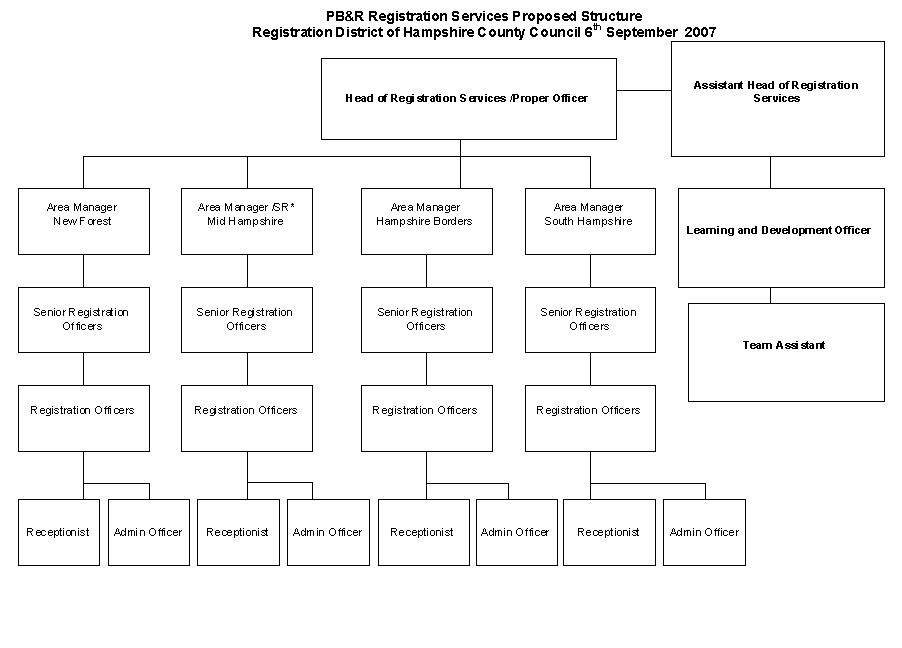
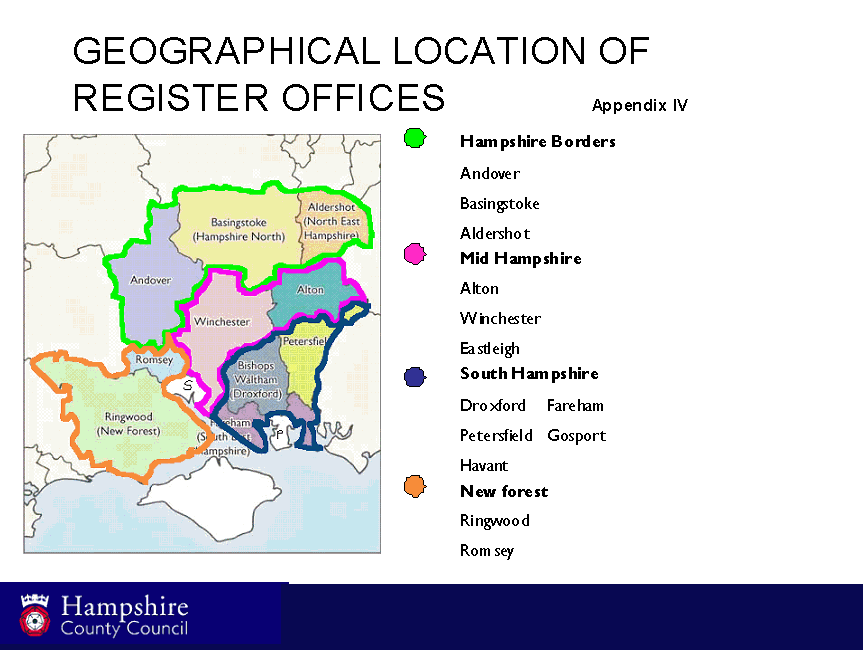
Locally, a new staffing structure has been developed which makes provision for four Area Managers. These staff will co-ordinate activity across the four geographical boundaries of the new Registration District. Details of the structure and boundaries are provided in Appendices II and III. These roles will afford an opportunity for sharing best practice, ensuring consistency of service provision and sustained improvement. |
7.1.4 |
New roles have been defined and evaluated. Working in parallel with this, a comprehensive analysis of activity has been completed, which will inform levels of resource required for the new service. Following completion of financial profiling, discussions will commence with individual staff to inform them of the personal impacts of the change. |
7.2 |
Community |
7.2.1 |
It is anticipated that the impact of any changes upon the local community will be minimal, and the continuity of service provision to Hampshire Residents will be assured (see Section 7). It is therefore proposed that a public notice will be issued in October 2007 to advise of the key changes and afford the opportunity for comment and feedback. The notice will be published in the Hampshire Chronicle and on Hantsweb (see Appendix V for further detail). |
7.2.2 |
Responses will be collated and any objections will be addressed either in person or by correspondence. Where a need is identified, meetings with local groups will be organised. |
7.3 |
Financial
|
7.3.1 |
There will be no direct financial impact in setting up the New Governance Scheme, although it is anticipated that efficiency savings will be achieved through remodelling the staffing structure. Such efficiencies will form part of the strategy to deliver the required savings in relation to Hantsdirect. |
8 |
Business Continuity |
8.1 |
Service continuity will be assured through a number of key strategic arrangements: a) The retention of fee payment for ceremonies in approved premises at weekends and bank holidays. The principal of fee payment for ceremonies which attract a charge to the public (e.g. marriages and civil partnerships) has, to date, ensured continuity of service provision. Any fundamental change to this arrangement would represent a high risk to the service. b) On the implementation of New Governance, the current Head of Registration (Proper Officer) will retire. This event has been planned for many months. In order to implement the new structure efficiently, with minimum disruption and the effective use of resources, it is proposed that the strategic element of these functions will be added to the role of the current Head of Performance and Development. This will enable the new post of Assistant Head of Registration to be introduced to ensure, together with the four new Area Manager roles, that there is sufficient managerial resource to maintain service delivery and standards. c) Expansion of the number of directly employed registration staff with a view to reducing the current reliance on "casuals". d) The new structure has been designed to meet the needs of the service, with the majority of staff able to transfer into broadly similar roles. e) Salary protection will be afforded to staff who experience pay detriment as a result of assimilation to the new pay bands, in accordance with EHCC guidelines. This is not anticipated to be significant. f) A reduced, flexible `casual pool' of staff will still be maintained in order to meet fluctuation in demand through the calendar year. g) No change to service delivery access points. In the new scheme, members of the public will be able to register key life events and provide notice of marriage or civil partnership at any service access point across the registration district of Hampshire County Council. |
9 |
Conclusion |
9.1 |
Given that the County Council has no other option but to proceed with the transfer of statutory officers into its employment, there is much to be gained from developing this opportunity to take advantage of the flexibility afforded by New Governance, as outlined in this report. |
LINK(S) TO CORPORATE STRATEGY | ||
Yes |
No | |
Hampshire safer and more secure for all |
_ | |
Maximising well-being |
_ | |
Enhancing our quality of place |
_ | |
This proposal does not link to the Corporate Strategy but, nevertheless, requires a decision because of the requirement by national government over a number of years to modernise the Registration Service. |
Section 100 D - Local Government Act 1972 - background papers
The following documents disclose facts or matters on which this report, or an important part of it, is based and has been relied upon to a material extent in the preparation of this report.
NB the list excludes:
1 Published works
2 Documents which disclose exempt or confidential information as defined in the Act
........................
........................
DraftEMPRRegistrationReport0907
Appendix I
Appendix I
Extract of outcome report presented to the Recreation & Heritage Policy Review Committee on 17 January 2002
The following are the recommendations of the review:
1. That consultations take place with staff with a view to restructuring the Registration Service to a single registration district, and appropriate recommendation is made to the Registrar General.
2. That consultations take place with staff and the public in regard to the rationalisation of offices and the closure of specific offices that fall below minimum standards.
3. That a programme of improvements is planned and implemented for remaining offices to ensure they meet required standards including accessibility, maintenance and decoration, waiting areas, reception facilities and IT links/provision.
4. That legislative changes be recommended to Central Government in regard to service delivery methods outlined in option 4, should the Government's report on the national review of the registration service not cover these issues.
NOTE; The principles set out in this extract have been adhered to in the current project to move to one district for the Hampshire County Council Registration service.