
Archived decisions
Hampshire Home to School Transport Pathfinder
Draft Submission - 18 October 2007
Section A - Contact Details
A1 Local Authority Name and Number
A2 Official Address
A3 Contact Name and Title
A4 Contact phone number
A5 Contact Fax number
A6 Contact address (if different)
A7 Contact email address
Section B - Background
B1 Backdrop to Proposed Scheme
B1.1 Hampshire is a diverse county. It has a population of over 1.25 million residents, 530 schools, 170,000 pupils aged 5 to 16, over 525,000 households, and households have on average at least one car. The population of the county is expected to grow to 1.30 million by 2011 - a 3 per cent increase, but with the largest increases being in the over 65's and over 85's. According to the 2001 census, 2.5 per cent of the county's population belong to minority ethnic groups, relatively widely dispersed throughout the county. However, 5.8 per cent of the 3 to 16 age group is from ethnic minorities and children in Hampshire's schools have 62 different first languages.
B1.2 In terms of socio-economic profile, Hampshire displays considerable diversity; car ownership per household is proportionally much higher in rural areas but there are pockets of lower car ownership in East Hampshire and the Gosport district. The Index of Multiple Deprivation (IMD) shows a higher level of deprivation in urban districts; Basingstoke, Havant and Gosport all have considerable deprivation.
B1.3 Current spend on home to school transport is well distributed across the county, though there remains a significant proportion of schools without current spend.
B1.4 On any of the 190 schooldays there will be significant increases in children and young people walking on pavements, cycling or being transported to school by coach, bus or car around 8.30am and 3.30pm. Surveys reveal the different ways parents and children approach the home to school journey and this submission responds to those in an affordable and adaptable approach. The schools range in size from a small rural infant school with 36 pupils on roll to a large secondary with 1807 pupils on roll. The average size of primary schools is 223 compared with the average secondary with 1,012 pupils. The number of schools, by type, is shown in the table below.
Table X School/Units by Type and Status
School/Units by Type and Status | ||||||
Community |
Controlled |
Aided |
Foundation |
Total |
Units | |
Nursery |
3 |
3 |
11 | |||
Infant |
111 |
10 |
3 |
1 |
125 |
12 |
Junior |
87 |
56 |
46 |
5 |
194 |
11 |
Junior & Infant |
97 |
8 |
5 |
1 |
111 |
10 |
11-16 Secondary |
53 |
1 |
1 |
8 |
63 |
19 |
11-18 Secondary |
2 |
1 |
5 |
8 |
||
Special |
26 |
26 |
||||
Education Centres (PRUs) |
7 | |||||
TOTAL |
379 |
75 |
56 |
20 |
530 |
70 |
B1.5 All community, controlled and foundation primary and secondary schools have defined catchment areas. Normally a junior or junior and infant school has a clear link to one, but occasionally more than one, secondary school. Some aided schools have defined catchment areas and also admit children from a wider area on denominational grounds. All Hampshire mainstream schools have a comprehensive intake. The County Council plans its school places so that sufficient capacity is available in the catchment area to take the children living in that area. When it builds new schools the County Council endeavours to ensure that these are within the normal walking distance for children within the catchment area. This pattern of school provision minimises demand for transport.
B1.6 The County Council maintains 26 special schools and 52 special units in mainstream primary and secondary schools to meet the needs of a wide range of pupils with special needs. In addition, children with SEN statements also attend mainstream schools where their needs are best met. Proportionately few children from Hampshire attend out-county schools to meet their special needs.
B1.7 The County Council's transport policies are set out in its Local Transport Plan (LTP) 2006-11 which was assessed as `excellent' by the government.
B 1.8 The vision for the LTP is of a transport strategy that:
"Enhances quality of life and economic prosperity by connecting people, communities, employment, goods, services and amenities".
The main objectives of the LTP are:
1 To increase accessibility
2 To promote safely
3 To reduce the impact and effect of congestion
4 To widen travel choice
5 To improve air quality
6 To support wider quality of life objectives
7 To encourage value for money and efficient asset management
B1.9 These objectives will be achieved by a balanced strategy that seeks to meet the needs of all residents. The strategy includes measures to tack existing and future problems. It aims to improve all modes of transport to provide a wider choice for people. It balances the need to protect the environment with the need for mobility. Environmental stewardship is an important corporate aim. Hampshire County Council is a signatory to the Aalborg Commitments and the Nottingham Declaration on climate change and is a national leader in its approach to the management of natural resources. At the heart of the strategy is the need to improve accessibility in its widest sense.
B1.10 The strategy also recognises that not all transport problems can be solved by traditional transport solutions. Congestion can be tackled by reducing the need to travel, for example the development of more sustainable communities through local use of spatial planning policy. Some services can be delivered directly to the customer, instead of requiring the customer to travel.
B1.11 The core philosophy of this LTP is that transport problems should be addressed by a process to reduce, manage and invest. Wherever possible, problems should be tackled or reduced at source - for example, tackling congestion by reducing the need for unnecessary journeys. If this approach is not sufficient on its own, transport should be improved by managing the existing networks to make best use of current road and public transport infrastructure. If neither of these approaches fully address the problems then investment would be needed to provide new services or infrastructure.
B2 Current pupil and travel data
B2.1 The proportion of pupils receiving free school meals along with pupils in receipt of free home to school transport is shown in the table below. The table also shows the number of schools with travel plans in place.
Free School Meals |
Free Home to School Transport |
Schools with Travel Plans | |
Primary Schools |
8.38% (8,245) |
2.07% (2,035) |
44% (40 schools) |
Secondary Schools |
6.45% (4,646) |
12.59% (9,069) |
56% (190 schools) |
Schools Overall |
7.58% (12,891) |
6.53% (11,104) |
237 |
B2.2 The mode share for pupils at primary and secondary schools is shown in the table below. A much greater proportion of primary school pupils travel by bus than secondary school pupils (either by public bus service or dedicated school bus), whilst more than double the proportion of secondary school pupils travel by car to school, when compared with primary school pupils.
Walking % |
Cycle % |
Car % |
Car share % |
Public bus service % |
Dedicated school bus % | |
Primary Schools |
49 |
8 |
18 |
3 |
9 |
12 |
Secondary Schools |
49 |
1 |
43 |
4 |
1 |
2 |
Schools Overall |
49 |
4 |
32 |
3 |
4 |
7 |
B3 Principal school travel issues in pilot areas, support by analysis
B3.1 There is a high degree of consistency between the LTP objectives and the principal school travel issues. The proposed pathfinder covers the first four (accessibility, safety, congestion and travel choice) of the seven LTP objectives and is also related to the remaining three (air quality, quality of life and value for money/asset management).
B3.2 The County Council has a team of school travel plan advisers and has also invested over £7 million in the last five years on its own safer routes to schools Capital Programme. While this programme has produced increases in non-car use for school journeys over the years the pathfinder programme will provide a step change in combining bus-based as well as walking and cycling initiatives.
B3.3 The programme is also supportive of the County Council's environmental policies including its Aalborg commitments which it take very seriously.
B3.4 The home to school transport pilot schemes were developed as part of an holistic approach to school transport in Hampshire. The aim of the pilots was to address car dependency, traffic congestion and remove transport impediments in choosing schools. The pilot areas were chosen to enable different modes of sustainable school transport to be introduced and their impacts assessed. The lessons learnt from the pilot schemes and the feedback from the stakeholders involved as well as the users and non-users is detailed in Section E, and has formed the basis of the development of the Pathfinder bid.
B3.5 Where groups of schools were identified as having issues of choice and congestion, these were clustered and put forward as pilots for the home to school transport schemes. Six Pathfinder pilot scheme clusters were also identified across the county based on the choice and congestion agenda.
B3.6 The diagram in figure X below illustrates the process that has been used to complete the ranking of schools. The technical information outlining the data sources and the ranking of process is set out in Appendix X.
Figure X Process for Ranking Schools
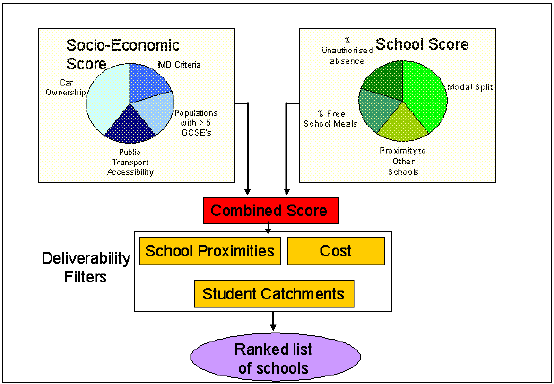
B3.7 From figure X it can be seen that for each school socio-economic and local data has been used to establish how highly they would meet the project aims of increasing sustainable travel and school choice. The top 15 ranked secondary and primary schools for each of the criteria are shown in figure X.
B3.8 In the development of the pilot project, further detailed work was undertaken with each school to determine the most appropriate mode to meet the school's needs. This detailed review had the following stages:
_ Review of existing school travel plan and issues raised;
_ Review of current transport options including walking and cycling routes and bus options;
_ Accessibility mapping of current pupils to identify gaps in public transport provision;
_ Evaluation of current school catchments including mapping student distance from schools; and
_ Discussion with Head Teachers regarding the level of interest in support of the pilot project and introducing and promoting sustainable transport.
B3.9 The desk top review to prioritise schools has been applied to all schools in Hampshire and the lessons learnt from the detailed development of each scheme will enable the correct application of the toolkit to each school in the County as part of the Pathfinder submission.
B4 Capacity of local authority and local partners to manage a pilot scheme
B4.1 During the last twelve months, Hampshire County Council has undertaken four important school travel pilot schemes, which have provided detailed evidence of the advantages and disadvantages of a range of different approaches to meeting corporate and national objectives, in particular reducing congestion and improving educational choice. Hampshire County Council has committed £1.5m to the development, implementation and operation of these pilot schemes over a three year period.
B4.2 In all schemes, the County Council adopted a process for ranking schools which could be applied in the development of the Pathfinder. This consists of scoring a number of both socio-economic and school characteristic factors, and using the resultant rankings to establish how well schools would meet the aims of increasing sustainability (transferring journeys from the car to walking, cycling and public transport, thus reducing congestion and CO2 emissions) and increasing choice.
B4.3 The pilot schemes consisted of:
1. Yellow Buses. This scheme consisted of the provision of three dedicated Yellow buses providing a number of services to one secondary school and its four feeder primary schools in the Basingstoke area. In line with similar practice elsewhere, the scheme required dedicated and specially trained drivers, CCTV on each vehicle, three point seat belts, dedicated pick-up points and registration for those attending primary/infant schools. In addition, one vehicle was fitted with a tail lift to accommodate those with mobility impairments. The scheme is described in detail at Annex ZZ.
2. Walking and Cycling. This scheme was run in the Farnborough area in Summer 2007 and involved nine nursery/infant/junior/primary schools and two secondary schools. Two different engagement techniques were utilised, and the scheme is described in detail at Annex WW.
3. Utilisation of Current Networks (Bus IT). This scheme was based around the concept of promoting additional use of existing scheduled bus services through publicity, promotion and simplified ticketing and incentives. A mapping exercise of existing catchment areas indicated three potential clusters, of which Eastleigh was selected for the pilot scheme. Three infant/junior/primary schools and three secondary schools were included in the project, and the local bus operator, Solent Blue Line, was a proactive partner. The scheme is described in detail at Annex XX.
4. Home To School Transport Services. This scheme was also marketed as Bus IT, and involved the use of non-commercial transport services in the Waterside area of the New Forest District. Three infant/junior/primary schools and two secondary schools were involved in the pilot, which consisted of additional and extended services, coverage for after school activities, simplified ticketing and promotional material. The scheme is described in detail at Annex YY.
B4.4 The figure below illustrates the project delivery structure that was established to ensure the development and delivery of the pilot schemes. The same proven project structure would be used to role out the sustainable transport options to every school in Hampshire as part of the Pathfinder process as well as developing the changes to charging policy.
Figure X Proposed Project Delivery Team Structure
Section C - Proposals for local school travel scheme
C1 Outline scheme arrangements, including aims and objectives
C1.1 The bid intends to tackle the three issues of parental choice, mode choice and social behaviour through a holistic approach to school transport which presents new opportunities for those travelling to school in Hampshire. We believe that this will enable Pathfinder to achieve our key aims and objectives. Influencing these issues will produce a series of `outcomes', which lie at the heart of the Pathfinder scheme.
Outline Scheme Arrangements.
C1.2 A number of highly valuable lessons have been learnt from the experiences of operating the four pilot projects, which will be incorporated into the Pathfinder project.
C1.3 Although the aims and objectives of Pathfinder are uniform, the clearest lesson from the pilot schemes has been that no single universal approach can be applied successfully to an area with such diverse characteristics as Hampshire. The third largest shire county in England in population terms, more than 90% of the county is classified as rural, but 87% of the population live in the urban areas. Hampshire is relatively prosperous, but there is a wide range of differences between communities with one district, Hart, being classed as the least deprived in England, while three wards in Havant contain areas of deprivation that are among the 10 per cent most deprived.
Addressing Principal School Travel Issues.
C1.4 The application of transport interventions and improved dissemination of information as a key element of out Pathfinder scheme has the advantage of allowing us to address the school travel issues identified above, together with a number of secondary priorities. This is best shown diagrammatically as follows:
Figure X The Structure of the Pathfinder Scheme
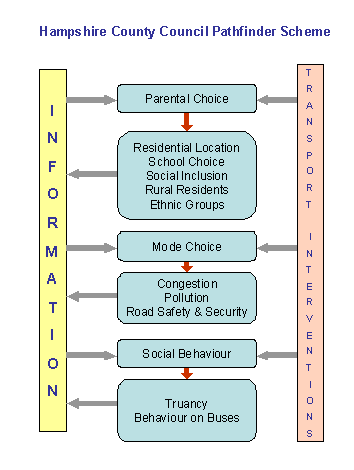
C1.5 For example, in determining the best mix of transport interventions and information provision, it is necessary to define the desired outcomes for a particular location or area. Influencing parental choice will require measures that take account of residential location, the number and type of schools that need to be made accessible (in both rural and urban environments) and the particular needs and preferences of ethnic groups. Similarly, in deciding on the best ways of impacting on mode choice, it is necessary to define what the relative priorities of tackling congestion, reducing pollution and greenhouse gas emissions and improving safety and security are in the area under consideration.
C1.6 Careful selection of the appropriate measures is intended to impact favourably on social behavioural issues, such as truancy and unacceptable behaviour on school buses, and successful outcomes in all of these areas will have a beneficial impact on the information "story", thus reinforcing the positive message that can be disseminated to schools, their pupils and crucially the parents.
Supporting Parental Preference and Pupils Travelling more than 2 miles
C1.7 Our Pathfinder proposal builds on our existing strategy for addressing the key aim of encouraging choice. Thus, although the project is considered to be a pilot scheme, we regard it as a further major stepping stone towards implementing a holistic countywide strategy that addresses accessibility to the most appropriate education facilities. All of our existing schemes, together with Pathfinder, which involve the use of school bus services, have been designed to introduce a standard charge of £1 for a return trip. Pathfinder enables us to extend this principle far more widely, and thus provide a more level playing field for parents wishing to exercise choice, particularly for those from areas of social deprivation.
Aims and Objectives.
C1.8 The Aims and Objectives of our Pathfinder successfully combine the general objectives required by the Government for Pathfinder schemes with Hampshire's key aims and our overarching Corporate Strategy. The two key aims are:
· To reduce the congestion associated with the number of journeys to school by car (by encouraging walking, cycling and use of public transport, thus reducing levels of car use on the home to school journey)
· To improve educational choice (by making transport arrangements that support parental preference and that are tailored to cater for pupils living more than two miles from school)
C1.9 Our Pathfinder will help address the following elements of our Corporate Priorities, by supporting the principles of improving choice, ensuring access to a wider range of schools and encouraging sustainability:
1. Hampshire safer and more secure for all
This is our top priority and is about developing and supporting stronger, safer communities for all by protecting vulnerable people, maximising safety in the places we live, helping young people to live positive lives and helping diverse communities to feel secure.
Helping young people live positive lives means providing the best start possible through our education system as well as providing other opportunities for young people to get the most out of their lives and to help them make positive choices for the future.
2. Maximising Wellbeing
This priority is about maintaining and improving quality of life and ensuring everyone has the opportunity to support themselves, be active in their community and have access to the services they need, whilst knowing that should things go wrong we are there to support them.
Fair and equal access to services for residents is vital and it's our job to ensure that we make it as easy as possible, particularly for those that might otherwise have difficulty. When providing one service, there may be others that can be offered at the same time.
3. Enhancing our quality of place
This priority is all about making the county a good place to be by protecting local distinctiveness and diversity, ensuring excellent facilities, respecting Hampshire's heritage and planning proactively for the future.
By looking ahead and planning for the future, we can be sure Hampshire remains as good a place to work, live and visit in the future. We want to ensure Hampshire continues to prosper without risking our environment. For example, we are currently working to help schools recycle more, cut energy and water consumption and source food from healthy, local sources. Not only is this of benefit to the schools but it helps get the message across to residents of all ages, both children and parents that when it comes to protecting the environment, Hampshire means business.
C2 Describe plans, including targets
C2.1 Pathfinder incorporates a menu of solutions, offering options to meet local needs. Our strategy has been to develop a holistic approach, encouraging cross-departmental innovation and involvement with local communities. We have balanced affordability with choice whilst pioneering new approaches, utilised intelligence from other authorities and consulted with partners and stakeholders to achieve a rationalisation and a focus on those options most likely to meet communities' needs over the next ten years. Pathfinder thus consists of a range of solutions, including both transport interventions and the dissemination of information, all of which incorporate engagement with a wide range of partners, including schools, colleges, transport operators, local authorities and other members of the Hampshire Children and Young People's Partnership.
C2.2 Our proposed Pathfinder bid consists of the following elements:
Pathfinder Scheme Element |
Cost |
Yellow Bus Provision (15 vehicles operating in the Andover, Basingstoke, East Hants, Havant and Rushmoor areas) |
£750,000 |
Expansion of the Bus IT Initiative (Additional areas, both urban and rural but likely to be different to the areas served by Yellow Buses) |
£800,000 |
Walk/Cycle Expansion (Soft measures and Education/Promotion) |
£150,000 |
Vehicle Utilisation (To cover extended school day, the Youth Agenda, use of smaller vehicles and links with Adult Services & Community Transport |
£300,000 |
TOTAL |
£2,000,000 |
C2.3 Embedded in each of these elements is a range of measures to improve the quality and quantity of information available to schools, pupils and parents to assist in their choice of school and to plan travel arrangements for the school journey. As well as helping pupils and parents to plan their travel arrangements, information is of significant value in providing reassurance during the journey. This can be through real time monitoring or `tracking' of individuals (or vehicles) as they travel. This permits communication between those travelling, the school or with parents. Trials have already begun as part of the Bus IT scheme and real time systems installed on one yellow school bus in Basingstoke. The costs quoted above take account of the investment required to install the technology for improving the flow of information.
C2.4 In delivering our Pathfinder project, we will apply the following set of values:
· Removing barriers to opportunities and improving choice for all
· Responding to the improvements that people say they want
· Planning for and investing in the future
· Encouraging partnership, participation and contribution
C3 Education benefits for pupils including impact on disadvantaged groups
C3.1 Education benefits for pupils including impact on disadvantaged groups
i) Pupils from low income families
C3.2 The County Council will extend the exemptions to payment that will be available to those entitled to assistance with transport to other pupils living within the 2-3 mile zone from their nearest school or attending another more distant school to which they would not normally receive assistance with transport costs. Free travel would be available on "yellow buses" and free Bus IT passes to children who are entitled to free school meals or whose families who are in receipt of the maximum level of working family tax credit. The exception would be the availability of the walking route. This should benefit pupils from low income families both in assisting with the cost of their journey to school and in enhancing the ability of parents to exercise a preference for a school.
ii) Pupils with SEN
C3.3 One of the intentions of the Bus IT scheme is to stimulate the market to provide buses at times that more easily meet the children travelling to school. Some children with special needs, particularly the older ones, will be able to make use of scheduled services to travel to school when currently they have no option but to use contract transport. Heads of special schools rightly see the ability of some of their children to learn to use public transport services as a preparation for when they leave school. A programme of enhanced mobility training will be part of the support provided by the Pathfinder scheme.
iii) Pupils from a specific minority ethnic group
C3.4 The County Council has undertaken an impact assessment to be considered in the development of this Pathfinder application and no adverse impact has been identified. It is expected that the benefits that will be available to children from the County Council's proposals will also be of benefit to pupils from ethnic minority backgrounds.
iv) Pupils with a history of truancy
C3.5 Experience, in particular, from the yellow bus pilot that the County Council has been running indicates that school attendance and prompt arrival at school can be enhanced from this approach. There is also evidence from other authorities who have introduced this approach that there is an impact on attendance levels. This Pathfinder should therefore impact on school attendance by improving the quality of journey to school for many pupils. It is, however, unlikely to impact on those whose poor attendance is linked to deep seated personal, family or school issues where travel to school is rarely the key issue.
v) Pupils living in remote areas
C3.6 In rural areas of the county there are demand-led services such as CANGO, where small vehicles are used to meet the specific transport requests of local people. It is envisaged that the Bus IT scheme would be available on these existing services and may increase their current levels of use.
vi) Strategies to minimise poor behaviour on buses
C3.7 Poor behaviour has not been a major issue on Hampshire buses. The County Council has always backed firm measures to remove any children causing difficulties. The launch of the Pathfinder initiative will include material designed to raise the profile of travelling to school by bus and the standards of behaviour expected.
C4 Benefit to wider community
C4.1 Reducing congestion and pollution has potential benefits both locally and across the wider road network
- Localised (school gate) congestion will be improved due to a reduction in car movements.
- Strategic, congestion on the wider road network will be reduced as greater use of buses makes more effective use of road space in line with the LTP objectives of Reduce, Manage and Invest.
C4.2 Safety Benefits
- Reduction of vehicle movements around school entrances will reduce the risk of accidents together with other initiatives the County Council is introducing particularly around speed limits and road safety training.
C4.3 Improved effectiveness of other publicly funded transport provision. This is a key element of this project and has a number of aspects.
- Better linkage with the local bus network through the Bus IT scheme will underpin the viability of the local bus network by increasing patronage to the advantage of the whole community. Where additional capacity is introduced this will enable greater journey opportunities for all users. Where journeys are more closely matched to school flows, this will increase the efficiency of the local bus network
- Linkage with the Accessibility Pilots, which are part of the LTP, in particular,
_ Whitehill, Bordon and Lindford, where the project will assist the pilot aim of improved access to all facilities
_ New Forest, access to healthcare, where realigning the operation of school special services will provide greater ability for the rest of the local bus network to meet other travel needs
_ Andover-Winchester, access to hospital, where addressing capacity issues at school travel times will allow other journey purposes to be served better.
- Linkage with Rural Pilots. This range of initiatives is one of eight schemes nationally which have recently been adopted by the Local Government Association Innovation Forum
_ The pilot in East Hampshire which will involve an audit of all forms of transport provision and the vehicle assets in all sectors. This will link closely with the vehicle utilisation element of the Pathfinder bid
- Vehicle utilisation, which is covered more fully at XX, is a key strand of the Pathfinder bid and has the potential to unlock resources which will offer benefits to many sections of the community: by facilitating transport for the extended schools initiative; by making minibuses available for evening and weekend trips to further the youth agenda; by ensuring that transport is not a barrier to activities across the extended school day; by sharing resources to bring different sections of the community closer to each other; for example looking at opportunities to share travel provision for older people with children with special educational needs.
C5 Evaluation strategy
Table X: How Hampshire's Scheme meets Pathfinder Criteria [to be completed]
Pathfinder Element |
How the proposal achieves this | |
Mandatory |
Transport arrangements that support parental preference |
|
Transport arrangements for pupils living more than 2 miles from school |
||
Reducing levels of car use on the home to school journey |
||
Optional |
Transport arrangements that support pupils receiving education at more than one institution as part of the delivery of the 14-19 strategy |
|
Transport arrangements that support pupils attending breakfast clubs, or after school activities under extended schools arrangements |
||
Pupils travelling to schools preferred on religious or philosophical belief grounds |
||
Pupils travelling along routes that parents consider unsafe |
||
Pupils participating in extracurricular activities |
Section D - Funding calculations
D1 Funding calculations
Information to be added
D2 Pupil charging arrangements
D2.1 In response to the acceptance of the Pathfinder scheme for funding from the DCSF it is anticipated that from September 2009 the County Council would introduce charges for home to school transport. There are exceptions and these are detailed in later paragraphs. Charges will be applied for children entitled to assistance with transport entering a new school from September 2009. This means that children continuing at the same school as they attended the previous academic year would not be affected by the County Council's new policy, but if a child changes school, i.e. from a primary to a secondary or enters a new primary or secondary as a result, for example, of a family move, from September 2009 they will be covered by the new policy.
D2.2 Transport assistance will be provided, on payment of a charge, £1 per day, paid by monthly direct debit or termly in advance if:
· A child is aged between 5 and 8 years and lives more than two miles from his/her nearest or catchment area school by an available walking route.
· A child is aged between 8 and 16 years and lives more than three miles from his/her nearest or catchment area school by an available walking route.
Parents will be exempt from charges if:
· Their child is entitled to free school meals or if the family is in receipt of the maximum level of Working Families Tax Credit.
· The child has special educational needs or other disabilities which mean that he/she is unable to walk to school.
· A parent has medical or other disabilities which mean that he/she is unable to accompany a child to school.
· The child is a Looked After Child.
· The walking route to the school has been declared unavailable by the County Council.
D2.3 From September 2009 the County Council will begin to introduce enhanced travel availability for children travelling to school who do not meet the County Council's criteria for assistance with transport. Some specific services (Yellow Buses) will be available to transport some children to school. More generally "Bus IT" tickets will be available, enabling children to travel to school on public service buses and some home to school contract buses for the equivalent cost of £1 per day.
Section E - Partners
E1 List of partners and the financial and non-financial contributions to scheme success
Contributions from Partners
E1.1 The schemes which are incorporated into the Hampshire County Council Pathfinder scheme will benefit from the active participation of schools, bus operators and other local authorities. The contributions which are anticipated from these organisations are based upon dialogue and stakeholder engagement during the preparation of this bid and experience from the ongoing `pilot' schemes within the County.
Schools
E1.2 The schools have demonstrated a willingness to contribute at the practical and educational level. Practically, they will assist in providing information to pupils and their parents about the schemes and promote the benefits to increase the take-up of walk, cycle and improved public transport to and from school.
E1.3 Schools will also address access arrangements to the site, to facilitate safe and secure boarding and alighting of pupils onto buses and the ease with which such vehicles can manoeuvre in the streets around the school gates.
E1.4 At an educational level, schools are prepared to include sustainable transport within the curriculum, reinforcing the message that walking, cycling and public transport can represent a viable alternative to the private car.
Bus Operators
E1.5 The bus operators have been enthusiastic contributors to the pilot schemes and have pledged their support for the Pathfinder scheme in Hampshire. Solent Blue Line has piloted the use of the student card and other services associated with the Bus IT scheme, demonstrating the importance of the participation of operators to its success.
E1.6 In piloting the Yellow Bus in Basingstoke, First Student has illustrated the benefits of active operator contribution to dedicated services. The operator assisted with defining the routes (and stops), agreeing access arrangements at individual schools, pupil recording and the general operation of the services. They also undertook driver training to ensure safety and security of pupils. Going forward to the Pathfinder scheme, First Student has undertaken to assist with the introduction of real-time information which will enable parents and the school to monitor the whereabouts of individual pupils as well as the bus itself. The operator will also extend its driver training programme and introduce evaluation training for those travelling on school buses.
Other Local authorities
E1.7 Rushmoor Borough Council has worked in partnership with Hampshire Country Council to implement the walk and cycle scheme. It is intended that Travel Planning Officers from a variety of authorities will combine to promote the benefits of walking and cycling to school. The authorities will also support Hampshire in the implementation of its public transport measures,
E1.8 Hampshire County Council has also worked closely with the Youth Council in identifying transport issues and designing measures to address these which accord with the views of the Youth Council. This is referred to in greater detail in the following sections and is therefore not repeated here.
E2 How the scheme will improve links between school, general public transport, social services, health, community and other publicly funded transport, post-16 transport policy statements, local transport plans and bus strategies. Wider community benefits
E2.1 The County Council's pilot studies have shown that one of the outcomes of the Bus IT approach has been the focusing of services more closely on meeting the travelling needs of young people attending schools. It is expected that this will also be of benefit to students travelling to colleges. Discussions have taken place with the Post-16 Transport Partnership about how the Pathfinder approach could link with initiatives the post-16 colleges may wish to develop.
E2.2 The Pathfinder bid will be a catalyst to develop innovative use of existing vehicles used by and for schools, and of proposed Yellow buses, to achieve wider community benefits and of other community resources to support the extended schools agenda.
E2.3 This accords with the aims of the Bus Strategy to address directly two of the overall objectives of the Local Transport Plan, namely:
· To increase accessibility to services
· To widen travel choice.
E2.4 These measures will also support other overall LTP objectives:
· Promote safety by encouraging the use of a safer travel mode,
· Help deliver value for money and achieve efficient asset management.
E2.5 Although there is a common theme of better outcomes through more innovative use of resources, the approach is more easily explained if the different strands are set out separately.
A: YOUTH AGENDA
E2.6 To enable access to facilities in the evenings and at weekends through (a) information and (b) easy to use facilities to hire vehicles.
E2.7 Passenger Transport Group, working with the youth service, are driving the development of website information (by district) which signposts youth type activities and how individuals can get there. Existing group hire of vehicles will be better promoted and supported with new software to allow groups to promote and manage seat allocation.
B: EXTENDED SCHOOL DAY
E2.8 To provide transport for the extended school day by funding schools to pay minibus drivers for additional hours so that their existing minibuses can be used more fully, for example to take children home from `after school clubs' and/or collect children before school for `breakfast clubs'.
E2.9 Year one would involve investigation / research and trialling at schools before being rolled out to a larger number in future years.
E2.10 Looking at schools where the County Council arranges insurance cover suggests there are 107 minibuses at secondary schools, 68 at special schools, 35 at primary schools and 20 at other establishments.
E2.11 The schools with existing minibuses provided through the HTST minibus scheme could be considered first. Currently there are 32 minibuses in this scheme (5 primary, 3 reducing 2 shortly secondary, 24 special and 2 EOTAS)
C: EXTENDED SCHOOL
E2.12 Extended school through wider community use of school facilities (such as school buildings for evening classes or use of vehicle downtime by wider community - see also part E)
E2.13 Working with schools to ensure transport is not a barrier to accessing adult education through the use of existing resources including yellow buses.
E2.14 Bid money could be used to pay operators (whether schools, CT organisations, commercial operators etc) an amount towards driver costs / other vehicle expenses to provide evening journeys for wider community access to continuing education or weekend journeys for field or study trips.
D: LINKS WITH ADULT SERVICES
E2.15 Use of existing Adult Services vehicles serving day centres or other adult services establishments in their downtime. This could include using them during the day after they have taken clients to centres and before they take them home again or using them in the evenings to feed into the youth agenda or extended schools.
E2.16 To work successfully this would need to resolve anxiety issues for centres over what happens if a vehicle gets damaged or a client becomes ill during the day etc as well as issues with how useful timings are for other users.
E: LINKS WITH COMMUNITY TRANSPORT
E2.17 This is a two-way strand, using Community Transport vehicles for school trips in their downtime or making school vehicles available to the CT sector between school runs. This could include using them in the evenings to feed into the youth agenda or extended school initiative.
E2.18 An existing example, which could be used as a model, is Eastleigh Community Services `One Community' who currently operate the Knightwood school minibus on their behalf. It is used to transport non entitled pupils to and from school for the extended school day and then made available for community use during the day.
F: SHARED JOURNEYS
E2.19 Adult Services and Special Education Needs transport often operates at similar times. Opportunities to share journeys would be investigated which could have social as well as economic benefits.
E2.20 Extension of the BusIT scheme together with better utilization of existing vehicles will further the 14-19 Agenda by making travel easier for those young people who receive their education at more than one school during the day.
E3 Evidence of consultation
E3.1 Consultation to inform this pathfinder bid has taken various forms: focus groups with parents; e-consultation; engagement with the Hampshire County Youth Council; face-to-face briefings; and analysis of survey and questionnaire data from our pilot projects.
Focus groups
E3.2 Consultation with parents has been carried out via a series of eight focus groups facilitated by Ipsos MORI held around the County between 16 and 26 July 2007. Focus groups comprised parents whose children are involved in each of the four school travel pilot schemes as well as parents who have had no experience of any of the pilots.
Main issues raised
E3.3 The reasons that lie behind parents' preferences around school transport can be summarised in four areas - safety, cost, reliability and flexibility. Convenience is also a key issue for many, and parents say they are unlikely to change their behaviour if it has a negative impact on their daily routine. Although parents are concerned about the environmental impact of car use, this is a subsidiary issue compared with the above, as also is the issue of travelling independently to school, although it is seen as beneficial. Most parents who are not already using alternatives to driving are open to change, as long as they are reassured that this is better for them and their child.
E3.4 Parents broadly support the home to school travel pilot schemes, and appreciate that different solutions are necessary for different parts of Hampshire. They recognise that some schemes will cost more than others to implement, but the wider costs are less of a concern than the outlay for them as potential users of any scheme.
E3.5 The Yellow Bus scheme was the most positively received of all the initiatives. Parents of younger children are also upbeat about the walking and cycling pilot. In the scheme area, parents say the pilot has encouraged more parents to walk or cycle with their children. The walking and cycling pilot was seen as less suitable for older children and different incentives would be needed to encourage this age group to get involved. Parents were less aware of the two BusIT schemes and recommended putting more resource into advertising the schemes to increase uptake.
E3.6 However, most parents welcome any improvements to the current school transport situation. They are particularly keen on the idea of increased flexibility for Home to School Transport services and think incentives for those who use public buses are also a good idea.
E3.7 In terms of cost generally, most parents are willing to pay if high quality services can be guaranteed. The figure of £1 return is thought to be fair by most, though some remain adamant that they should not be made to pay for school transport directly, particularly if they have no choice but to use it.
E-consultation
E3.8 E-consultation has been carried out with a wide range of stakeholders across Hampshire, including schools, school councils, transport operators, councillors, FE institutions and the LSC.
E3.9 A copy of the consultation document is attached.
Main issues raised
E3.10 All respondents supported the County Council's intention to bid for pathfinder funding. They favoured adopting a flexible approach, with a number of supporting comments that picked up on aspects of this: the different needs of parents; the need for flexibility from transport companies; the challenges of each school having a varied geographical catchment with differing public transport provision and overall accessibility.
E3.11 Respondents raised a number of issues which are pertinent to our pathfinder bid:
· The desire to see better integration between bus and train to help students make journeys involving more than one mode of transport (more particularly with relation to the 14-19 curriculum).
· Looking at where bus coverage is poor and seeking opportunities to add services where demand is high but provision is not in place
· Request for more cycle storage within schools and better cycle lanes
· Better use of minibuses and car sharing initiatives
· Bike promotions and walking buses
· Better evening transport, eg to assist students in attending extended school activities
· Improving public bus services to enhance their use by students
· Maximising usage of places on School Special Buses
· Discouraging parking (eg by road markings) around the school gate
E3.12 Unsurprisingly all respondents felt that reducing congestion, particularly at peak times such as on the school run, was of major importance and many noted particular problems in their area.
E3.13 The majority of respondents thought in principle that it was reasonable and pragmatic to introduce charging. A few were unsure or did not wish to comment at this stage, but only two were totally opposed to charging. The main provisos or concerns with charging were:
· That low income families should not be charged (which they would not, as long as they were in receipt of maximum WFTC)
· Concern about the costs where there are multiple siblings
· The need for the numbers benefiting from the opportunity to be greater than those likely to be put off by charging
· That it should not be set at a level which would make it a disincentive
· A suggestion that money should be recycled to provide for concessionary travel schemes for young people
E3.14 The small number who were expressly against charging objected on the following grounds:
· Cost, particularly for rural children
· Feeling unclear what additional improvements would arise as a consequence of the new charging regime
· Concern about pupils paying a flat rate regardless of distance from home to school
· Fears that parents would simply switch to using their cars
· We should consider other options before charging, eg car sharing
· A feeling that parents should only have to pay if children attend a school out of catchment
E3.15 Consultation began on Monday 3 September, and responses were requested by Monday 1 October. However, consultation remains open, and we will continue to process all responses received.
Engagement with the Hampshire County Youth Council
E3.16 The Youth Council are supportive of the proposals, and are particularly interested in the BusIT proposal, although they felt a significant investment in publicising the scheme would be necessary to ensure its success. The Youth Council have said they would like to be kept involved in proposals as they progress. Another theme raised regularly by the Youth Council is lack of access to transport generally for young people, and the high cost of transport, however we have explained that this particular pilot cannot provide assistance with out-of-school transport.
Face-to-face briefings
E3.17 Development of this pathfinder bid, and the pilots that have preceded it, has involved close working with schools, operators and others over a period of many months, as documented in this pathfinder bid and the supporting documents which give background on how schemes have been implemented.
Response to consultation to date
E3.18 The outcome of consultation supports the multi-faceted nature of this pathfinder bid and the intention to introduce charging for non-protected children is viewed by the majority as a reasonable way forward. A concern raised was that the benefits of the scheme could be outweighed by the numbers of parents who might use their cars rather than pay a charge for their child's transport. We are sensitive to this issue, and analysis to date suggests that our proposals will be sufficiently attractive to ensure a net loss of cars on the road. Comments about the need to publicise schemes well, particularly BusIt, have been borne in mind and this bid includes substantial investment to ensure the schemes are well publicised and understood. Parents raise a valid point about the need to think carefully about how to put together suitable incentives for older children to get involved in walking and cycling, and these are already being built into the existing pilot, eg some trials where bikes and equipment are being lent to schools to try out, to supplement some of the other pilot elements which are more geared towards primary-age children. Suggestions from consultation about maximising usage of existing services and taking account of before and after school activities are included in proposals outlined in this bid. Requests for improved infrastructure, eg more cycle lanes, will certainly be passed on to colleagues in our Environment Department, but the size of Hampshire is such that it would not be realistic to use pathfinder resources to invest in cycle lane/road improvements.
Further consultation plans
E3.19 Because of the multi-stranded nature of our pathfinder bid which is looking at a menu of options to tailor to the specific needs of our many different localities, this first phase of consultation has focused on testing views on the strategic, overarching principles that will underpin the bid. If we are successful in securing pathfinder money, our intention is to use a proportion of the pump-priming grant to carry out further detailed consultation with all areas where we propose to direct pathfinder resources, in order that we can engage effectively with parents and school communities on detailed proposals without having unnecessarily raised expectations prior to resources being made available through pathfinder
Section F - Declaration by Director of Children's Services
I have consulted with key partners (please list).
To the best of my knowledge all the information provided in this form is correct.
Name
Position
Signature
Date