
Archived decisions

River Hamble Harbour Authority
Governance Review 2007
Hampshire County Council
May 2007
Final Report
9S 4988




A CO M PAN Y O F
H ASK O N IN G UK LTD .
ENV IRO N MEN T
Burns House
Harlands Road
Haywards Heath, West Sussex RH16 1PG
United Kingdom
+44 (0)1444 458551 Telephone
01444 440665 Fax
[email protected] E-mail
www.royalhaskoning.com Internet
Document title River Hamble Harbour Authority
Governance Review 2007
Document short title River Hamble Governance Review 2007
Status Final Report
Date May 2007
Project name River Hamble Governance Review
Project number 9S4988
Client Hampshire County Council
Reference 9S4988/R/SJV/Hayw
Drafted by Dr Samantha Vize
Checked by Sian John
Date/i nitials check 10t h May 2007 SAJ
Approved by Dr Nicola Meakins
Date/initials approval 15t h May 2007 NCM


A CO M PAN Y O F


CONTENTS
Page
1 INTRODUCTION
1
1.1 Background to the Governance of the River Hamble Harbour
Authority
1
1.2 Current Governance Arrangements
2
1.3 Objectives set out for the Changes to the Governance
Arrangements
3
1.4 Objectives of the Governance Review 2007
4
1.5 Approach & Methodology
4
1.5.1 Introduction
4
1.5.2 Consultation exercise
4
1.5.3 Detailed literature rev iew
7
1.6 Structure of the Report
8
2 RESULTS OF CONSULTATION
9
2.1 Key Outc omes
9
2.1.1 Questionnaire analysis
9
2.1.2 Additional comments made
11
2.2 Other Issues arising from Consultation
14
3 COMPLIANCE WITH THE OBJ ECTIVES FOR CHANGE
15
3.1 Introduction
15
3.2 Objective 1: To modernis e the governance of the Harbour
Authority
15
3.3 Objective 2: To be in line with the Trust Ports Review 16
3.4 Objective 3: To be compliant with the Municipal Ports Review 17
3.5 Objective 4: To create a Harbour Board to streamline
administrative arrangements and ensure that decision-making is
in line with best practice
20
3.6 Objective 5: To have a Harbour Board of seven members with all
necessary skills, knowledge and experience
21
3.7 Objective 6: To retain the Management Committee in an advis ory
and scrutiny role
22
3.8 Objective 7: For meetings to be open to the press and public 22
3.9 Objective 8: To review the success of the new arrangement after
two years
23
3.10 Other issues
23
3.10.1 Model Code of Conduct for Local Authority Members 23
3.10.2 Consultation with stakeholders
23
3.10.3 Scheme of delegation to Harbour Authority staff 24
3.10.4 Harbour dues
24
4 RECOMMENDATIONS FOR IMPROVEMENT
26
4.1 Expertise and experience of Harbour Board members 26
4.2 Structure of the Harbour Board
27
4.3 Appointments Panel
28
4.4 Term of Office
28
River Hamble Governance Review 2007 - i -
9S4988/R/SJV/Hayw
Final Report
May 2007

4.5 Meetings of the Harbour Board
28
4.6 Model Code of Conduct for Local Authority Members 29
4.7 Training
29
4.8 Memorandum of Understanding
29
4.9 Management Committee
30
4.10 Stak eholder Liaison
31
4.11 Harbour Office
31
4.12 Finance
32
REFERENCES
APPENDICES
Appendix A River Hamble Harbour Authority Governance Review 2007
Consultation Questionnaire
Appendix B Consultees, Stakeholders and Interested Parties
Appendix C Summary report of Consultation Exercise
River Hamble Governance Review 2007 - ii -
9S4988/R/SJV/Hayw
Final Report
May 2007
1 INTRODUCTION
1.1 Background to the Governance of the River Hamble Harbour Authority
The River Hamble Harbour Revision Order 1969 (1970/249) (amended in 1982)
(1982/1370) established Hampshire County Council (HCC) as the Municipal Port
Authority for the River Hamble, together with the River Hamble Harbour Management
Committee. Until 1970, the River Hamble came under the control of the Southampton
Harbour Board pursuant to the Southampton Harbour Act 1949 (1949/12 & 13 Geo. 6).
Hampshire County Council's internal governance arrangements for the Harbour
Authority were subsequently amended in 2001, as a result of the Local Government Act
2000 (2000 c. 22). However, these were seen to be interim arrangements pending the
outcome of the Government's review of Municipal Ports (since completed). The
arrangements established for management of the River Hamble were:
· Decisions to be made by the Executive Member of Environment (where this
function was moved from the Recreation and Heritage Committee);
· With advisory groups to include
- River Hamble Executive Members Group (a small group of members
from the Management Committee, including local elected members and
representatives from the Royal Yachting Association and the marine
industry);
- River Hamble Harbour Management Committee (a sub-committee
meeting twice a year, with the majority of members being County
Council members); and
- River Hamble Harbour Advisory Committee.
This arrangement ultimately proved to be unsatisfactory. Informal discussions that took
place with the Ports Division of the Department for Transport concluded that the most
appropriate governance arrangement for Municipal Ports, including the River Hamble,
would be through a Harbour Board, made up of between seven and nine members with
all the necessary skills and experience to discharge both the Harbour Authority's
statutory obligations and discretionary activities.
Informal consultation also pointed out a number of other weaknesses in the interim
arrangements, including:
· Too many layers, with different types of meetings for every decision, and poor
use of staff time, both within the County Council and for Harbour staff; which
caused confusion for river users.
· With all decisions being made by one person, members of the Management
Committee and Executive Member's Group felt undervalued and disenfranchised
from the Harbour Authority.
· There was an apparent lack of clarity with respect to the framework within which
individual decisions were made by the Executive Member for Environment and
how those decisions related to the functions of the Management Committee.
River Hamble Governance Review 2007
9S4988/R/SJV/Hayw
Final Report
- 1 -
May 2007
· The statutory obligations of the County Council as Harbour Authority were not
fully delegated to the Management Committee. However, this reflected the fact
that, under the 1969 Harbour Revision Order (1970/249), decision making
responsibilities rested with the County Council, with the Management Committee
performing an advisory role.
· All the committees and groups were chaired by the same person, who made all
the decisions.
· There was no clear scheme of delegation to Harbour staff for day-to-day
decision making.
On 28 June 2004, the Cabinet approved commencement of the process to seek to
change the governance of the River Hamble. As a result, the County Council
commissioned Marine Enforcement Limited to produce a Discussion Paper (Marine
Enforcement Ltd, 2004a) outlining the various options available for changes to the
governance of the River Hamble Harbour Authority.
Based on this paper, formal consultation was undertaken between 13 September and 7
November 2004; with a questionnaire (Marine Enforcement Ltd., 2004b) being circulated
to all of the key stakeholder groups, including individual mooring holders, river users and
all those residents with a postal address within one kilometre of the banks of the River
Hamble. A 29% response rate was achieved with over 80% supporting the principles of
change.
1.2 Current Governance Arrangements
In December 2004, a report was submitted to the River Hamble Harbour Management
Committee that advocated modernising the River Hamble Harbour Authority. The
reports' recommendations were supported and submitted to the Cabinet and full Council
for approval (Hampshire County Council, 2004). As a result, in May 2005, Hampshire
County Council agreed:
1. That approval be given to the principle of the establishment of a River Hamble
Harbour Board, having full delegated powers to discharge the County Council's
responsibilities as Harbour Authority. It was proposed that the Harbour Board
should consist of seven members (including a Chairman, two County
Councillors, a Marine Director and three members appointed for their
recreational sailing, marine industry and environmental management skills).
2. That approval be given to the preparation of amendments to the County
Council's Constitution to be considered by the County Council.
3. That authorisation be given to the preparation of a Scheme of Delegation and
protocols defining the working arrangements between the County Council, the
Harbour Board and the River Hamble Harbour Management Committee, this to
include retaining the River Hamble Harbour Management Committee (as
required by the 1969 Harbour Revision Order) as a sub-committee of the Board
with an advisory and scrutiny role. Further to this, meetings of both the Harbour
Board and Management Committee were to be held in public and subject to the
County Council's deputation procedures.
River Hamble Governance Review 2007
9S4988/R/SJV/Hayw
Final Report
- 2 -
May 2007

4. That approval be given to the creation of an Appointments Panel for the Harbour
Board, comprising the Chairman of the Harbour Board, a representative of the
Royal Yachting Association, the British Marine Federation, the Integrated
Agency (Natural England) and a Member of the County Council (in addition to
the Chairman of the Board), and that support be given to the Panel by the
County Council's Human Resources Department.
5. That the River Hamble Harbour Advisory Committee be disbanded, leaving it to
the Harbour Board to decide how it would interact with river users.
6. That the informal consultation role played by the River Hamble Executive
Member's Group be discontinued.
Bringing these `modernising' changes into effect required a change in the County
Councils' Constitution, within the confines of the existing Harbour Revision Order.
1.3 Objectives set out for the Changes to the Governance Arrangements
The objectives set out for the changes in the River Hamble Harbour Authority`s
governance arrangements, put in place in May 2005, were:
1. To modernise the governance of the Harbour Authority, making it accountable,
open and fit for purpose.
2. To be compliant with the recommendations of the Municipal Ports Review
(Opportunities for Ports in Local Authority Ownership: A Review of Municipal
Ports in England and W ales) (DfT, 2006); published in May 2006.
3. To create a Harbour Board to streamline the administrative arrangements and
ensure that the decision-making process is in line with best practice for
discharging the County Council's statutory functions as the regulatory Harbour
Authority for the River Hamble.
4. To have a Harbour Board made up of seven members with all the necessary
skills, knowledge and experience to discharge both the Harbour Authority's
statutory obligations and discretionary activities (considered by the Ports
Division of the Department of Transport as being the most appropriate Board).
5. To retain the River Hamble Harbour Management Committee (as required by the
1969 Harbour Revision Order) as a sub-committee of the Board, with an
advisory and scrutiny role.
6. To have meetings of both the Harbour Board and the River Hamble Harbour
Management Committee that will be open to the press and public, unless
otherwise required by law (e.g. in the case of confidential business), and will be
subject to the County Council's normal rules of procedure.
7. To review the success of the new arrangements after two years to ensure that
these objectives were being met.
River Hamble Governance Review 2007
9S4988/R/SJV/Hayw
Final Report
- 3 -
May 2007

1.4 Objectives of the Governance Review 2007
Royal Haskoning, in conjunction with solicitors Rees & Freres, were commissioned by
Hampshire County Council in March 2007 to carry out a brief review of the governance
of the River Hamble Harbour Authority. This entailed a review of the revised
governance regime put in place by Hampshire County Council in May 2005 in order to
ensure its fitness for purpose. The ultimate objectives of the review were:
· To assess whether the objectives set out for the changes in governance
arrangements (see Section 1.3) have been met;
· To assess the effectiveness and fitness for purpose of the current governance
arrangements; and
· Where necessary, to make recommendations for improvement to the current
arrangements.
In undertaking this review, work has focused on compliance with the recommendations
of the Municipal Ports Review (DfT, 2006). Reflecting the Municipal Port status of the
River Hamble, consideration has only been given to compliance with the
recommendations of the Trust Ports Review Modernising Trust Ports - A Guide to
Good Governance (DETR, 1999) where the Municipal Ports Review (DfT, 2006) makes
reference to them.
The scope of the River Hamble Governance Review 2007 did not include consideration
of whether the River Hamble Harbour Authority should remain a Municipal Port or
become a Trust Port.
1.5 Approach & Methodology
1.5.1 Introduction
The approach taken to this brief assessment of the governance arrangements put in
place in May 2005 for the River Hamble Harbour Authority, focused on a consultation
exercise and review of the relevant literature. Both exercises were undertaken in light of
the objectives set out for the changes to the governance arrangements and, in
particular, the recommendations of the Municipal Ports Review (DfT, 2006).
1.5.2 Consultation exercise
The purpose of the consultation exercise was to take account of the views of key
stakeholders and interested parties, as well as members of the Harbour Board, the
Management Committee and the Harbour Office Staff, to help establish whether the
objectives setting out changes to the governance arrangements have been met and are
effective and are fit for purpose within the context of the Municipal Ports Review (DfT,
2006).
The consultation exercise was based on a series of questions, the format of which was
intended to enable the questionnaire to be easily completed through a face-to-face
interview, over the telephone or via the post. The content of the questionnaire (included
in Appendix A) and a list of consultees (Appendix B) was agreed with the River
River Hamble Governance Review 2007
9S4988/R/SJV/Hayw
Final Report
- 4 -
May 2007

Hamble Governance Review Steering Group following the Project Start-up Meeting in
March 2007.
Consultees were categorised into three groups and a cascade approach was adopted
for the consultation; set out below.
Group A - Structured Meetings:
Group A was considered to represent the key stakeholders with respect to the
governance of the River Hamble Harbour Authority.
Consultation with this group took the form of a structured face-to-face meeting by Royal
Haskoning's Project Manager with each consultee, i.e. Board or Committee Member,
and a group meeting in the case of Harbour Office Staff representatives.
Group A consisted of representatives of:
· The River Hamble Harbour Board
- constituting the Chairman and two Councillors from the County Council,
the Marine Director and the three independent advisors representing
recreational sailing, marine industry and environmental management;
· The River Hamble Management Committee
- constituting nine Councillors from the County Council and one each from
Eastleigh Borough Council, Fareham Borough Council and Winchester
City Council, the Royal Yachting Association, the Association of Hamble
River Yacht Clubs, the British Marine Federation, Associated British
Ports, the Hamble River Boatyard and the Marine Operators Association;
· The Harbour Office Staff; and
· The River Hamble Safety Advisor.
In addition, the following consultees (originally identified as Group B representatives)
requested a face-to-face meeting in place of a telephone interview:
· The River Hamble Mooring Holders Association;
· The River Hamble Berth Holders Association; and
· The Trust Ports Study Group.
Group B - Structured Telephone Interviews:
Group B represented the River Hamble's recognised stakeholder groups. Consultation
was in the form of a structured telephone interview undertaken by Royal Haskoning staff
with a nominated representative. The format of the interview was based on completion
of the questionnaire.
River Hamble Governance Review 2007
9S4988/R/SJV/Hayw
Final Report
- 5 -
May 2007
Group B consisted of the following stakeholder groups:
· The Hamble Estuary Partnership;
· Curdridge Parish Council
· Bursledon Parish Council
· Botley Parish Council;
· Hamble Parish Council;
· Gosport Borough Council; and
· Upper Hamble Canoe Club.
Group C - Contact by Letter:
Group C represented other interested parties. Consultation took the form of a letter
describing the project and requesting completion of the questionnaire, as well as the
provision of any comments. Owing to the short timescale of the project, the letter was
followed up by a telephone call to confirm receipt and to encourage a swift response.
Group C consisted of:
· Royal Southern Yacht Club;
· RAF Yacht Club;
· Hamble River Sailing Club;
· W arsash Sailing Club;
· W arsash Residents Association;
· Natural England; and
· The Crown Estate.
Consultation began on 3rd April 2007 and ended on 18t h April 2007. Forty-one
questionnaires were completed. Responses were compiled and a report prepared that
calculated percentage responses to relevant questions (i.e. % yes/no) and that provides
a summary of the detailed responses given to questions (Appendix C).
Four consultees declined to complete the questionnaire (see Section 2.1). All
accompanying notes and letters received were also individually considered.
The full responses from consultees have been provided to Hampshire County Council.
Data Protection legislation does not permit the publication of raw data that identifies the
respondent.
River Hamble Governance Review 2007
9S4988/R/SJV/Hayw
Final Report
- 6 -
May 2007

The consultation exercise undertaken was not a referendum or a vote, its sole purpose
was to take account the views of key stakeholders and interested parties, as well as
members of the Harbour Board, the Management Committee and the Harbour Office
Staff, in informing the review of the River Hamble Harbour Authority governance
arrangements.
1.5.3 Detailed literature review
Tables 1 and 2 below list the statutory legislation and documentation considered to be
relevant to the review (and provided by HCC), as well as appropriate background
literature. All documents listed were considered.
Table 1 Documentation reviewed
Docum ent
1 Southampton Harbour Act 1949 (1949/12 & 13 Geo. 6)
2 River Hamble Harbour Revision Orders 1969, 1982 & 1989 (1970/249; 1982/1370; 1989/2422)
3 Reports to the Management Committee, Cabinet and Council on Governance, including
amendments to the Constitution, Terms of Reference etc. (Hampshire County Council, 2004;
2005a; 2005b)
4 Report to the Management Committee and Harbour Board on `links with stakeholders'
(Hampshire County Council, 2005c; 2005d)
5 Minutes of Annual Forum, 2006 (Hampshire County Council, 2006a)
6 Answers to questions raised at the Annual Forum, 2006 (Hampshire County Council, 2006b)
7 Report of Annual Forum Working Group (Hampshire County Council, 2006c)
8 Solent Forum Marine Consents Guide (Solent Forum, 2002)
9 Port Marine Safety Code (DETR, 2000)
10 Governance questionnaire (Marine Enforcement Ltd, 2004b)
11 Streamlining Marine Consents report (Atkins, 2006)
12 Municipal Ports Review. Opportunities for Ports in Local Authority Ownership: A review of
Municipal Ports in England and Wales (DfT, 2006)
13 Modernising Trust Ports - A Guide to Good Governance (DETR, 1999)
14 Hamble Estuary Management Pl an (Hampshire County Council, 2003)
15 The Local Authorities (Model Code of Conduct) (England) Order 2001. Statutory Instrument
2001 No. 3575.
River Hamble Governance Review 2007
9S4988/R/SJV/Hayw
Final Report
- 7 -
May 2007

Table 2 Additional documents considered
The Harbour Authority has specific duties under the following legislation and regulations:
17 EU Habitat Regulations 1994
18 Wildlife and Countryside Act 1981
19 Biodiversity Act Plans
20 Protection of Wreck Act 1974
21 Environmental Protection Act 1990
22 Water Resources Act 1991
23 The Merchant Shipping (Oil Pollution Preparedness, Response and Co-operation) Regulations
1998
24 The Merchant Shipping and Fishing Vessels (Port Waste Reception Facilities) Regulations
2003
25 Hazardous Waste Regulations 2005
26 Food and Environmental Protection Act 1985
1.6 Structure of the Report
Following this introduction (Chapter 1), which provides the background to the
governance arrangements for the River Hamble Harbour Authority and the current
review, Chapter 2 summarises the responses received to consultation.
Chapter 3 discusses the key issues identified from the literature review and consultation
exercise in light of the objectives set out for the changes to the governance
arrangements of the River Hamble Harbour Authority in May 2005. Chapter 4 then
completes the report by making recommendations for improvements.
River Hamble Governance Review 2007
9S4988/R/SJV/Hayw
Final Report
- 8 -
May 2007
2 RESULTS OF CONSULTATION
2.1 Key Outcomes
As part of the consultation exercise undertaken (and described in Section 1.5.2 above),
50 key stakeholders and interested parties, as well as all the members of the Harbour
Board, the Management Committee (deputies were omitted) and the Harbour Office
Staff, were targeted. Forty-one questionnaires were completed in total (one of which
represents the views of four Harbour Office Staff members). Four consultees declined
to be interviewed. The reasons given for this were as follows:
· lack of knowledge regarding the Harbour Authority;
· not being willing;
· feeling that it would be inappropriate for them to comment; and
· considered it to be unnecessary as a colleague within the same stakeholder
group was also targeted and had completed the questionnaire.
One consultee declined to complete the questionnaire, but instead provided their views
in letter-form. One consultee was unobtainable throughout the consultation period. This
accounts for the full 50 consultees.
Most of the responses received were made by representatives on behalf of groups,
bodies and clubs; individuals' views within these organisations were not sought. The
key messages arising from the consultation exercise are summarised below.
The full summary report of the responses and comments made by consultees
(Appendix C) provides an indication of the range and type of views expressed.
However, it should be noted that the comments are extracts of the full text provided and
are not intended to provide verbatim responses; although they aim to reflect the intent of
the comment. The inclusion of a comment should not to be construed as support for
that comment.
2.1.1 Questionnaire analysis
Of the respondents:
17% were Harbour Board members;
37% were Management Committee members;
9% were Harbour Authority Staff; and
37% were others.
Further to this -
59% were boat owners; and
63% were, or have been, members of Yacht or Sailing Clubs, or other Association
or user group on the River Hamble.
River Hamble Governance Review 2007
9S4988/R/SJV/Hayw
Final Report
- 9 -
May 2007
Constitution - Harbour Board
71% thought that the structure of the Board was appropriate given its range of
duties/responsibilities;
71% were satisfied with the appointments process for members;
81% were satisfied with the tenure protocol for members;
83% were satisfied with the succession planning process; and
56% felt that the members act solely in the interest of the River Hamble Harbour
Authority.
Constitution - Management Committee
49% thought that the structure of the River Hamble Management Committee was
appropriate;
61% were satisfied with the appointments process for Committee members;
83% were satisfied with the tenure protocol for members; and
68% agreed that the Management Committee currently advises the Harbour Board
on the discharge of its powers, functions and obligations in a scrutiny and advisory
role.
90% were familiar with the roles and responsibilities of the Harbour Board and
Management Committee;
69% agreed that the roles and responsibilities of the Harbour Board and
Management Committee are appropriate; and
61% agreed that the Harbour Board is sufficiently accountable.
Appointments panel
81% were satisfied with the structure of the Harbour Board Appointments Panel.
Meetings
86% were satisfied with the frequency of Harbour Board meetings;
59% had attended Harbour Board meetings;
59% were satisfied with the frequency of the Management Committee meetings (i.e.
quarterly); and
78% had attended Management Committee meetings.
Questions to Harbour Board and Management Committee only
71% were satisfied with the working arrangements that exist between the Harbour
Board and the Management Committee; and
83% agreed that a clear scheme of delegation exists from the County Council to the
Harbour Board and the Management Committee.
River Hamble Governance Review 2007
9S4988/R/SJV/Hayw
Final Report
- 10 -
May 2007
Question to the Harbour Office staff only
75% agreed that a clear scheme of delegation exists, with respect to the day-to-day
decision-making of the Harbour Authority Staff.
Stakeholders
98% agreed that there should be a River Hamble Forum allowing river stakeholders
and interested parties the opportunity to voice concerns;
56% agreed that the arrangements for participation by stakeholders and the
exchange of views were adequate;
54% agreed that the Forum should be annual, rather than bi-annual, or quarterly;
71% had attended an Annual Forum;
59% disagreed that it should be compulsory for the Harbour Board and
Management Committee to attend Annual Forums; and
54% indicated that the interests of the River Hamble users were sufficiently
represented under the current governance arrangements.
Harbour dues
95% were happy with the Harbour Authority to raise its revenue from harbour dues
paid by River Hamble boat users;
73% agreed that harbour dues are set at a reasonable level; and
59% indicated that there should be no exemptions and no other contributors.
Funding
78% thought it appropriate for the County Council to charge the Harbour Authority a
nominal fee for providing accommodation (the Harbour Masters Office) and
administrative support (legal advice, insurance cover, personnel administration,
ITC); and
59% agreed that good commercial business planning was in place.
Governance changes
39% agreed that an accountable, open and fit for purpose Harbour Authority had
been bought about by the changes made in 2005 to modernise the governance
arrangements;
45% agreed that the administrative arrangements of the Harbour Board had been
streamlined and that a good decision-making process was in place as a result of
the changes in governance.
2.1.2 Additional comments made
Consultees were able to provide comments within the questionnaire and the majority of
consultees felt it necessary to provide comments on (i.e. qualify and amplify) their
responses to almost all of the questions asked.
River Hamble Governance Review 2007
9S4988/R/SJV/Hayw
Final Report
- 11 -
May 2007
The text below sets out the themes that recurred in the comments made. These have
been separated into comments on the Harbour Board, the Management Committee,
stakeholder involvement, funding and charges, and the changes in governance bought
about in 2005. They highlight the diversity of views that exist amongst the consultees;
even where quantification of the responses received appears to indicate a strong degree
of consistency (overall). That is, although in general a consultee may have been
inclined to answer yes rather than no (e.g. 71% of consultees were satisfied with the
appointments process for Harbour Board members), most answers were then qualified.
These qualifications are reflected below.
Harbour Board
· County Councillors lack knowledge of sailing and the River Hamble;
· The structure is not representative of river users;
· The combined knowledge of the 3 experts on the Board works well;
· The selection process for the County Council members of the Board is not
transparent;
· An effective succession planning process is not in place;
· The Harbour Board sometimes ignores advice of Management Committee;
· Parish representation is needed;
· The Harbour Board should be allowed to meet in private;
· The commercial interests of the river are not represented strongly enough; and
· Six year tenure is too long, it should be four years.
Management Committee
· Meetings need to take place before Harbour Board meetings;
· A lack of expertise and knowledge exists amongst Committee members;
· The Committee includes too many Councillors with no interest in the River
Hamble;
· The Model Code of Conduct for Local Authority Members (2001/3575) means
that expert opinions are excluded;
· Politics interfere with the best interests of the river;
· Often members do not turn up;
· The Management Committee often appears to think that their role is to
"manage";
· Slow reporting by working-groups;
· The current structure is dated, with the two groups duplicating each others
roles; and
· Not aware that there is an appointments process for the Management
Committee.
River Hamble Governance Review 2007
9S4988/R/SJV/Hayw
Final Report
- 12 -
May 2007

Stakeholder involvement
· The Annual Forum must be an opportunity for open question and answers, with
more discussion;
· The 2007 Forum was an improvement on the 2006 Forum;
· Open questions are good, but the meeting needs controlling;
· The same people always voice their opinions;
· The Harbour Board and Management Committee should be represented at the
Forum;
· People feel they are not adequately consulted; and
· The general public (walkers, parishes, small boat users) not represented.
Funding and charges
· Harbour dues are the only way that revenue can be raised;
· Equality is needed in harbour dues;
· Crown Estate/County Council split means that revenue is unnecessarily
diverted from the river;
· Harbour dues must be reasonable and set to meet costs (only);
· Canoeists should remain exempt, as well as charities, dinghies and young
peoples training;
· The Council should charge for its services to the Harbour Board at the going
rate;
· The Council services represent good value for money; and
· Commercial business planning has improved, but is still lacking in areas due to
a lack of business knowledge.
Changes in governance - open and fit for purpose
· Better than in past, but still some way to go;
· Accountability and local community involvement need to improve further;
· A Trust Port should be established; and
· Duplication within the Harbour Board and Management Committee does aide
accountability.
Changes in governance - streamlined
· Tools are in place, but needs some work;
· The process is more streamlined but decision-making has not improved;
· A clear decision-making process in place but it is not streamlined;
River Hamble Governance Review 2007
9S4988/R/SJV/Hayw
Final Report
- 13 -
May 2007
· Most problems stem from the Management Committee, who are too
politically influenced;
· Consents process is long winded; and
· The Management Committee needs to undertake more consultation with
stakeholders to make process better.
2.2 Other Issues arising from Consultation
The consultation exercise has highlighted a number of other issues which the
consultees feel strongly about but which are outside the scope of this review. These are
summarised below.
Trust Port status
More than 9% of the respondents were of the opinion that the River Hamble Harbour
Authority would be more open, accountable and fit for purpose if it was reconstituted as
Trust Port - run by a board of Trustees - instead of a Municipal port - run by the County
Council. A local Trust Port Study Group, members of which are represented on the
River Hamble Management Committee, has been researching the negative effects and
positive benefits of a Trust Port structure. The results of the study group are to be
published in a forthcoming report.
River Hamble public consultation in 2004
Two consultees were of the opinion that the public consultation conducted by Marine
Enforcement Limited in 2004 (Hampshire County Council, 2004; Marine Enforcement
Ltd, 2004a) was not, in fact, comprehensive. The consultation document / questionnaire
was sent to all stakeholder groups, mooring holders and addresses within 1km of the
River, amounting to 5,700 questionnaires. However, the consultees felt that the
members of boatyards and marinas on the River were not properly consulted and that
the large number of boat owners who live more than 1km away were excluded.
In addition, several comments have been received on each of the following issues:
· The necessity and added-value of the surveillance camera system that was put
in place some years ago, and the fact that the cameras are regularly out of
action;
· The Crown Estate and its high rates for mooring charges;
· The consents process for development is long winded and constraining (with a
lack of consultation on the Atkins Report (Atkins, 2006); and
· The poor access for small craft in the higher reaches of the River Hamble.
River Hamble Governance Review 2007
9S4988/R/SJV/Hayw
Final Report
- 14 -
May 2007

3 COMPLIANCE WITH THE OBJECTIVES FOR CHANGE
3.1 Introduction
This section discusses the key issues identified from the literature review and
consultation exercise in light of the objectives set out for the changes to the governance
arrangements for the River Hamble Harbour Authority put in place by the Hampshire
County Council in May 2005 (see Section 1.3).
It considers each objective in turn both with respect to, first, whether it has been
fundamentally met and, second, whether in attempting to meet the objective the
arrangements are considered to be effective and fit for purpose.
3.2 Objective 1: To modernise the governance of the Harbour Authority
The governance of the River Hamble Harbour Authority was modernised as a result of
the changes made by the County Council in 2005 and it is clear that it is broadly
accountable, open and fit for purpose. Annual reports (i.e. a business plan, strategic
plan and annual accounts) are produced and made publicly available. Many of the
criticisms levelled at the previous structure (i.e. too many layers, poor use of time, lack
of clarity for decisions, no clear scheme of delegation, oligarchy and the
disenfranchisement of stakeholders) have been resolved. This is evident from the
responses received to consultation. However, it is considered that the arrangements in
place are not entirely accountable, open and fit for purpose (or as good as they could
be).
Municipal ports are run for the benefit of their stakeholders, whether these are residents,
employees, recreational users or those with a direct commercial interest in the operation
of the port. Such ports need to have an open and accountable relationship with their
stakeholders. In achieving this it is recommended that local authorities should seek to
address stakeholder requirements and take full account of the commercial realities of
municipal port operations. It is also recommended that decisions relating to municipal
ports should be based on sound advice from officers who have a clear understanding of
the special needs of ports and the circumstances in which they operate.
From the responses received to consultation it is apparent that stakeholders do not feel
that their requirements are being fully addressed. For example, at least 24% of the
respondents1 felt that Council representation on either the Harbour Board and/or the
Management Committee is too strong (with 12 councillors represented in the latter
case). However, by virtue of the River Hamble Harbour Revision Order 1969 (1970/249)
(as amended in 1982) (1982/1370), Hampshire County Council is the statutory Harbour
Authority and the presence of such members brings local accountability to this County
Council service, hence, providing the rationale behind (and requirement for) democratic
representation on the Harbour Board and the Management Committee.
1 Of the 29% of respondents who thought the structure of the Harbour Board was
inappropriate given its range of duties/responsibilities (Appendix C, Question 3), 40% added
the comment that they felt that that Council representation on the Board was too strong. Of
the 51% of the respondents who thought the structure/constitution of the Management
Committee was inappropriate, 43% added the comment thought that they felt Council
representation was too strong.
River Hamble Governance Review 2007
9S4988/R/SJV/Hayw
Final Report
- 15 -
May 2007

Furthermore, review of the constitution of the Harbour Board has indicated that the
membership of the Board may not be based on officers with a clear understanding of the
business needs of ports. At least 24% of the respondents to consultation felt that
council members lacked relevant skills2 . In order for the board to be fully fit for purpose,
the candidates should have a defined range of suitable skills and competencies.
Members of the Harbour Board have received some training through training days and
workshops that have been organised. However, further training is recommended and
the implementation of a structured training programme designed to increase the relevant
skills and capabilities of the Harbour Board members would, in part, achieve this.
Examples of some of the skills and competencies that could be the focus of training for
members are provided in Table 3 (see Section 4.1), which is based on
recommendations made in the Trust Ports Review (DETR, 1999).
With respect to the financial accountability of the Harbour Authority, article 14 of the
River Hamble Harbour Revision Order 1969 (1970/249) requires that all monies
received by the County Council in connection with the undertaking, including interest
and other annual proceeds received on investments, is credited to the Hampshire
County Council county fund. Payments and expenses made and incurred are to be paid
or transferred out of the county fund. The local legislation also requires that the Council
keeps separate accounts so as to distinguish capital from revenue. The County Council
complies with these requirements.
Some of the costs incurred by HCC associated with running the Harbour Authority are
not passed on as they are deemed to represent part of the cost of the County Council
being the statutory Harbour Authority. For example, financial services and support are
generally provided at a fixed fee, which is based on a reduced rate.
Improvements to these arrangements could be made through the establishment of a
Memorandum of Understanding, whereby the Harbour Authority could be set up as a
discrete business, with the ambition to be self-funding; where costs/profits would not be
shared by the tax-payer but borne/applied for by the Harbour undertaking (see Section
3.4, xi).
These issues are discussed further below.
3.3 Objective 2: To be in line with the Trust Ports Review
From consideration of both the Trust Ports Review (DETR, 1999) and the Municipal
Ports Review (DfT, 2006), it is clear that the Municipal Ports Review draws closely on
the findings and recommendations of the Trust Ports Review, but with specific reference
to those issues that are relevant to the governance of Ports within Local Authority
ownership.
Hence, compliance with the recommendations of the Municipal Ports Review (DfT,
2006) (considered in Section 3.4 below) will equate to compliance with the
2 Of the 24% of respondents that felt that Board members lacked relevant skills, half of these
(12%) were comments provided by respondents that provided `Yes' answers to Question 3
(Appendix C) (i.e. that the structure of the Board was appropriate given its range of
duties/responsibilities).
River Hamble Governance Review 2007
9S4988/R/SJV/Hayw
Final Report
- 16 -
May 2007

recommendations of the Trust Ports Review (DETR, 1999) relevant to a Municipal Port.
The Trust Ports Review (DETR, 1999) per se is not, therefore, considered any further in
this report; although its key tenets are reflected in the discussion below.
3.4 Objective 3: To be compliant with the Municipal Ports Review
The Municipal Ports Review `Opportunities for Ports in Local Authority Ownership: a
Review of Municipal Ports in England and Wales' (DfT, 2006) provides an overview of
the Municipal Ports sector and presents recommendations on accountability and
decision-making, strategy and business planning, management and performance
review, and economics; with an emphasis on making Municipal Ports accountable and fit
for purpose.
The Municipal Ports Review (DfT, 2006) found that the most frequently identified short
and medium term challenges for municipal ports were issues relating to finance, facility
upgrades, attracting business, governance and management. Given this context, the
following recommendations (presented in italics) were identified as key benchmarks
against which the governance of the River Hamble Harbour Authority can be judged with
respect to its compliance with the Review.
i) Accountability and decision making: Paragraph 3.8
Within the legal framework of the Local Authority Regulations 2000, whether
decisions are made by the executive or a committee of the council, decisions
should be open to challenge by an overview and scrutiny committee, the
membership of which will exclude those making the decisions.
The River Hamble Harbour Authority is compliant in this respect, having a Harbour
Board that is open to scrutiny and challenge by the Management Committee, which
is excluded from making decisions. In addition, under the current arrangements,
the County Council could (if it so wished) include any aspect of the River Hamble
functions in its work programme for consideration by its Policy Review Committee.
ii) Accountability and decision making: Paragraph 3.20
In developing its arrangements, it is important that the authority gives full weight to
a range of considerations, including stakeholder involvement and consideration of
the appropriate level at which day-to-day decisions should be taken.
The River Hamble Harbour Authority is generally compliant in this respect.
However, improvements could be made in achieving genuine stakeholder
involvement (see Section 3.10.2) and clearly setting out reporting lines (e.g.
through a Memorandum of Understanding, see Section 4.8) so that these are
better understood.
iii) Accountability and decision making: Paragraph 3.26
Good practice ideas for the effective operation of overview and scrutiny committees
include:
· Co-opting to the committee a wide range of community and voluntary groups;
· Seeing views from local people and stakeholders to get a balanced picture of
the effects of policy and decisions; and
· Holding meetings to encourage an accessible and informal dialogue with the
public.
River Hamble Governance Review 2007
9S4988/R/SJV/Hayw
Final Report
- 17 -
May 2007

The River Hamble Harbour Authority is compliant in this respect in that stakeholder
groups are represented on the Management Committee and Annual Forum
meetings are held. However, improvements could be made with regard to
improving stakeholder liaison (e.g. by holding more frequent meetings) and
engaging in frank and open consultation with stakeholders (e.g. via a consultative
meeting format attended by members of the Harbour Board).
This objective could be further achieved through the re-constitution of the
Management Committee, should the opportunity arise (see Section 4.9 below).
iv) Accountability and decision making: Paragraph 3.28
Statutory harbour authorities have a duty to exercise their statutory functions in an
open and accountable manner. All statutory harbour authorities need to be openly
accountable for the discharge of their duties, powers, policies and standards.
The River Hamble Harbour Authority is compliant in this respect; all meetings are
open to the public for example. However, improvements could be made (see
Sections 4.8 to 4.10 below).
v) Strategy and business planning: Paragraph 3.39 recommendations
Municipal Ports should consider producing a business plan that looks at the future
prospects of the port and how it will meet the requirements of stakeholders, who
should be fully involved in its development. The plan should review the strategy of
the port and present measurable objectives.
The River Hamble Harbour Authority has a Business Plan in place for 2007/2008
(Hampshire County Council, 2007a) and a draft Strategic Plan (Hampshire County
Council, 2007b) has been produced recently. Therefore, it is compliant in this
respect.
vi) Management and performance review: Paragraph 3.48
Inclusion of people with relevant management skills in the decision-making process
would assist in the port being recognised as a valued business asset and managed
appropriately as such.
The River Hamble Harbour Authority is partially compliant in this respect through
the three independent members of the Harbour Board (representing sailing, marine
industry and environmental interests) and the Marine Director. However, the
relevance of the skills of the Council members of the Board has been questioned
(see Section 3.2 above).
Furthermore, the Municipal Ports Review (DfT, 2006) recommends that a full skills
audit is undertaken prior to Board members being appointed, in order to ensure
fitness for purpose. Improvements can be made in this instance (see Sections 3.6
and 4.2 below).
vii) Management and performance review: Paragraph 3.51
The establishment of a Harbour Management Committee (HMC) should bring
openness and accountability to port decisions, along with more expertise and
experience.
River Hamble Governance Review 2007
9S4988/R/SJV/Hayw
Final Report
- 18 -
May 2007

The Harbour Management Committee referred to in the Municipal Ports Review
(DfT, 2006) is comparable to the Harbour Board in the case of the River Hamble.
The establishment of the Harbour Board, with delegated powers to discharge the
County Council's responsibilities as Harbour Authority and open to public scrutiny,
has therefore introduced a much enhanced degree of openness and accountability
to harbour-related decisions (especially by contrast to the previous situation where
such decisions were taken solely by the Executive Member of Environment).
However, as noted above, the level of expertise and experience of the Board could
be enhanced (see Section 4.2 below).
viii) Municipal Port Finances: Paragraph 3.79
Municipal Ports could benefit from `assured' accounts.
Hampshire County Council, on behalf of the River Hamble Harbour Authority,
produces ring-fenced accounts for the Harbour.
ix) Making Harbour Management Committees Work: Paragraphs 4.15 to 4.19
Formation and membership of the HMC is critical. It should be apolitical. Ideally
the committee should comprise:
· 50% local authority appointees (not necessarily local authority employees or
councillors, but co-opted by the local authority to represent the interests of
other bodies or provide specific skills in support of port management). The
Harbour Master or Chief Executive officer should be included within the local
authority appointees.
· The remaining 50% should be made up from external appointees, including
stakeholder representatives.
· External members should be appointed by public advertisement using the rules
applicable to public appointments.
· The chairman should be a local authority member.
· There should be a formal and transparent appointments procedure.
· All members should be required to submit themselves for re-election at regular
(3 year) intervals.
With respect to these recommendations, the River Hamble Harbour Board is
compliant in the following areas: external members are appointed after public
advertisement and the Chairman is a local authority member. It is not fully
compliant, however, with respect to the following issues: the balance of council-
appointees versus external appointees, the application of a formal and transparent
appointments procedure and with regard to the tenure period.
x) Training: Paragraphs 4.21 and 4.22
Board members may require training in harbour operation, statutory and regulatory
obligations and governance issues.
River Hamble Governance Review 2007
9S4988/R/SJV/Hayw
Final Report
- 19 -
May 2007

The River Hamble Harbour Board has in place training days and workshops
sessions and is, therefore, compliant in this respect.
xi) Memorandum of Understanding: Paragraph 4.23
In order to operate effectively a formal Memorandum of Understanding should be
established between the HMN and the local authority. This should cover the
following reporting lines; charges and subsidies; the asset base; claw back
provisions; the establishment of assured accounts and business planning.
The River Hamble Harbour Authority has established reporting lines and defined
charges and subsidies, as well as having assured accounts and a business plan
(Hampshire County Council, 2007a) in place. In addition, an asset base list has
now been completed. However, a framework for the constitutional arrangements
between the Harbour Board and the County Council has not been established
through a Memorandum of Understanding (MoU). This would be best practice and
would include, amongst other things, a clear scheme of delegation between the
County Council and the Harbour Authority. By making this publicly available, the
confusion over roles that was apparent in the responses to consultation should
reduce; which should in turn enhance transparency and accountability.
3.5 Objective 4: To create a Harbour Board to streamline administrative
arrangements and ensure that decision-making is in line with best practice
From responses obtained to the consultation exercise, many consultees (27% of
respondents) felt that the administrative arrangements for the Harbour Authority have
not been sufficiently streamlined by the May 2005 changes. One quoted example is the
perceived duplication of roles between the Harbour Master and the Marine Director.
This confuses stakeholders, especially given that the Marine Director has a non-voting
position on the Harbour Board.
The Marine Director was a new post (with a 5-year fixed-term) established by the
County Council in 2005. The officer is an employee of the County Council. The role
arose from previous difficulties in finding a Harbour Master with the necessary skills and
experience to fulfil both the statutory duties of a Harbour Master and to develop the
Harbour Authority's future strategic direction (a requirement of the changes put in place
by HCC in 2005). However, creating this position has resulted in a degree of overlap in
the roles and responsibilities of the Harbour Master and Marine Director and has led to
some confusion in the management of the Harbour Office Staff.
This matter could be resolved by issuing role profiles for the two positions that clearly
allocate responsibilities (including responsibility for the management of Harbour Office
Staff). A performance review of the posts should be carried out after six months to
ensure that targets have been met and progress made. By making the role profiles of
the two posts publicly available, the confusion felt by stakeholders would also be
appeased.
However, given the size of the Harbour undertaking, it may not reflect best use of
resources to have both a Harbour Master and a Marine Director in the longer term. It
may be that, in due course, consideration should be given to merging these roles to
create one Harbour Master / Chief Executive officer (whose position should be
River Hamble Governance Review 2007
9S4988/R/SJV/Hayw
Final Report
- 20 -
May 2007
permanent). This would increase the efficiency associated with running the Harbour
Office and the management of the Harbour staff, bring cost savings and, potentially,
increase the field of applicants for the job.
It should be noted, however, that the Harbour Master / Chief Executive officer can only
be an advisor to the Board and, contrary to paragraph 4.18 of the Municipal Ports
Review (DfT, 2006), a Harbour Master is precluded from sitting on the harbour
Management Committee; as stated in section 80(1)(a) of the Local Government Act
1972 when read with section 104(1) of that Act.
The existence of a Harbour Board and a Management Committee, both with County
Council representation (and significant representation in the latter case), has also been
questioned by stakeholders with respect to the ambition to streamline administrative
arrangements. Many consultees consider that the relationship between the Harbour
Board and Management Committee lacks clarity, which can lead to disagreement,
uncertainty and frustration regarding decision-making, as well as a duplication of work.
The roles and responsibilities of the two groups need more clarity and better distinction.
This information should then be made widely available. This issue is discussed further
in Section 4.9.
With specific respect to streamlining administration, the County Council should also
consider whether it is necessary to continue providing legal, financial and administrative/
secretariat support to the Harbour Board and Management Committee meetings. If the
Harbour Authority were to operate as a more discrete business (see Section 4.12),
minutes of meetings could be taken by a personal assistant/administrative support
officer to the Harbour Master / Chief Executive officer. Under such an arrangement, if
legal and financial advice is required, the Harbour Authority should pay the County
Council for the provision of these services.
3.6 Objective 5: To have a Harbour Board of seven members with all necessary
skills, knowledge and experience
This objective has, in part, been fulfilled, in that a Harbour Board consisting of seven
members is in place and all relevant statutory and other functions are being
appropriately discharged. However, the consultation exercise has highlighted the fact
that many stakeholders (at least 24% of respondents) feel that the Board members do
not all have the necessary skills, knowledge and experience to manage the River
Hamble Harbour Authority as well as it could be managed (see Footnote 2 in Section
3.2 above).
The current constitution and method of appointment of members to the Harbour Board is
not conducive to establishing a Harbour Board with all the necessary skills to run a
Harbour in line with best practice. The Municipal Ports Review (paragraph 3.51) (DfT,
2006) states that "...the adoption of some of the structures established for Trust Ports, in
particular the Harbour Management Committee,....should bring openness and
accountability to port decisions, along with more expertise and experience (as a skills
audit will be carried out prior to board members being decided upon)". In this respect,
the Municipal Ports Review (DfT, 2006) makes recommendations regarding the
appropriate structure and composition of a Harbour Board in paragraphs 4.15 to 4.19
(discussed above).
River Hamble Governance Review 2007
9S4988/R/SJV/Hayw
Final Report
- 21 -
May 2007
The formation and membership of the Harbour Board is critical to the smooth running
and functioning of the Harbour Authority. In order for it to be fit for purpose, the
candidates must have a range of suitable skills and competencies, which should be
demonstrable, and reappointment should be on the basis of performance. Members of
the Harbour Board have received some training through training days and workshops
that have been organised, however the implementation of a structured training
programme designed to the increase the relevant skills and capabilities of the Harbour
Board members would, in part, achieve this. In addition, the Harbour Board should be
apolitical and comprise the balance of skills and experience required to effectively
manage the River Hamble (based on a skills audit). The Chairman of the Board also
needs to be competent at running a business and must have an interest in that role.
With respect to the maintenance of relevant skills and knowledge, there does not appear
to be clear succession planning in place for either the Harbour Board or Management
Committee members. In particular, the periods of tenure for Councillors are not
consistent or reliable and are governed by the cycle of Local Authority elections. This
will inevitably result in inconsistencies.
3.7 Objective 6: To retain the Management Committee in an advisory and scrutiny
role
The existence of the River Hamble Management Committee meets this objective and is
in line with the requirements of the River Hamble Harbour Revision Order 1969
(1970/249) (as amended in 1982) (1982/1370). The function of the Management
Committee is to advise the Harbour Board on the discharge of its powers, functions and
obligations. The Harbour Board should consult the Management Committee on relevant
issues and the Management Committee should scrutinise and advise on the decisions
made by the Harbour Board. However, comments made during the consultation
exercise indicate that the roles and responsibilities of the Management Committee
appear to many to be unclear and confused. This may, in part, be due to the name of
the committee (i.e. "Management" Committee); whereas, in fact, it does not have a
management role in the Harbour Authority.
Furthermore, no tenure, protocol or succession planning appears to be in place; with the
duration of tenure for Council representatives often being limited to the period of time
before the next local elections.
With respect to scrutiny, it is considered that the Management Committee does not need
to have a defined role in this respect if the HMC (Harbour Board) were to be constituted
in line with the recommendations of the Municipal Ports Review (DfT, 2006) (see
Section 4.2) and had all the necessary skills, knowledge and experience to run the
Harbour Authority. Scrutiny should be achieved through a proper appointments process
for members and genuine stakeholder liaison (see Section 4.10), as well as through the
relationship of the Board with the County Council itself.
The future role of the Management Committee is discussed further in Section 4.9.
3.8 Objective 7: For meetings to be open to the press and public
This objective has been met. Meetings of both the Harbour Board and Management
Committee are held in public, with minutes of the meetings recorded and made publicly
River Hamble Governance Review 2007
9S4988/R/SJV/Hayw
Final Report
- 22 -
May 2007
available on the internet. However, more transparency could be achieved through more
effective notice of meeting agendas.
3.9 Objective 8: To review the success of the new arrangement after two years
The current governance review fulfils this objective.
3.10 Other issues
3.10.1 Model Code of Conduct for Local Authority Members
The Model Code of Conduct for Local Authority Members (The Local Authorities (Model
Code of Conduct) Order 2001 SI 3575) has had a negative impact on the decision-
making process of the Harbour Authority. The Model Code of Conduct excludes
members of the Harbour Board and Management Committee who are deemed to have a
personal or prejudicial interest in the River Hamble (e.g. if they sail on the river, own a
house in the area, have moorings on the river or belong to a club or other body), from
participating in the decision-making process (voting) or in discussions relating to such
matters (they may only raise factual matters). An example of this negative influence
was provided by a meeting concerned with harbour dues, where members that were
mooring holders were asked to leave, which resulted in insufficient numbers being
present to carry a vote. To overcome this constraint central Government would need to
introduce amending regulations.
Of relevance to this, the Government has recently revised the Model Code of Conduct
(DCLG, 2007) following a period of consultation, in which HCC submitted that Standards
Committees should be given power to grant dispensations to co-opted members, such
as those on the Harbour Board. This has not been included in the revised Model Code
of Conduct (DCLG, 2007); although there are some circumstances where members with
prejudicial interests can make representations to a committee (declaring where their
interest lies), and are then able to partake in discussions, but must then leave before a
vote is taken.
3.10.2 Consultation with stakeholders
Stakeholder involvement and consultation is vital to the effective operation of the
Harbour Authority. Part of the role of the Management Committee is to seek the views
of stakeholders, listen to the ideas and suggestions of stakeholders, and consult with
them when necessary. Many of the issues raised by this consultation exercise focused
on inadequate stakeholder consultation (in particular with regard to small user-groups),
that is, the perceived lack of honest and open consultation, insufficient time for proper
consultation and the general feeling that stakeholders are often not listened to. Several
representatives of stakeholder groups felt that stakeholder involvement could be
improved if agendas for the public meetings were made available earlier to enable the
representatives sufficient time to consult with their clubs, bodies, user groups etc.
By contrast, it is worth noting that the Harbour Authority has made considerable efforts
to become more approachable and open in the last two years. This has been achieved
in several ways, such as by publishing Board and Management Committee member
contact details on the Harbour Authority web site, and the Harbour Office is always open
for walk-in discussions.
River Hamble Governance Review 2007
9S4988/R/SJV/Hayw
Final Report
- 23 -
May 2007
In addition, to date, two annual forum meetings have taken place. The first of these,
held in 2006, was a closed-question meeting whereby stakeholders and other interested
parties were required to submit questions prior to the meeting and were allocated a four-
minute slot to deliver their questions/concerns. Responses by the members were not
provided at the meeting but instead provided in writing after the event. This is not
considered to be a satisfactory approach to stakeholder involvement.
Improvements have been made since then and at the 2007 Annual Forum meeting
stakeholders were provided with direct responses. Stakeholders were also offered the
opportunity to meet to continue discussions, if necessary. However, further
improvements could be made in achieving genuine stakeholder engagement, such as:
· Better representation of Board and Committee members at Annual Forum
meetings;
· Members must be clearly identified and introduced at Annual Forum
meetings;
· Agendas and items to be raised at all meetings (i.e. Annual Forum, Harbour
Board and Management Committee) should be made publicly available no
less than three weeks prior to meetings to inform stakeholders and other
interested parties;
· The Chairman of the Annual Forum meetings should be appropriately skilled
in managing and chairing meetings (with training to be provided as
necessary); and
· Annual Forum meetings should be chaired by the Chairman of the Harbour
Board.
Further improvements in stakeholder consultation could also be achieved through the
establishment of a Consultative Committee (see Section 4.9) and by holding
consultation forums for stakeholders twice (rather than once) a year. Agenda planning
for the public meetings should also be implemented via the Harbour Authority or County
Council web site.
3.10.3 Scheme of delegation to Harbour Authority staff
Although 75% of the Harbour Authority Staff interviewed agreed that a clear scheme of
delegation exists, with respect to the day-to-day decision-making, it is apparent that
delegation could be improved through the establishment of a Memorandum of
Understanding between the Harbour Board and the County Council (see Section 4.8).
A memorandum should clearly define roles and responsibilities in particular with regard
to those of the Harbour Master and Marine Director.
3.10.4 Harbour dues
Levying harbour dues, like any other charge or `tax' will always result in some ill-feeling
and resentment. However, the consultation exercise has shown that the majority of
stakeholders and interested parties (74%) feel that the River Hamble harbour dues are
set at a reasonable level.
River Hamble Governance Review 2007
9S4988/R/SJV/Hayw
Final Report
- 24 -
May 2007
When setting the level of dues, as noted in paragraph 1.6 of the Municipal Ports Review
(DfT, 2006), care should be taken to avoid the exclusion of local stakeholders who have
traditionally used the harbour facilities for business and domestic pleasure purposes. In
line with section 27 of the Harbours Act 1964 (1964 c. 40), harbour dues should
reasonably reflect the value of the services that the County Council are providing.
Beyond this, through the Harbour Authority and appropriate representation on the
Harbour Board, there should be recognition of the wider value and benefits to the county
that the River Hamble brings both economically and socially.
River Hamble Governance Review 2007
9S4988/R/SJV/Hayw
Final Report
- 25 -
May 2007
4 RECOMMENDATIONS FOR IMPROVEMENT
The previous section has shown that many of the objectives for change in the
governance arrangements for the River Hamble Harbour Authority, put in place by the
Hampshire County Council in May 2005, have been achieved. Furthermore, several
tools are now in place or have recently been implemented that are in line with
recommendations of the Municipal Ports Review (DfT, 2006) (e.g. training of Harbour
Board members, strategic and business planning, schemes of delegation for day-to-day
management, ring-fenced accounts etc.). There is no doubt that, given time, these
recent actions will go some way to improving the current governance arrangements.
However, a number of recommendations for further improvement can be made following
the review of the structures in place for the governance of the River Hamble Harbour
Authority, based on both the consultation responses received and review of compliance
with relevant policy documents. In particular, the recommendations presented here aim
to ensure the compliance of the River Hamble Harbour Authority with the
recommendations of the Municipal Ports Review (DfT, 2006) and, in so doing, assist in
making it more accountable, open and fit for purpose.
From the review undertaken it is clear that the organisation of the River Hamble Harbour
Authority is generally in line with the recommendations of the Municipal Ports Review
(DfT, 2006) and is consistent with the requirements of the River Hamble Harbour
Revision Order 1969 (1970/249) (as amended) (1982/1370). However, in particular,
further scope exists for improvements to be made in accountability and for management
procedures to be streamlined and clarified.
Recommendations have been sought by HCC which are resource neutral or minimal.
4.1 Expertise and experience of Harbour Board members
In line with the recommendations of the Municipal Ports Review (paragraph 3.51) (DfT,
2006), Board members should be `selected' based on evidence of appropriate skills for
the management of a Harbour Authority. That is, a skills audit should be carried out
prior to the appointment of members to assess the balance of skills required to
effectively govern the harbour and deliver against its business plan (paragraph 4.17).
According to the Municipal Ports Review (DfT, 2006), members should exhibit a range of
skills and competencies and examples of the types of skills which may be required are
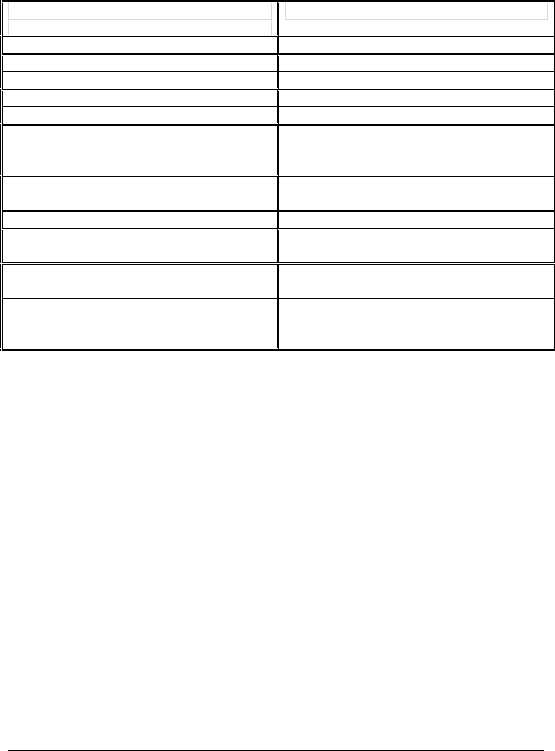
included in Table 3. This would help to ensure that the management of the Harbour
Authority is fit for purpose; with the Board members having all necessary skills,
knowledge and experience to discharge its statutory functions.
To achieve this, as well as implementing a future appointments process based on
evidence of these skills, a proper training programme should be implemented in line with
the criteria listed in Table 3. Skills and competencies of members should be
demonstrable and should be regularly reviewed. Re-appointment of members should be
on the basis of performance.
River Hamble Governance Review 2007
9S4988/R/SJV/Hayw
Final Report
- 26 -
May 2007
It is also recommended that the roles and responsibilities of the Board members are
clearly set out and that this information is made publicly available. This would clarify to
stakeholders and interested parties, amongst other things, the relationship between the
Harbour Board and Management Committee, and the relationship between the Harbour
Master and the Marine Director.
Table 3 Skills and competencies appropriate to Harbour Board members
Personal skills / competencies
Professional skills
Drive, vision, independence, confidence. Relevant and current commercial expertise.
Challenging, proactive approach to business. Relevant current maritime expertise.
Ability to motivate and gain respect. Health and safety.
Negotiating and communication. Management.
Impartiality and integrity.
Public relations / community issues.
Interpersonal - the ability to develop good
Industrial relations.
relations with and outside the Harbour
Authority.
Ability to work as a team member / supportive
Management of harbours (shipping / fishing /
colleague.
cargo handling).
Analytical approach to problem solving. Finance / management accounting.
Ability to formulate strategy. Leisure, tourism, boating management,
voluntary and commercial sectors.
Identify priorities.
Environment issues - specifically those
affecting port / conservancy.
Specific knowledge of / interest in the local
community, economic and social context within
which the Board operates.
Source: based on `Modernising Trust Ports - A Guide to Good Governance' (p.18) (DETR, 1999)
4.2 Structure of the Harbour Board
In order to ensure the fitness for purpose of the Harbour Board, and in line with the
Municipal Ports Review (paragraph 4.18) (DfT, 2006), it is recommended that it be re-
structured to consist of:
a) Eight to ten members - based on the size of the undertaking and the need to have a
representative element - of whom at least four and not more than five persons
should be appointed by the County Council.
b) The Marine Director or (in the future) Chief Executive officer (see Section 3.5)
(appointed and employed by the County Council); where the role is advisory and,
therefore, non-voting.
River Hamble Governance Review 2007
9S4988/R/SJV/Hayw
Final Report
- 27 -
May 2007

c) Of the Council appointments, ideally, two should be Councillors (of which one
should be the Chairman) while the other three should be appointed from amongst
persons having appropriate skills and experience in the management of harbours.
In an effort to further streamline the governance arrangements, this could include
the designated Safety Officer3 for the River Hamble provided that there was no
conflict with the Board member's interests in promoting the commercial interests of
the port.
d) The Chairman of the Harbour Board should be elected by the County Council.
e) The remaining 50% should be appointed, following public advertisement, by an
Appointments Board.
f) The County Council may also occasionally wish to co-opt up to 2 additional
members to the Board for individual terms of no more than twelve months, e.g. to
provide special project advice and experience.
4.3 Appointments Panel
The Appointments Panel should include the Chairman of the Harbour Board, the Head
of Hampshire County Council Human Resources (or a deputy) and at least three
stakeholder representatives. This is the structure currently in place for the River Hamble
Harbour Authority. Applicants are selected based on the Nolan procedures.
4.4 Term of Office
In line with the Municipal Ports Review (paragraph 4.19) (DfT, 2006) (and the Trust
Ports Review (DETR, 1999)), it is recommended that the initial term of all Harbour Board
members should be three years, with an option for a further two terms (i.e. up to nine
years). There should also be a system of rotation in place to ensure continuity of skills
and experience. That is, every three years a third of the Board should be re-elected.
Any period served on the Board to fill a "casual vacancy" should not count as a three
year term.
4.5 Meetings of the Harbour Board
In order to help improve the decision-making process, it is recommended that the
frequency of Harbour Board meetings is increased from six times a year to, at least, ten
times a year (matched by a reduced number of meetings of the Management
Committee; see Section 4.9 below.
3 Note that the designated Safety Officer must have direct ac cess to the Harbour Board.
Under normal circumstanc es the Harbour Master cannot also hold the post of designated
Safety Officer, as a situation may arise where the Harbour Master's duties with regard to
running a commercially successful harbour undertaking conflict with his/her functions as the
Safety Officer. However, the role of Safety Officer may be c onferred on the deputy Harbour
Master provided he/she had direct access to the Board. In order to avoid any potential
conflict, the post might be best undertaken by an employee of the Authority with direct
access to the Board.
River Hamble Governance Review 2007
9S4988/R/SJV/Hayw
Final Report
- 28 -
May 2007
4.6 Model Code of Conduct for Local Authority Members
The Model Code of Conduct for Local Authority Members (under the Local Authorities
(Model Code of Conduct) Order 2007 SI 1159), which came into force on 3 May 2007)
limits the voting rights of certain Harbour Board members and, therefore, can adversely
affect the decision-making process of the Harbour Authority. As discussed in Section
3.10.1, revisions to the Code of Conduct (DCLG, 2007) allow members with prejudicial
interests to make representations to the Council's Standards Committee (to allow
dispensations), which would enable such members to partake in discussions, but
without voting rights. The Council may wish to make representations to central
Government regarding the limitations the Code places on Board members and their
ability to conduct the business of the Harbour Authority. However, as things stand, the
Code should not dissuade the County Council from appointing additional non-
Councillors to the Harbour Board.
4.7 Training
Members of the Harbour Board currently attend training and workshop sessions in line
with the recommendations of the Municipal Ports Review (paragraph 4.21) (DfT, 2006).
Training should continue in order to ensure that members are able to competently fulfil
their roles on the Board. Training should concern matters such as port operations,
statutory and regulatory obligations and governance issues, in particular.
4.8 Memorandum of Understanding
As proposed in the Municipal Ports Review (paragraph 4.23) (DfT, 2006), ideally, a
formal Memorandum of Understanding should be established between the Harbour
Board and the County Council. This document would set out the recommended ground
rules for a framework between the Harbour Authority and the County Council. As a
minimum, the Memorandum of Understanding should cover the following topics (which
are set out in no order of importance):
· Reporting lines - this should include a clear scheme of delegation to Harbour
Authority staff for day-to-day decision-making.
· Charges and subsidies - on a yearly basis, the charges and subsidies should
be agreed between the County Council and the Harbour Authority. This
should include harbour dues and any asset rental.
· The asset base - all assets of the County Council that are part of the running
of the harbour should be listed (this has been implemented recently) and,
where possible, ownership should be passed over to the Harbour estate to
allow for proper maintenance and ownership of the harbour. These can be
buildings, infrastructure (piers, sea walls, jetties, etc.) and machinery
(computer systems, cars, boats, dredgers, etc.).
· Discrete business undertaking - the Harbour Authority should be established
as a discrete business that is self-funding with clearly defined statutory
functions (i.e. powers and duties) to improve, maintain and manage the
harbour in an efficient and economical manner.
River Hamble Governance Review 2007
9S4988/R/SJV/Hayw
Final Report
- 29 -
May 2007
· `Claw back' provisions - the MoU should set out the amount of profit required
for the Harbour Authority to be self sufficient with respect to its maintenance
and general upkeep. Once this level of profit has been reached, percentage
claw back provisions should be stated.
· Establishment of assured accounts - all monies generated by the harbour
should be assured for the running, maintenance and the future business
plans of the harbour. Assured accounts should include both reserve and
general funds.
· Business planning - aims and objectives for the next year should be clearly
set out and incorporated into the MoU and should also look forward to the
next five years.
Prior to establishing a MoU, however, it is recommended that a cost-benefit analysis is
carried out to identify the financial costs and benefits to the Harbour Authority.
4.9 Management Committee
The current constitution of the River Hamble Management Committee is in line with the
River Hamble Harbour Revision Order 1969 (as amended in 1982). However, to
increase accountability and streamline both the decision-making process and
administrative arrangements, it is recommended that Hampshire County Council
establish a Consultative Committee to replace the existing Management Committee.
This would have to be achieved through a Harbour Revision Order. Therefore, it is
recommended that, if the opportunity arises for the County Council to promote a
Harbour Revision Order (i.e. for river works etc.), the County Council should seek to
reconstitute the Management Committee as a (genuinely) Consultative Committee at the
same time. In conjunction with the reconstitution of the Harbour Board, as proposed in
Section 4.2, the existence of a Consultative Committee (rather than a Management
Committee) would be in line with the recommendations of the Municipal Ports Review
(DfT, 2006) and their promotion of a single, suitably skilled Harbour Management
Committee (HMC) to manage the Harbour Authority.
In the interim, the existing powers of the County Council could be used to establish a
Consultative Committee, which would increase accountability but would not necessarily
streamline administration. In the longer term, the Consultative Committee should not
contain Council or County Council representatives and consist only of representative
stakeholder members, such as those already on the Management Committee (i.e. the
Royal Yachting Association, Association of Hamble River Yacht Clubs, British Marine
Federation, Associated British Ports, etc.). The Chairman of this committee should, by
definition, be an experienced harbour user who may run a harbour-related business. To
this end, existing members could be replaced at the end of their term, as appropriate.
It is recommended that this Consultative Committee should meet between two and four
times a year in order to provide advice to and raise concerns with the Harbour Board.
However, the relationship between the HMC (Harbour Board) and the Consultative
Committee would need to be established through the Harbour Revision Order. In the
interim, the role of the Committee as a consultative forum (along with the role of the
Management Committee) should be clearly set out and made publicly available.
River Hamble Governance Review 2007
9S4988/R/SJV/Hayw
Final Report
- 30 -
May 2007
One of the key findings of the Municipal Ports Review (DfT, 2006) with respect to
accountability and decision-making was the perception that there is often insufficient
stakeholder engagement. Therefore, the establishment of a Consultative Committee
and the removal of the Management Committee (or the reconstitution of the existing
Management Committee as a Consultative Committee, made up of stakeholders), would
offer the opportunity for much improved stakeholder engagement, as well as
streamlining the existing administrative arrangements.
The role of the County Council in the management of the Harbour would then be wholly
fulfilled through a reconstituted and `fit for purpose' Harbour Board (the Harbour
Management Committee), with a duty to consult the Consultative Committee. It is
suggested that the County Council would not need to fulfil a scrutiny role through the
existing Management Committee with a competent Harbour Board in place, which has
been appointed in line with Government's Guide to Good Governance (DETR, 1999).
However, as Hampshire County Council is the statutory Harbour Authority, by virtue of
the River Hamble Harbour Revision Order 1969 (1970/249), democratic accountability is
required. Therefore, a scrutiny role would still need to be maintained by the County
Council's officers and it is recommended that it be passed to the HCC Policy Review
Committee process.
4.10 Stakeholder Liaison
To assist in enhancing stakeholder engagement, it is recommended that Stakeholder
Forums take place twice a year. These forums should be chaired by the Chairman of
the Harbour Board and agendas should be made publicly available at least three weeks
prior to each meeting. This will help to ensure that stakeholder representatives have
sufficient time to consult with their groups, clubs or bodies.
In order to further promote the transparency of the decision making process to
stakeholders (and provide a more open approach), it is recommended that agenda
planning for meetings of the Management Committee, as well as the Harbour Board,
should be made publicly available at least six months in advance of meetings.
4.11 Harbour Office
As part of the discrete harbour undertaking, and to maximise efficiency, it is
recommended that the Harbour Office should be staffed with the minimum number of
individuals required to fulfil its core duties and functions (e.g. compliance with the Port
Marine Safety Code (DETR, 2000)). The staff should ideally include (amongst others):
a) A Harbour Master / Chief Executive officer, thereby combining the existing
Marine Director and the Harbour Master positions in the longer term.
b) 1s t and 2n d deputy Harbour Masters, etc. (as appropriate).
c) A personal assistant to Harbour Master / administrative assistant.
In the interim, it is recommended that the roles of the Harbour Master and Marine
Director are better defined through the clear and concise allocation of responsibilities.
Furthermore, this information should be made publicly available to ensure that river
users and stakeholders are aware of how these roles relate to the statutory duties,
River Hamble Governance Review 2007
9S4988/R/SJV/Hayw
Final Report
- 31 -
May 2007
functioning and management of the Harbour Authority. The roles and responsibilities of
these posts should be reviewed regularly.
4.12 Finance
To comply with the recommendations of the Municipal Ports Review (paragraph 3.79)
(DfT, 2006), the following is recommended:
a) The Harbour Authority has `assured accounts'.
b) Any rental levy imposed on the Harbour Authority should be the subject of a
binding agreement between the Harbour Authority and the County Council.
c) The harbour undertaking should be a discrete business that is self-financing.
The feasibility of adopting a strategy for delivering a commercially viable
service for the benefit of all stakeholders, without subsidy, should be explored
by the County Council and this should be established through a Memorandum
of Understanding. Prior to this, a cost-benefit analysis should be carried out to
identify the financial costs and benefits of the Harbour Authority becoming a
discrete, self-financing business.
d) Any profit should be put back into the running / management / future business
planning of the Harbour Authority. This is currently in place.
e) Prudent and adequate provision should be made for capital asset replacement
and future development. This is currently being implemented.
f) The County Council should produce commercial accounts which help explain
the financial position of the Harbour Authority to the Board members without
local authority accountancy training.
g) A report of the annual accounts should (and currently is) made public (on the
worldwide web). This should clearly show income, expenditure and assets.
Through the implementation of such arrangements (including public accounts, business
planning and the annual review of the strategic plan) sufficient scrutiny of the Harbour
Authority and effective governance would be achieved.
River Hamble Governance Review 2007
9S4988/R/SJV/Hayw
Final Report
- 32 -
May 2007
REFERENCES
Atkins (2006). Streamlining of Coastal Consents Procedures. Final Report. Report for
Hampshire County Council. June 2006.
Department for Communities and Local Government (DCLG) (2007). Amendments to
the Model Code of Conduct for Local Authority Members. January 2007.
Department for Transport (DfT) (2006). Opportunities for Ports in Local Authority
Ownership: a Review of Municipal Ports in England and Wales. May 2006.
Department of the Environment, Transport and the Regions (DETR) (1999).
Modernising Trust Ports: A Guide to Good Governance. June 1999.
Department of the Environment, Transport and the Regions (DETR) (2000). Marine Port
Safety Code. March 2000.
Available to download from http://www.dft.gov.uk/pgr/shippingports/ports/pmsc/
Hampshire County Council (2003). Hamble Estuary Management Plan 2003-2008.
Available to download from http://www.hants.gov.uk/hambleharbour/emp.html
Hampshire County Council (2004). Future Governance of the River Hamble Harbour
Authority. Report of the Director of Environment. The River Hamble Harbour
Management Committee. 17 December 2004. Available to download from
/decisions/decisions-docs/041217-revhma-R1210160330
Hampshire County Council (2005a). Future Governance of the River Hamble Harbour
Authority. Report of the Director of Environment. Report to Cabinet. 24 January 2005.
Available to download from /decisions/decisions-docs/050124-
cabint-R0117093556
Hampshire County Council (2005b). Report of the Cabinet/Leader. Council Meeting 16
May 2005. Available to download from /decisions/decisions-
docs/050516-countc-R0509093340
Hampshire County Council (2005c). River Hamble Harbour Management Committee.
Links with River Hamble Stakeholders. Report of the Director of Environment. 29 June
2005. Available to download from /decisions/decisions-
docs/050629-revhma-R0630161052
Hampshire County Council (2005d). River Hamble Harbour Board. Links with River
Hamble Stakeholders. Report of the Director of Environment. 8 September 2005.
/decisions/decisions-docs/050908-rvhhbd-R0826111920
Hampshire County Council (2006a). River Hamble Forum - Notes of the Meeting held
at Victoria Hall, Warsash on 4 April 2006. Available to download from
/decisions/decisions-docs/060703-revhma-R0626101414
River Hamble Governance Review 2007
9S4988/R/SJV/Hayw
Final Report
- 33 -
May 2007
Hampshire County Council (2006b). River Hamble Harbour Board. River Hamble
Annual Forum - Questions and Answers. Report of the Director of Environment. 14
July 2006. Available to download from /decisions/decisions-
docs/060714-rvhhbd-R0707090828
Hampshire County Council (2006c). River Hamble Harbour Management Committee.
Report of Annual Forum Working Group. 15 November 2006. Available to download
from /decisions/decisions-docs/061115-revhma-
R1108123910
Hampshire County Council (2007a). River Hamble Harbour Authority Business Plan
2007/2008 - in draft. Available to download from
/decisions/decisions-docs/070323-rvhhbd-R0316143459
Hampshire County Council. (2007b). River Hamble Harbour Authority Strategic Plan -
in draft. Available to download from /decisions/decisions-
docs/070416-revhma-R0405173804
Harbours Act 1964 c. 40.
Local Government Act 1972.
Local Government Act 2000 Chapter 22.
Marine Enforcement Ltd (2004a). River Hamble Harbour Authority Governance in the
21st Century Discussion Paper. July 2004. Available to download from
http://www.marineenforcement.co.uk/docs/hamble_governance/Governance_report.pdf
Marine Enforcement Ltd (2004b). River Hamble Harbour Authority Governance in the
21st Century Questionnaire. Available to download from
http://www.marineenforcement.co.uk/docs/hamble_governance/Questionnaire.pdf
Solent Forum (2002). Marine Consents Guide - Edition 1.
Southampton Harbour Act 1949 12 & 13 Geo. 6.
The Local Authorities (Model Code of Conduct) (England) Order 2001. Statutory
Instrument 2001 No. 3575.
The Local Authorities (Model Code of Conduct) (England) Order 2007. Statutory
Instrument 2007 No. 1159.
The River Hamble Harbour Revision Order 1969. Statutory Instrument 1970 No. 249.
The River Hamble Harbour Revision Order 1982. Statutory Instrument 1982 No. 1370.
The River Hamble Harbour Revision Order 1989. Statutory Instrument 1989 No. 2422.
River Hamble Governance Review 2007
9S4988/R/SJV/Hayw
Final Report
- 34 -
May 2007
APPENDIX A
RIVER H AMBLE HARBOUR AUTHORITY GOVERNANCE REVIEW 2007
CONSULTATION QUESTIONNAIRE
River Hamble Governance Review 2007
9S4988/R/SJV/Hayw
Final Report
May 2007




 River Hamble Harbour Authority Governance Review 2007
Consultation Exercise
Background
The County Council is currently undertaking a review of the current
arrangements for governance of the River Hamble Harbour
Authority. To this end it has appointed Royal Haskoning, an
independent firm of consultants, to carry out the review. This
includes a consultation exercise, the purpose of which is to take
account the views of key stakeholders and interested parties, as
well as members of the Harbour Board, the Management
Committee and the Harbour Office Staff.
Your views
The consultation process will, in part, help to establish whether the
objectives set out for changes to the governance arrangements for
the River Hamble Harbour Authority and put in place by the County
Council in May 2005 have been met, are effective and are fit for
purpose within the context of the Municipal Ports Review.
The Next Stages
Comments received will be collated and will form an important part
of Royal H askoning's assessment of the Harbour Authority's
governance arrangements. The output of this process is intended
to guide any recommendations for improvement.
Further information
If you require further information regarding this consultation
exercise or have any queries about the questionnaire, please
contact the Project Manger at the following address:
Dr Samantha Vize
Royal Haskoning
Burns House
Harlands Road
Haywards Heath
RH16 1PG
Telephone: 01444-476634
e-mail: [email protected]

 River Hamble Harbour Authority Governance Review 2007
Consultation Exercise
Name:
Address:
Please tick the appropriate box:
Member of Harbour Board
Member of Management Committee
Harbour Authority Staff
Other Please state:......................................
Are you, or have you been, a member of a Yacht or Sailing Club, or any other
Association or user group on the River Hamble?
Yes No
If yes, which one:
Are you a boat owner?
Yes No
The Harbour Board is a mixture of elected Councillors (3 including the Chairman), the
County Council's Marine Director and experts (3) selected for their relevant marine
industry, recreational sailing skills and environmental knowledge. Do you think this
structure / constitution is appropriate when taking into account the range of duties and
responsibilities faced by the Harbour Board?
Yes No
If not, why not?
 River Hamble Harbour Authority Governance Review 2007
Consultation Exercise
The Chairman and Marine Director are appointed by the County Council. Appointment
of the 5 remaining Harbour Board Members (2 from the County Council and the 3 co-
opted Members) is undertaken by the County Council on the recommendation of an
Appointments Panel established by the County Council, chaired by the Chairman of the
Board. Are you satisfied with the appointments process for Harbour Board Members?
Yes No
If not, why not?
The Harbour Authority Appointments Panel includes the Chairman of the Harbour Board
and representatives of: the Royal Yachting Association, the British Marine Federation,
Natural England and Hampshire County Council (Human Resources). Do you think this
structure is appropriate?
Yes No
If not, why not?
The term of office of the Chairman of the Harbour Board is the period between
appointment and the first full meeting of the County Council and the next County Council
Elections. The initial term of office of the two Councillors (excluding the Chairman) will
be six years and four years (subject in each case to the Members continuing to hold
office as a County Councillor for that period). Co-opted members shall remain for six
years (recreational sailing/marine industry skilled) and four years (environment). After
the initial term of office has expired, all appointments for co-opted members made shall
be for a period of four years.
Are you satisfied with the tenure protocol of the Members?
Yes No
If not, why not?
Succession of the Harbour Board Members (3 Councillors and Marine Director) is by
appointment by the County Council, and the 3 independent members is appointment by
advertisement of posts with applicants selected adopting Nolan procedures (i.e. all
appointments to be based on the following seven principles: Ministerial responsibility;
 River Hamble Harbour Authority Governance Review 2007
Consultation Exercise
Merit; Independent scrutiny; Equal opportunities; Probity; Openness and transparency;
Proportionality. Are you satisfied with the succession planning process?
Yes No
If not, why not?
The Harbour Board normally meets once in every two months? Do you think this is
appropriate?
Yes No
If not, should meetings be more frequent or less frequent?
Have you attended any Harbour Board meetings?
Yes No
Do you feel that the Board Members act solely in the interests of the River Hamble
Harbour Authority?
Yes No
The following bodies are each entitled to appoint one member to the River Hamble
Management Committee: Associated British Ports; the Royal Yachting Association, the
Association of River Hamble Yacht Clubs; the British Marine Federation ; the river
Hamble Boatyard and Marine Operators' Association; Fareham Borough Council;
Eastleigh Borough Council; and Winchester City Council. The Committee includes at
least nine Members appointed by the County Council, so that a majority of the members
of the Committee are Council members. The Chairman is appointed by the County
Council. No member of the Harbour Board can also serve as a member of the
Committee. Do you think this structure / constitution is appropriate?
Yes No
If not, why not?
Are you satisfied with the appointments process for the Management Committee?
Yes No
If not, why not?
 River Hamble Harbour Authority Governance Review 2007
Consultation Exercise
All non-County Council Committee Members are appointments for a period of four
years. There is no bar on re-appointment at the end of that period. All County Council
Members, including the Chairman, hold appointments for the period until the first County
Council meeting after the next County Council elections. Are you satisfied with the
tenure protocol for Management Committee Members?
Yes No
If not, why not?
The Management Committee normally meets quarterly, subject to there being sufficient
business. Is this:
Too frequent Sufficient Too infrequent
Why?
Have you attended any Management Committee Meetings?
Yes No
The function of the Hamble Harbour Management Committee is to advise the River
Hamble Harbour Board on the discharge of its powers, functions and obligations in a
scrutiny and advisory role. Do you think this how the Management Committee currently
functions?
Yes No
If no, why?
Are you familiar with the roles and responsibilities of the Harbour Board and the
Management Committee?
Yes No
Do you think that they are appropriate?
Yes No
 River Hamble Harbour Authority Governance Review 2007
Consultation Exercise
Is the Harbour Board sufficiently accountable?
Yes No
If no, why?
Question for Harbour Board and Management Committee only
Are you satisfied with the working arrangements that exist between the Harbour Board
and the Management Committee?
Yes No
Question to Harbour Office Staff and the delegators
Does a clear scheme of delegation exist, with respect to day-to-day decision making, for
Harbour Authority Staff?
Yes No
If no, why?
Question to the Harbour Board and Management Committee
Does a clear scheme of delegation exist from the County Council to the Harbour Board
and Management Committee?
Yes No
 River Hamble Harbour Authority Governance Review 2007
Consultation Exercise
Do you agree that there should be a River Hamble Forum allowing river stakeholders
and interested parties the opportunity to voice concerns?
Yes No
Do you feel that the arrangements for participation by stakeholders and the exchange of
views are adequate?
Yes No
If not, why not?
How frequently do you think the Forum meetings should be held:
Annual Bi-Annual Quarterly
Have you attended any Annual Forums?
Yes No
Do you feel that it should be compulsory for the Harbour Board and Management
Committee attend the Annual Forum?
Yes No
Do you think that the interests of the River Hamble users are sufficiently represented
under the current Governance arrangements?
Yes No
If not, why not?
The Harbour Authority raises its revenue from harbour dues paid by River Hamble boat
users. Are you happy with this arrangement?
Yes No
If not, how do you think the income should be raised?
 River Hamble Harbour Authority Governance Review 2007
Consultation Exercise
Are harbour dues set at a reasonable level?
Yes No
Do you think anyone should be exempt from the harbour dues or should others
contribute?
Yes No
If yes, who?
The County Council charges the Harbour Authority a nominal fee (£35,000 in 2006) for
providing accommodation (including the Harbour Masters Office) and administrative
support (legal advice, insurance cover, personnel administration, secretarial support,
ITC support). Do you feel that this is appropriate?
Yes No
Is good commercial business planning in place?
Yes No
If no, what could be improved?
A key objective of the changes made in 2005 was to modernise the governance
arrangements of the Harbour Authority, making it accountable, open and fit for purpose.
Has this been achieved?
Another objective was to create a Harbour Board to streamline the administrative
arrangements, and ensure a good decision making process (i.e. ensure that before
making decisions those who need to be consulted are consulted). Has this been
achieved?
APPENDIX B
CONSULTEES, KEY STAKEHOLDERS AND INTERESTED PARTIES
River Hamble Governance Review 2007
9S4988/R/SJV/Hayw
Final Report
May 2007

Table of consultees, key stakeholders and interested parties
Category Organisation
Contact
Group A - Structured Meetings -
Harbour Board Members
A Hampshire County Council
Cllr. John V. Bryant (Chairman)
A Hampshire County Council
Cllr. Keith Evans
A Eastleigh Borough Council
Cllr. Keith House
A Independent (recreati onal boati ng) Tony Lovell
River Hamble Boatyard and Mari na Operators
Mr Chris Moody (Independent -marine
Assoc
industry)
A
A Independent (environment)
Dr Susie Tomson
A Harbour Master's Office
David Evans - Marine Director
Management Comm ittee
A Hampshire County Council
Cllr. Ray Ellis (Chairman)
A Fareham Borough Council
Clr. Sean Woodwood
A Hampshire County Council
C llr. Charlotte Bailey
A Hampshire County Council
Cllr. Adrian Evans
A Hampshire County Council
Cllr. Derek Blampied
A Hampshire County Council
Cllr. Glynn W. Davies-Dear
A Hampshire County Council
Cllr. Geoffrey Hockley
A Hampshire County Council
Cllr. Roger H Price
A Hampshire County Council
Cllr. Alan W. Rice
A Eastleigh Borough Council
Cllr. Bill Pepper
A Fareham Borough Council
Cllr. Trevor Cartwright
A Winchester City Council
Cllr. Cecily Sutton
A Royal Yachting Association
Mr Don Alexander
A Association of Hamble Ri ver Yacht Clubs John Greensmith (Honarary Secretary)
A British Marine Federation
Mr Sam Bourne
A Associated British Ports
Capt. Phillip Holliday/ Steven Young
Hamble River Boatyard and Mari ne Operator's
A
Assoc.
Mr Rupert Bossier
Others
Cpt. Mark Capon (River Hamble Safety
A Marine Enforcement Ltd
Advisor)
A River Hamble Harbour Authority Tony Clatworthy (Harbour Master)
A River Hamble Harbour Authority Andy Melhuish (Ass. Harbour Master)
A River Hamble Harbour Authority Jamie Williams
A River Hamble Harbour Authority Richard Lawton (Ass. Harbour Master)
A River Hamble Harbour Authority Ray Williams (Ass. Harbour Master)
A River Hamble Harbour Authority Wendy Stowe (Ass. Harbour Master)
A River Hamble Harbour Authority Elaine Brownlie (Admin. Assistant)
Group B - Structured Telephone Interviews -
B River Hamble Mooring Holders Association Mr Peter Middleton (Chairman)
B River Hamble Mooring Holders Association Reverend P. Crick
B River Hamble Berth Hol ders Association Mr Colin Harvey (Chairman)
B The Hamble Estuary Partnership Dr Steve Fletcher (Chairman)
B The Trust Ports Steering Group Peter Nicholson (Chairman)
B Curdridge Parish Council
Cllr. R. A. Wright
River Hamble Governance Review 2007
9S4988/R/SJV/Hayw
Final Report
May 2007

Category Organisation
Contact
B Bursledon Parish Council
Cllr. H. Millar
B Botley Parish Council
Mrs Jane Morgan (Parish Clerk)
B Hamble Parish Council
Mr Ian Underdown (Chairman)
B Gosport Borough Council
Cllr. Dennis Wright
B Upper Hamble Canoe Club
K Thomas
Group C - Contact by Letter -
C Royal Southern Yacht Club
Mrs Annette Newton (Commodore)
C RAF Yacht Club
Terry Saunderson (Commodore)
C Hamble River Sailing Club
Mrs Peggy Dorothy (Commodore)
C Warsash Sailing Club
Mr David Wightman (Commodore)
C Warsash Residents Association Mr Kenneth Prangnell (Chairman)
C Natural England
Tony Cosgrove
C Crown Estate
Mr Neil Jacobson
River Hamble Governance Review 2007
9S4988/R/SJV/Hayw
Final Report
May 2007
APPENDIX C
SUMMARY REPORT OF CONSULTATION EXERCISE
River Hamble Governance Review 2007
9S4988/R/SJV/Hayw
Final Report
May 2007


 River Hamble Harbour Authority Governance Review 2007
Consultation Exercise
River Hamble Harbour Authority Governance Review 2007
Questionnaire Responses
Total number of responses: 41
Member of Harbour Board: 17%
Member of Management Committee: 37%
Harbour Authority Staff: 9%
Other: 37%
1. Are you, or have you been, a member of a Yacht or Sailing Club, or any other Association
or user group on the River Hamble?
Yes 63% No 37%
Hamble Estuary Partnership
Chairman of Marine Operators Association
Warsash Sailing Club (5)
RYA member (3)
Southern Region Council
Royal Southern Yacht Club (8)
Member of Hampshire and Isle of Wight Wildlife Trust
Marine Conservation member
Upper Hamble Canoe and Dinghy club
IBM Sailing Club
River Hamble Boatyard and Marine Operators Association (2)
Association of River Hamble Yacht Club (Chairman)
River Hamble Berth Holders Association (Chairman)
Solent Racing and Cruising Asociation
River Hamble Mooring Holders Association (2)
 River Hamble Harbour Authority Governance Review 2007
Consultation Exercise
Hamble River Sailing Club
2. Are you a boat owner?
Yes 59% No 41%
3. The Harbour Board is a mixture of elected Councillors (3 including the Chairman), the
County Council's Marine Director and experts (3) selected for their relevant marine
industry, recreational sailing skills and environmental knowledge. Do you think this
structure / constitution is appropriate when taking into account the range of duties and
responsibilities faced by the Harbour Board?
Yes 71% No 29%
Comments from yes answers:-
- Harbour Board is an improvement to previous arrangements.
- Harbour Board seems a good representative body.
- There are enough experts to make decisions.
- Councillors have valuable input i.e. community background into process and decisions.
- Board discussions have shown good knowledge. No fear of expressing contrary views.
- Structure adequate provided there is sufficient knowledge of river amongst council lors.
- Councillors ideally need to be river users.
- There is a broad range of opinions from County Councillors on both sides of river. Marine Director input is
very worthwhile. Environment expert is valuable member.
- Combined knowledge of 3 experts works well.
- People selected must be chosen with great care for their skills and should not include interested parties.
- Board sometimes does not recognise they are one of a number of stakeholders and they have other
issues to take on board. Maybe board should include someone to look at wider aspects of river.
Comments from no answers:-
- 3 elected County Councillors are not interested in sailing; creating credibility issue.
- Councillors are not qualified to sit on Harbour Board and do not possess technical skills.
- Historically there have been unsuitable Councillors.
- It is hit or miss whether Councillor is suitable.
- Appears easily manipulated by Harbour Staff.
- Too much power gi ven to commercial voice.
- Slightly unwieldy. Difficult because Harbour Board has to try and please everyone.
- Need representative of small sailing communi ty and small boat owners.
- Board should be larger and be properly accountable. Should have a clear majority of elected members.
- The harbour should be a Trust Port and have independently elected trustees.
- The structure does not contain representative of river users and it is run by elected councillors and non-
elected officials of Hampshire County Council.
- Councillors do not seem to have relevant skills.
- Structure is too politically influenced and the contribution of the experts is restricted by the `code of
conduct'.
- County councillors lack local knowledge about the river.
- Creates political control and experience of some members is inadequate.
- There should be someone who is capable of covering the duties of the designated safety officer.
- It does not meet requirements of River or strictly the requirements of Municipal Ports Review in that 50%
should be county councillors (section 4.18)
- Board is too small and parish councillors are barred from involvement.
 River Hamble Harbour Authority Governance Review 2007
Consultation Exercise
4. The Chairman and Marine Director are appointed by the County Council. Appointment of
the 5 remaining Harbour Board Members (2 from the County Council and the 3 co-opted
Members) is undertaken by the County Council on the recommendation of an
Appointments Panel established by the County Council, chaired by the Chairman of the
Board. Are you satisfied with the appointments process for Harbour Board Members?
Yes 71% No 29%
Comments from yes answers:-
- Works well within constraints that are there.
- Good balance of representatives (industry, sailing, environmental). Good cross section of private and
business use.
- Anyone interested can apply.
- They are only volunteers, so as good as it can be unless more experts are attracted.
- Would like to check that 3 experts have required breadth of experience.
Comments from no answers:-
- Appointments panel requires representative from local community (Parish Council).
- Selection process for 3 Councill ors is less than transparent and confusion exists amongst public.
- The selection process is bent.
- Not enough expertise on Appointments Panel or in County Council. No background in sailing.
- Too County Council dominated.
- There are no clear skills in appointments panel and it is hard to define how these people are appointed.
- Having looked at Muni cipal Ports and Trust Ports Revi ew, independent members without vested interest
should be appointed. This has not happened.
- The political considerations are too powerful and the current appointments process can not produce a
Harbour Board that can run a business like the River Hamble.
- The Harbour Board is like a sub-committee of Hampshire County Council and not sufficiently
independent.
- The process would work if it was carried out correctly but currently it isn't, specifically in relation to
Councillor Evans.
5. The Harbour Authority Appointments Panel includes the Chairman of the Harbour Board
and representatives of: the Royal Yachting Association, the British Marine Federation,
Natural England and Hampshire County Council (Human Resources). Do you think this
structure is appropriate?
Yes 81% No 17% No answer 2%
 River Hamble Harbour Authority Governance Review 2007
Consultation Exercise
Comments from yes answers:-
- But would like it broadened to incorporate the local community.
- Appointments Panel should be set up for Council members as well.
- Very appropriate.
- Very good choice of panellists with right balance of people.
- It has roughly the right mix to do the appointing.
Comments from no answers:-
- Needs a representative of small boat owners.
- Boatyard and Marine Operators are not adequately represented.
- The commercial interests of the river are also not represented enough.
- Stakeholder and grassroot representation is not sufficient.
- Seems unusually static. Maybe should have rotation with members of Harbour Board.
Other responses:-
- The fundamental structure of Harbour Board is open to question as it is politically oriented. The
Appointments Panel structure seems to reinforce the control whilst giving the appearance of giving careful
consideration to choice of candidacy.
6. The term of office of the Chairman of the Harbour Board is the period between
appointment and the first full meeting of the County Council and the next County Council
Elections. The initial term of office of the two Councillors (excluding the Chairman) will be
six years and four years (subject in each case to the Members continuing to hold office as
a County Councillor for that period). Co-opted members shall remain for six years
(recreational sailing/marine industry skilled) and four years (environment). After the initial
term of office has expired, all appointments for co-opted members made shall be for a
period of four years.
Are you satisfied with the tenure protocol of the Members?
Yes 81% No 17% Yes and No 2%
 River Hamble Harbour Authority Governance Review 2007
Consultation Exercise
Comments from yes answers:-
- Anything less would not serve purpose - it takes time to know how things work.
- Gives continuity.
- There are often 2 members being replaced at same time which creates problems.
- There is little opportunity for succession planning for County Council lors.
- Yes, but Councillors cannot be relied upon to be present after elections.
- New person can get the job if it is not being done properly.
- Set up so that not everyone leaves at the same time - makes sense.
- Has to be at least 4 years because it takes time to get into subject matter.
- Too much change brings instability, so 4 years about right.
- More stable relationship with environmentalist is required.
- Important to have continuity.
- Allows fresh blood but also for expertise to build up.
- Should be 4 years to run inline with elections.
- But problem arises with elections.
- But here should be accountability procedures if members are not performing.
Comments from no answers:-
- A little too long - no problem with re-electing but 6 years is a long time. More regular elections are
required.
- Needs to be a shorter period because it is unclear how long County Councillors will stay in office. 6 years
is a little excessive.
- Should be 4 years across the board.
- Periods of tenure are too long.
7. Succession of the Harbour Board Members (3 Councillors and Marine Director) is by
appointment by the County Council, and the 3 independent members is appointment by
advertisement of posts with applicants selected adopting Nolan procedures (i.e. all
appointments to be based on the following seven principles: Ministerial responsibility;
Merit; Independent scrutiny; Equal opportunities; Probity; Openness and transparency;
Proportionality. Are you satisfied with the succession planning process?
Yes 83% No 15% No comment 2%
Comments from yes answers:-
- But Councillors should be appointed by panel as well because County Council only provides a limited
number of options.
- Works reasonably well.
- Beari ng in mind the Nolan principles are applied.
 River Hamble Harbour Authority Governance Review 2007
Consultation Exercise
Comments from no answers:-
- Need more local involvement. Too County Council dominated.
- There is no effective succession planning process in the County Council.
- The Nolan procedure is irrelevant in terms of getting the correct person - must have a goof field of
applicants.
- Suitable candidates should be sought and selected not elected.
- This is a smal l specialist governing body and the members should have knowledge, experience and
ability to do the job.
- Marine Director and Harbour Masters roles should be combined (eg Lymington Harbour).
- Trust Port Review (paragraph 98) states that there should be clear grooming of a successor for Harbour
Board chairman. Currently there is no clear planning for succession.
Other comments:-
- As long as the Nolan principles are applied there should be no problem.
- The problem with the el ection of the 3 County Councillors is that they should be responsible for managing
the harbour and must therefore be knowledgeable.
8. The Harbour Board normally meets once in every two months? Do you think this is
appropriate?
Yes 86% No 10% No Answer 2% No comment 2%
Comments from yes answers:-
- They seem to get through the business.
- Harbour Board should be allowed to meet in private even though decisions must be made in public.
- No more regularly is necessary but if it were less frequent it would be too long before decisions are
made.
- But, they meet frequently out of season and infrequently in season. There is a long gap between June
and September. It should be every 2 months regardless of season.
- Occasionally should meet when issue arises.
- Sufficient number of meetings, but should be in line with Management Committee meetings.
- Meetings are expensive due to legal/financial and administrative support required. More meetings = more
expense.
- Important that Harbour Board meet in private.
- Vital to be open to publ ic - no closed meetings except for commercially sensitive information.
- It is volunteer work so meetings should not be any more frequent due to attendance issues.
 River Hamble Harbour Authority Governance Review 2007
Consultation Exercise
Comments from no answers:-
- More frequent (once/month) and in private.
- Some commercially sensitive issues that public should not be aware off.
- There should be no closed meetings
- Should be quarterly, in line with Management Committee meetings.
- Reduce to 5 meetings/year and bring inline with Management Committee meetings.
9. Have you attended any Harbour Board meetings?
Yes 59% No 41%
10. Do you feel that the Board Members act solely in the interests of the River Hamble
Harbour Authority?
Yes 56% No 29% No Answer 5% No comment 10%
Comments from yes answers:-
- But they seem to ignore the interests of small user groups such as kayaks and small boat owners.
- They act in the best interests most of the time.
- Apart from some people who have personal agendas.
- The Board members views are important and that is why they are selected.
- Board members are aware of their duties.
- Overall they do but it is difficult because of constraints of the Model Code of Conduct.
- Although not in the interests of the wi der aspects of the river.
Comments from no answers:-
- Eastleigh Borough Council rep. does not always turn up when vote looks likely.
- Difficult to act solely in interests of Hamble when on Borough Council because they are representing their
constituency.
- Politics is interfering with best interests of river.
- Councillors need to be made aware that they must act in best interests of Hamble.
- Too many hidden agendas.
- Should be acting in interests of all river users not just the harbour authority.
- Because the Board is small there is a tendency to act in the interest of commercial aspects.
- Most of the Board are County Councillors and don't know what the river is about.
- Some members have a vested interest.
- There is a problem with the remit that the Harbour Authority has as the Harbour Board is a sub-
commi ttee of the County Council.
- Paragraph 1.15 of Trust Port Review suggests that the Harbour Board should not be acting solely in the
interest of Harbour Authority but in the interests of all river users.
- Job description of Marine Director includes economic development but there is a lack of clarity to his role
and his job might not be in the best interests of the ri ver.
 River Hamble Harbour Authority Governance Review 2007
Consultation Exercise
11. The following bodies are each entitled to appoint one member to the River Hamble
Management Committee: Associated British Ports; the Royal Yachting Association, the
Association of River Hamble Yacht Clubs; the British Marine Federation ; the river Hamble
Boatyard and Marine Operators' Association; Fareham Borough Council; Eastleigh
Borough Council; and Winchester City Council. The Committee includes at least nine
Members appointed by the County Council, so that a majority of the members of the
Committee are Members of the County Council. The Chairman is appointed by the County
Council. No member of the Harbour Board can also serve as a member of the Committee.
Do you think this structure / constitution is appropriate?
Yes 49% No 51%
Comments from yes answers:-
- Yes but needs updating because it is not a comprehensive list of stakeholders.
- Possibly not enough just to consult with Management Committee.
- Probl em is the structure inherited from legislation.
- Some problems with lack of expertise e.g. moorings capacity decision needed knowledge of Habitats
Directive.
- Stakeholders sufficiently represented and balance correct.
- Creates detachment from Board - which is good.
- But important to have commitment so that people turn up to meetings.
- Councillors must have interest in the river.
- Probl em with title `Management Committee'. They see themselves as `managers' whereas they should be
scrutinising the decisions of the Board. Maybe a change to `Scrutiny/Advisory Committee' might be more
suited.
- It is up to the Management Committee how they organise themselves.
- Parish Councils are not needed on the committee.
 River Hamble Harbour Authority Governance Review 2007
Consultation Exercise
Comments from no answers:-
- Too cumbersome with too many County Councillors with no understanding of river.
- Should be Mooring Holders Association representative.
- Reports from Management Committee take too long.
- Difficult to coordinate Management Committee.
- Should involve local parishes.
- Given that it is scrutinising body, needs to include small stakeholders.
- Representatives often look after the interests of their own club/group.
- Representative of `River users' is required.
- Needs more environmental expertise.
- No representative of Crown Estates.
- Could exclude ABP and Winchester CC.
- Councillors have limited knowledge/expertise.
- They vote in accordance with how their party wants them to vote.
- Independent mooring holders should be represented.
- 5 bodies representing commercial/sailing interests seems unfair.
- There should be a representative of Botley Parish council .
- Councillors may not be aware of local issues.
- RYA representative biased towards their own interests.
- Would be greater val ue in getting rid of Management Committee and expanding Harbour Board.
- There is confusion caused by having 2 groups and it is inefficient.
- There is no direct representation of boat using individuals on the river or of the Association of River
Hamble Berth and Mooring holders.
- Too much political process and control. Should the Management Committee have political domination in
an advisory role?
- Advisory committee should be primarily a Stakeholder representative body.
- The size of the Management Committee is a concern as is its relationship with the Harbour Board.
- The majority have no knowledge of river and letters to the Management Committee frequently go
unanswered.
- Need a greater degree of marine and River Hamble experience.
- This structure used to be suitable but it is dated now.
12. Are you satisfied with the appointments process for the Management Committee?
Yes 61% No 27% Yes and no 2%
No Answer 10%
Comments from yes answers:-
- Happy with 4 independents.
- It is up to the Management Committee to appoint their representative. Should a limit be put on how long
someone can serve?
- It is the consti tution so it can't be done any differently.
- Some members are in favour of Trust Port therefore should they be on the Management Committee?
- Anyone with a stakeholder interest in River can sit on the committee.
 River Hamble Harbour Authority Governance Review 2007
Consultation Exercise
Comments from no answers:-
- County Councillors appointed by Council so it is not clear who they are - too much continuity.
- Fresh blood is needed.
- Independent mooring holders should be represented.
- Councillors can come under severe pressure from local interests. A broader more independent panel of
knowledge would be useful.
- More local representation required.
- Not happy with statutory designation of who can be represented on the Management Committee.
- Not enough freedom to find the best people for the job.
Other Comments:-
- Not aware that there is any appointments process.
- Never aware of any competition for posi tions and there is no real structure to election of Management
Committee.
13. All non-County Council Committee Members are appointments for a period of four years.
There is no bar on re-appointment at the end of that period. All County Council Members,
including the Chairman, hold appointments for the period until the first County Council
meeting after the next County Council elections. Are you satisfied with the tenure protocol
for Management Committee Members?
Yes 83% No 15% No Answer 2%
Comments from yes answers:-
- Bodies would change their appointment if the job was not being done and members can be changed with
little disruption.
- Reappointments can bring complacency. Okay, as long as balance between old and new people is kept.
- 4 years is ok. There is a turnover but it is because of County Councillors changing.
- Provided there is sufficient continuity from County Council Committee members.
- Perhaps people should sit for 4 years then half of the members leave and half reapply.
Comments from no answers:-
- There needs to be a turnover of non-County Council members with maximum term of 8 or 6 years to help
stagger it. Ideally 4 years and subsequent 2 years.
- There doesn't seem to be a sensible continuity in tenure because of the County Councillors on
Management Committee.
- There is nothing in HRO that gives tenure length therefore it is currently wrong. Paragraph 4.19 of
Municipal Ports Review says tenure should be 3 years. There should be a period of appointment and it
should be coupled with a skill requirement.
- Current regime inappropriate due to model code of conduct excluding people with expert knowledge.
 River Hamble Harbour Authority Governance Review 2007
Consultation Exercise
14. The Management Committee normally meets quarterly, subject to there being sufficient
business. Is this:
Too frequent 7%
Sufficient 59%
Too infrequent 20%
No Answer 12%
It is up to the Management Committee to decide 2%
Comments:-
- Should meet pri or to the Harbour Board meetings.
- Once or twice a year is sufficient - or else it might not achieve much.
- Management Committee should meet 2 weeks before Harbour Board.
- Needs to be in line with Harbour Board.
- Meeting quarterly gives a better idea of the effects of consultation.
- Meetings shoul d be more regular because currently they are too long so some items are rushed.
Should be flexible as to when meetings are held.
- Hard to coordinate meetings so shouldn't be any more regular.
- Needs to be a month or 6 weeks before board meeting.
- Should be inline with Harbour Board meetings, with sufficient time between them for administration
matters to be completed.
- Whatever the frequency it should mirror the board meetings.
- The Management Committee is doing the work of the Harbour Board. Both bodies have to be in
agreement of most matters and this is cumbersome. Management Committee should meet twice/year.
15. Have you attended any Management Committee Meetings?
Yes 78% No 22%
 River Hamble Harbour Authority Governance Review 2007
Consultation Exercise
16. The function of the Hamble Harbour Management Committee is to advise the River
Hamble Harbour Board on the discharge of its powers, functions and obligations in a
scrutiny and advisory role. Do you think this is how the Management Committee currently
functions?
Yes 68% No 20% No Answer 10% No comment 2%
Comments from yes answers:-
- They act well as a scrutinising body.
- Sometimes Management Committee need Council or consultant support.
- Management Committee does not have expertise sometimes to write reports.
-Some issues are too detailed for Management Committee so they delay making a decision.
- Harbour Board has made decisions based on advice from Management Committee but then member of
Management Committee made complaint about the decision. Do representatives look after their own
interests?
- Can be a lengthy process.
- Current Chairman allows difference between Harbour Board and Management Committee to be
expressed.
- Slight improvement in last year.
- But it also fulfils a wider role in stakeholder function. Management Commi ttee must recognise that it has
no management function and their role is only to advise the Harbour Board and relay the views and
opinions of the stakeholders to the Harbour Board.
- There are times when the Management Committee tend to stray into that they consider to be
management and this is in-part down to the title of the group.
- There was slight resentment at having the Harbour Board above them, when often they came up with the
same decisions, but it now runs smoothly.
- But it is not necessarily taken notice of.
Comments from no answers:-
- They appear to push the agenda. Harbour Board should set agenda and Management Committee
scrutinise how the Harbour Board appl ies the policy.
- Management Committee has too much power and is not representing views of constituents.
- By making recommendations they are influencing Harbour Board.
- Advice should be more policy advice and scrutiny should be how policy is being applied.
- River users would feel it more democratic to have non-County Council representative as Chairman.
- Sometimes they are constrained politically. User groups manipulate members to get their views across.
- Small user groups have too much influence.
- Because of `Code of conduct' experts are excluded so Management Committee does not function in this
way.
- Management Committee see themselves as managers.
- It is not structured correctly to do this role and decisions taken by Harbour Board without any reference to
Management Committee.
- Scrutiny does not come into the Harbour Revi sions Order and there has not been a scrutiny report for 2
years.
- Mooring holders have written twice to Management Committee on harbour dues and never received a
reply.
Other comments:-
- Present functioning appears confused from an outsiders point of view.
 River Hamble Harbour Authority Governance Review 2007
Consultation Exercise
17. Are you familiar with the roles and responsibilities of the Harbour Board and the
Management Committee?
Yes 90% No 5% No Answer 5%
Do you think that they are appropriate?
Yes 69% No 22% No Answer 7% No Comment 2%
Comments from no answers:-
- There is confusion over thei r function.
- Two groups are duplicating each other.
- Needs modernising.
Is the Harbour Board sufficiently accountable?
Yes 61% No 22% No Answer 15% Other 2%
Comments:-
-50% of Harbour Board doesn't have accountability to anyone. Need to increase number of accountable
members.
- A Trust Port would be more accountable and more open than the current system.
- They are not accountable to anyone except who pays.
- Lack of public participation and parish council representation.
- It is not sufficiently accountable to river stakeholders.
- They can ignore the advice of the Management Committee without appeal or recourse.
- Management Committee with hold advice and do not scrutinise.
18. Question for Harbour Board and Management Committee only
Are you satisfied with the working arrangements that exist between the Harbour Board and
the Management Committee?
Yes 71% No 25% No Comment 4%
Comments from yes answers:-
- Although Harbour Board sometimes ignore advice from Management Committee.
- But easier if meetings coincided more and it's hard to keep track if Management Committee have seen a
certain report.
- Chairman of Harbour Board regularly attends Management Committee meetings.
- They have a good relationship, easy to discuss problems.
- The two groups move in the same direction when problems arise.
 River Hamble Harbour Authority Governance Review 2007
Consultation Exercise
Comments from no answers:-
- They are disharmonious and the Harbour Board seem to disregard the recommendations of the
Management Committee
- People complain regularly so there must be something wrong.
- Management Committee does not have a secretariat and have no budget for working groups - leads to
problems.
- Management Committee could be more proactive.
19. Question to Harbour Office Staff and the delegators
Does a clear scheme of delegation exist, with respect to day-to-day decision making, for
Harbour Authority Staff?
Yes 75% No 25%
Comments from no answers:-
- But it is currently being formulated in `Scheme of Delegation - Works Consents Decisions'
- It is in process at the moment, although it's difficult to reach the bottom of the chain.
20. Question to the Harbour Board and Management Committee
Does a clear scheme of delegation exist from the County Council to the Harbour Board
and Management Committee?
Yes 83% No 13% No answer 4%
Comments from yes answers:-
- The Harbour Board makes decisions on behalf of County Council. Nothing delegated to Management
Committee because not decision making group.
- County Council are a support role and have not constrained decisions.
- Used to be secretive but is more transparent now. Voices are heard and changes are made.
- County Council is statutory body and delegation is clear.
- Clear delegation to the Harbour Board but not Management Committee. The Management Committee
has no power to have delegated to it.
- Good liaison exists.
- Beginning to get better. At first people were unaware of lines of responsibilities.
Comments from no answers:-
-The County Council shouldn't be delegating anything to the Management Committee.
- The current si tuation is not agreeable because it is neither a Municipal or a Trust Port.
 River Hamble Harbour Authority Governance Review 2007
Consultation Exercise
21. Do you agree that there should be a River Hamble Forum allowing river stakeholders and
interested parties the opportunity to voice concerns?
Yes 98% No No comment 2%
22. Do you feel that the arrangements for participation by stakeholders and the exchange of
views are adequate?
Yes 56% No 42% No Answer 2%
Comments from yes answers:-
- Although a little too formal. Writing questions and then waiting for a reply is unsatisfactory.
- Stakeholders can express views at any time.
- Difficult to manage because people have `axes to grind'. Got to be democratic, some people might feel
ignored but at least they have been listened to.
- Meetings are well supported with good questions.
- Stakeholders can express views at any time. `Open door' policy.
- Open questions at Annual Forum is a good thing but it needs to be controlled.
- There are opportunities for stakeholders to meet Management Committee members outside of the
forum.
Comments from no answers:-
- Lack of representation of small boat owners.
- An advisory committee is needed. There used to be one but it was shut down because it was deemed
a nuisance.
- There should be but there isn't working. People feel that they haven't been consulted.
- If it were more open (good Chairman) it would be easier to express views.
- Stakeholders need to feel they can input more.
- Stakeholders who want more environmental protection are drowned out by demand for more berths.
- Answers to written questions are not satisfactory. Should be able to voice opinion at meeting.
- Management Committee and Harbour Board meetings shoul d be open to public participation.
- There is no exchange of views and despite the appropriate channels being available; there is not much
communication.
- Questions should be answered then and there and a report of proceedings made.
- Not much opportunity at meetings to ask questions. 7 day notice is required for questions but this is not
always possible.
- Probably not. Too often the River Hamble Mooring Holders Association appears only to see its side of
the argument.
- There is no proper consultation with stakeholders and questions are answered incorrectly or not at all.
- Advance notice of agendas needs to be given to stakehol der groups.
- In the management of the Harbour Authority participation by stakeholders is not a problem, however
the broader management of the river and general interests are not provided - The Hamble Estuary
Partnership includes all stakeholder views.
 River Hamble Harbour Authority Governance Review 2007
Consultation Exercise
23. How frequently do you think the Forum meetings should be held?
Annual 54%
Bi-Annual 34%
Quarterly 12%
Comments:-
- It is up to the stakeholders to express when they want to meet.
- Annual is sufficient because there are ample ways stakeholders can make views known.
- Meetings entail a lot of work so annual Is sufficient.
24. Have you attended any Annual Forums?
Yes 71% No 29%
25. Do you feel that it should be compulsory for the Harbour Board and Management
Committee attend the Annual Forum?
Yes 41% No 59%
Comments from yes answers:-
-Members of whichever group is chairing the meeting should attend.
- If at all possible.
- But they need to be introduced so that people know who they are.
Comments from no answers:-
- Not compulsory but if they do not attend they should write to Chairman to explain absence.
- Other commitments so not always possible.
- But it would be beneficial to all parties if the Harbour Board and Management Committee were
represented at the forum and were open to questions.
- But there should be effective representation and a willingness to participate.
- Others should be encouraged to attend and the chairman of Harbour Board should attend.
- But there should be representation from both.
 River Hamble Harbour Authority Governance Review 2007
Consultation Exercise
26. Do you think that the interests of the River Hamble users are sufficiently represented under
the current Governance arrangements?
Yes 54% No 42% Yes and No 2%
No answer 2%
Comments from yes answers:-
- Subject to a change in Management Committee structure.
- The Model Code of Conduct excludes relevant people from discussions and therefore valuable expertise
is lost.
- The Harbour Board have gone to a l ot of trouble to make themselves available - by publishing names
and numbers on the web.
- Tentative yes - County Council appropriately has the casting vote throughout but they should not
swamps users' views.
Comments from no answers:-
- Lack of representation of small user groups such as parish councils.
- Because in the last 20 years no report has been considered that has not been written by Harbour Board
or County Council officer.
- Too much emphasis on recreati onal sailing and commercial activity. Needs a broader, more independent
and technically sound representation to ensure integrated approach.
- It is not through the fault of people not wanting to express views.
- Not enough commercial representation.
- Casual users are effectively shut out of decision making.
- No arrangements exist for determining what those interests are.
- General public (walkers, parish councils, small boat users) are not represented.
- There is insufficient formal consultation.
- The recreational ameni ties on the river largely depend on the commercial operators and yet interests are
repressed by politicians.
- Harbour Authority has been undermined by the Harbour Board who tend to do their own thing. Board lack
the broader overview of what is going on in the River. Board does not appreciate the Partnership work that
the Harbour Authority is involved in.
27. The Harbour Authority raises its revenue from harbour dues paid by River
Hamble boat users. Are you happy with this arrangement?
Yes 95% No 5%
 River Hamble Harbour Authority Governance Review 2007
Consultation Exercise
Comments from yes answers:-
- Now that it is in some order.
- There are other sources of funding al ready.
- However, Harbour Authority need to listen to commercial experts and harbour dues and mooring dues
should be issued at the same time.
- It is the only way it can raise revenue and they were only established as a way to raise revenue for the
Harbour Authority.
- Riparian landowners should be making contribution to environmental costs.
- There should be equality between people that pay dues.
- Apportionment of dues (marina vs berth holders) is subject to appeal.
Comments from no answers:-
- Should be collected from river users but more fairly.
- Marina berth holders have 54% reduction for the same facilities.
- The split on the river between the Crown Estate and the County Council means that revenue is
unnecessarily diverted away from the river.
- The Hamble is prime sailing River in terms of location and potential facilities but over the years it has
been repressed by political governance.
28. Are harbour dues set at a reasonable level?
Yes 73% No 12% No Answer 15%
Comments from yes answers:-
- Possibly a little expensive.
- If Harbour Authority is short of funds then they raise dues.
- But they could be levelled out to be decided on the size of boat.
- It could be clearer what the charges are for.
- They are set to meet costs, so must be reasonable.
- Except that the subletting arrangements appear very convoluted and disadvantageous to the mooring
holder and sub letter that some appear to be making private arrangements.
Comments from no answers:-
- They are set at different levels depending where the boat is. There should be a level playing field, with
lower rates for smaller boats.
- Because of supervision charges
- Levels are unreasonably high because initiatives are taken without sufficient cost/benefit analysis.
- Dues are too low for such a prime sailing river.
29. Do you think anyone should be exempt from the harbour dues or should others contribute?
Yes 34% No 59% No comment 2%
No Answer 5%
 River Hamble Harbour Authority Governance Review 2007
Consultation Exercise
Comments from yes answers:-
- Sea scouts and charities should be exempt.
- Anyone that lives on banks of river who want to use small dinghies etc should be exempt.
- People who have always lived next to the river should not now be asked to pay.
- Young dinghy owners up to 16 years old and crafts less than 3m should be exempt.
- Disadvantaged people should be exempt.
- Groups of young people bei ng trained should be exempt..
- Day visitors should be exempt.
- Dinghys that are less the 18 feet should be exempt.
- Exemption should be considered on an individual basis for charitable purposes.
Comments from no answers:-
- Current exemptions only.
- Canoeists and rowers should not be exempt.
- Everyone should pay.
- Anyone benefiting from facilities should pay dues - apart from dog walkers.
- If you use your berth infrequently then a premium should be paid as it forces other users out and
increases demand.
- The right people are currently targetted for harbour dues.
30. The County Council charges the Harbour Authority a nominal fee (£35,000 in 2006) for
providing accommodation (including the Harbour Masters Office) and administrative support (legal
advice, insurance cover, personnel administration, secretarial support, ITC support). Do you feel
that this is appropriate?
Yes 78% No 10% No Answer 12%
Comments from yes answers:-
- County Council should make contribution towards running of harbour e.g. environmental protection.
- Good that it is a reduced rate.
- Harbour Authority does well out of reduced rate.
- The County Council should charge; the rate they pay is reduced rate. What is paid reflects amenity status
of the river.
- Good value for money.
Comments from no answers:-
- Don't need accountants so this is waste of money.
- Budgets are complicated and bureaucratic.
- Don't need County Councillors who aren't members coming to meetings e.g. Solicitors because Harbour
Board have their own solicitor.
- Frequent change within HCC so new people have to learn systems so budget constantly changes.
- If work was passed to firm of accountants money could be saved.
- The charges should be made on a proper commercial basis. The county council should charge the going
rate and the Harbour Board should be free to find alternative competitive services.
 River Hamble Harbour Authority Governance Review 2007
Consultation Exercise
Other comments:-
- It is too difficult to determine - what is a viable amount to charge?
31. Is good commercial business planning in place?
Yes 59% No 17% There isn't any 2%
No Answer 17% No Comment 5%
Comments from yes answers:-
- It has improved in last 2 years. County Council need to recognise that Harbour is a business.
- It is getting there. There is a business plan that creates structure and direction - still some way to go
though.
- It is balanced with the wider amenity aspects of the River Hamble.
- Better now than it has been and this is one of the reasons why there is a Marine Director and Harbour
Master. Once strategic planning i s in place, perhaps review whether Marine Director is needed.
- Improving all the time.
Comments from no answers:-
- Because it is run by the County Council who are not very commercially aware.
- Council is overstaffed so inefficient.
- Could simplify budgeting.
- Everything is set up so is a strategy required?
- Business plan is weak and non-specific.
- Harbour Board doesn't get paid enough by Crown Estate for collecting mooring charges. Harbour dues
should be collected by Crown Estates, or else Harbour Board should be paid more for doing it.
- There isn't any commercial business planning in place.
- Because it is politically led.
- In process of establishing good practice. Thinking ahead with budgeting.
- No cost benefit analysis carried out.
- A more critical view of proposals is required.
- Not sufficient business experience in the process.
- Majority of income from marinas which don't represent river users.
- There is no proper business planning in place.
Other comments:-
- It doesn't make a profit - should it?
- It isn't a visitor attraction (and nor should it be) - it doesn't have showers or visitor centre.
 River Hamble Harbour Authority Governance Review 2007
Consultation Exercise
32. A key objective of the changes made in 2005 was to modernise the governance
arrangements of the Harbour Authority, making it accountable, open and fit for purpose.
Has this been achieved?
Yes 39% No 24% No comment 8%
Other comments 22% No Answer 7%
Comments from yes answers:-
- Vast improvements made recently but more consultation is required.
- Must not get complacent.
- It is not an easy organisation to run but it works well.
- Relationship between Management Committee and Harbour Board is open and transparent.
- Pretty accountable, maybe too l arge but only way to get proper representation.
- Stakeholders are aware of what is going on. Marine Director is 75% responsi ble for ` leading light' status.
- Because it is still politically drive.
Comments from no answers:-
- Accountability and local community i nvolvement need to improve.
- Management Committee should scrutinise and Harbour Board should manage.
- A Trust Port should be established which is independent from Hampshire County Council.
- Because those who need to be consulted are not and consultation that does take place is not open and
honest.
- Lack of sufficient time to consult and lack of stakeholder confidence.
- Harbour Master has no knowledge of who is in marina so consultation can't be carried out.
- If people are not paying dues directly to Harbour Master then he has no idea who to consult regarding
safety matters. A proper audit system is required for dues.
Other responses:-
- Getting there but could be streamlined a little better. Making it a Trust Port would not make it any more
open or fit for purpose.
- `Leading light' status is a positive sign.
- If Management Committee is seen as advisory to Harbour Board then failure is at Management
Committee level where people feel they have no input.
- Need to get more and better environmental expertise on the Board who can contribute to the debate by
fully explaining and understanding the environmental chal lenges.
- Still a lot to be done.
- Duplication of Harbour Board and Management Committee doesn't aid accountability.
- County Council is very closed to public participation.
- Changes have created a power struggle between the Marine Director and Harbour Master - this has
created tension among the staff by internal politics.
 River Hamble Harbour Authority Governance Review 2007
Consultation Exercise
33. Another objective was to create a Harbour Board to streamline the administrative
arrangements, and ensure a good decision making process (i.e. ensure that before making
decisions those who need to be consulted are consulted). Has this been achieved?
Yes 45% No 27% Yes and No 2%
Other comments 24% No Answer 2%
Comments from yes answers:-
- More consultation required.
- It is streamlined but decision making has not i mproved.
- Issues are acted on. Forums have raised debates.
- Management Committee hasn't always been consulted.
- Mechanisms are there for consultation. Decisions made in public so open and transparent.
- But the purpose of setting up an autonomous Harbour Board was to accelerate the decision making
process but sometimes the interaction between the Harbour Board and Management Committee has
negated this acceleration.
- Political considerations sometimes frustrate the decision making process and this frustrates the
Management Committee and co-opted members.
- Largely over the last 2 years major decisions have been made after due and correct deliberations.
Comments from no answers:-
- Too much consultation. Developers should consult stakeholders.
- A clear decision making process in place but it is not streamlined.
- No consultation with the thousands of people who use the river or their representatives.
- Current structure is inadequate and Trust Port structure would be better.
- No, because the Management Committee and Harbour Board are duplicating each other and are
dominated by politicians who are unable to maintain a properly balanced view.
Other responses:-
- Not always but it is an efficient body who is doing its best to do a good job.
- To a point - Management Committee needs more consultation with stakeholders to make process
better.
- Tools are in place, but needs some work.
- Management Committee needs to understand parameters which they are working within.
- Management Committee is not capable of writing strategy.
- Should be less people on Management Committee involved i n industry/recreational boating. The
Management Committee does not reflect the mosaic of users/uses that River Hamble has.
- Too much demand for moorings, ignoring archaeological interests.
- The Harbour master and Harbour Office staff are hugely important and have the expertise required.
- Not fully, because Councils tend to operate on meeting schedule that might not work with planning
applications.
- Small user groups not represented.
- The consents process for development is long winded and constraining.
- From statutory point of view, Heal th and Safety and government processes, Harbour Authority does a
good job but commercially they are lacking.
- Partially, but Trust Ports elsewhere have proven that it is the way to do things.
- It is hard to reach communities but this is national problem caused by financial constraints.