
Archived decisions
PS/Alc10/07 | ||
Dear Colleague
ALCOHOL SCRUTINY REVIEW: ORAL EVIDENCE SESSION - 9 November 2007
Wellington Room, Elizabeth II Court, Winchester, SO23 8UJ
Thank you for agreeing to take part in the oral evidence session of the Hampshire County Council scrutiny review of access to appropriate services for people with alcohol problems on Friday, the 9th November 2007.
This meeting follows on the receipt of a wide range of written evidence, and members are looking forward to learning more about the review topic from the participants that have agreed to speak at next week's meeting, and at meetings arranged for the 16 and 19 November 2007.
I am enclosing a programme for the session, a list of the key question areas that the group intends to cover, as well as practical guidance relating to the session.
I would like to remind you that while this is a meeting where the participants are all pre-invited and therefore not a public meeting as such, it is nonetheless open to members of the public to attend if they wish, and in that respect the discussions and papers are in the public domain.
Also enclosed is a location plan of the Castle complex with Elizabeth II Court highlighted. When you arrive please sign in with Reception, Room 100, on the first floor. Parking in Winchester is difficult and you may wish to consider using the Park & Ride facility at Bar End. Alternatively, the Council's offices are only five minutes walk from the railway station.
I look forward to meeting you on the 9 November, and to gaining a better understanding of your views on the scrutiny topic.
Yours sincerely

Anna McNair-Scott
County Councillor
Chairman, Alcohol Scrutiny Review Group
HAMPSHIRE COUNTY COUNCIL
SAFE AND HEALTHY PEOPLE SELECT COMMITTEE
SCRUTINY REVIEW : ACCESS TO APPROPRIATE SERVICES FOR PEOPLE WITH ALCOHOL PROBLEMS
Select Committee style meeting, Friday, 9 November 2007
Wellington Room, , Elizabeth 11 Court, Winchester, 10.00 to 12.00pm
Focus: availability of early identification services and national best practice |
Time |
Line of Enquiry |
Written Evidence |
10.00 - 12.00 |
Early identification services Witnesses:
- Nikki Keeley, Options - Helen Erswell, Howard King, T2 - Zoe Fletcher, CRI DAIS - Colin Hughes, Two Saints Housing Association |
Appendix One Appendix Two |
12 00- 12.15 |
BREAK |
|
12.15 - 1.00 |
National best practice Witnesses: - Don Shenker, Director, Alcohol Concern, London |
Scrutiny Review: Access to Appropriate Services
for People with Alcohol Problems
Organisations Attending Select Committee Meeting
Session 1: Friday 9 November
Theme: availability of early identification services and national best practice
Nikki Keeley from Options
Options is a Charity that caters for over 18's from various centres across the County. They provide alcohol & drug counselling and information services (Tier 2).
Helen Erswell and Howard King from T2
T2 is a charity that caters for young people aged 12-18. They provide early intervention information and advice. The service focuses on areas of high deprivation and high population density in the target age range within Hampshire (Tier 2).
Zoe Fletcher from CRI DAIS (Winchester CLEMS)
The Crime Reduction Initiatives (CRi) Drug Advice Intervention and Skills (DAIS) service is a Charity targeted at adults with substance misuse issues, providing advice, information and support. Outlets in Hampshire are based in the north Test Valley and Winchester area (Tier 2).
Colin Hughes from Two Saints Housing Association
The Two Saints Housing Association is a charity which operates in Portsmouth, Hampshire and West Berkshire. It specialises in providing housing for vulnerable groups including the homeless, people with mental health problems, substance abusers and ex-offenders (Tier 1).
Don Shenker from Alcohol Concern
Alcohol Concern is a national charity which has done considerable research in the area of alcohol misuse and regarding service provision for people with alcohol problems. It aims to promote public awareness of alcohol issues and to advise on the development of national alcohol policy. Through this work Alcohol Concern hope to reduce the incidence and costs of alcohol related harm, and to increase the range and quality of the services available to people with alcohol related problems.
Tier 1 - alcohol-related information and advice; screening; simple brief interventions; referral
Tier 2 - open access, non-care-planned, alcohol specific interventions
(refer to the background paper on early identification services presented at the meeting held on 6 September for further information on the tier approach to service provision)
Questions
Questions for Witnesses for 9 November 2007
10.00 - 12.00
The scrutiny review group is interested in the role played by Tier One and Tier Two services for people with Alcohol problems in Hampshire, and to have the opportunity to consider aspects of service implementation and development with Hampshire providers. They understand that these services are primarily the ones that play a key role in identifying people early on and providing appropriate interventions; through the `live' evidence giving the review members hope to become better acquainted with the position as it is in Hampshire at present, for service users as well as carers, as well as following up points made in written evidence, addressing these to providers of both adult and younger peoples' services. The questions are also designed to explore the extent to which joint agency co-operation is currently supporting service improvement.
Options, T2 and CRI DAIS
1 Can you describe the services your organisation provides and what your strategy is for achieving your vision ?
2 What views do you have about the availability of services that can identify people with drink problems at an early stage in your area ?
3 How does your service relate to mainstream public services that would be providing Tier One services, and are those the source of many referrals to you ?
4 What are your views about Tier One services, and how they work for people in your area?
5 Do you have links with other service providers and, if so, do you work with them to provide/share things jointly e.g. training days, resources etc?
6 Do you find the services providing more specialist help with alcohol, such as Tier Three services, accessible ?
7 What pressures does your service face in relation to achieving successful outcomes with service users and carers, and for the future development of your service ?
8 In your experience do you consider there to be any gaps in early identification/intervention services in Hampshire?
9 Do you consider there to be potential to improve service provision through inter-agency co-operation?
Two Saints
10 Can you describe the service you provide and how you set out to achieve your goals ?
11 How do you identify people that use your service as having alcohol problems?
12 When your staff deal with people with alcohol problems, what particular support do you give these people?
13 What range of agencies does your service refer people to for further help ?
14 What are your views about the services providing more specialist help with alcohol that you link with ? Do you find them accessable?
15 What pressures does your service face in relation to achieving successful outcomes with service users and carers, and for the future development of your services ?
16 Does you organisation experience differences in the various parts of Hampshire that it operates in?
12.15 - 1.00
For the scrutiny review group to be able to develop its understanding about the potential to improve the delivery of effective service responses to service users and carers, the members wish to increase their awareness of what is considered best practice, nationally. They are aware of the national framework for integrated services, outlined in Models of Care, and some aspects of good practice in relation to delivering services to vulnerable groups. They wish to explore these matters further, as well as learning more about effective interventions.
Alcohol Concern
17 Can you tell us a bit about Alcohol Concern and the role it plays in influencing national policy on alcohol ?
18 From a national perspective, can you tell us how you see the implementation of Models of Care progressing, particularly with reference to the implementation of Tier One and Tier Two services ?
19 Are you aware of any initiatives designed to improve early identification of people with alcohol problems?
20 From your experience, how effective are early interventions, and are there other effective screening and interventions that are evidence based ?
21 Alcohol problems affect certain vulnerable groups more than the general population (offenders, mental health, homeless etc), are you aware of initiatives aimed at these particular groups that have been effective?
22 From the research done at Alcohol Concern and elsewhere, what has been found to be most effective in supporting and treating people with alcohol problems ?
23 Alcohol services tend to be under funded compared to drug services, can you explain this?
24 What would a Rolls Royce service for people with drink problems look like ?

PROVIDING ORAL EVIDENCE TO A SELECT COMMITTEE INQUIRY
GUIDANCE NOTES
Why Do I have to Give Written Evidence First?
An Inquiry Panel's time for taking oral evidence is limited so ideally all witnesses, even those whom an Inquiry Panel expects to invite to give oral evidence, are encouraged to submit written evidence; this not only makes oral evidence hearings more productive, as members use the written evidence to prepare useful areas of questioning, but also means that if witnesses are not invited or cannot attend to give oral evidence the Inquiry Panel still has the benefit of their views.
Following the initial written evidence the Inquiry Panel will invite those witnesses they wish to question to an oral session
Can I Know The Questions Beforehand?
It is often possible, with the Panel's agreement, to assist witnesses with their preparation by informing them of the possible lines of inquiry but witnesses should not expect Panel members to restrict themselves to these areas only.
Public / Private:
Inquiry Panels nearly always take their evidence in public so that you should expect there may be others observing or even recording the Hearing. If there is a good reason why you want to give some or all of your evidence in private you will need to discuss this with the Democratic services Officer or Scrutiny Manager at the time you are first invited to attend as an oral witness.
What will Happen?
Oral evidence sessions are normally no longer than 2 hours long and there will be likely to be several so that different witnesses can be called.
You may not be the only witness at a session and you will be asked to introduce yourself at the outset.
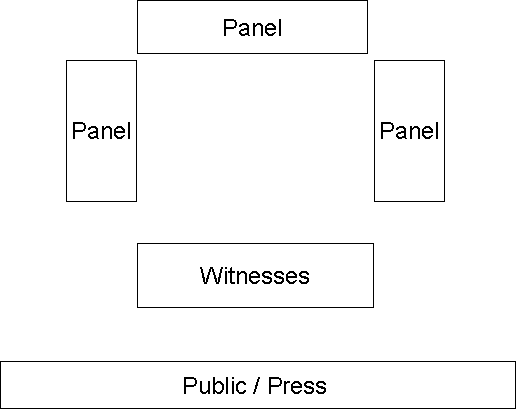
The room layout will be formal and similar to the pattern identified below.
Witnesses at an oral session will not be allowed to make opening or closing statements unless specifically requested to do so - all such evidence should normally be included in written evidence submitted beforehand. You will be there to answer questions.
Your evidence may be recorded to ensure that vital information is not lost although this will not all be transcribed.
The last witness at the last oral session of an Inquiry will normally be the Executive Member for the relevant area to allow them to provide the overview and policy context.
What will happen to my Oral Evidence?
· Oral evidence sessions may be recorded.
o Where they are recorded only those parts of the oral evidence that are contentious or are considered especially significant to the recommendations of the Panel will be transcribed and may be used in the report.
o If the session was recorded then at the end of the Oral sessions witnesses may request to see any transcripts of evidence they have given.
Further Questions:
If you have any further questions about the process the scrutiny officer supporting the review should be able to respond to these.
CLEMS Winchester Response to Alcohol Scrutiny Review October 2007
CLEMS is a Tier 2 Open Access Shop Front Drug Advice Drop In service. It is funded by the Hampshire DAAT and is run by a charity called CRI. CLEMS is the only service of its kind in Winchester therefore it is responsible for all the triage assessments of drug clients who wish to attend Spencer House for some form of treatment for their drug use.
Due to the nature of our service it is very common for us to see clients who have considerable alcohol dependence issues as well as some form of drug use. If it is apparent that alcohol is the main form of substance misuse we would encourage that person to attend The Trinity Centre in Winchester as they deal with Alcohol as a sole issue. If the person is in need of a triage then we would do this however we would only do this if they had a drug misuse issue as well.
In order to do a triage we would use the Common Assessment Tool which is a DAAT commissioned tool and is used for both drugs and alcohol assessments. This then is sent to Spencer House whom would then deal with the client directly.
My knowledge of the alcohol resources in Winchester are as follows, a person who wants to address their alcohol issues would need to attend their G.P and then they would be directly referred to Spencer House for assessment. I understand that the waiting list for such an assessment at times can be long due to the demand for the service and the fact that there is no intermediate service such as CLEMS whom do the triage assessments for alcohol.
We have 27 clients who we consider our "core" group who use our service daily and we would suggest that 10-15 of them have alcohol issues as well as drug dependency problems. However these people have a more serious drug issue that needs to be addressed and that is what we deal with in CLEMS.
We would always advise people of where they can obtain assistance for alcohol issues, as well as going to The Trinity Centre we have information on local AA meetings and we would support clients in attending such meetings as these. Our project has strong links with The Trinity Centre and we seek to do good quality partnership working with them on clients that cross both projects.
In Winchester the availability of services does seem to be sparse and although services such as Trinity and CLEMS fill in some of the gaps a service which is for people with different levels of alcohol dependence that can offer advice and support, harm minimisation messages and deal with issues that are surrounding the alcohol usage is missing.
1. Both managers said that Tier 1 services are readily available. Needs would be identified through support planning. Joint agency co-operation is to a high standard. This is through Spotlight, CDAS, Spencer House and use of GP's. Dettox is harder to access for our service users. The manager at Andover said in the four years she has been there only 2 service users had accessed this service. Both managers commented that alcohol was very much an afterthought now, with priority being given to drug users and that there is no available prescription substitute for alcohol available only a blocker.
2. Both commented that outreach work was missing from both areas. This ensures the earliest intervention. There are also some healthcare services for alcohol related diseases unavailable at times.
3. Both manager said the more contact individuals have with their alcohol workers the better the results.
4. The manager at Andover said that over 50% of their service users have alcohol issues and that this needs to be acknowledged.
Two Saints
31/10/07