
Archived decisions
HAMPSHIRE COUNTY COUNCIL
SAFE AND HEALTHY PEOPLE SELECT COMMITTEE
SCRUTINY REVIEW : ACCESS TO APPROPRIATE SERVICES FOR PEOPLE WITH ALCOHOL PROBLEMS
Select Committee style meeting, Friday, 16 November 2007
Former Grand Jury Room, The Castle, Winchester, 10.00 to 1.15pm
Focus: multi agency partnerships and workforce development and planning for the future |
Time |
Witnesses |
Written Evidence |
10.00 - 11.00 |
Partnerships - Sue Wilkes, DAAT - Jean Bradlow, PCT |
Appendix One Appendix Two |
11.00 - 11.45 |
Health - Ruth Monger, SHA - Rob Stait, Hampshire Partnership Trust |
Appendix Three Appendix Four |
11.45 - 12.00 |
Break |
|
12.00 - 1.00 |
HCC - Officer, Adult Services - Officer, Human Resources - Pete Marsh, Childrens' Services and Campbell Todd, DAAT |
Appendix Five |
1.00 - 1.15 |
Partnerships cont. - Sue North, Winchester DARG |
Questions
Questions for witnesses for 16 November 2007
The scrutiny review group recognises the importance of multi agency working in the commissioning and delivery of appropriate services for people with alcohol problems. It is interested in looking more closely at the current arrangements for this in Hampshire, and the strength of partnership working arrangements in place at present.
The review is considering the key aspect of workforce development and planning, crucial to the implementation of effective and quality services; the review group members wish to become better acquainted with the respective roles of agencies and partnerships in this and to test out some of the impressions it has gained from the written evidence submitted to the review.
DAAT
(partnership working)
· Would you say that Hampshire has a robust and transparent commissioning framework for managing and integrating effective services for people with alcohol problems, and what are your views based on ?
· Can you confirm what the current budget is in the DAAT for alcohol for both children and young people and for adults and which agencies are contributing to this ?
· Is there a shared view among DAAT members about additional resources the DAAT would need to carry out its task to commission effective services to respond to the level of identified alcohol treatment and support needs in Hampshire ?
· How are alcohol services performance managed and is there a way that the DAAT can oversee the performance of non commissioned Tier One Alcohol services ? Do you see this as part of its remit ?
· Would you agree that the involvement of service users and carers in the commissioning process contributes to the building of effective service responses, and, if so, what progress has been made to include them in the commissioning cycle ?
· Is the DAAT aware of how Hampshire ranks in terms of its strength of partnership working in comparison to other areas in the region ?
· How important are the Drug and Alcohol Reference Groups in supporting the implementation of the Hampshire Alcohol Strategy, and are there any barriers to them undertaking this ?
(Workforce)
· Does the DAAT have a role in ensuring that there is a transparent workforce strategy for all ages in Hampshire, and if not, whose role would it be ?
· You refer in your evidence to contracts with providers requiring national occupational standards compliance; what has the DAAT concluded from the audits it has carried out ?
· If the Common Assessment Tool underpins a common approach to delivering effective care, how does the DAAT promote the use of this across the workforce ?
· How many marks out of ten would you give to joint agency monitoring and review of workforce development, and planning for the future and do you consider this an essential part of the Hampshire alcohol strategy ?
LAA
(partnership working)
· The review group is aware that the new Alcohol Flagship LAA initiative is moving forward; can you describe the current stage reached by strategic partner organisations in respect of the Ten Point Plan that has been proposed ?
· How confident are you that the changes to the LAA arrangements in 2008 will provide the right environment to pursue the Flagship initiative's desired outcomes, and sustaining services in general ?
· What role do you see Hampshire County Council playing at present to ensure the delivery of effective service responses for people with alcohol problems, and is there scope for the Council to strengthen this with partners?
· Research by the UK alcohol treatment trial indicates that the spending on alcohol treatment services saves about five times as much as it costs in terms of expenditure on health, social and criminal justice services. This suggests it is in the interests of Health, Hampshire County Council and the criminal justice agencies to put money into alcohol services. What barriers are there, generally, to achieving this sort of joint funding commitment ?
PCT
(commissioning role)
· Which Tiers of alcohol services does the PCT commission and to what standards ?
· Is there a common outcome tool that the PCT would expect Tiered services to work to, and, if so, how well is this embedded in services ?
· You say in your evidence that the PCT has recognised that brief intervention services are not consistently accessible around the county; how adequate would you say the level of service is in those parts of Hampshire where they are available and what evidence do you have for your views ?
· What are the PCTs views about the range and effectiveness of Tier One and Tier Two alcohol services in Hampshire ?
· Can you explain why it has taken this long for new investment to be identified for alcohol services ?
· What are the PCTs views about any required expansion and improvement of the workforce ?
· Evidence suggests that GPs under identify alcohol problems in their patients; do you think that this is the case in Hampshire, and, if so, is there anything that the PCT could do to improve on this ?
SHA
(workforce)
· In your evidence you refer to one role of the SHA as being to sign off the
aggregated picture of health sector workforce supply and demand. Can you tell
something about how supply is matching demand in Hampshire at present in
respect of arriving at a competent alcohol services workforce ?
· You have told us that the SHA will be asking the PCT and Provider
organisations to produce workforce plans to underpin their commissioning and
operational plans. Does this mean that there are no such workforce plans in
place at present ?
· Do you agree with the House of Commons Health Select Committee comments in 2007 that workforce planning became marginalised in the Health Service due to organisational restructuring and the absence of a long term strategy ? If so, what impact might this have had in Hampshire in respect of skilling up the alcohol services workforce and planning for the future ?
Hampshire Partnership Trust
(partnership working)
· you mention in your written evidence that some teams provide education to GPs and Accident and Emergency on screening and brief intervention; is there potential for this to be done throughout the county, and, if so, could it be done within existing resources ?
· You indicate that you would like to provide better liaison links with hospitals, mental health services and GPs; where would the funding need to come from to resource this, and what model of service do you have in mind ?
(workforce)
· Can you give us an idea about what structures and mechanisms are being proposed to progress multi agency workforce development that you referred to as a forthcoming agenda item in your evidence ? What are the timescales for this ?
· You refer to specialist training courses within the Trust; does this refer to
specialist alcohol training and, if so, are these courses open to other provider
services, volunteers, carers and service users ?
· Some of the written evidence the group has received has referred to the prevalence of drinking problems among older adults. Does the training you refer to reach all staff that need it in your organisation, would you say, including those working in older adult services ?
· The review group is aware of the Ten Point Plan under the LAA to invest in a
variety of different Alcohol initiatives; what, in your opinion, is needed by
way of workforce development to underpin these developments ?
HCC
Adult Services
(partnership working)
· What proportion of the Adult Services Substance Misuse budget is being spent this year to meet identified needs of people with alcohol problems, and how is the balance of drug use over alcohol use decided on ?
· You note in your written evidence that lack of preventative, lower level services for people abusing alcohol has been identified as an issue, what is your department planning on doing to improve on this in future?
· You raise the point in your evidence that people over 65 may have an alcohol problem that exacerbates their other problems, but this age group may be missed by alcohol services. What joint agency discussions have taken place to improve the situation for this group?
(workforce)
· From the written evidence provided by Adult Services, there is a recognition that alcohol problems can effect peoples' lives regardless of the care group they belong to. This being the case, would you agree that there is some urgency about improving on the `limited opportunities' to develop the non-specialist Adult Services workforce in relation to alcohol issues ? If so, what plans does Adult Services have to do this ?
· There is mention in the written evidence to the training needs of staff in the private and third sector; what, if any, access does this staff group have to alcohol focused training ?
· Do service contracts ever specify expectations about Drug and Alcohol National Occupational Standards, for example, up to the level of Tier One competencies? If not, could this be considered ?
· The Adult Services Departmental Workforce Plan for 2007/08 refers to the co-ordination of workforce development activity across organisational boundaries for key stakeholder groups, private and voluntary sector, neighbouring Local Authorities, Strategic Health Authority and primary and secondary care trusts. How far has this work progressed, and what benefit is likely to arise for people with alcohol problems seeking help and their families ?
Human Resources
(workforce issues)
· In 2005, a Department of Health guide for Human Resources Directors in the NHS and Social Care provided a national framework to support health and social care local workforce strategies. One area for consideration it offered was to ensure that strategic workforce plans are fully integrated into local delivery and business planning within and across organisational boundaries, including related sectors. How far has this been progressed in Hampshire, and what impact could this have on improving services for people with alcohol problems ?
· Is it Hampshire County Council's policy to equip its own managers with competence in identifying drink problems among staff groups, and, if so, what is the policy reference for this and how does this happen ?
· What is happening within Hampshire County Council to promote a self help approach for members of staff and others who rely on drink too much ?
Childrens Services
(partnership working)
· What proportion of the budgets available in Childrens Services for substance misuse is being spent this year to meet identified needs of young people with alcohol problems, and how is the balance of drug use over alcohol use decided on ?
· The review group has heard that there will be no Tier One or Tier Two funding for children and young peoples' services for 2008/09; can you describe what impact this is having on partnership working and will have on the availability of assistance and support for Hampshire's younger age
groups ?
· Do service contracts ever specify expectations about Drug and Alcohol National Occupational Standards, for example, up to the level of Tier One competencies? If not, could this be considered ?
(workforce)
· With reference to the training needs of staff in the private and third sector, what, if any, access do these staff groups have to alcohol focused training ?
· What progress has been made to develop joint agency workforce planning and development that will benefit the delivery of effective services for young people who misuse alcohol ?
DARG
(partnership working)
· The review group understands that the network of Drug and Alcohol Reference Groups across the county supports the implementation of DAAT priorities and plans. Can you tell us how the DARG works in your area ?
· Can you give an example of how alcohol issues are being worked on at present in your area ?
· How has the DARG worked over the last year to influence improvements in the identification of people with alcohol problems and/or the delivery of effective service responses to them and their family ? What successes has it had with this ?
· What is your view of the balance of attention given to alcohol as opposed to drug issues in your local DARG discussions as well as county wide discussions ?

PROVIDING ORAL EVIDENCE TO A SELECT COMMITTEE INQUIRY
GUIDANCE NOTES
Why Do I have to Give Written Evidence First?
An Inquiry Panel's time for taking oral evidence is limited so ideally all witnesses, even those whom an Inquiry Panel expects to invite to give oral evidence, are encouraged to submit written evidence; this not only makes oral evidence hearings more productive, as members use the written evidence to prepare useful areas of questioning, but also means that if witnesses are not invited or cannot attend to give oral evidence the Inquiry Panel still has the benefit of their views.
Following the initial written evidence the Inquiry Panel will invite those witnesses they wish to question to an oral session
Can I Know The Questions Beforehand?
It is often possible, with the Panel's agreement, to assist witnesses with their preparation by informing them of the possible lines of inquiry but witnesses should not expect Panel members to restrict themselves to these areas only.
Public / Private:
Inquiry Panels nearly always take their evidence in public so that you should expect there may be others observing or even recording the Hearing. If there is a good reason why you want to give some or all of your evidence in private you will need to discuss this with the Democratic services Officer or Scrutiny Manager at the time you are first invited to attend as an oral witness.
What will Happen?
Oral evidence sessions are normally no longer than 2 hours long and there will be likely to be several so that different witnesses can be called.
You may not be the only witness at a session and you will be asked to introduce yourself at the outset.
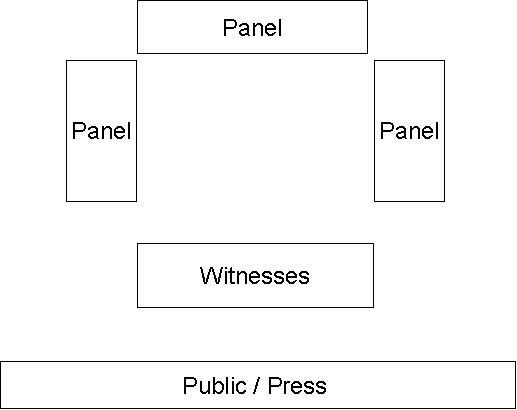
The room layout will be formal and similar to the pattern identified below.
Witnesses at an oral session will not be allowed to make opening or closing statements unless specifically requested to do so - all such evidence should normally be included in written evidence submitted beforehand. You will be there to answer questions.
Your evidence may be recorded to ensure that vital information is not lost although this will not all be transcribed.
The last witness at the last oral session of an Inquiry will normally be the Executive Member for the relevant area to allow them to provide the overview and policy context.
What will happen to my Oral Evidence?
· Oral evidence sessions may be recorded.
o Where they are recorded only those parts of the oral evidence that are contentious or are considered especially significant to the recommendations of the Panel will be transcribed and may be used in the report.
o If the session was recorded then at the end of the Oral sessions witnesses may request to see any transcripts of evidence they have given.
Further Questions:
If you have any further questions about the process the scrutiny officer supporting the review should be able to respond to these.
Tackling Drugs?
Tackling Training!
A Training and Development Strategy
For : 
Contents Page
1. Introduction 2
2. Young People's Service Tiers 4
3. Levels of training and training competencies (HAS) 6
4. Models of care 12
5. DANOS 15
6. Action plans 16
7. References 22
1. Introduction
1.1 Tackling drugs? Tackling training! began in August 2004. This purpose of the project being to create a training and development strategy for the Hampshire DAAT. The project aims to build a competent workforce, supported by a robust training and development strategy to deliver high quality substance misuse services in Hampshire.
1.2 In November 2004 a stakeholder event was held to enable stakeholders to come together as a cross-organisational group to contribute to the building of an influential substance misuse strategy to meet the needs of the people of Hampshire. The following outcomes were attained.
¬ An understanding of the need for and benefits of a joint training strategy
¬ An agreed way forward (action plan)
¬ An opportunity to build, influence and contribute to the strategy and a commitment to continued engagement with the strategy development and implementation across Hampshire
¬ A sense of enthusiasm for the difference we will make
1.3 In December 2004 a training audit was conducted. This comprehensive two-part survey was distributed across the DAAT area. The purpose of the survey was to identify the training/development activities provided for the workforce within each agency, and also identify the training/development activities being provided to other agencies or workforce groups. It was hoped that this information could be collated to publish a directory of learning opportunities for the Hampshire workforce.
1.4 In February 2005 a training needs analysis (TNA) was undertaken. This consisted of a one day worker census, conducted across all job types (Administration/client work/management). Each agency/organisation was also asked to identify training needs required by its workforce. Focus groups, telephone and Email consultation were also included in the methodology.
1.5 In March 2005 the second stakeholder event to provide feedback from the audit and training needs analysis took place. This allowed stakeholders to continue to contribute to Tackling drugs? Tackling training! and provide the direction for the strategy.
1.6 The Health Advisory Service (HAS) outlines 4 levels of training appropriate to those who work with young people. These levels are aimed at particular workers in particular tiers of service. They clearly identify the level of training workers in each tier should receive and what competencies they are expected to obtain. These competencies are not occupational standards and do not specify specific knowledge or skill levels required in order to become competence.
1.7 A national programme of workforce development is being implemented by the NTA. This competence based programme consists of a national set of competencies for roles in the substance misuse sector. The Drug and Alcohol National Occupational Standards, DANOS were published in May 2002. There are 3 areas in DANOS (A) Service Delivery, (B) Management of Services and (C) Commissioning Services. At the present the service delivery standards are adult and not young person focussed.
1.8 Unlike the HAS competencies DANOS specify the standards of performance that the people in the drugs and alcohol field should be working to. They also describe the knowledge and skills that workers need in order to perform to the required standard. This allows workers to be clear about what is expected of them in their work and help them to identify knowledge and skills that are required. DANOS relate to the job that a worker does as opposed to the tier of service in which they work.
1.9 The training and development strategy firstly outlines the work context of young peoples services and then outlines the Health Advisory levels of training and training competencies. It then outlines the treatment modalities in Models of Care (Adult service work context) as well as outlining the drug and alcohol national occupational standards (DANOS).
1.10 Training plans for the following areas are detailed :
1. Establish funding mechanisms to enable a DAAT based training co-ordinator post to be established
1. Develop an agreed approach to commissioning training and development activities across the DAAT area
2. Establish monitoring and evaluation of training activities
3. Enable services to identify learning opportunities within the organisation
4. Publish a directory of learning opportunities in Hampshire
5. Development of web based information and training resources
6. Support agencies to develop DANOS based job descriptions
7. Support training providers to map existing training against DANOS
8. Level 1 training for young peoples services
9. Basic drug awareness training
10. Develop and co-ordinate trainer pool for level 1 and drug awareness training
11. Training for trainers
12. Develop advanced drug knowledge
13. Provide training in Group work skills
14. Provide training in Counselling Skills
15. Provide training in Mental Health/Dual Diagnosis
16. Provide training in Relapse Prevention
17. Develop leadership and management skills
18. Develop blood borne virus, peer led education and awareness raising
19. Provide overdose prevention and resuscitation training to reduce drug related deaths
20. Provide Crack awareness training
21. Provide training in evidence based interventions to stimulant and crack cocaine users
22. GP Training
23. Develop relationships with training co-ordinators
24. Identify Core DANOS unit required for various tiers
25. Raise awareness with organisations
26. Identify training needs beyond workforce: Parents; Carers
27. Appraisal Skills Training
2. Young Peoples Service Tiers
The Health Advisory Service (HAS) reports (1996, 2001) `The Substance of Young Needs', describes a four-tier model covering generic, youth orientated and specialist services describing their roles and responsibilities in meeting the needs of children and young people in relation to substance use and misuse.
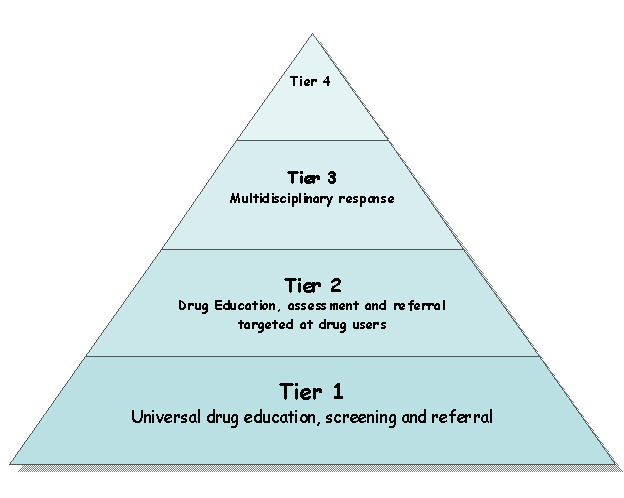
Tier 1 services
These are services that are accessible directly by the general public and are provided by primary care workers. These workers can have an influence on the young people they come into contact with but do not necessarily have the sole purpose of informing or intervening with children and young people who are at risk of substance use or misuse. At Tier 1 staff play an important role in recognising and identifying problem substance use and they require the competence to advise accordingly and make appropriate referrals to more specialist agencies in other tiers. Some staff in this tier may also continue to play significant roles in the shared care of children and young people after their referral to more specialised services.
Tier 2 services
These are services in which the workers have a more specialised understanding of child and adolescent development, knowledge of substance use and misuse by young people; and the ability to practice in circumstances that are appropriate to the culture of young people. Chief components of these services are the capacity to provide accurate information and advice; conduct assessment of needs; identify problems related to substance use and misuse and other problematic behaviours; offer advice and information to carers and families; and involve other appropriate agencies. Tier 2 staff include primary care workers with a special interest in drug and alcohol misuse problems; child and adolescent psychiatrists, educational psychologists, social workers with specialist knowledge and staff in one-stop shops/comprehensive centres. Staff in more specialised non-statutory services, health promotion and youth justice. Frequently in tier 2, individual specialist staff may support tier 1 staff.
Tier 3 services
These are more specialised services that can respond to the complexity of the problems presented to them. Examples include youth-orientated specialist addictions services, components of child and adolescent mental health services; and other specialist youth services. Frequently, in tier 3, specialist staff may work in multidisciplinary teams with individuals to bring the necessary skills to bear on their complex problems.
Tier 4 services
These consist of very specialised services, such as those that offer inpatient assessment, care and treatment; care and treatment for children and young people in secure provision; and a range of services for children and young people who misuse substances.
3. Levels of training and training competencies (HAS)
The Health Advisory Service outlines 4 levels of training, clearly identifying the level of training workers in each tier should receive and what competencies they are expected to obtain. These competencies are not occupational standards and do not specify knowledge or skill level required in order to gain competence.
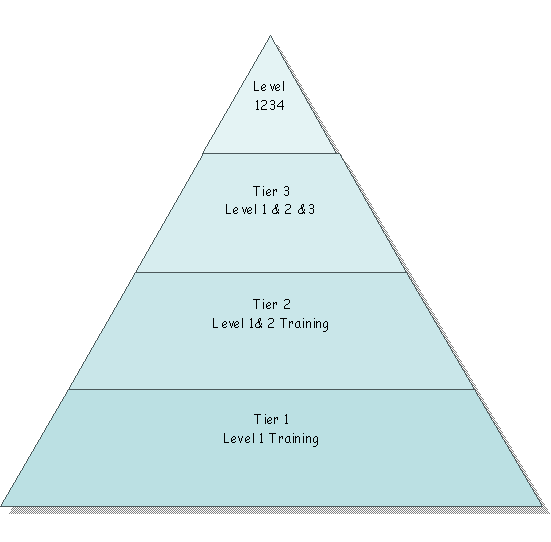
Level 1
All Tier 1 service providers should have level 1 training which is basic drug awareness, skills in recognition, screening and a level of intervention. Training should include substance use/misuse and related issues alongside the development needs of children and young people, and recognition of risk factors, including disaffected and vulnerable young people. All tier 1 workers should be aware of the local child protection and procedures.
All professional groups working with children and young people are expected to have level 1 competencies. Each level 1 competency is identified with its key area, and examples of training content have been added.
Level 1 competencies
1. Ability to deliver services which are sensitive to the impacts of diversity, for example ethnicity and culture, gender or sexuality
Key area: Diversity
· Legal framework e.g. Equal Opportunities, Race Relations Act, Disability Act, The Children Act, The Mental Health Act, The Human Rights Act
· Cultural competence
· Promoting accessibility, equality, diversity and rights
· Ability to promote anti-discriminatory practice and value diversity
2. A basic knowledge of the physical, psychological and social effects of mood-altering drugs and alcohol, including the impacts of substance misuse by parents on children and young people
Key area: Drug knowledge
· Drug set and setting (Zinberg)
· Actions and effects of psychoactive drugs on children and young people
· Routes of use
· Biological indicators
· Social impact of drug use
· Impact on parenting skills
· Legal issues
3. Awareness of your own attitudes towards, and experiences of substance use and misuse and how these may impact on your work with young people who use and/or misuse substances
Key area: Attitudes to drugs
· Assumptions about legal, illegal substances and over the counter medicines, and herbal substances
· Attitudes to own substance use and misuse
· Attitudes to substance use and misuse of others
· Impact of attitudes in the workplace
4. Recognise drug and alcohol use by young people, and related problems
Key area: Identification
· Signs & symptoms
· Indicators - health, education, social or behavioural
· Dimensions of risk
5. Identification of young people's substance related needs with particular reference to the ability to distinguish between substance use, for example of an experimental nature and harmful use
Key area: Identification
· Ten Key Policy Principles
· Screening
· Confidentiality
· Universal education
· Targeted prevention, advice and information
· Harm Reduction
· Child protection
· Referral
6. Basic life support skills
Key area: Dealing with casualties
· Overdose recognition
· Recovery position
· Resuscitation techniques
7. Ability to deliver simple interventions, for example information or advice about withdrawal from substance use and harm-minimisation, when appropriate
Key area: Simple Interventions
· Information giving approaches
· Accessibility of information
· Availability of information on service availability and eligibility or referral criteria
· Harm minimisation approaches /Newcombe's framework
8. Awareness of local specialist substance misuse agencies and specialist staff and about when and how to refer
Key area: Referral
· Local and national service availability
· Referral protocols and criteria
· HAS tiers
Level 2
Tier 2 service workers should have level 1 & 2 training. In addition they should be able to support tier 1 workers. Level 2 training is more advanced training. All training at level 2 should include substance use/misuse and/or child development and/or mental health issues. All training should be integrated with child development and protection needs.
Each level 2 competency is identified with its key area, and examples of training content are as follows:
Level 2 competencies
1. Skills in communicating with and counselling young people and/or their parents/carers
Key area: Young people skills
¬ Communication/councelling skills working with children and young people
¬ Communication/councelling skills for working with parents/carers
¬ Aspects of confidentiality and boundaries.
2. Knowledge of, and skills in therapeutic interventions, including those that are brief and focused, and knowledge of the indications for longer-term and more specialised interventions
Key area: Therapeutic Interventions
¬ Solution focused work
¬ Brief interventions
¬ Group work skills
¬ Life skills work
¬ Indications for specialised in-depth work
¬ Motivation work
¬ Problem solving approaches
3. Identification referral skills: being able to recognise the need for more specialised and
long term interventions and the ability to assess competence for counselling
Key area: Identifying Substance Related Needs
¬ Principles and purpose of screening and assessment
¬ Confidentiality
¬ Consent
¬ Trend in young people's substance use
¬ Distinguishing between substance use and misuse
¬ Screening and assessment procedures
¬ Professional boundaries and responsibilities
¬ Referral
4. Deliver evidence based universal education and prevention programmes
Key area: Education and prevention
¬ Evidenced based practice
¬ Trends in children and young people's substance taking
¬ Education and prevention approaches
¬ Context in which to deliver programmes
¬ Equality, diversity, and developments issues for education and prevention
5. Skills in multi-disciplinary working in a range of different contexts
Key area: Multi-agency working
¬ Confidentiality
¬ Information sharing policy and procedures
¬ Recognition of roles and responsibilities of self and others
¬ Communication
¬ Record keeping
6. Skills of managing conflict in attitudes, opinions and beliefs
Key area: Conflict Management
¬ Equality and diversity issues
¬ Attitudes of self and others
¬ Policies and procedures for managing conflict, complaints, incidents etc.
¬ Communication skills
7. Knowledge of when to inform parents or the authorities and when to offer confidentiality
Key area: Professional boundaries
¬ Legal guardianship
¬ The Children Act
¬ Confidentiality
¬ Fraser Guidelines (Mental Health Act)
¬ Child Protection Policy and Procedures
8. Knowledge of the law relating to purchasing and consuming drugs, alcohol and other substances with particular reference to young people
Key area: Legal issues
¬ The Misuse of Drugs Act plus amendments
¬ The Pharmacy Act
¬ Managing premises and incidents
¬ Licensing laws
9. The ability to construe and manage the boundaries of staff members' expertise
Key area: Team work
¬ Professional boundaries and responsibilities
¬ Communication
¬ Sharing information
¬ Referral criteria and procedures
10. Skills in record keeping, awareness of the needs for and methods of keeping detailed
contemporaneous records
Key area: Record keeping
¬ Data Protection
¬ Legal responsibilities
¬ Information sharing
¬ Confidentiality
¬ Monitoring methods
¬ Report writing
11. Skills of contributing to the development of services for managing people who misuse substances
Key area: Service delivery and development
¬ Consultation with children, young people, parent and carers
¬ Confidentiality
¬ Information sharing
¬ Multi-disciplinary working
¬ Monitoring and evaluation
Level 3
In addition to level 1 and 2 training all tier 3 service workers should have level 3 training. This is specialist drugs knowledge training and advanced skills for interventions and treatment of young people. In addition they should have access to and disseminate evidence-based information concerning the nature of young people's substance misuse and related problems and interventions. A team should have the ability to contribute to the training, support and supervision of colleagues including those in tiers 1 and 2. The team should ensure that there is aggregate competence for all aspects of intervention. Development and delivery of accredited advanced training in substance misuse and child development is to be actively encouraged. In particular, skills in pharmacology and its interventions in young people need to be developed.
Level 3 competencies
The following competencies are detailed for level 3 training
· A working knowledge of child and adolescent development
· Understanding of the particular impact of major events on the lives of children and young people for example abuse, bereavement and major traumatic events
· Skills in communicating with and counselling young people and their parents/carers
· Ability to conduct therapeutic interventions including brief focused practical work with peoples who misuse substances, and the knowledge of the longer-term and specialised interventions
· Knowledge and skills to handle confidentiality and consent to treatment that involves the rights of young people, and the responsibilities of parents and professionals
· Assessment skills with particular reference to discern the severity of risks of substance misuse, the complexity of any planned intervention and the competence of a person to consent to treatment and interventions
· The ability to manage and work with the child protection issues including those that concern the relationship between substance misuse and the vulnerability of children and young people
Tier 4 workers should be able to deliver specific treatments. Developed skills in paediatrics, addiction, forensic and child/adolescent psychiatry and primary care to take forward development in competencies in pharmacological interventions in young people is to be encouraged. This should not simply address competencies and a need for training in detoxification but general prescribing of potential drug misuse, use of adjuncts and the use of various settings for treatments. Training also needs to be mindful of the location where the young person presents, treatments needs to be location specific with primary care having an important role in first contact and identification.
The following competencies are detailed for level 4 training
· A working knowledge of child and adolescent development.
· Understanding of the particular impact of major events on the lives of children and young people for example abuse, bereavement and major traumatic events
· Skills in communicating with and counselling young people and their parents/carers
· Ability to conduct therapeutic interventions including brief focused practical work with peoples who misuse substances, and the knowledge of the longer-term and specialised interventions
· Knowledge and skills to handle confidentiality and consent to treatment that involves the rights of young people, and the responsibilities of parents and professionals
· Assessment skills with particular reference to discern the severity of risks of substance misuse, the complexity of any planned intervention and the competence of a person to consent to treatment and interventions
· The ability to manage and work with the child protection issues including those that concern the relationship between substance misuse and the vulnerability of children and young people
4. Models of Care
Models of care (NTA 2002) outlines a four tier framework for the commissioning and provision of drug treatment in line with identified client need within each Drug Action Team area. This model was based on the four-tiered approach for a variety of mental health and drug misuse services for young people outlined by the Health Advisory service (1996). The tiers in this model represent the modality of intervention offered by an agency rather than simply categorising the service.
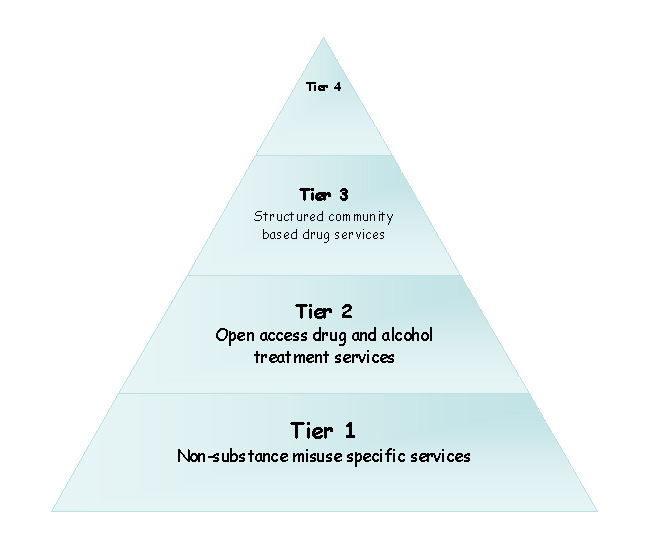
Tier 1: Non-substance misuse specific services requiring interface with drug and alcohol treatment
Tier 1 services work with a wide range of clients including drug and alcohol misusers, but their sole purpose is not drug or alcohol treatment. The role of Tier 1 services, in this context, includes the provision of their own services plus, as a minimum, screening drug misusers and referral to local drug and alcohol treatment services in tiers 2 and 3. Tier 1 provision for drug and alcohol misusers may also include assessment, services to reduce drug-related harm, and liaison or joint working with Tiers 2 and 3 specialist drug and alcohol treatment services. Tier 1 services are crucial to providing services in conjunction with more specialised drug and alcohol services (e.g. general medical care for drug misusers in community-based or residential substance misuse treatment or housing support and aftercare for drug misusers leaving residential care or prison).
Tier 1 consists of services offered by a wide range of professionals (e.g. primary care or general medical services, social workers, teachers, community pharmacists, probation officers, housing officers, homeless persons units). Such professionals need to be sufficiently trained and supported to work with drug (and alcohol) misusers who, as a group, are often marginalised from, and find difficulty in, accessing generic health and social care services.
Tier 2: Open access drug and alcohol treatment services
Tier 2 services provide accessible drug and alcohol specialist services for a wide range of drug and alcohol misusers referred from a variety of sources, including self-referrals. This tier is defined by its low threshold to access services, and limited requirements on drug and alcohol misusers to receive services. Often drug and alcohol misusers will access drug or alcohol services through tier 2 and progress to higher tiers.
The aim of the treatment in tier 2 is to engage drug and alcohol misusers in drug treatment and reduce drug-related harm. Tier 2 services do not necessarily require a high level of commitment to structured programmes or a complex or lengthy assessment process. Tier 2 services include needle exchange, drug (and alcohol) advice and information services, and ad hoc support, including harm reduction support, not delivered in the context of a care plan. Specialist substance misuse social workers can provide services within this tier, including the provision of access to social work advice, childcare/parenting assessment, and assessment of social care needs. Tier 2 can also include low-threshold prescribing programmes aimed at engaging opioid misusers with limited motivation, while offering an opportunity to undertake motivational work and reduce drug-related harm.
Tier 2 services require competent drug and alcohol specialist workers. This tier does not imply a lower skill level than in tiers 3 and 4 services. Indeed, many of the functions within this tier require a very high level of professional training and skills.
Tier 3: Structured community-based drug treatment services
Tier 3 services are provided solely for drug and alcohol misusers in structured programmes of care. Tier 3 structured services include psychotherapeutic interventions and structured counselling (e.g. cognitive behavioural therapy), motivational interventions, methadone maintenance programmes, community detoxification, or day care provided either as a drug- and alcohol-free programme or as an adjunct to methadone treatment. Community-based aftercare programmes for drug and alcohol misusers leaving residential rehabilitation or prison are also included in tier 3 services.
Tier 3 services require the drug and alcohol misuser to receive a comprehensive assessment and to have a care plan which is agreed between the service provider and client. The drug and alcohol misuser attending tier 3 services will normally have agreed to a structured programme of care which places certain requirements on attendance and behaviour (e.g. a certain number of days or hours attendance per week with a programme review triggered if attendance becomes irregular). The drug and alcohol misuser should also expect the care plan to be provided by the agency as agreed. For clients whose needs cross several domains, there should be a care co-ordinator, responsible for co-ordination of that individual's care on behalf of all the agencies and services involved. Changes to the care plan would take place in consultation with the drug and alcohol misuser.
Tier 3 services may be required to work closely with other specialist services to meet the needs of specific client groups. For example, Tier 3 services and mental health services should work closely together to meet the needs of drug misusers with dual diagnosis (psychiatric co-morbidity). In this instance, providers should have access to medical clinical leadership and/or advice from mental health specialists in line with good practice guidelines (Department of Health 2002).
Tier 4 Services: Residential services for drug and alcohol misusers
Tier 4a: Residential drug and alcohol misuse specific services
Tier 4 services are aimed at individuals with a high level of presenting need. Services in this tier include: inpatient drug and alcohol detoxification or stabilisation services; drug and alcohol residential rehabilitation units; and residential drug crisis intervention centres. Tier 4a services usually require a higher level of commitment from drug and alcohol misusers than is required for services in lower tiers. Tier 4a services are rarely accessed directly by clients. Referral is usually from tiers 2 or 3 services or via community care assessment.
Tier 4a services may be abstinence-oriented programmes, detoxification services or services which stabilise clients (e.g. on substitute drugs). Access to tier 4a requires careful assessment and preparation of the client in order to maximise readiness, compliance and programme effectiveness. Access to tier 4a may also require sequencing of other care pathways such as detoxification prior to placement in a drug- and alcohol-free residential programme. By definition, such programmes are highly structured. Drug and alcohol misusers receiving tier 4 services will require a designated care co-ordinator, allocated before entry to this tier.
Tier 4b: Highly specialist non-substance misuse specific services
Tier 4b services are highly specialised and will have close links with services in other tiers, but they are, like tier 1, non-substance misuse specific. Examples include specialist liver units that treat the complications of alcohol-related and infectious liver diseases and forensic services for mentally ill offenders. Some highly specialist tier 4b services also provide specialist liaison services to tiers 1-4a services (e.g. specialist hepatitis nurses, HIV liaison clinics, genito-urinary medicine).
5. DANOS
A national programme of workforce development is being implemented by the NTA. This competence based programme consists of a national set of competencies for roles in the substance misuse sector. The Drug and Alcohol National Occupational Standards, DANOS were published in May 2002. The programme has a qualification framework with clear pathways for entry, progression and transfer across the sector based on DANOS and other relevant national occupational standards. At the moment the service delivery standards are adult and not young person focussed.
Unlike the HAS competencies DANOS specify the standards of performance that the people in the drugs and alcohol field should be working to. They also describe the knowledge and skills that workers need in order to perform to the required standard. This allows workers to be clear about what is expected of them in their work and help them to identify knowledge and skills that are required. The DANOS standards describe all the functions and activities involved in improving the quality of life for individuals and communities by minimising harm associated with substance misuse.
There are three main areas in DANOS; service delivery, management of services and commissioning services. There approximately 90 units in the DANOS suite. Similar units are grouped together within each of these three main areas.
A. Service Delivery
AA. Help individuals access substance misuse services
AB. Support individuals in difficult situations
AC. Develop practice in the delivery of services
AD. Educate people about substance use, health and social well-being
AE. Test for substance misuse
AF. Assess substance misusers' needs for care
AG. Plan and review integrated programmes of care for substance misusers
AH. Deliver healthcare services
AI. Deliver services to help individuals address their substance use
AJ. Help substance users address their offending behaviour
AK. Support individuals' rehabilitation
B. Management of Services
BA. Develop, implement and review the organisation's policies, strategies and plans
BB. Promote the organisation and its services
BC. Deliver services to specifications
BD. Provide a healthy, safe, secure and suitable environment for the delivery of services
BE. Manage information
BF. Manage the organisation's human resources
BG. Manage the organisation's financial resources
BH. Provide administrative support for the delivery of services
BI. Manage relationships
C. Commissioning Services
CA. Identify needs for substance misuse services and develop strategies and plans to meet the needs
CB. Manage contracts for substance misuse services
6. Action plans
KEY TRAINING AREA |
RELATES TO |
TARGET GROUP |
ACTION PLAN |
BY WHOM |
1. Establish funding mechanisms to enable |
ATP 05/06 TNA (2005) |
August - identify funding Autumn - seek appointment |
DAAT Manager | |
2. Develop an agreed approach to |
TNA(2005) |
July - TOR for Steering Group in draft Autumn - Ratification |
Training Steering Group Training Coordinator | |
3. Establish monitoring and evaluation of |
ATP 05/06 TNA(2005) |
December - Steering Group to agree funding Establish training record file and training group database |
Training Coordinator | |
4. Enable services to identify learning
|
ATP 05/06 TNA(2005) |
Ongoing: Relevant individuals to join Steering Group |
Training Coordinator | |
5. Publish a directory of learning |
TNA(2005) |
Service Provider Practitioner Trainers |
To be completed when co-ordinator is in post and following Needs Audit |
Training Coordinator |
6. Development of web based information |
TNA(2005) |
Group 5 |
To be addressed - 5 |
Training Coordinator |
7. Support and encourage agencies to |
ATP 05/06 TNA(2005) |
Service Provider organisations |
Ongoing: Audit during 2006 |
Training Coordinator Training Steering Group |
8. Support training providers to map |
TNA(2005) |
All |
Ongoing |
Training Coordinator TSG |
9. Level 1 training for young people's services |
ATP 05/06 TNA(2005) |
Tier 1 (YPS) |
¬ Develop training package based on HAS level 1 competencies. ¬ Identify and train trainers to deliver ¬ Promote to under age again |
Training Steering Group |
10. Basic drug awareness training |
ATP 05/06 TNA(2005) |
Tier 1/2/3/4 workers organisations |
¬ Identify journals, reading materials and websites where relevant information can be obtained. ¬ Develop DANOS based training ¬ Identify and train trainers to deliver |
Training Steering Group |
11. Develop and co-ordinate trainer pool |
TNA(2005) |
All |
Alongside work for 5 & 6 during 2006 |
Training Coordinator |
12. Training for trainers |
TNA (2005) |
Tier 1/2/3/4 trainers and drug awareness trainers User group members |
Training Steering Group | |
13. Develop advanced drug knowledge |
TNA(2005) |
Tiers 1, 2,3 and 4 in adult and YPS |
¬ Identify journals/ websites where information can be obtained ¬ Develop training package ¬ Identify trainers for delivery |
Training Steering Group working with local partners |
14. Provide training in Group work skills |
TNA (2005) |
Tiers 1, 2, 3,4 workers |
¬ Commission DANOS based training to develop group work skills. ¬ Identify reading resources to support distance learning ¬ Identify learning placements for skill development |
Training Steering Group working with local partners |
15. Provide training in Counselling Skills |
TNA (2005) |
Tier 1 - 4 workers Service Providers including admin workers |
¬ Commission/develop basic counselling skills training ¬ Commission/ develop advanced counselling skills training |
Training Steering Group working with local partners |
16. Provide training Mental Health/Dual Diagnosis. CPD
|
TNA (2005) |
Service Providers |
¬ Develop information pack on drugs and mental health ¬ Identify journals/ websites where information can be obtained ¬ Develop[/commission training |
Training Steering Group working with local partners |
17. Provide training Relapse Prevention |
TNA (2005) |
Tier 2,3 client workers and aftercare workers |
Training Steering Group working with local partners | |
18. Develop leadership and management |
TNA (2005) ATP (05/06) |
Team leaders and service managers |
.... 4 - 7 |
Training Steering Group working with local partners |
19. Develop blood borne virus, peer led |
ATP (05/06) |
Users and carers |
Ongoing via SUG |
Training Steering Group working with local partners |
20. Provide overdose prevention and |
ATP (05/06) |
Service providers Emergency services staff Service users |
Identify trainers and level and provide to workforce |
Training Steering Group working with local partners |
21. Provide Crack awareness training |
ATP (05/06) |
Service providers |
Identify trainers and level and provide to workforce |
Training Steering Group working with local partners |
22. Provide training in evidence based interventions to stimulant and crack cocaine users. |
ATP (05/06) |
Treatment service staff |
Identify trainers and level and provide to workforce |
Training Steering Group working with local partners |
23. GP Training. PC and Pharmacists |
ATP (05/06) |
GP in shared care (tier 3) Other GPs on request |
Promote training and encourage engagement |
Training Steering Group |
24. Develop relationships with training |
TNA (2005) |
All |
Assess and monitor and link 7 |
Training Coordinator Training Steering Group |
25. Identify core DANOS unit required for |
ATP 05/06 TNA(2005) |
Training Coordinator Training Steering Group |
26. Raise awareness with organisations |
Ongoing |
Training Co-ordinator Training Steering Group | ||
27. Identify training needs beyond |
Audit - 2006 Best Practice |
Training Co-ordinator Training Steering Group | ||
28. Appraisal Skills Training |
Linked to 7 |
Training Co-ordinator Training Steering Group |
7. References
· DrugScope/Home Office (2003) `First steps in identifying young people's substance misuse needs'. Home Office
· Hampshire DAAT (2004) Adult treatment Plan 2005/2006 (unpublished)
· Hampshire DAAT (2005) Tackling drugs? Tackling Training! Report on training census and training needs analysis (unpublished)
· NTA (December 2002) Models of Care for the treatment of drug misusers. Part 2: Full reference report (NTA London)

Scrutiny Review : Access to Services for People with Alcohol Problems
Introduction
Hampshire DAAT is a multi-agency partnership, established in 2001 and responsible for the local implementation of the Government's ten year drug strategy: `Tackling Drugs' (as amended December 2002). The overall aim of the strategy is to `reduce the harm that drugs cause to society - communities, individuals and their families' focusing on 4 key theme areas:
Young People: To help young people resist drug misuse
Treatment: To support people to overcome their drug problems
Communities: To protect communities from drug related crime & anti-social behaviour
Availability: To stifle the availability of illegal drugs in the community
Following the publication of the National Alcohol Harm Reduction Strategy for England published in March 2004, Hampshire DAAT broadened its remit to oversee the implementation of the national strategy at the county level and to lead on the development of a local alcohol strategy for Hampshire.
The DAAT commissions services for people who have drug problems (including those who may have a secondary alcohol problem) from ring fenced budgets for both adults and children/young people. It also has a role in supporting the commissioning of services for people who have alcohol problems, in circumstances where mainstream funding is provided by a partner agency (or agencies), notably the PCT or Adult Services and aligned with the DAAT drugs funding in order to commission services for both drug and alcohol clients.
The DAAT Pooled Budget for adults which is an allocation from the National Treatment Agency (a Special Health Authority) is ring fenced for drug treatment provision only. The has no funding allocation for alcohol treatment provision.
Hampshire DAAT is not a provider of drug and alcohol services.
Issues and Questions Paper : Response
1) How available are early identification services at present, and how are agencies
co-operating to improve on this?
Our perception is that early identification of alcohol problems would tend to be largely reliant upon activity within primary health care services. Predominantly within the GP practice; during routine consultations or specific `well man' or `well woman' clinics when issues such as alcohol consumption would form part of the general health assessment.
The DAAT commissions eight open access shop front services across the county. These services offer information, guidance and support, one to one and group based motivational work and brief interventions, triage assessment (to enable individuals to access more structured treatment services, if required), relapse prevention, needle exchange and aftercare. In six of the services, additional funding has been identified from Adult Services and/or the PCT and in these services, alcohol clients who are drinking at hazardous or harmful levels are able to access a range of the services offered. In Winchester and Andover there is no additional funding. In Winchester, people who present with purely alcohol problems are likely to be referred by the Open Access Service to the Trinity Centre and in Andover they may access services from Two Saints, both of whom are homelessness providers and therefore not appropriate for all sections of the community.
Our perception is that there is a significant gap in provision for people who require additional support, over and above that provided by their GP but are not yet drinking a hazardous or harmful levels. These individuals may not feel able to /or may feel intimidated by the idea of accessing an open access drug or alcohol service, where the behaviour of clients may at times be quite chaotic.
For alcohol clients who require structured treatment services, these services are commissioned by the PCT alongside the structured drug treatment services commissioned by the DAAT and there are six Community Drug and Alcohol Teams (CDATs) across the county offering this provision. Clients may be referred directly by their GP or in six out of the eight Open Access Services described above, triaged using the DAAT Common Assessment Tool and referred to the CDAT's.
However, at the structured treatment level, structured counselling services for people with alcohol issues are particularly lacking at the present time and there are also cost pressures which relate to the provision of domiciliary care and residential rehabilitation provision (which may be `out of county' and high cost)for this client group.
The DAAT has been supporting the development of the 5th LAA flagship initiative and the 10 point plan, which has been developed along side this initiative, includes reference to the development of services in a number of settings that would offer brief interventions to people for whom their alcohol issues are becoming or have become problematic.
The DAAT remains optimistic that through partnership working via the LAA process resources may be made available to ensure that alcohol issues (which have an impact upon many partners' agendas) will begin to be addressed in a more strategic manner with greater `buy in' and commitment from partners and stakeholders that form part of the LAA process.
3. What multi agency workforce development is in place and what are the workforce planning arrangements for the future?
The DAAT, through its contractual arrangements with all providers requires the provider to be DANOS compliant (DANOS is a National Occupational Standard for Drug and Alcohol practitioners). As part of the contract monitoring arrangements in place, the DAAT has commissioned a DANOS audit of all providers for the past 3 years. From 2008/09 this audit will take place bi-annually due to funding constraints. It is the responsibility of the provider agency to ensure that the workforce delivering DAAT services has the relevant skills and knowledge to deliver the service.
In 2004, the DAAT began work on a project to create a training and development strategy for the Hampshire DAAT. The aim of the project (Tackling drugs? Tackling training!) was to build a competent workforce, supported by a robust training and development strategy to deliver high quality substance misuse services in Hampshire. A strategy document was launched in autumn 2005 with an accompanying action plan. Implementation of the action plan has not been delivered with the drive and focus it warranted due to competing priorities, but there has been progress. A Training Steering Group, historically hosted by the DAAT was disbanded to a lack of support.
The DAAT Alcohol Strategy Co-ordinator has developed and delivered a brief intervention training programme for front line staff during 2007. 8 training sessions have been completed and over 150 front line staff have been trained. Delegates have included officers / practitioners working for Housing providers, Magistrates, Children's and Adult Services and numerous others. It is hoped that the programme will be further developed in 2008 to include a more in depth course of longer duration.
The DAAT is in the process of developing an e-learning package with the support of an external Consultant and Hampshire Learning Centre. The package will include a series of modules which will build and understanding of drug and alcohol issues. All training has been mapped to DANOS standards and early discussion are in place with OCN (Open College Network). It is hoped that the package will be widely available both internally to HCC staff and externally to other stakeholders, their staff and the public. In addition, there are training programmes in place specifically targeted at practitioners working with young people and within the Young Persons Substance Misuse Plan, a DAAT Training Co-ordinator has been identified (although this post has not yet been recruited). All DAAT training is provided free of charge to the participant.
A basic alcohol awareness and an understanding of the options available to patients/clients and the referral routes into more specialist services who have alcohol problems, is considered essential training for front line staff who are regularly accessing people's homes or working with vulnerable people.
3. What improvements could be made to deliver effective support and treatment to the most vulnerable people, including those with mental health problems?
The DAAT has a strong view that there would be significant benefits and reduced duplication of effort if services for adult drug and alcohol clients were jointly commissioned from a single pooled budget for substance misuse, as is the case in many DAAT areas. This would primarily relate to funding from the DAAT (for drugs) and from the PCT and Adult Services (for both drugs and alcohol).
The DAAT Joint Commissioning Group (JCG) made up of key stakeholders, including Health, Adult Services, Probation, Community Safety Partnership's etc. to develop and agree the Adult Drug Treatment Plan and commission against it. However, the commissioning of services relates primarily to those commissioned from DAAT resources. This group already includes those key stakeholders who could jointly lead the commissioning of substance misuse services (drug and alcohol and would be well placed to do this).
Training, improving skills and competencies with in the substance misuse workforce, particularly in relation to diversity issues and underserved groups, including dual diagnosis is key. But, also raising the awareness of frontline workers in other non-substance misuse specific a services to the needs of people who have alcohol problems which may include mental health issues.
Early intervention and preventative work is essential, it is much easier to work with clients before their alcohol use becomes problematic and an entrenched part of their behaviour, potentially causing or exacerbating mental health symptoms.
Currently, mental health services may not be available to clients that are drinking, unless the mental illness is serious such as bipolar disorder or schizophrenia. Clients are being advised that they can't be assessed or worked with until they are sober, if they have common mental health problems such as depression or anxiety, which are very prevalent within this client group.
The DAAT understands that it is a local priority for Health and Social Care 2007/08 to review the Community Mental Health Teams and the role that Primary Care plays in the treatment of common mental health problems. A move towards early intervention and preventative work is integral to this and can only be welcomed.
Clear protocols are required to clarify the roles and responsibilities across the mental health and substance misuse sectors to ensure equity of access and provision of services to clients using both drugs and alcohol. This should be reinforced by further joint training countywide, to establish more effective liaison and support between the sectors for the benefit of dual diagnosed clients.
The DAAT currently provide funding to support dual diagnosis posts within the Community Mental Health Teams, however because of the funding constraints previously described these post are for clients who have a drug problem coupled with a mental health problem.
4. Are there any other matters that you would like to draw to the attention of the review group?
None at this time.
Sue Wilks
DAAT Manager
Scrutiny of Access to Services for People with Alcohol Problems
Response from the Director of Public Health Hampshire PCT/Hampshire County Council, lead for the LAA Flagship Initiative on Alcohol Harm Reduction
Summary of response
The organisations working together to deliver Hampshire's Local Area Agreement have recognised that alcohol harm reduction is a key priority for many individuals, families and communities within Hampshire and for the all the agencies involved in the LAA.
In March 2007 it was agreed that this should become an LAA Flagship initiative. Since then a multi-agency alcohol strategy has been agreed and a ten point delivery plan approved by the LAA Executive and Board in September 2007.
Hampshire PCT has committed to funding service gaps in brief intervention services and all other agencies have agreed to aligning budgets to identify areas where funding can be used more effectively to order the deliver the plan. The papers which were presented to the LAA board are attached to this response.
Question 1
How available are early identification services at present and how are agencies co-operating to improve on this?
1.1 How available are early intervention services for people who need them, from your point of view?
1.2 How does your agency/group identify people at an early stage of their drink problems, and what interventions do you offer?
1.3 What kind of joint agency co-operation is happening at present to improve on services that are available currently, and how involved are you in this?
Hampshire PCT currently commissions some early brief intervention services, as do the probation service. The PCT recognises that these are not consistently accessible across the county and has committed to investing an additional £300,000 in these services to meet service gaps and populations in greatest need. The development of these services is supported by the 10 point plan which has been agreed by all agencies. (Evidence LAA Board paper 28th September 2007).
Question 2
What multi-agency workforce development is in place and what are the workplace planning arrangements for the future?
2.1 What progress can you see being made to develop the workforce, including volunteers and informal carers, who respond to people with alcohol problems?
2.2 Which aspects of the above e.g. joint recruitment, joint training, growing the workforce, developing new ways of working, achieving a representative workforce
The strategic 10 point plan includes aspects of multi-agency training. The PCT and the county council are considering options for jointly commissioning services.
Question 3
What improvements could be made to deliver effective support and treatment to the most vulnerable people, including those with mental health problems?
3.1 What, in Hampshire, is proving most effective in responding to the vulnerable groups you know about?
3.2 Can this be improved on, and if so, how?
3.3 What are the barriers to making improvements?
People with mental health problems, problem drug users and offenders need access to effective and targeted services. Whilst Hampshire PCT does commission dual diagnosis services for people with alcohol and mental health services from Hampshire Partnership Trust this is an area which could be improved. One of the barriers is different funding streams - funding should be aligned and possibly pooled to ensure access to appropriate services.
Appendix 1
Alcohol Ten Point Plan
Current impact of alcohol misuse and potential benefits of future alcohol services
1 - Develop adult open access Tier 2 Services
For a definition of hazardous, harmful or dependant drinkers, please see Appendix 2.
1.1 What will this service do?
In order to be able to meet the needs of those within the community drinking at a hazardous or a harmful level, it is essential that Tier Two Services are available Hampshire wide.
Tier two interventions include the provision of open access facilities that give alcohol specific advice, information and support; extended brief interventions and the referral of those with more serious problems to structured services. (Models of care for Alcohol Misusers, DOH2006) Structured services operate at Tier three and would be more appropriate for those physically or emotionally dependant on alcohol.
By developing the provision of services at Tier Two, this will enable clients to be seen at an appropriate level and will prevent inappropriate referrals to Tier Three, thus preventing bottle necks in the treatment system. Currently no alcohol specific service is available within Hampshire at this level.
In line with Models of Care (NTA 2006) the children, carers or significant others of service users should also be considered during care-planned treatment. The needs of the children of drug-misusing parents also require greater attention.
Tier 2 services will ensure identification parental status and assessment of parenting capacity in relation to adults using alcohol problematically and accessing services. Adult providers should participate in multi-agency care planning in partnership with Children's Services, including in particular Children and Families and early interventions services, to provide joint interventions.
1.2 Cost: Approximately £330,000
This would allow for 1 worker to be based within each Local Authority Area.
1.3 What is the current impact of alcohol misuse in this area?
All Crime and Disorder Reduction Partnership's have identified alcohol misuse as a significant issue, with several identifying alcohol related offending as their top priority and a key focus for delivering against PSA1 and other local targets. A key target group are those people who could be described as hazardous drinkers who are also priority `offenders' that, by and large, remain in the community.
The breakdown of hazardous /harmful drinkers and dependant drinkers in each Local Authority area of Hampshire is enclosed below. It is estimated by Alcohol Concern that Hampshire has 116,975 adults drinking at hazardous or harmful levels, that is one in eight adults, with the distribution as follows:
Population over 16 |
Drunk over 6/8 units on at least one day in the last week | |
Basingstoke and Deane |
120,227 |
14,427 |
East Hampshire |
86,982 |
10,437 |
Eastleigh |
91,773 |
11,012 |
Fareham |
86,813 |
10,417 |
Gosport |
60,673 |
7,280 |
Hart |
66,470 |
7,976 |
Havant |
93,479 |
11,217 |
New Forest |
138,512 |
16,621 |
Rushmoor |
71,515 |
8,581 |
Test Valley |
86,742 |
10,409 |
Winchester |
87,278 |
10,473 |
Alcohol Concern also estimate that the number of people who are drinking at a level that would mean that they are either physically or psychologically dependant on alcohol is 65,311 adults in Hampshire , or one in fifteen adults.
Population over 16 |
Number of people dependent on alcohol | |
Basingstoke and Deane |
120,227 |
8,055 |
East Hampshire |
86,982 |
5,827 |
Eastleigh |
91,773 |
6,148 |
Fareham |
86,813 |
5,816 |
Gosport |
60,673 |
4,065 |
Hart |
66,470 |
4,453 |
Havant |
93,479 |
6,623 |
New Forest |
138,512 |
9,280 |
Rushmoor |
71,515 |
4,791 |
Test Valley |
86,742 |
5,811 |
Winchester |
87,278 |
5,847 |
Local Housing data highlights the impact that those misusing alcohol have on the area in which they live. For example, it is estimated that up to half of the 4,200 Tenants using Drum housing in East Hampshire are misusing alcohol and that between 30-40% of tenancy breakdown is alcohol related. Alcohol services are not easily available for these clients.
While many children of alcohol misusing parents will not be adversely affected, some may, and therefore it is essential that the impact of parental substance misuse on childcare and child well-being is assessed.
Hidden Harm (ACMD 2003) found that on average parental drug and alcohol misuse accounted nationally for approx for one-quarter of cases on the child protection register.
1.4 How will this work benefit existing services?
Health: It will allow those misusing alcohol to access treatment sooner. The recent UK Alcohol Treatment Trial (2005) estimated that for every £1 spent on alcohol treatment, £5 is saved by the public sector.
Local Authority Area: A higher number of residents would be able to access timely treatment services. This would also help to prevent local tenancy breakdown, of which 30-40% is estimated to be alcohol related.
Local Authority Area: Ensure earlier identification of families at risk and offer a package of support prior to child protection procedures.
CDRP: Allow those in the community who drinking at high levels and who are causing problems to be able to access treatment services.
1.5 Target and baseline
10 Point Plan Target |
Target indicator |
Baseline 07/ 08 |
Year 2 Target |
Year 3 Target |
Develop adult Tier 2 Services |
Within a Tier 2 setting, over three years, increase by 30%, the numbers of hazardous, harmful or dependent drinkers (adults aged over18) completing brief advice and brief interventions |
Establish baseline for number of clients currently completing brief advice and brief interventions |
Baseline + 10% |
Baseline + +20% |
2 Develop alcohol services within Winchester Prison
A survey carried out within Winchester Prison in 2006 highlighted the strong link between alcohol misuse, the amount that prisoners were drinking prior to entering prison, and criminal activity. This work has been recognised nationally.
2.1 What will this do?
The prison drug service is not able to work with alcohol clients, they can only be seen if an illicit drug is also involved. When prisoners were asked if they would use an alcohol service, 198 (49%) said they would. However, of this group 67 (37%) were not eligible to access the service.
An alcohol service would allow prisoners to receive help before they are released back into the community. The Probation Service cites evidence of the effectiveness of brief interventions and the potential usefulness of this form of intervention when working with offenders. (National Probation Service Strategy for alcohol misusing offenders, 2006)
2.2 Cost: Approximately £40,000
This would allow for one full time worker within Winchester Prison
2.3 What is the current impact of alcohol misuse in this area?
46% of prisoners stated that alcohol was linked to their criminal activity, with violent crime accounting for half of these offences. The highest percentage within each crime group who believe that their offending was related to alcohol consumption is as follows:
Robbery - 71% Violence Crime - 68% Theft - 46% Burglary - 42%
Prisoners identified a range of social problems that they linked to their drinking, with the areas where alcohol causes the greatest difficulties being violence to others (156 out of 405), relationship problems (144 out of 405) and money problems (128 out of 405). When Prisoners return home, if their alcohol misuse is not addressed then it is unlikely that these social issues will be either, and they will continue to have a negative effect on the area in which they live.
Compared with data from the National Alcohol Strategy, Winchester Prison has 10 times as many hazardous / dependant drinkers than the general population. The average consumption among those who said they did not have a drinking problem was 43 units per week; among those who say that they do the average consumption was 157 units. 50 Units a week is taken to be the point at which a man starts to drink at a dependant levels. 35% of prisoners believe that they have a drinking problem.
2.4 How will this work benefit existing services?
Local Authority area and Police: National estimates suggest that around 47% of violent crime and 30% of sexual crime is alcohol related. By addressing the alcohol misuse and targeting those already in the criminal justice system, it is likely to lead to a reduction in offending and repeat offending. A breakdown of the estimated costs of these crimes is given in point 5.3.
Local Authority Area: When Prisoners return to the area in which they live, if their alcohol misuse is addressed then these social issues will not continue to have such a negative effect on the area.
2.5 Target and Baseline
10 Point Plan Target |
Indicator |
Baseline 07/ 08 |
Year 2 Target |
Year 3 Target |
Develop alcohol services within Winchester Prison |
The number of prisoners a year who receive an Alcohol Brief Intervention |
Establish baseline of prisoners currently accessing brief intervention |
Baseline + 10% |
Baseline + 20% |
3 Pilot a family focused interventions service
3.1 What will this service do?
There is a need for close working between statutory and other agencies to ensure substance misuse prevention forms part of a holistic, family-based approach to vulnerable and disadvantaged children and young people.
There is evidence suggest that a brief, family-focused intervention designed to target family management and parental monitoring through motivational interviewing, individual consultation and feedback, can produce significant long-term reductions in overall tobacco, alcohol and cannabis use in young people (Dishion et al. 2003). (NICE guidance 2007)
The target population is vulnerable and disadvantaged children and young people aged 11-16 years and assessed to be at high risk of alcohol misuse and parents or carers of these children and young people.
The intervention offered will be a family-based programme of structured support drawn up with the parents or carers of the child or young person and led by staff competent in this area. The parent focused curriculum is used focusing on family management skills of encouragement, limit setting and supervision, problem solving, and improved family relationship and communication patterns.
3.2 Cost: Approximately £30,000
The full project would cost approximately £200,000, which would allow for a team in both the North and the South of the county. A pilot worker for this would cost £30,000.
3.3 What is the current impact of alcohol misuse in this area?
Local data suggests that a high percentage of local anti-social behaviour is alcohol related.
For example, research in Fareham suggested that since May 2006 1/6 of all 101 complaints specifically relate to Young People drinking alcohol. The view of the Police was that the vast majority of problems at the weekend / evening in this area are caused by Young People fuelled by alcohol.
In 2006/07, of the 289 young people in drug treatment in Hampshire, 93 young people's primary substance was alcohol and 73 young people's secondary (associated) substance was alcohol. Thus the majority of young people in drug treatment in Hampshire have significant alcohol misuse issues.
3.4 How will this work benefit existing services?
The Local Authority, Police and CDRP The intermediate goals of the program would be to
improve parent family management and communication skills while its long- term goal would be to
prevent the development of teen antisocial behaviour and alcohol use.
Treatment Services: The project would increase referrals to young person's treatment services.
3.5 Targets and baseline
10 Point Plan Target |
Target Indicator |
Baseline 07 / 08 |
Year 2 Target |
Year 3 Target |
Pilot a family focused intervention service |
Reduction in average frequency of alcohol use in the past 3 months among clients |
Frequency of alcohol use at screening. To be established. |
Baseline + 10% |
Baseline + 20% |
4 Develop Data Collection and Brief Intervention work with A+E
4.1 What will this service do?
Collect information on alcohol related A&E attendances; carry out screening and brief intervention work within A+E, for both young people and adults with alcohol related attendances. Clients will be picked up through a screening process and referred on to the alcohol worker who will work with them over one or two sessions, as appropriate. Evidence from the World Health Organisation shows that people who are identified as drinking at harmful and hazardous levels can be successfully treated with brief interventions. Lasting 5-10 minutes and delivered over 2-3 sessions, brief interventions have the following benefits:
· Saving approximately £1,300 per year of ill-health treatment or premature death
· Reduce weekly drinking between 13% and 34%
4.2 Cost: Adults Approximately £80,000
This would allow for an adult alcohol worker to be based within Basingstoke and Winchester A+E
4.3 What is the current impact of alcohol misuse in this area?
Within Hampshire last year, it is estimated that 2264 individuals were admitted to hospital for alcohol related issues. A recent survey in Frimley Park Hospital A+E showed that between 10. P.M. and 6 A.M. on a Friday and Saturday night, 93% of those surveyed were present as a result of alcohol misuse of some description. The National Alcohol Strategy estimates that those attending A+E for issues where alcohol has been a contributing factor account for up to 35% of all attendances.
It is estimated that alcohol related diseases account for 1 in every 26 hospital bed days and 1 in 80 day cases is attributable in some measure to alcohol misuse. (Alcohol Misuse Interventions, DH 2005). In addition, studies have shown that approximately 20% of patients admitted to hospital for illnesses unrelated to alcohol are consuming alcohol at potentially hazardous levels. (Royal College of Physicians response to the National Alcohol strategy)
Alcohol related violence within A+E is a growing concern. One recent staff survey in a Lincolnshire Hospital revealed that 15% of workers have been assaulted by patients or relatives, many of whom were under the influence of alcohol. (BBC News, April 2006). Currently Winchester and Basingstoke Hospitals do not collect information on alcohol related A&E attendances.
4.4 How will this work benefit existing services?
Health: In Hampshire and IOW SHA 1,711,511 bed days were used in 2005 - 6. That is to say that 65,827 bed days could be alcohol related and that meeting the needs of 10% of this group could save £1,645,675. If even 15% of the 2264 identified alcohol only clients were diverted away from alcohol misuse, this would be a potential saving of £223,740 in bed days.
In 2004 the model was successfully used in Southampton General Hospital. During a year, working one day a week, the work led to a cost saving in the region of £100k or a cost saving per patient of approximately £4,000. (Southampton Nurse led alcohol liaison service, Dr Nick Sheron, 2004)
Police Service: This will lead to a reduction in alcohol related violence within A+E
Local Authority Area: By addressing the needs of those presenting to A+E as a result of alcohol misuse, this will help to improve the Night Time economy.
4.5 Target and Baseline
10 Point Plan Target |
Indicator |
Baseline 07 / 08 |
Year 2 Target |
Year 3 Target |
Develop Brief Intervention work with A+E |
The number of alcohol related brief interventions carried out within each A+E |
To carry out 150 alcohol related brief interventions within each A+E |
Baseline + 10% |
Baseline + 20% |
5 Arrest Referral work
Costs and number of crimes taken from Civic alliance Tool kit - March 2006 - March 2007
5.1 What will this service do?
Arrest referral schemes aim to tackle alcohol related crime by addressing the alcohol misuse of the offender. An individual will be referred in to the scheme either through Police Custody Suites, a Domestic Violence Court or a Priority and Prolific Offender Scheme. They will then have their alcohol misuse assessed and, if suitable, will then receive brief intervention / motivational interviewing sessions. Currently, services only work with drug and not alcohol related offenders.
Similar projects operate in many other parts of the country including Surrey and Dudley. The Dudley scheme in has been externally evaluated and findings show good levels of identification and referral, acceptable attendance and retention levels and effective outcomes in terms of attitude and reduced re-offending within the study period. (Sharp 2004)
5.2 Cost: Approximately £250,000
This will allow for 6 alcohol workers, 1 administrative workers and 1 co-ordinator.
5.3 What is the current impact of alcohol misuse in this area?
Nationally, offenders have found to be intoxicated in 30% of sexual offences, 33% of burglaries and 50% of street crime. In addition, around half of all violent crimes are alcohol related. (Figures taken from Alcohol Misuse, developing a local programme of interventions. 2005)
If these figures are put against crime figures for Hampshire, then the total cost of alcohol related violence crime potentially is £46,533,581 and the cost of alcohol related sexual crime is potentially £20,696,970. The cost of crimes figures are taken from the Civic alliance Tool kit - March 2006 - March 2007. The cost includes the social, economic, emotional and criminal justice costs of crime against both individuals and households.
In terms of the breakdown of alcohol related violent crime and Sexual crime to each Local Authority area, the numbers and the cost to each area are included below.
For example, in Basingstoke in 2006 - 2007, 3429 violent crimes were carried out of which 1612 could involve alcohol misuse. The total cost to the Local Authority area of these crimes would be £7,049,673
For example, in East Hampshire in 2006 - 2007, 74 sexual offences were carried out of which it is estimated that 22 would involve alcohol misuse. The total cost to the Local Authority area of these crimes would be £312,354.
For example, in East Hampshire in 2006 - 2007, 1380 violent crimes were carried out of which 647 are estimated to involve alcohol. The total cost to the local health economy of these crimes would be £2,837,136
The below tables outline the probable local and county wide cost of alcohol related violent crime and sexual crime misuse, as taken from the Civic alliance Tool kit (March 2006 - March 2007) The Percentage of criminal activity attributable to alcohol misuse taken from the National Document `Alcohol Misuse, developing a local programme of interventions'. (2005, Pg.26)
Local Authority area |
Incidents of Violence against the person in Hampshire, March 06 - 07 |
Total number that are estimated to be alcohol related (national estimate 47%) |
Estimated cost of alcohol related crime to the health service |
Estimated cost of alcohol related crime to the CJS |
Esatimated cost to the LA of alcohol related violence against the person crime |
Basingstoke and Deane |
3429 |
1612 |
£1,120,075 |
£ 1,603,195 |
£7,049,673 |
East Hampshire |
1380 |
647 |
£450,774 |
£645,206 |
£2,837,136 |
Eastleigh |
2114 |
994 |
£690,553 |
£988,380 |
£4,346,205 |
Fareham |
1848 |
869 |
£603,654 |
£864,014 |
£3,799,331 |
Gosport |
2119 |
996 |
£692,166 |
£990,718 |
£4,356,484 |
Hart |
914 |
430 |
£298,552 |
£427,332 |
£1,879,107 |
Havant |
3266 |
1535 |
£1,066,831 |
£1,526,986 |
£6,714,679 |
New Forest |
2248 |
1057 |
£734,034 |
£1,051,030 |
£4,621,697 |
Rushmoor |
2035 |
956 |
£664,728 |
£951,444 |
£4,183,737 |
Test Valley |
1705 |
801 |
£556,935 |
£797,156 |
£7,010,671 |
Winchester |
1576 |
743 |
£514,797 |
£736,844 |
£3,240,123 |
Total |
22634 |
10638 |
£7,393,340 |
£21,164,601 |
£46,533,581 |
Local Authority area |
Incidents of Sexual Offences in Hampshire, March 06 - 07 |
Total number that are estimated to be alcohol related (national estimate 30%) |
Total cost of alcohol related crime to the health service |
Total cost of alcohol related crime to the CJS |
Total cost to the LA of alcohol related sexual offences crime |
Basingstoke and Deane |
214 |
64 |
£32,760 |
£105,866 |
£903,294 |
East Hampshire |
74 |
22 |
£11,676 |
£36,608 |
£312,354 |
Eastleigh |
128 |
38 |
£17,587 |
£63,322 |
£540,288 |
Fareham |
110 |
36 |
£15,114 |
£54,417 |
£464,310 |
Gosport |
132 |
40 |
£18,137 |
£65,300. |
£557,172 |
Hart |
60 |
20 |
£9,068 |
£29,682 |
£25,3260 |
Havant |
231 |
70 |
£35,266 |
£114,276 |
£975,051 |
New Forest |
160 |
48 |
£21,984 |
£79,152 |
£675,360 |
Rushmoor |
126 |
38 |
£17,312 |
£62,332 |
£531,846 |
Test Valley |
136 |
41 |
£20,762 |
£67,279 |
£1,913,520 |
Winchester |
100 |
33 |
£13,740 |
£49,470 |
£422,100 |
Total |
1471 |
441 |
£673,718 |
£2,425,679 |
£20,696,970 |
This national data is supported by recent data collection of the admissions into each of the three custody suites in the Western OCU area at various points over the last year, revealing a profile for alcohol related offending which reflected national findings.
The 101 number data indicates that a large % of calls are alcohol related. For example, in East Hampshire, of the 53 reports received over the first 3 months of the service, 8% were alcohol specific and 52% were rowdy and intimidating behaviour
5.4 How will this work benefit existing services?
The Local Authority area and Police: Existing schemes show that it is possible to achieve attendance rates of 70% and 46% completing the scheme. Of those who had completed the scheme, none had been re-arrested for an alcohol related offence within three months.
It is expected that a service would be able to work with around 1500 clients a year, with around 15 per month form each Local Authority area. This would have an impact on the criminal activity in each area.
The Probation Service: The Probation Service Alcohol Treatment Requirement Service only works who are drinking at dependant levels, currently no mechanism exists to work with offenders who are drinking alcohol at hazardous or harmful levels. This service would allow this client group to be worked with and could potentially have a significant impact on the level of criminal activity that was alcohol related.
5.5 Target and Baseline
10 Point Plan Target |
Indicator |
Baseline 07 / 09 |
Year 2 Target |
Year 3 Target |
Develop a county wide Arrest Referral Service |
Support existing LAA target E2.1: Reduce recorded violent crime in public places |
Baseline established 05/06. 15,969 incidents of recorded violent crime in public places |
Baseline +10% |
25.3% reduction over 4 years |
Develop a county wide Arrest Referral Service |
Carry out Brief Intervention sessions in Hampshire |
Establish baseline |
Baseline +10% |
Baseline +20% |
6 Brief Intervention Training
6.1 What will this service do?
Brief Interventions can be delivered in a variety of different settings by front line staff. In a variety of trials they have been shown to be effective, for example heavy drinkers receiving brief interventions are twice as likely to moderate their drinking 6 to 12 months after receiving an intervention compared to drinkers receiving no intervention (Wilk et al, 1997)
Training up front line staff, such as Police Community Safety Officer's, Accredited Community Safety Officers, and housing workers, to be able to deliver Brief Interventions, would enable more services to be able to work with clients that might be drinking at harmful or hazardous levels.
This service would be available for workers that work with both adults and young people.
6.2 Cost: Approximately £10,000
6.3 What is the current impact of alcohol misuse in this area?
Alcohol misuse affects people from a variety of organisations. For example, research suggests that a third of those sleeping rough reported heavy drinking (Bines 1994) and, in 2006, anecdotal evidence from Andover Direct Access hostel suggests that around 50% of tenants are using alcohol.
As mentioned previously, a large number of residents within Hampshire are drinking at harmful / hazardous / dependant levels and these individuals will come into contact with front line serves at a variety of different points. The alcohol misuse may be an underlying issue or a causal factor but not necessarily the primary reason for them contacting a front line service.
6.4 How will this work benefit existing services?
Health Service: The World Health Organisation showed that the cost effectiveness of brief interventions for alcohol misuse equated to £1,300 per year of ill health and pre mature death averted, at an estimated cost of each brief intervention being £20. Figures taken from Alcohol Misuse, developing a local programme of interventions. (2005)
Local Authority Area: By training up front line staff, it is hoped that this would enable more services to be able to work with clients that might be drinking at harmful or hazardous levels. This would then enable them to moderate their drinking, which could potentially reduce the negative impact that they are having the service, and also allow partner agencies to better refer on to alcohol treatment services.
6.5 Target and Baseline
10 Point Plan Target |
Indicator |
Baseline 07 / 08 |
Year 2 Target |
Year 3 Target |
Brief Intervention Training |
Number of staff trained to carry out Alcohol Brief Interventions |
Establish baseline |
Increase by 10% |
Increase by 20% |
7 Develop effective joint commissioning for drug and alcohol services
7.1 Aim
Consider the development of joint commissioning arrangements across Hampshire Council and Hampshire PCT for drug and alcohol services, potentially through the DAAT. This would include both existing funding and the new alcohol money.
7.2 Cost: Within existing resources
8 Develop co-ordinated approaches around alcohol misuse in the Night Time Economy, through CDRPs which involves all relevant LAA agencies, including the Local Authority, Health, Police, Adult Services, Probation and focus approaches in areas of greatest need.
8.1 Cost: Pooling of existing resources
8.2 What would this do?
This would allow for a co-ordinated approach to tackle alcohol related problems within the Night Time Economy. In order to effectively develop and carry out this strategy, it is essential that the proposed work in the previous action points, especially that relating to work in A+E and an arrest referral scheme, is carried out.
Co-ordinated action across a range of other initiatives including:
· Strengthening work by Hampshire County Council Trading Standards Test Purchasing Team on selling to underage drinkers.
· Gather local data around hot spot areas from A+E and implementing local change
· Continue to develop Alcohol Exclusions Zones in hot spots
· Discourage premises from running happy hours and irresponsible drinks promotions
· Continue to support local Pub watch schemes
· Encourage Challenge 21 Policy
8.3 What is the current impact of alcohol misuse in this area?
In 47% of violent incidents, the victim believed the perpetrator to be under the influence of alcohol. A recent survey of custody records in the western Occupational Command Unit Area indicated that 40% of those within custody were alcohol related.
The recent removal of the Licence from Eastleigh's Earth Bar and Club was the result of more than 140 incidents of trouble outside the club, including large scale drunken brawls breaking out in nearby streets well into the early hours of the morning.
The `Choosing Health in the South East' report indicates that the level of recorded crime attributable to alcohol is above the South East average within Havant, Gosport, Rushmoor and Basingstoke and Deane areas. The level of violent crime attributable to alcohol is above the South East average for Havant, Gosport, Rushmoor and Basingstoke and Deane areas.
8.4 How will this work benefit existing services?
In order to effectively work to address Alcohol misuse, existing work to tackle alcohol misuse in the Night Time Economy, for example that carried out by Hampshire Constabulary, must be built upon. This would include the proposed actions already mentioned in the Ten Point Action Plan.
The benefits would be:
· An improvement in the perception of and the reality of the Night Time Economy.
· Those within Police Custody suites being referred on to Alcohol Arrest Referral Scheme, as appropriate
· Reduction of alcohol related incidents and arrests
· Positive media perception
9 Promote effective linkages between alcohol services and Supporting People services, tying in housing and support in order to maximise outcomes. Developing Supporting People Services for people with alcohol related problems
9.1 What would this do?
Ensure that housing staff are aware of the issues relating to alcohol misuse and are trained be able to carry out Brief Interventions with those using their services. This would also ensure that staff are able to refer effectively on to existing services, particularly those at Tier Two.
9.2 What is the current impact of alcohol misuse in this area?
A high percentage of tenants within housing associations who have a history of alcohol misuse have experience of being evicted or abandoning tenancies. (Preventing Homelessness Report, 1996) Those interviewed identified a variety of problems associated with their drinking, including depression, considering suicide and losing accommodation.
Research suggests that a third of those sleeping rough reported heavy drinking (Bines 1994) and, in 2006, anecdotal evidence from Andover Direct Access hostel suggests that around 50% of tenants are using alcohol.
In Hampshire 2005 / 06, there were 3890 new clients that entered short term Supporting People funded services. Of these, 554 (14.24%) were assigned either the primary client group or secondary client group of either Alcohol or Drug Problems.
9.3 Future benefits of this service
Health: The WHO showed that the cost effectiveness of brief interventions for alcohol misuse equated to £1,300 per year of ill health and pre mature death averted, at an estimated cost of each brief intervention being £20. This is nearly as effective as smoking cessation interventions which save around £1,200 per year. Figures taken from Alcohol Misuse, developing a local programme of interventions. (2005)
Local Authority Area: By training up front line staff to be better able to work with those misusing alcohol, it is hoped that a number of tenancy breakdowns could be avoided. It is estimated that only one in ten housing officers has received any alcohol awareness training. (Preventing Homelessness Report, 1996)
10 Review and update the Hampshire Alcohol Strategy, ensure that the Alcohol Flagship Initiative is embedded within DAAT governance structures and establish performance indicators to be monitored by LAA.
10.1 Cost: Nil
10.2 Extensive and valuable work is already being undertaken across the county by many agencies including Crime and Disorder Reduction Partnerships, the Hampshire DAAT, Hampshire County Council Adult Services, the PCT, Hampshire Constabulary, Hampshire Probation, Prison authorities and Supporting People.
10.3 A number of delivery mechanisms for the Hampshire Alcohol Strategy (2006 -2009) have already been established with Hampshire and these include:
Hampshire Alcohol Focus Group
The Hampshire Alcohol Focus Group was established last year and has been well attended by a range of expert practitioners from a variety of organisations. This includes the PCT, Police, Prison Service, Treatment Services, Voluntary Sector, Alcohol Concern, and Service User Groups.
Alcohol Service User Group
The Hampshire Alcohol Advisory Group (HAAG), for Alcohol Service Users, has now been in operation for over 6 months with the group meeting every 4-6 weeks.
10.4 However in order to oversee and deliver the LAA 5th Flagship Priority Issue it is important that:
· The Alcohol Flagship be embedded within the DAAT Governance Structure
· The LAA identify appropriate leadership responsibility to drive progress and ensure that actions proceed
· The Hampshire Alcohol Focus Group will be developed into a Hampshire-wide Partnership Board with responsibility for monitoring the implementation of the Strategy and the delivery of targets.
Appendix 2
A definition of the different types of drinkers is as follows:
Hazardous Drinkers Hazardous drinkers are drinking at levels over the sensible drinking limits, either in terms of regular excessive consumption or less frequent sessions of heavy drinking. They have so far avoided significant alcohol-related problems. A hazardous drinker will regularly drink above the recommended daily limit of 3-4 units for a man and 2-3 units for a woman. |
Harmful Drinkers Harmful drinkers show clear evidence of some alcohol-related harm but may not have understood the link between their drinking and the problems they may be experiencing. Harmful drinkers are usually drinking at levels above those recommended for sensible drinking, typically at higher levels than most hazardous drinkers. |
Moderately Dependent Drinkers Moderately dependent drinkers may recognise that they have a problem with drinking, even if this recognition has only come about reluctantly through pressure, for example from family members or employers. This is a very broad category and includes a wide range of severities and types of problem. |
Dependent Drinkers and drinkers with complex problems Dependence is essentially characterised by behaviours previously described as `psychological dependence', with an increased drive to use alcohol and difficulty controlling its use, despite negative consequences. |
Severely dependent drinkers People in this category may have serious and long-standing problems. This category includes individuals described in older terminology as `chronic alcoholics'. Typically, they have experienced significant alcohol withdrawal and may have formed the habit of drinking to stop withdrawal symptoms. Severely dependent drinkers may have progressed to habitual significant daily alcohol use or heavy use over prolonged periods or bouts of drinking. |
The above table was taken from Models of care for Alcohol Misusers, DOH2006.
Report to the Local Area Agreement Board: 28 September 2007
Proposals for delivering the Alcohol LAA Flagship
1. Purpose of Report
This paper is the next stage in the development and implementation of the Hampshire Alcohol Strategy (2006-2007). It occurs against the backdrop of an increased focus nationally on tackling alcohol misuse, most recently from the updated National Alcohol Strategy: Safe, Sensible, Social (June 2007).
2 Background
The Hampshire Alcohol Strategy has been developed in consultation with partner agencies and service users and has been a driver for an increased awareness of the impact of alcohol misuse in Hampshire. In addition alcohol is the subject of a current scrutiny review.
Within Hampshire, a variety of surveys have demonstrated the need for increased local work that would reduce alcohol related harm, deliver positive savings and improve outcomes by filling existing gaps in services. This would allow a comprehensive alcohol strategy to be delivered.
At the LAA Linkages Workshop held on March 19th 2007, alcohol was identified as a cross cutting issue which had not been fully reflected within the LAA. In order to drive forward the Alcohol Agenda it was agreed that that a new Flagship Initiative should be established to ensure the coordination and performance management of all areas of this work.
On the 20 June a paper was taken to the LAA Executive Group. This outlined a Ten Point Action Plan to be considered by the Executive Group, along with background information on alcohol misuse within Hampshire, which was in principle agreed upon. At this meeting further detail was requested on estimated local levels of drinking and the potential impact on partner organisations. This paper is a follow up to the Ten point Action Plan document.
3 The Impact of Alcohol on Partner Agencies
Local Authority Area
Local Housing data from Drum in East Hampshire highlights that between 30-40% of tenancy breakdown is alcohol related. (Appendix 1, 1.3)
All Crime and Disorder Reduction Partnership's have identified alcohol misuse as a problem, with several identifying alcohol related offending as their top priority and a key focus for delivering against PSA1 and other local targets. (Appendix 1, 1.3)
Health
In Hampshire it is estimated that 116,975 adults, that is one in eight, are drinking at hazardous or harmful levels. A breakdown of distribution (Appendix 1, 1.3)
A survey in Frimley Park Hospital A+E showed that between 10. P.M. and 6 A.M. on a Friday and Saturday night, 93% of people were present as a result of alcohol misuse of some description. Alcohol related diseases account for 1 in every 26 hospital bed days. (Appendix 1, 4.3)
Police: Alcohol is a factor in 47% of violent crime and 30% of sexual crime. That is to say that last year alcohol was potentially a factor in 10638 violent crimes and 441 sexual crimes. (Appendix 1, 5.)
Supporting People: In Hampshire 2005 / 06, there were 3890 new clients that entered short term Supporting People funded services. Of these, 554 (14.24%) were assigned either the primary client group or secondary client group for either Alcohol or Drug Problems. (Appendix 1, 9.2)
Young People: In 2006/07, of the 289 young people in drug treatment in Hampshire, 93 young people's primary substance was alcohol and 73 young people's secondary (associated) substance was alcohol. (Appendix 1, 3.3)
Winchester Prison: 46% of prisoners stated that alcohol was linked to their criminal activity, with violent crime accounting for half of these offences. (Appendix 1, 2.3)
4 Existing Alcohol Work in progress
Alcohol harm reduction work is already being undertaken across the county by many agencies including Crime and Disorder Reduction Partnerships, the Hampshire DAAT, Hampshire County Council Adult Services, Hampshire PCT, Hampshire Constabulary, Hampshire Probation and Supporting People. Hampshire County Council Trading Standards Test Purchasing carries out a large amount of alcohol work around selling to underage drinkers.
Full details of this current work are contained within the Hampshire Alcohol Strategy and the previous report. Further work is ongoing to estimate current investment in alcohol related services.
The Young Persons Substance Misuse Grant supports young people who are misusing alcohol; however it can only be used for alcohol if an illegal substance is involved. The two most common substances used by young people are cannabis and alcohol.
In order to effectively tackle alcohol misuse within Hampshire, a co-ordinated joined up approach is needed that covers all of the wide ranging aspects of alcohol misuse. The Ten Point Plan has been developed to ensure the effective delivery of the cross cutting agenda encompassed by this flagship initiative. Key aspects of this are in relation to adult health and the criminal justice system and these will build upon, and add value to, existing good work.
The desired outcomes of the overall project will be:
· A reduction in alcohol related crime and disorder
· Reduced alcohol related nuisance within each Local Authority area
· An increased availability of alcohol treatment services
· Decrease in repeat alcohol related A+E attendees
In addition, the Ten point plan mirrors actions from the updated National Alcohol Strategy and will this will help to ensure that Hampshire remains at the cutting edge of alcohol related partnership working.
5 Co-ordinating the Plan
The post of the Alcohol Strategy Co-ordinator was initially developed to pull together the Hampshire Alcohol Strategy. The role has now broadened to encompass overseeing the implementation of the strategy and it would seem appropriate the post holder continue to co-ordinate this work working collaboratively with representatives from partner organisations.
Two key supporting structures are currently in place which support joint working around alcohol. These are, firstly, the Hampshire Alcohol Focus Group which was established last year and has been well attended by a range of expert practitioners from a variety of organisations. This includes the PCT, Police, Prison Service, Treatment Services, Voluntary Sector, Alcohol Concern, and Service User Groups.
Secondly the Alcohol Service User Group (HAAG) has now been in operation for over 6 months with the group meeting every 4-6 weeks.
These structures will need to be strengthened for the effective implementation of the strategy and monitoring of progress against targets and objectives. It is proposed that the Alcohol Focus Group becomes a formal Alcohol Partnership Board which is accountable to the LAA Executive initially through the DAAT Steering Group and eventually through the Health and Wellbeing Partnership once this is established. This multi-agency steering group will take responsibility for ensuring effective implementation.
6 Reasons for the Ten Point Plan
The proposed Ten Point Plan is a holistic, multi-faceted approach to the problems raised by alcohol.
To be fully effective, the actions within the Ten Point Plan will have to compliment each other, however the evidence and business case for each part of the plan has been looked at individually.
7 Funding and implementation
Further work is required to ensure costings are accurate but it is estimated that the delivery of the ten point plan for Hampshire will be in the region of £750,000. It is proposed that this funding comes the pooling of funding from partner organisations and that the funding is managed centrally to deliver the plan. All projects will be fully evaluated prior to requests for recurrent funding. In the first instance Hampshire PCT will commit £300,000 for the implementation of A&E data collection and the development of brief interventions services in priority areas as part of the South Central Inequalities funding. At the LAA Executive meeting on the 18th September it was agreed that other agencies would prioritise alcohol in funding rounds and would commit to effective joint working including alignment of existing alcohol related budgets in order to identify areas where joint working could produce savings for re-investment in the ten point plan.
It is proposed that the LAA executive delegates responsibility for administering the budget to the Director of Public Health, as lead for this flagship, who will report to the LAA on outcomes of the service. Business cases for delivery of the ten point plan will be approved and implementation monitored through the steering group.
8 Recommendations
1 That the LAA Executive Committee agree in principle the ten point plan and to the strengthening of partnership arrangements around alcohol harm reduction
2 That the Hampshire Alcohol Partnership Board is established by November 2007 with revised terms of reference and representation from all partner organisations
3 That the LAA Executive agree targets for the implementation of the plan by March 2008.
4 That a pooled budget is established to fund the business cases for key elements of the plan as agreed by the partnership board as finance becomes available.
5 That authority to administer the budget is delegated to the Director of Public Health
6 That the Director of Public Health brings an interim implementation report back to the LAA Executive in March 2008
Mike Webb, Alcohol Co-ordinator Hampshire DAAT
Jean Bradlow, Director of Public Health, Hampshire PCT and Hampshire County Council
September 2007
South Central SHA - Response to the Scrutiny of Access to Services for People with Alcohol Services
At the SHA we have various regional and strategic workforce planning links with other key bodies. These are at varying degrees of development:
Skills for Health and the Learning and Skills Council
The SHA with Skills for Health and the Learning and Skills Council for the South East has a joint agreement on matched funding particularly aimed at support workers in pre state registration levels of employment. We are in the process of building a strategic alliance and this work is being led by NHS Education South Central which is part of the SHA.
Care Services Improvement Partnership
CSIP works at a regional level with organisations and is rolling out the "Creating Capable Teams" approach". The SHA and CSIP are setting up links to ensure our aproaches to workforce development in mental health services are joined up.
Government Office of the SE
The public health director at the SHA is a joint appointment with GOSE. A joint report on the issue of alcohol consumption in the SE has been produced recently and the SHA is working with the Hampshire Constabulary on a 1 year joint communications strategy.
Joint Training
The SHA via NHS Education South Central, commissions education and training using the Department of Health multi professional education and training levy. This funding is used mainly to train Doctors, Nurses, Allied Health Professionals and Scientific and Technical roles working within the Health Sector.
The SHA is encouraging a multi professional approach to health training and where appropriate professions are trained together, at least for some part of their training.
Both pre and post registration courses have embedded in the learning outcomes the principles of interagency working.
Employers also have a responsibility for training and developing their staff and should be able to tell the committee about local service approaches to joint training and development.
Growing the Workforce
In NHS South Central the Primary Care Trusts have recently produced strategic service commissioning plans, and Operational Plans. These plans are currently being analysed and the SHA will be asking PCTs and Provider organisations to produce underpinning workforce plans.
Workforce demand is driven by service and financial plans and workforce planning needs to be integrated with the PCTs planning process to ensure we minimise any under or over supply of particular skills and competencies. This is particularly critical for professions where there are long training periods and also to ensure we do not waste training resources.
Workforce Planning in the Future
NHS South Central has just embarked on the Next Stage Review - Our NHS Our Future led nationally by Lord D'Arzi. Workforce planning and education and training are a key part of that review and there is recognition that workforce planning needs to be more evidently and consistently linked with new models of care and with financial and service planning at all levels in the system.
The role of the SHA in workforce planning is to sign off the aggregated picture of health sector workforce supply and demand for the SHA patch. The health sector workforce demand analysis is based on provider workforce demand plans. The health sector workforce supply plans are based on analysis of the regional picture and the education commissions are then, based on PCT strategic and workforce plans.
The development of workforce planning at regional level with other agencies is at an early stage but the reorganisation of SHAs to be coterminous with local government offices will facilitate joint working in this area and NHS South Central is keen to make these links.
Ruth Monger
Head of workforce Strategy
NHS South Central
October 2007