
Archived decisions
Hampshire County Council River Hamble Harbour Board 23 November 2007 Environmental Update Report of the Director of Recreation and Heritage |
Item 7 |
Contact: Alison Crang tel 01489 576387 email: [email protected]
1. Summary
1.1 This report summarises the activities and events relating to the environment of the River from May 2007.
2. Recommendation
2.1 That this report be noted.
3. River Hamble Harbour Oil Spill Contingency Plan
3.1 This plan is a statutory requirement under the Merchant Shipping (Oil Pollution Preparedness, Response and Co-operation Convention) Regulations 1998, SI 1056 and is the responsibility of the RHHA for the River Hamble. Its purpose is to set in motion the necessary actions required by the Harbour Authority and other organisations to stop or minimise an oil discharge and to mitigate its effects. This plan has just undergone a 5-yearly review in line with the Regulations, and was approved by the Maritime & Coastguard Agency in July 2007 and is now valid until July 2012.
3.2 The AHM(E) attended the Oil Spill Management Course in July to enable effective reviewing of the Oil Spill Contingency Plan (OSCP), planning of an exercise and ability to respond appropriately in an actual incident. The Harbour Master has also been trained to the management level, with the majority of RHHA staff being trained to incident response level.
4. Oil Spill Response Exercise - Contingency Plan & Defence Boom Deployment
4.1 On the 24 September an Oil Spill Contingency Exercise took place at Warsash which was organised by the Harbour Office and Oil Spill Response Limited and East Asia Response Limited (OSRL&EARL). The exercise was designed to confirm the Harbour Authority contingency plan, ensure that RHHA staff are familiar with the plan, to test the response of RHHA's oil spill response contractors and to complete the three yearly deployment exercise required by legislation.
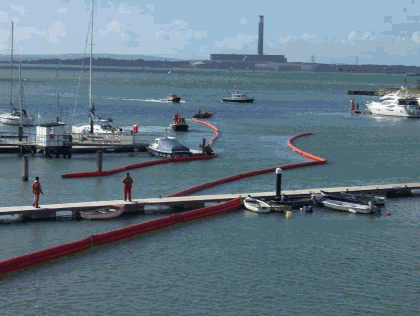
4.2 An oil boom was successfully deployed across 250 metres of the Hamble near the entrance despite challenging tidal and weather conditions. This was the first boom deployment since the construction of the Fishermen's jetty.
4.3 A table-top exercise was also conducted to exercise the Oil Spill Management Team (OMT). RHHA staff were responsible for full management of a theoretical oil spill including the response to unknown injects and the formation of the oil spill management team which also comprised HCC Emergency Planning Department, local police and the Environment Agency.
4.4 The day was also an opportunity to demonstrate and explain to the Harbour Board, The Management Committee, various stakeholders and the local community how the Harbour Authority would proceed should an oil spill response be required. During the day briefings were given by the Harbour Master, the Assistant Harbour Master (Environment), OSRL&EARL and HCC Press Office to local residents, local businesses, emergency planning officers from Eastleigh Borough Council, Fareham Borough Council, Hampshire County Council, the Environment Agency, Coastguard, the River Hamble Management Committee, Police Contingency Planning Teams, the Marine Police and the Harbour Board.
4.5 The exercise was highly successful with positive feedback. On conclusion of the exercise a press statement was released detailing the days activities.
4.6 The River Hamble Oil Spill Contingency Plan has now been confirmed by the Maritime Coastguard Agency and is undergoing printing by Hampshire Printing Services prior to distribution. Attached to this report at Annex A is the post exercise report.
4.7 Notices have been put up at all fuelling berths on the River to remind skippers to monitor their activities when refuelling (to prevent fuel spills) and of their responsibilities to the environment.
5. Environmental Groups on the River Hamble
5.1 A meeting of the Hamble Estuary Partnership (HEP) will be held in November. The Estuary Management Plan is due for review in 2008 and will require significant input from the RHHA.
5.2 There have been a number of recent staff changes from other agencies and authorities who have responsibilities covering the River and so a meeting was held with all relevant environmental/biodiversity officers to improve working relationships and discuss current environmental issues on the River. The meeting was a success and the benefits of improved relations have been evident throughout discussions surrounding consent applications.
6. Waste Management
6.1 The Port Waste Management Plan for the River Hamble is the responsibility of the RHHA. This plan is currently undergoing its 3 yearly review in line with the Merchant Shipping (Port Waste Reception facilities) Regulations 2003, on completion of which it will be submitted to the MCA for approval.
6.2 A new sewage pump-out station was installed earlier this year as part of the refit of the new Harbour Master's Jetty at Warsash.
6.3 New and changing waste legislation is driving the way we manage and dispose of waste. Current changes to the Landfill (England & Wales) Regulations 2002 are setting targets that will apply to the RHHA, marinas, boat yards and clubs with the aim of reducing waste production and diverting waste away from landfill. The most logical option will be to provide recycling facilities.
6.4 The HM and AHM (E) are currently working with the Green Blue to set up a river-wide scheme called "Get on Board and Recycle". The most effective way of encouraging boaters to recycling is by having a scheme that mirrors that in the home. Different processes for recycling currently operate on the two banks of the river which might lead to confusion for boaters wishing to recycle. Our aim is to have a consistent approach throughout the river and we are currently in talks with various marinas and local councils to establish a simple and recognisable system for implementation for the start of next season.
6.5 MDL and Premier are currently running recycling trials from which we can learn, and our aim to also run a trial with a selection of regular boaters next season to diarise how they are managing their recycling, finding provision of facilities, and changing behaviours with regards to purchasing packaging and separating recyclables on board.
6.6 The long term aim will not only be to help establish recycling points throughout the river but also to help river users to achieve a recycling regime aboard their boats. We hope to achieve these aims though a number of initiatives but mainly by providing waste reception points, information and guidelines as well as providing further updates on our website of recycling locations as they become established in harbours and marinas throughout the Solent This scheme is still in the early stages and very positive feedback is being received from marina operators and councils.
7. Student Placements
7.1 Two students studying for a degree in Coastal & Environmental Management at Bournemouth University were accepted by the Harbour office for a 6 week placement during the summer. Both Students not only gained a valuable insight into all aspects of running a harbour office, but also assisted staff with various tasks including moorings management and environmental site appraisals.
8. Impact Assessments
8.1 This report provides a position statement only, therefore an impact assessment, in terms of the Race Relations (Amendment) Act, has not been undertaken.
Section 100 D - Local Government Act 1972 - background papers | |
The following documents disclose facts or matters on which this report, or an important part of it, is based and has been relied upon to a material extent in the preparation of this report. | |
NB the list excludes: | |
1. |
Published works. |
2. |
Documents which disclose exempt or confidential information as defined in the Act. |
TITLE |
LOCATION |
None. |
ANNEXE A
"Solent Breeze"
Incident Management Exercise
Project Number: 3207
Author: Position: |
Richard Seddon Senior Spill Response Specialist / UKR Team Leader |
27 September 2007 | |
Reviewed by: Position: |
Andy West Team Supervisor / Duty Manager |
08 October 2007 | |
Approved by: Position: |
Jo Unwin Business Manager, Projects |
09 October 2007 | |
Approved by: Position: |
Mr Tony Clatworthy Hamble Harbour Master Co-Author of Oil Spill Contingency Plan |
15 October 2007 | |
Approved by: Position: |
Alison Crang Asst. Harbour Master (Environment) Co-Author of Oil Spill Contingency Plan |
15 October 2007 | |
Operations Department Oil Spill Response And East Asia Response Ltd Lower William Street Southampton SO14 5QE United Kingdom Tel 023 8033 1551 Fax 023 8033 1972 |
| ||

"Solent Breeze"
Incident Management Exercise
Contents
Introduction Executive Summary Background Safety Exercise Play and Observations Recommendations and Actions Conclusion List of Visitors Personnel on Site and HSE Brief |
"Solent Breeze"
Incident Management Exercise
1) Introduction
The scope of this report covers the Incident Management Exercise which was planned & directed by OSRL/EARL on behalf of the River Hamble Harbour Authority (RHHA).
In accordance with the Merchant Shipping (Oil Pollution Preparedness, Response and Co-operation Convention) Regulations 1998, the Maritime & Coastguard Agency (MCA) requires OPRC compliant ports to hold an Incident Management Exercise, which includes equipment deployment at least once every three years.
This report documents the actions of the Oil Spill Management Team (OMT) in response to a simulated oil spill incident & makes recommendations to improve the speed & efficiency of any future response.
2) Executive Summary
The exercise was designed to test the skills of the OMT in response to a realistic oil spill scenario, namely a ship collision outside the River Hamble limits, but with the potential for oil to enter the estuary.
Using the scenario of a collision between two vessels in the Solent, the exercise was run over a three hour period and involved decision making by the representatives from various local government and other organisations in a consultative role. A set of recommendations was produced after the exercise that is contained in this report.
This was the first oil spill incident management exercise for some of the personnel involved, all of whom gained a level of understanding of what was required.
In addition to the Incident Management Exercise, OSRL/EARL (assisted by cadets from Warsash Maritime Academy) carried out a deployment of the River Hamble protection boom to prove the feasibility of joining the boom to the new fishing jetty at Warsash.
3) Background
The exercise was held on the River Hamble at Warsash on 24th September 2007 to simulate a spillage of oil from an incident involving a dredger in collision with a bunker barge on the western approaches of the Solent during the hours of darkness.
The exercise was designed to guide the players to respond to the incident as if it were a real oil spill. The first priority was to mobilise the appropriate people and resources, and develop a strategy to deal with the spill effectively, and stop the contamination spreading with the wind and tidal movements. The players were expected to respond to the situation, as far as possible, as if it were a real incident. Injects with additional information and external phone calls were fed in to the exercise by the exercise co-ordinators.
Scenario:
Location: Solent, Western Approaches
Time: 0330 hrs
Date: Tuesday 24th September 2007
The bunker barge Ruby IV, whilst on passage from Poole to Southampton Docks is heading up the Thorn Channel, south-west of the Bramble Bank. At the same time the Dutch dredger, Sea Plough also on passage to Southampton heading west using the South Channel, is about to make the turn at the Bramble Bank. The two vessels are within two cables of each other and the skipper of the Ruby IV isn't aware of the other vessels intentions. As the skipper of the Sea Plough starts to change course to starboard the vessel fails to respond and continues its original course and collides lightly with the bunker barge. The dredger does not sustain any major damage but the Ruby IV is holed on its starboard side aft and ruptures a cargo tank containing 200T of IFO 380. All of the crew of the vessels have been accounted for and no injuries reported. The damaged vessel is brought alongside Fawley Refinery jetty at 07:30 for assessment / survey and is no longer leaking - except for a plume of sheen around the ruptured tank.
Weather: Hypothetical, pre-determined weather for spill modelling purposes Southerly wind 5
Position at time of collision: 500 47' 00 N 010 19' 0.4 W
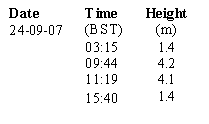
Tides:
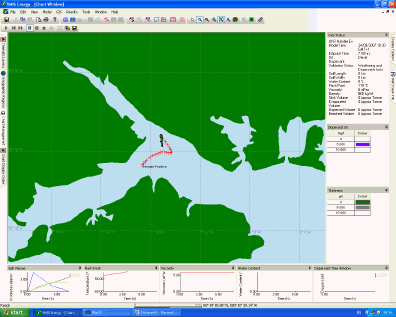
Fig. 1 OSIS model oil spill trajectory
FFDD
Exercise objectives:
· To test the River Hamble Oil Spill Contingency Plan and note all discrepancies or problems for future action
· To exercise and develop the necessary skills required of key individuals in dealing with a Tier 2 oil spill
· To set up the Oil Spill Management Team in situ
· To test the operational interface between OSRL/EARL, River Hamble Harbour Authority and external agencies
· To test the capabilities, response times, and deployment of physical resources and key personnel
· To use all available resources to make the response effective
· To consider arrangements for disposal of recovered oil and oily waste
· To confirm the Harbour's Oil Spill Contingency Plan fully considers the environment and habitat regulations in controlling and cleaning up pollution in the River Hamble
· To log all documents, information and actions to assist/prevent claims and costs
4 Safety
RHHA was responsible for the safe operation and management of the exercise within River Hamble port limits. The HM had ensured that river users were aware of the exercise by posting a `Notice to River Users' on its website, and by having patrol craft patrolling the river whilst the boom was being deployed.
Some of the exercise injects included injuries (simulated) to spill responders that were dealt with by the OMT throughout the exercise.
5 Exercise Play and Observations
5.1 The exercise commenced at 0540h when the Harbour Master (HM) called OSRL/EARL to mobilise the Tier 2 service, and asked for the response team to rendezvous at 0700h at the Hamble Harbour Office.
5.2 At 0710h an initial briefing was conducted by Tony Clatworthy (Hamble HM) for all players outlining details of the spill scenario and what was hoped to be achieved. This was followed by a `safety briefing' presented by Richard Seddon, OSRL/EARL highlighting the key areas of safety concern, such as Personal Protective Equipment (PPE) weather conditions, working aboard vessels, deploying booms on mudflats, etc.
5.3 The gusty overnight weather conditions were improving as from 0730h, although wind was still south-westerly F4 - 5 but reducing during morning.
5.4 A full `Site Safety Management System' (SSMS) site assessment was conducted by an OSRL/EARL staff member - time taken 40 minutes, but did not include air quality measurement.
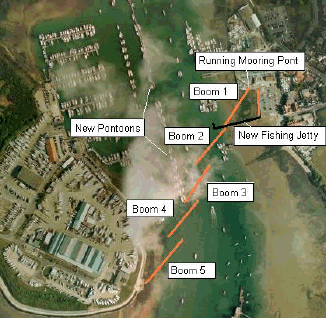
5.5 The boom deployment commenced at 0730h with a team comprising six OSRL/EARL responders led by Gareth McCorkill (UKR Team Leader) and six cadets from Warsash Maritime Academy, with jobs delegated to each team member as required. The plan was to deploy three cascading boom sections of boom on the eastern side of the river, from the foreshore at Warsash adjacent to the Harbour Office rather than a deployment right across the river (see Fig. 2 - Booms 1 - 3). At 0820h the first boom section was deployed and pulled into position by OSRL/EARL's 5m Rib `Sparrowhawk'. The UKR Regional Response Vehicle (RRV) and OSRL's Tier 2 equipment package was used for the deployment. Equipment used included 10m and 20m sections of Sea Sentinel boom and Shore Guardian booms, anchors, marker buoys and ropes.
5.6 OMT member (Phil Griffiths, HCC) arrived at 0815h.
Note: Oil Spill Management Team (OMT) consists of:
Harbour Master; Assistant Harbour Master Environment; Environment Agency; Coastguard; HCC Emergency Planning;
5.7 The HM gave a briefing to the OMT support staff (Hamble Harbour Office staff) on job roles and admin. tasks to be carried out during the exercise.
5.8 The IMT exercise (Incident Management Exercise) commenced at 0850h, time-compressed to 0430h. Information given that 5 - 10 tonnes of IFO 380 was released into the Solent after a collision between two vessels. All available members of the OMT (HCC, and Environmental Group) had now arrived and started to manage the response.
5.9 Injects concerning safety, public affairs and security were fed into the OMT throughout the exercise commencing at this point, by a series of telephone and verbal injects taken from cue cards. The group were asked to discuss how they would deal with each problem.
5.10 The OMT used a chart to plot the expected spill trajectory and then used information from the `Oil Spill Information Manager' (OSIS) computer model to give a more accurate prediction of the areas of beach impact in vicinity of the Hamble River (see Fig. 1). At this stage the HM confirmed he would be calling in a contractor to remove seaweed and debris from beaches before oil impact.
Fig. 2 Aerial view of River Hamble showing cascade boom configuration (Booms 1 - 3 deployed during exercise)
5.11 The use of a Material Safety Data Sheet (MSDS) was discussed and this was
down-loaded from the Internet.
5.12 A number of media and telephone calls from the public came in, mainly
requests for information by newspapers, TV news and the public calls were
reports of oiled birds on local beaches and compensation claims by boat-
owners.
5.13 A media statement was issued approximately 1½ hours after commencement
of the exercise. This was simulated as being managed by and through HCC Media Centre/Press office.
5.14 The exercise continued for approximately 3 hours, and then three groups of
stakeholders including local government, industry and residents, were given a
short briefing by the Harbour Master concerning the Hamble River Contingency Plan. OSRL/EARL as the harbours' Tier 2 oil spill contractor gave a short introductory talk and the environmental risks to the river in the event of an oil spill were discussed by Alison Crang the Assistant Harbour Master Environment.
Observations
The following observations were noted and brought up in the `hot-wash' meeting after the exercise.
5.15 Callout & Mobilisation - HM called OSRL/EARL emergency contact number at 0540h and presumed he was talking to the Duty Manager. He was in fact speaking to OSRL/EARL Security and the mobilisation message was not passed on to the DM by the officer. Also, the `Mobilisation Authorisation Form' was not completed and returned to OSRL according to our mobilisation protocol. This matter was fully investigated and procedures adopted by OSRL to overcome the problem in the future.
5.16 Briefing - In a real event this could have taken longer, to provide time to complete the Site Safety Management System (SSMS) by OSRL/EARL staff, issue PPE to outside contractors and conduct a full HSE briefing.
5.17 Setting up the Teams - The OSRL/EARL Tier 2 contract provides a response team comprising three responders plus a Team Leader, and will require back-up from either RHHA or contractors/volunteers to deploy the River Hamble protection boom, especially during poor weather or high range tides. In the case of this exercise, the extra manpower was welcome although the inexperience of the cadets slowed the process slightly. This of course will always be the situation.
5.18 Boom deployment - Need to amend the lengths of booms on the Plan:
RHHA requested navigational lights to be put on the boom for navigational purposes
5.19 Setting up Control Room
The administration of the control room was well thought out and pre-planned. The introduction of more display boards may be required to help assimilate information quicker, especially to visitors.
5.20 Communications
This was done well, but insufficient writing space and `follow-up' column.
People receiving / logging calls found it hard to hear caller above VHF `chatter' in Incident Command Room / Control Room.
Issue of `traffic' on VHF Channel 68.
Phone numbers that will be regularly required need to be more accessible to save referring to the OSCP each time (i.e. HCC Media Centre)
5.21 Stakeholders briefings
These all went very well, with all questions being answered in full. They gave an excellent opportunity to meet and discuss issues with other authorities who would be involved. Extra copies of the OSCP were requested by Eastleigh and Fareham Emergency Police Departments, and Eastleigh Environmental Health.
5.22 Demobilisation
This went well, and was completed within 1 hour of Endex. However, the addition of another person in a dry suit to assist with pulling in the boom across the mudflats on Warsash foreshore would have made things easier.
6 Recommendations and Actions
The recently revised `River Hamble Oil Spill Contingency Plan' (OSCP) was generally well used with clear communication and actions that were well performed and efficient. A number of recommendations are made as a result of the exercise:
6.1 Call-out
OSRL/EARL will investigate the issue of the mobilisation message not being passed on to Duty Manager, and we intend to conduct further training for our staff in the near future to ensure that the Tier 2 response service is mobilised as per our Service Level Agreement.
In a `real event' the procedure for activating OSRL/EARL is for the client to call the `Emergency Contact' Tel: 023 8033 1551 which will be answered by a Security Officer at its Southampton base. The Duty Manager will receive a notification call from OSRL/EARL Security and he will then call back the client (in this case, the Harbour Master) within a 10 minute timeframe, and will ask for a `Mobilisation Authorisation Form' to be signed and sent by fax to OSRL/EARL. The HM may also be asked to provide a `Notification Form' which gives the Duty Manager information on the characteristics of the oil, spill details, and weather conditions.
6.2 Oil Spill Contingency Plan
· Pre-prepared media holding statement to be available in electronic form - ready to complete and send by fax/e-mail
6.3 Boom deployment
· OSRL/EARL need to amend the lengths of booms in each cascade section and pass this information to RHHA for inclusion in the OSCP.
1st section 90m, 2nd section 80-100m dependant on tide, 3rd section 100m.
This should provide a 30 metre overlap between booms.
· Navigational lights marking boom location to be made available by OSRL/EARL, although not an item kept aboard the RRV.
· Currently there is insufficient boom in the Southern RRV to deploy booms across the River Hamble (5 sections) - more boom to be made available and transported to site on another vehicle.
6.4 Control Room
· To maximise efficiency, the Incident Command Room / Control Room should be large enough for the OMT to work in and have telephone, internet, VHF, and fax access. It should also have areas where information can be displayed:
o Oil slick position and predicted route
o Weather - current and forecast
o Objectives
o Incident Action Plan
o Issues board
6.5 Communications
· Future `log sheets' need more writing space and an additional column to flag up where a follow up action is required.
· People receiving / logging calls should be located in a separate office as it was hard to hear above the VHF and Incident Command Room / Control Room discussions.
· Once VHF contact has been made on Channel 68, change to Channel 10.
· Phone numbers that will be regularly required need to be more accessible to save referring to the OSCP each time (i.e. HCC Media Centre)
6.6 Waste Management
Regardless of the size of the spill the issue of waste management requires addressing in the early stages in order to avoid unnecessary delays to recovery operations. Consideration should be given to the types of waste that are expected to be generated and their respective disposal routes. RHHA have confirmed they have a contractor that can be used for emergency clean up with manual and mechanical clean-up facilities.
6.7 Health and Safety
The most dangerous period of an oil spill is when the oil is freshly spilt. Freshly spilt oil will release gases and each blend of oil will release differing types and amounts of gases. These can be not only flammable but also acutely or chronically toxic. Material Safety Data Sheets (MSDS) for the individual products will provide most of this information but this ought to be backed up by gas monitoring, An MSDS should be requested as soon as the product name is known and access to the site should be restricted until is it known that there is no danger to personnel. Advice is available from OSRL/EARL who hold an extensive portfolio of MSDS sheets.
7 Conclusion
In conclusion, the exercise proved to be a very good learning experience for all parties involved, especially the admin staff in the Harbour Office who had never participated in an oil spill exercise before. The incident was responded to in a calm and efficient manner by all staff with the Tier 2 resource being mobilised within the MCA OPRC guidelines.
A number of issues need to be addressed by the River Hamble Harbour Authority and OSRL/EARL, but the main issue would be the initial communication between the call-out authority and OSRL/EARL and would rank as most important in this context.
8 List of Visitors
Group 1 (11.00am)
Local businesses - Emergency Services - BC EP- HCC EP
Marine Police 2 officers with police patrol boat
Warsash Maritime College David Wilcox
Fire and rescue Richard Caws
Fareham BC (Parking & enforcement) Kevin Wright / Garry White
Fareham BC(Director of Regulatory Services)
Lyndhurst Police Insp. Jennings Sgt Murrant
* Hampshire CC EP Phil Griffiths
* Environment Agency Chris Musslewhite
Group 2 (11.30am)
Harbour Board
Cllr Bryant
Cllr Evans
Chris Moody
Dr Susie Thomson
David Evans
Kate Ball (HCC Press Office)
Group 3 (12.15pm)
Management Committee - Local Residents
Cllr Evans
Cllr Pepper
Cllr Sutton
Mr Lawrence MDL Marine Activities
Mr Frank Greensmith
Note:
* denotes Oil Spill Management Team (OMT) - plus Tony Clatworthy H.M. & Alison Crang AHM (Env.)
9 Personnel on Site and HSE Brief
Date: 24 September 2007
Full Name |
Organisation |
Time/Time On-Site |
Date/Time Off-Site |
Completed HSE Briefing |
Issue PPE |
Signature |
Remarks | |
1 |
Tony Clatworthy |
RHHA |
06.45 |
15.30 |
_ |
_ |
Incident Commander | |
2 |
David Evans |
RHHA |
06.45 |
15.30 |
_ |
_ |
||
3 |
Wendy Stowe |
RHHA |
06.45 |
15.30 |
_ |
_ |
||
4 |
Elaine Brownle |
RHHA |
06.45 |
15.30 |
_ |
_ |
||
5 |
Andy Melkusu |
RHHA |
06.45 |
15.30 |
_ |
_ |
||
6 |
Ray Williams |
RHHA |
06.45 |
15.30 |
_ |
_ |
||
7 |
Jamie Williams |
RHHA |
06.45 |
15.30 |
_ |
_ |
||
8 |
Alison Crang |
RHHA |
06.45 |
15.30 |
_ |
_ |
||
9 |
Stephan Williams |
RHHA |
06.45 |
15.30 |
_ |
_ |
||
10 |
Michael Hart |
RHHA |
06.45 |
15.30 |
_ |
_ |
||
11 |
Brett Winslow |
RHHA |
06.45 |
15.30 |
_ |
_ |
||
12 |
Richard Seddon |
OSRL/EARL |
06.45 |
15.30 |
_ |
_ |
Course Director | |
13 |
Andy West |
OSRL/EARL |
06.45 |
15.30 |
_ |
_ |
||
14 |
Steven Saunders |
OSRL/EARL |
06.45 |
15.30 |
_ |
_ |
||
15 |
Tristan Barston |
OSRL/EARL |
06.45 |
15.30 |
_ |
_ |
||
16 |
George Fabling |
OSRL/EARL |
06.45 |
15.30 |
_ |
_ |
||
17 |
Gareth McCorkill |
OSRL/EARL |
06.45 |
15.30 |
_ |
_ |
UKR Team Leader | |
18 |
Lucy Heathcote |
OSRL/EARL |
06.45 |
15.30 |
_ |
_ |
||
19 |
Steve Storey |
OSRL/EARL |
06.45 |
15.30 |
_ |
_ |
||
20 |
Beth Esau |
OSRL/EARL |
06.45 |
10.40 |
_ |
_ |
Course Director | |
21 |
Phil Griffith |
HCC EMP |
07.30 |
15.30 |
_ |
N/a |
||
22 |
David Wilcox |
WMA |
06.45 |
11.00 |
_ |
_ |
||
23 |
Adel Hawkes |
WMA |
06.45 |
14.30 |
_ |
_ |
||
24 |
Rupert Hughes |
WMA |
06.45 |
14.30 |
_ |
_ |
||
25 |
Jack Pinson |
WMA |
06.45 |
14.30 |
_ |
_ |
||
26 |
Luke Richards |
WMA |
06.45 |
14.30 |
_ |
_ |
||
27 |
Ian Rolfe |
WMA |
06.45 |
14.30 |
_ |
_ |
||
28 |
Matthew Thornhill |
WMA |
06.45 |
14.30 |
_ |
_ |
||
29 |
Chris Musslewight |
EA |
08.30 |
14.30 |
N/a |
N/a |
||
30 |
John Tickle |
HCC |
10.20 |
14.30 |
N/a |
N/a |