
Archived decisions
Hampshire County CouncilHealth Overview and Scrutiny Committee Item 4 27 November 2007 Inquiries Received and Action Taken Report of the Chief Executive |
Contact: Denise Holden ext. 7338
e-mail: [email protected]
1. Summary and Purpose
1.1. This report provides Members with information about the issues brought to the attention of the Committee and the response to these referrals. It sets out the inquiries received, the source of this inquiry and any action taken. Where appropriate comments have been included and copies of briefings or other information attached.
1.2. The approach adopted provides the route through which Patient and Public Involvement Forums (P&PIFs) and other partner organisations (Hampshire district councils, NHS organisations, voluntary and independent sector providers and organisations that are representative of social care service users and carers) can raise issues with the Committee.
1.3. Where inquiries raised with the Committee are already subject to monitoring or other performance management activities the action taken will be focused on the local resolution of inquiries through appropriate sign-posting to the agency best placed to respond.
1.4. Where an issue cannot be satisfactorily resolved between the parties concerned then the Committee can consider options for further action.
1.5. New issues raised with the Committee, and those that are subject to on-going reporting are set out in Table One of this report.
1.6. The recommendations included in this report support the Corporate Strategy aim of maximising wellbeing through the overview and scrutiny of health services in the Hampshire County Council area.
Table One: Inquiries Received and Action Taken
Topic/inquiry |
Source |
Action Taken |
Comment |
Fordingbridge Hospital |
Committee members |
Following the closure of the hospitals to in-patient admissions on the grounds of patient safety the Chairman wrote to the PCT asking for clarification about the process being followed, when the investigation would take place and the arrangements in place to ensure that patients were being treated as locally as possible (letter at Appendix One). Reports of two visits by the P&PIF, one on 2006 and one in August 2007 are attached at Appendices Two and Three respectively. |
Members will wish to be satisfied with the grounds for continued closure to in-patient admissions. If the HOSC is not satisfied then the option exists to refer the matter to the SoS |
Recommendation: members highlight any additional information required from the PCT and indicate if they are satisfied with the case for continued closure on the grounds of patient safety. | |||
Oak Park Hospital |
Chairman/committee members |
The business case for the new Oak Park Hospital is attached at Appendix Four. Members will wish to be clear this provides the range of services committed to in the 2003 consultation. |
|
Recommendation: Any additional information requested by members is provided by the PCT | |||
Milford on Sea War Memorial Hospital |
Chairman/Committee members |
A meeting with key local stakeholders on 23 October indicated broad support for the way forward proposed by the PCT. The recommended next steps by the PCT is attached at Appendix Five |
|
Recommendations: · The PCT provides any additional information requested by HOSC members · Members are satisfied with the next steps put forward by the PCT with regard to engagement with local people. | |||
Continence Services |
Committee Member |
Further to the last meeting additional information has been requested from the PCT with particular regard to: · the rationale/evidence base underpinning the policy limiting the supply of continence pads to 4 per day · how individual patient need is assessed and by whom · how the limitation on supplies is enforced · the prevalence of this policy across Hampshire · what arrangements are in place to ensure that patients dignity/well being is protected at all times- particularly those people with mental health conditions · how patient satisfaction with these arrangements is evaluated · what happens if a patients needs more pads · what are the cost implications of providing pads according to need across different care settings |
The policy sent by the PCT confirmed that people were limited to 4 pads per 24 hours. Subsequent information suggested that for new patients the limit is three pads in any 24 hours. The individual complaint is being pursued through the appropriate complaints procedure. |
Recommendation: The PCT will provide the HOSC with a response to the issues raised. | |||
Incidence of deaths from c.difficle at WEHT and SUHT |
Executive member |
Incidence of c.difficile at both hospitals is reported to the PCT and the relevant figures were shared with the Executive member. In response to a request for additional information SUHT and WEHT will attend the meeting on 27 November to present this information. |
Reporting information required by the PCT is attached at Appendix Six |
Recommendation: Any additional information required by members is provided by the PCT | |||
Development of the PCT Strategy |
HOSC Chairman |
Further to the presentation from the PCT at the last meeting the next steps in developing a strategy to inform strategic commissioning arrangements will be shared with members. |
|
Recommendation: Members agree how they wish to inform this work | |||
Hampshire PCT Performance |
Committee Members |
A summary of PCT performance against key target areas is attached at Appendix Seven |
|
Section 100 D - Local Government Act 1972 - background papers
The following documents disclose facts or matters on which this report, or an important part of it, is based and has been relied upon to a material extent in the preparation of this report.
NB the list excludes:
1. Published works
2. Documents that disclose exempt or confidential information as defined in the Act.
Appendix One: Hampshire HOSC- letter to Hampshire PCT- 23 October 2007.
Fordingbridge Hospital: closure of in-patient admissions
Thank you for advising me of the action that you have taken in response to the complaints about patient treatment at Fordingbridge Hospital. I know that, since first alerting us to this situation on 12 October you have spoken briefly to Denise and produced an up-date for local people about setting out the reasons for your actions. This briefing is very helpful and I would ask that you ensure it is widely distributed to local people as well as County, District and Town Councillors to ensure they are aware of your position.
My purpose in writing is to ask for further clarification about the likely terms of reference and timescale for conducting the external investigation you are setting up. We are mindful of the need for the PCT to take action to protect patients and the confidentiality of staff, however the closure of Ford ward to admissions will have an impact on local people in an area where alternative options for intermediate care are not readily available without travelling some distance. Equally we need to be clear of the focus of the investigation- is it on the incidents in question or a wider debate about the future configuration of services at the Fordingbridge. If it is the latter then we would need very clear information about the grounds for keeping the ward closed until this work is complete.
I know you are very familiar with the sensitivity of local people about community hospitals and the services they provide. I am also aware of the sterling work that the PCT has taken forward with regard to both the Fenwick and Milford on Sea Hospitals. It is essential that all stakeholders are clear about what is happening at Fordingbridge and the way in which the investigation is likely to unfold. Although the PCT will not wish to pre-empt this review, an indication of timeframes and purpose would ensure that there is clarity about the process being followed.
This matter will be considered at our meeting on 27 November and it would therefore be appreciated if you could let me have a response prior to this. It would also be helpful if you could confirm what arrangements are in place to support patients who would otherwise have been admitted to Ford ward.
Appendix Two: Hampshire P&PIF Report
Report: |
Fordingbridge Hospital |
Date: |
12th December 2006 |
Report by: |
Hampshire Primary Care PPI Forum, New Forest Network |
Summary
1. In response to concerns voiced by members of the Public, the New Forest Network (previously New Forest PPI Forum), part of the Hampshire Patient and Public Involvement Forum undertook to carry out formal visits to Fordingbridge Hospital.
2. Two visits took place with the main area of focus being the patient experience.
3. Members of the visiting group spoke to patients, staff and members of the management team along with the Chair of the League of Friends.
4. Main areas of concern to members were:
· Inadequate signage
· Security
· Staffing levels
· Lack of leadership
· Lack of provision of daytime activities for patients
· Bed management system
· Patients' mouth care
5. The following are recommendations from the visiting group:
· There is a need for a stronger management structure
· The members recommend that there be an increase in staffing the Community Rehabilitation Team
· There needs to be a review of the bed management and admissions system
· There is a need for the PCT to identify and act on, methods of stimulation for patients
· Hospital management needs to be more pro-active in working with the League of Friends
· The PCT to take forward the issue of increased and improved road signage with the Highways Department
1. Introduction
1.1. Patient and Public Involvement Forums have a duty to monitor services and inspect premises where health services are provided. Equally, NHS and other organisations are bound to accept the Forum's "visiting powers".
Copies of this report will be sent to the Hampshire Primary Care Trust, the South Central Strategic Health Authority, the Hampshire Overview and Scrutiny Committee and the Commission for Patient & Public Involvement in Health (CPPIH). It will also be made available to the public upon request and will be accessible via the Commission's website www.cppih.org
1.2. The New Forest Patient and Public Involvement Forum (now part of the Hampshire Primary Care PPI Forum) had been approached by members of the public expressing concern regarding the situation at Fordingbridge Hospital. A main area of concern experienced by patients and carers being described as "staff attitude".
The NF PPI Forum agreed to monitor the situation and a subgroup was formed, members of which are Martin Cox, Les Simmons, Audrey Howe and Dr Miranda Whitehead (co-opted). It was decided to carry out formal visits to the hospital on 18th September and 23rd October 2006.
1.3. The visits centred on the in-patient experience but other aspects of the hospital were also considered.
2. Methodology
2.1. Members of the PPI subgroup visited the Hospital on two occasions speaking to patients, staff and managers.
2.2. Prior to the 1st visit posters were displayed within the hospital advising staff, patients, carers and visitors of the Forum's intention to visit. In advance of the second visit letters were also distributed to patients and staff expressing the hope that all interested parties would take the opportunity to talk to the Forum Members.
3. Background
3.1.1. On 18th September the group were taken on a tour of the hospital by Ann Montague, Manager of Inpatient Nursing Services (Ann has since left the organisation). Ann explained the layout and facilities provided by the hospital. Facilities Management (FM) Services are currently hosted by Salisbury NHS Trust with plans in place to transfer this to the New Forest (now part of Hampshire) PCT.
3.1.2. The X Ray department operates both "pre-booked" and "drop in" sessions; this facility is hosted by Salisbury NHS Trust.
3.1.3. Hampshire Partnership NHS Trust have the use of offices within the main building, Community Psychiatric Nurses operate from this base.
3.1.4. School Nurses and the Community Rehabilitation Team all operate from the hospital.
3.1.5. Outpatients clinics are provided by Salisbury Hospitals.
3.1.6. There is a physiotherapy department and room used by the Out of Hours Service on site.
3.1.7. Ford Ward (the only in-patient facility in the hospital) contains 30 inpatient beds, with 20 operating currently; of these 10 are "GP" beds. There is also a palliative care room with en suite facilities.
There are two day rooms for the use of patients, one of which is not well utilised as the patients prefer to be in an area where there is more activity.
3.1.8. Members met with Richard Clarke, Operational Development Manager and discussed the security of the building.
3.1.9. Patients sitting in the day room talked to members of the monitoring group detailing some of their experiences whilst in the hospital.
3.2.1. During the visit on the 23rd October more in depth conversations were held with patients and staff on the ward, the occupational rehabilitation team and the hospital cook (employed by Salisbury Trust) gave of their time to talk to the members.
3.2.2. Ann Hickman, Chair of the League of Friends met with members to present the views of their group.
4. Approaching the Hospital
4.1. Prior to entering the building, members noted that en route to the hospital road signage was inadequate, with the need for additional signs to be placed, by the Highway Authority, at the roundabout on the High Street and on the right hand side of Bartons Road.
4.2. There is a need for larger car park directional signs and improvement in site signage to identify the reception area.
4.3. The disabled access door is not monitored by reception staff.
5. Areas of Concern to Clinical Staff
5.1. The following information was gained from discussions with the Clinical Practice Facilitator (she is leaving a few days after this interview, there does not seem to a replacement for her), a staff nurse on Ford Ward and the Operational Lead for the Community Rehabilitation Team.
5.2. The CPF (Clinical Practice Facilitator) expressed the opinion that community hospital staffing levels should be the same as those for acute beds, i.e. 65% qualified to 35% unqualified staff. At present a shift ought to consist of two trained nurses and three care assistants, but, in practice, numbers are sometimes below this level.
5.3. There is great loyalty to community hospitals from the staff, but it is felt that the divisions of responsibilities for various functions between the PCT, Salisbury Trust, and SUHT leads to a lack of corporate direction which is reflected in the patient experience.
5.4. The hospital has 20 beds running, if a patient is from out of area they are put under the care of a Salisbury Consultant. The SHOs from Lymington Hospital visit three times a week and see the patients who are causing concern to the nursing staff.
5.5. There is a transport problem for people who do not live very near to Fordingbridge.
5.6. Bed management is reported as a problem for GPs. To access a bed the GP has to go through the New Forest Bed Management Team. It is possible to ring and get no answer, not even a messaging service. Therefore, if a local GP has a patient who has had a fall in a nursing home they cannot get through to the BM Team and so cannot admit the patient to Fordingbridge
5.7. Nursing staff training used to be provided by Salisbury. This has changed and staff now have to travel to Southampton General Hospital. Some members of staff are not able to drive and public transport to Southampton is extremely difficult. The position concerning parking costs is unclear to the staff.
5.8. At ward staff level there is a lack of any information, or consultation concerning, indicative budgets.
5.9.1. There have been no new referrals taken for work in the community since 1 June 2006. The Nurse Consultant for older people will be working 2 days a week for 6 months with the Community Rehabilitation Team. Staffing is down across the Forest area by 43%.
5.9.2. The Rehabilitation Team covers a huge geographic area from Hale to Linford to Martin.
The Team consists of: Team Operational Lead x1 37 hours
Physiotherapist x1 14 hours
Physiotherapist x 1 12 hours
Occupational Therapist x1 21 hours
Occupational Therapist x1 22 hours
Physiotherapy assistant x2 36 hours each
Rehabilitation Assistant x1 16 hours
There is currently a Rehab Assistant completing a nursing course leaving 30 hours weekly not being back filled.
The Complex Discharge Team
Senior Occupational Therapist, Occupational Therapist and two Rehab Assistants. This team will "in-reach" to all the community hospitals in the New Forest.
5.10. The patients do not get enough physiotherapy due to staff shortages. If someone is discharged direct to home from Salisbury Hospital for example, they would not receive physiotherapy.
5.11. The team has a good relationship with Social Services staff in Lymington.
5.12. The Multi Disciplinary Team meeting on Mondays works well. The patient electronic record is updated and everyone can access that.
6. Speaking to patients
6.1. Whilst in the day room speaking to patients some commented that although there is a television it was never put on. There were also complaints from patients that they did not have any exercises, not even a walk outside in the fresh air for a short time.
It was noted that there was some encouragement to take part in interaction with staff at the time of the visit by way of arm exercises.
6.2. Interview with Mr A aged 86
Cannot sleep because he is worried
He was admitted to Salisbury Hospital with ulcerated stomach. He is now better. Was in a lot of pain.
His wife is at home in Ringwood (aged 84). She cannot get to see him easily as the journey entails two buses and two walks therefore she does not visit often. She cannot bring his clean clothes, she takes his dirty clothes home and washes them.
Mr A says he is going to Bickerly Green rest home but does not know when. Says it takes ages to sort everything out.
Mr A said he could walk with a Zimmer when he came in (six weeks ago?) but now he cannot walk. At home he could walk about 75 yards with a Zimmer and his wife (to the end of the road). Now he cannot walk at all.
He is brought to the day room by wheel chair every day.
He has had two strokes but has recovered from those although he is very tearful.
Mr A says he gets Physio every day (for a few minutes he thinks), the food is all right. He cannot eat well today because his hands are trembly.
This morning his hands would not work so he could not wash or shave
Mr A said his GP has not been to see him while he has been in Fordingbridge (Dr Hogan), and he does not know why.
Life would be better if I could get about
It's not too bad in here but I get bored sitting about all day
Mr A says his routine is:
Woken up with a cup of tea at 7.
Had breakfast in a chair because he could not sit up in bed, he keeps falling over.
Dressed and organised by about 10 am.
Done nothing since then except sit in a chair.
Cannot read because since the stroke his eyes are gone.
At home he would listen to the radio or the news.
Does not talk to anyone much.
He has not been outside the ward since he has been there.
Goes to bed at 6.30 pm.
When he leaves the ward he would like to be walking again.
His mouth is OK but his teeth are not cleaned every day.
Sometimes a nurse helps him.
Monitoring group member's observation:
Mr A's clothes were clean and fresh. He was wearing clean pyjama bottoms and a shirt and knitted waistcoat. His mouth was dry and a bit cracked.
I watched from a distance as Mr A ate all his food unaided.
He also was seen by a physio assistant while we were there.
6.3. Interview with Mr X (aged 85)
Summary of conversation with Mr X:
Not happy with the food. Does not like the menu. Finds it difficult to swallow since a CVA last year (very thin).
Started at Lymington Hospital and was moved up to Fordingbridge. Not sure why. Waiting to go to a nursing home in Exeter.
Has got worse since he has been in Fordingbridge. Walking has got worse.
He gets physio every day for about an hour?- Uses a zimmer.
The books from the library are all by women (light novels) - this is a bit dull.
Not sure about eating at a table together with other patients.
No help with clothes washing. He gets help with washing himself.
Monitoring group member's observation:
Mr X's shirt and knitted waistcoat were stained with food.
His mouth was very dry.
I watched from a distance as he ate his food. He ate the pudding (instant whip) first and some of the vegetables.
Seen by a physio assistant while we were there.
7.0. Meal Sampling
7.1. When the midday meal was served the cook was in charge in the Day Room, and there were plenty of staff on hand to serve, and to see everyone got a meal. It was also noticed that where required, staff gave their patients a hand by helping them to eat.
7.2. Patients had chosen their own menu previously, the main meal was good, and the selection of sweets were of a good choice. The whole process of distributing the midday meal was efficiently handled, with the cook in charge, she has to be congratulated for the work she does.
7.3. The food provided was of good quality, it was hot and tasty, and there was plenty of it.
7.4. Kitchen staffing is being cut, losing 18 hours per week. The cook has concerns that this should not have an adverse effect on the quality of patient food.
8. Meeting with Ann Hickman, Chair of the Hospital League of Friends
Summary of statement made by Ann:
Everything is very slow at the moment, nothing seems to happen.
Ann said her impression is that the staff are worried about their jobs as the future of the hospital is in doubt; they are doing night duties as well as days because they dare not refuse in case they lose their jobs.
Fordingbridge Hospital has nothing in common with any of the other New Forest community hospitals; they look to Salisbury for their services.
The hospital staff do not appreciate what the Friends could do, they offered to run a Christmas party but this was refused last year.
The LoF have about £24,000 saved with the Summer Fete raising approximately £1,000.
Day care has moved to West Street (Social Services decided).
Day care could be provided at the hospital - there are empty rooms (dialysis room for example).
The goodwill of the staff is the only thing that keeps the hospital going.
9. Other Areas of Concern
9.1.1. Following a previous, informal, visit by the Forum it was brought to the attention of NFPCT that night time security was an issue of concern impacting on the morale of staff. Since that visit security lighting has been installed by the front door to the main building.
9.1.2. During our discussions with Richard Clarke (18 September 2006) we learnt that security is still a problem, with local youths congregating by the front door, small fires having been ignited in the alcove.
9.1.3. A comment was received from a local GP that he does not find it easy to arrange admission for his patients as "the admission system keeps changing".
10. Findings
· 10.1. Inadequate signage.
· 10.2. Security remains a problem, it was reported the outside lights on the drive are not working despite this being reported to management.
· 10.3. Whilst there is great loyalty to the hospital by the staff, moral is being undermined by low staffing levels, the distance staff need to travel to attend training and the costs involved. If the staffing does not include enough trained staff then support workers are not well supervised, and the patients will get more pressure ulcers and have more falls. This also presents a lack of opportunity to learn about individual patients.
· 10.4. Understaffing of the Community Rehab Team is causing:
Delayed discharges
Regression of patients
Limitation of community work
· 10.5. There is a lack of leadership / clear management structure.
· 10.6. There appears to be no provision for daytime activities for patients, a particular problem for those with hearing or sight impairment.
.
· 10.7. With constant changes there is no contact directory for the PCT and, in particular, there appear to be difficulties in phone answering by the Lymington Bed Management Team.
· 10.8. Details of PALS need to be clearly displayed for patients and visitors.
· 10.9. The split in responsibilities between the three Trusts involved in the provision of services and training appears to cause some confusion and inconsistencies.
· 10.10. Patient's mouth care is not good.
11. Recommendations
· 11.1. There is a need for a stronger management structure.
· 11.2. The members recommend that there be an increase in staffing the Community Rehabilitation Team.
· 11.3. The bed management and admissions system is in need of review.
· 11.4. The PCT needs to identify and act on methods of emotional and physical stimulation of patients in the day room.
· 11.5. The hospital management needs to be more pro-active in working with the League of Friends.
· 11.6. The PCT to take forward the issue of increased and improved road signage with the Highways Department.
The members of the Hampshire Primary Care PPI Forum - New Forest Network wish to extend their thanks to members of staff and patients who took the time to speak to us, all of whom were most helpful.
The members appreciate that, in the course of about six years, Fordingbridge Hospital has been a Salisbury "satellite", part of a New Forest PCG, part of a New Forest PCT, part of the South West Alliance PCT and is now part of the Hampshire PCT.
The hospital is a well loved and vital community facility which can be enhanced by addressing the points made in this report.
This report has been ratified and agreed by the members of the New Forest Network at a Meeting in Public held on 23 January 2007.
For further information or clarification on any of the issues raised in this report please contact the Forum Development Officer on 07717 702133 or at [email protected]
Appendix Three: Hampshire PCT P&PIF Report
FORDINGBRIDGE HOSPITAL VISIT 7th AUGUST 2007
MEETING WITH PAULA HULL 21st SEPTEMBER 2007
NATURE OF VISIT AND AIMS
The visit was carried out by members of the subgroup of the Forum who had attended on the previous visits in 2006, namely Martin Cox, Miranda Whitehead, Audrey Howe and Les Simmons. It was an unannounced visit carried out within a period notified to the PCT in accordance with CPPIH protocols.
The visit was intended to identify any changes that had occurred in Ford Ward following the report made to the PCT by the Forum, dated 12th December 2006. Visiting members were aware of the response to that report, made by the PCT on 21st February 2007. The members also took into account the comments made by members of the public at the Meeting in Public at which the response by the PCT was discussed.
As Paula Hull was on leave at the time of the unannounced visit a subsequent meeting with her was arranged to discuss management issues. For the sake of clarity the results of both the visit and the meeting will be combined and will address the eight issues responded to by the PCT in their letter dated 21st February 2007.
VISIT 7th AUGUST
Members are grateful for the time given to them by staff in the course of the visit. In addition to talking to staff they had the opportunity to talk to a significant number of patients.
MEETING 21st SEPTEMBER
The meeting with Paula Hull took place at Ford Ward and was attended by all the Forum members involved in the subgroup.
REPORT
1. Management Structure and Leadership
It was apparent that the management structure now in place, although differing from that described in the letter from the PCT (21st February), is resulting in improved morale. The pending appointment of Sister Isaac should provide further local leadership and build on the improvement arising from the team structure now in place. The new arrangements for training are providing better encouragement for staff participation.
There was an identifiable improvement in the "life" of the ward since last year's visits.
2. Community Rehabilitation Team
It was clear from our visits in 2006 that many patients did not have a clear discharge plan. It was also clear, as agreed by the PCT in their response, that there were staff shortages due to financial constraints. It is recognised that work has recently been undertaken by Paula Hull to ensure that staff establish with patients clear and specific rehabilitation goals. We seek reassurance that CRT staffing levels have been restored to pre-July 2006 levels.
We have some concerns in respect of the arrangement of the "package" required on discharge to enable patients to have adequate support, both in health and social care, in their home environment. There needs to be robust support to the ward team in arranging this, particularly for "out of area" patients.
3. Bed management
The system is still not operating satisfactorily and, members understand, local GPs have on occasion found the need to deal direct with ward staff.
4. Activities for patients
The ward appeared to be much more "alive", compared with the previous visits. We have suggested that approaches could be made to the League of Friends for the funding of ward televisions and/or radios for less mobile patients.
The question of church services was also raised by some patients and Paula has undertaken to check the position with local clergy particularly in the context of the existence or otherwise of a hospital chaplain.
We understand that a business case has been made for an activities co-ordinator and the Forum members strongly support this as an essential appointment .
5. Mouthcare
The revised training arrangements have removed this concern, and the staff are to be congratulated on the care now being given.
6. League of Friends
The relationship with the League of Friends appears to be improving and, subject to health and safety constraints, they continue to be involved in supporting the ward. The latest newsletter reports the comprehensive talk that Paula gave to their meeting in June.
7. Road Signage
The external signage, the responsibility of the County Council, does not appear to have improved. A newly appointed SHO from Lymington found difficulty in locating the hospital on her first visit. As agreed with Paula Hull, one of our local Forum members will be raising this with the local County Councillor.
On site signage does show some improvement.
8. Staffing Levels
It is recognised that actual staffing levels are, at present, under pressure due to long term sickness and suspensions, the latter information being supplied by third party sources. This is resulting in high levels of agency staff to the detriment of both continuity of patient care and finances.
9. Additional Comments
We recognise that staff have been responsive to problems which arose over change of visiting times and that visitors must realise that clinical needs and rehabilitation must have priority.
We have some concerns about the need for door security in view of the fact that there are a significant number of frail elderly patients but understand that this is under consideration.
We have also concerns as to the differing level of clinical cover provided from Lymington as compared with Salisbury. It may be that this needs to be considered as part of the locality Practice Based Commissioning plan.
CONCLUSIONS
As mentioned in our report the visiting members of the Forum were impressed with the improvements which have lead to a significant improvement in patient care.
The Forum, in this report, have made constructive suggestions to maintain and enhance this improvement. In particular they recognise the key role that Practice Based Commissioning has to play in the future of Fordingbridge Hospital.
We welcome a response from the PCT.
NEW GENERATION COMMUNITY HOSPITALS
BID FOR DEPARTMENT OF HEALTH CAPITAL FUNDING
OAK PARK COMMUNITY HOSPITAL, HAVANT
This paper provides the information required to enable the South Central SHA and the DoH to assess whether the proposed investment in this new generation community hospital redevelopment should be supported with central capital funds.
The paper is set out in two parts.
Part 1 provides background to the proposals and explains how these match the vision for the new generation of community hospitals.
Part 2 follows the structure set out in guidance on information required for central assessment of proposed investment in new generation community hospitals.
The structure of this submission is as follows:
PART 1
1. Strategic context
2. Service vision
3. New facilities: Oak Park Community Hospital
PART 2
1. Design principles and service need
2. Formulation of options
3. Affordability
4. Timetable and deliverability
Oak Park Community Hospital is a long established component of strategic plans for hospital provision across Portsmouth and South East Hampshire. The development will be a LIFT scheme. The non-works costs for the scheme which could be supported from central capital funding total around £7M.
1. STRATEGIC CONTEXT
1.1 Strategy for hospital provision in South East Hampshire
For almost two decades the strategy for provision of hospital services in Portsmouth and South East Hampshire has been based on further development of major acute hospital services in Portsmouth, supported by a network of community hospitals.
The largest capital investment in services for the health system locally is the redevelopment of Queen Alexandra Hospital, through a PFI scheme. This scheme is currently under construction and will complete in mid 2009.
The strategy of providing a network of community hospitals not only reflected the desire to provide locally accessible services, but also recognised that the volume of services required by the large catchment population of more than 550,000 could not be best provided in a single acute hospital in Portsmouth.
The strategy was first developed in the late 1980's and involved providing 4 purpose built community hospitals in Petersfield, Gosport, Havant, and Fareham. These plans included rationalising small scale hospital provision then existing on 9 hospital sites, into the planned 4 new community hospitals.
Purpose built community hospitals in Petersfield and at Gosport War Memorial Hospital were developed, replacing 5 smaller local hospitals.
Current plans are to complete the network originally proposed with development of new community hospitals at Oak Park in Havant, and at Coldeast in Fareham. When completed these new community hospitals will replace facilities on 4 hospital sites and a leased community clinic.
The development of Oak Park Community Hospital is being planned as a LIFT scheme. The NHS LIFT Stage 1 Business Case submission for that scheme was approved by the PCT and the SHA in 2006, and is currently with the Department of Health awaiting approval to proceed to Stage 2.
Approval of proposals for Oak Park and Fareham Community Hospitals will signal commitment to implementation of the final element of the network of four community hospitals. These are essential to provided supporting and complementary services, and together with the redevelopment of Queen Alexandra Hospital in Portsmouth, will provided comprehensive hospital services fit for the 21st century for the population of more than 550,000 in Portsmouth and South East Hampshire.
1.2 Interdependencies between main acute and community hospitals
There are key interdependencies between the redeveloped acute services at Queen Alexandra Hospital in Portsmouth and local community hospitals. In relation to Oak Park Community Hospital these will focus on:
· A&E and Minor Injury Units
· In patient pre acute and step down care
· Day care elderly assessment, treatment and rehabilitation
· Out patients and supporting diagnostics, including endoscopy
These key interdependencies have been a consistent and important component of established strategic plans for redevelopment of hospital services in Portsmouth and South East Hampshire.
1.3 Joint Review 2002
In June 2002, the Strategic Health Authority, Portsmouth Hospitals Trust and the three local PCTs completed a review of the PFI scheme for the redevelopment of Queen Alexandra site. This review was required to confirm the necessary commitments before negotiations on the PFI proposals proceeded to Final Business Case stage.
The conclusions from the June 2002 review included the following:
· To centralise acute inpatient services on the QAH site, through a PFI scheme
· To re-provide services on the Gosport peninsular, consequent upon the closure of Haslar Hospital
· To provide a new community hospital on the Oak Park site in Havant, to facilitate the development of more local services and to rationalise existing provision in East Hampshire.
· To re-provide services in Fareham through development of community hospital facilities on the Coldeast site.
Underpinning the PFI capacity plans were a set of assumptions linked to availability of community hospital facilities. Key assumptions included:
· Day Surgery activity equivalent to one theatre would be provided away from the main site. The ISTC which opened in Portsmouth in December 2005 provides this capacity. Some minor surgery will be available in community hospitals;
· Endoscopies could be provided in community hospital facilities in each area;
· 30% of all outpatient activity will be seen in community hospitals
· Elderly rehabilitation beds and elderly day care would be provided in community hospital settings
1.4 Public consultation
Proposals for service development at Oak Park Community Hospital were confirmed following Public Consultation which was completed by the PCT in early 2003.
The SHA endorsed the proposals following Public Consultation. These will result in the closure of the Victoria Cottage Hospital in Emsworth and Havant War Memorial Hospital. Key services provided from these hospitals will transfer to new facility at Oak Park.
2. SERVICE VISION
The White Paper," Our Health, Our Care, Our Say", refers to a new generation of community hospitals "serving catchment areas of roughly 100,000 people". This is the same scale of population as the catchment area to be served by Oak Park Community Hospital. The Borough of Havant has a 2006 population of around 116,000. The Community Hospital will also serve some southern parts of East Hampshire District Council area.
Oak Park Community Hospital will include a range of service models described in the vision for new generation community hospitals in the White Paper. These include:
· Health specialist working alongside generalists, skilled nursing staff and therapists to provide care covering less complex conditions
· Specialists provide clinics for patients, mentoring and training for professionals
· Speedy access to key diagnostic tests
· Intermediate step-up care to avoid unnecessary admissions, and step-down care for recovering closer to home after treatment
· Facilities for patient self-help groups and peer networks to provide support to people in managing their own health
· Access to support for the management of long-term conditions
· Urgent care provided during the day in a minor injuries unit and facilities for "out of hours" co-ordinated at night.
3. NEW FACILITIES: OAK PARK COMMUNITY HOSPITAL
The Oak Park Community Hospital will include the following services:-
· Minor Injuries
· Outpatients
· Endoscopy
· Diagnostic Imaging (ISTC)
· 25 in-patient beds: GP step-up/step-down
· 15 place Assessment/Treatment/Rehabilitation Centre for elderly medical day care
· 20 place Assessment/Treatment/Rehabilitation Centre for older people with mental health problems
The range of facilities to be included in the hospital offers a close fit to many components of the vision for modern community hospitals set out in the White Paper.
PART 2
The structure of the remainder of this submission follows the requirements set out in guidance. There are four main sections:
1. Design principles and health service need
2. Formulation of options
3. Affordability
4. Timetable and deliverability
1. DESIGN PRINCIPLES AND SERVICE NEED
1.1 Locally led
Proposals for a Community Hospital development at Oak Park, Havant, were a key component of the application to establish a LIFT initiative covering the former East Hampshire and Fareham and Gosport PCTs. Following approval of the local LIFT initiative by the Secretary of State the PCTs published the Strategic Service Development Plan in December 2002. This outlined priority schemes, including Oak Park Community Hospital. Widespread support was obtained for the Strategic Service Development Plan. This included support expressed by four Local Authorities, Hampshire Social Services, and the Hampshire Partnership Trust.
The Business Case for establishing the LIFT Co covering East Hampshire and Fareham & Gosport, and for approval of two sample schemes, was submitted to the Strategic Health Authority in June 2004, and approved by the Strategic Health Authority Board in July 2004.
Formal Public Consultation on service changes arising from the development of Oak Park Community Hospital took place in 2003. Key components of these service changes were the closure of Havant War Memorial Hospital and Emsworth Victoria Cottage Hospital. The Strategic Health Authority agreed the content of the formal consultation paper at a Board meeting in January 2003. The agreed process for consultation included three public meetings as well as a range of other publicity, presentations and discussion. The outcome of the public consultation was that the proposals should proceed, with the development of the community hospital. The Strategic Health Authority Board confirmed this in April 2003, with approval of the report from the PCT setting out the conclusions from the public consultation.
Public and patient involvement in service design related to services proposed for Oak Park dates from 2001/2. Initial work included consideration of a range of care pathways, with facilitation provided through the Modernisation Agency. Patient and public involvement has been maintained in planning and design for the community hospital.
Public involvement has also included presentations and open days and open evenings focussed on outline planning proposals submitted to, and approved by, Havant Borough Council.
A representative from the PPI Group has been a member of the Whole Hospital Design Team, which co-ordinates and oversees the work of the full range of user groups planning ward and departmental accommodation for the new hospital.
1.2 High Quality Services
There will be three elements to service provision in Oak Park Community Hospital. These include services provided by Portsmouth Hospital Trust and/or an ISTC provider, services provided by the PCT itself and thirdly services from local GPs. Each of these types of provision is well established in local community hospitals, including Gosport and Petersfield.
Portsmouth Hospitals Trust and the PCT have well established clinical governance arrangements in place to ensure clinically appropriate and safe care is provided. Commissioner reviews ensure that the cost effectiveness of services is under regular scrutiny.
1.3 Patient pathways
Service design in the local network of community hospitals is the result of extensive consultation with patients, the public and local partners. Service strategies fit with the provision of major acute services from the Queen Alexandra Hospital in Portsmouth. The new generation community hospital provision at Oak Park was planned on a whole health economy basis with Portsmouth Hospitals Trust and other stakeholders.
The underlying drive from the patient and public is to ensure services are provided locally wherever possible and that care pathways are simplified.
To this end care pathways are in place which encompass key interdependencies between major acute services in Portsmouth and purpose designed provision in community hospitals. These interdependencies are based on defined clinical protocols which cover elements of acute service provision in community hospitals, linked to the main specialist provision in Portsmouth. At Oak Park these links will cover a minor injuries unit, specialist out patient services with supporting diagnostics, including endoscopy, and day assessment, treatment and rehabilitation of older people.
1.4 Changing population needs
Health needs analysis was undertaken as part of service review and consultation by the PCT as a prelude to determining the proposals for community hospital development at Oak Park. This included analysis of population projections, morbidity and mortality.
1.5 New Technologies
The proposals for Oak Park include provision of an endoscopy suite and diagnostic imaging.
It is anticipated that technological advances will increase the range of investigation and treatments, which will become available using the new facilities. The diagnostic imaging facility will provide the flexibility to introduce scanning in addition to x-ray and ultrasound, should this prove cost effective.
The presence of the ISTC in Portsmouth is providing transferable learning in relation to adoption of new technologies. Examples include remote reading of x-rays and other images. The infrastructure in the new community hospital will allow the adoption of new technologies, where this will be cost effective.
1.6 Planning across primary and secondary care
Because of the significant range of proposed developments across Portsmouth and South East Hampshire, the SHA requested an overarching summary of capacity and funding proposals, covering the three PCTs and Portsmouth Hospital Trust which make up the local health economy. This comprehensive report -"A new direction for hospital and community services in Portsmouth and South East Hampshire" - known as the Capacity Map, covered capacity and development proposals for the next 10 years. It was submitted jointly by the four local NHS organisations to the SHA at the end of December 2005.
The PCT and Portsmouth Hospital Trust Boards approved the Capacity Map proposals at Board meetings in April 2006. The SHA Board expressed support for the strategic direction set out in the Capacity Map, at a Board meeting in May 2006.
1.7 Affordable for the whole health economy
The financial analysis in the Capacity Map assumed that the additional costs of implementing the proposals would have to be met from efficiency savings rather than by use of future growth funding. The Capacity Map reflected that recent SAFF and LDP processes had shown the cost of meeting inflation and "must do" targets had exceeded growth funding available. It was assumed this situation was unlikely to change, with future growth allocations expected to be lower from 2008/9. It was concluded that additional infrastructure costs arising from all the proposed developments in the Capacity Map would need to be funded from efficiency savings.
Furthermore, the view taken in the Capacity Map analysis was that any financial recovery of commissioners and providers should not shift financial problems around the local health system, or significantly destabilize organisations' income bases.
The Capacity Map looked at the totality of major developments proposed across the health system with financial effects over the period to 2014/15. The conclusion of the Capacity Map financial analysis was the range of additional efficiency targets for all local health organisations.
The revenue assumptions for the Oak Park scheme have been updated since the Capacity Map was approved. The Stage I submission for the scheme confirms that they remain broadly in line with the financial framework underpinning it.
1.8 Promotion of integrated service solutions
The proposals for services at Oak Park were developed by the PCT as part of a wider review of strategy and proposed service provision. The functional content and supporting service strategies were reviewed by the PCT as a prelude to completion of the Stage 1 submission for the scheme, approved by the PCT Board and SHA in 2006. This included Local Authorities, Councils of Community Service and a range of voluntary sector organisations. The latter, for example, participating fully in a stakeholder day which focussed specifically on services for older people.
The service solutions are based on the Community Hospital model which has had consistent and widespread local support. The Capacity Map approved by the SHA in May 2006 was based on the Community Hospitals model.
1.9 Engaging staff
Local staff are keen to develop new advanced leadership roles. The additional new consulting and clinic facilities included in Oak Park Community Hospital will be designed to ensure modern facilities are available for a range of nurse and therapist led services, as well as for GP specialist and Consultant clinics in a wider range of specialties. The nurse and therapist led clinics include those provided by Nurse Specialists, Health Visitors, Clinical Psychologists, Speech therapists and Specialist Mental Health Nurses. The development will also provide modern facilities for mentoring and treatment associated with a range of chronic conditions.
1.10 Staff transition
The local move to extend the range of hospital services in the community hospital setting is a further extension of established arrangements. A number of Portsmouth Hospital Trust staff is based in the existing community hospitals in Gosport and Petersfield, and other staff, such as visiting Hospital Consultants, have for many years provided local clinics. Further development of these working arrangements is not expected to present any particular difficulties in areas such as long-term conditions, or training and support.
2. FORMULATION OF OPTIONS
2.1 Patient and public involvement
Public and patient involvement in service design related to services proposed for Oak Park dates from 2001/2. Initial work included consideration of a range of care pathways, with facilitation provided through the Modernisation Agency. Patient and public involvement has been maintained in planning and design for the community hospital.
Public involvement has also included presentations and open days and open evenings focussed on outline planning proposals submitted to, and approved by, Havant Borough Council.
A representative from the PPI Group has been a member of the Whole Hospital Design Team, which co-ordinates and oversees the work of the full range of user groups planning ward and departmental accommodation for the new hospital.
Formal Public Consultation on service changes arising from the development of Oak Park Community Hospital took place in 2003. Key components of these service changes were the closure of Havant War Memorial Hospital and Emsworth Hospital. The Strategic Health Authority agreed the content of the formal consultation paper at a Board meeting in January 2003. The agreed process for consultation included three public meetings as well as a range of other publicity, presentations and discussion. The outcome of the public consultation was that the proposals should proceed, with the development of the community hospital.
2.2 Option appraisal: models of service provision
The PCTs covering East Hampshire and Fareham and Gosport developed and consulted on proposals based on three broad models of service provision. These were described as:
· Dispersed Model
· Community Hospital Model
· Centralised Model
Details of the full list of capital investments required under each model were developed. The Community Hospitals model was the model, which received most support and was adopted by the PCT. The Capacity Map approved by the SHA in May 2006 was based on the Community Hospitals model.
2.3 Site planning
The Oak Park site was acquired by the NHS for use a community hospital in 1993. The site was formerly a secondary school. The site overall consists of a total of 6.42 acres. The site is divided by a narrow link roadway effectively providing two areas for development. The smaller of these two areas, consisting of 1.36 acres, was developed by LIFT as the Children's Services Centre (Phase 1 of the Community Hospital). The Centre opened in March 2006.
The remainder of the site (5.06 acres) is in PCT ownership. Buildings on the site were demolished prior to site acquisition. The site is earmarked for use as a community hospital in the Havant Borough Plan. A resolution to grant Outline Planning Permission was made in April 2004 based on a proposed two-phase development.
The Stage 1 LIFT submission shows a possible site development plan for the two storey community hospital. It also identifies some 5500m2 of the site which may be surplus to requirements. It is the PCT's intention to work with its LIFT partner to maximise the benefit of the surplus land.
2.4 Costs: funding bid
Based on the proposed functional content for the scheme the Stage 1 submission set out a baseline capital cost, for a public sector comparator, estimated at £29.3m at MIPS 514.
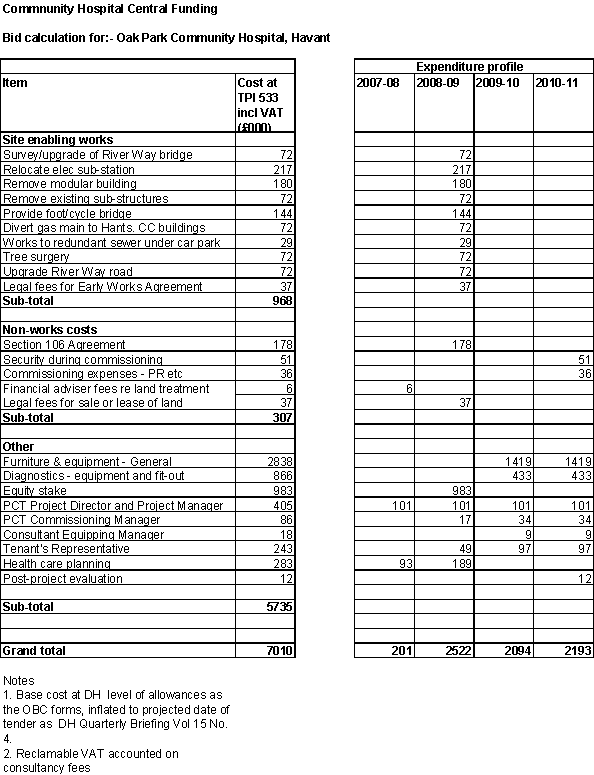
Oak Park Community Hospital will be procured as a LIFT Scheme. This precludes an application for central new community hospital capital funding for the main works costs of the development. However, based on current advice from the Department of Health there are a number of categories of costs which can be funded centrally. These categories and the estimated costs associated with them for Oak Park Community Hospital are summarised in the table below. A detailed breakdown is attached as an annex.
Item |
Cost at TPI 533 incl VAT (£000s) |
Expenditure profile | ||||
2007-08 |
2008-09 |
2009-10 |
2010-11 | |||
Site enabling works |
968.0 |
968.0 |
||||
Non-works costs |
307.0 |
6.0 |
215.0 |
87.0 | ||
Other |
5735.0 |
194.0 |
1339.0 |
2094.0 |
2107.0 | |
Total |
7010.0 |
201.0 |
2522.0 |
2094.0 |
2193.0 | |
3. AFFORDABILITY
The LIFT procurement process envisages the PCT and the LIFT partner initially producing a joint outline estimate of the lease plus charge for the proposed development which is then used as the basis of calculating the Affordability Cap.
The Lease Plus Charge, which is entirely a revenue cost, covers a range of elements, not just the initial capital cost of the building. Whilst it is similar in some respects to a unitary charge for a PFI development, it includes other costs which reflect the nature of the LIFT partnership but excludes the cost of soft facilities management. In general terms the costs included are:
· The capital cost of the building;
· The acquisition of the land for the hospital from the PCT;
· Legal, technical and due diligence costs associated with closing this specific project;
· Lifecycle costs for the building for the twenty five year term;
· Hard Facilities Management for the twenty five year term;
· A proportion of the consortium's initial bid costs under the LIFT procurement process;
· `Partnering Services' such as healthcare planning and property advice provided by the Lift Partner to the PCTs;
· A contribution to the overheads of running the LIFT partner organisation (general manager, chairman, business expenses etc).
The following table summarises the projected revenue costs of the Oak Park Community Hospital, set out in the Stage 1 Business Case submission. Overall, the table shows the projected cost of the Community Hospital is approximately £3.77m per annum. This compares with an estimate of £3.74m in the Capacity Map paper.
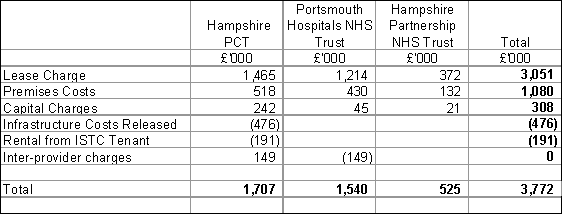
The significant financial impact associated with the capacity map is recognised by the local health economy and, given the financial growth projections for the NHS in the medium term; it is assumed that efficiency savings and service re-design alongside new investment will meet the ongoing revenue consequences. The PCT will work with the other stakeholders to develop a more robust affordability framework quantifying how these efficiencies savings will be delivered incorporating the impact of the service design review outlined. This will be undertaken as part of the preparation of the NHS LIFT Stage 2 Business Case.
The revenue costs associated with the development will be met partly from the closure of Emsworth Victoria Cottage Hospital and Havant War Memorial Hospital but the PCT recognises that there are considerable additional costs which will have to be funded from savings generated through service re-design and greater efficiency. It is intended to revisit the service re-design opportunities available to the PCT following approval of the Stage 1 Business Case submission and prior to the initiation of the detailed design process, in order to finalise the functional/space requirements to support the service model.
4. TIMETABLE AND DELIVERABILITY
4.1 Milestones
The Stage 1 submission is with the DOH awaiting approval. There is as yet no firm date for approval. The submission included the following timescales for the scheme. These are based on a "best case scenario" assuming no slippage.
· Start of detailed design to Financial Close: 12 months
· Construction: 24 months
· Commissioning: 3 months
The best estimate is therefore a period of 39 months from approval of the Stage 1 submission by DoH.
4.2 Deliverability
No significant impediments to the scheme have been identified during site planning to date. Two key factors which should allow good progress are that the site is in PCT ownership and is designated in the Local Plan for a community hospital.
Outline Planning Approval was granted to the PCT by Havant Borough Council for the development of a community hospital on the Oak Park site in June 2004. At the same time both parties entered into a Section 106 Agreement. The Children's Services centre comprises approximately 2000 m2. Detailed planning and design of the Community Hospital will confirm the required areas, but at an estimated 7500 m2, this will be considerably less than earlier estimates on which the planning approval was granted.
The development of a community Hospital at Oak Park has been a high priority for Havant Borough Council for many years.
The LIFT arrangements are well established locally. Oak Park Community Hospital will be the fourth major project to be delivered by the LIFT partner.
Annex
DEVELOPING SERVICES FOR THE POPULATION OF MILFORD-ON SEA
1. INTRODUCTION
1.1. This paper provides a brief summary of the work that has been undertaken in collaboration with local people and stakeholders from Milford-on-Sea to develop responsive health services for the future. The paper also sets out how this work will be taken forward with the support of local stakeholders. The paper has been brought to the Hampshire Primary Care Trust Board for information.
2. BACKGROUND
2.1. Milford-on-Sea is a town of 4,600 population1 situated in the south west New Forest approximately four miles from Lymington. The delivery of health services in Milford-on-Sea has been subject to a long-standing debate between the NHS and local residents. Much of this debate has centred on the role of Milford-on-Sea War Memorial Hospital, a 19 bedded community Hospital, most notably since the former New Forest PCT considered the closure of the Hospital in 2004/05. The opening of the new Lymington New Forest Hospital in January 2007 resulted in the planned transfer of 10 of the 19 beds dedicated to stroke rehabilitation to the new Lymington based facility. At the point of transfer, the newly established Hampshire PCT made a commitment to local stakeholders to keep the remaining 9 beds at the Hospital open pending the development of a vision for local services by the local Practice Based Commissioning group and the local community.
3. DEVELOPING A VISION FOR MILFORD-ON-SEA HEALTH SERVICES
3.1. Since January 2007 the PCT has been working with local community leaders, GPs and local people about the future of local health services the Hospital. In the summer the PCT visited a number of local community groups, talked to 450 local people and received written comments from another 176.
3.2. From these discussions it is clear that local people:
· would like the Hospital to provide a range of health and wellbeing services for the local population;
· want to end the uncertainty surrounding the Hospital and secure its future;
· would like more local support for people with long term conditions to help them stay well and prevent hospital admissions;
· want to see more services locally to avoid the need to travel, particularly for the chronically ill and elderly;
· want more support for carers in the local area;
· believe that rehabilitation and support for older people after an illness or injury is vital;
· have a strong desire that the hospital does not become merely a local centre for offices or administration.
3.3. A series of meetings with the Milford Hospital Stakeholder Group proved to be exceptionally productive, resulting in the proposed model of care that was developed securing strong support from local stakeholders.
3.4. The proposed model of care is focused on supporting local people with long term conditions, providing extended community rehabilitation, day rehabilitation and extended outpatient clinics at Milford Hospital. It will include:
· appointing a community matron, physiotherapist and rehabilitation assistant to strengthen the community rehabilitation service;
· working with the Practice-based Commissioning locality to develop a significantly extended community rehabilitation service to support more people at home;
· extending the range of clinics run at Milford to include nurse-led clinics for:
o falls
o Parkinson's Disease
o diabetes
o heart disease
o chronic lung disease
o stroke
o leg Ulcers
· opening a dialysis unit from January 2008;
· day rehabilitation already takes place, but is planned to increase following the appointment of a new physiotherapist;
· assessment and support for patients and carers with Alzheimers disease provided by the local outreach worker.
3.5. Importantly, in the light of the Department of Health enabling the PCT to extend and develop services at Lymington New Forest Hospital, the PCT has proposed to (and indeed has already opened) rehabilitation beds for local people in the new purpose-built hospital with better access to diagnostics and medical care.
3.6. The PCT is also working with Social Services who are keen to explore using Milford as a base for providing carer support, advice and assessment.
4. NEXT STEPS
4.1. The PCT has already started communicating with local people on the proposals with a view to rapid implementation. Local stakeholders are sad that there will not be any beds at Milford Hospital, but recognise that there are new facilities at the Lymington New Forest Hospital four miles away. Moreover, after two and a half years of discussions with both the New Forest PCT and Hampshire PCT, the stakeholders feel that Milford War Memorial Hospital has a future.
4.2. A key message that has come back from the community was that they wished to see new services in place before the reduction in existing models of care. Consequently, the PCT is already extending the community rehabilitation service. A community matron has been appointed and starts work in November, and a new physiotherapist and rehabilitation assistant are being recruited. The dialysis unit is due to open in January 2008, some nurse-led clinics have already started and more nurse-led clinics will begin over the winter.
4.3. The PCT has already started opening more rehabilitation beds at Lymington New Forest Hospital and it is proposed that patients in need of rehabilitation care will be cared for in these beds from December 31, 2007. In the light of this ambition, as patients currently being cared for in the inpatient beds at Milford-on-Sea Hospital are discharged the PCT is not proposing to admit more patients to these beds.
4.4. A public meeting is planned for Milford-on-Sea to share the new model of care to local people, to complement the communications programme that is already underway.
4.5. The PCT has also written to the Hampshire Health Overview and Scrutiny Committee to set out its proposed action and to seek its support to move to implement these proposals.
5. RECOMMENDATION
5.1. The PCT Board is asked to receive this briefing on the future shape of health services in Milford-on-Sea for information.
Appendix Seven: Hampshire PCT Summary Performance Report. November 2007.
4. SUMMARY OF KEY PERFORMANCE ISSUES - NOVEMBER 2007
4.1 Primary Care Access
In quarter three the PCT continued to achieve the standard for access to a primary care doctor within 48 hours, but did not meet the standard for access to a primary care professional within 24 hours. Work is being undertaken with the two practices concerned to diagnose issues and support solutions, as part of the PCT's action plan to improve access, which has been submitted to the Strategic Health Authority.
4.3 Diagnostic Waiting Times
Overall, September 2007 has seen a significant reduction (554) in the number of patients waiting in excess of the March 2008 national milestone of a 6 week maximum wait. However, there remain substantial services commissioned by the PCT that are considerably adrift of the PCT's trajectory. The principal concern is Audiology services commissioned from Portsmouth Hospitals NHS Trust, although the number of Hampshire patients waiting in excess of 10 weeks decreased by 14% in September (from 1810 to 1565). Audiology performance at Portsmouth is reported to the PCT commissioning team on a weekly basis, while the Turnaround and Performance Group reviews diagnostics waiting times on a monthly basis.
4.4 Ambulance Response Times
Performance in the Hampshire division of South Central Ambulance Service (SCAS) recovered slightly in September and October 2007, but continues to be rated red. For SCAS as a whole (the basis on which Annual Health Check ratings are calculated), performance is currently rated green (but deteriorating) for the category A (8 minutes) and red for the category B (19 minutes) standards. Working with the Ambulance Service's lead commissioners, the PCT has created a commissioning strategy that aims to increase local performance to the required level by March 2008. A final version of this strategy will be presented to the Turnaround and Performance Group in January 2008.
4.5 Inpatient Waiting Times
Overall, September 2007 has seen a slight increase in the number of patients waiting in excess of the March 2008 national milestone of an 11 week maximum wait. Although numbers have increased, the PCT has still achieved its monthly trajectory. However, a total number of 48 breaches of the 20 week maximum wait represents a significant increase on August's figures, with the main concerns being Royal West Sussex and Frimley Park.
4.6 Infection Control
MRSA
The Department of Health and South Central SHA have undertaken a number of review visits across the health economy where acute providers have been identified as being outside trajectory. For Hampshire PCT there is engagement in each of these reviews and subsequent action planning.
· SUHT monthly monitoring
· WEHT monthly monitoring
· PHT weekly monitoring
SCPCT and PCtPCT are the coordinating PCT's for SUHT and PHT, and HPCT for WEHT and BNHHft.
As a consequence there is very close working between the PCT's and the acute organisations and a set of high level committments has been developed to underpin the current practice of working together.
Clostridium Difficile (C Diff)
The PCT has considerable work to do to ensure there is sufficient infrastructure to support root cause analysis across the PCT's provider arm and to engage the HPA in relation to RCA's in private sector nursing homes.