
Archived decisions
Policy and Resources Select Committee
Review of Hampshire County Council's Furniture Procurement and Replacement
Key issues arising in evidence from stakeholders
24 September 2007
Contact: Scrutiny Officer
This document, together with the accompanying budget information at Annexe A contains a summary of the responses from the following stakeholders:
Departmental budget holders/devolved finance units/officers responsible for departmental procurement:
· Head of Business Management, Environment Department
· Head of Finance, Environment Department
· Support Services Manager, County Treasurer's Department
· Assistant Head of Resources, Property Business & Regulatory Department (PBRS)
· Head of Finance, PBRS
· Administration Manager, IT Services
· Head of Management Services, Children's Services
· Head of Finance, Adult Services
· County Manager, Capital Resources, Adult Services
· Business Support Manager, Chief Executive's Department
Managers of relevant services:
· Sustainability Team Leader, Environment Department
· Assistant Director of Environment (Waste and Resource Management)
· Director of Human Resources
· Strategic Health and Safety Adviser
Corporate Procurement Team and Leads of Major Projects
The in-depth response from the Corporate Procurement Team and responses relating to key corporate projects are attached at Annexes B-D.
Part 1
1) Would centralised corporate policy and processes for the procurement of furniture and fittings help HCC to achieve the aims of its Corporate Procurement Strategy? Please consider the following in your answer:
a. Value for money
b. Environmental factors
c. Social factors
d. Any other factors
a) Yes. Cost may be the main driver for getting a centralised corporate policy and processes but we do need to ensure that suppliers meet other criteria i.e. environmental factors. (Environment Department).
b) We must ensure that the Enterprise Buyer List includes only the suppliers that can supply furniture and fittings which accord with requirements of the Corporate Procurement Strategy. (Environment Department).
c) Yes - to improve value for money. It would also ensure that environmental and social factors are prerequisites of contracts. The current County Supplies contracts already provide value for money. (County Treasurer).
d) Relevant contracts from County Supplies already in place which provide value for money. I do not know enough about the contracts to know if improved value for money could be achieved through a centralised policy as we do not have information or benchmarks for our current practice. Savings would be small given our current budget (£60k/pa) (PBRS).
e) Most suppliers offer a similar product with relevant environmental and social standards and I don't know what benefits would be realised through having a corporate policy. (PBRS).
f) Yes in principle - through better competitive tendering procedure, environmental concerns included in the tender etc. Relevant Key Performance Indicators should be included in the tender to help manage availability, response times and performance. (IT Services)
g) To my knowledge, Children's Services furniture is purchase through the County Council centralised buying arrangements and therefore meets the requirements of the Procurement Strategy. Individual decisions about the purchase of furniture and fittings should remain the responsibility of individual departments with the need to balance this cost against other priorities. Given the sums of money normally expended I see little value in moving towards a more centralised system or that the cost of setting up such a system will generate savings or even be cost neutral. (Children's Services).
h) Yes. This would be essential to help consistently apply the principle of value for money on a whole-life cost basis. However, there appears to be minimal evidence to show this is happening on a consistent basis at present. (Sustainability Team).
i) Using approved contractors ensures we have supplier that meet the standards (including health and safety/equalities/insurance/value for money) that HCC requires. The Ashburton Court project has helped to identify a framework arrangement for the provision of furniture and equipment - this should enhance HCC's ability to ensure value for money and purchase from local contractors. (Chief Executive's Deparment)
j) We already used the approved contractors from County Supplies. Contractors are required to demonstrate value for money, quality and, increasingly, sustainability. Where possible, local contractors are used. (Adult Services).
2) Would a centralised corporate policy on the re-use and recycling of furniture and fittings help HCC to achieve the aims of its Corporate Procurement Strategy and Sustainability targets?
a) Yes, but not sure fittings should be included in this.(Environment Department)
b) Suggest a central store (or stores) would be helpful, plus online inventory of available kit (with photos, dimensions etc.) (Environment Department).
c) It is currently difficult to reuse and recycle due to lack of storage space. Flexible working should help reduce procurement through optimising current office accommodation etc. (County Treasurer).
d) County Treasurer's always works hard to recycle or donate to other departments, units or schools. (County Treasurer).
e) Guidance would be helpful, but I think we are already adopting best practice. We look for ways to reuse existing furniture. If no options, we sell to a commercial third party or sell to staff in the department. Very few items put into the waste stream. (PBRS).
f) Yes, it would help to raise the profile of the policy and contribute practically by making staff think in terms of reuse rather than buying new. (IT Services)
g) Yes, this could help to deliver HCC's sustainability targets, particularly if it included the need to undertake Sustainability Impact Assessments (SIA) where appropriate within a new corporate procurement Gateway system. The 2008 CPA Use of Resources Assessment includes the requirement for SIAs to be undertaken for all strategic policy decisions and major projects (a level 4 criteria under the `Internal Control' section). This is not something that is currently in place as standard across HCC and therefore should be considered for future implementation as it is likely to remain in the 2009 assessment criteria. (Sustainability Team).
h) Yes this would be helpful. This would improve mechanisms for redistribution of redundant furniture: it could also include redistributing to schools or community groups to enhance social responsibility. (Chief Executive's Department)
i) Yes, this would help. At present reuse and recycling is fragmented. (Adult Services).
3) What are the barriers to the recycling and re-use of furniture and fittings?
Most commonly quoted reasons:
a) Lack of storage space (in EII Court furniture in corridors has caused problems), although one stakeholder pointed out that the cost of storage relative to the cost of the furniture being stored would need to be a consideration.
b) Incompatibility between pieces of furniture (size, colour, etc)
c) Lack of communication between departments regarding what is available
d) No corporate policy, procedure or guidelines: a lack of clarity about the `rules' for passing furniture to other HCC and non-HCC organisations and people.
e) Time limitations due to pressing operational issues (i.e. using admin time to find new users for items) and space
f) Lack of understanding of `full costs' of the product lifecycle.
g) Unsuitability of furniture not fit for purpose i.e. not conforming to DSE legislation.
h) Finding a suitable commercial third party to collect and sell the items and lack of knowledge of local options available for reuse and recycling.
i) Departments not wanting to release redundant furniture to others without a financial compensation for the asset they had purchased previously.
j) Overhead costs of central arrangements.
k) Desire for and a culture of wanting new furniture when moving offices.
Part 2
4) Does your department/section comply with the Corporate Procurement Strategy in its procurement of furniture and fittings?
a) Yes - procurement done through Enterprise Buyer (Environment Department)
b) Cost effectiveness probably already very good, but environmental factors could be considered more. (Environment Department)
c) Yes - procurement done through preferred suppliers to achieve value for money. However, this does not provide us with details of supplier ethics, product impact on the environment/social factors. (County Treasurer).
d) Yes. All our items are specified by professional interior designers/space planners and not administration staff. (PBRS).
e) Only approved suppliers used. (IT Services)
f) Approved suppliers on SAP used. (Chief Executive's Department)
g) Yes. (Adult Services).
5) What are the barriers in achieving the aims of the Corporate Procurement Strategy in your procurement of furniture and fittings?
a) Enterprise Buyer can restrict flexibility if wanting to purchase from unlisted suppliers (Environment Department)
b) Financial cost due to increasing budget limitations where suppliers may not be seen as cost effective, but should provide overall value for money when taking into account factors outside of initial cost. (County Treasurer).
c) Lack of awareness and understanding of the Strategy. (County Treasurer).
d) Research and knowledge of environmental factors. (PBRS).
e) Knowledge and training of relevant staff that specify items to understand the Procurement Strategy. (PBRS).
f) Lack of storage; L-shaped desks favoured by County are not ideal for flexible working and there may be conflict with other policies and strategies; customised, designer furniture in some officers - potentially in Ashburton Court - could be an issue for replacement or additional similar furniture. (IT Services)
g) There are limited options for specialist furniture providers, users wanting products that are not in contracts etc. (Chief Executive's Department)
h) Cost - achieving a balance between affordability and ideals; restrictions on purchasing through approved contractors only; time. (Adult Services).
6) Would a centralised procurement process help you to achieve the aims of the Corporate Procurement Strategy more effectively? Please consider the following in your answer:
a. Value for money
b. Environmental factors
c. Social factors
d. Any other relevant factors
a) Yes. Particularly for value for money, compatibility with existing furniture. But suppliers would need to be vetted for compliance with, for example, sustainability aims. (Environment Department).
b) The department uses the corporate contracts from County Supplies. This works well and provides value for money managed locally. (County Treasurer).
c) If there was a tighter procurement framework, this would ensure that we were all within the strategy irrespective of local knowledge and training. (PBRS).
d) Corporate guidelines would streamline the process.
e) Current procurement practice works well in that Supplies manage the suppliers and negotiate prices and ensure that they confirm to standards. If procurement was processed centrally then there is a potential problem of double handling as the purchase would need to fill in details of requirement and then this might need to be re-input by a central team. However, controls over availability and type of products could help to ensure more uniformity of furniture which could allow us to move furniture around more easily and enable more flexible working - already part of the FM Modernisation project. (Chief Executive's Department)
f) In practice, a central process exists and is used. (Adult Services).
7) How does your department/section identify a need for new/replacement furniture i.e. is furniture replaced automatically after X number of years?
a) Furniture is supplied or replaced on basis of need: new member of staff, broken/obsolete furniture, to meet health and safety requirements. There is no automatic replacement after a number of years. (Environment Department).
b) Furniture is replaced if no longer fit for purpose (broken or unsuitable). (County Treasurer).
c) There are 5 reasons why new furniture may be purchase (reasons in written evidence). For purchases over £3k, approval from a management team and budget holder needs to be sought. (PBRS).
d) We have no plans to increase our footprint or headcount. We replace furniture when broken or for occasional occupational health requirements. (IT Services)
e) Operational/organisational needs of the department. No programmed replacement. (Children's Services).
f) Requests for furniture normally go through Senior Administration Officer. No formal programme for replacement. (Chief Executive's Department)
g) If broken; if legislation requires its replacement; to improve use of space. (Adult Services).
8) Does your department/section re-use and recycle furniture and fittings?
a) Yes. A recycling company called Rosewood was used in the past, but this ceased due to lack of storage space. (Environment Department)
b) See Q.2d (County Treasurer).
c) Yes. We move items to other parts of the department or sell to staff. (PBRS).
d) Yes where possible. Costs of transporting items between offices need to be considered. (IT Services)
e) Yes, where suitable and possible. (Children's Services).
f) Yes, where possible, given constraints in storage and time. (Chief Executive's Department)
g) Yes as much as possible. (Adult Services).
9) How much of your department/section's furniture and fittings has been recycled or re-used over the past 3 years?
a) Unknown. Estimate 40-50 workstations have been reused in last 12 months. For staff moving from Ashburton Court West, it is anticipated all furniture will be reused and new furniture will be purchase for space-saving solutions. (Environment Department)
b) Not quantified precisely, but details in evidence. (County Treasurer).
c) No statistics available as such, but I personally ask what happens to our furniture - 80% is reused. (PBRS).
d) Hard to quantify. We have not purchase new equipment for office moves, new staff etc. unless there is no alternative. (IT Services)
e) Difficult to quantify. However, there was very little new purchase following the creation of the new Children's Services Department. (Children's Services).
f) Not formally measured - probably between 10-20%. This is mainly because replacement furniture is identified when old furniture has no useful life. (Chief Executive's Department)
g) Estimate 30%. (Adult Services).
10) What barriers exist to the recycling and re-use of furniture and fittings?
a) See Q.3 (Environment Department)
b) See Q. 3 (PBRS).
c) See Q.3 (IT Services)
d) See Q.3 (Chief Executive's Department)
e) See Q.3 (Adult Services).
11) Would a corporate policy on the recycling and re-use of furniture and fittings be of benefit to your department/section? Please consider the following in your answer:
a. Value for money
b. Environmental factors
c. Social factors
a) Yes. See Q.2 (Environment Department)
b) Yes. However a firm procedure would be needed to support this and the resources made available to make this happen. A person/section would need to be responsible, assessment made of whether it is cost effective to store, reuse or dispose or equipment, regular review of stock needs etc. (County Treasurer).
c) Yes - guidance would be helpful. (PBRS).
d) Yes. (IT Services)
e) See Q.4 (Chief Executive's Department)
f) See Q.3 (Adult Services).
12) Who is involved in the procurement of furniture and fittings in your department/section?
a) Office Services team procure all furniture and fittings for the HQ department (Ashburton Court West) via a centrally controlled budget (£55k/pa). Budget controlled by Head of Business support and administered by Office Services Manager. In Area Offices, local Office Managers are responsible for procurement from their own cost centres. (Environment Department)
b) Departmental procurement team. Purchases authorised via SAP. (County Treasurer).
c) Interior Designers and Space Planners. (PBRS).
d) 3 Business Support/Administration Managers. (IT Services)
e) County Office Service Manager. (Children's Services).
f) Procurement generally done through the General Office Administration Officer. Head of Resources has overall responsibility for procurement. (Chief Executive's Department)
g) Facilities Management Team. (Adult Services).
13) Do you consider there to be sufficient procurement expertise in your department/section?
a) Yes. Office Services staff trained and frequently briefed. (See full evidence for details). (Environment Department)
b) Our small team will ensure that we improve our knowledge and skills on procurement. (County Treasurer).
c) Yes - we have people with the knowledge, but we don't always ask the right questions of these people. (PBRS).
d) Yes. (IT Services)
e) Yes. (Children's Services).
f) Yes, but there is still scope for further awareness regarding who to contact for advice. (Chief Executive's Department)
g) Yes. (Adult Services).
14) Are you aware of any staff training in procurement in your department/section?
a) Yes. See table in evidence for full details. (Environment Department)
b) Staff involved in procurement have training from the Hampshire Systems Training Team. 3 members of staff attending training this year. (County Treasurer).
c) No. (PBRS).
d) Yes. (IT Services)
e) Yes. (Children's Services).
f) Yes. See evidence for details. (Chief Executive's Department)
g) Yes. (Adult Services).
15) How many staff in your department/section have been trained in procurement
a) 111 Environment staff trained over the past 2-3 years. (Environment Department)
b) 10. (County Treasurer).
c) Not sure. Approx 400 in Property and up to 100 across Regulatory and Business Services. (PBRS).
d) Half-day seminar for 38 managers and staff. County Supplies training know to have been undertaken by 2 staff. (IT Services)
e) This is a bigger question - not sure of its relevance to this enquiry. (Children's Services).
f) When the new procurement system was implemented in 2003/4 every user was required to undergo rigorous training. This equated to 62 days for 240 people in the department and nearly 50 staff attending events. Now the department includes HR, therefore 100 out of a total 550 staff have training. Most of the department are not involved in procurement. (Chief Executive's Department).
g) All staff - 8. (Adult Services).
Part 5. Other information considered important by stakeholders.
a) Sustainability Team Leader, Environment Department
It is encouraging to see sustainability come through as such a strong theme in the key issues document prepared for this scrutiny review. The only area that is noticeably weak is section 6 which crucially covers HCC's sustainability position. The County Council's Sustainability Team can help provide more information for the Review Group if required, but the headlines on the County Council's Aalborg Commitments Baseline Review can be found at http://intranet.hants.gov.uk/aalborg_baseline_review_06.pdf. Of particular note are two Aalborg Commitments relevant to this topic, both of which have been identified as priority areas for improvement within the County Council's sustainability improvement work:
a. Aalborg Commitment 2.4 - `Ensure that sustainability issues are central to decision-making processes and that resource allocation is based on strong and broad sustainability criteria'.
b. Aalborg Commitment 4.4 - `Undertake sustainable procurement'.
b) Strategic Health and Safety Adviser
Health and safety issues need to be considered alongside any other issues when furniture and fittings are purchased or recycled. Some of the health and safety requirements are driven by legislation.
Legislation
It should be noted that where the items are to be used at work, i.e. not purely decorative, the Provision and Use of Work Equipment Regulations 1998 will apply. This legislation makes it a legal requirement to ensure that equipment provided for use at work is suitable from a health and safety perspective for the use to which it will be put. It also requires that equipment is maintained in a suitable condition and applies to all equipment whether purchased new or second hand or donated.
The Health and Safety (Display Screen Equipment) Regulations 1992 (amended 2002) set minimum requirements for workstations that are used in conjunction with computers and similar display screen equipment. The definition of workstation includes desk, chairs and ancillary equipment such as telephones and document holders as well as addressing light levels, lighting glare and blinds or similar at windows. The requirements are not particularly demanding but need to be included where furniture is to be used in an office or similar.
Health and safety would generally support the adoption of a corporate policy and processes for procurement of furniture and fittings as this would increase control and enable health and safety related issues to be more easily addressed via the processes. These issues are best addressed in the initial specification of the items concerned so that any items ordered match the needs of the person, the location where they will be used, and the nature of the work involved.
Examples of health and safety issues include: fire retardant treatment for soft furnishings, electrical equipment that is safe, provision of ergonomically suitable workstations, provision of chairs that match the specific needs of individuals such as chairs for heavier individuals or equipment for people with disabilities.
Health and safety issues will also need to be addressed where furniture and fittings are recycled. Any items reused need to be suitable and meet any specification requirements. If the intention is to recycle furniture outside of the Council, there can sometimes be concerns about the liabilities involved if the furniture breaks or malfunctions and someone is injured as a result. If furniture and fittings are to be recycled externally then there will need to be an assessment of the condition of the items before they are passed on. As long as the assessment of the condition is undertaken by suitably competent persons, there are no reasons, from a health and safety perspective, that items cannot be recycled.
Health and safety is not a major component of procurement of furniture and fittings, but should be an essential aspect of the process so as to avoid future problems.
c) Director of Human Resources
The HR implications are relatively minimal, except for the issue of staff training. I am aware that training is already in place and current performance suggests that the 2008 target will be set in terms of number trained. However, I think this specific training needs to be underpinned by awareness raising for all HCC staff of the issues that are laid out in the review documentation.
d) Assistant Director of Environment, include Waste and Resource Management
The procurement of furniture and its disposal has a significant impact on the way HCC uses material resources, a Priority Action Area in the Local Area Agreement 2006-2009, and also on materials related Aalborg Commitments, especially under Theme 4, Responsible consumption and lifestyle choices.
Used or remanufactured office furniture usually costs between 30 and 50% of the new price, and increasing demand could reduce costs even further. Significant CO2 savings can be made from reducing production of steel and aluminium. (Purchasing specifications for remanufactured goods, Centre for Remanufacturing and Reuse)
We would strongly support a corporate policy for the procurement of furniture and fittings, including a clear whole-life objective to use material resources more efficiently. Key objectives should be:
i) Diversion of furniture from disposal, and
ii) Purchase of refurbished furniture or furniture with maximum recycled content, whilst minimising cost.
A hierarchy of best practice should be developed, and innovation should be encouraged during the procurement process; the following may be helpful:
Removal:
i. Research provision of collection-for-reuse services mentioned in paragraph 7 of the Review document, and others.
ii. Invite large companies, SMEs and Third Sector providers to tender for management of reuse, refurbishment or removal of redundant HCC furniture, and advise departments/make arrangements for the most sustainable removal route in each individual case. Assess tenders based on environmental, financial (whole-life) and social employment criteria, and as set out in Annex A, the DEFRA/OGC Procurement Policy Framework. Appoint a range of providers as appropriate.
Purchase:
i. Ensure purchasing decisions are made on whole life costs and benefits, not just initial purchase costs, eg durability, suitability for end of life recycling.
ii. Research and provide catalogue options for suppliers of refurbished furniture, considering local social enterprises as well as larger suppliers.
iii. Suppliers should be able to supply spare components for expected life of furniture, and operate a take-back scheme.
iv. For purchase of new furniture, set minimum requirement for % recycled material.
v. Ensure supplier of refurbished or, if necessary, new furniture removes any packaging for recycling.
Annexe A
Scrutiny of Furniture and Fittings - Budget information from stakeholders |
||||
Department |
Environment |
Treasurer's |
Adult Services |
PBRS |
Role |
Head of Business Support |
Support Services Manager |
Head of Finance, AS |
Head of Finance/Asst Head of Resources |
Budget |
£55k/pa |
Actual spending figures below all arrived within budget. |
Actual spending figures all within budget |
Approx £60k pa for Property. |
Spend |
||||
2004-5 |
£33,900 |
£25,973 |
£284,190 |
£228,952 |
2005-6 |
£53,200 |
£6,831 |
£341,422 |
£134,176 |
2006-7 |
£8,800 |
£23,467 |
£153,862 |
£290,730 |
2007/8 - £379 to date |
||||
Comment |
*Furniture & fitments purchased every month (sometimes weekly). Probably 200+ separate orders. SAP reports available on request. |
*Full breakdown of expenditure plus commentary outlined in evidence |
*Full breakdown for PBRS provided in evidence | |
|
|
|
|
|
|
|
|
|
|
Department |
IT |
Children's Services |
||
Role |
Business Support Manager |
Facilities Manager |
||
Budget |
Annual budget set for F&E and specific projects i.e. Hantsdirect. |
Actual spending figures within budget |
||
Spend |
||||
2004-5 |
£4,000 over 3 years |
|||
2005-6 |
2005/6 - £21k IT Services, £6.5k Hantsdirect Project team - to be reused by Contact Centre |
|||
2006-7 |
2006/7 - £9.5k |
|||
2007/8 - £3k IT Services + £15k for Hantsdirect Project Team - to be reused in Contact Centre. |
||||
Comment |
*Furniture & fitments purchased on a need basis throughout year. See evidence for full details. |
*Furniture purchased in 2007/8 |
||
Annexe B
Evidence from Corporate Procurement Team
Part 1: Questions for all stakeholders
1. Would centralised corporate policy and processes for the procurement of furniture and fittings help HCC to achieve the aims of its Corporate Procurement Strategy?
1.1 The current arrangements for the procurement of furniture and fittings do address the Council's general aims in terms of value-for-money and environmental purchasing, but there is scope for improvement. A large proportion of expenditure on furniture is already made against central purchasing arrangements or is separately tendered, but there may be an opportunity for further work on rationalisation, selection and aggregation.
1.2 Evidence of such corporate processes and progress against the objectives of the corporate procurement strategy includes the contract recently awarded for the supply of Office Furniture to Hampshire County Council.
· The Design Services team (Property, Business and Regulatory Services) took part in this process to ensure that the successful suppliers would be able to meet the Council's main requirements over the next four years. The selected suppliers offer furniture which will match in with most of the existing ranges now in use (keeping replacement costs to a minimum).
· Suppliers for desks and pedestals have confirmed that their products are Forest Stewardship Council (FSC) approved. FSC certified forests are managed to ensure long term timber supplies while protecting the environment and the lives of forest dependent people. In addition to this, suppliers also have Programme for the Endorsement of Forest Certification Schemes, which ensures replanting, the conservation of forest wildlife and ecosystems, and the rights of workers and indigenous people. All three of the suppliers also have ISO14001 and stringent Environmental Management Systems (EMS).
· All of the suppliers confirm that all MDF and Chipboard boards originate from recycled, sustainable or replaceable sources. All boards have a low or zero formaldehyde content and carry an environmental accreditation such as Swan or Eco markings. All waste products are required to be re-used within the manufacturing plants either for heating in heaters fitted with afterburners to ensure no toxic fumes enter the environment.
· Suppliers selected are able to offer at least a ten year guarantee on the products offered to Hampshire County Council. The suppliers have also agreed to ensure the continuity of the Furniture for 5 years after the end of the Contract Period to allow for repairs and replacements. All of the suppliers have confirmed that in most cases the furniture can be repaired to reduce the ongoing cost to the Council.
· It has been made a condition that the products specified in the tender must be recyclable at the end of their useful life. In fact one of the operators chairs currently under consideration is the `Think' chair from Steelcase which is itself made from 44% recycled materials, contains no hazardous materials (chrome, lead, mercury or PVC) and is 99.9% recyclable at the end of its life.
1.3 In general terms, County Supplies manages a number of arrangements for the supply of furniture to customers throughout the county. Aggregation and centralised arrangements are indicators of good practice as is our participation in wider collaboration with the other members of the Central Buying Consortium (CBC). The CBC has a Furniture Group, which meets approximately three times a year to review contracts and establish working groups for contracts which are to be re-tendered. The CBC also has a strong relationship with another public sector buying organisation, the Eastern Shires Purchasing Organisation (ESPO).
1.4 Details of the principal suppliers together with an indication of expenditure are provided in Appendix A to this response. With regard to the sustainability agenda, some 49% of these suppliers are based in Hampshire and this rises to 83% of suppliers of office furniture. Further background information is attached to this response as follows:
Appendix B - a schedule of tender exercises due for completion (most relate to the requirements of schools and other education customers)
Appendix C - a breakdown of expenditure by departments in 2004/5
Appendix D - a summary of the major projects in which County Supplies has been involved from April 2005 to the present.
2. Would a centralised corporate policy on the re-use and recycling of furniture and fittings help HCC to achieve the aims of its Corporate Procurement Strategy and Sustainability targets?
Information exchanged with the Environment Department has typically identified paper and cardboard as the most significant waste stream from the County Council's offices and schools and it is this area which has received most attention. With regard to ongoing purchases of furniture, the de facto policy has been that "staff and their managers are expected to ensure that the furniture in use is in a safe condition and is `fit for purpose' and if it does not meet these requirements then it should be replaced." Many furniture products will last indefinitely so there are few hard-and-fast rules about replacement cycles and expenditure is often driven by office re-organisation, and the adoption of new working methods and technology.
Policy messages about the need to reduce purchases of `new' items, re-use of surplus items and recycle have been communicated widely within the County Council and there are undoubtedly many individual examples of where existing furniture in a good condition has been re-used. Agreements have also been concluded for office removals (including provision for the disposal of redundant equipment) and very recently with Green-Works. In terms of the policy environment, it would be beneficial to bring together the information on options for recycling, re-use and disposal to provide more `visible' guidance for building users and budget holders.
3. What are the barriers to the recycling and re-use of furniture and fittings? Please list up to 3 items:
Re-use is reasonably common (e.g. furniture from Ashburton Court has been used in Hampshire House at Eastleigh), but constraints would be:
i. Volume and timing of availability of surplus items
ii. Age and condition
iii. Suitability of design for current requirements (e.g. twin pedestal desks are unlikely to be suitable for users of display screen equipment and older styles are generally less likely to `fit' within designs for modern flexible working environments.)
Re-cycling:
· Awareness of options/prioritisation
· Costs and operating procedures of recycling company (e.g. requirement for minimum quantities, on-site storage prior to collection, ability to process a full-range of items.)
Part 2: Questions for departmental budget holders/resources groups/departmental leads responsible for procurement
4. Does your department/section comply with the Corporate Procurement Strategy in its procurement of furniture and fittings? Please refer to the following three points for consideration:
a. Value for money
b. Environmental factors
c. Social factors
Within PBRS, the Design Services team have an effective working relationship with the buying team at County Supplies and the requirements of the corporate procurement strategy are addressed in relation to the Council's major projects (see also Question 1)
5. What are the barriers in achieving the aims of the Corporate Procurement Strategy in your procurement of furniture and fittings? Please list up to 3 items:
Much expenditure on furniture tends to be project-based and is already spent against arrangements that are made centrally and this area of procurement has not previously been identified as a key target for an internal review. As indicated in Section 5, the priority targets for procurement reviews tend to be larger categories of expenditure. At the same time, the Council is making some good progress on environmental procurement and is increasingly building such considerations into its procurement arrangements.
One of the potential barriers is some uncertainty about specific targets beyond those included in the corporate business plan and about the possible resource impact of further commitments in the area of sustainable procurement.
6. Would a centralised procurement process help you to achieve the aims of the Corporate Procurement Strategy more effectively? Please consider the following in your answer:
a. Value for money:
b. Environmental factors:
c. Social factors:
d. Any other relevant factors:
Major projects are delivered through a centralised procurement process and much of the expenditure by departments and schools is against arrangements made centrally by County Supplies. Suppliers would welcome a firmer advance commitment on the volume and ranges that will be purchased, but it is uncertain that such forecasts would be reliable and there would be a further cost for such co-ordination. Further work on rationalisation and aggregation as part of a centralised process could result in some further economies of scale, but it is difficult to anticipate the scale of any benefit without significant further research.
7. How does your department/section identify a need for new/replacement furniture i.e. is furniture replaced automatically after X number of years?
The PBRS business units do not have a fixed cycle for the replacement of furniture. Over recent years, new purchases have tended to be driven most commonly by the standards required for staff working with display screen equipment and office re-organisation.
8. Does your department/section re-use and recycle furniture and fittings?
Modern furniture would be re-allocated and re-used if possible. End-of-life or broken items have typically been treated as waste.
12. Who is involved in the procurement of furniture and fittings in your department/section?
Within County Supplies, there is a dedicated Principal Buyer for furniture, Karen Wright. Karen is supported by a Project Officer and an Assistant Buyer and the staff have received appropriate training.
13. Do you consider there to be sufficient procurement expertise in your department/section?
Please see answer for Q12
14. Are you aware of any staff training in procurement in your department/ section?
14.1 A corporate skills development programme has been developed by the Procurement Development Team in the Corporate Procurement and County Supplies unit in PBRS and is available to all relevant staff in the County Council.
14.2 Five procurement courses have been developed to meet the needs of staff as agreed by the Corporate Procurement Network in November 2004 as part of the programme to develop procurement skills and competencies. The courses cover the following areas:
· an overview of procurement
· the essentials of procurement
· contract and supplier management (including negotiation)
· specification writing
· procurement partnerships.
In addition, a number of specific workshops, seminars and events have been delivered to respond to requests for support or to promote current issues.
14.3 As at August 2007, 827 delegates from across the County Council have attended the whole range of procurement related training courses, workshops and events, since the start of the programme in March 2004. Of these, 548 delegates have attended the suite of five procurement courses. Table One below shows the number of delegates per course and the total number of courses delivered. 53 places have been filled by Corporate Procurement & County Supplies (CPCS) staff.
Table One - Analysis of Procurement Courses | |||
Course Title |
No of Attendees |
No of Attendees from Corporate Procurement & County Supplies |
No of Courses Delivered |
Procurement Overview |
353 |
16 |
27 |
Procurement Essentials |
123 |
14 |
13 |
Contract / Supplier Management & Basic Negotiation |
21 |
13 |
3 |
Procurement Partnerships |
25 |
5 |
2 |
Specification Writing |
26 |
10 |
3 |
TOTAL |
548 |
58 |
48 |
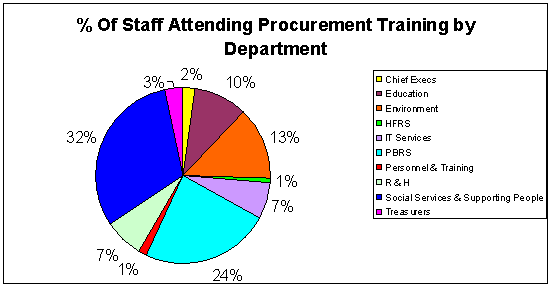
14.4 Attendees by department are shown in the chart below. PBRS staff account for 24% of the total number of attendees.
14.5 In the current year, several CPCS staff have also attended external courses on EU Procurement Directives and two staff have attended Prince Project Management courses.
15. How many staff in your department/section have been trained in procurement?
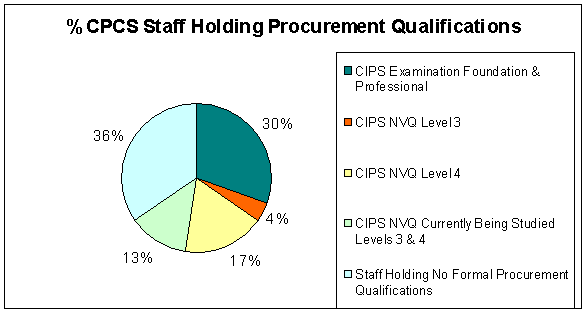
15.1 23 staff within the Corporate Procurement & County Supplies unit in PBRS are directly involved in the procurement of goods and/or services. 15 (64%) of these staff have achieved, or are working towards, membership of the Chartered Institute of Purchasing & Supply (CIPS). A variety of study programmes have been undertaken full examination for Foundation & Professional stages and via the NVQ route. One member of staff is qualified with the Charted Institute of Public Finance and Accountancy (CPFA) and two CIPS qualified staff have also recently taken Prince2 Project Management qualifications (results awaited).
Part 5: Provide any further information you consider important to this review.
Context: Procurement Priorities and Efficiencies 1.1 Whilst the County Council's Corporate Procurement Strategy promotes the importance of improving procurement performance across all areas of the County Council, it does recognise that in practical terms the focus of effort should be on those areas which can provide greatest benefit and added value. 1.2 The Procurement Strategy includes a `portfolio analysis' of the County Council's external spend and this portfolio analysis categorises spend by risk and value. The County Council spends on average £550m a year on goods, works and services (revenue and capital) and the high risk and high value services account for 80% of total spend. The high risk and high value areas of procurement are: · Social care (£160m p.a.) · Property Construction and Maintenance (£130m) · Highways Construction and Maintenance (£45m) · Waste Management (£45m) · Housing Related Support (supporting people) (£30m) · Passenger Transport (£28m). The full procurement portfolio is shown below: PROCUREMENT PORTFOLIO ANALYSIS Bottleneck £m Strategic £m High Risk / Low Value High Risk / High Value
Raw Materials and Agricultural 1 Social Care 160 Education, Training and Information 4 Property Construction and Maintenance 130 Insurance, Medical, Research & Testing 2 Highways Construction and Maintenance 45
Waste Management 45
Housing Related Support (supporting people) 30
Passenger Transport 28
Total 7
Total 438 Routine £m Leverage £m Low Risk / Low Value Low Risk / High Value
Stationery and Office Supplies 6 Consultancy & Specialist Services 15 Curriculum Supplies 5 Utilities and Fuels 14 Furniture and Fittings 4 IT Equipment and Services 12 Cleaning, Janitorial and Hardware 3 Telecommunications 10 Advertising 2 Agency Staff 8 Medical Equipment and Living Aids 1 Cleaning, Disposal and Recycling 5 Plant, Tools and Machinery 1 Printed and Pre-Recorded Media 4 Health & Safety, Security, Storage & Removals 1 Food and Drink 4
Catering and Hire of Facilities 4
Landscaping & Grounds Maintenance 3
Design, Print & Promotional Services 3
Vehicle Supplies & Services 2
Financial & Legal Services 2
Total 22
Total 86 TOTAL PORTFOLIO
£553 m Strategic - Complex and specialist purchasing which is critical to the delivery of services to the public Bottleneck - Failure of supply would cause significant disruption, source not easy to replicate Routine/Leverage - Generic products and services, to be purchased under corporate framework agreements 1.3 Furniture, fixtures and fittings accounts for around 1% of procurement spend and this includes a wide range of products including schools' requirements (such as desks and lockers), carpeting, flooring, window dressings, residential furniture, outdoor furniture and office furniture. The impact of any changes to procurement and management processes should be weighed against the cost of such changes and the impact across the total procurement portfolio of £553m p.a. 1.4 Members on the Buildings, Land and Procurement Panel (BLaPP) set the priorities for procurement efficiencies, improvement and development. BLaPP has set the following priorities for the review of procurement arrangements in the following areas: · Domiciliary care for older people · Domiciliary care for children · Taxi services for home to school and social care · Support to the Supporting People Strategic Review · Payment processes for domiciliary care · Cost of care in residential and nursing care services. These reviews will cover £100m of procurement spend, with the potential to save at least £4m over 3 years. 1.5 Corporate common-use contracts have been the source of recurring procurement efficiency savings over the last three years of £4.2m (across both corporate departments and schools). Furniture, fixtures and fittings related contracts have contributed a total of £202,000 towards this through more effective procurement arrangements including lower prices, clearer specification or requirements and aggregation. | ||||||||
Appendix 1
Appendix 2
Reference Number |
|
Contract Title and Lead Authority |
CBC Spend over Contract Period (est) |
Hants Annual Spend (est) |
Planned Contract Start/Renewal date |
Length of Contract |
|
|
|
|
|
|
|
HS54500T07 |
CBC |
Wooden Storage Furniture (Kent) |
£1,000,000.00 |
£120,000 |
Sep-07 |
4 |
HS54500T7 |
Hants |
Office Furniture for Hampshire County Council (NEW) |
£0.00 |
£1,000,000 |
Sep-07 |
4 |
HS54500T07 |
CBC |
Poly Storage Trays (Kent) |
£500,000.00 |
£50,000 |
Oct-07 |
3 |
HS54612T07 |
Hants |
Removals (NEW) |
£0.00 |
£150,000 |
Oct-07 |
3 |
HS54500T07 |
CBC |
Poly Chairs and Stools (Kent) |
£1,500,000.00 |
£185,000 |
Nov-07 |
3 |
HS54500T08 |
CBC |
Metal Furniture (Hertfordshire) |
£2,000,000.00 |
£150,000 |
Jan-08 |
2 |
HS54500T08 |
CBC |
Furniture - Office Desking & Seating (Kent) |
£10,000,000.00 |
£600,000 |
Jan-08 |
3 |
HS54500T08 |
CBC |
Residential Furniture (Kent) |
£1,500,000.00 |
£150,000 |
Jan-08 |
3 |
HS54500T08 |
CBC |
Curtains and Blinds (Northants) |
£1,000,000.00 |
£200,000 |
Mar-08 |
3 |
HS54500T08 |
CBC |
Street Furniture (ESPO) |
£365,000.00 |
£90,000 |
Apr-08 |
2 |
HS54500T08 |
CBC |
Staging & Audience Systems |
£2,032,000.00 |
£350,000 |
Apr-08 |
4 |
HS54500T08 |
CBC |
Steel Lockers (Hertfordshire) |
£1,200,000.00 |
£50,000 |
Oct-08 |
3 |
HS54500T08 |
CBC |
Classroom Tables (Kent) |
£2,000,000.00 |
£180,000 |
Nov-08 |
3 |
HS54300T08 |
CBC |
Flooring Services (Hertfordshire) |
£1,500,000.00 |
£200,000 |
Nov-08 |
3 |
HS54500T08 |
CBC |
Whiteboards and Noticeboards (Suffolk) |
£3,000,000.00 |
£400,000 |
Dec-08 |
3 |
HS54500T08 |
CBC |
Security and Fire Safes (Suffolk) |
£300,000.00 |
£15,000 |
Dec-08 |
3 |
HS54500T09 |
Hants |
Library Shelving and Display Units |
£0.00 |
£150,000 |
Aug-09 |
4 |
HS54500T09 |
CBC |
Folding Furniture |
TBA |
£120,000 |
Oct-09 |
4 |
HS54500T10 |
Hants |
Entrance Matting |
£0.00 |
£29,000 |
Jul-10 |
4 |
HS54500T11 |
Hants |
Flexible Working Solutions |
£0.00 |
£150,000 |
Jun-11 |
4 |
HS54500T11 |
Hants |
Designer Furniture |
£0.00 |
£250,000 |
Jul-11 |
4 |
|
|
|
|
|
|
|
Appendix 3
2004/05 Furniture Purchases: HCC (excluding External Customers, Colleges and Schools) | |||
Department |
Total Spend by Department |
On Central Contracts |
Other |
|
|
|
|
Chief Executives |
92,411 |
90,483 |
1,928 |
Treasurers |
31,545 |
29,781 |
1,764 |
Education |
51,613 |
44,700 |
6,913 |
Environment |
47,637 |
45,986 |
1,652 |
IT Services |
39,761 |
35,730 |
4,030 |
PB&R |
679,439 |
622,505 |
56,934 |
Personnel HR |
129,872 |
121,461 |
8,411 |
Recreation & Heritage |
368,961 |
309,499 |
59,462 |
Social Services |
398,513 |
376,490 |
22,023 |
Totals |
1,839,753 |
1,676,636 |
163,117 |
91% |
9% | ||
NB.1 This report was produced for 2004/05 data (unfortunately, this overview is very time consuming to prepare and this is the latest available version). | |||
NB.2 A number of contracts have since been let which meet the requirements of specific departments. This has reduced the 'other' spend by approximately £75,000. | |||
Appendix 4
Major Projects Value from April 2005 | ||
Project |
Date of Completion |
|
|
|
|
NCIS - Ticehurst |
May 2005 |
|
NCIS - Willow Court |
July 2005 |
|
|
|
|
|
|
|
NCIS - Emsworth House |
April 2006 |
|
NCIS - Westholme |
May 2006 |
|
Romsey Library |
June 2006 |
|
NCIS - Marlfield |
July 2006 |
|
NCIS - Forest Court |
August 2006 |
|
Hollywater Special School |
September 2006 |
|
NCIS - Oakridge House |
September 2006 |
|
NCIS - Bickerley Green |
October 2006 |
|
NCIS - Fleming House |
November 2006 |
|
Mary Rose (Portsmouth) |
February 2007 |
|
Montgomery House |
March 2007 |
|
|
|
|
|
|
|
Whitchurch Library |
May 2007 |
|
Pinewood Infants |
June 2007 |
|
Contact Centre |
June 2007 |
|
Springwell (Southampton) |
August 2007 |
|
John Hunt Community College (est) |
September 2007 |
|
Winchester Cultural Centre (est) |
November 2007 |
|
Sundridge School |
September 2007 |
|
Woodlands Education Centre |
November 2007 |
|
Ashburton Court (est) |
Ongoing |
|
|
|
|
|
|
|
Total |
£6,083,544 |
|
Annexe C
P&R Select Committee Furniture Review
Part 4: Questions for Lead Officers on major corporate projects:
Ashburton Court Refurbishment
The following response relates directly to the selection and procurement of furniture on the Ashburton Court Refurbishment project.
Questions 1 and 2
Ashburton Court is a phased refurbishment project which is due for completion in the Spring of 2009. The first phase (East Block) is due for occupation at the start of 2008. The requirements for furniture have been developed through a rigorous process based upon:
- A complete audit of all existing furniture in the building.
- Identification in the decanting process of what furniture could move to new locations with the staff on the basis of sustainability and fit for that location.
- The Ashburton Court Project Board has determined that the furniture for East Block should be new on the basis that this assists with the occupation of the first phase and sets an appropriate benchmark for future office development.
- The furniture audit of existing also assessed its condition and suitability for re-use in accordance with current good practice and fit with the requirements of the refurbished building, i.e. size, shape, cable management capabilities etc.
- A decision has yet to be made on the proportion of new and re-used furniture in the future larger phase of North/West blocks. This will be the subject of further design work and briefing discussions with the proposed user departments in 2008.
- There are budget limitations and final decisions on the proportion of new and re-used furniture will also be driven by this availability of funding and the wishes of occupying departments to contribute to enhancing the furniture in the building.
All of the furniture which is an acceptable condition and could be re-used is being stored elsewhere. Any surpluses are being offered to departments for re-use associated with local `churn' moves.
Question 3
The purchase of furniture for Ashburton Court has been fully compliant with the Corporate Procurement Strategy. A new OJEU compliant tendered furniture framework has been established. The Ashburton Court project is the first and major part of this framework, established to run over the next four years. A rigorous selection process and evaluation based on price, quality, sustainability and a basket of other factors was used to determine the selection to the framework. The County Council's Supplies Department led on the tender process in collaboration with Property Services.
Questions 4 and 5
The Gateway Review process for Ashburton Court used the OJEU compliant tender process for selection stated in Question 3 above.
Question 6
Benefits of a detailed and thorough tender process following the `Gateway Review' are that:
- The whole market is tested for availability.
- We can be confident that the best price is obtained through a framework where there are economies of scale offered for larger purchasing agreements.
- All factors related to quality, sustainability, maintenance and service can be evaluated as well as price so the final choice is the best fit for the particular project.
Question 7
No drawbacks have been experienced on the Ashburton Court project.
Annexe D
P&R Select Committee Furniture Review
Responses regarding Hantsdirect Contact Centre
In the past HCC's Property Department funded one and a half Project Officer positions in order to support the Architects and Designers on their work on capital funded projects. This meant that the Project Officer would then work with the Designer on the requirements for the project and obtain quotations, place the order and oversee the delivery and installation. Hantsdirect was slightly different as the project was not funded from capital. County Supplies made recommendations for contracted suppliers that might be able to offer suitable furniture for Hantsdirect. An initial meeting took place with the Interior Designer and County Supplies advised of suppliers to obtain quotes from (Coexistence, Creative Office Environments, Kinnarps, Portsdown). The Designer requested quotes from these suppliers, providing them with a design brief, drawings and furniture specifications and then on receiving the quotations the Designer selected furniture in conjunction with the client, taking into consideration suitability and cost, and obtained final quotes. County Supplies checked the final Schedule produced by the Designer against which orders were then placed.
Under normal circumstances County Supplies will work with the Architect and Designer on capital funded projects as detailed above. However, where the project is funded by the client it is very rare for a Designer to be involved and County Supplies has in these circumstances liaised directly with the client.
New furniture was ordered for this project as the County did not, at the time, have any surplus furniture to relocate. In addition to this Hantsdirect had specific requirements for a call centre layout and therefore required particular furniture in order to accommodate enough staff.
The Interior Designer has overseen the 2nd and 3rd phase installation of the Contact Centre.
NB. Further information regarding the approach to the procurement of furniture and fitments for Hantsdirect is pending and will published shortly.