
Archived decisions
Hampshire County Council |
||
Cabinet |
Item 6 | |
17 December 2007 |
||
Corporate Business Plan Progress - 2007/08 Half Year Corporate Performance Report | ||
Report of the Chief Executive | ||
Contact: Gary Smith, ext 7402/ Chris Tee ext 7677
1 Summary
1.1 On 13 July 2006 three new Corporate Strategy priorities1 for the authority were approved. Following this, in conjunction with DMTs (Department Management Teams), the Corporate Business Plan2 was developed to translate these political visions into specific areas for action. Together these constitute the Council's Corporate Strategy.
1.2 The Corporate Strategy provides the Council with a clear direction and identifies the specific priority areas for improvement. As a consequence, the organisation's half year performance reporting now focuses on these improvement priorities; reporting progress against these and highlighting areas of risk to allow remedial action to be taken. This report also contains the latest Best Value Performance Indicator (BVPI) and Corporate Business Plan performance indicator results in the attached appendices one and two. Together these provide a useful `snapshot' of the work of the organisation. It should be noted that the report provides a cross-cutting view of corporate performance and is not intended to reflect everything that the Council does. The approach, in terms of content and format, will continue to develop.
1.3 This report should be viewed in the context of the major achievement of being rated four out of four in the `Harder Test' Corporate Assessment by the Audit Commission in May - one of only two county councils to do so. In addition, the services for children and young people were judged in the Joint Area Review to be making a `good' contribution in the five core Every Child Matters outcomes as well as the enhanced inspection of the youth service with all areas reviewed judged as `good'. We also opened the new HantsDirect contact centre and successfully completed the ENHANCE project providing 500 nursing home beds across the County.
2 Recommendations
2.1 That Cabinet agree that the 2007/08 half year corporate performance report and results will be used to inform the continuing development of the Corporate Business Plan.
2.2 That strong progress made during the half year and the work by staff to achieve improved results is recognised and that any areas of risk are noted or action taken, as appropriate.
3 Purpose of the Report
3.1 The aim of this report is to provide Executive Members and Chief Officers with a half year progress update against the Corporate Strategy. It shows the extent to which the Corporate Business Plan has been and is being achieved with summary graphs providing an update for each priority by outcome.
3.2 The information contained in this report concern the first six months of the 2007/08 financial year. Contributions towards and progress against each key activity have been provided by departments who have also assessed whether the activity is on target to be achieved or at risk (green to red - see below for full explanation). These have then been presented as graphs to show the `RAG' status for each priority by outcome, this provides an easy to use indication of which outcomes are progressing well and others which are not.
RAG Colour Code |
Risk level |
On track - low risk of non achievement | |
To watch - medium risk of non achievement | |
Action needed - high risk of non achievement |
3.3 It is proposed that any risks and areas for improvement identified should inform the further development of the Corporate Business Plan in 2008/09 and the development of the new Local Area Agreement.
4 Corporate Business Plan Performance Summary
4.1 The Corporate Business Plan, published in February 2007, is now the key performance management reporting mechanism and sets out:
_ Specific outcomes with key activities to deliver
_ Performance measures with targets
Hampshire safer & more secure for all
Summary of overall progress against this priority
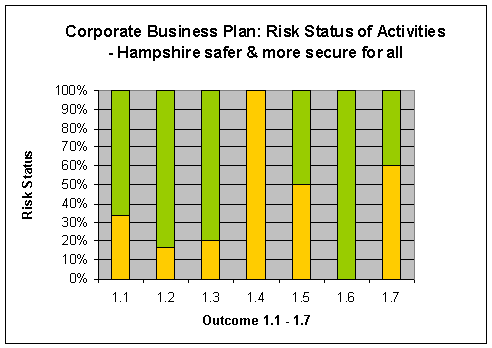
Results show that there is generally good progress being made in many areas. However, the crime figures obtained from Hampshire Constabulary in relation to recorded violent crime in public places, domestic burglaries and the British Crime Survey Comparator show that they are currently likely to fail to meet their respective end of year targets. The graph below depicts the risk status for the activities contributing towards this priority and appendix 3 provides a list of all the Outcomes by their title for ease of reference.
Performance Detail
The ACSO (Accredited Community Safety Officers) service continues to develop with current staffing levels for the service at 42 against an establishment of 48. Achievements for this period include the delivery of the service over a considerably wider area of the county, including new deployments to Test Valley, Hart and East Hampshire.
Provision of bicycles to ACSO staff have proved successful and have increased still further the direct contact with residents. The trial of Airwave radios has also improved both service delivery and officer safety with a further 39 sets ordered so that all ACSOs have one. This has been done in consultation with the Emergency Planning Team and will enhance the delivery of both services in the case of a civil emergency. Community engagement by the service continues with the development of a youth project for year 6 pupils called the Junior Community Team (JCT). The trial of JCT in Gosport has been very well received and plans are underway for a roll out across the county.
The future of the new 101 non-emergency telephone number service is possibly at risk. Central government announced in mid November that with effect from February 2008 only the infrastructure funding will continue. There will no longer be any money to pay for our pilot or any expansion to the service. Consideration needs to be given, in conjunction with our partners, as to options for the service post-February 2008.
Problem Resolution In a Multi-agency Environment (PRIME) project was set up because vandalism in the area of Westwood Country Park was high. CCTV installed elsewhere had the effect of displacing crime to the woods. A programme of activities with young people was therefore set up to engage them as volunteers and for them to see the value of their environment. After two years this was deemed sufficiently successful and is now being wound down. The Youth Offending Team's Restorative Justice programme (RJ) is well established and continues to equip youth offending and residential workers with positive approaches to managing offending behaviour through its emphasis on victim involvement and reparation.
The New Safer Roads Partnership was established in April 2007 to take over from the Safety Camera Partnership. This is developing a full range of strategic casualty reduction initiatives across the Hampshire police force area. However, the recent court case regarding speed limit signing on the A27 will require an urgent review of these signs on safety camera routes across the County.
HATs (Hampshire Action Teams) are now working with parishes on the `Village 30 Project" and a programme for 2007/08 for villages to be included in the first tranche of 30 mile an hour speed limits. Both the 2007/08 Safer Routes to School and `Streets Ahead' programmes are on-track and the `20 is Plenty' campaign, using poster signs advising drivers to adopt lower speeds outside schools, has been launched.
The street lighting outline business case for the Private Finance Initiative (PFI) was submitted to the Department for Transport (DfT) on time on 30 March 2007, but delay in the DfT approval timetable has increased the risk of an unaffordable project resulting. Work is continuing to prepare inventory data and project documentation in anticipation of a successful outcome and to accelerate project delivery if approved. Formal approval is now expected on 18 December.
Emergency Planning and Trading Standards staff contributed to the success in helping contain the outbreak of Foot and Mouth Disease in Surrey by rapidly setting up and enforcing Protection and Surveillance zones within north east Hampshire in conjunction and co-ordination with Defra.
Areas of Risk
· The future of the new 101 non-emergency telephone number service is possibly at risk following the withdrawel of central government funding from February 2008. Consideration needs to be given, in conjunction with our partners, as to options for the service post-February 2008.
· The street lighting outline business case for the Private Finance Initiative (PFI) was submitted to the Department for Transport (DfT) on time on 30 March 2007. There have been delays in the DfT approval timetable but approval is now expected on the 18 December.
Maximising wellbeing
Summary of overall progress against this priority
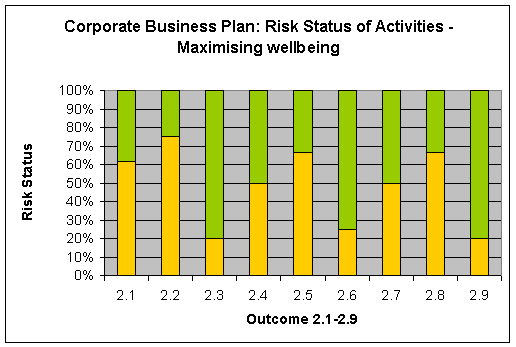
Steady progress has been made with the activities of this priority, particularly in Adult Services which is on track to meet or exceed many of its 2007/08 targets by year end, as well as promoting social inclusion and access to universal services for vulnerable people with both internal and external partners, particularly in the voluntary sector. The graph below depicts the risk status for the activities contributing towards this priority.
Performance Detail
In trying to maximise the wellbeing of older people, the Older People's Area Link (OPAL) project has been established. This provides teams of experienced volunteers to signpost and support isolated older people to re-engage with activities and organisations in their communities and is run by Age Concern Hampshire. It started in September in Totton and Eastleigh and will be eventually working in all Community Innovation Team areas. It has been given additional Big Lottery funding for the next three years.
Consultation with Adult Services service users and other stakeholders has taken place on direct payments and individualised budgets and their ideas and suggestions fed into the development of a high level future solution. The draft (high level) future process mapping is complete and the case for change report is currently being worked on, to refine the details of the proposed new process. A consultation task group has been set up to plan for consultation on the future process.
The Adult Services County Supporting team has developed district and county level forums to ensure voluntary sector participation in decision making. As part of this development the Health and Wellbeing Partnership Board has been established and the County has met both Community Action Hampshire and ROCC, the umbrella organisation for supporting people providers, as their involvement is crucial to the implementation of the wellbeing agenda. In addition, each HAT officer is now allocated a dedicated Adult Services commissioning officer working with each of the 11 districts, improving links and providing greater liaison at a local level.
As regards the modernisation of Day Care, the Adult Services Day Service provision is being revised to ensure that service users benefit from an individual approach appropriate to level of need, supporting social inclusion, independence, wellbeing and choice. The first stage of this has been to ensure that all day care centres from whom services are commissioned (block contracts and in-house) are in a position to meet the Draft National Minimum Standards for Day Carers and provide value for money. To date, the majority of block contracts in the New Forest, Basingstoke and the North and East Hampshire localities have been reviewed and renewed, introducing the new service specification, with capacity and demand aligned and contracts renegotiated accordingly.
Regarding children and young people, the Children's Services Joint Commissioning Strategy Group has agreed a framework to address choice, suitability and stability of placements for children in our care and those being privately fostered and will focus on specialist services, including those for children in care and children and young people with learning difficulties and/or disabilities. There is a risk of non-achievement of placement choice and stability as this is dependent on the supply of suitable foster carers and additional resources to meet enhanced fee levels. There is also a lack of a resource pool for recruitment of children's centre support teachers and any delay in the capital programme would lead to non-delivery against expenditure timescales.
Health inequalities for children and young people that are being addressed include targeting the pockets of deprivation, immunisation rates, sexual health screening and mental health services.
As regards to engaging hard to reach groups, diversity networks are developing as part of a project led by Community Action Hampshire. Specific work has been commissioned to develop local diversity reference groups and are developing the role of Member diversity champions in each HAT. Adult Services in partnership with the PCT, have appointed a number of community development workers, in order to build capacity across black, minority and ethnic (BME) groups. Recreation and Heritage are in the process of identifying a lead person to enable their services to be more responsive to the BME communities.
Consultants have been commissioned to identify by district the number of households with no or poor accessibility to key facilities by public transport or walking and no access to a car. The final report of the Whitehill, Bordon and Lindford accessibility pilot study has set out a methodology for assessing travel needs and poor accessibility. This technique will now be used to prepare Information Packs to inform Town Access Plans.
Areas of Risk
· Placement choice and stability success is dependent on the supply of suitable foster carers and additional resources being provided to meet enhanced fee levels.
· In targeting pockets of urban and rural deprivation, there is a need for better departmental co-ordination, so that all services are working to a common aim.
· The short term funding of community development projects risks achievement of the long term aim of community cohesion.
Enhancing our quality of place
Summary of overall progress against this priority
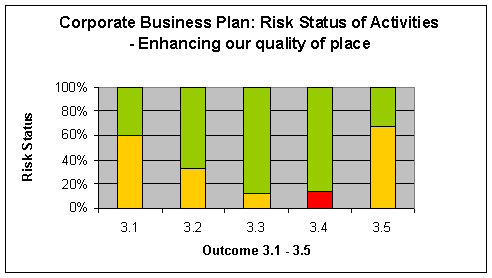
Overall progress under this priority is good. However, there is one activity shown as Red in the graph below; this is the Rowner regeneration project. Good progress has been made on this but further progress is subject to many external factors. The graph below depicts the risk status for the activities contributing towards this priority.
Performance Detail
Eight Hampshire district Waste Collection Authorities (60% of the total) now operate an alternate weekly collection system. Work to reduce the level of contamination of recyclables delivered for recycling has achieved a 2.4% reduction over last year, helping the half year recycling rate for Hampshire to exceed 40%. The original target of recycling 350 tonnes of school waste has been revised to include recycling in public sector offices as 290 additional tonnes had been collected to end of July 2007. Pilot schemes are also underway to improve recycling communication methods, particularly in urban areas, areas of high density and high rise dwellings where recycling and composting can be significantly improved.
Limited work has been undertaken with businesses at Segensworth exploring opportunities for an area travel plan as there has been a lack of staff resources, due to vacancies and increasing workload from development related travel plans. This is restricting progress on increasing the awareness of Smarter Choices initiatives.
The report of the Examination-in-Public of the draft South East Plan endorsed many County Council promoted policies although it recommended a 5% increase in Hampshire's house building. A training programme has been devised in outline (and agreed with the other Hampshire authorities) to give local authority officers the necessary skills to ensure higher design and environmental efficiency standards in new housing development.
A number of key strategic projects and plans have been developed for the stewardship, conservation and management of country parks with some successful lottery awards obtained, e.g. £1.1m award for restoration of Basing House.
The Ashburton Court renovation project first phase construction is on track to be completed ready for occupation at the beginning of 2008 with the main contract let within budget. Decanting moves are now complete for East and West Blocks programme.
Audits of several care properties have been carried out by the Environment department to identify existing biodiversity interest and to give guidance on maintaining and enhancing wildlife for the benefit of those in care.
Excellent results have been achieved in enhancing the breeding success of birds of European conservation concern on the Lymington and Keyhaven Nature Reserve. The condition of the Basingstoke Canal has also been improved through bank restoration. This is one of the richest freshwater habitats in the country. A strategy for the maintenance of biodiversity on the New Forest road network is currently under consultation with partners. The acquisition and use of a conservation grazing herd has improved biodiversity on several countryside sites owned by the County Council.
Areas of Risk
· There are multiple risks associated with the Rowner regeneration project including finance and managing a complex partnership involving the private sector as well as managing local aspirations. These risks will need to be carefully managed.
Management Plan
Summary of overall progress against this priority
Once more progress has been generally good in this area. A well-managed programme of modernisation and recovery has been established within Adult Services, whilst continuing to improve performance through robust monitoring and performance management. Financial targets are reported to be on course for recovery within two years and the modernisation plan is currently on track; it does, however, remain a complex business change programme.
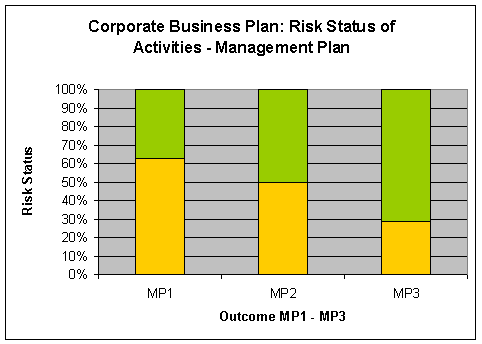
Although not strictly part of the political vision and priorities, the Management Plan element of the Corporate Business Plan was created in order to encompass all the `back office' activities and strategic projects which are needed to contribute to and support achievement of the three corporate priorities. The graph below depicts the risk status for the activities contributing towards the management plan.
Performance Detail
The Corporate Procurement Network continues to provide corporate leadership on procurement improvement and value for money. Over 800 staff have attended procurement training to date. The Corporate Procurement Network has agreed to use the SECE (South East Centre of Excellence) Business Portal as the County Council's Corporate Contract Register. The volume of purchasing through the Hampshire Marketplace continues to increase and stands at over £750,000 to date. Savings for District Councils are estimated to be over £40,000. The corporate common use contract portfolio now exceeds the target of £100m per annum, which is a year ahead of target.
Progress towards even greater corporate integrated planning and reporting is good. The effectiveness of integrated resource and performance management processes was noted in the Corporate Assessment carried out by the Audit Commission in May 2007. Departmental three year financial projections are being categorised alongside the outcomes in the Corporate Business Plan for the first time and a Support Services Review has been initiated which will seek to benchmark cost and performance of the Council against others in the public and private sector. The continuing challenge is to integrate further and to improve consistency across the board.
In relation to the Improving Attendance Project the managers tool kit has been agreed and the project has moved to the implementation stage with processes and criteria published to help managers to control sickness absence within their departments. To date PBRS, Environment, Chief Executive's, Treasurer's and IT Services have all carried out briefing sessions and completed their roll-out strategy. In addition, the Occupational Health Unit has developed a more effective process for the management of ill-health cases, with both the Employment Practice Centre and Occupation Health actively engaging and working with managers to advise, in particular, on the services that Occupational Health offer. Increased numbers of staff are being referred to the service at a time where earlier intervention can be applied and absence can be effectively managed. The Hampshire Learning Centre has delivered 50 days of activity to support the project.
The HantsDirect project has successfully completed Phase one delivered on time and within budget. Phase two (Adults and Childrens Services) is underway. However, the reaccreditation of the Investors in People (IiP) award has resulted in the organisation being awarded "retained status" as three services did not meet the required standards. They will be reassessed in February 2008 with a view to full reaccreditation being awarded.
Areas of Risk
· The Adult Services modernisation plan is currently on track but remains a complex business change programme which will continue to need careful management.
· The HantsDirect project is on track but remains a complex business change programme which will continue to need careful management.
· The main risk to the continued development and embedding of integrated planning and reporting across the organisation is the sheer scale of operations that are carried out by the council.
5 Refresh of the Corporate Business Plan
5.1 The Corporate Business Plan is currently being refreshed for the 2008/09 financial year to update the key activities, ensure they are more specific and update any changes to those responsible for delivering these. The refresh has also sought to ensure performance indicators are FABRIC3 and the corresponding targets are SMART4. In addition, three year targets are being added to align further service planning with three year financial plans.
6 Best Value Performance Indicator Progress
6.1 There is limited new data available at the half year point for Best Value Performance Indicators, with only 68 out of the 107 indicators having new half year data. This year is the final year of Best Value Performance Indicators and from 1 April 2008 we will be moving to the new 198 strong National Indicator Set.
6.2 Particularly notable performance was achieved once more in Children's Services in relation to educational achievement for the academic year 2006/07 where schools continue to improve and outperform the national average of 46.5% with 51% of 16 year olds achieving five or more GCSE grades, including Maths and English. The provisional examination results also show that 62.1% of pupils achieved five or more A*-C grades slightly above the national average of 61.5% and the percentage of pupils achieving more than A*-G grades is significantly above the national average (91.9% compared to 87.7%).
6.3 However, there is a further reduction in the percentage of children leaving care achieving one or more GCSEs grade A*-G, down to 52% from 56%. With 98% of all Hampshire pupils achieving at least one GCSE, there continues to be a significant gap between the attainment of children in our care and their peers.
6.4 Other areas of high performance in relation to the national indicators include the continuing high level of performance in Trading Standards where 100% achievement continues to be reported in compliance with BVPI 166b. The majority of Corporate Health indicators show an improvement with reduced staff sickness levels down to an average of 6.19 days and a further increased percentage of invoices are being paid on time, now reported as 96.2%.
7 Audit of BVPI performance results 2006/07
7.1 The auditors have given the Council no reservations on any BVPI following their review of data quality, part of which included testing the accuracy and validity of a selection of BVPI data. This is the Council's best result yet and vindicates the continuing focus on the improvement in the accuracy of performance indicator collection and reporting systems.
8 Half Year Performance of Local Area Agreement
8.1 Instead of producing a single report on performance of the Local Area Agreement (LAA) as at half year 2007/08, each of the LAA Priority Lead Officers has given (or will be giving) a presentation to the LAA Board and Executive outlining current performance issues. Copies of the presentations and updated performance reports are available on the LAA web pages at http://www3.hants.gov.uk/localareaagreement/cx-laa-performance.htm . The final presentations are being made to the LAA Board on the 18th December. All reports will be available on the LAA website by this time.
8.2 Strong progress continues to be made towards the majority of the LAA outcomes. However, a few areas at high risk of non-achievement have been identified. These include Hampshire's share of South East VAT Registrations where a very stretching target is at high risk of not being met, levels of obesity where the % of people on GPs registers with a body mass index of 30 or more continues to rise and there are continuing concerns that levels of British Crime Survey comparator crime may not be falling quickly enough to meet the March 2008 targets.
8.3 Performance towards achieving outcomes within the current LAA will help to shape the revised agreement to operate from 1 April 2008.
9 Impact Assessment
9.1 The proposals in this report are the result of performance monitoring carried out in accordance with the County Council's performance management policy. This policy applies equally to all services and ensures consistent performance management decisions across all services.
10 Conclusions
10.1 Overall the results are positive and progress against the Corporate Strategy priorities good with over half `on track' with a low risk of non-achievement. Of the remaining key activities 42% have been rated as a medium risk of non-achievement but in many cases these are already being monitored carefully or remedial action already taken. There is, however, one specific area which should be monitored carefully, the Rowner regeneration with further action taken to continue to minimise the risk of its non-achievement.
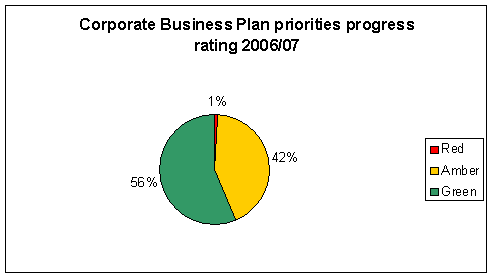
10.2 The assessment of risk associated to each of the activities of the Corporate Strategy and Corporate Business Plan have been provided by those responsible for the work being carried out. They are given here in good faith to give you a sense of the progress made but it is recognised that this process still needs further refinement.
10.3 The positive progress in improving performance has to be seen in the context of the financial pressures under which the County Council is operating. Efficiency and other savings of £18.9m are included in the 2007/08 budget and demographic and inflationary spending pressures are being managed within tight budgetary assumptions. Good progress is also being made in managing these budget pressures, as reported to the Cabinet in November.
LINK(S) TO CORPORATE STRATEGY | ||
Yes |
No | |
Hampshire safer and more secure for all |
_ |
|
Maximising well-being |
_ |
|
Enhancing our quality of place |
_ |
|
Section 100D - Local Government Act 1972 - background papers
The following documents disclose facts or matters on which this report, or an important part of it, is based and has been relied upon to a material extent in the preparation of this report.
Departmental returns of performance results - held by the Corporate Performance Team and by departmental performance contacts
N.B. The list excludes:
1. Published works
2. Documents which disclose exempt or confidential information as defined in the Act.