
Archived decisions
Item 8
Report to the
Transport for South Hampshire Joint Committee
Date: 8 January 2008
Report by: Keith Willcox, Project Director (Hampshire County Council)
tel: 01962 846997 email: [email protected]
Subject: Development of a Freight Strategy for Transport for South Hampshire
Purpose of the Report
To seek support to develop a Freight Strategy for the Transport for South Hampshire (TfSH) sub-region. As a parallel process, a Freight Strategy for the county of Hampshire is being developed. The report addresses four considerations:
(i) why a Freight Strategy is needed for the TfSH sub-region;
(ii) what should be included (outline of contents and indicative list of policies);
(iii) timescales of preparation of the strategy; and
(iv) which stakeholders will be consulted during the strategy development.
Recommendations
1. That approval be given to commence work on the development of a Freight Strategy covering the South Hampshire sub-region.
2. That the draft contents list and indicative policies form the starting point for informal consultation.
3. That approval be given in principle for the establishment of a Transport for South Hampshire Freight Forum to lead on the development of the Freight Strategy and subsequent future reviews.
Why a Freight Strategy is Needed
1. The preparation of a freight strategy will facilitate partnership working with freight industry stakeholders to identify what the key issues are that affect freight within the sub-region, and a mechanism to begin to resolve them. The process of dialogue with stakeholders will allow careful consideration of the social, economic and environmental impacts of freight transport, and allow a balanced consensus view to be formulated.
2. Once the strategy has been produced, and a TfSH Freight Forum has been established, both will help to inform future policy development and investment decisions within the sub-region. The flow diagram below shows how the freight strategy would fit in.
National |
EU Level |
Regional Transport |
Stakeholder |
||||||||
|
Policies |
Strategy |
Consultation |
||||||||
|
|||||||||||
|
TfSH Freight |
Periodic |
TfSH | ||||||||
|
Strategy |
Review |
Freight Forum | ||||||||
Funding |
Local Transport Plan |
||||||||||
Allocation Priorities |
Policies (HCC, SCC & PCC) |
||||||||||
|
|||||||||||
Local Transport |
|||||||||||
Investment Decisions |
|||||||||||
 Policies




3. The strategy will contain an action plan that will identify short, medium and long term measures that stakeholders can take forward to tackle specific identified problems and issues. The strategy will foster continued close partnership working between stakeholders with an interest in the freight transport sector, helping to improve the understanding of freight issues and provide a forum to discuss the merits of potential solutions.
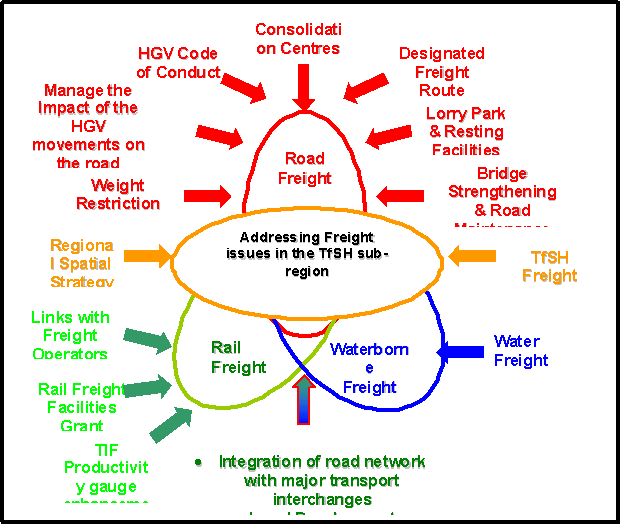
4. The diagram below shows areas that the strategy should take account of in terms of road, rail and maritime freight.
What Should Be Included in the Strategy
5. A suggested list of contents for the strategy is attached as Appendix 1. The final structure and content of the strategy will be subject to the agreement of the TfSH Freight Forum and further consultation with stakeholders.
Indicative List of Policies for a TfSH Freight Strategy
6. The exact scope and nature of the policies will be developed through the consultation process. The example policies set out in Appendix 2 are suggested as a starting point to inform this initial consultation.
Indicative Timescale for Preparation of the Strategy
7. Below is a suggested timetable for preparation of the TfSH Freight Strategy:
· January 2008 - "In principle" decision to start work on a TfSH Freight Strategy, its scope and preferred approach
· January-March 2008 - Informal consultation with key stakeholders on outline of content of Strategy and Membership of TfSH Freight Forum
· April-June 2008 - Draft Freight Strategy produced
· June-July 2008 - Formal consultation with stakeholders on Draft Strategy
· September-October 2008 - Production of final freight strategy and relevant covering reports
· November-December 2008 - Final Strategy approved by TfSH Joint Committee in January 2009
· January 2009 - Freight Strategy to be published and uploaded to appropriate web sites
· Autumn 2011 - Review of TfSH Freight Strategy and updating of document
Resources and Funding
8. The TfSH Business Plan identifies the development of a freight strategy for South Hampshire as a key task to be achieved as part of the supporting sustainable growth. The principal resource needed to develop the Strategy will be staff time. The three local authorities supported by Consultants, Port and Airport operators, SEEDA, FTA, freight forwarders and other stakeholders, will all be required to dedicate resources for the strategy to be successful. The Business Plan also identifies funding of £20,000 to help develop the strategy over 2007/08 and 2008/09. In addition to this, contributions towards the funding of the Freight Strategy will be sought from organisations with an interest in the outcome of the strategy, together with in-kind expertise from stakeholders and organisations with suitable experience of developing similar strategies elsewhere.
List of Stakeholders to be Consulted
9. Bearing in mind the need to keep the size of a working group manageable in the informal stage of consultation, the following organisations and bodies will be invited to join a TfSH Freight Forum, with one representative each:
· Freight Transport Association (FTA) - London and South East Region representative
· Road Haulage Association (RHA) - Southern and Eastern Region Area Manager
· Hampshire Economic Partnership (HEP)
· Highways Agency (HA)
· Government Office for the South East (GOSE)
· South East England Regional Assembly (SEERA)
· Rail Freight Operators (eg EWS, Freightliner)
· Port of Portsmouth
· Port of Southampton
· Portsmouth City Council
· Southampton City Council
· Two District Councils
· Hampshire County Council Economic Development
· Hampshire County Council Transport Policy
Comments will be sought from the following groups to help inform the Freight Strategy Working Group's development of a Draft Strategy:
· HEP Transportation and Logistics Task Group
· Southampton Port Consultative Group
· Partnership for Urban South Hampshire (PUSH) Working Group
10. In the formal stage of consultation, the following organisations and bodies will be invited to comment on the draft Freight Strategy, in addition to the groups and bodies listed above:
· Freight Operators
· Freight Transport Association (FTA)
· Associated British Ports - Southampton (ABP)
· Portsmouth Port
· HEP
· Road Haulage Association (RHA)
· South East England Development Agency (SEEDA)
· SEERA
· GOSE
· Department for Transport (DfT)
· HA
· Environmental Lobby
· Other road users
· Residents
· Air Freight (eg BAA/Bournemouth Airport)
· Police
· Elected Members of the principal authorities
· District Councils
· New Forest National Park Authority
· Internal Consultees (eg Minerals and Waste representatives)
· Neighbouring authorities
· Chambers of Commerce
· City Centre/Town Centre Management bodies
· Network Rail
· EWS
· Freightliner
· South West Trains
· The Office of Rail Regulation
Section 100 D - Local Government Act 1972 - background papers | |
The following documents disclose facts or matters on which this report, or an important part of it, is based and has been relied upon to a material extent in the preparation of this report. | |
NB the list excludes: | |
1. |
Published works. |
2. |
Documents which disclose exempt or confidential information as defined in the Act. |
TITLE |
LOCATION |
None. |
1538Rpt/KW
APPENDIX 1
SUGGESTED LIST OF CONTENTS FOR THE STRATEGY
1. INTRODUCTION
1.1 Background
Why a freight strategy is needed for TfSH
Strategic importance of TfSH sub-region as gateway for nationally and regionally important freight flows
Contribution of freight to the local economy
Volumes of freight movements and future trends
Commercial nature of freight transport and logistics industries
1.2 Definitions of terms
Logistics and Distribution
Supply Chain
Intermodal freight terminals
Freight consolidation centres
Just-in-time delivery
1.3 Strategic Aims and Objectives
· How to promote freight to maximise the development of the local economy
· Positively address the impacts of freight transport on the environment in terms of maintenance, air quality, the urban environment and climate change
· Support the growth agenda, based upon improved economic activity
· Provide an efficient and effective transport system with improved journey time reliability
· To encourage greater use of rail and shipping based freight in place of road based freight where appropriate
· Assist the movement of freight to achieve the above
· To identify investment needed to improve connections between ports and their hinterlands and make the case for funding with regional/ national decision makers
2. EXISTING ROLES OF FREIGHT TRANSPORT MODES
2.1 Role of Road Freight
Strategic Freight Movements
Lorry Parks
Environmental Load Limits
Weak Bridges
Abnormal Loads
Accidents involving Goods Vehicles
2.2 Role of Rail Freight
Freight Movements
Freight Issues
Network constraints
2.3 Role of Maritime Freight
Ports
Import of Aggregates
2.4 Role of Air Freight
2.5 Local Freight Issues - Area Transport Strategies (air quality, congestion, etc)
3. POLICY CONTEXT
3.1 The National Position - White Papers, Development Control Leaders' Group agenda, Eddington and Stern Reports
3.2 The Regional Position
3.3 Existing Freight Policies in Hampshire, Southampton and Portsmouth
4. FUTURE ISSUES
4.1 Policies and Measures (strategic, road, rail, ports, air freight)
4.1.1 Types of Policies and Measures
4.1.2 Distribution System Measures
4.1.3 Opportunities for Freight Consolidation Centres
4.1.4 Access Measures
4.1.5 Point of Delivery Measures
4.1.6 Information Measures
4.1.7 Vehicle Standards and Vehicle Use Measures
4.1.8 Education and Public Awareness Measures
4.1.9 Routeing Measures, Maintenance and Lorry Parks
5. ACTIONS AND SOLUTIONS
5.1 Action Plan
6. MONITORING AND PERFORMANCE INDICATORS
6.1 List of potential indicators to measure progress against freight policies
7. QUESTIONS FOR CONSULTATION WITH STAKEHOLDERS
8. STRATEGIC ENVIRONMENTAL ASSESSMENT OF DRAFT FREIGHT STRATEGY
APPENDIX 2
INDICATIVE LIST OF POLICIES
Strategic Issues; Steps Towards Delivery
1. Take an integrated multi-modal approach to regional freight transport planning that achieves a sustainable balance between environmental and economic operational objectives;
2. Review land-use policy to take into account opportunities for promoting and protecting environmentally sustainable freight facilities;
3. Investigate inter-modal freight interchanges in the TfSH sub-region; road/rail and road/rail/sea;
4. Create a balance between freight and passenger on rail to ensure freight is accorded appropriate priority;
5. Work with others to develop integrated freight policies for ports and airports;
6. Develop a greater understanding of the patterns of movement of goods and role of freight in the TfSH sub-region;
7. Identify suitable data sources to be monitored and subsequent collation of statistics;
8. Understand the current and likely future role of distribution centres and freight transport in the TfSH sub-region, including those in adjacent local authority areas;
9. Consider the potential future impacts of charging on the road network;
10. Encourage more sourcing and consumption of locally sourced produce;
11. Develop and promote a `Freight Direct' information service for the TfSH sub-region, in partnership with other transport authorities;
12. Develop appropriate stakeholder partnerships; such as a TfSH Freight Forum and Freight Quality Partnerships (FQPs) at a variety of different levels (e.g. port-hinterland);
13. Consider the scale of ideas and solutions; comparatively small-scale rural projects could provide locally very significant benefits to a rural economy and communities; and
14. Consider how freight transport and networks are affecting and will be affected by climate change.
Road Freight; Steps Towards Delivery
1. Improve the efficiency of road freight (such as reducing empty running);
2. Encourage greater use of telematics to improve efficiency;
3. Reduce the environmental impact of road freight vehicles, in particular the effects of greenhouse gases emissions and pollutants;
4. Identify a strategic lorry route network for the TfSH sub-region, and key links across borders of the sub-region into neighbouring local authority areas;
5. Develop localised lorry route maps;
6. Maintain a consistent network (particularly in rural areas);
7. Provide parking for road freight transport (locations, facilities required and pricing);
8. Consider specific parking for drivers' rest areas; and
9. Identify a pilot freight consolidation centre and understand role of distribution centres in (and serving) the TfSH sub-region.
Rail Freight; Steps Towards Delivery
1. Work with Network Rail/DfT to ensure that the needs of the freight industry in the TfSH sub-region are taken into account in making decisions about rail infrastructure and train path allocation;
2. Increase the carrying capacity of the railway as cost effectively as possible, focusing on the passenger and freight links which make the biggest contribution;
3. Identify potential options for rail-road facilities;
4. Ensure that land-use policies seek opportunities for promoting rail freight facilities are protected, particularly relating to protection of potential road/rail interchanges; and
5. Carry out scenario planning of rail proposals, identifying potential environmental benefits;
Ports and Shipping; Steps Towards Delivery
1. Promote use of inland waterways and coastal shipping where practicable;
2. Promote the county's ports and shipping overseas and assess the potential through associated international freight market intelligence;
3. Promote added-value activities at ports, identifying environmental benefits;
4. Identify port locations where new facilities could be developed, including in particular potential multi-modal and port-based inter-modal sites;
5. Consider port-related rail freight path availability;
6. Review routes to ports for road freight, including signage, limitations and standards;
7. Continue to monitor and support improvements to skills in port operation and logistics; and
8. Work with the DfT to develop an active policy on the future of ports, in order to help ensure that future development takes place in a sustainable way.
Air Freight; Steps Towards Delivery
1. Consider the role and sustainable growth of air freight, to assist economic growth;
2. Consider air freight in the context of need; seek alternatives where speed is not paramount; and
3. Consider airport surface access for air freight, including access to airports outside the TfSH sub-region (eg Bournemouth Airport).