|
|
1 |
Summary |
|
|
|
There are a number of key drivers which provided the impetus for Hampshire Fire and Rescue Service (HRFS) to embark upon a project to implement a structure for Equal Pay. The project has taken a noticeable amount of time and resources to reach the current stage. This is now a critical point for the Project and it is appropriate to bring the work completed to the attention of Members, and to seek endorsement of our proposed approach to complete this critical piece of work. |
|
|
2 |
RecommendationError! Bookmark not defined.(s) |
|
|
2.1 |
The HR Committee note the work that has been completed to date to progress the Equal Pay Project. |
|
|
2.2 |
The Service completes the process to introduce the necessary changes that will help ensure equal pay principles are applied across the organisation within its financial limits. |
|
|
3 |
Introduction Error! Bookmark not defined.and Background |
|
|
3.1 |
As part of the 2004 pay settlement within the National Joint Council for Local Government Services (NJC), the 2004 Implementation Agreement required local Government bodies, who had not already done so, to complete and implement a grading review by 31 March 2007. It stated that the reviews should include the following: · Equality impact assessment of proposed changes to grading and other terms and conditions. · Equal pay audit where local pay reviews have been completed without such an audit. HRFS had not completed such a process. It was therefore agreed that a project would be initiated to meet these requirements. |
|
|
3.2 |
The project commenced in April 2006 although progress was initially slow. A new Project Manager was appointed in September 2006 initially to undertake stages 1-3 of the project. In June 2007 it was agreed to extend the scope of the project to incorporate stages 4-7 and thus complete a full equal pay audit. |
|
|
3.3 |
The Service can be divided into two groups of employees based on the type of contract they hold. These are commonly known as `Grey Book' and `Green Book' terms and conditions. The Green Book posts are job evaluated by the NJC Scheme and Grey Book posts on the NJC recommendations for job assimilation and evaluation that enabled the transition from `Rank to Role'. The two schemes are neither compatible nor comparable, and were therefore unlikely to provide a reasonable defence under any equal pay challenge. In addition, the two pay schemes and related terms and conditions of service are set differently, with different pay scales and pay awards. |
|
|
4 |
Project Objectives and Stages |
|
|
4.1 |
The Project Objectives were set as follows: 1. To work under Equal Pay legislation and Equal Opportunities Commission (EOC) Guidance. 2. To establish an Equal Pay Policy in agreement with Representative Bodies. 3. To research equal pay issues in the United Kingdom to inform the Service's decision making approach and Risk Management. 4. To establish a methodology to provide a comparison between Grey and Green Book pay as currently determined by Grey and Green Book job evaluation schemes without undermining either scheme. 5. To support work by sustainable pay modelling software to enable changes in pay and rewards, job evaluation, structured re-organisations etc to be easily recalculated/reviewed. 6. To undertake an equal pay audit in stages in line with the EOC 5 Steps in conducting an Equal Pay Audit. 7. Calculate and set a budget to cover consultant fees, training, employment tribunal claims, equal pay gaps etc. 8. Establish a process for dealing with equal pay claims. 9. Establish a Communications Plan to inform employees and members. 10. Ensure processes are open and transparent and in line with core values and subjected to audit and external scrutiny. |
|
|
4.2 |
The project was divided into 7 stages. These were designed to follow the EOC model, but were adapted to meet HRFS needs. This resulted in the 7 stages detailed below. Stage 1: Basic pay comparison via job evaluation, supported by work on the rewards review on Additional Responsibility Allowances. Stage 2: Examination of any genuine material difference. Stage 3: Adjust pay and create new pay scales. Stage 4: Monitor and review. Stage 5: Review other pay and rewards including terms and conditions of employment. Produce Action Plan and implement via workforce Planning Steering Group Sub Groups. Stage 6: Review equality of opportunity in Promotion / Recruitment / progression, learning and development and access to flexible working, job share, part-time working, compressed hours, home working etc. Produce Action Plan and implement via workforce Planning Steering Group Sub Groups. Stage 7: Review and adjust (where local) and/or provide National input for harmonisation of pensions and other pay, terms and conditions not able to be managed locally. Produce Action Plan and implement via workforce Planning Steering Group Sub Groups. |
|
|
5 |
Progress to date |
|
|
5.1 |
The Service has made significant progress to date. All posts within the Grey and Green Book terms and conditions have been subjected to a robust evaluation process using the Hay Job Evaluation system. These have provided weighted job scores which are therefore both compatible and comparable. |
|
|
5.2 |
A number of pay models have been worked through to understand the issues that each would bring and were tested against the objectives of the project. At the time of writing the next iteration of the modelling is being concluded. The basis of the model is that the Grey Book posts will provide the benchmark against which Green posts will be compared. It has been accepted that it would not be an objective that would have any reasonable expectation of success to seek to adjust locally, the nationally agreed pay scales for Firefighters. Therefore, any adjustments that may be required to address equal pay, are likely to be made within the Green Book staff cadre. There remain challenges in this approach as Green Book staff are affected by national negotiations on pay. However, the actual rates and the scope of pay bands are determined locally by employers/Local Authorities. |
|
|
5.3 |
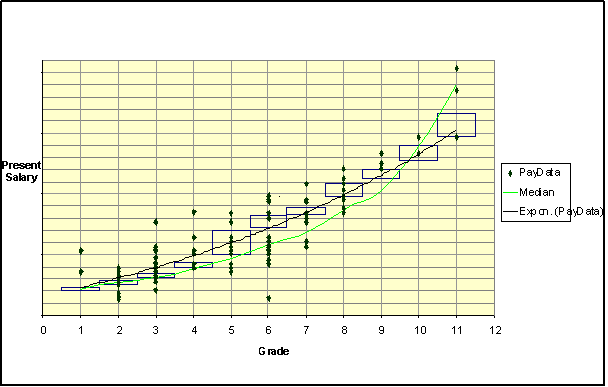
The proposed model aims to provide a fair and equitable pay structure that meets the requirements for equal pay, is affordable within the Service and will satisfy 2004 Implementation Agreement. Annex A provides the outline for the current thinking on the expected model we will use. This remains subject to negotiation with our Trade Unions. |
|
|
6 |
Contribution to Corporate Aims and Objectives |
|
|
6.1 |
The Service has publicly expressed its aims to live its core values. It has also explicit targets to meet the requirements of the Equality Standards for Local Government (ESLG). The Service has recently been accredited at level 2 with some encouraging feedback on our progress towards achieving level 3. Ensuring that we have a pay system that is free from discrimination is a key facet to achieving our aims in this regard |
|
|
7 |
Risk Analysis |
|
|
7.1 |
Failure to ensure that the systems for pay and reward within the organisation will leave HRFS exposed to the risk of litigation. This is a real and increasing risk, with some unions looking to bring test cases to force Local Authorities and other public sector bodies to act. There are four principal legislative measures which need to be taken into account in the field of `equal pay' as follows: · Equal Pay Act 1970. · Sex Discrimination Act 1975 (and as amended 1986, 1999 and 2001). · Treaty of Rome 1957 (Article 141). · Equal Pay Directive and Equal Treatment Directive
In practice, sex discrimination is much more likely to operate against women than against men. However, the legislation protects both sexes equally. The effect of the Equal Pay Act (EPA) 1970 is to give every employed person a right to equal terms and conditions of employment where they do one of the following: · Like work to that of a fellow employee of the opposite sex. · Work that has been rated as equivalent under a job evaluation study to the work of a fellow employee of the opposite sex. · Work that can otherwise be shown to be of equal value with that of a fellow employee of the opposite sex.
The EPA 1970 applies to all contracted terms and conditions, and not just to pay. The equality principle therefore extends to all contractual benefits, including benefits in kind, holidays etc. There will be no breach of the equality clause where the employer can show that the differential rates of pay are attributable to factors other than sex a Genuine Material Difference (GMD). |
|
|
7.2 |
There is a significant risk to the reputation of the Service if we were to be challenged and found to have systems of pay that were unequal due to an individuals gender. The Service is able to achieve many of its corporate objectives based in part, on the high levels of trust and confidence that the public has in HRFS. Anything that significantly diminishes that would have an adverse effect on our ability to achieve our aims. |
|
|
8 |
Resource Implications |
|
|
8.1 |
Human Resources |
|
|
|
The resource requirements for the Workforce Planning Management Information and Workforce Support teams within Human Resources (HR) are likely to be significant to both amend the HR database records and prepare data to facilitate the notification of results and any payments to candidates. These commitments will be factored into the Medium Term Planning (MTP) considerations for Financial Year (FY) 2008/09. |
|
|
8.2 |
Physical Resources |
|
|
|
No additional physical resources have been identified at this time. |
|
|
8.3 |
Information and Communications Technology Resources |
|
|
|
Communications have been led by the Marketing and Communications Department and have included communications to all employees and managers' briefings. Further work will be concluded to help educate colleagues on how equal pay fits with the Service's Integrated Risk Management Plan (IRMP), core values, fairness and dignity aims and legislative and NJC pay award implementation agreements. |
|
|
8.4 |
Financial Implications |
|
|
|
The proposed pay model indicates that the implementation costs can be contained within the budget of £300k with savings accruing over 4 years from the unwinding of pay protection of those posts that have been identified as being above the new scales. The 4 year projections will be provided when the scales are agreed. |
|
|
9 |
Equality Impact Assessment |
|
|
9.1 |
An Equality Impact Assessment for the project has been completed in December 2006. As the project progresses, the Impact Assessment will be reviewed and additional actions identified. These will be subject to scrutiny by the Local Diversity Group. |
|
|
9.2 |
The proposals within this report are considered compatible with the provisions of the European Convention on Human Rights, the Human Rights Act 1998, and the Race Relations (Amendment) Act 2000. |
|
|
|
|
10 |
Consultation |
|
|
10.1 |
The Trade Unions must be fully involved in the development of each stage and key work streams. Ideally formal agreement to these is desirable as the final proposals will inevitably affect pay, and are therefore a matter for negotiation. So far, we have effectively worked in partnership with Trade Union Representatives in conducting the Equal Pay Audit. We have yet to share the findings with them pending the views of both Management and Members (via this Committee). |
|
|
10.2 |
Efforts have been made to enable managers and employees to input into the process. This has by necessity been through existing mediums, forums and representative bodies. |
|
|
10.3 |
Members have a key scrutiny role and must agree the proposals to meet the requirements of the project affecting basic pay at Stages 1 to 4. Work on the rewards review and Additional Responsibility Allowances (ARA's) will be provided under separate papers as this work is concluded and as may be required. |
|
|
11 |
Conclusion |
|
|
11.1 |
Completing this important piece of work will provide compliance with legislation and the requirements of the 2004 Pay Settlement within the NJC. Furthermore, it will demonstrate that HFRS is true to its core values. It is also a key part of our drive to progress through the Equality Standards for Local Government as detailed within the IRMP. |
|
Background Information (Section 100D of Local Government Act 1972) |
|
The following documents disclose the facts or matters on which this report, or an important part of it, is based and has been relied upon to a material extent in the preparation of the report: "None" Note: The list excludes: (1) published works; and (2) documents that disclose exempt or confidential information defined in the Act. |
Secretarial/WP/Corporate/HFRA/Committee, 01Feb08Error! Bookmark not defined.Equal Pay Project 13.12.08
Secretarial/WP/Corporate/HFRA/HR Committee/HFRA HR 1.2.08 Annex A to report Equal Pay Project 13.12.08