
Archived decisions
Hampshire County Council
Safe and Healthy People Select Committee
Access to services in Hampshire for people with alcohol problems
Report of the scrutiny review group
14 February 2008
Table of Contents
Section Page
Foreword 4
Executive Summary 5
Introduction 7
Terms of Reference 7
Review Organisation 8
Background: 9
- Alcohol misuse in Hampshire
- Identifying people with alcohol problems
- Effective service responses
- Policy context
Findings of the Review:
- Availability of early identification services and agency 17
cooperation to improve this
- Multi agency workforce development and planning for the future 26
- Improvements to deliver effective support and treatment to the most 32
vulnerable groups, including those with mental health problems
Conclusions 43
Recommendations 43
Appendices: 47
Appendix One: Background documents
Appendix Two: Those contributing to the review
Appendix Three: Oral evidence sessions programmes
Appendix Four: Definitions of drinking categories
Appendix Five: Alcohol Ten Point Plan
Appendix Six: QuADS and DANOS
Further information regarding this report can be obtained from:
Review Officers: Philippa Smart and Marie Mannveille
Tel. 01962 847336
e-mail: [email protected]
Reports that have been submitted to Council can be downloaded from: http://www3.hants.gov.uk/scrutiny/scrutiny-committees/safe-healthypeople/cx-puscr-alcohol.htm
ACCESS TO SERVICES FOR PEOPLE WITH ALCOHOL PROBLEMS. SCRUTINY REVIEW REPORT
January 2008

Foreword
By Councillor Anna McNair Scott.
Chairman, Alcohol scrutiny review group.
ACCESS TO SERVICES FOR PEOPLE WITH ALCOHOL PROBLEMS. SCRUTINY REVIEW REPORT
Executive Summary
Background
1.1 This scrutiny review, which was set up as part of the Safe and Healthy People Select Committee work programme, ran from ....... to ...... 2008.
1.2 The purpose of the review was to ................
1.3 The review group set its objectives through posing three questions:
· How available are early identification services at present and how are agencies cooperating to improve on this ?
· What multi agency workforce development is in place and what are the workforce planning arrangements for the future ?
· What improvements could be made to deliver effective support and treatment to the most vulnerable groups, including those with mental health problems ?
Conclusions
Recommendations
A
1. Introduction
1. 1 At the April 2007 meeting of the Safe and Healthy People Select
Committee, access to services in Hampshire for people with alcohol problems was adopted as a subject for scrutiny review.
1.2 The immediate background to the review was the identification of the initial work programme for the Safe and Healthy People Select Committee, formerly known as the Policy Review Committee, which had held its first meeting in November 2006. When considering items for in depth scrutiny review the Committee identified a number of topics of interest, including mental health and alcohol issues.
1.3 Some initial exploration was carried out in order to prioritise the topics, involving background research followed by a seminar which included contributions from statutory and voluntary sector personnel. Following the seminars, and the receipt of information from the DAAT at a Member Briefing, the Committee prioritised Alcohol as its first review topic, retaining within that a focus on mental health in terms of the experience of people with dual diagnosis: alcohol as well as mental health problems.
1.4 The review group understood early on in their work that there was a move to raise the priority of Alcohol issues in Hampshire through the work of the Local Area Agreement (LAA) Executive. Discussions with the Director of Public Health, leading that work, ensured that, at the outset, there was a shared understanding of the review's terms of reference as well as of the potential influence the review could have on the LAA initiative.
2. Terms of Reference
2.1 Purpose:
To define the progress being made in Hampshire to identify people with alcohol misuse problems, and the potential to improve the delivery of effective service responses to them and their families.
2.2 The review group set its objectives through posing three questions:
· How available are early identification services at present, and how are agencies cooperating to improve on this ?
· What multi agency workforce development is in place and what are the workforce planning arrangements for the future ?
· What improvements could be made to deliver effective support and treatment to the most vulnerable people, including those with mental health problems ?
2.3 For the purposes of the review, it was agreed that `people' would largely refer to adults, both working age and older adults, rather than children and young people. This was in recognition of the `adult' remit of the parent Select Committee which had set the scrutiny topic, although the review group was keen from the outset to avoid unnecessary artificial divides and to be open to issues surrounding transition into adulthood. In addition, as one of the key questions posed by the review referred to `vulnerable groups', the review group, having learned that children and young people were generally considered to constitute one of those groups, accordingly included issues affecting younger people relating to that aspect of the review.
3. Review Organisation
3.1 Cllr. Robin McIntosh agreed to lead the scrutiny review group; during the
course of the review, the role of chair passed to Cllr. Anna McNair Scott. The full membership was:
· Anne Edwards (Bedhampton and Leigh Park)
· Phil Heath (Basingstoke South East)
· Roger Kimber (Aldershot West)
· Eric Neal (Aldershot East)
· Anna McNair Scott (Chairman, Candovers)
· Sam Payne (Petersfield Butser)
· Jackie Porter (Itchen Valley)
In addition, support to the review was provided by David Sheehan, alcohol lead at the Government Office of the South East.
3.2 The review group held its first meeting in June 2007, where it agreed
the project plan for the review, received initial background information and
began work on identifying key stakeholders.
3.3 In its preliminary meetings, the review group considered a number of national reports highlighting policy and practice issues relating to the three key areas to be explored in the review in order to understand the context in which the situation in Hampshire could be understood. A list of background papers is attached at Appendix One.
3.4 At the evidence taking stage of the review, this was carried out in the style of a select committee, which included evidence gathering through:
· invitations to a wide range of stakeholders to contribute written views
· three meetings held in public to receive oral evidence from invited witnesses
A full list of those who have contributed to this process is shown in Appendix Two and the programmes for the oral evidence sessions are shown in Appendix Three.
In addition, the review included a number of different ways whereby the members could listen to what people with experience of alcohol problems had to say about the scrutiny topic. This was done both through direct contact with service users at a specialist alcohol service as well as at a mainstream service and with members of Alcoholics Anonymous, as well as indirectly with other service users via the DAAT Service User Development Worker.
The review group are grateful for the time and consideration given by different members of the public who contributed their views to the review in these ways, as well as to the DAAT, Trinity House and Spencer House staff who helped to make this possible.
Information about the review, including evidence received, was made available to the public on the Hampshire County Council review webpage -
http://www3.hants.gov.uk/scrutiny/scrutiny-committees/safe-healthypeople/cx-puscr-alcohol.htm
4 Background
4.1 Alcohol misuse
4.1.1 Alcohol misuse is associated with negative impacts on many aspects of peoples' lives. It can be linked to mental ill health and social problems, crime and disorder, disease, injury, disability and even death, and can have a significant impact on the general well being of individuals, families and communities. It is also a factor in the workforce; for example, in May 2005, approximately 1.8% of the people in the South East claiming incapacity benefit or severe disablement allowance had a diagnosis of alcoholism. This figure is significantly above the England national average of 1.65% and is the fourth highest of the nine regions in England.
4.1.2 The national terminology for describing people with alcohol misuse problems refers to hazardous, harmful and dependent drinkers. This categorisation is intended as helpful to commissioners in planning for a full range of services for a local area, and provides a common language for all those working in the sector. It is also recognised that individual drinkers may move in and out of different categories over the course of a lifetime. Definitions of the categories are contained in Appendix Four.
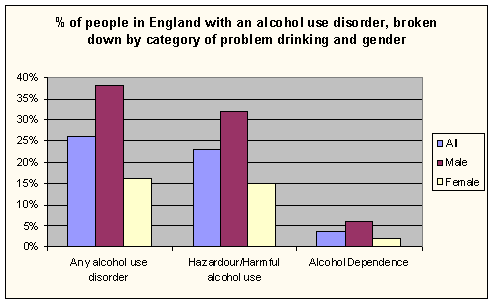
4.1.3 The national alcohol needs assessment for England carried out in 2004 found that 38% of men and 16% of women aged 16 to 64 years of age have an alcohol disorder; this includes hazardous, harmful and dependent drinkers, approximating to 8.2 million people (see chart below).
4.1.4 Nationally, although alcohol treatment services can play a significant role in helping with problem drinking, the provision of treatment does not match need. Around 1 in 15 people are dependent on alcohol in the country and yet the national budget for alcohol is a fraction of that for drug misuse, which affects far fewer people. It has been estimated that approximately 1 in 20 people in need of alcohol services actually receive them in the south east.
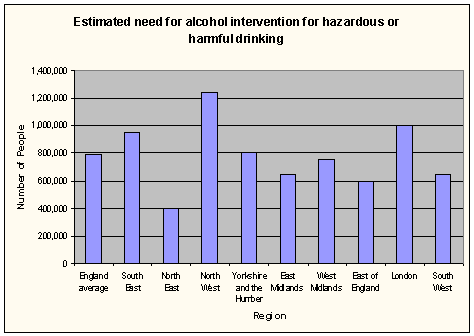
4.1.5 From background research, the review group learned that estimates in 2004 of people in Hampshire that could benefit from alcohol services were 80-90,000. However, this figure is of people who are drinking at harmful levels and above, and is not inclusive of all those whose hazardous pattern of drinking may be leading them into difficulties in their own and others' lives. The level of need for interventions to address hazardous or harmful drinking in the South East is the third highest among regions in England and is significantly higher than the national average (see chart below).
4.2 Identifying people with alcohol problems in Hampshire
4.2.1 In Hampshire, the responsible body for the local implementation of the National Alcohol Harm Reduction Strategy is the Hampshire DAAT. A DAAT Strategic Partnership Board works at strategic level to create the vision and direction for the Hampshire DAAT, to drive policy, monitor DAAT budgets and to performance manage the wider DAAT Partnership.
4.2.2 Because the responsibility of tackling alcohol issues is not the responsibility of any one organisation or agency, the wider DAAT Partnership consists of a range of organisations with a responsibility or interest in this. The range of agencies with such an interest includes:
- Local Strategic Partnerships
- Hampshire County Council: Children and Young Peoples' and Adult Services, schools
- District and Borough Councils
- Health: Primary Care Trust, provider Trusts, GPs and primary care
- Local Authority Councillors
- Service users and carers
- Probation
- Police
- Youth Offending Teams
- Community Safety Partnerships
- Voluntary, community and independent sector
4.2.3 The Hampshire DAAT is a commissioning body, while services for people with alcohol misuse problems are provided by a wide range of organisations, both statutory, voluntary and self help.
4.2.4 In any area, an estimate of the needs of people by type of alcohol misuse should be calculated as a basis on which commissioners plan the type and volume of support and treatment services required.
In terms of assessing the needs of the Hampshire population, an assessment of how local specialist community alcohol services for adults can contribute to the reduction of alcohol related crime and disorder in their areas was commissioned by the DAAT; the assessment was carried out by Alcohol Concern in 2004. Contained within the report is statistical evidence on the level of alcohol related problems for adults in the county and its districts and boroughs. However, in the words of the report this `is not intended to be a full needs assessment'; an obvious limitation is that the assessment did not include younger people's needs. Neither did it include the needs of minority populations in Hampshire, these having been researched in 2002.
The Hampshire Alcohol Strategy 2006 - 2009 also contains brief estimations of the scale of need within both the adult and younger people age groups.
More recently, Hampshire County Council and Hampshire PCT have led the development of the joint strategic needs assessment of the health and well being needs of residents in the county.
Proposed action.
The DAAT should take steps to plan with partners how the Hampshire wide alcohol needs assessment can be reviewed and updated
4.2.5 The organisations that work together to deliver Hampshire's Local Area Agreement considered and agreed in 2007 to set up a Flagship Initiative under the LAA to give greater priority to reducing the harms that alcohol misuse can cause. The Initiative consisted of a number of projects described in a Ten Point Plan, see Appendix Five. The PCT committed to investing an additional £300,000 in services and all other agencies agreed to align budgets to identify where funding could be used more effectively in order to deliver the plan.
4.2.6 As part of the new performance framework for local authorities and partners, greater emphasis is to be placed on the role of the LAA in enabling organisations to work in partnership to identify and prioritise improvements in their areas and to achieve an outcome focus. The review group has been aware that the Hampshire LAA has been in a transition phase during the latter period of the scrutiny review, and attention has been given by LAA partners as to whether the Alcohol Flagship Initiative would continue in its original form, or change in the light of new national indicators and the new Sustainable Community Strategy.
4.3 Effective service responses to people with alcohol misuse problems and their families
4.3.1 In keeping with national standards, as outlined in Models of Care for Alcohol Misusers (MoCAM) policy guidelines, Department of Health June 2006, and other related guidance, Hampshire DAAT, Hampshire PCT and Hampshire County Council Adult Services commission elements of a local system for alcohol treatment within a four tier framework of provision.
4.3.2 The national guidance emphasises that the tiers refer to the level of interventions provided and do not refer to the provider organisations.
`Commissioners need to ensure that all tiers of interventions are commissioned to form a local alcohol treatment system to meet local population needs'. Models of Care for Alcohol Misusers. 2006
4.3.3 The four tiers are:
Tier 1 interventions |
Alcohol related information and advice; screening; simple brief interventions; and referral |
Tier 2 interventions |
Open access, non-care-planned, alcohol specific interventions |
Tier 3 interventions |
Community-based, structured, care-planned alcohol treatment |
Tier 4 interventions |
Alcohol specialist inpatient treatment and residential rehabilitation |
4.3.4 MoCAM advocates a stepped model of care where, if a minimal intervention does not succeed for the individual, their care can be stepped up to the next level of intervention. The two main components to this model are:
· Provision of brief interventions for those drinking excessively but not requiring treatment for alcohol dependence
· Provision of treatment interventions for those with moderate or severe dependence and related problems
4.3.5 Because the object of the scrutiny was to define the progress being made in Hampshire to identify people with alcohol misuse problems, and the potential to improve the delivery of effective services to them and their families, the review confined its areas of interest primarily to tier one and tier two type services and interventions.
4.3.6 In order to ensure that the tiered approach is successfully put in place and delivered, the national guidance emphasises the importance of workforce planning and workforce strategies
`Workforce strategies to maximise and expand the expertise in alcohol interventions and treatments should complement the development of tiered frameworks of provision in local areas'.
Models of Care 2006
These should be developed in a multi agency way in partnership with those responsible for developing local workforces, such as Strategic Health Authorities (SHAs), local voluntary sector employers, criminal justice workforce planners etc.
`Alcohol training and liaison posts would be helpful in promoting alcohol interventions and treatment in primary care, acute hospital, criminal justice, domestic abuse, housing, social services and other mainstream settings'. Models of Care. 2006.
4.3.7 In addition to national standards for effective models of care, an expert review
of the effectiveness of treatment for alcohol problems was commissioned
nationally by the National Treatment Agency for Substance Misuse and
and reported on in 2006. Key messages from that report include:
· the majority of people, including dependent drinkers, move into and out of
different patterns of drinking without recourse to professional treatment.
Unassisted or natural recovery is often mediated through self-help, family
and friends, and mutual aid groups
· treatment effectiveness may be as much about how treatment is delivered as it is about what is delivered eg. therapist characteristics count for around 10 - 50 per cent of treatment outcome variance
· there is a choice of effective treatments to suit the variety of potential service users:
- 7.1 million hazardous or harmful drinkers may benefit from brief interventions given by generic workers in almost any setting
- 1.1 million dependent drinkers may benefit from more intensive treatment given by specialist workers
· treatment for alcohol problems is cost effective. Overall, for every £1 spent on treatment, £5 is saved elsewhere
· interventions of all kinds are only effective if delivered in accordance with their current descriptions of best practice and carried out by a competent practitioner
· the evidence base for the effectiveness of alcohol problems interventions is strong
4.3 Policy context
National
In 2004, the government published the Alcohol Harm Reduction Strategy for
England. This strategy aimed to reduce the harm caused by alcohol misuse
through a programme of joint government and industry action for:
· better education and communication
· improving health and treatment services
· combating alcohol-related crime and disorder
· working with the alcohol industry
In 2006, the strategy was reviewed and, with regard to improving health and
treatment, progress was reported on trailblazer research trials in NHS and
criminal justice settings. The trials are designed to help improve the way
harmful drinkers are identified and supported, based on international
research that shows that early identification of alcohol misuse and the delivery
of simple advice can be very effective in reducing people's drinking to more
sensible levels.
The updated national alcohol strategy, `Safe. Sensible. Social', published in 2007, outlined the next steps in reducing the harm to health, and associated violence and anti-social behaviour.
The new Local Government and Public Involvement in Health Act 2007 lays a
duty on local authorities and PCTs to undertake a joint strategic needs
assessment of the health and well-being needs of the local community. In
addition, it places a duty on local authority and named statutory partners,
including PCTs and health Trusts to cooperate with each other to build a
shared vision and identify LAA targets that will deliver improved outcomes
for their whole population.
Regional
The updated national alcohol strategy defined a new role for Government Offices for the Regions.
Regional Directorates of Public Health have a particular role in supporting local partnership activity to reduce the harm to health caused by alcohol by -
· engaging other stakeholders, including regional development agencies and media
· completing regional mapping of alcohol related issues to identify priority localities and progress in tackling the alcohol related agenda
· negotiating and performance managing local alcohol improvement targets through new style LAAs
· promoting the preparation of local alcohol action plans and use of the proposed common framework to enable self assessment and performance management to underpin local delivery
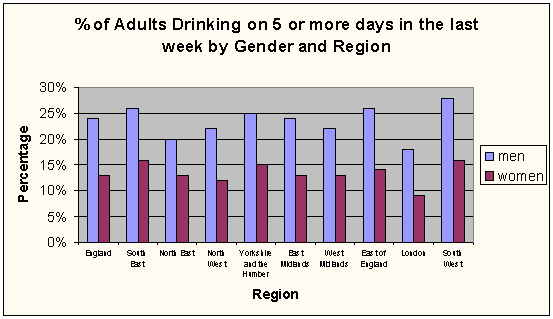
The publication of the regional document `Choosing Health in the South East: Alcohol' in 2007, described alcohol consumption and its consequences for health and social well-being as a significant challenge in the region. Men and women in the south east drink more often than those in almost any other region in the country (see chart below).
` According to the GHS (General Health Survey), the proportion of men (26%) and women (16%) in the South East region who report drinking on five or more days in the last week is higher than in most other regions and is above the national average for England'.
Choosing Health in the South East: Alcohol'. 2007
Hampshire
Hampshire aims to implement national policy within a local context by means of the Hampshire Alcohol Strategy 2006 - 2009. The strategy is wide ranging, covering the following areas:
- Local Area Agreement (LAA)
- Information and Communication
- Licensing and the Night Time Economy
- Binge Drinking
- Young People
- Adult Health
- Sexual and domestic violence
Referring to the place of alcohol in the partnership approach to dealing with alcohol issues in the county, through the Hampshire Local Area Agreement, the strategy states:
`The overall outcome is to reduce the harm caused by substance misuse to individuals, their families and the wider community'.
Executive Summary, Hampshire Alcohol Strategy
Alcohol featured in the Hampshire 2006 - 2009 LAA within the priority on
tackling crime and anti-social behaviour recognising the harm caused by drug
and alcohol misuse. In addition, Alcohol featured in a Domestic Abuse LAA
Flagship Initiative, where monitoring included an alcohol focused target.
During the course of the review, discussion was taking place among partners
in Hampshire about which targets to adopt and what place alcohol will have in
the new style LAA for 2008. Indications, to the date of this report, suggest that
there is strong support for Alcohol remaining a priority.
5. Findings of the review group
5.1 Availability of early identification services and how agencies are
cooperating to improve on this.
5.1.1 The review posed the question of `how available are early identification services at present, and how are agencies cooperating to improve on this?'
5.1.1 Written and oral evidence received provided information to the review from a variety of tier one and tier two stakeholders, including local authorities, other statutory agencies, and voluntary sector organisations.
Availability of early identification services
5.1.2 The main source of information about services for people with alcohol problems in Hampshire is the online Hampshire and Isle of Wight Substance Misuse Treatment Services Directory, compiled on behalf of the Hampshire Drug and Alcohol Action Team. This is a useful document, readily available on the DAAT webpage, and includes services for adults as well as for children and young people. The Directory lists those services commissioned by the DAAT, as well as by the PCT.
5.1.3 Not included are the tier one services for the different age groups, with the exception of one, commissioned tier one young people's service. To include these would mean listing a multiplicity of mainstream agencies across the different sectors, coming into contact with people whose drinking behaviour is causing either themselves, or others around them, difficulties.
5.1.4 The review group understands the challenge providing a directory of tier one services would pose; nevertheless, the group would see merit in including something about the range of agencies that would be expected to provide tier one interventions in the Hampshire Directory, so that there is a clear commitment by those agencies to being seen to be part of the tiered approach to identifying, and delivering appropriate responses to people with alcohol problems in Hampshire as well as for the public who might access the Directory to understand where they could expect to obtain low level support.
Proposed action
That the DAAT works with partners to develop the Hampshire and Isle of Wight Substance Misuse Services Directory to include reference to tier one services in Hampshire.
5.1.5 With regard to tier one services, the review invited, but received back, less written evidence than it had hoped for from individual organisations that potentially provide these types of interventions either alone or in addition to tier two interventions. The review took the opportunity to follow up the information it did receive at the oral evidence sessions to explore attitudes about their availability and functioning from both tier one and tier two providers.
5.1.6 Strengths highlighted in the evidence included:
(i) close working between the Hampshire Supporting People scheme and DAAT commissioned services
(ii) HCC Youth Service and South Central Connexions staff trained in both alcohol awareness and brief interventions, some staff up to tier two level
(iii) Use of routine reporting and assessment systems by Hampshire Constabulary to identify alcohol problems
(iv) Innovative alcohol prevention work in Eastleigh Borough Council with links to tier two services
(v) Integrated mental health services for working age and for older adults carry out screening for alcohol problems, with links to tier two type interventions by mental health or other staff
(vi) A network of Alcoholics Anonymous self help groups across the county providing support to approximately 1,000 individuals a week to acknowledge their drink problems and to deal with them
5.1.7 Issues highlighted in relation to the availability, accessibility and functioning of tier one interventions included:
a) certain factors, such as under self-reporting and cultural expectations, may conspire to reduce the presentation of alcohol problems in relation to the older adult population as well as the younger age groups. Another factor that may affect the identification of people is probable under diagnosing in primary and community care, and the role of eligibility criteria for services; alcohol misuse problems by themselves may not be sufficient to meet those criteria, but in conjunction with other factors would.
b) similar concerns about under identification was mentioned by Winchester Youth Counselling in relation to children and young people, due often to young people's denial that their drinking is anything other than the normal thing to do.
c) limited opportunities to develop Hampshire County Council Adult Services front line staff was described in terms of relevant training courses not being attended by staff in older adult, learning disability and physical disability teams. A recommendation relating to this issue is made later in the report under paragraph 5.2.9 d
d) concerns that Hampshire County Council's alcohol in the workplace policy is not considered to be robust enough; the Occupational Health manager considered there to be inadequate managerial competencies, a general tendency to be cautious about raising alcohol issues with staff, and scope for the use of tools to promote self help and access to early interventions. Recommendations relating to these issues are made later in the report under paragraph 5.2.9 d
e) T2, a voluntary sector tier two provider service, considered tier one services to be `patchy' in different areas, working relationships with tier two services depending on individuals rather than intrinsic to agency cooperation. T2 expressed concern that it did not appear to be any particular organisation's or partnership's responsibility to oversee tier one and tier two relationships. As a result, this is left to individual organisations and individuals, which is time consuming and often unpredictable.
f) Two individual members of AA suggested that possible barriers to people accessing self help through AA included people's perception of the organisation, which can often be based on poor information or prejudice. A concern was expressed that some professionals' pre conceived ideas about AA preclude them mentioning it to people with drink problems, thus reducing a person's choice of support. Other service users said that they would not choose to join an AA group.
The National Treatment Agency review of the effectiveness of treatment for alcohol problems in 2006 confirmed that AA appears to be effective for those alcohol misusers who are suited to it and who attend meetings regularly. It also commented on the effectiveness of Al-Anon and Alateen for families of AA members. However, acknowledging that not all alcohol misusers find the AA approach acceptable, the authors of the report encouraged the development of non-12-Step mutual aid groups as well as research into their effectiveness.
In terms of an overview, in the view of the DAAT manager, there is not yet the breadth of referrals from tier one, mainstream services into more structured interventions for alcohol that would indicate successful tier one interventions are in place in Hampshire.
This perspective mirrors a conclusion in the 2004 national alcohol needs assessment for England:
` There is considerable scope for increased identification and referral to specialist care from generic services including primary care, general hospitals, mental health services, criminal justice agencies, and social services. These findings suggest this needs to be tempered by ensuring adequate capacity in specialist alcohol services to meet increased demand from initiatives to increase screening and referral activity in non specialist services'.
Alcohol Needs Assessment Research Project, Department of Health 2004
Proposed actions
That the DAAT works with tier one organisations to establish a way to connect them to the work of the DAAT .
That commissioners emphasise the importance of tier one and tier two services encouraging service users and their families to access self help groups, such as AA, and influence the piloting of an alternative model of self help to the AA Twelve Step Model in order to promote choice across the county
That the DAAT and partners, as part of the reassessment of need across Hampshire, include the need for self help support
5.1.8 With regard to tier two interventions, the review received both written and oral evidence from a number of different organisations
5.1.9 Strengths highlighted in the evidence included:
(i) A range of tier two commissioned services for both children and young people and adults
(ii) A Ten Point Plan endorsed by the LAA Executive and LAA Board in September 2007. The ten projects identified in the plan are:
o Developing adult tier two services
o Supporting enhanced tier two services in Winchester prison
o Pilot a family focused interventions team at a tier two level to work with young people and their families
o Develop data collection and brief intervention work with Accident and Emergency departments
o Developing a county wide, alcohol focused Arrest Referral service
o Developing brief interventions training for front line staff across partner agencies
o Develop effective joint commissioning for drug and alcohol services
o Develop a co-ordinated approach around alcohol misuse in the night time economy through CDRPs which involves all LAA agencies
o Promote effective linkages between alcohol services and Supporting People services
o Review and update the Hampshire Alcohol Strategy
5.1.10 Issues highlighted with regard to the availability and functioning of tier two interventions included:
a) Gaps in access to early interventions across the county
` There is co-operation between agencies but the real issue is the lack of investment in services for people with alcohol problems which has resulted in inequity in service provision between areas based upon historic health funding'. Hampshire Partnership Trust
Evidence from both providers of services as well as from service users themselves, indicated that in the Andover area, for instance, adults with alcohol problems understand that in order to obtain support and treatment they need to present themselves to services as having a history of drug misuse as well. This will then get them support for their alcohol problems, but via the drug misuse services. The review group heard that a similar situation holds in Winchester prison.
The consequence of the absence of adequate, dedicated alcohol interventions at tier two level was described by T2, a voluntary sector service provider, as impacting downwards, where tier one services are pressed to take on more referrals or, alternatively, upwards where more people are referred to tier three services. Neither is an effective way of working.
An example of the latter is Winchester, where the review group heard how Spencer House, a tier three service, also provides tier two interventions.
`In the absence of a tier 2 service, our team accepts all referrals and after a comprehensive needs assessment will offer brief interventions and access to groups to those patients who are referred, who are at an earlier stage of their drinking problem'. Winchester community alcohol service.
While respecting the valuable contribution this work was making, the review group were concerned about the pressures on the team, which was described by the team leader as `firefighting' to the point where stretched resources were posing difficult choices such as providing care and treatment or monitoring service effectiveness for service users.
Other agencies, such as Hampshire Constabulary, Hampshire County Council Adult Services, and Stonham Housing Association also expressed concerns about the lack of services to which to refer people.
It was noticeable, from evidence provided by T2 and by the Hampshire DAAT, that fewer problems have existed up to now regarding the availability of tier two interventions for younger people with alcohol problems. This has been associated with the differences in funding streams which allows for dedicated alcohol provision for younger people. The review group members were concerned about the potential difficulties this poses for continuity of support for younger people as they move into adulthood. Also of concern was the evidence from the DAAT and other stakeholders, which described the pressures the younger peoples' tier two services were under arising from the loss of £350,000 over this and the following year from the Young People's Substance Misuse grant. Eastleigh Borough Council described how this was going to have an adverse impact on their young peoples' alcohol prevention project. The impact of this, and other DAAT funding reductions, was acknowledged by Hampshire County Council in October 2007, when it offered to provide partial relief from the impact of the cuts.
Proposed actions
That the Safe and Healthy People Select Committees draws the relevant central government departments' attention to the local inequities in access to appropriate early interventions for the different age group with alcohol problems in Hampshire and their assistance sought to ensure that funding streams and levels of funding do not inhibit the commissioning of effective tier two services
That consequences of the impact of cutbacks in national funding for younger peoples' alcohol interventions should be monitored by the DAAT and reported back to the Safe and Healthy People Select Committee at six and twelve months after the review report is published
b) Even where tier two type services were commissioned, the review group was concerned to hear about the vulnerability of funding arrangements for voluntary sector provider posts, particularly where these are supported from a number of different funding streams, including charity money.
The pressures on these providers to spend valuable time on fund raising, for example from Comic Relief, to ensure that posts can be sustained over time was expressed by T2. The difficulty of working with three year funding agreements was raised by T2 and by Winchester Youth Counselling, both of whom would find longer term contracts more conducive to delivering predictable services.
` It is very hard to plan for the future when we are constantly having to find enough money in order to survive'. Winchester Youth Counselling
How agencies are co-operating to improve on services
5.1.11 The review was provided with evidence about a range of different ways in which agencies in Hampshire cooperate to improve early identification services for people with alcohol problems. Some of these are through formal partnerships, others through less formal arrangements. The review has chosen to highlight the following aspects of co-operation:
Formal partnerships
5.1.12 The DAAT, as a multi agency commissioning partnership, plays a central role in seeking improvements to services. The review group understands that commissioning services for people with alcohol problems is not all carried out through the DAAT at present, and would wish to see the other commissioners - the PCT and Adult Services - take the next steps to joint commissioning to promote the development of continuous and accessible services. The range of organisations linked to the DAAT Partnership are referred to earlier in the report at paragraph 4.2.2.
The DAAT, not being a provider of services itself, uses the mechanisms of contracting, purchasing and contract monitoring to influence services at tier two level and above. Tier one interventions are assumed to be delivered within mainstream public and voluntary sector services In addition, the DAAT delivers training and encourages high standards within services through its publications such as the common assessment tool, easily accessible on the DAAT webpage.
Proposed action
The LAA Executive Board should prioritise the work on developing effective joint commissioning of services for people with alcohol problems, as stated in the Alcohol Flagship Initiative Ten Point Plan.
Contracting and purchasing
The difficulty facing the DAAT is the limitations on the scope for commissioning set by the funding streams it manages. As there is, nationally, no ring fenced money for alcohol, DAAT alcohol commissioning rests on the alignment of the provision of mainstream funding from partners, such as the PCT and Hampshire County Council Adult Services, with DAAT drugs funding in order to commission services for both drug and alcohol providers. The review group have been impressed with how flexible the DAAT management team has been in adapting the funding to meet obvious need in Hampshire, recognising that there are severe difficulties imposed by funding restrictions set nationally.
However, the review group was interested to learn from evidence provided by Alcohol Concern about the additional national funding within the Choosing Health allocation, which includes alcohol interventions, made available from the Department of Health to PCTs for 2007-2008. The review group members had difficulty understanding why there had been such a delay in this funding becoming accessible in Hampshire through the DAAT partnership, but are pleased that it is now available to support service improvements through the LAA Alcohol Flagship Initiative Ten Point Plan, referred to in paragraph 4.2.5.
The review group is convinced that for early intervention services to improve in the long term, further strengthening of the DAAT partnership is needed, in relation to transparency and alignment of budgets, but also in connection with links between the DAAT and mainstream services providing tier one interventions.
Contract monitoring
The review group heard how the DAAT influences the attainment of high standard care for individuals through its monitoring of services, for example against QuAD ( Quality in Alcohol and Drug Service) standards, see Appendix Six.
Also, the DAAT has worked to promote high quality care and treatment through the promotion of the Drug and Alcohol National Occupational Standards (DANOS), producing an annual report of the use of DANOS within services for adults. A description of the standards are contained in Appendix four. This is now moving to a biannual reporting cycle due to funding constraints. The initial report was said to show a mixed level of adoption of DANOS standards across commissioned services; in addition, the DAAT manager reported some concern about how well the standards are integrated into the work undertaken by staff.
Proposed action
That the DAAT Strategic Partnership Board supports the work of the DAAT Support Team in promoting DANOS in services for adults, and considers how it could influence its promotion within tier one services, to ensure that continuing progress is made to embed the standards into the care and support provided to people in Hampshire with alcohol problems
5.1.13 The adoption of the Alcohol Flagship Initiative by the LAA Executive Board in 2007 ensures that partner organisations, within the formal Hampshire partnership, now lend their support at the strategic level of their respective organisations to the service improvement projects contained within the Initiative's Ten Point Plan.
The review group was encouraged by the Flagship Initiative, and benefited from the Director of Public Health's account of progress on the different schemes at an oral evidence session in November 2007. Clearly, significant preparatory work has been undertaken by the DAAT, particularly by the DAAT manager and the Hampshire Alcohol Strategy Co-ordinator, to develop the various proposals, and the group fully supports the Plan as the way forward in Hampshire.
The review group is keen to see how the governance arrangements for the Flagship Initiative, which were in the process of being put in place at the time of the review, will lend themselves to steering progress with the different strands of the Plan.
Proposed action
That the LAA Executive Board be invited to provide an update to the Safe and Healthy People Select Committee, twelve months after the publication of the review report, on progress with the Ten Point Plan
5.1.14 The review group received evidence about a network of district based groups, called Drug and Alcohol Reference Groups (DARGs), set up to support the priorities and plans of the DAAT, and have links with the district Crime and Disorder Partnerships.
These are groups that bring together local substance misuse workers from across the range of agencies involved, to identify gaps in service and enable efficient targeting of resources. DARGs are intended to provide a forum for information exchange on substance use and trends, good practice, and the development of new initiatives.
Evidence provided by the chair of the Winchester DARG caused the review group to be concerned that the group is struggling to ensure that alcohol issues achieve the consideration they require.
`I have recently taken over as chair of the DARG; my concern is that emphasis is very much on drug use and misuse, alcohol coming a very poor second'. DARG chair, Winchester
The group attempted to obtain evidence from another DARG chair, but did not have the opportunity to confirm whether this was the case elsewhere. Given the important role such groups can play in promoting improvements in services the review group members would hope that the DAAT oversight and support to DARGs ensure that they are helped to address alcohol issues as much as those of dugs.
Proposed action
That the DAAT reviews the balance of attention given to alcohol issues within DARGs and, where necessary, seeks to influence groups to redress any obvious imbalance
Informal partnership working
5.1.15 During the course of the evidence gathering, numerous examples of less formal agency co-operation to improve services that identify people early on in their drinking habits were given. These included:
· Connexions working with schools and voluntary sector young peoples' groups
· AA work with various statutory agencies such as the police, probation and schools to improve access to self help
· Health, older adult mental health specialist providing training to non specialist staff in other agencies
· Health, community alcohol team liaising with and providing training to local GPs
· Agencies working together on one off events eg. Alcohol Awareness week
· Service user group work on training material for Custody Officers
· Voluntary sector provider services such as T2, Two Saints and Stonham Housing Associations, Trinity House, Salvation Army, networking to publicise their own services within other services in order to make them more accessible
Such informal networking is invaluable to the delivery of seamless services and integrated pathways to service users. Much, inevitably, depends on the goodwill of individual members of staff, and the review group congratulates workers who engage in this style of working, managers who support it, as well as individual champions who go the extra mile.
5.1 Multi agency workforce development and planning for the future
5.1.1 The review group posed the question `what multi agency workforce development is in place and what are the workforce planning arrangements for the future'? The assumption the group made was that single agencies would be taking measures to secure and equip the workforce they needed for services they provide. From the point of view of the review as a whole, given that the direction of national policy on alcohol support and treatment issues are couched in multi agency terms, the group's interest was in seeing to what extent Hampshire was making progress jointly with others on this particular aspect.
5.1.2 Stakeholders were invited to give their views about what progress in general they saw being made to develop the workforce, such as joint recruitment, joint training, growing the workforce, developing new ways of working, and achieving a representative workforce. They were also invited to comment on which aspects were happening on a joint agency basis and how.
5.1.3 The group received written and oral evidence on this aspect of the review which has allowed it to explore the potential in Hampshire to improve the delivery of effective service responses from the point of view of workforce capability.
5.1.4 From background research, the review group learned that there has been a variety of guidance over the last few years relating to workforce planning and development as it might apply to the provision of services for people who misuse alcohol. Some of this is of a general nature, directed at Health and Social Care related sectors; some is specific to the national Alcohol Strategy and to the national Mental Health strategy.
5.1.5 Main messages include:
· Strategic workforce plans in Health and Social Care should be fully integrated into local delivery and business planning within and across organisational boundaries, including related sectors such as relevant education providers, voluntary and community sectors, volunteers and informal carers
· There should be greater alignment of local workforce planning with finance and activity planning
· Public service staff awareness of alcohol issues should be raised
· Staff capacity and capability needs to be built at all levels, and this should involve breaking down barriers to change, including old style professional barriers
· There need to be sufficient resources to carry out workforce planning and development
Multi agency workforce development in place
5.1.6 The review received examples of how providers of services have been or are working jointly in different aspects of workforce development in relation to both adults and younger people. Examples included:
- local champions of joint agency training, such as that initiated by an NHS older person's alcohol and mental health specialist clinician with non alcohol specialist staff such as physiotherapists, domiciliary and residential care staff, housing managers, and by an NHS adults Community Alcohol Service Team Leader with Accident and Emergency staff and local GPs
- joint health and social care recruitment of Drug and Alcohol team post
- joint health and social care training on Adult Protection in a tier three substance misuse team
5.1.7 Examples of how commissioners are or have been engaged in workforce development were also made available:
- multi agency brief interventions front line staff joint training by the DAAT Alcohol Strategy Co-ordinator
- targeted training programmes through the DAAT for practitioners working with young people
- DAAT initiated Training and Development Strategy, which included identifying training needs to include those of service users, carers and parents
- development of an e learning package to include a series of modules, including alcohol issues, by the DAAT
- Childrens workforce development through the Hampshire Children's and Young People's Plan 2006-2009
- Strategic Health Authority (SHA) and Care Services Improvement Partnership (CSIP) cooperation regarding joined up mental health workforce development
- SHA, Skills for Health and the Learning and Skills Council for the south east joint agreement on matched funding: aimed at support workers level of employment
- joint mental health workforce plan development
Multi agency workforce planning for the future
5.2.8 Examples, at the time evidence was gathered, of planning for the future included:
- the development of modular drug and alcohol training for staff working with
young people, to inform a young people's substance misuse workforce
- the workforce elements of the LAA Alcohol Flagship Initiative Ten Point
Plan
- continuation of DAAT led training, and development of an e learning
package
- continuation of single agency training, which is open to other groups eg.
Hampshire Partnership Trust training for substance misuse and adult mental
health staff and others
In addition, there was an expressed interest by the SHA in developing links with local government officers at regional level to work on matters of common interest with regard to respective workforces.
5.2.9 Impressions gained by the review group members from reading and listening
to evidence was that while there were clearly examples of joined up approaches, these were far from robust, both in respect of commissioner and provider activity. This is undoubtedly influenced by the absence of national expectations, unlike those influencing drug misuse where there is a requirement to substantially increase the number of workers employed in the sector. Nevertheless, the review group believes that there is still scope for making progress in the alcohol field.
a) the review group is aware that strategic workforce planning in Health and Social Care is in place, and were encouraged to learn that there are mechanisms through the Children's Workforce Development Council, for this to work across organisations. An example of the benefit of this approach is the common induction framework for staff, which includes alcohol issues.
No comparable mechanism in respect of adult services appears to be in place, however, despite the National Framework to Support Local Workforce Strategy Development - A Guide for HR Directors in the NHS and Social Care being published in 2005. This guidance stressed the importance of integrated workforce planning between health care, social care, public health, children's services, the wider education sector, voluntary and community sectors, volunteers and informal carers:
`It is important that the health and social care workforces naturally link with many other areas......it will be important to think these through in developing local workforce strategies'.
Department of Health, A National Framework Support Local Workforce Strategy Development 2005
In the context of planned investment in alcohol services through the Ten Point Plan, as well as the continuing need to strengthen the tier one workforce, the review group would like to challenge the key health and social care commissioning organisations to consider whether they are doing everything possible to ensure that the development of the different elements of the current and future workforce involved in tier one and two identification and interventions is planned for jointly.
Proposed action
That the SHA, PCT and Hampshire County Council open a dialogue to explore how they can work more closely together to support workforce strategy development in respect of multi agency staff groups responding to the needs of adults with alcohol problems
That the SHA, PCT and Hampshire County Council work to ensure that their approaches to learning and skills development providers include a consistent approach to the consideration of how they can work in partnership with service users, carers and parents; for example, how they can be equipped with relevant knowledge, skills and understanding
b) Evidence from the DAAT and others about the joint agency front line training on brief interventions is very positive.
`Feedback from the training has been very positive and further training sessions are planned. It is also hoped to be able to develop further training that will be relevant to existing service providers'. Alcohol Focus Group.
The LAA Alcohol Flagship Initiative Ten Point Plan includes proposals to extend this training to include more front line staff
such as members of the Police force, Community Safety Officers, and housing officers.
`By training up front line staff, it is hoped that this would enable more services to be able to work with clients that might be drinking at harmful and hazardous levels. This would enable them to moderate their drinking, which could potentially reduce the negative impact they are having...and also allow partner agencies to better refer on to alcohol treatment services'. Director of Public Health.
The review group supports the extension of the training, and in particular the multi agency approach that it takes, seeing this as a key part of tier one and tier two workforce development.
Proposed action
That the LAA Executive Board gives high priority to the Brief Intervention Training Proposal within the Ten Point Plan.
c) With regard to there being sufficient resources to carry out workforce planning and development, the review group is appreciative of how time intensive a multi agency approach can be. The Hampshire DAAT are to be commended on the work with partners that it initiated in 2004 to create a DAAT training and development strategy. Evidence received suggested that there may have been resourcing issues affecting progress in implementing the strategy.
`Implementation of the action plan has not been delivered with the drive and focus it warranted due to competing priorities, but there has been progress. A Training Steering Group, historically hosted by the DAAT, was disbanded due to lack of support'. DAAT manager.
The group is aware that in other DAAT areas, a dedicated HR Manager is funded to lead on drug and alcohol workforce planning and development. The advantages of such a post would be to provide dedicated time to progressing and overseeing the objectives of a local workforce strategy.
Proposed action
That the DAAT Strategic Partnership Board provides assurances to the Safe and Healthy People Select Committee -
i) that all that can be done is being done with regard to implementing the
Hampshire DAAT training and development strategy in respect of alcohol
ii) that any separate adult and young people's workforce initiatives are integrated
to avoid duplication, and to aid the best use of resources
d) With regard to improving the identification and treatment of people with alcohol problems, the national alcohol strategy, Alcohol Harm Reduction Strategy for England 2004, flagged up that one of the problems was that public service staff had a low awareness of alcohol issues. The strategy proposed that staff awareness and their ability to deal with misuse issues should be raised. This has been reinforced by the Department of Health Choosing Health policy where alcohol is one of six national priorities to promote better health in the population, and there is a recognition that capacity and capability of staff needs to be built across health, local government, other statutory agencies and the voluntary sector.
Evidence made available to the review from more than one source has led the review group to believe that more could be done within the Hampshire County Council's own workforce to raise staff awareness.
o Information provided to the review by the Occupational Health
Manager suggested that there was scope for developing links with other agencies in order to connect their knowledge about alcohol issues and contact organisations to the Hampshire workforce. For example, work that is being done by Occupational Health staff with teachers on mental health issues could include alcohol issues. In addition, the manager felt that the Hampshire substance misuse Health and Safety policy could be strengthened as it relates to alcohol, particularly by developing manager competencies. A similar view about the policy is contained in the Hampshire Alcohol Strategy 2006 - 2009.
Proposed action
That Hampshire County Council reviews its substance misuse Health and Safety policy as it relates to alcohol, with a view to strengthening its implementation.
That Hampshire County Council's Occupational Health Department -
a) builds DANOS into its staff appraisal process, in order to strengthen its ability to deliver tier one interventions to staff with alcohol problems
b) explores opportunities for joint training with Health staff on alcohol issues and the use of evidence based screening tools such as the Alcohol Use Disorders Identification Test (AUDIT)
c) reviews its role in facilitating access to tier two services for those in the workforce that it identifies as needing additional support
o Evidence provided by an Adult Services manager reported that there were:
` ...limited opportunities to develop the non specialist workforce in relation to alcohol issues'.
`...the need for more awareness raising training in Older Persons, Physical Disability and Reception and Assessment teams has been suggested'. Liz McGill, Commissioning Manager
While Hampshire Learning Centre provides a course, and this is recommended for certain staff groups such as Children's and Mental Health services, staff in Older Persons, Learning Disability and Physical Disability teams would not normally attend. Staff may also access the DAAT training.
In addition, it was suggested that there needs to be training of staff in the private and voluntary sector, volunteers and informal carers.
Proposed action
That Adult Services look to increase the number of its staff who access alcohol awareness training, and include DANOS within its appraisal process for appropriate staff groups
That Adult Services research whether volunteers and carers would benefit from Alcohol awareness training and, if so, how this might be accessed.
5.3 Improvements to deliver effective support and treatment to the most vulnerable people, including those with mental health problems.
5.3.1 The third question that the scrutiny review group members posed at the outset
of the review was:
What improvements could be made to deliver effective support and treatment to the most vulnerable people, including those with mental health problems?
Effective support and treatment
5.3.2 The national review of the effectiveness of treatment for alcohol problems,
referred to in paragraph 4.3.7, is the main source of information about which
interventions work for people with drink problems along the spectrum of
dependency from hazardous to severely dependent.
The report emphasises the importance of screening, assessment and outcome
measurement, as well as treatment interventions, self help and mutual aid.
With regard to screening, for instance, the research suggests that validated
screening instruments are used. Reference has already been made in the report
to the AUDIT tool, for instance, in recommendations relating to paragraph
5.2.9.
AUDIT (Alcohol Use Disorders Identification Test), which comprises of 10 questions, is noted by the NTA as being a `screening instrument of good sensitivity and specificity for detecting hazardous and harmful drinking among people not seeking treatment for alcohol problems' and that this `should be considered as the screening instrument of first choice in community settings'.
This suggests this screening tool could be used effectively in various frontline service settings to identify people with hazardous and harmful drinking patterns, followed up with brief interventions. This could help reach vulnerable people with a drink problem who may not be drinking at levels sufficient to seek help from alcohol services, but may be accessing other services, such as homeless support, mental health services etc. If their drinking is influenced at an early stage, this can prevent the situation becoming worse.
` Reliance on informal methods of screening may miss the majority of
hazardous drinkers without obvious signs of alcohol related harm'.
A summary of the Review of the Effectiveness of Treatment for Alcohol
Problems'. NTA 2006
The NTA research highlights a range of approaches to assessment and
outcome monitoring. With regard to the latter, the report suggests:
`There is ample scope to mix different scales to create an agency preferred
package drawing on commonly used instruments'.
A Summary of the Review of the Effectiveness of Treatment for Alcohol
Problems. NTA 2006
The review group heard from the DAAT about how it promotes the use of an
outcome monitoring tool through the commissioning process. In addition,
there is guidance and a toolkit on the DAAT website to support the
identification of substance related needs of children and young people aligned
with the use of the Common Assessment Framework. The review group
With regard to treatment, the NTA report finds that -
`brief interventions, of various forms and delivered in a variety of settings, are effective in reducing alcohol consumption among hazardous and harmful drinkers to low risk levels'.
This indicates brief interventions are a successful method of preventing people drinking at hazardous and harmful levels from getting worse, and in reducing the levels of their drinking and therefore their impact on services, such as healthcare and criminal justice. Furthermore, the report finds that `effects of brief interventions persist for periods up to two years after intervention and perhaps as long as four years', which suggests the effects of brief interventions last a reasonable time and highlights the importance of their availability.
Despite the effectiveness indicated, the report concludes that `most healthcare professionals have yet to incorporate screening and brief interventions for hazardous and harmful drinking into their routine practices'.
The review group support the direction of the LAA Ten Point Plan in seeking to increase the amount of training in, and delivery of brief interventions in Hampshire, as mentioned in paragraph 5.2.9, and is hopeful that the impact of this could be particularly beneficial to people who fit the vulnerable groups categories, as reduced drinking levels may enable them to have greater success in tackling their other issues.
With regard to self help and mutual aid, some methods such as self help manuals and web based programmes have been found to be effective for particular groups. Collective mutual aid through AA, has been referred to in paragraph5.1.7 f); the evidence is less strong at the present time for other forms of mutual aid groups.
The review group finds it a sobering conclusion of the NTA report where it puts the treatment journey in context:
`To summarise, there are many influences on an individual's drinking and treatment is one of them. Directly or indirectly, treatment probably accounts for around one third of all improvements made'.
A summary of the Review of the Effectiveness of Treatment for Alcohol Problems'. NTA 2006
Vulnerable groups
5.3.3 Within the literature on Alcohol misuse, the following groups are identified as particularly vulnerable:
· children/young people
· people involved with domestic violence
· offenders and victims, and offenders in general
· the homeless,
· those with mental health problems.
These groups can often be interlinked, for example young people can be homeless and have mental health issues. People who fall into these categories are more likely to have a problem with alcohol misuse than others. Their situation makes them vulnerable and service provision needs to be attuned to their particular needs.
`Choosing Health in the South East: Alcohol' recommends that `high risk and vulnerable groups should be targeted' by service providers. It suggests `individuals with mental health problems, offenders, both in custody and in the community, and homeless people need to feature more prominently in local alcohol and health strategies'.
There are often underlying causes behind problem drinking. People may be drinking as a method of coping with problems such as mental health issues, domestic violence, parental problems, stress etc. Alcohol services need to be aware of this and able to offer counselling services etc to help people deal with the causes of their drinking. In written evidence provided by the Winchester Youth Counselling service they note young people `are often using alcohol as a way of avoiding deeper emotional problems'. If the underlying cause isn't dealt with, it will be difficult for them to address their drink problem.
Children & Young People
5.3.4 Children often start drinking before the legal age, with statistics showing that by the age of 13 the number of young people who drink outnumber those who don't drink1. A significant proportion of those that drink go on to binge drink, consume 5 or more alcoholic drinks in one sitting,; for example a 2002 survey indicated that 50% of 15-16 year olds had done so, and more than 25% had done so 3 or more times within the past month2. Children and young people's drinking can result in them getting excluded from school, becoming violent, being involved in anti-social behaviour, getting in trouble with the police, and having unprotected sex. Children can also be affected if their parents are problem drinkers. The literature suggests these children are at increased risk of developing emotional and psychological problems and are more likely to underachieve at school.
A picture of under age drinking in Hampshire is outlined in the Hampshire Alcohol Strategy, including proposals for bridging the gap between support that is in place and what is needed.
As part of the evidence received by the review, an example of good practice to address young people's drinking was described by Eastleigh Borough Council. To respond to the needs of the area, the council has set up a project called `Start Tackling Alcohol Responsibly' (STAR) with an action plan from November 2006 to March 2008. An example of the success of this programme is the diversionary activities they arranged. It is noted in the literature on alcohol misuse that one way to tackle young people's drinking is to encourage them to take up other leisure activities so they spend their time on this instead of drinking3. In Eastleigh, a beauty course was run on a Friday night and places on the course were targeted at individuals known to be involved in anti-social behaviour. Engaging these individuals on the course resulted in a dramatic reduction in cases of anti-social behaviour on a Friday night. However, the STAR project uses tier 1 and tier 2 interventions, and, as has been noted in paragraph 5.1.10, funding for this is being cut centrally from March 2008. It would be a shame to lose such successful early intervention work, particularly as the Health agenda is increasingly focused on prevention4. Hampshire County Council is attempting to ameliorate the effect of this funding cut by allocating extra resources to the Hampshire Drug and Alcohol Action Team5. The Review Group supports this approach.
Work is also going on in Hampshire in terms of educating children through schools about the dangers of alcohol. However, the review group understands that this is currently undertaken on an ad hoc basis: for example, Members of Alcoholics Anonymous may go into schools to give talks. The National Healthy School Status guide for schools, produced by the Department for Education and Schools in 2005 states that `Alcohol education and PSHE are key parts of the national healthy schools programme'.
Under the `Every Child Matters' agenda, a Common Assessment Framework has been introduced to provide a process for identifying children's needs and bringing services together to meet those needs more swiftly and effectively. In Hampshire, locality teams are being set up in each district to co-ordinate this process. This system is designed to support early intervention and co-ordinate the different services a child may require. This could make connecting children to relevant alcohol services easier. Identifying alcohol problems and offering brief interventions through staff in locality teams will be of greater importance from April 2008 due to the funding cuts to tier 1 and 2 services. However, concerns have been expressed regarding how well embedded this system is, with staff reluctant to take on the `lead professional' role for example. Evidence provided by Childrens Services suggested Children's Centres could potentially play a bigger role in this area.
Issues
1. Transition - services are provided for children and young people, aimed at particular age groups. However, once they reach a certain age they are no longer eligible to use these services and must instead find the adult services equivalent. The age of transition varies for different services and sometimes there may not be a similar service at adults level as the funding arrangements are different. These problems affect alcohol services. Therefore for the individual to receive continuity, this transition needs to be carefully managed. It was acknowledged during the oral evidence sessions that the split between Children's and Adults services is an issue and that greater awareness is needed of what each side is doing to co-ordinate service responses. Hampshire has put in an `invest to save' bid to look at the transition issue.
2. Impact of alcoholic parents on children - children can develop problems if their parents are misusing alcohol, but this aspect may not be picked up by service providers. Written evidence provided by Winchester Remix indicates they are looking at the feasibility of providing the MPACT course offered by Action on Addiction which supports parents with an alcohol problem and their children in tandem. A child with problems may serve as an indicator that the parent has problems. Evidence also suggests young people's drinking levels are influenced by their parents habits. Parents need to be educated about the fact that they are role models for their children in terms of alcohol consumption.
3. extent of alcohol education in schools - how well embedded is alcohol education in Hampshire schools under the Healthy Schools Programme
Proposed actions
That the `invest to save' work on transition services includes work on the transition between Children's and Adult's Alcohol Services, and between Children's and Adult's Mental Health Services.
That the good practice in Eastleigh with regard to diversionary activities for young people, following evaluation of this work, be communicated County wide, and that districts be encouraged to set up similar projects, where appropriate, in the interest of both the alcohol and the anti-social behaviour agenda.
That Hampshire schools review how well embedded alcohol awareness is in their Personal Social & Health Education curriculum and Healthy Schools Programme.
That staff in Children's Services locality teams be trained in alcohol problem identification, including awareness of the potential for a child's problems to be related to parental drinking.
Domestic Violence
5.3.5 Research shows there are significant links between alcohol consumption and domestic violence. In a study of `battered women' 52% of offending males were described as `frequently drunk'6. In a US study 62% of male alcoholics undergoing alcohol treatment had committed husband to wife violence (compared to 12% among non-alcoholic males)7. Research on offenders convicted of domestic violence indicates that 48% were alcohol dependent8. Victims of domestic violence may also develop alcohol problems, perhaps as a coping mechanism.
In Hampshire, domestic violence was a flagship initiative of the 2006 - 2009 Local Area Agreement. In the Delivery Plan for the flagship initiative, reference was made to the National Domestic Violence Delivery Plan, within which key objectives for 2006 - 7 included:
`Increase the identification of and intervention with, victims of domestic violence earlier by utilising all points of contact with key frontline professionals'.
Alcohol services are an example of frontline services likely to come into contact with domestic violence victims who could perform this role.
A number of women's refuges in Hampshire were written to when evidence was invited for the review, however unfortunately the review group did not receive a response from this stakeholder group.
Proposed actions
That commissioners of alcohol training for staff ensure this covers awareness of the high risk of people with alcohol problems committing intimate partner violence, and that staff in alcohol services can signpost female clients to domestic violence support services, if appropriate.
Offenders
5.3.6 Alcohol misuse is also a significant factor in crimes. The need for greater recognition of this and of the wider health and social care needs of offenders is reflected in the current national consultation on a strategy for improving health and social care services for people subject to the criminal justice system. The vision is of -
`Improved assessment of offenders' mental healthcare needs (including the risk of self injury or suicide, and substance misuse) and access to treatment, either during the criminal justice process, or, as appropriate and where the public protection risks are low, by diversion out of the criminal justice system'.
Improving Health, Supporting Justice: a consultation document. Department of Health 2007
In a survey of prisoners at Winchester prison 46% stated that alcohol was linked to their criminal activity, and for violent crime in particular 68% believed their offending was related to alcohol consumption9. The research at Winchester prison suggested that the prison population there contained 10 times as many hazardous/dependent drinkers than the general population. Of those questioned, 49% said they would use alcohol services within the prison, but 37% of this group were not eligible to access current service provision, mainly because they had not taken drugs and the service provided is for drug problems with alcohol treated as a secondary substance. As drugs are illegal, there is more focus and money available to deal with individuals with drug problems, however alcohol is a bigger problem in terms of contributing to crime.
According to the Hampshire DAAT -
`given the link between alcohol and offending, the potential reduction in re-offending through addressing problem drinking behaviour would indicate that this would be a cost-effective intervention strategy'10 DAAT, HCC
In Hampshire, an alcohol arrest referral scheme is currently being piloted in the Test Valley area. The pilot runs until March 2008, and the outcomes of this are awaited. Arrest referral schemes have been evaluated in other parts of the country and show good outcomes in terms of levels of identification and referral, acceptable attendance and reduced offending. The Test Valley pilot picks up people who are drinking at hazardous and harmful levels. In written evidence provided by the Hampshire Alcohol Advisory Group, they support extending the Alcohol Arrest Referral service to be county wide.
The CARAT (Counselling Advice , Referral, Assessment and Through care) team, which supports prisoners, is currently only funded to work with drug users. Written evidence provided by Hampshire Partnership Trust suggested that extending the remit of this team to include working with people with alcohol problems could help prevent re-offending by this group.
The review received evidence from Hampshire Probation Area, which has traditionally worked closely with the voluntary sector to support alcohol dependent offenders. The Probation Service has also spent a quarter of a million pounds in 2007 on commissioning a county wide scheme focusing on the Alcohol Treatment Requirement (ATR) as part of the community order.11 This is a means whereby offenders take alcohol treatment as part of their court order. The ATR scheme provides assessment under Models of Care, a brief interventions service, and triage to tier three and tier four services. The ATR is only open to those who are dependent drinkers.
The probation service can provide alcohol services, however they are only responsible for prisoners serving more than 12 months in prison.
Primary Care Trusts are now required to provide equity of service to offenders in prison, following the transfer of this responsibility to Primary Care Trusts in April 2006; this suggests to the review group that alcohol services and other non specialist alcohol related care and treatment, commissioned by the PCT, should be available to all offenders.
Issues
1. lack of alcohol services available to offenders despite clear need
2. strong link between alcohol misuse and crime, however money focuses on drugs
Proposed actions
That within the Alcohol Ten Point Plan, the LAA Executive Board:
(i) prioritise the possible expansion of the arrest referral scheme to other parts
of Hampshire, as appropriate, depending on the successful evaluation of the
Test Valley scheme
(ii) prioritise the work of the proposed alcohol worker in Winchester prison on
hazardous and harmful drinkers
Homeless
5.3.7 Many Homeless people have alcohol misuse problems, sometimes accompanied by other drug use (research suggests up to 50% of rough sleepers are dependent on alcohol12). However, homeless people have low uptake of alcohol services (a survey indicated only 36% of those dependent on alcohol had used an alcohol service in the last year13). Their alcohol misuse may also prevent them from benefiting from homelessness services, as most hostels ban substance use (a survey indicated over half of those dependent on alcohol had been banned from homelessness services14). Homeless people are often not connected to the routes through which referral to alcohol services would normally come e.g. GP's. Therefore, it is important for their alcohol problem to be picked up when they access homeless shelters/support services, or for outreach work to take place to go out to them.
Michelle Gardner from Trinity House in Winchester (a drop in centre for the homeless) provided oral evidence to the review. She reported that the most vulnerable homeless have such chaotic lives that they are unlikely to even access homelessness support services. She suggested that outreach work is the best way to reach these people, and to gradually bring them in to the system. She indicated that at present a very small outreach programme exists via Cranstoun (drug services), however funding for such work is limited.
In Hampshire, service providers estimate around 50% of housing support service users have an alcohol problem15. Michelle Gardner indicated that around 60-70 people a day come in to Trinity House and that many of the clients she sees have drug and/or alcohol problems. She reported that clients were comfortable coming in to Trinity House, and may not be likely to access other services. She therefore suggested that other services (potentially alcohol services) could make use of reaching people with alcohol problems by providing services within Trinity House.
Some area's have `wet' hostels, which accept homeless people with a drink problem. This method works on the basis of harm reduction. By allowing homeless people with a drink problem to stay in a hostel, it means they are off the streets, and therefore less likely to cause social nuisance, get arrested, or end up in A&E. This requires specialist workers who are able to cope with clients with an alcohol problem. This is increasingly considered an effective model. The review group is not aware of any `wet' hostels operating in Hampshire at present. Michelle Gardner from the Trinity Centre in Winchester indicated she was in favour of this model, although her own service operates on `dry' principles and is effective in its own way. It was noted that `wet' hostels exist in Southampton. Hampshire may be able to learn from experiences there to apply the same system to parts of the County Area of Hampshire.
Issues
1. lack of outreach services so don't pick up those potentially in most need
2. lack of wet hostels
Proposed actions
That when the Hampshire wide alcohol needs assessment is reviewed and updated by the DAAT, that consideration is given to:
a) the need in Hampshire for extended outreach to enable alcohol workers to reach
the homeless who are unlikely to be connected to mainstream services
b) the need for `wet' services for people with alcohol problems
Mental Health
5.3.8 Alcohol misuse is also linked with mental health problems. Sometimes people consume alcohol to `self medicate' for low level mental health problems such as anxiety and depression. However, according to the World Health Organisation `sufficient evidence now exists to assume alcohol's contributory role in depression'16. Alcohol actually exacerbates symptoms of anxiety and depression because it depletes certain neurotransmitters. Therefore drinking alcohol may make the condition worse, and therefore lead to more drinking. Alcohol misuse is also correlated with more serious mental illnesses, for example people with severe mental illness such as schizophrenia are at least three times as likely to be alcohol dependent as the general population.
In 2002 the Department of Health published a Dual Diagnosis Good Practice Guide, aimed at promoting good practice in the provision of mental health services for people with severe mental health problems and problematic substance misuse, whether drug or alcohol. In 2004 progress was reviewed and described as `modest'. The dual diagnosis guidance suggests that people should be treated within one service, rather than passed between services, therefore handling both problems at the same time as they may well be inter-related. Therefore, if the mental health problem is the bigger issue, they should be treated within mainstream mental health services, with support, consultancy and training provided by alcohol services.
In Hampshire, in addition to the range of community and in-patient mental health services, the PCT commissions an early intervention psychosis team, which is a good step towards dealing with potentially severe mental health problems in the early stages. A themed review of dual diagnosis services in Hampshire took place last year. The results of this are not yet available. However, evidence was provided to the review by a mental health services commissioning manager, who indicated that mental health service workers lack the skills to deal with alcohol problems and that there is a lack of alcohol specific workers to refer to for support. She reported that there is very little money set aside for dual diagnosis. There is one worker in the north of the county with an alcohol specific role, whose job was partly funded by comic relief money, however this person was off work on long term sick at the time of the review.
Issues
1. Concern about possible lack of confidence of mental health workers to deal with alcohol issues.
2. Concern about the service user's experience of the transition from Child and Adolescent Mental Health Service (CAMHS) to adult mental health services; young people treated by CAMHS may find that when they reach adulthood, their condition does not meet the criteria for access to adult mental health services.
3. Strong link between alcohol problems and mental health problems but little money put in to this area.
Proposed actions
That progress on actions following the Dual Diagnosis review be reported by Adult Services to the Safe and Healthy People Select Committee during 2008
6 Conclusions
6.1 The key questions the review sought answers to were:
· How available are early identification services at present, and how are agencies cooperating to improve on this ?
· What multi agency workforce development is in place and what are the workforce planning arrangements for the future ?
· What improvements could be made to deliver effective support and treatment to the most vulnerable people, including those with mental health problems ?
(To be written)
7 Recommendations
a) The DAAT should take steps to plan with partners how the Hampshire wide
alcohol needs assessment can be reviewed and updated
b) That the DAAT works with partners to develop the Hampshire and Isle of Wight
Substance Misuse Services Directory to include reference to tier one services in
Hampshire.
c) That the DAAT works with tier one organisations to establish a way
to connect them to the work of the DAAT .
d) That commissioners emphasise the importance of tier one services, encouraging
service users and their families to access self help groups, such as AA, and
influence the piloting of an alternative model of self help to the AA Twelve
Step Model in order to promote choice across the county
e) That the DAAT and partners, as part of the reassessment of need across
Hampshire, include the need for self help support
f) That the Safe and Healthy People Select Committees draws the relevant central
government departments' attention to the local inequities in access to appropriate
early interventions for the different age group with alcohol problems in
Hampshire and their assistance sought to ensure that funding streams and levels
of funding do not inhibit the commissioning of effective tier two services
g) That consequences of the impact of cutbacks in national funding for younger
peoples' alcohol interventions should be monitored by the DAAT and reported
back to the Safe and Healthy People Select Committee at six and twelve months
after the review report is published
h) That the LAA Executive Board prioritise the work on developing effective
joint commissioning of services for people with alcohol problems, as stated in the
Alcohol Flagship Initiative Ten Point Plan.
i) That the DAAT Strategic Partnership Board supports the work of the DAAT
Support Team in promoting DANOS in services for adults, and considers how it
could influence its promotion within tier one services, to ensure that continuing
progress is made to embed the standards into the care and support provided to
people in Hampshire with alcohol problems
j) That he LAA Executive Board be invited to provide an update to the Safe
and Healthy People Select Committee, twelve months after the publication of the
review report, on progress with the Ten Point Plan
k) That the DAAT reviews the balance of attention given to alcohol issues within
DARGs and, where necessary, seeks to influence groups to redress any obvious
Imbalance
l) That the SHA, PCT and Hampshire County Council open a dialogue to explore
how they can work more closely together to support workforce strategy
development in respect of multi agency staff groups responding to the needs of
adults with alcohol problems
m) That the SHA, PCT and Hampshire County Council work to ensure that their
approaches to learning and skills development providers include a consistent
approach to the consideration of how they can work in partnership with service
users, carers and parents; for example, how they can be equipped with relevant
knowledge, skills and understanding
n) That the LAA Executive Board gives high priority to the Brief Intervention
Training Proposal within the Ten Point Plan.
o) That the DAAT Strategic Partnership Board provides assurances to the Safe and
Healthy People Select Committee -
(i) that all that can be done, is being done with regard to implementing the
Hampshire DAAT training and development strategy in respect of alcohol
(ii) that any separate adult and young people's workforce initiatives are integrated
to avoid duplication, and to aid the best use of resources
p) That Hampshire County Council reviews its substance misuse Health and Safety
policy as it relates to alcohol, with a view to strengthening its implementation.
q) That Hampshire County Council's Occupational Health Department -
(i) builds DANOS into its staff appraisal process, in order to strengthen its
ability to deliver tier one interventions to staff with alcohol problems
(ii) explores opportunities for joint training with Health staff on alcohol
issues and the use of evidence based screening tools such as AUDIT
(iii) reviews its role in facilitating access to tier two services for those in the
workforce that it identifies as needing additional support
r) That Adult Services look to increase the number of its staff who access alcohol
awareness training, and include DANOS within its appraisal process for
appropriate staff groups
s) That Adult Services research whether volunteers and carers would benefit from
Alcohol awareness training and, if so, how this might be accessed
t) That the `invest to save' work on transition services includes work on the
transition between Children's and Adult's Alcohol Services, and between
Children's and Adult's Mental Health Services.
u) That the good practice in Eastleigh with regard to diversionary activities for
young people, following evaluation of this work, be communicated County wide,
and that districts be encouraged to set up similar projects, where appropriate, in
the interest of both the alcohol and the anti-social behaviour agenda.
v) That Hampshire schools review how well embedded alcohol awareness is in their
Personal Social & Health Education curriculum and the Healthy Schools
Initiative
w) That staff in Children's Services locality teams be trained in alcohol problem
identification, including awareness of the potential for a child's problems to be
related to parental drinking.
x) That commissioners of alcohol training for staff ensure this covers awareness of
the high risk of people with alcohol problems committing intimate partner
violence, and that staff in alcohol services can signpost female clients to
domestic violence support services, if appropriate.
y) That within the Alcohol Ten Point Plan the LAA Executive Board:
(i) prioritise the possible expansion of the arrest referral scheme to other parts
of Hampshire, as appropriate, depending on the successful evaluation of the
Test Valley scheme
(ii) prioritise the work of the proposed alcohol worker in Winchester prison on
hazardous and harmful drinkers
z) That when the Hampshire wide alcohol needs assessment is reviewed and
updated by the DAAT, that consideration is given to:
(i) the need in Hampshire for extended outreach to enable alcohol workers to
reach the homeless who are unlikely to be connected to mainstream services
(ii) the need for `wet' services for people with alcohol problems
A) That progress on actions following the Dual Diagnosis review be reported by
Adult Services to the Safe and Healthy People Select Committee during 2008
Appendix One - Background Documents
Appendix Two - Those contributing to the Review
Appendix Three - Oral evidence sessions Programmes
Appendix Four - Definitions of drinking categories
Appendix Five - Alcohol Ten Point Plan
Appendix Six - QuADS and DANOS
Appendix One : Background Documents
Hampshire documents |
Hampshire Alcohol Strategy 2006 - 2009 Hampshire and Isle of Wight Substance Misuse Treatment Services Directory Hampshire. Tackling Alcohol. 2004 Hampshire Local Area Agreement. Summary 2006 - 2009 HMP Winchester. Survey of Prisoners. Alcohol Misuse. Hampshire DAAT. |
Regional documents |
Choosing Health in the South East: Alcohol. 2007 Mental Health and Well-Being in the South East. 2006 |
National documents |
Alcohol and Intimate Partner Violence: key findings from the research. Home Office Findings 216. Andrea Finney Alcohol Concern. Young People's Drinking - Factsheet 1: Summary Alcohol Harm Reduction Strategy for England. Cabinet Office. Prime Ministers Strategy Unit. 2004 Alcohol Misuse Interventions: guidance on developing a local programme of improvement. Department of Health. 2005 Alcohol Needs Assessment Research Project (ANARP). The 2004 national alcohol needs assessment for England. Department of Health 2005 A National Framework to Support Local Workforce Strategy Development. A Guide for HR Directors in the NHS and Social Care. Department of Health 2005 Cheers ? - understanding the relationship between alcohol and mental health. The Mental Health Foundation. Choosing Health: Making healthy choices easier. Department of Health. 2004 Delivering Choosing Health - making healthy choices easier. Department of Health. 2005 Domestic Violence Offenders: characteristics and offending related needs. Home Office Findings 217. Elizabeth Gilchrist at al Dual Diagnosis in mental health in-patient and day hospitals settings. 2007 Finding the Key - developing a good practice guide to key working in hostels with homeless people who drink heavily. Providence Row Charity Good Practice Report on Offender Health. Department of Health. Home and Dry ? - homelessness and substance use in London. National Addiction Centre. Jane Fountain and Samantha Howes Improving Health, Supporting Justice: a consultation document. Department of Health 2007 Mental Health: New Ways of Working for Everyone. Department of Health. 2007 Mental health policy implementation guide: Dual Diagnosis Good Practice Guide. Department of Health. 2002 Mental Health Services - Workforce Design and Development. Department of Health/NIMHE. 2006 Models of Care for alcohol misusers. Department of Health. 2006 National Mental Health Workforce Strategy. Department of Health 2004 Review of the effectiveness of treatment for alcohol problems. 2006 Safe. Sensible. Social. The next steps in the National Alcohol Strategy. 2007 The National Service Framework for Mental Health - Five Years On. Department of Health. 2004 Youth Homelessness and Substance Use: report to the drugs and alcohol research unit. |
Websites |
Department of Health: www.dh.gov.uk ... |
Appendix Two: Those Contributing to the Review
Stakeholder group |
Organisation |
Local Authority: |
Basingstoke and Deane Borough Council Eastleigh Borough Council Hampshire County Council: - Adult Services - Children and Families Services - Occupational Health - Supporting People - Youth Service |
Other statutory agencies |
Hampshire Constabulary Hampshire Partnership NHS Trust: - Community Mental Health Team for Older People - Director of Public Health - Substance Misuse Service - Winchester Community Alcohol Team Hampshire Primary Care Trust Hampshire Probation Area South Central Connexions South Central Strategic Health Authority University of Southampton Department of Mental Health |
Non statutory agencies |
Acorn Drug and Alcohol Service Alcohol Concern Ayurva CLEMS Winchester CRI Salvation Army Stonham Housing Association T2 Trinity House Two Saints Housing Association Winchester Remix Winchester Youth Counselling |
Service Users |
DAAT service users Hampshire Alcohol Advisory Group Spencer House service users |
Partnerships |
Hampshire Drug and Alcohol Action Team - DAAT officers - Alcohol Focus Group Wessex Youth Offending Team Winchester DARG chair |
Executive Member |
Cllr. Felicity Hindson, Adult Services |
Members of the Public |
Jaimie Jackson and Peter North, members of Alcoholics Anonymous |
Appendix Three: Oral evidence sessions programmes
HAMPSHIRE COUNTY COUNCIL
SAFE AND HEALTHY PEOPLE SELECT COMMITTEE
SCRUTINY REVIEW : ACCESS TO APPROPRIATE SERVICES FOR PEOPLE WITH ALCOHOL PROBLEMS
Select Committee style meeting, Friday, 9 November 2007
Wellington Room, , Elizabeth 11 Court, Winchester, 10.00 to 12.00pm
Focus: availability of early identification services and national best practice |
Time |
Line of Enquiry |
Written Evidence |
10.00 - 12.00 |
Early identification services Witnesses:
- Nikki Keeley, Options - Helen Erswell, Howard King, T2 - Zoe Fletcher, CRI DAIS - Colin Hughes, Two Saints Housing Association |
Appendix One Appendix Two |
12 00- 12.15 |
BREAK |
|
12.15 - 1.00 |
National best practice Witnesses: - Don Shenker, Director, Alcohol Concern, London |
HAMPSHIRE COUNTY COUNCIL
SAFE AND HEALTHY PEOPLE SELECT COMMITTEE
SCRUTINY REVIEW : ACCESS TO APPROPRIATE SERVICES FOR PEOPLE WITH ALCOHOL PROBLEMS
Select Committee style meeting, Friday, 16 November 2007
Former Grand Jury Room, The Castle, Winchester, 10.00 to 1.15pm
Focus: multi agency partnerships and workforce development and planning for the future |
Time |
Witnesses |
Written Evidence |
10.00 - 11.00 |
Partnerships - Sue Wilkes, DAAT - Jean Bradlow, PCT |
Appendix One Appendix Two |
11.00 - 11.45 |
Health - Ruth Monger, SHA - Rob Stait, Hampshire Partnership Trust |
Appendix Three Appendix Four |
11.45 - 12.00 |
Break |
|
12.00 - 1.00 |
HCC - Officer, Adult Services - Officer, Human Resources - Pete Marsh, Childrens' Services and Campbell Todd, DAAT |
Appendix Five |
1.00 - 1.15 |
Partnerships cont. - Sue North, Winchester DARG |
HAMPSHIRE COUNTY COUNCIL
SAFE AND HEALTHY PEOPLE SELECT COMMITTEE
SCRUTINY REVIEW : ACCESS TO APPROPRIATE SERVICES FOR PEOPLE WITH ALCOHOL PROBLEMS
Select Committee style meeting, Monday, 19 November 2007
Chute Room, Elizabeth 11 Court, Winchester, 10.00 to 12.30pm
Focus: Improvements in effective support and treatment for vulnerable groups, including mental health |
Time |
Line of Enquiry |
Written Evidence |
10.00 - 10.30 |
Effective support and treatment Witnesses: - Sue Wilks and Mike Webb, DAAT |
Appendix One |
10.30 - 11.45 |
Improvements in effective delivery to vulnerable groups Witnesses: a) Offenders - Representative, Hampshire Probation Service b) Homeless - Michelle Gardner, Trinity House c) Dual diagnosis (alcohol & mental health) - Liz McGill, Hampshire County Council |
Appendix Two Appendix Three |
11.45 - 12.00 |
Break |
|
12.00 - 12.30 |
Executive Member - Cllr. F Hindson, Executive Member for Adult Services |
Appendix Four: Definitions of drinking categories
Category |
Definition |
Hazardous drinking |
This is a pattern of heavy alcohol consumption which carries a high risk of future damage to the health of the drinker, but which has not yet resulted in significant physical or psychological harm. The Department of Health Alcohol Needs Assessment Research Project (ANARP) defines this as around 22-50 units per week for men, and 15-35 units per week for women. |
Harmful drinking |
This can be defined as heavy alcohol consumption already resulting in physical or mental harm to the user. ANARP defines this as more than 50 units per week for men and more than 35 units per week for women. This group does not include drinkers who have developed alcohol dependence. |
Dependent drinking |
Dependent drinking is defined in terms of psychological dependence on alcohol, with an increased desire to consume alcohol and difficulty in controlling its use despite awareness of the potential consequences. Moderately dependent drinking Drinkers in this category show moderate levels of alcohol dependence. Moderately dependent drinkers may recognise that they have a problem with drinking, even if this has been acknowledged only reluctantly. Severely dependent drinkers People in this category may have serious and long standing problems. In traditional language, they include individuals described as `chronic alcoholics'. |
Choosing Health in the South East: Alcohol . South East Public Health Observatory. 2007
Appendix Five: Alcohol Ten Point Plan
The Ten Point Plan
1. Develop adult Tier 2 services (advice, information, brief interventions, group work etc), building on existing countywide provision across 8 open access bases for drug services, providing best value and economies of scale.
- currently no alcohol specific service is available within Hampshire at this level
2. Support enhanced Tier 2 services within Winchester Prison to provide support services to the prison population.
- currently the prison drug service is not able to work with alcohol clients unless an illicit drug is also involved
3. Develop a county wide, family focused interventions team at a Tier 2 level. This would work with young people and their families, encouraging services to screen for alcohol use and make referrals.
- there is evidence to suggest that brief family focused interventions can produce significant long term reductions in tobacco, alcohol and cannabis use in young people
4. Develop schemes with Accident & Emergency Departments for accurate data collection and the development of alcohol worker posts to provide screening, onward referral and opportunistic brief interventions. Additional workers to work with Young People who are admitted to A+E for alcohol related issues.
-brief interventions in this setting have been shown to be effective, and can then reduce the number of alcohol related hospital admissions. This model was used in Southampton General Hospital and over a year it was estimated to result in a cost saving in the region of £100k
5. Develop a county wide Arrest Referral Service which will identify individuals whose offending is a consequence of alcohol and which delivers brief interventions.
- significant numbers of crimes are associated with alcohol use, reducing the alcohol use of offenders could reduce re-offending rates
6. Develop and deliver `Brief Intervention' training for front line staff across all partner agencies, for both Young People and Adults.
-brief interventions have been shown to be effective, and can be provided by frontline staff in various settings. If these staff are trained to do so, this could reduce levels of drinking among those drinking at harmful or hazardous levels
7. Develop opportunities to jointly commission substance misuse services (drug and alcohol).
8. Develop a Communications Strategy around alcohol activity which involves all LAA agencies - Health, Police, Adult Services Department, Probation.
- this would allow for a co-ordinated approach to tackling alcohol related problems within the Night Time Economy.
9. Promote effective linkages between alcohol services and Supporting People services, tying in housing and support in order to maximise outcomes.
- a high percentage of tenants within housing associations have alcohol misuse problems. Reducing the alcohol misuse of this group could help stabilise their housing situation.
10. Review and update the Hampshire Alcohol Strategy, ensure that the Alcohol Flagship Initiative is embedded within DAAT governance structures and establish performance indicators to be monitored by LAA.
It is estimated that the total cost of these actions would be £750,000.
Appendix Six: QuADS and DANOS
QuADS (Quality in Alcohol and Drug Services)
QuADS are organisational standards for alcohol and drug treatment services. A manual describing them was produced by Alcohol Concern and DrugScope in1999. They are intended for use by alcohol and drug treatment service providers as an assessment tool to help them develop quality services. This was to form the basis of a national quality assessment system.
QuADS is a comprehensive set of 37 standards that cover -
Governance
Management
Human Resources
The Care Environment
External Relationships
Performance Monitoring
Review
Core Service User Charter Standards
Access
Planned Care
Service Specific Standards
Target Group Standards.
The guidance specifies the standards of quality expected of organisations delivering alcohol and drugs services. DANOS (see below) complement QuADS by describing the standards of performance required by individual workers in seeking to achieve QuADS standards and meet service users needs.
DANOS (Drug and Alcohol National Occupation Standards)
DANOS form part of a series of national occupational standards and competence frameworks developed by Skills for Health. They specify the standards of performance that people in the drugs and alcohol field should be working to. They also describe the knowledge and skills workers need in order to perform to the required standard.
The Alcohol Harm Reduction Strategy for England in 2004 suggested that a number of competent workers would be required to meet the needs of the millions of people who misuse alcohol as well as the hundreds of thousands who misuse drugs. The Drugs and Alcohol National Occupational Standards (DANOS) provide the cornerstone for the substance misuse workforce development strategy which requires significant increases in the number of competent workers, the range of skills they possess and the level of their knowledge and skills.
The Drugs and Alcohol National Occupational Standards are relevant to everyone who is working to improve the quality of life for individuals and communities by minimising harm associated with substance misuse. This ranges from non specialist front line workers to specialist drug treatment workers.
The non specialists include the hundreds of thousands of people - such as school teachers, youth workers, social workers, police officers, probation officers, prison officers and employers - whose work may have a completely different focus, but who occasionally have to respond to individuals displaying signs of substance misuse. The DANOS standards are also applicable to doctors, pharmacists, PSHE teachers, custody sergeants in police stations, medical officers in prisons, social workers and probation officers who regularly work with substance misusers.
For substance misuse specialists - such as Drug Action Team co-ordinators, commissioners of substance misuse services, drugs and alcohol workers, drug and alcohol education officers, hospital staff working in detoxification units, psychiatrists, psychotherapists, CARATS teams in prisons, Arrest Referral workers in police stations, probation officers supervising offenders under Drug Treatment and Testing Orders - the DANOS standards cover all the key aspects of their work with substance misusers. The work of each of these specialists is different, so it is very important to identify those DANOS units which describe their role.
The DANOS standards cover three key areas in:
A. Service Delivery
B. Management of Services
C. Commissioning Services
There are 107 units in the DANOS suite. Similar units are grouped together within each of these three key areas. Different units are appropriate for different workers. The DANOS guidance gives examples of which units would be relevant to which type of workers.
National Occupational Standards help organisations identify the activities that must be carried out to achieve their strategic objectives and plan the numbers of personnel and the competences they need to carry out these activities. National Occupational Standards can be used to assess both the performance of individual workers and the extent to which they possess the required knowledge and skills. The assessment may be for a number of different purposes, such as selection, identification of training needs, evaluation of the effectiveness of training, performance management, quality assurance or qualifications.
National Occupational Standards offer a useful structure to support partnership development, because they provide a common language and an overall framework in which all partners can understand their own roles and other partners' roles in working towards a common purpose.
The DANOS standards have been developed to complement other initiatives designed to improve the quality and quantity of substance misuse services and the efficiency and effectiveness of the workforce delivering these services.