Archived decisions
Hampshire County Council Executive Member - Recreation and Heritage 11 March 2008 Proposed rescission of the Rights of Way Diversions Policy Report of the Director of Recreation and Heritage |
Item 1 |
Contact: Alex Lewis, Tel: ext 6044 email: [email protected]
1. Summary
1.1 This report proposes the rescission of the County Council's existing diversions policy in favour of guidance which encourages prospective applicants to offer improvements to the rights of way network.
2. Recommendation
2.1 That the existing diversions policy be rescinded in favour of the attached guidelines (Appendix 2).
3. Background
3.1 Hampshire County Council has a power to make orders to divert public footpaths, bridleways and restricted byways if it is in the interests of the landowner, or the public, to do so and that, in all the circumstances, it is expedient to do so. Members of the public may apply to the County Council for a diversion order, but there is currently no obligation on the County Council to accept or process such applications or to grant the diversion requested.
3.2 In 2002 the County Council adopted a policy whereby it accepted and processed only those applications which were clearly in the interests of the public. This policy was adopted because it was considered desirable to reduce the number of contested applications that were being made purely in the interests of individuals at a time when resources were badly needed to update and republish the definitive map. The County Council has always been committed to achieving improvements to the network by addressing needs identified by Countryside Access Plans (`CAPs') and, by reducing the amount of time spent on contested diversions, officer time was freed for seeking improvements for the benefit of the wider public. The policy was amplified slightly in 2006, and a copy of the policy, as revised, is annexed hereto.
3.3 The Countryside and Rights of Way Act 2000 contains provisions whereby owners and occupiers of land used for agriculture will have the right to apply for a diversion (on the same grounds as existing). These provisions have not yet been implemented. The new rules have recently been consulted on but it is not known when, or if, the new rules will be brought into effect and what form they will finally take. If implemented in their present form, they will give owners and occupiers of land used for agriculture a right to have their application considered and adjudicated on in a transparent way, although this does not mean that applicants will have the right to have a diversion. There are rights of appeal against a refusal. The existing diversions policy is clearly incompatible with this `right to apply'.
4. Why a change is proposed
4.1 The policy requires re-consideration for the following reasons:
· the new definitive map was published on 1 January 2008
· CAP improvements are to be sought and implemented at an area level
· whether or not the `right to apply' is implemented soon, it is clearly Parliament's intention that landowners should have the opportunity to have their diversion applications considered as part of a proper and transparent process and the County Council needs to be ready to meet this objective
· there are tensions in applying the existing policy because of the subjectivity inherent in a determination of what is, or is not, materially in the interests of the public, and because of the negative impression it gives of the County Council
5. The proposals
5.1 It is proposed that the existing policy be rescinded, so that all diversion applications which are properly made are considered and adjudicated upon.
5.2 Instead of a diversions policy that limits the number of applications that will be accepted, it is proposed to try to influence the quality of future applications by providing improved guidance for applicants in advance of the making of an application. Our officers already provide advice to landowners in advance of an application and it is intended that this service will continue. The new written guidance is intended to
· maximise the quality of the proposed new routes
· manage the landowners' expectations
· discourage applications with little prospect of success
· encourage the making of improvements to the network
· take a positive attitude to the prospect of change
5.3 The guidance is intended to be in the form annexed at Appendix 2. It is in three parts. The first part deals with the process itself and answers a number of basic questions intended to be of assistance to those contemplating making an application, such as the grounds on which a diversion may be made, and the costs. The second part is intended to influence the quality of the proposed new route and to identify factors that will lead to a successful application. The third part sets out landowners' responsibilities for rights of way in general, so that a landowner will be aware of his or her future obligations with regard to the new (and any existing) routes.
5.4 The guidance will not be prescriptive, because the overall quality of a new path will be a combination of many different factors: the quality of the existing route, the importance of the path in the network, the nature of the terrain, local needs and opportunities and level of future maintenance, to name but a few. The guidance will not, therefore, say `footpaths must be at least 2 metres wide', but will be phrased more on the lines of `if the proposed new route is 1 metre wide we are less likely to accept the diversion than if it is 2 metres wide' or, `if you can offer the user a route with no structures we are more likely to look favourably on the application than we would if the new route involved a number of structures', or `if you do need to have structures, these must meet certain minimum requirements in terms of accessibility'.
5.5 The County Council will retain its discretion whether or not to grant a diversion order in any given case.
6. Consultation
6.1 The guidelines have been prepared after consultation with Area Rights of Way Officers, who manage and maintain the network, and a sub-group of the Hampshire Countryside Access Forum.
7. Consequences of the proposals
7.1 There is expected to be a rise in the number of applications and, possibly, an initial surge from applicants whose proposals we will not currently process because, whilst not necessarily disadvantaging the public they, nonetheless, do not contain sufficient public benefit to meet our existing policy.
7.2 There will be more reports to the Regulatory Committee and consequently member time in considering same.
7.3 There will also be an additional burden on partners and volunteers who are consulted and whose feedback we welcome in informing our decisions. We are happy to work with any such organisations to streamline the consultative process. It is an issue that will arise in any event should the right to apply be brought into force.
7.4 The quality of diversions and of the rights of way network should improve in line with needs identified in the County's Countryside Access Plans.
8. Financial implications
8.1 The diversion process should be self-funding to the point at which the order is made: the Local Authorities (Recovery of Costs for Public Path Orders) Regulations 1993 provide that a charge may be made for the costs incurred in making the order and for the costs of advertisement. However, the power to charge does not extend to any procedures after the making of the order. This cost is not insignificant, even if the order is unopposed, and includes the costs of confirming the order and giving notice of the confirmation, certifying that the new route is in a fit condition for use, signing and waymarking the new route and amending the definitive map of rights of way. If the order is opposed, the post order-making costs can be higher, and may include the cost of preparing for, and holding, a public inquiry or hearing. A full consultation will take place before any diversion is placed before the Regulatory Committee for decision, which is intended to identify and resolve any possible objections at an early stage. However, there is no guarantee that objections will not be made when the order is published, by the consultees or by others.
8.2 The order can be abandoned if objections are made after the order is advertised (it remains within the discretion of the County Council to do this) but, if so, the applicant is entitled to recover his costs to date. Thus, whether or not an order is objected to, there is an irrecoverable cost to the County Council, for which there is currently no specific budget allocation.
8.3 The County Council has undertaken diversions for many years and has been prepared to bear the costs of the post-order administrative work as part of a service to land owners and managers and to achieve improvements to the network. The proposed rescission of the diversions policy does not alter this position. Its impact lies in the fact that, if more diversion applications are approved than at present, there is a proportionate increase in administrative costs to the County Council.
8.4 The guidance makes clear that there is no obligation on the County Council to agree to a diversion, that a proposal which has a negative or null impact on the public enjoyment is not likely to be approved and only one which a positive impact is likely to be the subject of an order. There should therefore be some tangible benefit to the public from the administrative costs that are met by the County Council.
8.5 No additional resource for the proposed change is being sought but it is recognised that steps may need to be taken to limit the number of orders being made if the administrative cost of processing them exceeds the resources currently available. Consideration will be given to this once the volume of applications is ascertained.
8.6 It is proposed, in any event, to review the current level of charges for processing diversion applications.
9. Alternative courses of action
9.1 Retain existing policy: The existing policy has the advantage that it filters diversion proposals at an early stage, thereby reducing the number of applications. It should result in improvements to the network. However it will be unsustainable in the long term if the `right to apply' becomes law. It also lacks transparency, and does not project a co-operative, can-do attitude.
9.2 Adopt an alternative policy: If our existing resources are not able to cope with the demand for diversions it may yet be necessary to introduce a policy which limits the number of applications that are accepted. One option may be for officers to consider applications, say, twice a year and to process only a realistic number of those applications, chosen according to their contribution to the network. The criteria set out in the guidance will still be used to assess the value of the diversion. This will ensure that only diversions of the highest quality are put to Regulatory Committee, but denies the applicant the opportunity of having his or her application considered by members and therefore lacks some of the transparency offered by a more open policy. The volume of applications will be monitored closely if the existing policy is rescinded and the Executive Member will be asked to consider further proposals if the demand for orders exceeds our ability to process them.
10. Legal implications
10.1 It is considered that there are no adverse legal implications given that there is no statutory obligation on the County Council to accept and process diversion applications.
11. Impact Assessment
11.1 It is considered that there is no adverse impact: new guidance is intended to improve the rights of way network for all and give landowners greater opportunities to manage rights of way on their land.
Links to Corporate Strategy
Yes No
Hampshire safer and more secure for all _
Maximising well-being _
Enhancing our quality of place _
Section 100 D-Local Government Act 1972-background documents.
The following documents discuss facts or matters on which this report, or an important part of it is based and have been relied upon to a material extent in the preparation of this report.
NB: the list excludes:
1. Published works
2. Documents which disclose exempt or confidential information as defined in the Act.
Title Location
HCC Diversions Policy Mottisfont Court
Appendix 1
Policy for Diversions of Rights of Way under s.119 Highways Act 1980
Approved by the Executive Member for Recreation and Heritage on 27 June 2002. Paragraph 3.6 is an amendment agreed by the Executive Member for Recreation and Heritage on 24 October 2006.
1. Introduction
The Highways Act 1980 gives the County Council the power to make an order to divert a right of way if it is in the interests of the landowner or in the interests of the public. However, the Act does not place any duty on the County Council so to do. In contrast, the County Council has a duty to produce and thereafter to maintain an up to date Definitive Map, by the making of orders under the Wildlife and Countryside Act 1981. It has already been agreed that the publication of an up to date Definitive Map is a priority of the Rights of Way Section and it follows that claims for changes to the map need to be dealt with in order to update that map once published.
2. Previous policy
Hampshire County Council's previous policy has been to entertain and consider all diversion applications and to recommend that a diversion order is made in those cases where the statutory criteria are met. However, processing these applications diverts resources from the statutory duties which are now the priority of the section and in respect of which there is an acknowledged backlog.
3. Proposed new policy
It is proposed that, until the current review of the Definitive Map has been completed, diversion applications under the Highways Act are accepted and processed only where the diversion is clearly in the interests of the public.
A diversion will be considered to be in the interests of the public if it materially enhances or improves the network for the public. The following factors will be taken into account in considering whether or not a proposed diversion is in the interests of the public:
3.1 The avoidance of imminent danger to the public where other remedial health and safety action is not appropriate
3.2 The opening up a path blocked by long term obstruction due to permanent buildings or other substantial development
3.3 The moving of a path so as materially to increase public enjoyment (for example by providing views or opportunities to observe wildlife etc or to avoid permanent water logging)
3.4 The removal of a real sense of invasion of privacy for the public (not just a perceived one by the applicant) where this is a serious deterrent to use which it has not been possible to overcome through clear signing and way marking
3.5 The opening up the network by the provision of an important link to the rest of the network not provided by the existing path.
3.6 The resolution of a long term anomaly between the route of the path shown on the definitive map and the line actually in use or, if there is no alternative route in use, the resolution of a long term obstruction or deterrent to use, provided that such anomaly has not been caused by the deliberate action of any owner or manager of the land crossed by the path with the intention of achieving such a diversion, nor is it directly attributable to any failure on their part to keep the legal right of way clear and unobstructed.
4. Clarification of basic criteria
The following basic criteria are also expected to be met on any diversion application:
4.1 Statutory criteria complied with (s119 Highways Act 1980)
4.2 Definitive line open and safe to use (except where affected by substantial obstruction due to permanent buildings or other development, but not any development put in place with a view to forcing a diversion)
4.3 Status not in dispute
4.4 Applicant known to keep rights of way on land in their ownership clear and safe to use
4.5 Applicant willing to meet costs up to the maximum permitted by the Local Authorities (Recovery of Costs for Public Path Orders) Regulations 1993.
Applications will not be accepted as a means of avoiding obstructions or nuisances which can readily be removed, nor in lieu of the correct procedures under the Town and Country Planning Act 1990 to divert paths affected by development.
5. Diversions promoted by the County Council
In addition to considering applications from landowners which significantly enhance or improve the network for the public, the County Council will, as resources permit, be proactive in promoting diversions which meet this objective. Nothing in this policy is intended to prevent the County Council promoting a diversion where it considers it expedient do to do.
6. The policy in practice
Any person seeking a diversion should provide the County Council with reasons why he or she considers that the diversion is in the interests of the public and a site visit will be made if the policy criteria appear to be met. In respect of those applications considered to be clearly in the interests of the public the application will be accepted, consulted on and a report presented to the Regulatory Committee for consideration.
7. Diversions by District Councils
Diversions necessary for the implementation of development for which planning permission has been given are made by District Councils under s.257 Town and Country Planning Act 1990. District Councils may also make diversion orders under s.119 Highways Act 1980 and nothing in this policy is intended to restrict their power to do so.
Appendix 2
Part I: The Process for the Diversion of a Public Right of Way
The route of a public right of way should not be moved unless the change has first been authorised by a legal order, known as a diversion order. Diversion orders can be made by the County Council or by District Councils. This guidance explains how to apply to Hampshire County Council for permission to move a footpath, bridleway or restricted byway. Different rules apply to the diversion of a byway open to all traffic.
When can a path be diverted?
A diversion will only be granted if the proposal meets certain requirements, which are set out in the Highways Act 1980. The proposed diversion must be in the interests of the owner, occupier, or lessee of the land crossed by the right of way, or in the interests of the public and the new route must not be substantially less convenient to the public. Above all, it must be expedient to have the diversion. In deciding whether it is expedient, we will take into account the public's enjoyment of the whole path and the effect of the diversion on other land. The same rules apply to some diversions made by the District Councils, but District Councils also have power to divert paths to enable development to take place.
We can also make diversion orders to improve school security and to reduce crime, but we would like these to be discussed with us before an application is made, as different considerations apply.
Who can apply?
Anyone can apply for a diversion, but we would be most unlikely to agree to a diversion without the consent of the owners and occupiers of the land crossed by the old and new routes.
How long does it take?
We hope to make our decision on an application within six months (it takes this long because we need time to consult others about the proposal and fit the application into the decision making cycle of the Regulatory Committee). Even where we agree to make an order, it will take at least a further six months before the legal processes are complete. If the order is contested, it can take considerably longer.
What does it cost?
The diversion cannot be completed until the new path is put into good condition. We will specify any work that needs to be done before we make a diversion order but, if the diversion proceeds, the applicant must carry out the work, to our satisfaction, at his own expense. We have the power to do the necessary work and recover the cost from the applicant if he fails to do so.
We charge the applicant for the time we spend processing an application before an order is made (in the region of £800-1250 (no VAT)) and for the actual cost of advertising the diversion in the local press (approximately £1,000, depending on the length of the advertisement and the newspaper concerned). We bear the cost of processing an order once it has been made.
An applicant may be required to pay compensation to anyone whose land is devalued as a result of the diversion.
We can require an applicant to enter into an agreement with us to pay these costs and expenses.
Who decides whether a path should be diverted?
Initially, we do. The case officer will make a recommendation to our Regulatory Committee, which will decide whether or not a diversion order should be made. However, the making of an order is a public process, and if we receive objections to the order we may decline to take the matter further, or we may refer it to the Secretary of State for a decision. This may result in a public inquiry, or hearing, or be dealt with by way of written representations.
Please note that we do not have to make a diversion order, even if it complies with the requirements of the legislation. We hope that, by providing advice in Part II of this guidance, applicants will be encouraged to propose diversions which improve the network, or offer the public better access opportunities. We reserve the right not to agree to diversions that do not do so. We will, however, consider all applications and give reasons for our decision.
First steps
1. We recommend that anyone thinking of moving a public right of way first finds out the correct, legal line of the path (this may not be exactly how the path is used in practice). The most up to date information about the rights of way network is available at our offices in Mottisfont Court, High Street, Winchester, SO23 8ZF, or online at http://www3.hants.gov.uk/locating-row/row-online-maps. Each public right of way is uniquely referenced by the name of the parish in which it is located, and a number. We will need this information to process an application.
2. The proposed new line of the path should be planned using the Part II guidance. We can provide informal advice at this stage in order that an application has the best possible chance of success. We can also advise at an early stage if the proposal is unlikely to succeed. The initial contact is our Network Development Officer (01962 846891).
3. In makes sense to consult with local residents and users of the route before submitting a formal proposal to the County Council, so that their views can be canvassed at an early stage, thereby reducing the chances of objections after the application fee has been paid. We suggest:
· erecting a notice beside the section to be diverted, explaining the proposed diversion and seeking comments and suggestions from those who use the route. Include a large scale plan showing the current rights of way network in the area (we may be able to assist in this respect).
· contacting local representatives of interested user groups and asking for their input. We will be able to supply contact details for representatives of the Ramblers' Association, the Open Spaces Society and the Parish Council, and also the British Horse Society and Cyclists Touring Club (in the case of bridleways) and the British Driving Society (in the case of restricted byways).
The application
We will provide copies of the application form, which should be sent to us once the proposal has been finalised, together with a map showing the proposed diversion and the initial fee of £400.
The process
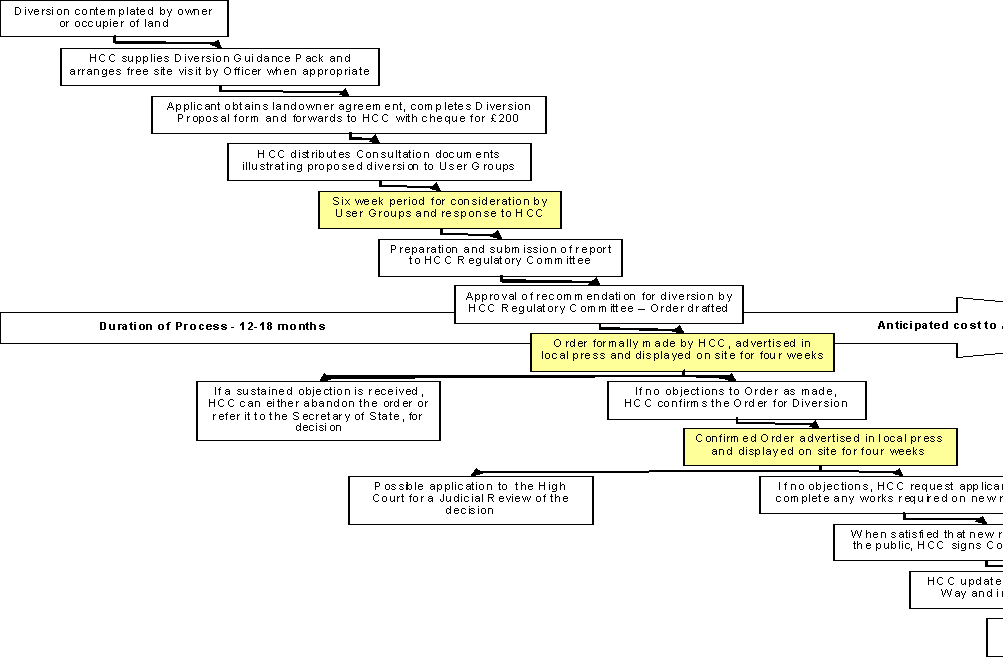
The attached diagram illustrates the procedure involved after receipt of the application.
Part II: Choosing a new route
This part of the guidance is intended to help applicants promote a diversion which provides the best possible alternative route and an application which is, therefore, more likely to be approved. It is also intended to discourage the making of applications that stand little or no prospect of success.
We recognise that the needs and aspirations of the users of a path need to be taken into account when a path is diverted as well as those of the land owner and/or manager. We will consider both and we will also have regard to our Countryside Access Plans, which drive and inform the way in which we manage the network of public rights of way. These are the result of research and consultation with local residents, access user groups, land owners, farmers and land managers. The plans can be seen at www3/hants.gov.uk/hampshire-countryside/countryside-development/access-plans.
We recognise that different users have different needs and not everyone using the rights of way network will agree on the qualities which make it special. We have consulted a number of people and organisations with different interests and have sought to draw out the most obvious issues of concern. The guidance is not intended to be prescriptive, because the overall quality of an application will be a combination of many different factors. These might include:
· the quality of the existing route and the proposed new route, in terms of surface, gradient, views and quality of the user's experience
· the importance of the path in the network,
· the nature of the terrain,
· local needs and opportunities
· level and ease of future maintenance
Our recommendations on widths, for example, are for guidance only, because the provision of a path at our suggested width does not guarantee that the application will be looked on favourably, any more than non-compliance means that application will necessarily be unsuccessful. We are suggesting that new footpaths should be at least 2 metres wide, because this width provides for ease of use and makes the path more accessible for machinery used for cutting. However, if there are good practical, or land management, reasons why the width should be less the diversion may nonetheless be acceptable. We want to encourage easier access to the countryside for all, so we will look more favourably on a new route that has no gates or stiles than on one which affords less accessibility. However, we also recognise that there are reasons why structures may be necessary to manage land properly, so a new path which includes such gates or structures may still be approved. Our guidance should be read in this spirit.
1. Accessibility to users and for maintenance purposes
Structures:
· We like routes without gates, stiles, or other structures.
· We don't like routes with structures unless these are necessary to prohibit unauthorised use or to control livestock. If a structure is needed to prevent unauthorised use, where possible a gap should be left at the side for pedestrian (and, where possible, equestrian) access. Structures needed for the control of livestock may be authorised under s.147 Highways Act 1980.
· We don't like stiles.
· We would like you to discuss with us the specification of any structures before submitting your application. Bridleway gates need to be a minimum 5 ft wide and have a longtail latch. We would like to see Radar gates and medium mobility gates where improvements to accessibility are needed or desirable.
· We like structures on bridleways at junctions with roads to be sited sufficiently far back from the road junction to provide an area for riders to wait safely before crossing.
Widths:
· We don't like new paths to be narrower than the paths they replace
· We like paths to be wide enough for people to use easily and for machine access should surface cutting be necessary, ideally a minimum of 2 metres for a footpath and 3 metres for a bridleway but, generally, the wider the path the better
· We don't like to find that diverted paths are subsequently narrowed by fencing or hedges, so if a path is to be enclosed at least an additional 0.5 metres of width should be offered.
2. Quality of surface
· We don't like new paths to have a surface which is less durable than the old, or which costs more to maintain. Drainage of the new path is an important matter to consider, as is the ability of the path to dry out after wet weather. The surface of a brand new path across open land may not be as durable as the surface of a path that has been compacted as a result of having been trodden for centuries, so the new path may need to be drained or engineered before it is of a similar standard.
· We like new paths with improved durability, consistent with their character and situation. We will advise on the required standard of construction of a new path. This will vary according to its location and future use. For example, if the diversion means that the path is likely to be used more after the diversion than before, we may require the new path to be constructed to a higher standard than the old.
· We don't like new paths to use private access points where livestock congregate or where surface damage can be caused by farm machinery.
3. Quality of experience
· We like paths which offer the user a similar, or enhanced, experience to the path being diverted, in terms of character, views, gradient and convenience of use
· We don't like a significant increase in length, unless this is justified where it offers an improved experience or a link to a network not as conveniently accessible on the existing network
· We don't like paths which take the user away from points of interest, such as views, historic features, or water unless an equivalent feature is available on the new route
· We like diversions which reduce potential hazards for the user, such as taking users off a busy road, or away from land used by plant and machinery
· We like paths which are safer for users, such as those with improved sight lines at road crossings
· We like paths which take a route that is easy for the users to follow without excessive signing and waymarking
4. Strategic value
· We like diversion proposals which provide improvements in connectivity to other parts of the rights of way network or to areas of public access
· We don't like diversions that do the opposite
· We like diversions which offer network improvements identified by the relevant Countryside Access Plan better than those which do not. All diversion proposals should meet the standards recognised in such access plans as relevant to highways of that type.
· We like diversions which offer additional rights for non-motorised users. If a new footpath is suitable and appropriate for use by horse riders and cyclists, we will welcome the dedication of additional rights for those users.
We reserve the right not to process an application for diversion if rights of way on land owned by the landowner are not fit for use as a result of any default on the part of the owner or occupier of the land.
We will not make or confirm an order if we do not consider it expedient to do so. In deciding whether or not it is expedient, we may take into account the cost of promoting an order once made, and the prospective benefit afforded to the public by the new route.
Part III: A landowner's responsibility for the network
The County Council will become responsible for the maintenance of the surface of any public right of way that has been diverted, but landowners have certain responsibilities for public paths which cross their land. We think it worth reminding prospective applicants of these, so that future liabilities can be taken into account when a new route is proposed.
Vegetation
A landowner must ensure that vegetation from land on either side of a right of way does not overhang or encroach onto the public path. If a path is to be enclosed by hedges, or is to run next to a hedge or woodland, the regular cutting back of vegetation will be an ongoing responsibility on the part of the landowner or occupier of the land on which they are planted. Care should also be taken to ensure that there is adequate headroom for users of the path. In the case of a bridleway, clear headroom of at least 3 metres must be maintained. Any tree falling across a right of way should be cleared by the owner of the tree.
Ploughing and cropping
There is a right to plough across a footpath or bridleway if it runs across a field, provided that it is not reasonably convenient to avoid disturbing the surface of the path. A footpath should be reinstated within 14 days to a minimum width of 1 metre and a bridleway should be reinstated to a minimum width of 2 metres within 14 days of the first disturbance for sowing of a crop, and within 24 hours in any other case. The potential disturbance to users caused by the ploughing of a right of way is a factor that we will take into account before approving a diversion, but where it has been approved, landowners should be aware that the right to plough comes with the responsibility to reinstate. It is an offence to disturb the surface of headland paths.
Any path running through a field of crops must be kept clear by cutting or spraying to the same widths.
Structures
Landowners and occupiers are responsible for the maintenance of gates and other structures on rights of way unless they have been erected by us under our traffic management powers. They should be repaired or replaced when necessary so that they are safe and easy to use. We can provide advice and assistance when structures need to be replaced. No structures should be erected unless previously authorised by us.
Livestock
Livestock and the public do not always mix. All land managers are under a duty not to put at risk the health and safety of persons not in their employment. Specific rules relate to bulls: it is an offence to keep any bull in a field crossed by a right of way unless i) the animal is under 10 months old or ii) it is not of a recognised dairy breed and is at large with cows or heifers.
Obstructions
It goes without saying that rights of way should not be obstructed, even temporarily and that it is an offence to erect signs or act in a way intended to mislead or deter members of the public from using public rights of way.
We would remind landowners that the maintenance of free passage along public rights of way is a key farm activity that falls within the cross-compliance rules of the Single Payment. The County Council, as a relevant enforcement body, is encouraged to report Good Agricultural and Environmental Condition (GAEC) breaches to the Rural Payments Agency (`RPA'), particularly those which breach GAEC 8 - Public Rights of Way. The RPA will then consider a reduction in the Single Payment Scheme.