
Archived decisions
Hampshire County Council Regulatory Committee 12 March 2008 Applicant: Raymond Brown Extraction of sand and gravel, landfilling with inert construction, demolition and excavation waste and restoration to agriculture, erection of minerals processing plant and ancillary buildings and equipment, construction of new access off A27, including demolition of bungalow, at Roke Manor, near Romsey (Application No. 07/02771/CMAS) Report of the Head of Planning and Development |
Item 6 |
Contact: Julia Davey, ext 6732 email: [email protected]
1. Summary
1.1 This report considers an application for extraction of sand and gravel, landfilling with inert construction, demolition and excavation waste and restoration to agriculture, erection of minerals processing plant and ancillary buildings and equipment, construction of new access off A27, including demolition of bungalow, at Roke Manor, near Romsey.
1.2 The site of Roke Manor was a Preferred Area in the Hampshire Portsmouth and Southampton Minerals and Waste Local Plan 1998 which has been carried forward under a saved policy into the current Minerals and Waste Development Framework. This application is a departure from the development plan because it proposes a wider access point (to allow for screening) than in the plan; a mineral washing plant which is outside of the preferred area boundary, and the haul route has been altered from its Preferred Area position (to move it away from residential properties).
1.3 To conclude, this site that would provide the county with 804,000 tonnes of mineral for which there is a clear need. However, it is also a site which has houses in close proximity to its access located on the A27 and two cottages either side of the extraction area. There are also some properties to the east of the haul route near the A27 by Squabb Wood and further away on Old Salisbury Lane. Therefore that the key issue is whether the need for the mineral outweighs the level of environmental impact that would be caused by this proposal being worked. In reaching a conclusion it is noted that no objection has been received to the application from any of the statutory consultees, including Natural England regarding nature conservation, the Highway Authority regarding traffic and road safety issues, the Environmental Health Officer regarding amenity issues and the Environment Agency regarding hydrological issues. It is considered the proposal can be worked subject to conditions without causing significant environmental impacts on the locality, and the clear need outweighs the adverse impacts. The application is a departure from the development plan. However, it is considered that the departures are justifiable in that the change to the layout would lessen impacts on amenities and that it is best practice to have a washing plant near the source of mineral. Also the location of the washing plant would not be likely to cause any significant impacts to local amenities as it is remote from housing and well-screened. Accordingly, taking all matters into account, it is considered on balance that permission be granted subject to a legal agreement and conditions.
2. Recommendation
That permission for extraction of sand and gravel, land filling with inert construction, demolition and excavation waste and restoration to agriculture, erection of minerals processing plant and ancillary buildings and equipment, construction of new access off A27, including demolition of bungalow, at Roke Manor, near Romsey be granted subject to a legal agreement to secure long term management of the woodland and a financial contribution for highway maintenance and improvements and the conditions set out in Appendix 1.
Reason for Approval
Although a Preferred Area, the proposal would not be in accordance with the development plan (summary attached) because it proposes a wider access point (to allow for screening) than in the plan; a mineral washing plant which is outside of the preferred area boundary, and the haul route has been altered from its Preferred Area position (to move it away from residential properties). However, it is considered an acceptable departure. It would not materially harm the character of the area or the amenity of local residents, would be acceptable in terms of highway safety and convenience and, on balance the need for the mineral is considered to outweigh any impacts the development may cause.
3. The Site, Planning History and Constraints
3.1 The site, as shown on the attached plan, extends across a total area of 31.05 hectares within the `red line'. The site comprises:
(i) the mineral extraction area (`the extraction area') bordered to the north by Old Salisbury Lane, Roke Manor Farm and associated cottage to the east; woodland and a pair of cottages known as Roke Manor Cottages to the west, and to the south by woodland comprising part of a Site of Importance for Nature Conservation (SINC) known as Squabb Wood. The mineral extraction site has a gross area of 25.1 hectares including margins and buffer zones;
(ii) the mineral washing plant site (`the washing plant site') within an area of pasture land enclosed on all sides by woodland - the washing plant site would be linked to the extraction area by a haul route and conveyor through the woodland; and
(iii) vehicular access and haul route from the A27 between two houses, enclosed and screened by earth bunds throughout its entire length from the A27 to the washing plant site. The access would be wider than that proposed in the 1998 Minerals and Waste Local Plan due to the purchase and demolition of a bungalow by the applicant - this would give additional space for screening/bunding.
3.2 The application area affects two farms. The extraction area and washing plant site are part of Roke Manor Farm and are currently pasture land with the extraction area used by foraging pigs. The access to this Farm is from Old Salisbury Road which forms the northern site boundary.
3.3 The second farm is the land between the A27 and the extraction site and is known as Stanbridge Ranvilles Farm. This farm is generally in arable use and includes a business storing and distributing straw bales. The existing access to this farm is onto the A27 between the residential properties of Ashness and Kintail, as shown on the attached plan, and is used by farm traffic including heavy goods vehicles (HGVs) and articulated lorries.
3.4 The majority of dwellings near to the site form a linear development along the eastern boundary of the A27. The gardens back onto the land forming Stanbridge Ranvilles Farm. The back gardens and first floor windows of the nearest properties would have a view of the bunded haul route linking the A27 with the washing plant site.
3.5 Near to the extraction area there are two properties that directly border the site and would be separated from the extraction area by a 100 metre stand-off zone and an earth bund to protect them from noise. Roke Farm Cottage in the north-east corner provides accommodation for the farm manager. In the north-west corner beyond woodland lie a pair of cottages known as 1 and 2 Roke Manor Farm Cottages.
3.6 To the north of the extraction site across Old Salisbury Lane is Stanbridge Earls School (for Special Needs) and two further houses.
3.7 At the south-east corner of the extraction area is a business use developed in the grounds of Roke Manor (Roke Manor Research). The access to this is from Old Salisbury Lane via a private road approximately 50 metres to the east of Roke Manor Farm.
3.8 Approximately 100 metres west beyond Roke Manor Farm Cottages on the northern side of Old Salisbury Lane is an isolated house (Croylands). Further west beyond Croylands lie further houses on the northern edge of Old Salisbury Lane.
3.9 To the south of the site lies an extensive area of woodland known as Squabb Wood (which is a SINC - Site of Importance for Nature Conservation). Beyond this is the existing Squab Wood landfill and Embley Quarry operated by Viridor.
3.10 The nearest properties to the haul road (away from the A27) are Troy House and Longdown Cottage, some 150 metres to the south, and Stanbridge Ranvilles Farm the same distance to the north.
3.11 The Test Way long distance footpath crosses the western part of the extraction area over a length of approximately 175 metres. It presently crosses the corner of a field used for pig farming and it is proposed to temporarily divert the path to a route alongside the existing field boundary marked by hedgerows.
3.12 The Test Way continues through Squabb Wood to the south of the site, joining up with Footpath No. 3 that runs through Squabb Wood from the A27 past Troy House. None of these rights of way, apart from that section of the Test Way to be diverted, would be directly affected by the proposals.
3.13 An Agricultural Land Classification (ALC) was undertaken by the Ministry of Agriculture in November 1994. This shows that the majority of the extraction area comprises land of moderate quality (Grade 3b) with a small proportion (approximately 15%) of good quality land (Grade 3a) alongside Old Salisbury Lane. The remainder of the application site has not been surveyed in detail, but is shown within a wide area of Grade 3 land on the regional ALC plan for the South East.
3.14 The extraction area has a generally flat appearance with a level of 55 metres Above Ordnance Datum (AOD) at its eastern end rising gradually to 64 metres AOD at its western boundary. Land to the north and east of the extraction area is also generally flat of complementary levels. Land to the south within woodland drops away quite steeply to the south and south-east. Agricultural land to the west of the extraction area beyond Roke Manor Cottages is separated from the extraction area by a narrow wooded valley.
3.15 The River Test lies approximately 700 metres to the east and is a Site of Special Scientific Interest (SSSI).
3.16 The mineral extraction site has a gross area of 25.1 hectares within which the extraction area is 21.0 hectares excluding margins and buffer zones.
4. The Proposal
4.1 Planning permission is sought for extraction and processing of sand and gravel and restoration of the land to agricultural use for a period of ten years from the commencement of development. The time provides for the set up of the site (construct the access, plant site and conveyors) and to restore it having regard to seasonal restrictions, and allows for possible slippage in the programme.
4.2 The extraction site contains an estimated 780,000 tonnes of workable sand and gravel. It is proposed that this will be extracted in phases at a rate of circa 150,000 tonnes per annum over a period of approximately five years. Restoration by importing inert materials will commence upon the completion of Phase 1. This is expected to be one year from the commencement of extraction. Both mineral extraction and restoration will continue together until mineral extraction is completed. Excavation of the northern part of the plant site would provide material to be used for constructing bunds and roadways. The minerals in the southern part of the plant site ( 13000m3/24,000 tonnes) would be processed through the plant and exported from the site.
4.3 It is not anticipated that inert restoration will keep pace with the mineral extraction due to the variable availability of inert materials. It is expected that by the time extraction is finished, two phases will remain to be restored. Restoration of the final quarried area will then be completed as soon as possible. The expected overall operational period of quarrying and restoration is therefore eight years.
4.4 The applicant has secured control over adjoining land for the purposes of providing off-site planting, woodland management and monitoring. This area is outlined in blue on the Site Location Plan in accordance with the normal convention.
5. Mineral Extraction
5.1 The sand and gravel will be worked progressively in five phases commencing at the western end of the extraction area. The initial operations comprise the stripping of soils. These will be used to form perimeter banks (known as bunds) generally up to three metres in height (four metres in places) and seeded with grass. The bunds on the boundaries closest to Roke Manor Farm Cottages, Roke Manor Farm and Roke Manor Research will serve as screening and noise attenuation barriers. The bund near to Roke Manor Farm Cottages will be constructed upon the commencement of Phase 1 and will remain for the duration of working since it will serve a useful amenity function throughout the life of the operations.
5.2 Following removal of the soils to expose the underlying mineral, the sand and gravel would be excavated using a 360o excavator, face shovel or similar mobile quarrying plant and loaded onto the ground conveyor spur via a feed hopper. The mineral would then be transferred onto the main conveyor and onwards to the washing plant site.
5.3 The sand and gravel would be worked in parallel strips and the spur conveyor progressively would be moved as each strip is completed and the main conveyor line extended. The ground conveyor system will sit on metal support skids on the mineral surface and will have an overall height of less that one metre, except for the transfer and loading points. The mineral would be worked to an average depth of 3.5 metres.
Restoration
5.4 Restoration would follow on behind the mineral extraction on a phased basis. Imported materials would be restricted to inert construction, demolition and excavation wastes. These materials are defined in the Landfill Directive as:
"waste that does not undergo any significant physical, chemical or biological transformations; inert waste will not dissolve, burn or otherwise physically or chemically react, biodegrade or adversely affect other matter with which it comes into contact in a way likely to give rise to environmental pollution or harm to human health. The total leachability and pollutant content of the waste and the ecotoxicity of the leachate must be insignificant and in particular not endanger the quality of surface water and/or groundwater"
and therefore do not give rise to concerns about odours or leachate.
5.5 The materials will be delivered to the site by lorry. These will mainly be rigid eight-wheeled tipper lorries with a load capacity of up to 20 tonnes. These will travel to the tipping area via the internal haul road system.
5.6 Once any phase has been filled to the required level soil will be replaced to the original depths occurring on the site. It should be noted that the existing soils are relatively thin. It is proposed that restoration soils will be directly placed using soils being excavated from a future mineral extraction phase.
5.7 It is proposed that, wherever possible, the empty tipping vehicles will be used to deliver sand and gravel from the site. This practice, known as `backloading', is dependent on the delivery point for the aggregates and collection points for the waste, and also the nature of the waste materials. It is estimated that 50% backloading is achievable.
6. Mineral Washing Plant Site
6.1 The washing plant site covers an area of approximately two hectares. It is completely surrounded by trees and woodland. The amenities of the area would be further protected by lowering the base of the area by an average of approximately two metres as part of the overall civil engineering operation, and by the construction of screen banks around the plant site. The screen banks would be constructed using:
(i) topsoil and subsoil stripped from the plant site area;
(ii) sand and gravel arising from the lowering of the site; and
(iii) imported materials.
6.2 The soil and gravel bunds will be seeded with appropriate grass/plant seed mix. The surplus mineral generated by the engineering works (13,000 cubic metres/24,000 tonnes) would be processed through the washing plant site when it is functioning and would be sold and exported off-site.
6.3 The ground conveyor will discharge into a raw material stockpile in the north-west corner of the washing plant site. This stockpile needs to have sufficient capacity to hold several days stock to cater for stoppages of the conveyor. From the stockpile the sand and gravel will be fed as required by loading shovel or equivalent mobile plant into the primary feed hopper for the sand and gravel processing plant. The plant will principally comprise mobile units of linked screens and conveyors to produce a range of graded aggregates to meet market requirements.
6.4 The washing plant site will incorporate a washing plant to remove silt from the excavated minerals. The washing plant will be of similar design to the company's plant at the Rookery Landfill near Fareham and provide for a more sustainable use of water. This avoids the requirement for traditional silt ponds. The silt is washed out from the aggregate and then pressed into a `cake' in an enclosed plant. The water is recycled through the plant, and the silt cake removed to be used for restoration.
6.5 The plant site area would be restored using 40,000 cubic metres of infill material. This would comprise 20,000 cubic metres of material reclaimed from the bunds along the haul roads leading from the A27 which cannot be used as aggregate. The balance would be imported fill.
7. Access and Haul Roads
7.1 The proposed access onto the A27 meets the technical requirements for a commercial access onto a principal road subject to a 40 mph speed limit. The first 60 metres of the access will also serve as the commercial access to Stanbridge Ranvilles Farm and would have a width of 7.3 metres and appropriate bellmouth radii. This is designed to allow two lorries to pass and is sufficient to avoid any backing up of traffic onto the A27. Beyond the 60 metre point the haul road is limited to four metres width with inter-visible passing places.
7.2 The existing farm access between Ashness and Kintail will be retained solely as a domestic access for these two houses.
7.3 Soil banks will be formed alongside the access road between the A27 and the plant site to screen quarry traffic and mitigate noise.
7.4 The access and haul route would be metalled (concrete or tarmac) between the A27 and the wheel wash located at the plant site. Beyond this point haul roads would generally be built up utilising indigenous sand and gravel. However the steeper section between the plant area and the extraction area where it crosses the valley will also be metalled to avoid rutting and erosion. Gradients will be eased on this section through the formation of a low embankment across the valley floor and cutting into the side banks in a `cut and fill' operation.
7.5 The average vehicular movements will vary throughout the life of the working. Initially the movements will be restricted to the mineral extraction. Once restoration commences both minerals and restoration vehicles movement will occur, although with a degree of backloading empty movements will be minimised.
7.6 Finally, once mineral extraction is completed, the restoration vehicles will continue until the restoration is completed. The estimated average movements (ie in and out) during the extraction/restoration phases and allowing for backloading is 84 per day with a forecast maximum of 114 per day.
7.7 All traffic will travel via the A27 towards Romsey except for local deliveries.
7.8 An alternative access onto the A27 via Squabb Wood landfill site has been investigated, but it has not been possible to come to any agreement with the landowner.
8. Landscaping
8.1 Additional planting is proposed at the outset in the following locations shown of the detailed landscape proposals. This includes:
(i) off-site planting in three blocks generally north of the access road to filter the view from Shootash and Old Salisbury Lane; and
(ii) hedgerow planting along the site access.
8.2 The proposed bunding also serves a screening function for landscaping purposes, for example along Old Salisbury Lane. Bunding is also proposed alongside the main access/haul road as indicated on the detailed drawings. These will be constructed using on-site soils and, if necessary, imported materials. All bunds will be grass seeded and maintained.
9. Restoration and Aftercare
9.1 As part of the restoration proposals planting is proposed in the following locations:
(i) Woodland blocks on the southern perimeter of Phases 4 and 5 (the eastern end of the extraction area). These are designed to reinforce the Tree Protection Order and provide replanting for the trees lost. It will also provide a long-term screen for the Roke Manor Research car park.
(ii) Replanting of the woodland across the valley between the extraction area and the washing plant site.
(iii) The provision of a new hedgerow across the restored land. The total area of planting is 0.92 hectare and 931 metres of hedgerow.
9.2 The landowner wishes to return the land to agricultural use. Land within the site not required for quarrying operations will continue in agricultural use.
9.3 The restoration contours have been designed to maintain the existing drainage pattern off-site whilst providing sufficient slopes for drainage on-site. Because the existing site is very flat (particularly at the eastern part which represents the majority of the extraction area) it is necessary to provide a shallow domed landform to achieve satisfactory restoration levels.
9.4 In this case satisfactory drainage is achieved by raising the height of the final landform to a maximum of Phase 1 (the western field) by two metres and Phases 2-5 by up to three metres in the centre of the site. The resulting imported inert material volume has been estimated at 520,000 cubic metres. It is proposed that this be filled over seven years at an annual rate of 75,000 cubic metres commencing as soon as practicable following the completion of extraction in Phase 1.
9.5 The restoration design incorporates swales (hollows or shallow ditches) around the perimeter of the filled area. These are to collect the surface water run-off and allow re-charge through the remaining gravel by channelling into the groundwater.
9.6 Aftercare would be carried out for a period of five years following the completion of restoration of any phase and will provide for the management of the soil resources to establish sustainable agricultural use. It is anticipated that the initial restoration would be to a grass lay, and in time stock can be introduced as the restoration becomes established.
9.7 Upon the completion of mineral extraction the minerals processing plant will be removed. The stockpiles of processed aggregates will remain until sold. Restoration will continue for a period after mineral extraction and the washing plant site buildings and weighbridge will need to be retained until restoration is complete.
9.8 The washing plant site itself will be backfilled with imported inert waste to slightly above original ground levels for drainage purposes and restored similarly to the extraction area.
9.9 The ground conveyor and haul road between the extraction area and the washing plant site will be removed and the land restored, including the replacement of trees in the woodland sections.
9.10 The proposed access onto the A27 would be retained for the duration of mineral extraction. Upon completion of working the access would be closed with the land reverting to a housing plot (subject to planning permission) and the old farm access being re-opened.
10. Hours of Working
10.1 The proposed operational hours are those regarded as standard in the industry:
0700-1800 Monday-Friday
0700-1300 Saturday
with no working on Sunday or recognised public holidays (except for essential maintenance) unless previously agreed with the Mineral Planning Authority.
11. Environmental Impact
11.1 The proposal is an EIA Development under the Environmental Impact Assessment Regulations 1999 and an Environmental Statement has been submitted. The key topic summaries are outlined below:
(i) Landscape
The report considered the landscape character of the site, the impact of working and the need for appropriate landscaping measures.
A Landscape Character Assessment identifies the site as falling within the landscape character type called `Mixed Farmland and Woodland'. This is an area comprising large areas of woodland allied with large areas of arable farmland along with areas were smaller fields and woodland occurs.
Only three individual trees require removal and these are in a poor condition. Extensive new individual tree planting is proposed to select existing and new hedge planting. Hedge removal is confined to the removal of two small sections of hedge at the western end of the haul road along with the removal of an isolated hedge located at the eastern end of the extraction area. In total 931 metres of new hedge planting is proposed.
The small strip of woodland within Squabb Wood that is required for removal to accommodate the haul route will be replanted at completion. In addition six new areas of woodland are proposed for planting at commencement with a further woodland area, `W7', being planted on completion. This will give a total area of new woodland amounting to 5,485 square metres or 0.54 hectares.
The new tree, hedge and woodland planting support the strategies and guidelines set out in guidance prepared by Hampshire County Council.
The landform and landscaping proposed is designed to integrate with their surroundings and will serve to enhance the landscape well into the future.
(ii) Ecology
Within the extraction area there will be the temporary loss of 19.8 hectares of arable land, 145 metres of hedges and 3 trees. Within the haul road route there will be the temporary loss of 0.2 hectares woodland, 0.18 hectares of wet meadow, 1.77 hectares of improved grassland and the house and curtilege of `The Cedars'. Following cessation of working the site will be fully restored back to its original use and the haul road removed. Woodland will be replanted and the wet meadow reinstated. Bunds along the haul road will be removed.
Populations of dormouse present within the adjacent woodland will not be adversely impacted by the scheme, and mitigation and enhancements will ensure an overall improvement to the habitat. A programme of hedge restoration and management will be instigated and new hedges totalling 931 metres will be replanted and compensation and enhancement woodland totalling 9.2 hectares will be planted.
Further long-term benefit will be enhancement works in Squabb Wood Site of Importance to Nature Conservation (SINC), including replanting, thinning, rhododendron clearance and the preparation and implementation of a management plan.
No impact is predicted on the sensitive hydrological seepages in Squabb Wood SINC.
Although there will be a short-term low negative impact, in the medium term there will be a low positive gain.
(iii) Hydrology
The hydrogeological assessment indicates the presence of seasonal winter groundwater in parts of the southern area of the site. By working these areas in the dry summer months the site will be worked `dry', ie without any need to pump out groundwater. Rainwater will soak away naturally. There will therefore be no significant effect on groundwater.
There is a potential impact on surface water resources particularly relating to a number of springs within Squabb Wood and their associated ecological interest. A full assessment of the hydrology and hydrogeology of the site and its context has been carried out. It is concluded that the development will have no material impact on these springs and associated ecology during operations or post restoration, or on the wider water environment.
(iv) Noise
The Environmental Statement concludes that that the overall `worst case' noise levels associated with the development would comply with national mineral planning guidance (Minerals Policy Statement 2 `MPS2') with noise criterion based on the existing background levels as measured at the local dwellings and that at all locations. Compliance with the MPS2 upper limit of 55 dBA LAeq, 1hr would always be assured.
In subjective terms, on the basis of the predicted change in overall ambient noise levels due to the proposed development, the noise impact on the local community would, in the main, be classed as a slight impact. When extraction is closest to Roke Manor Farm Cottages, in Phase 1, there would be a moderate impact. On the basis of the proposed development as described, the overall conclusion is that not only would the appropriate MPS2 noise criteria be complied with, but also that the noise impact in the community would be minimised by the implementation of the Applicant's noise mitigation strategy.
(v) Highways
All vehicular access will be from the A27 through a property called `The Cedars'. This will enable a superior access to the one shown in the Hampshire Minerals and Waste Local Plan. Use of this access will amount to 84 HGV average movements per day in the middle four year period when both mineral extraction and inert fill takes place. In the first year and the last three years the number of vehicles using the access will be lower. Any occasional periods of greater activity will be followed by periods of reduced activity to ensure the site does not exceed its annual quotas.
Recent traffic counts show that traffic flows on the A27 are relatively low and even in the morning peak period amount to some 830 vehicles per hour. The recent accident history indicates that there were accidents at the Shootash cross roads junction some years ago, but the introduction of a 40 mph speed restriction along this section of the A27 has reduced the frequency of occurrence.
The proposed access layout is appropriate for the level of usage and the period it is likely to be used. It is submitted that widening of the A27 to form a right-turn lane would not be beneficial and would result in traffic travelling faster along the road.
The additional traffic from the development would add 1.3% to the existing daily traffic flows.
No mitigation is considered necessary on the A27 because of the relatively low flows and the good standard of the existing road.
(vi) Other Issues
Dust: The proposed scheme is not assessed to be a significant source of dust emission. Simple practicable measures should be taken to eliminate dust at source and it is suggested that the details of such measures should be dealt with by planning condition. It is noted that farming activities have significant potential for dust emission, particularly at Roke Manor where pig rearing leads to bare earth.
Agriculture: The restoration and aftercare proposals will be subject to planning conditions to ensure that the land is returned to agricultural use. There will be some temporary loss of agricultural land during the phased working of the site, but there will be no material long term impact.
Airfield Safeguarding: The site lies on the fringe of the Safeguarding Zone for Southampton Airport (Eastleigh) which is located approximately 13 kilometres to the south-east of the site. The proposed working and restoration schemes will not attract gulls or water fowl. No substantial tree planting is proposed.
Rights of Way: The Test Way crosses the corner of Phase 1. It is impracticable to maintain the path on its existing route during working. To protect the amenities of users the path is to be temporarily diverted. The temporary route will be marginally longer than the existing route.
(vii) Vibration and Subsidence
Shallow sand and gravel workings excavated by standard quarrying methods are very unlikely to give rise to vibration and subsidence. They do not involve blasting or the use of percussive equipment.
The scheme incorporates buffer zones between the working area and residential and business properties which are more than adequate to deal with any such concerns, whilst the processing plant is located in a remote position. The proposed processing plant site is also remote from any sensitive properties.
(viii) Alternatives
The site is a Preferred Area for sand and gravel extraction and therefore it is not appropriate to consider alternative extraction sites since this process was gone through in the preparation of the Hampshire Minerals and Waste Local Plan.
However, alternative site layouts, locations for the washing plant site and haul/access routes have been considered. The submitted proposals have sought to minimise the impact of the proposals on the local area.
(ix) Archaeology
Although the application site does have archaeological potential which requires further exploration, there is no unequivocal evidence for the existence of significant remains within the area affected by the proposed mineral extraction.
However, archaeological investigation of the proposed extraction site should commence as soon as possible following the determination of the application. The potential remains on the site could include artefact concentrations and funerary or occupation sites that would require further phases of detailed excavation and recording. It is clearly preferable that there is sufficient scope in the timetable to allow for any work of this type to be carried out well in advance of extraction to avoid undue delays.
11.2 Overall it is concluded that the proposed development, included the recommended mitigation measures, would not give rise to any significant environmental effects.
12. Development Plan
12.1 Hampshire Minerals and Waste Core Strategy policies DC1 (sustainable development), DC3 (landscape impact), DC4 (archaeology), DC6 (highways), DC7 (biodiversity), DC8 (pollution, health, amenity), DC10 (water resources), DC12 (restoration and aftercare), DC14 (landfill), DC15 (sand and gravel), S1 (sustainable design and construction), S6 (landfill), S8 (sand and gravel) and S14 (safeguarding) apply.
12.2 The Test Valley Local Plan `Revised Deposit Plan' Adopted June 2006 policies SET03 (protection of countryside), ENV04 (SINC) and ESN01 (retention of existing housing) apply.
12.3 The Hampshire, Portsmouth and Southampton Minerals and Waste Local Plan (adopted 1998):
The Roke Manor site (`the Site') was identified as a Preferred Area for the extraction of sand and gravel in the Hampshire, Portsmouth and Southampton Minerals and Waste Local Plan that was adopted in December 1998 (Preferred Area 3). The Site had also previously been identified in the original 1987 Minerals Plan and has therefore been reserved for sand and gravel extraction for some 20 years.
12.4 The Hampshire Minerals Plan (Regulation 26 consultation) Preferred Sites Document identifies the Site together with other adjacent land within the same ownership for mineral extraction.
12.5 The current proposal is a departure from the adopted Minerals and Waste Local Plan because it proposes a minerals washing plant which is outside the Preferred Area boundary; the proposal would alter the alignment of the haul route linking the A27 to the extraction area by locating it further away from the houses on the A27 and Old Salisbury Lane; and the proposal would also widen the haul road for screening purposes and slightly vary the access point between residential properties on the A27.
12.6 Regional Planning Guidance for the South East (RPG9) - Waste and Minerals - sets out Hampshire's requirements - the `apportionment' - for sand and gravel.
13. Consultations
13.1 The local Member, Councillor Perry, raises a number of concerns about the application. Councillor Perry is concerned about the access point location near a bend by the Shootash crossroads and the type and speed of traffic along the A27 as well as the flow of traffic; he considers that an access towards Squabb Wood using the Viridor landfill access would be the most appropriate solution were this possible. Councillor Perry also raises concerns about the feasibility of dry working in an area that can be prone to water logging; impacts on amenity by way of noise, air quality and dust. Councillor Perry also raises concerns about the plant site and the fact that this is outside the Preferred Area boundary. He adds that if granted this could prejudice the fair consideration of the new Minerals Framework Plan. Councillor Perry adds that one of his other key concerns is the cumulative impact of mineral and waste working over many years in the Shootash area which is already blighted by the Squabb Wood site. He comments that if the applicant's proposed site of Stanbridge Ranvilles Farm in the Framework consultation were to succeed, it would create a vast area that would be worked over many decades. If the concerns about cumulative impact on PPS1 are to have any meaning then they should apply here. It is important that impacts to wildlife and nature conservation where the haul route crosses through the woodland are fully addressed including protection of the dormice that have been found in the wood.
13.2 Sherfield English Parish Council states that its comments relate to the impact the development may have on the residents of Sherfield English. The Parish Council queries whether with more recycling coming on-stream the ten year timeframe given is realistic. The Parish Council is concerned that the neighbouring Squabb Wood Landfill has already been granted an extension of time and the Framework Regulation 26 consultation proposes to surcharge part of the Squabb Wood site which may give rise to the need for a further extension of time. The Parish Council states that the vehicles accessing the site could be different from that described, in that they could be long and large and to have both the Squabb Wood access and the proposed access quite nearby on the A27 could be dangerous, particularly at the access shown close to the Shootash crossroads. The Parish Council asks that the County Council use its statutory powers to create a joint access for both developments (Squabb and Roke at the Squabb Wood entrance). It adds that it understands some of the landfill material proposed would be from the Marchwood incinerator site. The Parish Council is concerned this could create more problems than commercial and industrial waste and queries whether it is inert and free from any pollutant material.
13.3 Awbridge Parish Council raises concerns about the impact of the application on the local area and its residents. The Parish Council expresses concern that the application has been submitted now prior to the Framework Plan being completed and concern that Roke Manor is only viable if Stanbridge Ranvilles is also worked for gravel and landfill. It queries where the landfill material would come from and how long it would take to fill, as in the new HMP it states that by 2020 the amount of waste going to landfill will be very limited in quantity. It is also very concerned about increased volumes of traffic and that Awbridge could suffer as a result of the proposal. Some unscrupulous drivers use Saunders Lane and Danes Road as a shortcut. The junction at north end of Danes Road by the Primary School is very dangerous. Query why Squabb Wood access cannot be used. People entitled to a respite as people of Awbridge lived with workings for over 40 years.
13.4 Braishfield Parish Council objects to the application on the grounds that the noise report was inadequate as it did not cover the concrete crusher.
13.5 The Environment Agency has no objection in principle to the proposal subject to conditions, relating to the storage of oils and chemicals, landscape management plan and planting and including the requirement for a groundwater and surface water monitoring scheme to be agreed.
13.6 The Environmental Health Officer Test Valley Borough Council raises no objection to the proposal subject to the buffer zone between houses and the extraction area being increased to 82.5 metres, and conditions relating to noise as put forward on page 5 of the Barnhawk Acoustics report; also conditions should be imposed controlling working hours (07.00-19.00 Monday to Friday. These hours are discussed in MPS2 and described as normal. Saturdays should be limited to 08.00-13.00); noise monitoring; white noise type reversing bleepers; screening bunds erected before works commence; day-time noise limit increased to 70dBA (A) LAeq, 1 hour freefield at the boundary of any noise sensitive premises for up to eight weeks per year, in accordance with temporary working Annex 2 of MPS2; and a lighting scheme should be submitted for approval. The scheme should include details of all outside lighting, including floodlighting, safety lighting and illumination from within the site, around the plant and along the haul route, and measures to prevent general light pollution. Emphasis should be placed on measures to prevent excessive glare and light spillage onto neighbouring residential properties.
13.7 The Highways Authority raises no objection to the application subject to conditions and the completion of a Section 106 Agreement to secure a financial contribution towards safety improvements, repairs and maintenance of the A27 during the operation of the site and subject to planning conditions. Due to the strength of local concerns raised about the A27 near the site and the Shootash Junction, the Highway Authority has again reviewed the three year Personal Injury Accident record for the A3090 and A27 close to their intersection. Seven accidents have occurred on the approaches, one was serious and the remainder were slight. A further seven accidents occurred at the junction, all of these were slight. None of the accidents involved HGVs.
13.8 The junction does not have a good recent safety record and in response to this the County Council has a low-cost safety scheme in its road safety programme to improve the junction.
13.9 Despite the recent poor safety record it is important to note that none of the accidents involved HGVs. As previously stated the development proposals will only increase 12 hour traffic on the A27 by 1.6% (108/6,465 x 100). Mindful of this, it will be difficult to prove that sufficient demonstrable harm will occur as a result of the proposal to successfully sustain a highway reason for refusal at appeal.
13.10 In answer to concerns raised about the need for a right hand turn lane, the Highway Authority considers that a right hand turn lane is not justified on capacity grounds. It also considers that it is not required on safety grounds as forward visibility from approaching vehicles to the access is very good, in fact in excess of the relevant standards. In addition, the Highway Authority states that there is no evidence of right turning accident problems at other local junctions without right turning lanes on this part of the A27. Furthermore a right turn lane would widen the A27 and create a very long regime of right turning lanes stretching from Embley School to the site via Squabb Wood. This arrangement would be likely to encourage higher vehicle speeds and therefore not contribute to overall road safety in this area.
13.11 The Ramblers' Association objects to the application on the basis that there has been enough disturbance in the area over the years and that if the Test Valley footpath that passes through part of the site is to remain permanently it would be affected by the proposals.
13.12 Ministry of Defence Safeguarding raises no objection to the application.
13.13 BAA Airport safeguarding raises no objection subject to a condition requiring that the perimeters of the swales must have dense marginal planting and the surrounding grassland be kept long to reduce the attractiveness of swales to feral geese which could endanger the safe movement of aircraft and the operation of Southampton Airport.
13.14 Romsey and District Society objects to the application as the extraction area adjoins Squabb Wood, a valuable amenity and nature/wildlife woodland area, and also impacts on the Test Way. Traffic would be noisy, dusty and create fumes.
13.15 The South East England Regional Assembly has been informed of the proposal.
14. Report of the Site Visit
14.1 Some Members of the Committee (Councillors Beagley, Bryant, Carew, Cooper, Hockley, James and Price, with Councillor McIntosh in the chair) undertook a site visit on 25 February 2008 to Roke Manor, near Romsey. Members also met the applicant, agent, representatives of Awbridge Parish Council, Romsey Extra Parish Council and Sherfield English Parish Council.
14.2 Councillors Caroline Nokes and Gordon Bailey from Test Valley Borough Council were also present.
14.3 The Head of Planning and Development introduced the application and outlined the key features of the proposal for the extraction and processing of sand and gravel and restoration of the land to agricultural use. Revised plans were displayed which showed the boundary of the site and the contours of the land with phasing details.
14.4 Members noted the position of the site, the location of Roke Manor Farm Cottages, Roke Manor Farm and Roke Manor Research. Members viewed the site from Roke Manor Farm's pasture land currently being used by foraging pigs, the washing plant site, the extraction area and the link through the woodland by the haul route and the conveyor and the location of the entrance for the haul route from the A27.
14.5 Members noted that the applicants had purchased a bungalow which they intended to demolish to create a haul route and earth bunds, and the latter would protect the houses on either side of the haul route. Planting all the way along the edge of the bunds would also protect the neighbouring houses from noise and dust.
14.6 Issues of land drainage, light pollution, noise levels, gates and protection of resident dormice were raised by some of those present.
14.7 It was noted that all lorries would be routed along the A27 into the site and only access for agricultural use by the farmer would be permitted. The installation of gates was a management issue for the applicant.
14.8 Ecologists had been involved at the pre-application stage and had discussed the woodland. A management plan was to be secured as a result should permission be granted. All possible options for a route through the woodland had been investigated including minimising the loss of trees. The route proposed was the one selected because it had been viewed as the most appropriate spot through the woodland which had reached a balance between protecting the ecology of the area and a crossing. Natural England had been satisfied that the dormice could be protected through a mitigation plan.
14.9 Concern was noted that Awbridge would be affected by light pollution, however there was no lighting proposed and the bunding and advanced hedgerow planting would minimise any light pollution.
14.10 In response to a question about projected noise levels and the woodland, it was noted that the Environmental Health Officer at Test Valley Borough Council had raised no objection to a 82.5metre stand-off between the s however a 100 metre stand off has now been proposed to further protect the properties and Test Valley Borough Council Environmental Health Officer had indicated its satisfaction.
14.11 It was noted that the site would be restored to farmland and that a hydraulic system would be installed to maintain the status quo and ecology with regard to drainage to avoid water-logging. However this would not ameliorate the situation with the flooding of Old Salisbury Lane.
14.12 It was noted that extraction of sand and gravel would take place over a period of five years and progressive restoration of the site over a period of eight years.
15. Representations
15.1 At the time of writing this report 31 letters of objection have been received to the application on the following grounds:
(i) Traffic impacts - flow, speed, location of access;
(ii) Amenity impacts - noise, dust ; walkers using local footpaths;
(iii) Cumulative impact with other sites such as Squabb Wood landfill site and length of time the locality has been disturbed by mineral and waste operations;
(iv) Impact on wildlife;
(v) Departure from development plan;
(vi) Recycling not permitted;
(vii) Devaluation of property;
(viii) Applicant has put forward in Framework an extension at Stanbridge Ranville Farm and fear that if granted then this other site would be more likely to get into the Framework;
(ix) Light pollution; and
(x) Need a right hand turn lane.
15.2 At the public exhibition held by the applicant last year, 14 comment sheets were filled in and, as well as all the issues outlined above, a comment was raised about the water supply to Roke Manor Farm cottages, to which the applicant replied that the house is currently fed off the Roke Farm supply and alterative arrangements will be made for a new supply.
15.3 Shootash Against Gravel Extraction (SAGE) objects to the application on the basis it is contrary to policy and development of the site is not in the public interest. It is contrary to policy because it proposes a gravel washing plant; raises land levels and would have unacceptable traffic, amenity and environmental impacts, including the cumulative environmental impact with other sites working close by such as Squabb Wood Landfill. There are two schools in the vicinity of this site and, together with the village of Shootash, all could be affected by the movement of dust in the air. With regards to traffic the A27 does not form part of what was a proposed lorry network and is not considered a suitable route for lorries. Other major accesses on this stretch of the A27 have been dealt with by way of right lane turns (Hampshire Collegiate School and Squabb Wood). The Roke Manor site is in a potentially yet more dangerous position. Whereas the right lane turnings to the School and Squabb Wood are on a clear, straight section of road, the proposed entrance is on a winding stretch of the A27 and there is no possibility of a right turn lane being created. It is at the beginning of double white lines running along the A27 up to the junction with Danes Road and is also between two bends which severely impact on visibility. SAGE adds that the site is also in the vicinity of listed buildings to which there could be material harm caused by the development.
15.4 Awbridge Quarry Action group consider that a number of issues raised in the application are not in accordance with the development plan, both in terms of overall policy and site specific criteria, ie a processing plant is proposed; the land is to be raised on restoration; restoration is to be achieved with locally derived clays rather than inert waste; there are potentially groundwater issues with regard to the presence of standing water and dry working only. It also raises issues about the programme of working, hydrogeology, transportation (accident statistics; right hand turn lane; capacity of A27; length of time lorries may be needed to infill the site if recycling happens in future); and environmental issues (lighting; noise and dust). There is a concern that the applicant may want to develop a long term or permanent recycling plant on the site in the future which would significantly add life to the landfill in the future. Concern is raised with regard to the recycling facility because the applicant has referred to the need to keep this under review in clause 2.44 of his application. In summary the Action Group considers that the requirements of structure plan policy MW2 have not been met in that the need for the development does not outweigh the environmental impact it may cause. The gravel resource is relatively small; it cannot be shown that landfill is available in the time period; numerous inert sites are unrestored; emphasis on recycling will diminish availability of landfill materials, far more sustainable to use marine dredging to provide this quantity of gravel in 19 days (British Marine Aggregate Producers Association).
15.5 Sherfield English Environmental Protection Society (SEEP) objects to the application on grounds of highway impact, impact on neighbouring houses; and raising of ground levels. SEEP states there seems little regard to safeguard traffic from not turning westwards to protect villages such as Sherfield English and Whiteparish as well as those that would be used as rat-runs to the A36. SEEP requests that a right hand turn lane is installed on the A27 for the duration of the extraction and filling process which would also aid the very busy and dangerous crossroads further west at the Danes Road/Tanners Lane Junction. The applicant's highway consultants do not take account of traffic turning west so either no traffic turns west or they produce a calculation and design a solution to prevent this happening. Concerns about noise relate to reversing bleepers based on experience of Sole Hill Farm and visiting other waste sites. SEEP accepts that the Environmental Health Officer has considered the noise impacts. It is considered that trees will not grow on banks and that existing drainage is satisfactory so no need to land-raise as proposed.
16. Commentary
16.1 The principle of this site (excluding the washing plant area) being worked for sand and gravel was secured through the 1998 Hampshire, Portsmouth and Southampton Minerals and Waste Local Plan (HPSMWLP) where it was a Preferred Area. The site has been carried forward as a saved policy in the new Core Strategy. The main issues raised by the proposal are:
(i) departure from development plan;
(ii) need for the mineral;
(iii) landscape and visual impact;
(iv) ecology;
(v) hydrology/hydrogeology;
(vi) traffic;
(vii) archaeology; and
(viii) amenity issues - noise/dust.
Departure from Development Plan
16.2 The site is a departure from the development plan because the applicant has made changes to the 1998 HPSMWLP layout which the applicant considers reduces impacts on local amenities. These changes involve moving the haul route away from houses on Old Salisbury Lane and taking a conveyor and haul route through woodland; and purchasing a bungalow next to the site entrance which is to be demolished to allow for bunding, planting and other screening either side of the haul route at its junction with the A27. The application is also a departure because it includes a mineral washing and grading plant on land adjacent to the Preferred Area boundary separated from it by woodland. In the 1998 HPSMWLP the gravel was to be worked as dug. However, in the last ten years demands on natural resources have increased and technology developed to ensure that virgin mineral can be washed and more accurately graded to ensure that best use can be made of the resource. It is best practice now, where environmentally acceptable, to have a washing and grading plant next to the quarry where the mineral is being extracted. The applicant is proposing the washing plant site be located in an enclosed area of pastureland surrounded by trees on all sides.
16.3 It is considered that, whilst the proposal is technically a departure from the development plan, the justification for any departures is environmentally sound. The relocation of the haul route through woodland, out of sight at a lower level and away from houses, would mean that the site could be operated with less impact on local amenities. The purchasing of the bungalow on the A27 next to the haul route that in the Preferred Area layout was to go through the bungalow's garden, would enable bunding and screening to take place either side. This would not have been possible without this change. Finally the washing plant site is a departure from the development plan and it is located outside of the Preferred Area. However, it is located in an enclosed field away from houses and surrounded by trees. Accordingly it is considered that in terms of sustainability, it is preferable to wash and grade the mineral at source rather than transport it as dug to another site for processing. It is considered therefore that the amendments to the proposal making it a departure are positive and not negative changes.
Need for the Mineral
16.4 According to the Hampshire Annual Mineral Monitoring Report (AMR) 2006/07, the overall Hampshire landbank at 1 January 2007 was 3.6 years at the current apportionment level. The landbank for the Downland area into which Roke Manor falls, was even less, at 1.8 years. Both figures are well below the 7 year level, and indicate a need for more mineral.
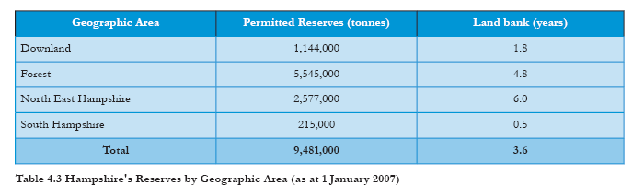
16.5 Further assessment, taking into account estimated sales to date, gives an estimated current county wide landbank of four years at the end of February 2008. For the Downland (Roke Manor) area the equivalent estimated figure is 41.34 years. There is clearly a need to extract this mineral to increase the County Council's mineral landbank.
Landscape and Visual Impact
16.6 There would be a temporary landscape impact created by the implementation of the proposal but it is considered that the impacts would be minimised through screening and planting to make such impacts acceptable for the duration of working. A bunded haul road would be visible from houses on the A27 and others in the locality but there would be hedgerow planting along the edges of the bunds and the bunds would be seeded to reduce impact. Along Old Salisbury Lane there would be a combination in places of bunding and planting . All bunding would be removed at the end of the development and the land restored back to its original use. The only part of the landscape scheme which would create a permanent change would be the need to land raise the fields subject of extraction. This is necessary because the site would be filled with inert material imported to the site and minimum gradients are necessary to ensure that water is shed off the land into surrounding drainage trenches. The issue of how steep and therefore how high the land needs to be to drain adequately is always a matter of debate. Technology and computer systems are available that automatically work out the necessary fall based on rainfall, material area of site, etc. Currently the land is proposed to be raised at its highest point by three metres. The County Council has been in discussion with the applicant about this issue since the application was submitted. The applicant states that this land-raising is necessary and the technical assessment submitted with the application justifies this. However, it is considered that some height reduction could take place, particularly on the field subject of the initial extraction phases to the west which is smaller than the larger pig field to the east. Accordingly it is recommended that if permission is granted a condition be attached requiring revised levels to be submitted which would enable the land to drain efficiently, but also requiring the levels to be reduced where possible to minimise any landscape impacts. The applicant has submitted a visual assessment which concludes that the landscaping would not create any significant landscape impacts post-restoration.
Ecology
16.7 Ecology is an issue because the proposed haul route and conveyor would be constructed through existing woodland where, amongst other flora and fauna, dormice, a protected species, have been found. The dormice have been located in a habitat of a 30 metre band within the woodland. A full ecological assessment and mitigation strategy has been submitted with the application. Natural England, whilst understandably preferring that the haul route does not go through the woodland, has raised no objection to the proposal subject to the proposed mitigation. Accordingly, subject to a Section 106 Agreement to secure long-term management of the woodland post restoration, and conditions ensuring that the necessary mitigation is undertaken, it is considered there would be no significant permanent ecological impact created by the proposal and that the longer term management would enhance the nature conservation value of the woodland.
Hydrology/Hydrogeology
16.8 The applicant has submitted a full hydrological and hydrogeological assessment looking at the whole site and its surroundings, including the extraction and woodland areas. The assessment concludes that with the proposed mitigation measures there would be no significant impacts on local surface and groundwater. It is noted that the Environment Agency raises no objections to the proposal and it is considered the Environment Agency's view, as experts in this field, should be supported.
Traffic
16.9 The issue of highway impacts and environmental impacts of traffic are perhaps the most sensitive local issues raised by the application. The concern of local Members, Parish Councils, residents groups and a number of local residents is noted. However the applicant has submitted a detailed highway assessment. The Highway Authority has examined and reviewed the submitted evidence, has gained additional evidence and clarified a number of issues with the applicant. It is noted that, after full analysis of the situation, the Highways Authority raises no objection to the application subject to a Section 106 Agreement for a financial contribution towards the road network. It is also noted that some residents have mentioned that a right hand turn lane would be preferable, however the Highway Authority considers that a right hand turn lane is not justified on capacity grounds. It also considers that it is not required on safety grounds as forward visibility from approaching vehicles to the access is very good, in fact in excess of the relevant standards. In addition, the Highway Authority states that there is no evidence of right turning accident problems at other local junctions without right turning lanes on this part of the A27. Furthermore a right turn lane would widen the A27 and create a very long regime of right turning lanes stretching from Embley School to the site via Squabb Wood. This arrangement would be likely to encourage higher vehicle speeds and therefore not contribute to overall road safety in this area. To conclude it is clear that the Highway Authority considers the proposal satisfies current highway safety standards and does not consider that a right hand turn lane would be of benefit to local highway safety.
Archaeology
16.10 There is the potential for some archaeological remains to be found on the site but it is recommended that if permission is granted these can be protected by way of a watching brief secured through a planning condition.
Amenity Issues
16.11 This issue of amenity impact is another sensitive issue. It is considered that revisions have been made to the proposal by way of its layout moving the haul route near the extraction area into the wood, increasing buffer zones around properties to 100 metres and bunding the access and haul route that will minimise impacts on local amenities. It is noted that the Environmental Health Officer raises no objection to the application subject to conditions including a buffer zone of 82.5 metres from the boundaries of properties next to the extraction area. As already noted here the applicant has increased this to 100 metres. With conditions imposed to protect against adverse noise and dust and no external lighting, it is considered that amenity impact would be minimised as much as practically possible.
16.12 To conclude, this site would provide the county with 804,000 tonnes of mineral for which there is a clear need. However, it is also a site which has houses in close proximity to its access located on the A27 and two cottages either side of the extraction area. There are also some properties to the east of the haul route near the A27 by Squabb Wood and further away on Old Salisbury Lane. Therefore that the key issue is whether the need for the mineral outweighs the level of environmental impact that would be caused by this proposal being worked. In reaching a conclusion it is noted that no objection has been received to the application from any of the statutory consultees, including Natural England regarding nature conservation, the Highway Authority regarding traffic and road safety issues, the Environmental Health Officer regarding amenity issues and the Environment Agency regarding hydrological issues. It is considered the proposal can be worked subject to conditions without causing significant environmental impacts on the locality, and the clear need outweighs the adverse impacts.The application is a departure from the development plan. However, it is considered that the departures are justifiable in that the change to the layout would lessen impacts on amenities and that it is best practice to have a washing plant near the source of mineral. Also the location of the washing plant would not be likely to cause any significant impacts to local amenities as it is remote from housing and well-screened. Accordingly, taking all matters into account, it is considered on balance that permission be granted subject to a legal agreement and conditions.
Section 100 D - Local Government Act 1972 - background papers | |
The following documents disclose facts or matters on which this report, or an important part of it, is based and has been relied upon to a material extent in the preparation of this report. | |
NB the list excludes: | |
1. |
Published works. |
2. |
Documents which disclose exempt or confidential information as defined in the Act. |
TITLE |
LOCATION |
Extraction of sand and gravel, land filling with inert construction, demolition and excavation waste and restoration to agriculture, erection of minerals processing plant and ancillary buildings and equipment, construction of new access off A27, including demolition of bungalow, at Roke Manor, near Romsey |
Environment Department Castle Avenue Room G, Lower Ground Floor |
1604/JD
APPENDIX 1
Conditions
Time Limits
(1) The development hereby permitted shall be begun before the expiration of three years from the date on which this planning permission was granted.
Reason: To comply with Section 91 of the Town and Country Planning Act 1990; to provide local residents with notice and to enable the Mineral Planning Authority to monitor the development.
(2) The sand and gravel extraction hereby permitted shall be completed within five years of the date of commencement of extraction in Phase 1 and the extraction area restored with clean uncontaminated inert construction, demolition and excavated material within a period of seven years following the commencement of infilling. Infilling shall commence within 12 months after the commencement of extraction. The extraction area shall be fully restored to agriculture within nine years of the date of extraction commencing and in accordance with the restoration scheme approved under Condition (26) below. Within ten years of the date of commencement of extraction, all bunds, concrete hardstandings, haul roads, conveyors and mineral plant shall have been removed and the land restored to agriculture, and nature conservation and amenity in accordance with the approved scheme. This includes the relocation of the Test Way public footpath back to its original alignment within three years of the commencement of extraction or on completion of the restoration of the area across which it is routed whichever is the sooner.
Reason: To provide for the completion and progressive restoration of the site, within the approved timescales, in the interest of local amenities.
Working Programme, Phasing and Direction of Working
(3) Unless otherwise approved in writing by the Mineral Planning Authority, the working and restoration of the site shall be carried out only in accordance with the approved working programme and phasing plans, drawing numbers RBMR/ROKE/PA3 (revised March 2008), RBMR/ROKE/HR3/A, RBMR/ROKE/PA5/A and PA4 (revised March 2008) and in accordance with the accompanying written statement. No part of the operations specified therein shall be amended or omitted without the prior written approval of the Mineral Planning Authority.
Reason: To enable the Mineral Planning Authority to control the development and to minimise its impacts on the amenities of the local area and to ensure the site is restored within the timescales envisaged in the application.
(4) Prior written notification shall be given to the Mineral Planning Authority a minimum of seven days in advance of the intention to start stripping soils; start extraction; start infilling; start felling trees and start demolition of the bungalow known as The Cedars.
Reason: To provide local residents and monitoring staff with sufficient notice of the commencement of these operations.
(5) Prior to the commencement of the development the following shall be pegged/marked out on site and agreed with the Mineral Planning Authority on site:
(i) The stand-offs of mineral extraction (100 metres) from the nearest residential properties Roke Manor Cottages and Roke Farm Cottages .
(ii) All trees to be felled within the extraction site and within the woodland to make way for the haul route and conveyor.
(iii) The alignment of the haul road from the A27 through the woodland and the alignment of the conveyor through the woodland and associated land.
(iv) The temporary alignment of the Test Way public footpath which shall be undertaken in accordance with Plan No. RBMR/ROKE/HR3/A.and as shown on RMBR/ROKE/PA3(A- revised March 2008).
Reason: In the interests of local amenities and the natural environment.
(6) Prior to the commencement of the development the site entrance and associated visibility splays shall be pegged out, and constructed to the satisfaction of the Mineral Planning Authority in accordance with the scheme approved under drawing number B69/1A (May 2007- Richard Parker Consultancy) and outlined in Transport Assessment Report by Richard Parker Consultancy.
Reason: In the interests of local amenities and highway safety.
Hours of Working
(7) No vehicle shall enter or leave the site and no operations shall take place except between the hours of 07.00 and 18.00 Monday to Friday and 08.00 and 13.00 on Saturday. There shall be no working on Sunday or recognised public holidays(except for essential maintenance) unless previously agreed with the Mineral Planning Authority
Reason: In the interests of local amenities.
Access and Routeing
(8) The only permitted access for vehicles subject of the approved development entering and leaving the site shall be the proposed access point onto the A27 as shown on approved drawing no.
B69/1A May 2007 Richard Parker Consultancy.
Reason: To ensure the protection of the Site of Special Scientific Interest/proposed Special Protection Area.
(9) The surfacing of the site access shall be kept free of potholes and cracks, and any that occur shall be satisfactorily repaired within seven days of identification. Such maintenance and repair shall continue until such time as it is no longer required for these operations. The haul road shall be constructed in accordance with the Road Details Plan No. RBMR/ROKE/HR1/A and in the location shown on Plan No. RBMR/ROKE/PA3 (revised March 2008).
Reason: In the interests of highway safety and safeguarding the local environment.
(10) The visibility splays at the access parallel to the A27, shall be kept clear of undergrowth and any shrubs trimmed back to less than 1.0 metre high where necessary to ensure that forward visibility to the south and north is not obstructed.
Reason: In the interests of highway safety (it is acknowledged that there is only currently grass verge but this condition allows for any vegetation growth that could occur in the future).
(11) Prior to the commencement of the development signs shall be erected in approved locations on the highway verges to warn approaching drivers of the site access and pedestrians using the public footpath that crosses the access.
Reason: In the interests of highway safety.
(12) No exportation of sand and gravel or soils shall take place until the approved wheel washing facilities have been installed in the location shown on drawing RBMR/ROKE/PA4.
Reason: In the interests of highway safety.
(13) All lorries exiting the site with minerals and soils, and entering the site with inert material, shall be satisfactorily sheeted to avoid spillage onto the public highway.
Reason: In the interests of highway safety.
(14) The public highway shall be kept clear of mud caused by lorry traffic accessing and egressing the site at all times.
Reason: In the interests of highway safety.
Minimising Disturbance from Dust
(15) Dust mitigation, including measures to monitor emissions,shall be implemented in accordance with the submitted dust scheme During adverse, dry and prolonged weather conditions, operations close to affected properties shall cease in the event of dust becoming a nuisance.. Dust monitoring records should be made available on site for inspection at all reasonable times by the Minerals Planning Authority.
Reason: To protect the amenities of local residents.
Minimising Disturbance from Noise
(16) No development shall commence until the screening bunds to protect the residential properties adjacent to the extraction area, alongside the haul routes, around the plant site and separating the site from Old Salisbury Lane (as shown on Plan RBMR/Roke/PA3(A)(revised March 2008) have been implemented to the satisfaction of the Mineral Planning Authority in accordance with the approved scheme.
Reason: To protect the amenities of local residents.
(17) The level of noise emitted from temporary site operations, such as initial soil removal, formation of screen bunds and works of restoration, shall not exceed 70 dB LAeq, 1hr (freefield) at noise sensitive properties and shall be restricted to no more than 8 weeks in any 12 month period. The noise levels from these temporary operations shall be monitored in accordance with the monitoring scheme approved under Condition (18)..
Reason: In the interests of local amenities.
(18) Noise emitted from the site, including vehicle movements on the associated haul road, should not exceed the day-time noise limits calculated using the MPS2 noise criterion. The noise level should be measured at the boundary of the noise sensitive property. These levels are different for each of the noise sensitive properties as outlined in the approved acoustics report by Barnhawk Acoustic September 2007. The level of noise emitted from the mineral extraction operations shall not exceed the levels stated in this report at the detailed noise sensitive properties listed in the report unless otherwise permitted by way of Condition (19).
Reason: To protect the amenities of local residents.
(19) A scheme of noise monitoring should be submitted for approval relating to the protection of nearby residential properties and implemented as approved. The proposed scheme should include monitoring of both temporary and normal mineral extraction activities at Roke Manor Quarry, undertaken with a frequency of at least once every three months reducing to six-monthly after the first year of operations. A copy of each noise assessment report shall be submitted to the Mineral Planning Authority. Should the noise levels be breached then additional mitigation measures, to be agreed with the Minerals and Waste Planning Authority, should be put into place.
Reason: To protect the amenities of local residents.
Archaeology
(20) No development, including soil stripping, shall take place within the site until the applicant has secured and implemented a programme of archaeological work in accordance with a written scheme of investigation which has been submitted to and approved in writing beforehand by the Mineral Planning Authority.
Reason: To ensure that adequate archaeological investigation and recording is undertaken prior to the development taking place.
Landscaping
(21) Within three months of the date of this permission or prior to sand and gravel extraction taking place, whichever is the sooner, a detailed plant specification for the site to take place in accordance with the submitted drawing LA02/A (revised March 2008) and drawing no. LA03 (revised March 2008) shall be submitted to the Mineral Planning Authority for approval in writing and thereafter implemented in accordance with that approval. Such a scheme shall include details of:
(i) the positions, species, density and initial sizes of all new trees, shrubs and hedgerows;
(ii) the programme of implementation of the scheme; and
(iii) arrangements for subsequent maintenance.
The scheme as approved shall be carried out in full (unless with the prior approval of the Mineral Planning Authority in writing to a variation).
Reason: The provision and maintenance of a satisfactory degree of landscaping is considered essential in the interest of visual amenity.
(22) No sand or gravel extraction operations shall take place within a distance of five metres from the canopy of any existing trees (ie `the buffer zone'), or any shrubs or hedges which have been identified as having to be retained in accordance with approved plans and the five metre buffer zone shall remain in place for the duration of the development and no trees, shrubs or hedges that are to be retained shall be damaged, destroyed, uprooted, felled, lopped or topped during that period without the previous written approval of the Mineral Planning Authority. Any such trees removed without permission or dying or being seriously damaged or diseased during that period shall be replaced in the following planting season with trees of such size and species as may be approved with the Mineral Planning Authority. Where the buffer zone is actually a soil/overburden bund as shown on the approved plans, separating trees from the sand and gravel extraction area, the bund shall not extend under the canopy of trees to be retained, nor within three metres of any hedgerows and shrubs to be retained. Where there is no bund protective fencing shall be erected prior to the commencement of extraction along the outer edge of tree canopies and three metres from the edge of all hedges and shrubs to be retained.
Reason: In order to safeguard the visual amenity of the area.
Soil Stripping and Storage
(23) Topsoil and subsoil stripping shall be implemented in accordance with the soil methodology submitted with the application and:
(i) the topsoil shall be stripped to the full depth (generally 30 centimetres) and shall be stored separately for subsequent replacement; and
(ii) the subsoil to be retained for use in the restoration process shall be immediately re-spread over the replaced overburden. If this re-spreading is not practicable the subsoil shall be stored separately for subsequent replacement.
Reason: To minimise structural damage and compaction of the soil and to aid the final restoration of the site.
(24) All topsoil, subsoil (soil-making materials) and overburdens stripped from the areas to be extracted shall be removed and stored separately, before operations commence, for use in site restoration Following extraction the overburden shall be replaced and regraded in accordance with the approved final levels and ripped using appropriate machinery. The overburden shall be in turn covered with the topsoil and subsoil in original sequence and to even depths appropriate to the restored land use.
Reason: To minimise structural damage and compaction of the soil and to aid the final restoration of the site.
(25) All work of soil stripping, stockpiling and reinstatement should be carried out when the material is in a dry and friable condition, and transported only along clearly defined routes when being moved to storage locations. In the event that the soil's final surface position is located a significant distance from a storage bund, then the topsoil and subsoil shall be transported by dump truck and not bladed.
Reason: To minimise structural damage and compaction of the soil and to aid the final restoration of the site.
Restoration
(26) The extraction site shall be progressively restored in accordance with the approved sequence of phasing of restoration, as detailed in plans approved under Condition (3) (Working programme) and restored to levels and cross sections shown on Plan RBR/ROKE/PA6 and PA7 (revised March 2008)and Plan LA03/A (revised March 2008) and thereafter managed for agricultural purposes . The mineral plant site shall be restored in accordance with a scheme to be submitted to the Mineral Planning Authority for approval within six months of the date of this certificate.
Reason: To ensure the site is restored to a satisfactory standard to support the nature conservation and grazing objectives of the approved after use.
(27) No later than 12 months from the date of completion of mineral extraction all plant, machinery, foundations, hardstandings and access roads no longer required in connection with the workings, restoration or future use or management of the site shall be removed and the land restored in accordance with Condition (26) above. The bellmouth/access onto the A27 should be removed and the land planted and restored to the satisfaction of the Mineral Planning Authority within 12 months of the date of completion of mineral extraction in accordance with the scheme approved under Condition (26).
Reason: In the interests of local amenities.
Pollution Control
(28) All silts and fines that accumulate around various parts of the conveyor system linking the extraction area and the washing plant site shall be contained, to the satisfaction of the Mineral Planning Authority, so that they are not deposited in the woodland or ecosystem through which the conveyor and haul route pass.
Reason: To protect the existing ecosystem.
(29) No excavation shall take place to levels below the final working depth indicated on the approved drawing unless otherwise agreed in writing by the Mineral Planning Authority.
Reason: To ensure that the final landform is in keeping with the locality and capable of beneficial after-use.
(30) No development shall commence until the detailed surface water drainage scheme in accordance with the principles shown on Plans RBR/ROKE/PA3(A), LA02/A and LA03/03 has been approved in writing by the Mineral Planning Authority and thereafter implemented as approved.
Reason: To ensure there is no discharge of silt into water courses leaving the site and no flooding of surrounding land.
Nature Conservation
(31) No trees or large areas of shrub/scrub shall be felled during bird nesting seasons unless otherwise agreed in writing by the Mineral Planning Authority.
Reason: To ensure the protection of breeding birds.
(32) The implementation and management of the haul route and conveyor through the woodland where dormice and other sensitive wildlife species, flora, fauna and associated habitats have been identified shall be carried out solely in accordance with the programme of working and ecological mitigation detailed in report by Andrew Ward Associates dated September 2007 and in accordance with a detailed scheme to be submitted within six months of the date of this certificate and prior to the commencement of the development. The detailed scheme shall include 1:200 sections of the haul route crossing the wet grassland area and a detailed programme of construction, together with detailed construction sections and plans of the conveyor and haul route through the woodland. It shall also include dormice mitigation details as outlined in the approved ecological report. (Note - the long-term management of the woodland is secured through a Section 106 Agreement subject of this permission.)
Reason: To ensure that the nature conservation interest and associated species such as dormice inhabiting the said area are protected during and after the implementation of the development subject of this permission.
Aftercare
(33) An aftercare scheme showing the steps to be taken to restore the physical characteristics of the extraction site to a condition suitable for agriculture shall be submitted for approval of the Mineral Planning Authority within six months from the date of this permission.
Reason: To ensure the land is satisfactorily managed for nature conservation purposes.
(34) Aftercare meetings between the developer and the Mineral Planning Authority shall be held annually, and no later than four weeks before each annual meeting a detailed `scheme of works' for the aftercare of the restored land for the next 12 months shall be submitted to the Mineral Planning Authority. No later than two weeks following the annual aftercare meeting the annual `scheme of works' shall be revised as necessary and submitted for the approval of the Mineral Planning Authority in writing.
Reason: To bring the land to a standard suitable for agricultural use and nature conservation.
Other
(35) There shall be no external lighting on the extraction site. There shall no lighting externally on any other part of the site unless. previously agreed in writing by the Mineral Planning Authority.
Reason: In the interests of local amenities.
(36) The plant area shall be constructed and laid out in accordance with approved scheme number SAB17-00 and ancillary offices plan AV-CAN-3210 (TD) and RBMR/ROKE/PA4/A.
Reason: In the interests of local amenities.
(37) Stockpiles of materials shall not exceed four metres in height above new ground level, unless otherwise agreed beforehand by the Minerals Planning Authority in writing.
Reason: In the interests of local amenities.
(38) All soil storage bunds intended to remain in situ for more than six months or over the winter period are to be grassed over and weed control and other necessary maintenance carried out to the satisfaction of the Mineral Planning Authority. The seed mixture and the application rates are to be agreed with the Mineral Planning Authority in writing no less than one month before it is expected to complete the formation of the soil storage bunds.
Reason: To preserve the existing soil resource and prevent weed spread.
APPENDIX 2
Annexe to Reasons for Conditions
(as required by Article 22 of the Town and Country Planning
(General Procedure) Order 1995 - as amended)
__________________________________________________________________
Hampshire Minerals and Waste Core Strategy DPD 2007
Policy DC1 - Sustainable Minerals and Waste Development
Minerals and waste developments will only be permitted if they meet the standards outlined in Policy S1 and, in appropriate circumstances, are designed and constructed to use water and energy efficiently.
Policy DC3 - Impact on Landscape and Townscape
Minerals and waste development will only be permitted if due regard is given to the likely visual impact of the proposed development and its impact on, and the need to maintain and enhance, the distinctive character of the landscape or townscape. If necessary, additional design, landscaping, planting and screening, including planting in advance of the commencement of the development, should be proposed.
Policy DC4 - Historic Heritage
Minerals and waste development will be granted if due regard is given to the likely effects on the need to protect and safeguard sites of archaeological, historical, and architectural importance, and the settings of these sites.
Policy DC6 - Highways
Major mineral extractions, landfills and `strategic' recycling, aggregate processing and recovery and treatment facilities, will be permitted provided they have a suitable access to and/or route to the minerals and waste lorry route as illustrated on the Key Diagram.
In all cases, minerals and waste development will only be permitted if it pays due regard to the likely volume and nature of traffic that would be generated by the proposal and the suitability of the proposed access to the site and of the road network that would be affected. Consideration should be given to highway capacity, road and pedestrian safety, congestion and environmental impact, and whether any highway improvements are required and whether these could be carried out satisfactorily without causing unacceptable environmental impact.
Policy DC7 - Biodiversity
Minerals and waste developments will only be permitted if due regard is given to the likely effects of the proposed development on biodiversity and, where possible, proposals should conserve and enhance biodiversity.
Development likely to adversely impact upon `regionally or locally designated sites or protected species' - designated in adopted Local Plans or Local Development Frameworks - (including Sites of Importance for Nature Conservation (SINCs), Species of Principle Importance for Biodiversity, Regionally Important Geological Sites and Local Nature Reserves) shall only be permitted if the merits of development outweigh the likely impact.
Policy DC8 - Pollution, health, quality of life and amenity
Minerals and waste development will only be permitted if due regard is given to the pollution and amenity impacts on the residents and users of the locality and there is unlikely to be an unacceptable impact on health and/or the quality of life of occupants of nearby dwellings and other sensitive properties. Where necessary minerals and waste developments should include mitigation measures, such as buffer zones between the site and such properties.
Policy DC10 - Water Resources
Non-hazardous landfill developments in areas that overlie major aquifers, and Groundwater Source Protection Zones I and II, and mineral extraction or inert landfill in areas that overlie major aquifers and Groundwater Source Protection Zone I will not be permitted .
All minerals and waste developments will only be permitted if they are unlikely to have an unacceptable impact on coastal, surface or ground waters and due regard is given to water conservation and efficiency.
Policy DC12 - Restoration and Aftercare
Mineral extraction, landfill and other appropriate developments will not be permitted unless there is satisfactory provision for the restoration of the site, within a reasonable timescale, for an after use consistent with the general planning objectives of the area.
The restoration and after care of sites should seek to meet two or more of the following planning objectives:
a. Improving public access to the countryside, including public access for disabled people and recreation;
b. Use for management of water resources and/or flooding management;
c. The improvement of biodiversity;
d. Use as back-up grazing for the New Forest;
e. Return to agriculture, forestry or other `open' use recreational facilities.
Proposals for mineral extraction and landfill must include provision for at least five years of aftercare following restoration of the site.
Restoration proposals for mineral workings in Aerodrome Safeguarding Zones should take account of the need for progressive working and restoration, to prevent open water bodies becoming bird roosts.
Policy DC14 - Landfill
Planning permission will be only be granted for landfill provided the site:
a. Is identified for landfill use, as part of the restoration of a mineral site, in the Hampshire Minerals Plan, or pending its adoption is an existing or proposed un-restored mineral void, and in the case of non-hazardous landfill is within the non-hazardous landfill potential area shown on the Key Diagram, and
b. Appropriate provision is made for the pre-treatment or sorting of waste, either on or off site, to substantially reduce its biodegradable and recyclable content, and
c. It does not pose an unacceptable environmental risk, including risk to groundwater, and
d. It is close to, and with good access to, the minerals and waste lorry route, as shown on the Key Diagram.
Policy DC15 - Sand and gravel
Sand and gravel extraction will be permitted, provided the site:
a. Is identified for sand and gravel extraction in the Hampshire Minerals Plan or pending its adoption, is within the Mineral Resource Area shown on the Key Diagram, or
b. The proposed development involves a small-scale extension to or deepening of an active sand and gravel extraction site, or
c. There is less than seven years of permitted reserves of sand and gravel and a need for sand and gravel which cannot reasonably be met from identified sites and locations and it can be shown that working such land would be equally acceptable to working within an identified site or location, and
d. Is not within or likely to adversely impact upon the setting of the New Forest National Park, the Proposed South Downs National Park or Areas of Outstanding Natural Beauty, and
e. The proposals include restoration opportunities for increasing biodiversity or access to public open space, or help to meet other planning objectives, and
f. Where necessary, proposals for landscaping and planting (prior to operation)are included, and
g. Is close to, and with good access to, the minerals and waste lorry route illustrated on the Key Diagram.
Policy S1 - Sustainable Design, Construction and Demolition
New built development should facilitate the efficient use of resources through:
a. Designs and layouts that allow the effective sorting, recycling and composting of waste;
b. Design principles and construction methods that minimise primary aggregate use and encourage the use of high-quality building materials made from recycled and secondary sources;
c. Construction and demolition methods that minimise waste production and re-use/recycle materials, as far as practicable on-site.
Policy S6 - Landfill
During the period to 2020, up to 5.3 million tonnes of non-hazardous landfill capacity will be provided within the Landfill Potential Area shown on the Key Diagram. By 2015, the landfilling of untreated municipal waste will cease. Where technically and environmentally appropriate, non-hazardous landfill void will be conserved by the reuse of inert daily cover materials, or the use of alternative daily cover materials.
During the period to 2020, 18.5 million tonnes of non-recyclable inert waste will be used:
a. in restoring mineral excavations and for landfill engineering, or
b. for civil engineering and other infrastructure projects, or
c. beneficially at the site of production.
Additionally, provision for London's landfill requirements post 2016 will be considered by a review of the Strategy.
Policy S8 - Sand and Gravel
Provision will be made for the production of land-won sand and gravel at a rate of 2.63 million tonnes a year until 2020, principally from within the Mineral Resource Areas shown on the Key Diagram. To meet local needs from indigenous materials the following local apportionment will apply for the period to 2016:
North East Hampshire 0.433 mtpa
Forest (excluding the New Forest National Park) 1.163 mtpa
Downland 0.643 mtpa
South Hampshire 0.391 mtpa
The Mineral Planning Authorities will endeavour to maintain a landbank of at least seven years of planning permissions for the extraction of sand and gravel.
In the event that the South East Plan apportionment for Hampshire is modified the sand and gravel production and local apportionment will be adjusted accordingly.
Policy S14 - Safeguarding of Existing Development
All existing minerals and waste sites, including associated transport infrastructure, which are needed for future requirements will be safeguarded. These requirements will be determined by a review of all such sites. Sites identified, in the Hampshire Minerals or Waste Management Plans, or on the Proposals Map, to fulfil the requirements of this Strategy will also be safeguarded. Pending the outcome of this review, all existing sites will be safeguarded. Incompatible development, within 250 metres of existing or planned quarries and landfills or within 50 metres of other mineral/waste operations, will not be supported