Archived decisions
Hampshire County CouncilHealth Overview and Scrutiny Committee Item 4 25 March 2008 Inquiries Received and Action Taken Report of the Chief Executive |
Contact: Denise Holden ext. 7338
e-mail: [email protected]
1. Summary and Purpose
1.1. This report provides Members with information about the issues brought to the attention of the Committee and the response to these referrals. It sets out the inquiries received, the source of this inquiry and any action taken. Where appropriate comments have been included and copies of briefings or other information attached.
1.2. The approach adopted provides the route through which Patient and Public Involvement Forums (P&PIFs) and other partner organisations (Hampshire district councils, NHS organisations, voluntary and independent sector providers and organisations that are representative of social care service users and carers) can raise issues with the Committee.
1.3. Where inquiries raised with the Committee are already subject to monitoring or other performance management activities the action taken will be focused on the local resolution of inquiries through appropriate sign-posting to the agency best placed to respond.
1.4. Where an issue cannot be satisfactorily resolved between the parties concerned then the Committee can consider options for further action.
1.5. New issues raised with the Committee, and those that are subject to on-going reporting are set out in Table One of this report.
1.6. The recommendations included in this report support the Corporate Strategy aim of maximising wellbeing through the overview and scrutiny of health services in the Hampshire County Council area.
Table One: Inquiries Received and Action Taken
Section 100 D - Local Government Act 1972 - background papers
The following documents disclose facts or matters on which this report, or an important part of it, is based and has been relied upon to a material extent in the preparation of this report.
NB the list excludes:
1. Published works
2. Documents that disclose exempt or confidential information as defined in the Act.
Appendix 1

WORKING TOGETHER WITH LOCAL COMMUNITIES TO SHAPE SERVICES FOR THE FUTURE- SOUTH EAST HAMPSHIRE
Following feedback received through the Hampshire Health Overview and Scrutiny Committee and the Hampshire Patient and Public Involvement Forum, Hampshire PCT has given a commitment to undertake a refresh of its capacity mapping work in South East Hampshire to ensure plans are clear, transparent and fit for future needs.
Key stakeholders from the local community (list attached) have been invited to an event on 20 March 2008, at Fareham Reach. The meeting is intended as a forum for stakeholders to hear the calculations and rationale underpinning the latest position and provide an opportunity for stakeholders to discuss these with senior managers/directors from Hampshire PCT.
The aim is to ensure that:
· local community leaders are involved in the development of the latest version of the capacity map
· the PCT and Trust are listening to the views of the local community and addressing issues of concern in any future plans
· a way forward and next steps are agreed.
The meeting will:
1. Outline work-to-date on South East capacity mapping (i.e. context, journey).
2. Outline community engagement to date.
3. Update stakeholders on the latest work on the capacity map and set out the rationale and calculations underpinning the most up-to-date position including details of bed numbers and facilities.
4. Explain built-in flexibility and provide assurance to stakeholders that plans are future-proof.
5. Set out the process for the next stage of testing and checking the latest version of the capacity map.
6. Ask stakeholders for their views on this process and specifically:
a. What issues would you/local people expect see addressed by the latest version of the capacity map?
b. Were there any issues covered tonight that you feel need further clarification or a more convincing rationale?
c. How would you like to be involved in the process as we go forward?
d. How might we address any concerns that local people may have?
e. How can we keep the public better informed?
7. Agree next steps.
Suggested agenda
1. Welcome and introduction: Richard Samuel, director of corporate affairs, Hampshire PCT
2. Background and engagement: Inger Hebden, director of capital planning, Hampshire PCT
3. The latest position Martin Dorey: Portsmouth Hospitals NHS Trust
4. Future-proofing our plans: Martin Dorey/Inger Hebden
5. Facilitated discussion to gather stakeholder views and agree the next steps.
Next steps
Following feedback from this meeting the PCT and Portsmouth Hospitals NHS Trust will review engagement structures and devise a detailed engagement plan for the future. If it is felt necessary we will run another event such as this in May.
Appendix 2
REPORT ON ACCESS TO HEALTH SERVICES FOR PEOPLE WHO ARE HOMELESS
FOR : HEALTH OVERVIEW SCRUTINY COMMITTEE - HAMPSHIRE COUNTY COUNCIL - MEETING 25 March 2008.
Report and presentation by Ian Davies - Centre Manager of the Trinity Centre, part of TrinityWinchester.
Background.
TrinityWinchester is a long established local charity part funded by Winchester City Council and Hampshire County Council but heavily reliant on a large number of charitable trusts and donations.
In terms of access to health care for it client group this report will necessarily focus on the situation in Winchester but there is no reason to believe that the situation is not similar across Hampshire subject to local influences.
The TrinityWinchester group runs:-
A Day Centre Drop in at the Trinity Centre St Pauls Hill Winchester
The Trinity Womens Centre at Bridge Street Winchester
The Camrose Centre (Day Centre Drop in) recently opened in Basingstoke.
The Trinity centre deals with the homeless and otherwise socially excluded. It provides basic needs: (food, bathing and laundry facilities), and support, advice and information on housing, benefits and substance use.
Health Care at the Trinity Centre is provided through the Homeless Health Care Team - currently one GP two mornings a week and a CPN (Community Psychiatric Nurse) one morning a week. There is a dedicated Treatment/Consulting Room within the Centre and kitted out by the PCT.
Some statistics
Around 200 new people are seen every year. We are currently averaging 55 service users a day when the national average for day centres like Trinity is 53 (Homelesslink 2007 survey). Between half and a third of service users are rough sleeping. Defined as Around a third to a half of visitors are rough sleeping . Defined as including people in the nightshelter and anyone currently `sofa surfing' i.e. short term stay at a friend's.
An average of 45 meals are provided per day. This includes a vegetarian option and nutritional needs are always kept in mind..
260 individuals received health care at the Trinity Centre last year. Numbers are limited at present by part time staffing. The GP has a full list each day she visits.
Homeless Client group Characteristics.
All these characteristics affect how the client group accesses health care.
- They can have chaotic lifestyles because of substance misuse or social interaction problems. They react to day to day or even minute to minute needs rather than working to a schedule or regular routine.
- They are excluded often because of the attitudes and assumptions of others.
- They have different priorities meaning that basic needs such as food and shelter can be much more pressing than health care.
Health Issues for this client group.
- Consequences of substance use - anything from abscesses to chronic liver failure
- The full range of Mental Health and learning disabilities
- Everyday issues exacerbated by living conditions and difficulties accessing care.
- Health problems can be complex.
Problems accessing Health Care.
Many of Trinity's service users are locally registered with a GP and we always encourage them to use them when they need to. This is usually the case with service users who have been around a while and have been able to develop stability in their lives though secure housing etc. There are though a number who aren't registered, some don't want to, others are registered but don't like using their GP. These service users have the same legal right to health care as anyone else - the same right to a GP for example. So what are the problems?
- With no address it can be difficult to fit a homeless client to the system. The allocation process locally has apparently lead to a wait of up to two weeks before client actually gets to see a doctor.
- The chaotic lifestyle of some means a poor relationship can build up quickly with a GP practice if appointments keep being missed. Drug and alcohol services work hard to get clients to work with appointments. Trinity has such services holding `drop in' clinics on site in order to increase the possibility of getting to see a particular client
- Clients can be `undemanding' in the sense that they don't press for their rights, they can assume they are in the wrong if faced with obstacles of bureaucratic process. These clients may not cope well with things as `simple' as paperwork and if more complex problems arise they don't have the wherewithall to sue!
- There is of course potential for behavior that would rightly exclude them from a GP practice. Aggression can be a problem. Trinity has a history of working with people who have been barred form other places such as the benefits agency for example.
- Finally this client group can be sensitive to the idea they don't conform easily to the expectations of a system. Conversely they may fall foul of inaccurate assumptions and stereotyping.
What works well for Homeless Healthcare provision
- Health care for this client group needs to be proactive and less driven by performance.
- It needs to be intensive and persistent to cope with the issues of `unreliability' which would test the patience of a GP system based practice.
- Things need to happen with relative immediacy or the client may be get frustrated and engagement will be lost.
- Staff need to be approachable and build up trust. They need to show an apparent lack of other agendas such as needing to satisfy targets
- It helps to focus on issues relevant to the client group - Hepatitis, sexual health, mental health. Referrals to other services need to be appropriate and good professional links and monitoring of progress should be maintained. Arguably the HHCT relieves pressure on A&E simply through picking up people who don't have anywhere else to take medical problems.
- The service should offer or have access to a wide range of services. A podiatrist regularly visits Trinity; there are complementary therapies available.
- Finally the Health Care Team should take advantage of its position to act as an advocate for individuals that would not otherwise be equiped to deal with the systems they encounter in mainstream health care.
If no dedicated healthcare team were available.
- National priorities of Hep B immunisation and Hep C screening would suffer in a client group particularly at risk from these illnesses.
- Health problems may be left unacknowledged by the service users until they have become more serious.
- Without a Mental Health worker service staff and the community are open to risks presented by new people with unknown history particularly in terms of serious mental health issues..
Recent History of the Homeless Health Care Team at the Trinity Centre
Two years ago the team had one full time senior nurse with a GP visiting twice a week. There was also a Sexual Health specialist nurse and a resident CPN. This has now reduced to 1 GP twice a week and CPN one day a week due to staff leaving.
The service appears to have suffered under PCT re-organisation in respect of staff not being replaced and some uncertainty around who would be running the service. The current situation of one lone working GP limits what can be done safely for Trinity's clients. The Homeless Team CPN works only three days a week, (the post being a job share), Although duty staff at the statutory service at Connaught House are available, the dedicated cover is not available all through the week.
The Impact of the Service for the Homeless and Socially Excluded.
Having homeless and otherwise socially excluded people accessing Health Care through a dedicated healthcare team fits well with both WCC corporate priority - Promoting Health and Wellbeing and HCC corporate priority - Maximising Wellbeing. Beyond providing care it helps promote a healthy lifestyle.
When this dedicated Health Care is provided at places like the Trinity Centre it means services can engage with clients more successfully and help them towards a situation where as a consequence, the risks to their health are reduced.
Ian Davies March 2008
Appendix 3
Date: February 2007
Report written by: Phillip Campling- Divisional Director Hampshire
Report Title: Hampshire Division Performance Update

Please find below a brief outline of developments and performance within Hampshire Division and Hampshire PCT
Performance - Please see appendix for charts and performance tables
After a very good set of performance figures in November, December proved a very difficult month due to significant delays at A&E and large increases in demand. We are however pleased to report that during January that these pressures are slightly reduced, although Southampton General Hospital continues to delay crews on a regular basis. We do experience queuing at QAH but not at the same level as pre Xmas or that experienced currently at SGH
In January a number of further developments / initiatives as part of the overall Call Connect Service improvement programme were rolled out. These include
· Appointment of Dispatch Performance Manager (Secondment)
· Implementation of ORH standby points within Emergency Operations Centre.
These two initiatives have resulted in a significant improvement in the use of standby and a reduction in `from station activation' of crews to incidents. This has the benefit of reduced distance and reduced time to scene.
· Automatic External Defibrillators. (AED's)
Over 40 of the 50 static AED's SCAS invested in for Hampshire have been rolled out or we are in the process of training staff to use. This includes a breakthrough with Police Custody Suites where we now have agreement to implement AED's within all major suites across Hampshire. This presents an excellent opportunity in terms of both patient care and performance once these have been fully implemented. We have already seen over 0.5% increase to Category A 8 minute excluding any benefit we will see from the custody suites as a result of rolling out these AED's
· Winter pressure money
We were fortunate to be given additional winter pressure money by the PCT's which allowed for the continuation in private providers for a 4 week period. With this money we have been deploying up to an additional 100 hours per day of Rapid Response cover. This has had a direct contribution of 1-2% on Category A 8 minute standards.
· Roll out of new rosters
With new staff coming on line each month we have now begun the process of rolling out the new frontline rosters. These new rosters will result in more frontline lines crews, a better profiling across the day and week, and more relief. We are aiming to achieve 33.3% relief within our rosters to ensure that any sickness, annual leave, training is backfilled and that frontline resource availability is not compromised. We have approx 45 additional staff in training and due to be operational by end of March 2008
· Call Answering Times
This is an area we have seen excellent performance during January. We are now consistently answering over 90% of all our calls within 10 seconds, averaging 5 seconds to answer. This is not only best across SCAS but also amongst the best in the country. This has been achieved through re profiling rosters, recruitment and changes to the way calls enter the control room.
Although January results have improved, the figures are heavily affected by poor performance on the 1st and 2nd Jan. If we remove these two dates Category A 8 minute performance is actually over 1% higher at just under 74% and call connect circa 56%.
Moving forward there are still a number of pressures we face including, hospital queuing, paramedic training, staff sickness and the roll out of new rosters and staff. To mitigate these risks and work in conjunction with the call connect delivery program we are focussing significant management effort and planning into minimising the impact on performance. This includes:
· Increased presence of managers at A&E
· Daily conference calls with health economy
· Sickness management workshops
· Increased management support to assist with the roll out of rosters
· Targeted overtime
SCAS Performance
For end of year reporting and Health Care Commission assessment the Trust and PCT's within its geographical boundaries are measured against overall Trust performance.
In line with Hampshire performance during December the Trust struggled with demand and turnaround times. The SHA recently stated that there were over 2500 reported delays at A&E's across South Central, a third of the national total.
During January the Oxford / Bucks division relocated its Oxford Emergency Operations Centre to co-locate with Bucks in Deanshanger. This resulted, as expected, in a drop in performance as Oxford staff orientate themselves with new systems and processes. Oxford and Bucks are confident that performance will improve as news ways of working begin to embed
Category |
Oct 2007 |
Nov 2007 |
Dec 2007 |
Jan 2008 |
Year to Date |
Category A 8 minute |
74.22% |
78.09% |
71.38% |
71.98% |
75.1% |
Category A 19 minute |
94.89% |
96.18% |
93.70% |
94.29% |
95.0% |
Category B 19 minute |
91.71% |
93.52% |
89.34% |
91.08% |
91.4% |
The Trust remains confident that both Category A standards will be met by year end.
If there are any further information requirements or queries relating to this report please do not hesitate to contact myself or one of the team
Phillip Campling
Divisional Director - Hampshire
Figure 1: Hampshire Division Category A 8 minute performance
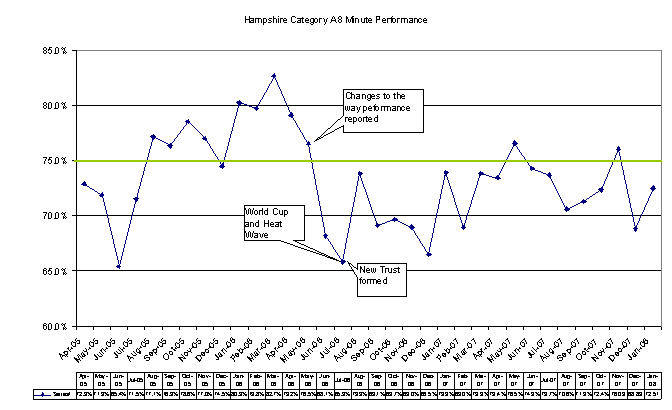
Table 1: Hampshire PCT Performance Matrix
Target |
Location |
YTD |
April 07 |
May 07 |
June 07 |
July 07 |
Aug 07 |
Sept 07 |
Oct 07 |
Nov 07 |
Dec 07 |
Jan 08 | |
Category A 8 minute - Standard |
75% within 8 minutes |
HANTS DIV |
72.76% |
73.4% |
76.5% |
74.3% |
73.7% |
70.6% |
70.4% |
72.39% |
76.04% |
68.83% |
72.51% |
HANTS PCT |
67.77% |
68.1% |
71.2% |
68.7% |
68.6% |
64.7% |
64.4% |
67.8% |
71.22% |
65.21% |
68.59% | ||
Category A 8 minute - Call Connect |
75% within 8 minutes (April 08) |
HANTS DIV |
53.02% |
52.0% |
57.3% |
54.4% |
51.5% |
52.3% |
51.8% |
52.30% |
55.52% |
49.57% |
54.73% |
HANTS PCT |
47.74% |
45.6% |
51.2% |
48.2% |
46.3% |
46.1% |
45.7% |
47.54% |
51.01% |
49.17% |
50.64% | ||
Category A 19 minute |
95% within 19 minutes |
HANTS DIV |
93.22% |
93.9% |
94.6% |
93.6% |
93.0% |
92.7% |
93.2% |
93.8% |
94.18% |
91.22% |
92.73% |
HANTS PCT |
91.03% |
92.1% |
92.5% |
91.1% |
90.5% |
90.0% |
91.2% |
93.58% |
91.85% |
88.86% |
90.80% | ||
Category B 19 minute |
95 % within 19 minutes |
HANTS DIV |
87.49% |
88.2% |
90.4% |
88.4% |
87.5% |
87% |
86.5% |
88.64% |
89.42% |
83.58% |
86.63% |
HANTS PCT |
85.89% |
86.4% |
89.1% |
86.7% |
85.4% |
85.0% |
84.8% |
87.06% |
88.43% |
82.59% |
84.93% | ||
Thrombolysis |
68% within 60 mins door to needle |
SCAS |
61.1% |
56% |
62% |
56% |
70% |
60% |
66% |
62% |
52% |
62% |
TBC |
HANTS DIV |
62.1% |
50% |
59% |
56% |
76% |
61% |
68% |
65% |
54% |
64% |
TBC | ||
Conveyance % |
5% decrease 07/08 |
HANTS DIV |
58.12% |
58.9% |
58.9% |
58.1% |
57.9% |
57.1% |
57.0% |
58.43% |
59.24% |
57.64% |
58.28% |
HANTS PCT |
57.96% |
58.1% |
58.4% |
58.2% |
57.2% |
57% |
57% |
58.54% |
59.23% |
57.85% |
57.91% | ||
Time taken to respond to 75% of Category A calls |
HANTS DIV |
8.28 secs |
8:16 secs |
7:50 secs |
8:06 secs |
8:15 secs |
8:51 secs |
8:51 secs |
8:30 secs |
7:48 secs |
9:14 secs |
8:43 secs | |
HANTS PCT |
9:29 secs |
9:33 secs |
8:46 secs |
9:20 secs |
9:20 secs |
10:03 secs |
10:03 secs |
9:29 secs |
8:50 secs |
10:08 secs |
9:26secs | ||
Improvement | |
Worsening |
Figure 2: Hampshire Division Category A Revised Performance Trajectory (Current Measurement Standards)
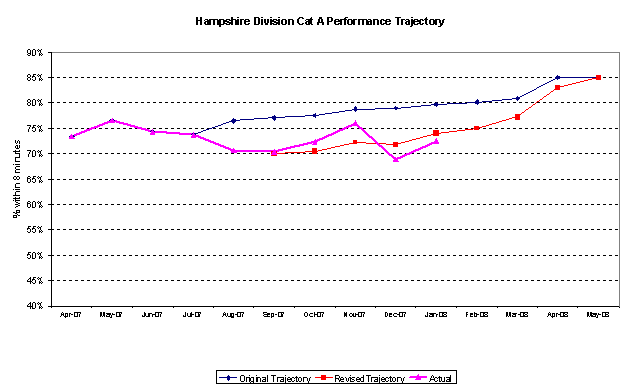
Figure 3: Hampshire PCT Category A Revised Performance Trajectory (Current Measurement Standards)
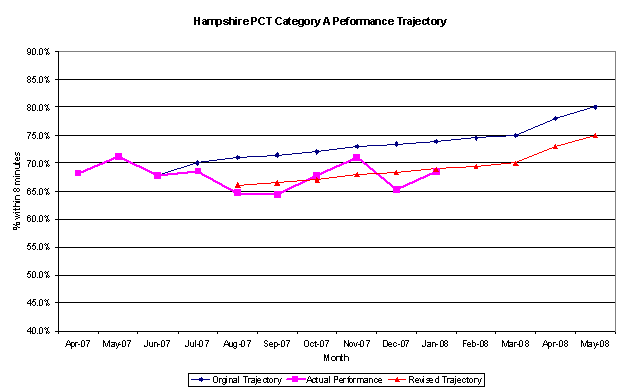
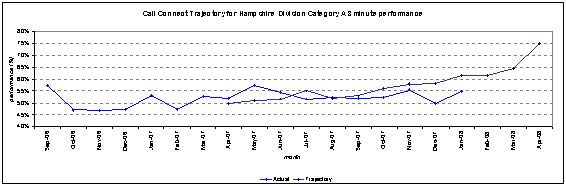
Figure 4: Hampshire Division Call Connect Trajectory
Appendix 4
 DRAFT
DRAFT
PLAN TO ESTABLISH INTEGRATED COMMUNITY LEARNING DISABILITY TEAMS: HAMPSHIRE COUNTY COUNCIL and HAMPSHIRE PARTNERSHIP NHS TRUST
1. Purpose
The purpose of this report is to advise the Hampshire Overview and Scrutiny Committee of the progress being made to establish integrated community teams serving people who have a learning disability, the rationale for these plans, and their implications.
2. Introduction
2.1 Since 2004 Hampshire County Council (`the Council') Adult Services Department have been working in partnership with Hampshire Partnership Trust to develop an integrated community learning disability service. Following a recent period of organisational change for both organisations the project has been given new impetus especially with the release of "Valuing People Now" with its focus on making dramatic improvements to the lives of adults with a learning disability over the next five years and beyond.
2.2 The integration of services for people with a learning disability in Hampshire is driven by two main factors: improving outcomes for service users; efficiency and effectiveness in providing "joined up" health and social care services and maintaining the Council's star ratings. It is seen as a `must do' service arrangement in supporting people with learning disabilities who find the current arrangements confusing and difficult to access, and also to provide the structure that will support high performing services which deliver the best practice outcomes of Valuing People and Putting People First.
3. Rationale for Integration
3.1 To provide a more efficient and effective service to people with a learning disability and their families through integrated working between health and social care staff.
The key objectives of the Integration project are as follows:
· Increase access to service through a one-stop shop approach
· Increase efficiency by reducing duplication of effort, work and progress through the implementation of this new way of working facilitated by co-location and unified line management
· Improve commissioning through joined-up working and a shared understanding of client's needs and a shared vision of desired outcomes
· Establish a structure that provides a flexible platform for further modernisation
4. Progress to date
4.1 The Executive Member for Adult Social Care approved in April 2004 that work should be undertaken to establish integrated teams, and the Board of Directors of Hampshire Partnership NHS Trust also made a similar decision at that time. These decisions were reported to the Hampshire Learning Disability Partnership Board. The Board welcomed this news, as for a long time families had been pressing for health and adult services staff to join together, to provide `a one stop shop' model of service.
4.2 A sub-group of the Hampshire Learning Disability Partnership Board, consulted very widely with people who have a learning disability, their families and stakeholder organisations (both statutory and non-statutory) on the development of a joint operational policy for the integrated community teams. The Partnership Board approved the new Operational Policy.
4.3 A Project Board was established in 2005 to develop and put in place the arrangements that will lead to integrated teams being established. The Project Board has a place in its membership for representation of families. The Project Board reports to the Partnership Board which is co-chaired by a person who has a learning disability and has several other members who have a disability and families.
4.4 The Executive Member if Adult Social Care agreed in principle for the work to go ahead following an update in December 2005 (which notified her of consultation work that had occurred to date) and formally agreed to create the joint service in January 2008.
5. The nature of the changes planned
5.1 The new Operational Policy which the integrated teams will work to (or are indeed already working to in Eastleigh, which became an Integrated Team in 2006) has been the subject of extensive consultation, and was welcomed by all.
5.2 The plans now to establish integrated teams to efficiently and effectively operate the Operational Policy, are of an administrative nature. There will be no inconvenience caused to service users. Most face to face contact with staff takes place in their own homes. Thus if it was necessary to establish new team bases it would affect the staff rather than service users and their families. The most important aspect of service modernisation for families was the establishment of a `one stop shop'.
5.3 There are some important key principles that have been agreed that are fundamental to the development of integrated services. These include:
· That Hampshire Adult Services will have the lead accountability for the majority of integrated learning disability services.
· That the process of developing integrated services will not require staff to change their employing organisation
· That staff will retain professional accountability to their professional bodies and the professional leads within their employing organisation
· That there will be a single line management structure supporting the majority of both health and social care staff and the financial resources of both organisations
· That integration will require some staff to change their roles and about supporting them to take on the new roles and tasks of integrated working in a modernised learning disability service
· That the process of integration will value the diversity of skills, experiences and values that different professionals bring to multi-disciplinary teams
· That existing partnerships will be built upon and developed
5.4 There will be a 4 tier model of services

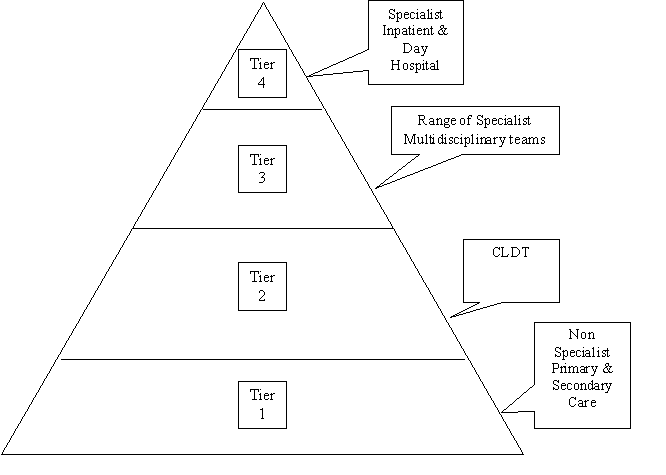
The vast majority of health and social care services specifically for people with a learning disability will be provided within tier 2 and will form the basis of co-located integrated health and social care services with a single line management structure for which Hampshire Adult Services will have lead accountability. These services will both commission and directly provide services for people with a learning disability as well as facilitating access to generic health and community services.
For a very small number of people with a learning disability, the highly specialist nature of the support that they need for their mental health needs or for their behaviour, is best provided by specialist NHS services within Tier 3 and 4. Hampshire Partnership NHS Trust would retain lead accountability for these services.
*HAP is a Health Action Plan PCP is a Person Centred Plan
6. Administrative/Managerial Planned Changes
6.1 The vast majority of health and social care services specifically for people with a learning disability will be provided within the community and will form the basis of co-located integrated health and social care services with a single line management structure for which Hampshire Adult Services will have lead accountability. These services will both care manage and directly provide services for people with a learning disability as well as facilitating access to generic health and community services. These will include both community teams and day services.
6.2 There will be five localities based on district or borough council boundaries as follows:
1. Fareham, Gosport and Winchester
2. Eastleigh and Test Valley
3. Havant and East Hampshire
4. Basingstoke & Deane, Hart and Rushmoor
5. New Forest
Each locality will have one locality service manager who is appointed jointly by Hampshire County Council (HCC) and Hampshire Partnership NHS Trust (HPT).
Locality service managers will report to the Head of Integrated Learning Disablity Services appointed and employed by HCC.
6.3 Staff affected by the changes are the HCC Learning Disability (LD) service managers and HPT LD locality managers within Hampshire.
Both organisations recognise that the success of these changes will depend on the commitment, involvement and co-operation of the staff within the affected services. Staff can be confident that they will be treated fairly, in accordance with the agreed policies for both HPT and HCC.
6.4 The number of Community learning Disability Teams is currently under consideration. There is likely to be an increase on the current number of community care teams as health and social care staff combine in given localities. (For example the size of the Team, once staff are combined, will be such that it will probably be better to have two Teams serving different parts of the New Forest). However, as previously stated this will not affect the people who use the services, because service users and their families rarely come to the base. Instead it is the staff who go to them. Consultation with affected staff will take place once the proposals have been formed regarding the number of teams. Proposals should be finalised by the end of March 2008.
7. Conclusion
7.1 Very extensive consultation and involvement with people who have a learning disability, their families and other stakeholders took place in 2002 and 2003 to develop a common Operational Policy for integrated Community Learning Disability Teams (CLDT's). There was a great deal of support to establish `one stop shops' i.e. a single point of access to health and social care services. This was approved by the Hampshire Learning Disability Partnership Board.
7.2 There followed agreement in principle by the Board of Hampshire Partnership NHS Trust and the Executive Member for Adult Social Care to establish a project board to develop plans to put in place an integrated service with integrated teams. The project board reports to the Hampshire Learning Disability Partnership Board.
7.3 The planned changes to the existing Teams are of an administrative and managerial nature, to which staff have contributed over the past three years in a variety of forums, and will be further consulted in the near future.
Recommendation
The Hampshire OSC is asked to note this progress report and to welcome the fact that good progress is now being made to establish integrated teams, to establish a single point of access for which people with a learning disability and their families have been pressing for such a long time.
Martin Barkley
Chief Executive
10/3/08
Appendix 5

Aldershot Centre for Health
The face of health care in Aldershot is changing, and it's looking good.
The new Aldershot Centre for Health (ACfH) is a huge investment for health care in the area, where services will be shared between the military and NHS. Building work on the site is due to finish late February 2008, with the centre fully operational from the summer. The cost of the project is £28 million.
Run by Hampshire Primary Care Trust (PCT) and the Army, the ACfH will contain 700 rooms to house the large array of treatments and services that will be based there.
Doctors and dentists, clinicians and counselors for civilian patients, to Army doctors, a 20 bed Medical Reception Station, standing medical board, psychiatrists and offices for the military will be on site. It will also have a pharmacy, making it a truly all-inclusive one-stop shop for health care, and the largest of its kind in the UK, possibly Europe.
Despite the NHS and Army jointly using the site, soldiers' confidentiality and safety will not be compromised, as civilians and every day patients will not be able to access military areas.
For the first time, a health centre will be able to offer sophisticated diagnostics, without the need to visit hospital. For example, it will no longer be necessary to visit Frimley Park Hospital for a CT scan; you can just visit ACfH instead.
At a huge 13,000 square metres, the architecturally-spectacular ACfH will embed itself into Aldershot's skyline, and into the future of local health care.
What services will Aldershot Centre for Health provide?
· Three GP practices
· District nursing and health visiting teams
· Community Dental service
· Physiotherapy
· Podiatry
· Retail Pharmacy
· Health promotion/Public Health
· Outpatient department
· Diagnostics - X-ray, path lab and CT Scan
· Counselling service
· Acorn (drug and alcohol team)
· Community mental health teams
· Child health services
· Children and adolescents mental health services
· Army medical reception ward 20 beds, general practice, psychiatric service and standing medical board
· Office space, staff facilities, meeting rooms, training rooms and library
Project costs
· The total cost of Aldershot Centre for Health is £28million.
· The cost of the building to Hampshire PCT is £1.7 million revenue
· Equipping of the building is underway and delivery of:
· 291 paper towel dispensers
· 95 toilet roll holders
· 551 coat hooks
· 264 soap dispensers
· User group visits are underway
Business case
In 2003 the business case for Aldershot Centre for Health was approved by Blackwater Valley and Hart PCT and Hampshire and Isle of Wight Strategic Health Authority. The document says;
"The new centre will also contain space for a Minor Injuries/Illnesses Unit although it is important to note that the funding required to operate the unit has not been identified within the PCT's current Local Delivery Plan. Should the PCT be able to identify funding in the 2006-2009 LDP, the unit will have the potential to contribute to maintaining low waiting times in the main A&E department at Frimley Park and supporting the access targets for primary care. There is considerable interest amongst local stakeholders in developing an integrated service model between the PCT, Surrey Ambulance Service, Frimley Park and the Army."
Stakeholder concerns
In recognition of the concern expressed by a variety of stakeholders the PCT wishes to explore the issues further around ACfH having a Minor Injuries Unit.
Services
Please note that each area may have slightly differing criteria, for example what may be seen or treated in one Minor Injuries Unit/Walk in Centre or Urgent Care Centre may not be seen or treated in another.
What is an MIU?
Minor Injuries Units (MIU) are led by specially trained Emergency Nurse Practitioners who are as experienced as many doctors in dealing with minor injuries. They are skilled in assessing patients and providing a wide range of advice and treatments. They are trained to know when a specialist is needed and, if necessary, can refer a patient to their GP.
What can an MIU do?
For adults and children aged three years and over (though often this will be for children aged five years and over), an MIU is able to treat;
- Sprains and strains
- Broken bones
- Wound infections
- Minor cuts, burns and scalds
- Minor head injuries
- Insect and animal bites
- Minor eye injuries
- Injuries to back, shoulder and chest
- Remove foreign bodies from ears, noses, etc
- Remove splinters
- Dress minor wounds, cuts and grazes
An MIU is NOT equipped to treat;
- Children under the age of three
- Chest pain
- Breathing difficulties
- Major injuries
- Problems usually dealt with by a GP
- Stomach pains
- Women's problems
- Pregnancy problems
- Allergic reactions
- Overdoses
- Alcohol related problems
- Mental health problems
- Conditions likely to require hospital admission
What does a GP surgery do?
All practices in the local area offer services for patients who have suffered an open wound in the last 48 hours.
What is an Urgent Care Centre?
Urgent Care Centres (UCCs) are usually made up of an MIU and A&E Department working in close proximity. Patient are usually seen at the same reception and then guided to the right department to ensure they are seen by the most appropriate clinician.
They are led by Emergency Nurse Practitioners with primary care practitioners and often a doctor.
Urgent Care Centres need access to diagnostics, plain x-rays and point-of-care blood tests throughout their opening hours.
Access to services
What services are offered by other Trusts and what are the travel distances?
Service |
Site |
Distance from Hospital Hill, Aldershot GU11 1PB (Source - The AA) |
Opening hours |
A&E Department |
Frimley Park Hospital |
7.65 miles |
24 hours |
A&E Department |
Royal Surrey County Hospital, Guildford |
9.90 miles |
24 hours |
A&E Department |
Basingstoke and North Hampshire Hospital |
18.14 miles |
24 hours |
A&E Department |
Queen Alexandra Hospital, Portsmouth |
40.63 miles |
24 hours |
Walk-in Centre |
Woking Community Hospital |
12.28 miles |
7am to 10pm, Monday to Friday 9am to 7pm, Saturday, Sunday and Bank Holidays |
Waiting times for Accident and Emergency at Frimley Park Hospital
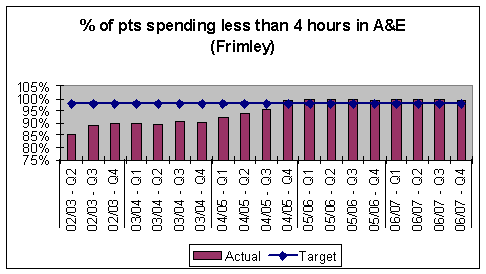
The waiting times for the Accident and Emergency Department at Frimley Park Hospital improved significantly from April 2002 to March 2005. This improvement has been sustained for the last two financial years.
Where is the Out of Hours Primary Care Service?
The local Primary Care Centre is co-located with the Accident and Emergency Department at Frimley Park Hospital. It sees people with urgent problems who cannot wait until the next time the GP practice is open.
The centre is accessed by appointments made by the Out of Hours telephone system or by attending and waiting to be seen. It is open from 6.30pm to 8.00am Monday to Thursday and 6.30pm Friday evening to 8.00am Monday morning (Tuesday morning if the Monday is a Bank Holiday).
Its location means it can refer patients with problems outside its remit to the Accident and Emergency Department directly.
As has been previously reported, the PCT has no immediate plans to develop a minor injuries unit at ACH. The reasons for this have been explored above. An additional driver is that the funding for A&E services remains for the present with the host PCT. In the case of Frimley Park Foundation Trust & Royal Surrey Hospitals the host is Surrey PCT and they are responsible for commissioning these services.
If in the future the funding regime changes the funding may then follow the patient. However, although discussions have started to consider this change, no date has yet been given for such a change.
Helen Clanchy
Area Director of Commissioning
Appendix 6
RE/ |
|
8 January 2007 |
|
Health Overview and Scrutiny Committee | |
Elizabeth 11 Court, The Castle | |
Hampshire Primary Care P&PIF Winchester and Andover Network c/o Help and Care Wessex House Upper market Street Eastleigh SO50 9FD |
Winchester, SO23 8UJ |
Telephone 01962 847338 | |
Fax 01962 867273 | |
E-mail [email protected] | |
www.hants.gov.uk | |
Dear Mr Wade
Patient and Public Involvement at Friarsgate Surgery Winchester
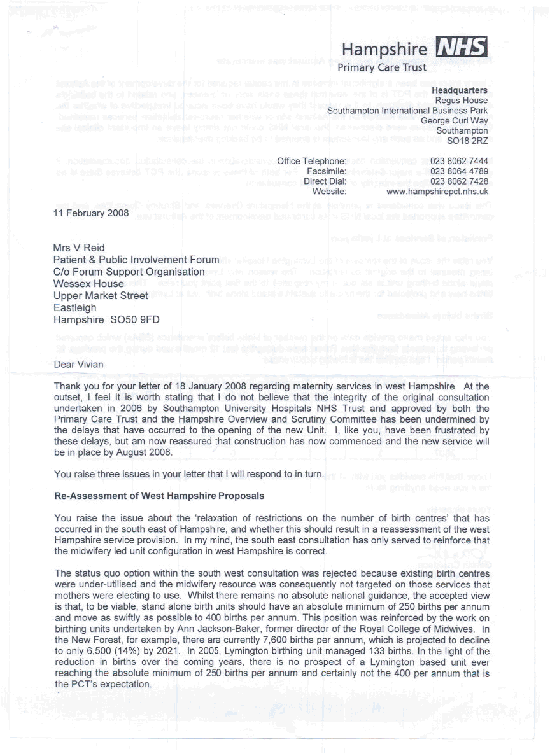
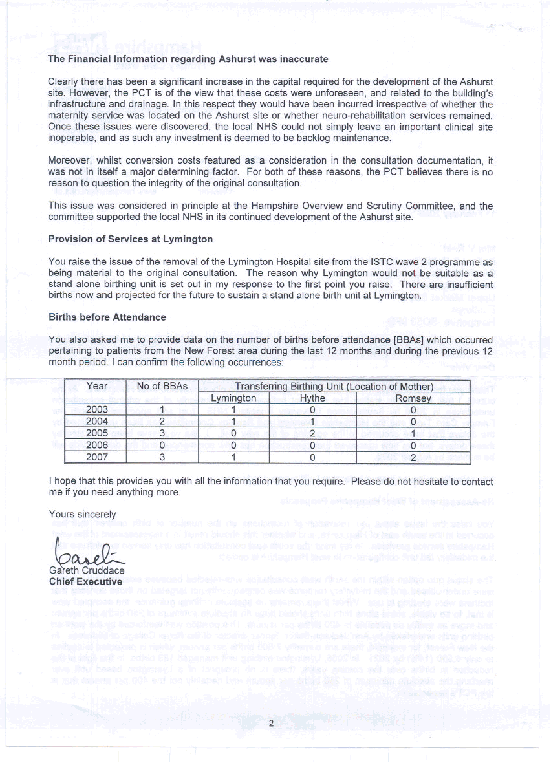
Thank you for your letter of 31 December 2007, asking us to clarify our `support' of the PCTs position with regard to possible changes to the location of GP premises.
For the sake of clarity I attach the text of the response that we sent to the enquiry we received from the PCT about the potential for relocation of the GP practice. We have commented about the substantial nature of the move and our expectation that local people are involved in planning any changes in relocation.
I think the important distinction to draw out here is the discussion about the nature of the change (i.e. is it substantial), which requires statutory consultation, and the need for patients and the public to be involved in planning any changes. The penultimate paragraph of the PCT letter refers to this latter point, suggesting that a number of patients have already been engaged with this process and that over coming months this will intensify. My understanding is that the PCT has indicated that it is keen to work with the P&PIF to ensure this process is robust and meaningful.
I trust this clarifies our position and look forward to hearing how local people are able to feed into and shape the proposals.
Cllr Dr Raymond J Ellis C.Chem FRSC
Chairman, Health Overview and Scrutiny Committee
cc |
Richard Samuel- Hampshire PCT Frank Rust- Hampshire PCT P&PIF |
Excerpt from an E-mail to Hampshire PCT: 2 February 2007
`As a general rule the HOSC focuses on actual service change rather than location when looking at whether a proposal is substantial. Whilst there is an expectation that local people are involved in planning the change (and a lack of this would be an issue for us) we do try and ensure that our expectations are proportionate in terms of what is being proposed.
If the change in location is pursued, unless there was an impact on service delivery we would not consider that the proposal represents a substantial change in services. It will however be important that you continue working with other local stakeholders, including the P&PIF to ensure you are addressing the 'section 11' expectations. If anything is likely to come up it will be access issues and in this respect it will be important that patients are made aware of any changes at the earliest opportunity.
It would be helpful to ensure that local councillors, who may have a particular interest in your proposals are aware(dependent of course of how you decide to proceed). If you could let me have the outcome of the Boards' deliberations I will draw these to the attention of the lead officer working with members in the area affected. I am sure she will be in touch if there is any query from members.'
Friarsgate surgery move - Update
March 2008
Background
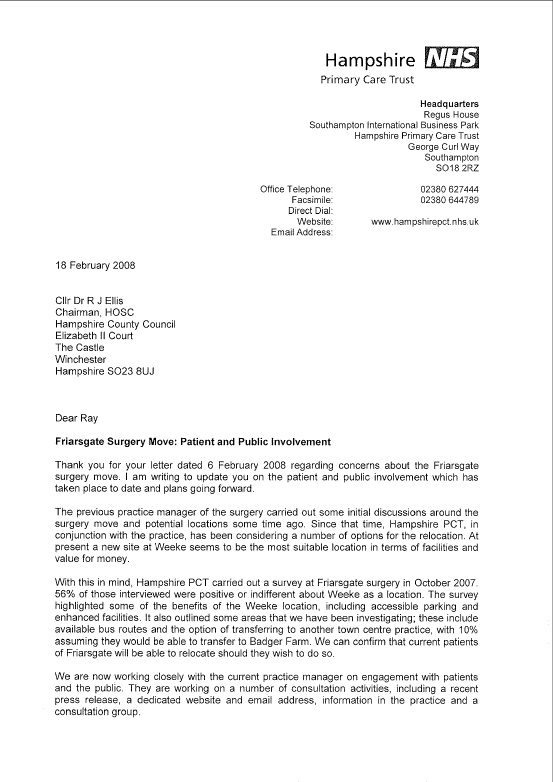
Further to the sale of the current premises of Friarsgate, the surgery, in conjunction with Hampshire PCT, has been looking at a number of options for relocation. Following suitability assessments and engagement over the last few years, the preferred option is likely to be at a new site in Weeke. We are now working on ensuring that the correct level of involvement is in place going forward.
Previous engagement
· Information on notice boards in the surgery 2005
· Information in newsletters in 2005
· Stakeholder event, summer 2005 - approx 40 people attended
· Invitations to join a stakeholder group in 2005
· Email responses to Weeke development 2006/07
· Patient letters 2005-07
· Small survey undertaken in surgery (50 patients), October 2007 (results shared with PPI Network)
· Press release to Hampshire Chronicle, January 2008
Deborah Upham, Head of Stakeholder Relations at Hampshire PCT has attended that last few Winchester and Andover PPI Network meetings. The last meeting was held on 12 March 2008, where the following current and future engagement was agreed as the right way forward. This was also discussed in a meeting between Richard Samuel, Director of Corporate Affairs, Hampshire PCT and Colin Wade, Chair of the PPI Network.
Current/Future engagement
· Information on notice boards in surgery
· Specific email address for comments ([email protected])
· Active email group, now asking for volunteers to help with relocation plan
· Working on a specific website, currently in draft form
· Number of transport ideas being explored
· Writing out to a list of people who have expressed concerns to ask for their participation in future planning
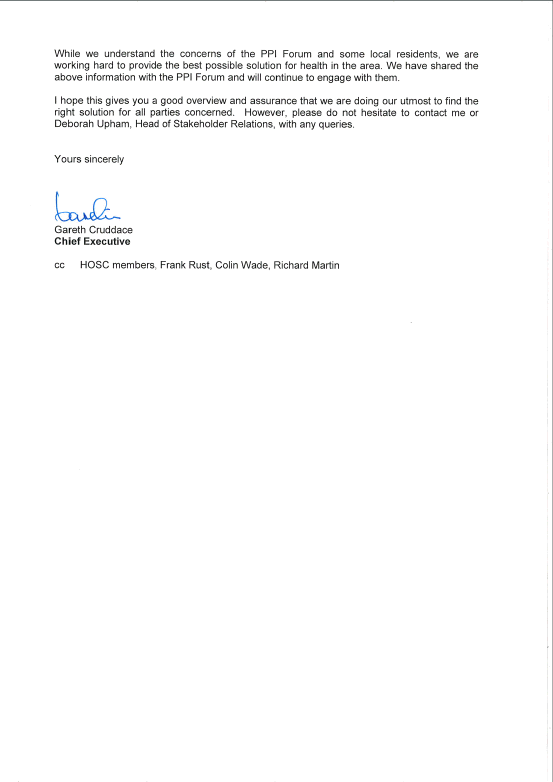
· Writing out to all patients to inform them of change in next few weeks
· Patient involvement features high on new 5 year business plan
Hampshire PCT is working closely with the current practice manager on progressing the above engagement activities.
Appendix 8 
Appendix 9