
Archived decisions
- Audit Commission descriptor to be inserted by Publishing-
Document Control
Author
Kate Handy; Graham West
Filename
HFRSA Annual Audit and Inspection Letter 2006_7 (1.2).doc
Status of our reports
This report provides an overall summary of the Audit Commission's assessment of the Authority, drawing on audit, inspection and performance assessment work and is prepared by your Relationship Manager.
In this report, the Commission summarises findings and conclusions from the statutory audit, which have previously been reported to you by your appointed auditor. Appointed auditors act separately from the Commission and, in meeting their statutory responsibilities, are required to exercise their professional judgement independently of the Commission (and the audited body). The findings and conclusions therefore remain those of the appointed auditor and should be considered within the context of the Statement of Responsibilities of Auditors and Audited Bodies issued by the Audit Commission.
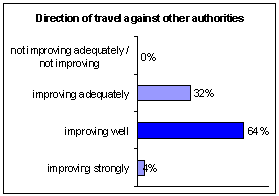
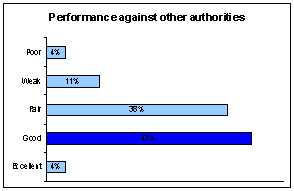
Reports prepared by appointed auditors are:
· prepared in the context of the Statement of Responsibilities of Auditors and Audited Bodies issued by the Audit Commission; and
· addressed to members or officers and prepared for the sole use of the audited body; no responsibility is taken by auditors to any member or officer in their individual capacity, or to any third party.
Copies of this report
If you require further copies of this report, or a copy in large print, in Braille, on tape, or in a language other than English, please call 0844 798 7070.
Key messages 4
Action needed by the Authority 4
Purpose, responsibilities and scope 5
How is Hampshire Fire and Rescue Service Authority performing? 6
The improvement since last year - our Direction of Travel report 6
Service assessment 11
The audit of the accounts and value for money 13
Looking ahead 16
Closing remarks 17
Availability of this letter 17
Key messages
1 Hampshire Fire and Rescue Service Authority continue to demonstrate that they are performing well in comparison to other authorities, achieving one of its key aims to be in the top 10 of the best performing fire and rescue services in the country. The Authority is improving outcomes in the majority of its key priority areas and is addressing areas of weaker performance. These improvements are reflected in the high levels of public satisfaction achieved in recent surveys.
2 The Authority continues to prepare robust accounts on a timely basis and performs well within our scored use of resources assessment. Further improvements can be secured but these may require significant investment of resources. The cost of these improvements needs to be weighed against other pressures for resources.
Action needed by the Authority
3 We have identified a number of areas for further improvement following our work in carrying out the above assessments. These have been reported to officers and agreed in action plans. The main actions arising for the attention of members from this letter for the coming year are:
· continue to develop processes for clearly evaluating outcomes of initiatives and partnership working against corporate objectives.
· monitor progress on driving down working days lost to sickness by improving data capture, and making processes stronger
· develop a set of local performance measures to evaluate asset use in relation to strategic corporate objectives.
· ensure there is an annual review of the risk management process
· complete the formal assessment of compliance with the Civil Contingencies Act
Purpose, responsibilities and scope
4 This report provides an overall summary of the Audit Commission's assessment of the Authority. It draws on the most recent Comprehensive Performance Assessment (CPA) and Direction of Travel review and from the findings and conclusions from the audit of the Authority for 2006/07.
5 We have addressed this letter to members as it is the responsibility of the Authority to ensure that proper arrangements are in place for the conduct of its business and that it safeguards and properly accounts for public money. We have made recommendations to assist the Authority in meeting its responsibilities.
6 This letter also communicates the significant issues to key external stakeholders, including members of the public. We will publish this letter on the Audit Commission website at www.audit-commission.gov.uk. In addition the Authority is planning to publish it on its website www.hantsfire.gov.uk.
7 As your appointed auditor I am responsible for planning and carrying out an audit that meets the requirements of the Audit Commission's Code of Audit Practice (the Code). Under the Code, I review and report on:
· the Authority's accounts;
· whether the Authority has made proper arrangements for securing economy, efficiency and effectiveness in its use of resources (value for money conclusion); and
· whether the Authority's best value performance plan has been prepared and published in line with legislation and statutory guidance.
8 This letter includes the latest assessment on the Authority's performance under the CPA framework, including our Direction of Travel report. It summarises the key issues arising from the CPA process.
9 We have listed the reports issued to the Authority relating to 2006/07 audit and inspection work at the end of this letter.
How is Hampshire Fire and Rescue Service Authority performing?
10 The Audit Commission's overall judgement is that Hampshire Fire and Rescue Service Authority is improving well and Hampshire Fire and Rescue Service Authority was assessed as Good in the Fire and Rescue Comprehensive Performance Assessment carried out in 2005. The latter assessed authorities on their corporate management, their achievements, community fire safety and how they planned to respond to incidents through their Integrated Risk Management Plan (IRMP). It did not consider tactical management of emergency response. The following chart shows the latest position across all Authorities. We are now updating these assessments, through an updated corporate assessment, in authorities where there is evidence of change.
Figure 1 Overall performance of authorities in CPA
|
|
The improvement since last year - our Direction of Travel report
11 Hampshire Fire and Rescue Authority is improving outcomes in the majority of its key priority areas and is addressing areas of weaker performance. Performance is above average in 12 out of the 14 key indicators, taking the Authority into the top 10 of the best performing fire and rescue services in the country. Direction of travel continues to be good, especially in the area of improving community safety. The service is also committed to continuous improvement, and learning from, and sharing good practice with, other organisations.
12 The Service is also making good contributions towards the wider community outcomes. It has published a comprehensive children and young person strategy and implemented a wide range of initiatives to improve their lives and make communities safer. These include running 24 LIFE (Local Intervention Fire Education) schemes to reduce arson, young fire-fighter association programmes to engage difficult to reach individuals and diversionary initiatives such as motor cycle schemes designed to engage with local young people and provide integrated safety training. Education and awareness programmes have been given to 90% of children at Key Stage 1, 2, and 3, and a programme is being developed to meet the need of pre-school age children and their carers.
13 An Arson Task Force has been established in conjunction with Hampshire Police, which has seconded an experienced detective constable to the task force. The service is involved in local community warden schemes, training wardens to refer home fire safety visits for vulnerable people, and to alert the service to potential arson targets.
14 The Fire Authority has appointed a station manager to develop a comprehensive road safety strategy and co-ordinate road safety initiatives across the county. Engagement with the Strategic Safer Roads Partnership for Hampshire and District Road Safety Councils ensure that the Authority is involved in wide-ranging prevention activities such as the new "Drive Safe, Stay Alive" road show. Involvement in the Momentum Project for pre-drivers has already indicated that participants are 50% less likely to have an accident in the first 3 years of driving.
15 The ambitions, priorities and strategic direction of the Authority are driven by the 5 outcome-based corporate aims:
· Reduce deaths and injuries from accidental fires by 20% by 2010;
· Reduce the number of deliberate fires by 20% by 2010;
· Reduce the number of fires by 20% by 2010;
· Work with others to reduce deaths and serious injuries on the road by 40% by 2010;
· Be in the top 10 fire and rescue services in the country.
16 All activities, from the strategic level down to the station level, are now well linked to these aims and performance is closely monitored against them. The service has further developed the existing strategic planning process and the performance management framework so that the corporate plan (IRMP) and all supporting service, business, and station plans are focussed on delivering outcomes. Current and emerging issues and pressures are identified through regular reviews and risk analyses, and these help to inform any necessary adjustments to activities.
17 The Strategic Risk and Improvement Planning Registers are regularly monitored and updated jointly by members and officers. The Risk Intelligence Team has been centralised and a new Community Safety Risk Register is being developed which will further improve intelligence data and act as a repository for gathering information for key partners. The service recognises that it still has more work to do on evaluating outcomes of initiatives and partnership working clearly against corporate objectives.
18 The Authority has developed a comprehensive consultation strategy and programme to engage actively with the public and other stakeholders in developing and prioritising future plans and objectives, including budget and council tax proposals. Public consultation around the Corporate Plan (IRMP) has improved and now includes user focus groups, including those defined as hard to reach. This is helping the authority to better gauge public needs within communities.
19 The latest opinion survey showed that Hampshire ranked 2nd out of the 33 participating services in terms of public satisfaction and performance in dealing with emergency incidents in domestic dwellings. 95% of respondents indicated that they had at least one smoke detector in their home. The service has invested resources in electronic access to service to provide public/commercial access to fire safety services. It has been awarded "platinum status" and funding to utilise the Fire Gateway portal to deliver services more effectively, and improve communication with, the public and businesses.
20 The Service has made progress towards improving the diversity of its workforce and how it relates with its ethnic minority and diverse communities. It has now reached level 2 of the Equality Standard for Local Government and is confident of achieving Level 3 by 2008. It has recently revised and published its gender equality scheme which, with the other equality and diversity policies, provides clear and realistic action plans to ensure the service promotes equal opportunities to all that it does.
21 The service has established community outreach teams and local advocates to work with hard to reach groups in the community. For example, fire safety officers have provided informal advice to the local Chinese business community, using a local café as a venue, as it has a multi-cultural customer base. A translation service (available 24/7 via the control room) has been engaged to ensure that the service can communicate effectively with all parts of the community in whatever circumstance. In addition retained fire fighters have been recruited from the growing Polish community.
22 Capacity has been developed to deliver outcomes through a range of strategies and activities, including:
· focused partnership working
· delivering different ways of working
· developing the working
· pursuing value for money.
23 The service is refining its partnership working to enhance its safety and prevention activities. It has developed and introduced a corporate partnership framework and toolkit which ensure that activities are appropriately linked to core or statutory business. It now has a number of personnel seconded to partner agencies to achieve shared objectives. For example, a technical fire safety officer is seconded to, and funded by Hampshire County Council, to lead on the risk assessment of major HCC building projects and stock.
24 The 6 co-responder schemes operating in partnership with South Central Ambulance Service are well established and continue to save lives and reduce community risk as well as helping the ambulance service meet its own attendance standards. In 2006/07 the service attended 2262 incidents. The serviceCharlotte I take it these figures refer to the co-responder scheme. is also cost-effective as it uses a retained fire fighter and a car (£50) rather than an appliance and full crew (£267) as provided by other fire services.
25 It has also implemented a successful and innovative partnership with West Sussex Fire and Rescue Service to create excellent compartment fire behaviour training facilities at the training centre at Eastleigh. This shared-use resource is expected to provide spare capacity for the wider benefit of the South East Region.
26 The service has developed a high degree of influence at regional and national levels, ensuring it has an appropriate voice and input in developing local services. The Chair of the Authority is also chair of the South East Regional Management Board (RMB) and the Chief Officer is lead of the HR RMB workstream as well as vice-president elect of Chief Fire Officers' Association. He is also an executive member of the LAA board and other directors hold key roles on regional service boards. Hampshire Fire Service has been instrumental in progressing regional partnership working such as the development and implementation of Assessment and Development Centres (ADCs) and in enabling the RMB to become an improvement partnership, managing capacity building funding. This is the only partnership of its kind in the country.
27 The Service has implemented changes to the organisation and management structure that are enhancing its capacity to deliver new ways of working. This includes the dedicated strategic projects and specialist response directorate to spearhead major modernisation schemes and an integrated service delivery directorate that pulls together prevention, protection, and response activities driven by better risk intelligence. The restructuring has produced £115K per annum in cashable efficiency savings.
28 A range of approaches, including mentoring, coaching and investment in professional development through higher education courses and post-graduate programmes, has significantly increased the skills, knowledge base and competencies of senior and middle managers to enable them to challenge, champion and deliver the modernisation and change agendas. The implementation of the Workforce Strategy includes linking objectives through Personal Development Reviews to IRMP priorities. The Integrated Personal Development System has now been fully implemented.
29 Assessment and Development Centres have been run at all levels and a comprehensive workplace assessment system has been implemented to ensure that all staff possess and maintain the relevant key competences according to their role map and national occupational standards. Absence management has been recognised as an area for improvement, and the service has established an Attendance Improvement Working Group which is focused on driving down working days lost to sickness by improving data capture, and making processes stronger
30 The innovative Personnel Reserve System enables the identification of excess capacity (above a pre-determined level) in night shifts and uses this to redeploy activities. This provides additional resource to support Home Fire Safety Visits and other community safety initiatives as well as providing back up crewing cover for retained stations and advanced training activities.
31 The transition from day crewing to continuous crewing has been completed at Winchester and Andover stations through crewing rationalisation at other stations. This approach is being extended in 2008. These initiatives have already significantly improved response times both in local communities and, because of their strategically important location, across the whole county. It is also improving levels of community engagement and enabling more community safety activities. A retained duty system has been introduced in Southampton, which is the first retained unit to operate in a major UK city. This is enhancing operational resilience as well as improving the diversity of the workforce and encourages access to hard to reach groups in the local community.
32 The service recognises that the active involvement and decision-making role of members of the Fire Authority is critical to the corporate planning process and effective performance management. It has improved members' induction and introduced a members' scheme to supplement regular training and awareness sessions, formalised in the "Elected Member Awareness Framework".
33 The Authority identifies and pursues opportunities to manage and reduce costs or improve quality within existing costs. Ambitious targets are set to improve efficiency and the Authority has already exceeded its projected 3-year targets by over 1%. The service uses best procurement practice and is securing significant gains through co-operative procurement arrangements with other fire services and partners. For example, the Authority has taken a leading role in establishing an Insurance Mutual with 9 other fire authorities for from September 2007. This has resulted in immediate savings of 15% on insurance premiums, with further projected savings of 25% by 2008. The Director of Corporate Services has been elected Chair of the Mutual board and this innovative and collaborative partnership has had a dramatic impact on improving competition within the insurance market place for the wider benefit of all fire services.
34 Over the last 3 financial years the fire authority has managed to keep the average increase in council tax at or below the average increase in state pension inflation. It has made use of efficiency gains to fund risk reduction initiatives. The aim to transfer 2% of resources to protection activities by 2008 was achieved 18 months ahead of time.
35 The Audit Commission has undertaken a fire and rescue service assessment of the Authority. The assessment focused on service delivery and looked at the effectiveness of the service as experienced by recipients. The assessment was constructed from two elements.
· The performance information element (an analysis of outcome focused best value performance indicators selected from those nationally available to assess the outcome of the services delivered by the authority).
· The operational assessment of service delivery element (provided to the Commission by the Department of Communities and Local Government (DCLG)).
36 The assessments for Hampshire Fire and Rescue Service Authority are provided in Table 1.
Table 1 Fire and rescue service assessment
Element |
Assessment |
Performance indicator |
4 out of 4 |
Overall fire and rescue service assessment |
4 - Performing strongly - well above minimum requirements |
Source: Audit Commission
37 DCLG's 2006 operational assessment of service delivery assessed the planning and delivery of emergency response. The following text was provided by DCLG as part of their assessment of Hampshire Fire and Rescue Service Authority.
38 Hampshire Fire and Rescue Service is performing strongly in most areas of service delivery from its work in prevention and protection, operational preparedness, and call management and incident support.
39 The Service is significantly involved with partner organisations in order to deliver community safety, and it ensures that resources are targeted to those most in need. Its response to emergencies is both flexible and appropriate. Constant monitoring enables the Service to attend incidents efficiently, and ensure that the most appropriate resources are sent. There are evident strengths in the provision of the technical infrastructure, systems and human resources required to sustain call management and incident support arrangements.
40 Risk analysis is good with tangible outcomes from the relocation of resources. Resources are targeted at objectives linked to the integrated risk management plan, and there are clear policies for civil protection. Overall, the Service is performing strongly with a clear heath and safety culture and a resolute commitment to equality and diversity.
The audit of the accounts and value for money
41 The statements of account were prepared in a timely manner, were supported by a good standard of working papers, and complied with recommended accounting practices. The Statement on Internal Control (SIC) had been prepared in accordance with proper practice specified by CIPFA and was consistent with the findings from our audit.
42 As your appointed auditor I have reported separately to the governance committee of 10 September 2007 (nominated as those charged with governance (TCWG) for the purpose) on the issues arising from our 2006/07 audit and have issued:
· my audit report, providing an unqualified opinion on your accounts and a conclusion on your vfm arrangements to say that these arrangements are adequate on 17 September 2007; and
· my report on the Best Value Performance Plan confirming that the Plan has been audited.
· my unqualified opinion on the Whole of Government Accounts consolidation pack.
43 The Authority took a positive and constructive approach to our audit. There were no significant issues arising to report to those charged with governance. However, we did make some minor recommendations to improve the effective operation of financial control systems.
Use of Resources
44 The findings of the auditor are an important component of the CPA framework described above. In particular the Use of Resources score is derived from the assessments made by the auditor in the following areas.
· Financial reporting (including the preparation of the accounts of the Authority and the way these are presented to the public).
· Financial management (including how the financial management is integrated with strategy to support Authority priorities).
· Financial standing (including the strength of the Authority's financial position).
· Internal control (including how effectively the Authority maintains proper stewardship and control of its finances).
· Value for money (including an assessment of how well the Authority balances the costs and quality of its services).
45 For the purposes of the CPA we have assessed the Authority's arrangements for use of resources in these five areas as follows.
Table 2
Element |
Assessment |
Financial reporting Financial management Financial standing Internal control Value for money |
3 out of 4 3 out of 4 3 out of 4 2 out of 4 3 out of 4 |
Overall assessment of the Audit Commission |
3 out of 4 |
(Note: 1 = lowest, 4 = highest)
The key issues arising from the audit
46 These headline scores are the same as last year and the authority continues to perform well in the use of resources, meeting above the minimum requirements overall. This is a creditable achievement as the assessment process gets tougher each year. We have presented a report to officers with the detailed scoring and highlighting the areas where work is needed to meet new and tougher standards next year.
47 All work was completed in 2007 and considered procedures in place and operating up to 31 March. Our conclusions on each theme was as follows:
Financial Reporting:
48 The financial statements were produced to a good standard, well within deadlines and only contained minor errors, which were corrected.
Financial Management:
49 The Authority has a soundly based medium term financial strategy supported by robust annual budgets. Financial and service planning timetables are aligned. Budget management is sound and there is evidence of active management of the asset base.
50 The Key area for improvement in financial management is to develop a set of local performance measures in relation to assets that evaluate asset use in relation to strategic corporate objectives.
Financial Standing:
51 The Authority manages spending within available resources and the overall financial position remains sound. Balances are at a level in line with the risk assessment and this is monitored and reported to members.
Internal Control:
52 Risk management processes and training have become more embedded with the implementation of the Community Fire Risk Management Information System (CFRMIS), and rolling out of PB Views throughout the service so managers can monitor dynamically their performance against indicators. Systems of internal control are generally sound and adequate processes are in place to ensure probity and propriety in the conduct of the Authority's business.
53 This theme score continues to be lower than the others. Improvement areas for this theme required to raise the score were noted as being to:
· ensure that there is evidence of the risk management process being reviewed for fitness for purpose and updated on an annual basis.
· complete the formal assessment of compliance with the Civil Contingencies Act and report to members with remedial action agreed to address residual risks.
· implement, in addition to the National Fraud Initiative work, a programme of proactive local counter fraud work linked to a formal local risk assessment ensuring it is adequately resourced.
· proactively raise the standards of ethical conduct amongst members and staff through regular communications and training and monitor the attendance at such training.
54 We are aware from recent work at the Authority, piloting a new audit approach for the use of resources assessment, that improvements have been made since March and expect our future assessments to reflect an improved score in this theme.
Value for Money
55 The Authority is achieving good overall value for money. The cost of the service is low at £38.18 in comparison to other services (for example Kent at £42.22 and Essex at £42.21). Value for money is articulated in templates for group plans and benchmarking is used regularly at a corporate level, sharing good practice through a web-based database. The Authority is developing "Beacon Stations" - where rewards and flexibilities will be awarded for good performance.
56 The Authority has demonstrated that it has a good understanding of costs and performance and of where it needs to improve outcomes to achieve and has made tangible progress from last year by consolidating value for money processes, and ensuring that all levels of the organisation understand and contribute to value for money targets.
Looking ahead
57 The Commission consulted on the changes to the key lines of enquiry for the 2008 use of resources assessment during April to June 2007. The Commission's response to the consultation can be found on its website. The key lines of enquiry for 2008 reflect some of the changing priorities for councils as they respond to the major challenges facing them and the higher expectations of them. Making further improvements in efficiency will be critical for councils in responding to the changing demographic profile of communities, increasing public expectations of public services and expected constraints on funding from Government.
58 The key lines of enquiry give more emphasis, mainly at level 4, to areas such as: sustainability, working in partnership and using IT to secure service and value for money improvements; strategic asset management and joint procurement. These areas signal the changes which will be given more emphasis in the use of resources assessment under Comprehensive Area Assessment (CAA), the new performance framework for local services.
59 CAA will provide the first holistic independent assessment of the prospects for local areas and the quality of life for people living there. It will put the experience of citizens, people who use services and local taxpayers at the centre of the new local assessment framework, with a particular focus on the needs of those whose circumstances make them vulnerable. It will recognise the importance of effective local partnership working, the enhanced role of Sustainable Communities Strategies and Local Area Agreements.
60 CAA will result in reduced levels of inspection and better coordination of inspection activity. The key components of CAA will be a joint inspectorate annual area risk assessment and reporting performance on the new national indicator set, together with an enhanced annual direction of travel assessment and an annual use of resources assessment. The auditors' use of resources judgements will therefore continue, but their scope will be widened to cover issues such as commissioning and the sustainable use of resources.
61 The first results of our work on CAA will be published in the autumn of 2009. This will include the performance data from 2008/09, the first year of the new Local Area Agreements.
Closing remarks
62 This content of this letter has been agreed with the Director of Corporate services, the Treasurer and the Chief Fire Officer and Head of Paid Service. A copy of the letter will be presented at the Governance Committee on 28 March 2008. Copies need to be provided all Authority members by 31 March.
63 Further detailed findings, conclusions, and recommendations on the areas covered by audit and inspection work are included in the reports issued to the Authority during the year.
Table 3 Reports issued
Report |
Date of issue |
Audit and inspection plan |
May 2006 |
Final accounts memorandum |
November 2007 |
Annual Governance Report |
September 2007 |
Opinion on financial statements |
September 2007 |
Value for money conclusion |
September 2007 |
Use of Resources feedback |
December 2007 |
Direction of Travel & Service Assessment |
January 2008 |
Annual audit and inspection letter |
March 2008 |
64 The Authority has taken a positive and constructive approach to audit and inspection work, and I wish to thank the Authority's staff for their support and cooperation during the audit.
65 This letter will be published on the Audit Commission's website at
www.audit-commission.gov.uk, and also on the Authority's website.
Kate Handy
Relationship Manager
7 March 2008