Archived decisions
Hampshire County Council Cabinet 31 March 2008 Future Approaches to Transport Investment in Lyndhurst Report of the Director of Environment |
Item 5 (c) |
Contact: Stuart Jarvis, ext 7430 email: [email protected]
Hannah Baker, tel: 02380 427601 email: [email protected]
1. Summary
1.1 The objective of this report is to seek Members' views on a future approach to investment in traffic relief/environmental enhancement measures for the village of Lyndhurst in the New Forest. The Cabinet will take into account the recommendations of the Environment and Transportation Select Committee scrutiny review of a case for a Lyndhurst bypass.
1.2 The Environment Department commissioned its professional services consultant Mott Gifford to establish and test the range of options available to address traffic congestion in and on the approaches to Lyndhurst. The range of options included whole and partial bypasses to both east and west of the village, and included the Parish Council's proposed eastern outer bypass. The study used a robust methodology of appraising a spectrum of options under both national and local objectives.
1.3 Supporting evidence was also prepared in the form of extensive traffic surveys, a scoping study for the habitats regulations in the Lyndhurst area and public opinion surveys (focused on New Forest and Lyndhurst residents). This evidence was provided to the Environment and Transportation Select Committee to assist in its review of prioritising a bypass for Lyndhurst.
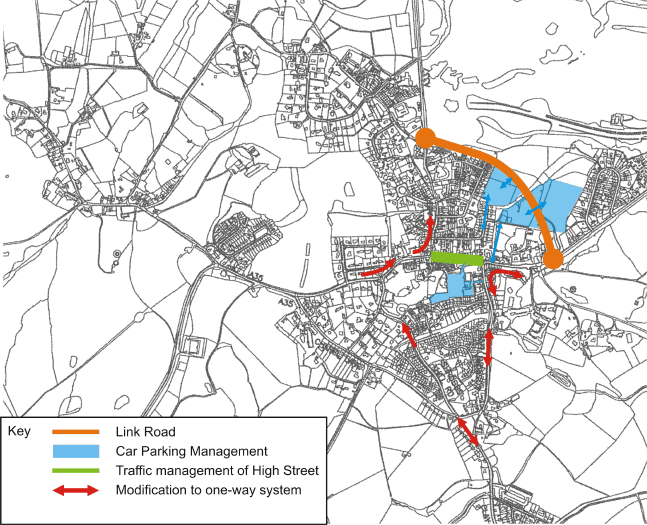
1.4 The `best' option as determined by the consultants report is to provide an eastern inner link road to allow north/south traffic to bypass the High Street, together with a package of other measures including associated car park relocation, traffic management and partial pedestrianisation of the High Street (known as Option 7B - refer to Appendix 1 for schematic plan.).
1.5 This preferred option has yet to be fully developed in terms of detailed technical appraisal, and has not been subject to detailed local or stakeholder consultation at this stage. The scheme has been preliminarily estimated to cost of £6.8 million (a bid of up to £8.97 million would be required including the government requirement for inclusion of an uplift for `optimism bias' in the RFA bidding process). Though compared with bypass proposals the environmental impacts are reduced in scale and extent, and the cost/benefit ratio is likely to be significantly more favourable, there are a number of associated risks in terms of deliverability.
1.6 The Regional Transport Board (RTB) is refreshing the regional transport funding allocations later this year, and has invited submissions by early April. The focus of the Regional Funding update will be to review the already agreed programme to 2016 and consider candidate schemes for an extension of the programme to cover the period 2016 to 2018, to be submitted to the Secretary of State.
1.7 The submission of a scheme at this early stage of development for funding consideration by the Regional Transport Board would not normally be considered. However sufficient work has been done to meet the technical requirements, and there is unlikely to be a further bidding window for funding in the next two years. As the 2008 submissions would not be likely to secure funding until 2016 at the earliest, it is considered that there is merit in considering an advance submission at this stage while scheme development and consultation work continues. Therefore Cabinet is invited to consider making a submission now while further scheme development work continues. The County Council could withdraw the submission should significant contrary indications emerge as the scheme develops and further consultation takes place. Early discussion with the National Park, as the local planning authority, will be particularly important.
1.8 The criteria suggested by SEERA for the RTB to evaluate schemes against has three main features:
(i) compliance with the South East Plan;
(ii) value for money; and
(iii) deliverability.
In this context the Lyndhurst package may not score particularly well.
2. Recommendations
That the Cabinet :
(i) approves the preferred Option 7B (based on the Lyndhurst inner eastern link road and associated car park relocation, traffic management and partial pedestrianisation of the High Street) as a basis for further technical development work and consultation with the local community and stakeholders; and
(ii) considers submitting an advance outline bid for a package of measures for Lyndhurst to the Regional Transport Board in April 2008 (based on the preferred Option 7B) for consideration in the formulation of its advice on regional transport funding priorities due to be submitted to the Secretary of State.
3. Background
3.1 Over the past four years the number of public representations and complaints about traffic congestion on the approaches to and within the village of Lyndhurst have risen. Congestion in peak periods often results in long journey times which is a major concern of motorists and residents alike. Attempts by the County Council to secure bypasses in the 1970s and 1980s both failed.
3.2 Since the 1980s the County Council has implemented a range of transport measures aimed at alleviating traffic and improving the environment of the village. More recently, Lyndhurst Parish Council has promoted a bypass proposal to local people and the County Council. The Parish Council's proposal involves a bypass to the east of the village, running through the open forest joining the A337 north and south of the High Street.
Environment and Transportation Select Committee
3.3 Two New Forest transport seminars hosted by the County Council (2006 and 2007) highlighted the strength of local concern about the traffic queues and congestion in Lyndhurst. As a result, the Leader of the Council asked the Environment and Transportation Select Committee to review the existing traffic situation and the Parish Council's Bypass proposal. The Committee's remit was to assess the current traffic situation, the range of options available to improve congestion and particularly whether a bypass would be a viable option. Its work commenced in July 2007 and was completed in March 2008. The outcome and recommendations of the Select Committee will also be considered at this Cabinet meeting.
4. `Optioneering'/Appraisal Process
4.1 The consultants were tasked with undertaking a high level appraisal of a range of traffic improvement options culminating in the `Lyndhurst Transport Study' (refer to Background Paper). The identified options should meet a set of defined local and national objectives. The national objectives used as part of the assessment were those prescribed by the Government's `New Approach To Appraisal' (NATA). These include improving or lessening the impact on the environment, safety, the economy, accessibility and integration.
4.2 The local objectives are based on the same five themes but targeted at the specific local problems of congestion and poor air quality in the village.
4.3 It is important that a study of this preliminary nature assesses a full range of options and not solely the solution that seems most prominent or widely discussed (ie bypasses). This is largely because of the environmental policy context of the area and in particular the tests under the EU Habitats Directive `Appropriate Assessment' procedure which oblige all potentially less damaging schemes/options to be assessed alongside one which may have environmental impact.
4.4 The preliminary/high level nature of this study precludes any in-depth analysis or assessment at this stage. The optioneering report `Lyndhurst Transport Study' included 25 bypass options, 6 village centre traffic/demand management options and 2 package options (ie link roads and traffic management),. To accompany the Transport Study the following work was also carried out:
- Scoping Study for Habitats Regulations
- Public Opinion Surveys
- Traffic Surveys.
(Please refer to the Background Paper for further details.)
Scoping Study for Habitats Regulations: Assessment of a Lyndhurst Bypass
4.5 An independent consultant commissioned by the County Council has reviewed the implications of the Habitats Regulations for the assessment of the Lyndhurst Parish Council bypass proposal. At the time of commissioning the study the Parish Council proposal was the only proposal in the public realm. The consultant's report comprises the following:
(i) an explanation of the legislative and policy framework for undertaking a Habitats Regulations assessment of such a scheme;
(ii) a description of the habitats, species and conservation objectives of the International sites;
(iii) identification of the types of adverse ecological effects that would potentially result from such a scheme;
(iv) identification of the range of research and survey requirements that would be necessary to inform a Habitats Regulations assessment, in the event of a formal proposal, and an estimate of the costs entailed in undertaking such work (provisionally of £235,000).
4.6 The report details a range of potential adverse effects from the Lyndhurst Parish Council bypass route. Although not a full Appropriate Assessment, it indicates that this bypass route should only be considered as an option if it is firstly demonstrated that there are no alternatives and if it is then proven that there is overriding public need.
4.7 Assessment under the Habitats Regulations would have to be undertaken to determine the viability of any other bypass route that crosses internationally designated land around Lyndhurst. Additionally, any bypass option would require impact assessment to take account of legislation and policy relating to a variety of other environmental issues, for example:
(i) other ecological designations, such as Sites of Scientific Interest (SSSIs);
(ii) ancient semi-natural woodland;
(iii) protected species;
(iv) National Park objectives;
(v) archaeology;
(vi) landscape; and
(vii) commoning.
Public Opinion Surveys
4.8 Public opinion surveys conducted by Ipos/MORI in November 2007 focussed on issues such as the environment, the good and bad things about Lyndhurst and the New Forest and types of possible traffic improvement measures.
4.9 The results, based on a sample of the population, revealed that residents prioritised protecting the natural environment when considering solutions to Lyndhurst's traffic situation. Residents felt strongly about the levels of traffic generally and specifically of lorries in the village. They also considered that traffic queues on the approaches to the village should be prioritised for improvement.
Traffic Surveys
4.10 Extensive surveys were undertaken in June and August 2007. Cordon surveys revealed that 60% of all traffic was classed as `through traffic' ie not stopping in Lyndhurst. The remaining 40% of traffic passes through a single cordon point suggesting that traffic is travelling to or from a location within the village itself.
4.11 There has been minimal traffic growth on all routes in Lyndhurst over the last ten years. Heavy Goods Vehicles make up between 3% and 4.8% of traffic on the A35 and A337.
5. Preferred Options
5.1 A number of traffic surveys conducted in the summer of 2007 revealed that Lyndhurst's road network has experienced limited growth over the past ten years. The level of through traffic at 60% of the total trips passing through a cordon around Lyndhurst diminishes the case for a traditional bypass.
5.2 Consequently, the consultant has recommended an eastern link road (part inner bypass with least environmental impact), including the revision of the one-way system, traffic management controls/widening of junctions and the closure of the High Street to traffic (Option 7B - refer to Appendix 1). This would also include the relocation of part of the parking provisions from the central car park to land close to the link road, leaving potential development opportunities for some of the existing car park located south of the High Street. The assessment was undertaken with consideration of technical/engineering issues, likely traffic extraction benefits, costs, and deliverability issues, particularly focussed on the environmental context. The NATA guidelines recommend that the best, lowest cost and next best options are assessed in greater detail beyond the initial appraisal stage.
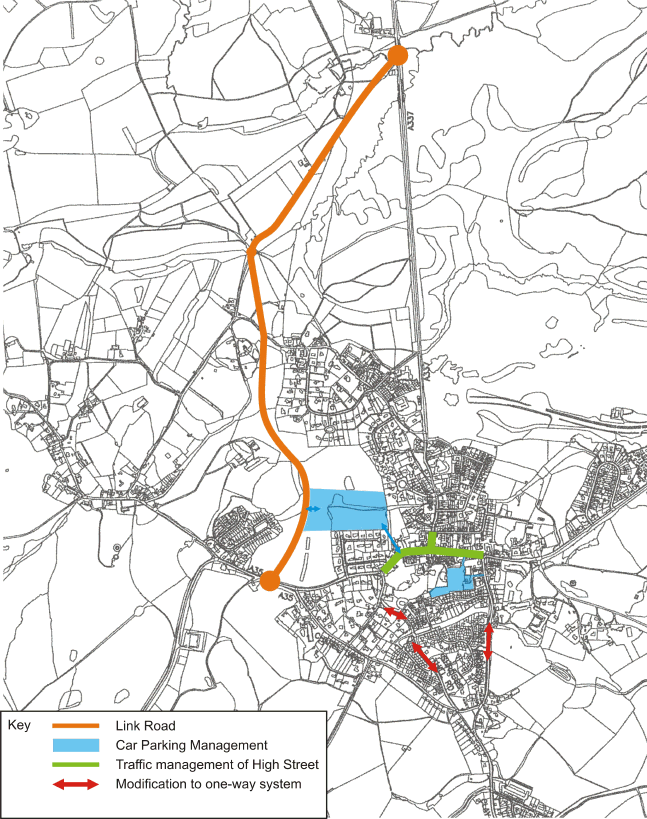
5.3 The next best option is a western link road, Option 7A, which includes a similar revision to the one-way system and relocation of the car park to Option 7B. The preferred lowest cost option is a series of traffic management improvements to defined junctions within the village.
5.4 The report concluded that bypasses are generally constrained by the environmental protection sites within and surrounding Lyndhurst, in particular nature conservation designations and National Park status.
5.5 The assessment was undertaken with consideration of technical/ engineering issues, likely traffic extraction benefits, costs, and deliverability issues, particularly focussed on the environmental context. The preferred options identified range from £5 million for the low cost traffic management option, £6.8 million for Option 7B and to £12.5 million for Option 7A (provisional costs).
5.6 The report concluded that bypasses are generally constrained by the environmental protection sites within and surrounding Lyndhurst, in particular nature conservation designations and National Park status. Bypasses ranged in provisional costs from £5 million to £51.4 million.
5.7 The report did not recommend the perusal of any form of `whole' bypass due to the environmental constraints of the local area which would seriously affect the deliverability of such an intervention. Similarly, bypasses do not achieve all of the local objectives, for example, minimising the effect on the environment, and are contrary to national policy.
6. Funding Opportunities and Prioritisation
6.1 A scheme of £5 million or more can either be funded by the region or by the County Council through its Local Transport Plan (LTP) block allocation. With the funding restrictions faced by the County Council through changes in National Government funding provisions in relation to Capital Borrowing, there is no scope to add a major scheme at Lyndhurst to the current LTP programme (2008/09-2010/11). Therefore, if such a scheme were to be funded locally, it would need to be included within the third LTP, due to be submitted in 2010 for the period 2011-16.
6.2 In order to prevent unpredicted cost overruns in major scheme, the Government Office dealing with the Regional Funding Allocation require `optimism bias' to be included in the estimated costs of transport schemes from the outset. The Department for Transport have used empirical evidence from previous transport schemes to establish `uplifts' to planned costs based on the probability or risk associated with cost overrun.
6.3 In view of the fact that the cost estimates outlined in the Lyndhurst Transport Study were arrived at an early stage, the cost estimations are not robust. Therefore it is recommended that the higher level of optimism bias (for road schemes) has been applied in this instance. It is advised that the risk of overrun should be less than 20% which equates to a cost uplift of 32%. In applying the optimism bias to the low cost traffic management measures and Options 7A and 7B, the revised costs based on the initial costs estimates would be as follows:
(i) Traffic Management Measures - £5 million with optimism bias £6.6 million;
(ii) Option 7A - £12.5 million with optimism bias £16.5 million; and
(iii) Option 7B - £6.8 million with optimism bias £8.97 million.
6.4 The development time required to prepare a scheme for Lyndhurst would also fall outside the current LTP period. It is likely that the development stage would take four to five years.
7. Impact Assessments
7.1 Assessment of the Race Relations (Assessment) Act has been considered in this report but no adverse impact has been identified in terms of race, creed or gender.
8. Conclusion
8.1 Localised congestion is problematic in the village of Lyndhurst and greatly effects the consistency of journey times for motorists who visit or travel through the village.
8.2 A way forward needs to be sought in terms of whether the County Council wishes to prioritise the consultants preferred option for Lyndhurst. This could be implemented by either the future LTP block allocation of funds or as a County Council's submission for regional funding.
LINK(S) TO CORPORATE STRATEGY | ||
Yes |
No | |
Hampshire safer and more secure for all |
||
Maximising well-being |
||
Enhancing our quality of place |
_ |
|
Section 100 D - Local Government Act 1972 - background papers | |
The following documents disclose facts or matters on which this report, or an important part of it, is based and has been relied upon to a material extent in the preparation of this report. | |
NB the list excludes: | |
1. |
Published works. |
2. |
Documents which disclose exempt or confidential information as defined in the Act. |
TITLE |
LOCATION |
Background Papers |
All documents - |
1. Summary of Supporting Information, Hampshire County Council 2008 |
- Members' Rooms. - Environment Reception, Castle Ave, Winchester. - Hampshire Highways West, Totton. - New Forest Centre, Lyndhurst |
2. Traffic Flows and Trends, Lyndhurst: Past and Present, Hampshire County Council 2007 | |
3. Lyndhurst Residents' Survey, Ipsos MORI/Hampshire County Council 2007 | |
4. Scoping Study for Habitat Regulations: Assessment of a Lyndhurst Bypass, Hampshire County Council/Jonathan Cox Associates 2007 |
|
5. Lyndhurst Transport Study, Hampshire County Council/Mott Gifford 2007 |
1577Rpt/SJ/HB
APPENDIX 1
Option 7A
Option 7B