
Archived decisions
Older People's Well-Being Strategy
Draft Strategy for Consultation
April 2008 - March 2011

Contents
4. How to Define Well-Being 55
5. Framework of County Priorities 55
6. What Older People in Hampshire Say 66
7. Benefits of Taking a County Wide Approach 77
9. Links to other strategies and groups 88
10. Framework of Proposed County Priorities 1010
Appendix 1 - How to Define Well-Being 1515
Appendix 2 - National Agenda 1616
Appendix 3 - Ageing Population 1919
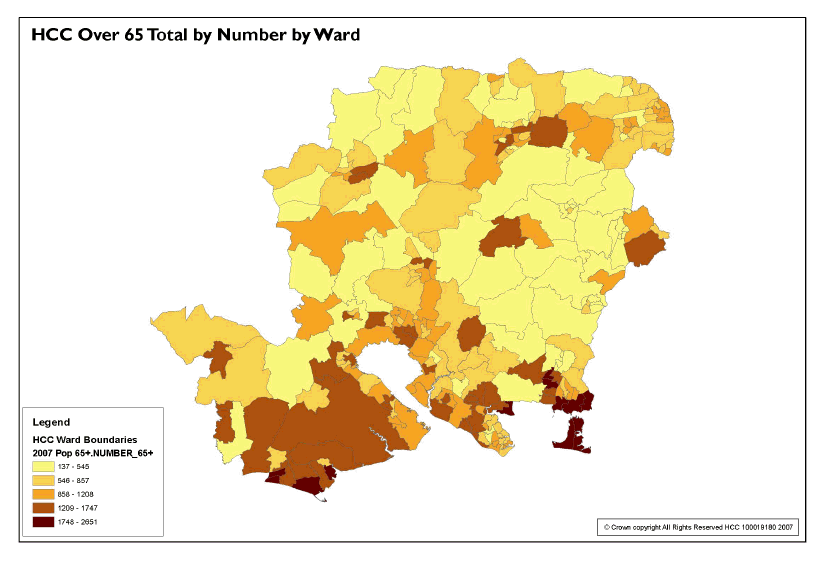
Appendix 5 - Hampshire County Council Over 65 Total by Ward 2121
Appendix 6 - Table of Provision of Unpaid Care by Age, 2001 2222
Appendix 7 - Table of Ethnicity 2222
Appendix 8 - Table of Population Need 2323
Appendix 9 - Number of Responses and their Priority Number 2424
Appendix 10 - Graph of Priority Responses 2626
Appendix 11 - Summary of Individual Comments from the Feedback Forms 2727
1. Aim
"well-being means not being alone and isolated, having people to care about and being cared for in return"
"to have choice about where I live, work and love."
"to have easy access to the things that are important to me at the time e.g. GP or leisure opportunities and to have a voice in my life."
"General feeling of feeling healthy and able to do what I want to do".
"being involved in community, friends and family"
These comments, made by older people at consultation events in September and October 2006, encapsulate the aim of this strategy, which is to improve and enhance the well-being of older people across the county.
2. Setting the Scene
There is already a great deal of work going on across the county to support older people to live independent and fulfilling lives. This strategy is intended to provide an overarching framework to better coordinate this work and provide a basis for future initiatives to be developed with key partners, including older people, voluntary sector organisations, health, district councils and Hampshire County Council.
It will provide opportunities to work in partnership, pool resources and get the most out of actions taken at a local and county level. Partners will be able to prioritise the wide scope of work that it is possible to pursue, so that efforts can be channelled into making the most impact.
It is now clearly acknowledged that the population profile of Hampshire, like the rest of the country is changing1. In 2007 21% of the population is over 60 years of age but this is currently set to rise to 27% by 2026. The largest growth is going to be in the "older old" i.e. those over the age of 85 years of age. There is a responsibility on us all to promote ways for these to be healthy and fulfilled extra years.
The strategy therefore focuses on the 84% of older people, over the age of 65 years of age, who are not intensively using health and social care services2. It is a positive outward looking strategy, not wanting to concentrate on the care needs of the older population - but rather their role as citizens of the community of Hampshire.
It is now recognised that central to improving older people's well-being is to develop services and support that will allow them to live independently in their own home for as long as possible, whilst maintaining a positive quality of life.
There are two clear themes running through this strategy, drawn from the evidence of national policy and research documents. They are:
· Addressing isolation and loneliness by improving access to and the range of social activities available for people to get involved with - leisure, learning, physical activities etc, has a powerful effect on an individuals mental and physical well-being and health.
· Developing ways of providing "that little bit of help" at the right time e.g. shopping, listening ear, transport to a social activity, support after bereavement, help with gardening, can help to break a "cycle of decline" and feelings of not being able to cope.
(see Appendix 2, The National Agenda)
The work of this strategy will be taken forward at a county level by the Joint Older People's Well-Being Steering Group, which has membership from county council departments as well as voluntary sector organisations, and other organisations including the Pension Service. A number of projects have already been developed as a result of the partnership work between Hampshire County Council Older People's Well-Being team (established February 2006) and the members of the steering group. They have included, amongst many others, a slipper swap as part of a falls campaign, Older People's Area Link (OPAL) and Chat to a Friend projects developed to assist with social isolation.
At a local level there will be action plans for each district and borough council area. They will provide the local detail and be able to respond to local circumstances. Across the county, district councils are at different stages in this process, some areas already having developed their own locally agreed older people's strategy and action plans. What this county framework wants to ensure is the work of this strategy is linked into and supporting these local initiatives.
3. Who has been involved?
This strategy has been developed after listening to older people and to partners from the Health Service, Hampshire County Council departments, Police Service, Fire and Rescue Service, District Councils, The Pension Service, voluntary and community organisations who are involved with working with and alongside older people. It has been steered and overseen by the Joint Older People's Well-Being Steering Group. It is also a way of responding to the many national policy and research documents relating to older people.
The strategy is based on consultation with older people. Two consultation workshops were held on 14th September, 2006 at Colden Common and 6th October, 2006 at Hartley Wintney.
Over 200 people attended, the majority being older people and representatives drawn from voluntary and community organisations, Health Service, County Council departments, Police Service, Fire and Rescue Services and District Councils. They were asked, using the 7 Dimensions of Independence, to identify their priorities and to let the team know what was already working well in the county. A summary of these findings was sent out to all participants and can be accessed on http://www.hants.gov/bettertime
Over 150 of those who attended agreed (within the terms of the Data Protection Act 1998) to have their names placed on a data base and to participate further by becoming a virtual reference group. They will be contributing to the feedback on the draft strategy and proposed county priorities.
4. How to Define Well-Being
In the context of this strategy we are defining well-being using the Dynamic Model for Well-Being as developed by the South East Regional Public Health Group3. This defines well-being as:
· Being at ease with oneself
· Having a sense of purpose, meaning and fulfilment
· Experiencing positive emotions and having the resilience to deal with life's difficulties
· Belonging to a respectful community
(more detail in Appendix 1)
5. Framework of County Priorities
The strategy has been structured around the Audit Commission/ Better Government for Older People (BGOP) 7 Dimensions of Independence (2004)4.These were drawn up after consulting with older people in 2003/04. Since then they have been consistently used in research and policy documents. They provide simple and clear headings within which to balance the complex interaction between what individuals can do and what the wider community needs to address in order to affect older peoples well-being and quality of life.
The seven areas are:
1. Housing and home
e.g. be able to maintain the fabric of the house, adequate heating, safety in the home, maintaining the garden, help with household duties.
2. Neighbourhood
e.g. feel safe in ones community, adequate lighting, pavements, relationships across the generations
3. Social activities, social networks, keeping busy
e.g. a variety of activities available to attend, visitors to the home, activities can carry out at home, be able to be a volunteer ,leisure, learning
4. Getting out and about
e.g. transport , driving, access
5. Income
e.g. advice available on entitlements, adequate money to live on
6. Information
e.g. easily accessible information, easy to understand information collated together from a variety of sources
7. Health and healthy living
e.g. approachable services when required, access to healthy activities and information
6. What Older People in Hampshire Say
Below is a summary of those issues most often repeated as being important to the participants at the consultation workshops held in September/October 2006; within the 7 Dimensions of Independence.
What is immediately apparent is that the issues, concerns and solutions highlighted through national research and reports are equally as important to older people in Hampshire (see Appendix 2)
It may look as if some items are under the wrong dimension (e.g. financial advice within the housing and home section) but this is how the participants fed back at the workshops. It is a useful indication of the inter-dependence between the various dimensions and how it is difficult at times to segregate them.
1. Housing and home
· Access to handy -person
· Sufficient income to live on for heating etc
· Help with gardening
· Cleaning -at various levels
· Financial advice
· Assistance to down size in housing
· Telecare
2. Neighbourhood
· Feeling safe
· Make it easier for all ages to mix
· Visible policing/wardens
· Footpath maintenance, lighting, road crossing
· Older People champions in local community - village/parish
3. Social activities, social networks, keeping busy
· Opportunities for young and old to mix
· Activities not just age based
· Advertising range of volunteering activities
· Access to social groups
· Access to leisure activities
· Cheap activities
4. Getting out and about
· Access to public transport
· Transport integrated
· Transport to hospitals
· Equality in tokens/bus passes
· Accessible transport
5. Income
· Welfare benefits advice
· Fixed income
· Part-time work opportunities
· Debt/budgeting help
· Equity rich but cash poor
· Financial advice
6. Information
· Available in lots of different places and formats and at all levels
· More public awareness of what is available
· One stop shop
· Use of IT
7. Health and healthy living
· Information in GP surgeries
· Diet information/advice
· Fresh fruit and vegetables (food coops)
· Walking for health
· Social activities
· Improve relationships with GP/nurse
7. Benefits of Taking a County Wide Approach
There are a number of benefits of taking a county wide approach:
· There is the opportunity to work together across the county on a shared vision
· The strategy can highlight those things that older people have told us are important to them and ensure they influence the work of this and other county and local strategies and action plans.
· It can raise the profile of older people's issues across the county and provide new solutions and build on existing initiatives.
· To develop new partnerships as a result of the initiatives developed.
· It can promote the key messages of dignity, independence and choice for older people
· It is able to provide a framework that ensures activities get evaluated and good work shared across the county
8. Local action plans
Each district/ borough council area in Hampshire (excluding Southampton and Portsmouth) has been asked to develop a local action plan to underpin this county strategy. If there are existing plans then the areas are being asked to ensure they are inter dependent.
Already some local action plans are being developed not only led by the district councils but also local Older People's Forums or Community Voluntary Services. This highlights the need for each area of Hampshire to choose their most appropriate way of producing a local action plan.
It will be important for these local plans to link in to the work of the other local forums and strategies which affect the lives of older people, including the Local Strategic Partnership, Sustainable Community Strategies, Crime and Disorder groups and Health and Well- Being groups.
Evidence from other strategic well-being work has identified how crucial it is to have this local engagement with local partners from the beginning. The success of the local action plans will rely, in part, on individuals and organisations working together in a different, more imaginative way.5
The county wide Joint Older People's Well-Being Steering Group will be tasked with ensuring that the County priorities become a reality and outcomes are achieved. It will also assist in ensuring the local action plans reflect older peoples changing priorities and that their outcomes are achieved.
9. Links to other strategies and groups
This strategy will interlink and support a number of key strategies so that it can have the maximum effect and avoid duplication. It will crucially support the specific improvement priorities and targets expressed in the Hampshire Local Area Agreement and the work of the developing County Health and Well-Being Partnership Board.
The Hampshire Sustainable Community Strategy6 - sets out some of the key challenges facing quality of life in Hampshire such as demographic change, lifestyle phenomenon, development and economic changes and climate change and proposes a set of longer term ambitions for the county. This document has been prepared by the Hampshire Strategic partnership and reflects sustainable community strategies prepared by Local Strategic Partnerships for the 11 districts in Hampshire.
The Hampshire Local Area Agreement7 - is an agreement between partners in Hampshire and the Government to improve the lives and conditions of Hampshire communities. The current agreement focuses on 8 priority outcomes drawn from the Hampshire Community Strategy and the 11 District Community Strategies. These outcomes all have a bearing on older people to a greater or lesser extent as they address the issues such as accessibility, housing and accommodation, tackling crime and anti social behaviour and empowering local people to have a greater voice and decision making and delivery of services. However, the key priority is Priority F which "promotes the health and well-being of people in Hampshire".
The Local Area Agreement is being updated from May 2008 in line with new duties under the Local Government and Public Involvement in Health Act 2007 and to reflect the longer term ambitions for Hampshire expressed in the revised Hampshire Sustainable Community Strategy, also being adopted in 2008.
The draft improvement priorities for the County include "provide information and support to older people to enable them to live independently". This reinforces the key messages of this strategy.
Joint Commissioning Strategy for Older People's Mental Health (2008- 2011)- The first step on the care pathway for supporting older people with mental health needs is promoting their health and well-being whilst still within the community. It is at this stage that the action plans within the well-being strategy will be crucial. There is a great deal of research that confirms that physical activity, social engagement, feeling valued and being supported when required can help to maintain an individuals mental health8
Draft Carers Strategy (2008- 2011) - A new Hampshire Carers Strategy is being developed by local stakeholders including carers, local community groups and representatives from health and social care. The strategy is being developed to progress local issues for carers and to complement work that is being done at a national level.
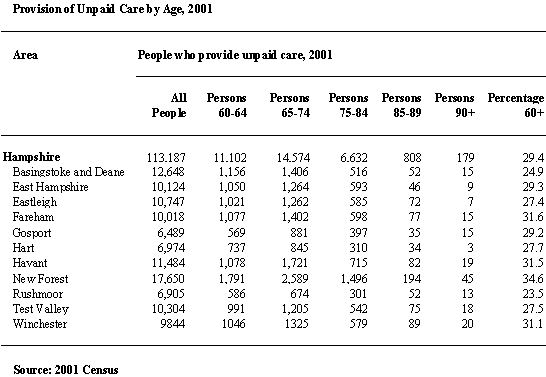
The strategy considers carers as people in their own right and reflects that carers need support in all aspects of life. The main areas of focus for the strategy are; health and social care, employment, income and equality. These are, as one would expect, similar issues to those being addressed through this strategy. The table in Appendix 6 shows the numbers of carers, over the age of 60, who provide unpaid care within each district.
The formal consultation on the draft Carers Strategy ends April 2008.
Health And Well-Being Partnership Board - The Health and Well-Being Partnership Board, will be the vehicle for delivering the health and wellbeing partnership agenda for the Local Area Agreement. It is proposed to build up the scope of the Board incrementally, beginning with areas including Supporting People, monitoring the targets of relevant Local Area Agreement indicators such as telecare, and developing Hampshire's public health agenda through the strategic needs assessment and annual reports of the Director of Public Health.
Supporting People Strategic Review of Older People Services - The Supporting People programme provides funding for housing related support in areas including hostels, supported housing and sheltered housing. At the time of writing it is reviewing all its provision for older people to ensure that the resources involved best meet the needs of older people in Hampshire.
Better Housing Options Programme - The Adult Services Department is working to extend the choice of supported accommodation available in Hampshire. This includes the development of four new build extra - care schemes that will be built over the next few years.
Self Directed Support -The Government has recently launched its plans for the future of adult social care. It emphasises a move towards self-directed support, where people who use social care services will increasingly shape and commission their own services. Work in Hampshire to progress this agenda has begun in one area and will eventually be adopted county-wide. This strategies action plans at both county and local level will feed into and support this evolving agenda and help inform the Council's Commission on Personalisation of Care Services.
10. Framework of Proposed County Priorities
Although there will be action plans for each district council area, there are some pieces of work that will affect the whole of the county.
Outlined on the proceding page are a set of proposed county priorities, under the 7 Dimensions of Independence, that the Joint Older People's Well -Being Steering Group and the Hampshire County Council Older People's Well-Being team believes will begin the process of developing actions to address some of the issues that older people have told us are important to promote their well-being. This is not a definitive list but forms a realistic beginning for work over the next 3 years.
These initial priorities cannot take into account all that older people have told us they want changed, improved or developed. They do however, form a positive beginning and an opportunity for statutory and voluntary sector organisations and older people to work together within the restraints of resources.
Under each of the county priorities a work plan will be produced, which will include agreed timescales, an assessment of the current situation and the monitoring and evaluation processes that will be used. This work will be overseen by the Joint Older People's Well-Being Steering Group.
Numerous partners will be drawn from across the county to work in partnership to deliver these priorities. These include older people, voluntary and community organisations, Police Service , Fire and Rescue Services, faith organisations, Health Service, Pension Service, District Council departments and Hampshire County Council departments (for example Adult Services, Trading Standards, Transport, IT, Recreation and Heritage, Libraries )
What older people in Hampshire say
A. Housing and home |
Proposed County priorities | |
Most often repeated issues: Access to handy -person Sufficient income to live on for heating etc Help with gardening Cleaning -at various levels Financial advice Assistance to down size in housing Telecare |
A1. A2. A3. |
Consider a variety of ways to access existing handy person and home improvement activities, including energy savings and insulation Promote information about existing gardening services. Support the development of low maintenance gardening initiatives and gardening schemes where required Promote an awareness of the tele-care appliances for independence in the home |
B. Neighbourhood |
Proposed County priorities | |
| Most often repeated issues: Feeling safe Make it easier for all ages to mix Visible policing/wardens Footpath maintenance, lighting, road crossing Older People champions in local community - village/parish |
B1. B2. B3. |
Encourage activities between the young and the old. Develop further ways to promote personal safety Promote work at local level to improve social interaction |
C. Social activities, social networks, keeping busy |
Proposed County priorities | |
| Most often repeated issues: Opportunities for young and old to mix Activities not just age based Advertising range of volunteering activities Access to social groups Access to leisure activities Cheap activities |
C1. C2. C3. C4. |
Increase the opportunity to access a variety of social activities and the co-ordination between existing resources Promote local and county accessible IT initiatives Promote initiatives to encourage volunteering Assist with the networking and support for local and county initiatives to reduce social isolation and cascade good practice |
D. Getting out and about |
Proposed County priorities | |
| Most often repeated issues Access to public transport Transport integrated Transport to hospitals Equality in tokens/bus passes Accessible transport |
D1. D2. D3. |
Advertise transport schemes in a variety of settings and formats Utilise results of current pilot feasibility study on ways to share community transport vehicles across more organisations Work with transport agencies to improve access and services. |
E. Income |
Proposed County priorities | |
| Most often repeated issues: Welfare benefits advice Fixed income Part-time work opportunities Debt/budgeting help Equity rich but cash poor Financial advice |
E1. E2. |
Co-ordinate an on -going benefits campaign across the county with the Pension Service and other agencies Explore equity release opportunities |
F. Information |
County priorities | |
| Most often repeated issues: Available in lots of different places and formats and at all levels More public awareness of what is available One stop shop Use of IT |
F1. F2. |
Develop the Older People's Well-Being website; in-order to cascade information across the county and to provide a central sign posting service Develop an older people's county forum to enable a continuous two -way dialogue to improve communications and tackle issues. |
G. Health and healthy living |
County priorities | |
| Most often repeated issues: Information in GP surgeries Diet information/advice Fresh fruit and vegetables (food coops) Walking for health Social activities Improve relationships with GP/nurse |
G1. G2. G3. G4. |
Provide well-being activities and information through GP flu clinics Promote simple and regular physical activities in a variety of settings. Promote simple and clear health and well-being messages in a variety of settings and ways. Develop a network of trained "Falls Risk Champions" within the community and voluntary sector |
11. Consultation Period
A consultation period ran from Monday 10th December 2007 - Monday 10th March 2008, for 13 weeks to ensure it complied with the One Compact for Hampshire9 and inline with the Cabinet Office Guidelines.
The consultation on this strategy welcomed feedback on which of the proposed priorities were felt to be the most important. It was agreed that future work would be prioritised on the basis of the feedback received.
12. Feedback from the Consultation
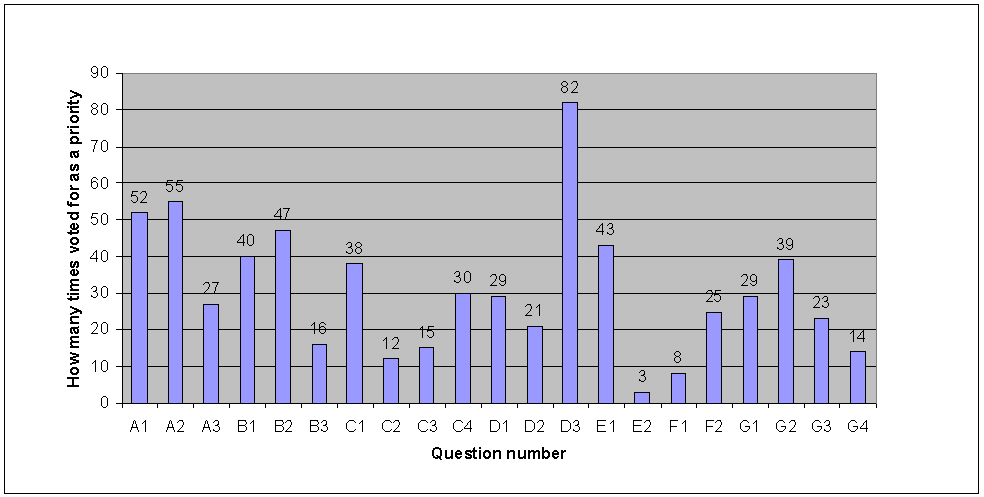
The full results of the consultation can be found in Appendices 9,10 and 11.
The proposed county priorities which received the greatest number of responses in order of priority are:-
1. Work with transport agencies to improve access and services.
2. Promote information about existing gardening services. Support the development of low maintenance gardening initiatives and gardening schemes where required
3. Consider a variety of ways to access existing handy person and home improvement activities, including energy savings and insulation
4. Develop further ways to promote personal safety
5. Co-ordinate an on -going benefits campaign across the county with the Pension Service and other agencies
6. Encourage activities between the young and the old.
7. Promote simple and regular physical activities in a variety of settings.
8. Increase the opportunity to access a variety of social activities and the co-ordination between existing resources
Each feedback form had a comments box on it. A summary of the comments received can be found in Appendix 11. These consist of a combination of individual concerns, recommendations for future actions and an explanation of why particular priorities have been chosen. The most consistent comment is the need to address isolation and loneliness for older people.
It has been acknowledged by the Joint Older People's Well-Being Steering Group that despite a wide distribution of the summary draft strategy through grass root organisations the views of isolated older people are inevitably under represented.
However, the variety and breadth of responses does ensure that the resulting work plan will be developed with a clear understanding of the main issues it must address.
13. The Resulting Work Programme
As outlined on page 4 and page 7 of this strategy the resulting work will be taken forward at two levels; the county level and the local district level. This will ensure maximum benefit is gained from being linked into existing local and county forums and strategies whilst allowing new and exciting partnerships to be forged and benefits gained.
A summary of the full strategy document will be produced by July 2008.It will be proof read with older people to ensure it is produced in a form that is easy to read and useable for the community as a whole.
The outcomes from the Equality and Diversity Impact Assessment will be absorbed into the work programme.
The county wide Joint Older People's Well-Being Steering Group will be tasked with ensuring that the County priorities become a reality and outcomes are achieved. It will also assist in ensuring the local action plans reflect older peoples changing priorities and that their outcomes are achieved
County level
The county work programme will be produced by July 2008 and structured around the 7 Dimension of Independence .This work programme will identify timescales, partner organisations, resources, monitoring and evaluation procedures . It will be a "living document", regularly reviewed and monitored to allow it to be developed and modified as circumstances and needs evolve over the three years.
It will recognise that issues cannot be addressed in isolation. Therefore priorities identified as important from the consultation feedback may be merged to make more productive use of partners working together and crucially develop more meaningful actions and outcomes.
The county work programme will be including those issues that are broad and include many partners which need to be looked at cohesively across a wider area, for example accessible transport, promoting benefits uptake.
Local Level
Each local district/borough council area will have their own local action plans. They will choose their most preferred way of producing the local action plan, always ensuring that it is linked into their key local strategies and forums. These local plans are at different stages of development around the county -some local areas have completed their action plan, others are reviewing their existing plans in the light of this strategy and some are still to be developed.
The Older People's Well-Being Team is available to work with individual local areas to facilitate this process.
The local action plans will have some of the same actions as the county one but will also crucially respond to local issues and actions that affect their local older people.
Appendix 1 - How to Define Well-Being
In the context of this strategy well-being is being defined using the Dynamic Model for Well-Being as developed by the South East Regional Public Health Group10 (see table below)
This defines well-being as:-
· Being at ease with oneself
· Having a sense of purpose, meaning and fulfilment
· Experiencing positive emotions and having the resilience to deal with life's difficulties
· Belonging to a respectful community
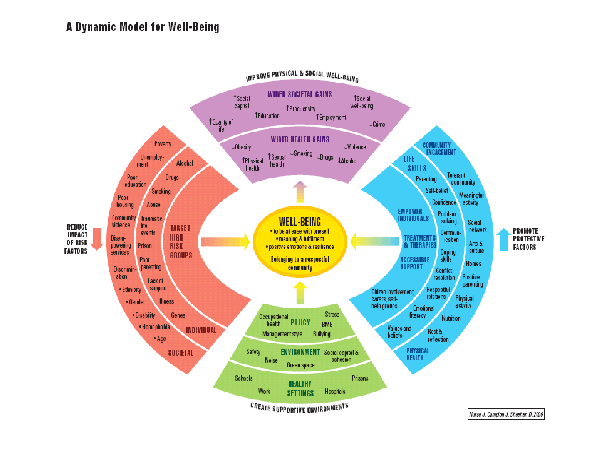
To achieve this we have to balance and counter balance the aspects of risk and support both for the individual and for the wider society they live in. An example is putting in place activities and support for the individual whilst at the same time working on the wider initiatives of access to transport and safer neighbourhoods which all play their part in improving the individual's well-being and so quality of life.
The quotes from individuals who attended the consultation workshops in September and October 2006 which appear in the opening paragraph of this strategy (see page1) reflect the same aims.
Appendix 2 - National Agenda
Government departments and national voluntary organisations and pressure groups have over the last few years produced a variety of policy documents which highlight the need to plan for an ageing population. They also recommend ways that this growing and diverse group within society can make a positive contribution to the life of their community, both nationally and locally, if their quality of life is maintained.
The National Service Framework for Older People (2001) 11 was important in laying down for the first time national standards and targets that had to be met to improve services for older people in hospitals, care homes and the community and begin to address the issues of age discrimination and dignity of care. It also significantly in Standard 8 looked at "Living well in later life" and the need for a coordinated approach to promoting healthy active life in old age and for partner organisations to work together to achieve this.
This theme of promoting "Active Ageing" is taken up in future policy documents. In 2005 The Department for Works and Pensions, produced Opportunity Age: meeting the challenges of the 21st century12 which outlined for the first time the steps to creating a coherent national framework for supporting the growing ageing population. Along with addressing income and employment it considers the need for services like adequate housing and transport to ensure older people can live active and fulfilling lives, maintain their independence and be able to make choices about the services they want. It also maintained this forward planning should begin from the age of 50 years of age. A healthy midlife contributes to achieving an active and fulfilled later life.13
The green paper Independence, wellbeing and choice (2005)14 and the following white paper Our health, our care, our say (2006)15 take forward a broader more holistic view of health and well-being. They acknowledge the need to shift towards prevention and community based care, in order to meet, in part, older peoples desire to stay independent in their own homes, for as long as possible. They also recognise the need to promote higher levels of physical activity for older people as well as more social engagement amongst secluded older people. This against a backcloth of 70% of those aged over 65 years coping with a longstanding condition.
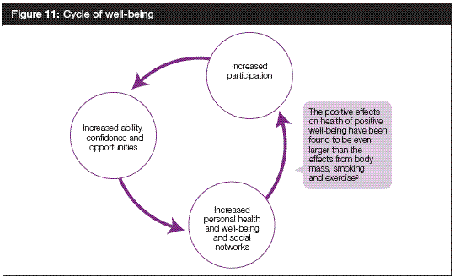
The report from the Social Exclusion Unit, Sure Start to Later Life (2006)16 draws together many of these themes and highlights the crucial link between being socially excluded and the impact on health and well-being. The requirement is for more joined up services at key times. It advocates the need to promote a "cycle of well-being" (see figure below) - through participation, leisure, education improved health and ensuring older people are valued in families, workplace and communities. The effect of this cycle of participation on an individuals health could be greater than the effect from body mass, smoking and exercise. Indeed other research reiterates this same powerful message of the therapeutic effect of social participation in improving and individual's well-being, especially mental health and quality of life.17 It is known that at any given time 15% -25% of older people are diagnosed with depression, but that as many as 1:4 are struggling alone without assistance.
The importance of prevention to well-being is also recognised. What the Joseph Rowntree Foundation refer to as "that little bit of help" 18 .Low level support and care provided at the right time can prevent a downward decline e.g. after bereavement, loss of health, experience of crime, loss of family role. There is a continuous need to stop the "cycle of decline" and bring in the "cycle of well-being".
Despite the negative effect of social isolation older people clearly want to stay for as long as possible independently in their own homes. To achieve this, with a positive quality of life, there is a responsibility to provide adequate and appropriate joined up support and services by both statutory and voluntary and community services.19. For example houses need to be well-maintained and heated. Six in ten of those over 65 years of age own their own house and so have the responsibility for looking after the fabric of the house and garden. They also spend 70- 90% of their time in their own home20.
Adequate income is also required to be able to maintain a healthy lifestyle and not to skimp on the essentials of, for example food, heating and social contact. Appendix 8 provides a table of over 60 years of age population need by district council, reflecting the variances across the county.
The wider issue of accessible transport has to be addressed. 91%of single pensioners and 53% of pensioner couples do not own a car and those of state pension age are more reliant on public transport than young people. This is exacerbated in rural areas and is given as a barrier to accessing services and also activities. In Test Valley for example a quarter of the population lives 6 kilometres from a supermarket.21
The challenge is not to see older people only as the recipients of support and services but also the provider. Volunteers are known to play a pivotal role in reducing social isolation and providing the precious "little bit of help" e.g. with gardening, shopping, befriending, information, lunch clubs, transport, a listening ear....the list goes on. However, in the recent joint report from the Older Peoples Programme (sponsored by Councils of Voluntary Services (CVS), Help the Aged and British Red Cross)22 90% of the volunteers interviewed reported an increase in their self esteem and confidence. There are reciprocal benefits. In 2005 31% of 65- 74 year olds and 21% of over 75 year olds reported being involved in regular formal volunteering.
In the same way, for some, the ability to continue in paid employment is known to have a positive effect on their physical and mental well-being; whilst providing an opportunity to save more and so be able make more informed choices.23
The numbers of older people who do participate in social, leisure and learning opportunities does decline over the age of 6024 and this n eeds to be increased to benefit their overall health. The most popular recorded exercise for older people is walking up to 2 miles a day. Research like that undertaken for "Fit as a butcher's dog"25 shows that older people are aware of the links between physical and mental health but get confused by the plethora of messages given them.
Appendix 3 - Ageing Population
National Population Trends
The demographic make up of the population of the UK is changing; with the growth in the population as a whole slowing down, the number of children and young people falling, but the proportion of older people steadily growing.
In 2007 the number of people over 65 has exceeded the number of children under 16 26.
The aspirations of older people are also changing especially with the post World War Two "baby boomers", expecting the same choice and quality of services and involvement as they always have had. In fact to continue into old age "carrying on being themselves" 27
Rural areas have a higher level of over 65 year olds nationally and this trend is expected to continue with the numbers of over 65 year olds rising 20% more than in England as a whole. The over 85 year olds will, by 2051 account for 6% of the total population.
South-East Population Trends
In the South East, 16.5% of the population is over 65 years of age - just slightly higher than the national average. It is projected that by 2020 over 40% of the population will be over 50 years of age. The number of over 65year old will also have increased by nearly 50% and those over 85 will have more than doubled in number.28
Hampshire Population Trends
In 1971 the proportion of those aged 60 years of age and over was 19%, in 2007 it is 21% and is currently set to rise to 27% by 2026. It is predicted that by 2026, close on half of the population of Hampshire will be aged 45 years and over; with the largest growth to occur in those 85 years of age and over29 It is within this age group that the probability of poor health increases with the resulting reduction in independence and higher reliance on others for care.30
The latest estimates of the present population in Hampshire are shown in the table below. It shows by district council area the spread of the over 60 population in the county. The New Forest shows the highest number of older people and by 2026 it is predicted that 60% of their population will be 45 years or over. The map in Appendix 5 visually shows the current number of over 65 years olds across the county (excluding Portsmouth and Southampton). The table in Appendix 7 shows ethnicity by district across Hampshire. This is important to understand as older people in ethnic minority groups do face greater problems of social isolation, poor health and financial difficulties than the general older people population.31
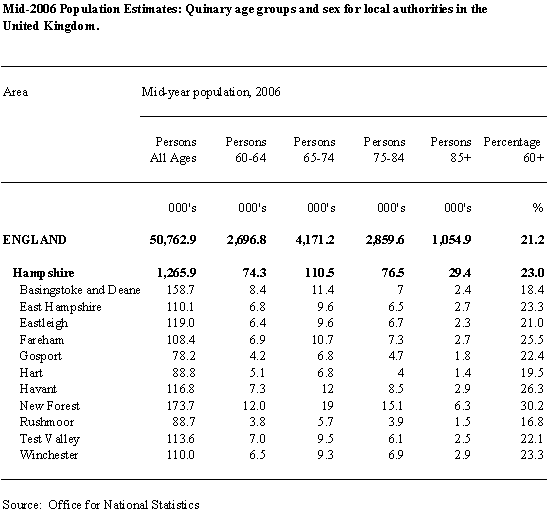
In Hampshire, the Office for National Statistics predicts that by 2008 the county's over 65s will total 223,900, by 2025 that figure will have risen to 322,300. The number of over 85s will total 31,200 in 2008, rising to 52,300 in 2025.
The table below shows Hampshire County Councils projected figures for the population growth, in Hampshire as a whole, up until 2026.
Long Term Projections for the years 2010, 2016, 2021 and 2026 for Hampshire |
||||||||
Year |
60-64 |
65-69 |
70-74 |
75-79 |
80-84 |
85+ |
Total Population | |
2010 |
81,756 |
65,731 |
53,765 |
44,821 |
34,312 |
34,672 |
1,301,861 | |
2016 |
75,276 |
79,200 |
63,235 |
49,111 |
37,747 |
40,727 |
1,320,159 | |
2021 |
82,523 |
71,518 |
74,054 |
57,406 |
41,663 |
46,757 |
1,336,671 | |
2026 |
90,437 |
78,435 |
67,475 |
67,489 |
49,121 |
54,103 |
1,355,919 | |
Source: Long Term Projections as at Oct 07, HCC |
||||||||
Appendix 5 - Hampshire County Council Over 65 Total by Ward
Appendix 6 - Table of Provision of Unpaid Care by Age, 2001
Appendix 7 - Table of Ethnicity
Ethnicity in Hampshire
Age 65+ |
White |
Mixed |
Asian |
Black |
Other |
Basingstoke |
98.9% |
0.3% |
0.4% |
0.3% |
0.1% |
East Hants |
99.5% |
0.2% |
0.2% |
0.0% |
0.1% |
Eastleigh |
99.3% |
0.1% |
0.4% |
0.1% |
0.2% |
Fareham |
99.5% |
0.1% |
0.2% |
0.1% |
0.1% |
Gosport |
99.2% |
0.3% |
0.3% |
0.0% |
0.2% |
Hart |
99.4% |
0.1% |
0.3% |
0.1% |
0.0% |
Havant |
99.6% |
0.1% |
0.1% |
0.1% |
0.1% |
New Forest |
99.7% |
0.1% |
0.1% |
0.0% |
0.0% |
Rushmoor |
98.0% |
0.4% |
0.8% |
0.2% |
0.6% |
Test Valley |
99.5% |
0.0% |
0.2% |
0.1% |
0.1% |
Winchester |
99.5% |
0.1% |
0.2% |
0.1% |
0.1% |
Total |
99.4% |
0.1% |
0.2% |
0.1% |
0.1% |
Source: 2001 Census
Appendix 8 - Table of Population Need
Population needs by area - variance from county average | |||||
|
80yrs +/pop 65+ |
People over 60 on income support/ 65+ pop |
Disability Living Allowance Claimants over 60/pop 65+ August 2006 |
Lone Pensioners/ pop 65+ |
Average |
Havant |
-7% |
26% |
45% |
0% |
16% |
Gosport |
-2% |
13% |
30% |
7% |
12% |
Rushmoor |
-1% |
13% |
5% |
17% |
9% |
Eastleigh |
-5% |
9% |
14% |
2% |
5% |
Basingstoke |
-8% |
2% |
7% |
-3% |
0% |
Test Valley |
-2% |
2% |
-7% |
-1% |
-2% |
East Hants |
1% |
3% |
-16% |
-1% |
-3% |
New Forest |
11% |
-13% |
-16% |
-3% |
-5% |
Fareham |
-3% |
-12% |
-1% |
-9% |
-6% |
Winchester |
8% |
-13% |
-31% |
5% |
-8% |
Hart |
-4% |
-30% |
-31% |
-15% |
-20% |
Source 2001 Census, Hampshire planning stats and ONS website |
|||||
Appendix 9 - Number of Responses and their Priority Number
County Proposed Priority |
Number of responses |
Priority number | |
A |
Housing and home |
||
A1 |
Consider a variety of ways to access existing handy person and home improvement activities, including energy savings and insulation |
52 |
3 |
A2 |
Promote information about existing gardening services. Support the development of low maintenance gardening initiatives and gardening schemes where required |
55 |
2 |
A3 |
Promote an awareness of the tele-care appliances for independence in the home |
27 |
11 |
B |
Neighbourhood |
||
B1 |
Encourage activities between the young and the old. |
40 |
6 |
B2 |
Develop further ways to promote personal safety |
47 |
4 |
B3 |
Promote work at local level to improve social interaction |
16 |
15 |
C |
Social activities, social networks , keeping busy |
||
C1 |
Increase the opportunity to access a variety of social activities and the co-ordination between existing resources |
38 |
8 |
C2 |
Promote local and county accessible IT initiatives |
12 |
18 |
C3 |
Promote initiatives to encourage volunteering |
15 |
16 |
C4 |
Assist with the networking and support for local and county initiatives to reduce social isolation and cascade good practice |
30 |
9 |
D |
Getting out and about |
||
D1 |
Advertise transport schemes in a variety of settings and formats |
29 |
10 |
D2 |
Utilise results of current pilot feasibility study on ways to share community transport vehicles across more organisations |
21 |
14 |
D3 |
Work with transport agencies to improve access and services. |
82 |
1 |
E |
Income |
||
E1 |
Co-ordinate an on -going benefits campaign across the county with the Pension Service and other agencies |
43 |
5 |
E2 |
Explore equity release opportunities |
3 |
20 |
F |
Information |
||
F1 |
Develop the Older People's Well-Being website; in-order to cascade information across the county and to provide a central sign posting service |
8 |
19 |
F2 |
Develop an older people's county forum to enable a continuous two -way dialogue to improve communications and tackle issues |
25 |
12 |
G |
Health and healthy living |
||
G1 |
Provide well-being activities and information through GP flu clinics |
29 |
10 |
G2 |
Promote simple and regular physical activities in a variety of settings. |
39 |
7 |
G3 |
Promote simple and clear health and well-being messages in a variety of settings and ways. |
23 |
13 |
G4 |
Develop a network of trained "Falls Risk Champions" within the community and voluntary sector |
14 |
17 |
Appendix 10 - Graph of Priority Responses
Appendix 11 - Summary of the Individual Comments in the Comments Box on the Feedback Form
Key - p = public bodies comments
V = voluntary organisation comments
I = individuals comments
General Comments
Needs of Minority groups - (v)
Services at ward level -(v)
A standard county wide reporting system/form per dimension - to measure data and outcomes (P)
Lack of local CAB - (v)
Under utilised existing services - e.g. Adult Placements (P)
Identify through action plans where are local providers who can be expanded to deliver services (v)
A post code lottery in Hampshire (v)
Each district have an older person's champion to ensure it is delivered (v)
Reduce age discrimination (i)
Health and safety important- but don't wrap us in cotton wool, like those in care, want to live normally (i)
Volunteers meeting together from across the county 2/3 times a year to collate effort (i)
Where will local leadership come from? The LSP health and wellbeing groups, HATs? (p)
No- where funding is mentioned (v)
Diagrams of how local and county groups linked together (p)
To show on action plan who will take the lead responsibility for each priority.(i)
Incorporate wellbeing and independence into mainstream healthcare (i)
Include Parish Councils (i)
1. Housing and home
More gardening like "bird in the hand" scheme in Winchester (i)
Carry out a gap analysis and develop services where required (V)
Buy houses for older people near shops and transport (i)
Checks on older people's toasters etc (i)
Help with little things e.g. getting curtains down, turning a mattress (i)
Like to see downsizing as a county priority (p)
Using existing sheltered housing stock as communal facilities for the community (p)
Need to refer to extracare housing and a range of suitable housing (p)
Help with taking rubbish from a top floor flat (i)
More social events in housing schemes (i)
2. Neighbourhood
Up keep of pavements and lighting (i)
Better seats at bus stops (i)
Retain local post offices and shops (i)
3. Social
More "provocateurs who set up self maintaining social groups (i)
Not too much interaction -want to be individuals (i)
In a village encourage older people to participate through personal contact and through "tell a friend, neighbour acquaintance" (i)
Loneliness- older people loose the ability to communicate and socialise (i)
4. Getting out and about
Cost of getting to activities and transport services being withdrawn (i)
Need a county wide not for profit transport service or "beef up" CVS/ social enterprise operators (i)
Information on how to access transport (i)
Ensure link both HCC and district transport strategies together (V)
Transport for those who cannot walk to the bus stop (i)
Consider older people as they got more frail mentally and physically (i)
5. Information
Silver surfers all year round and have "badged" centres like libraries where can access the computer (i).
Need information in written form everywhere, not just on the web. Leave in pubs, clubs etc (i)
One stop shop in each area e.g. libraries (v)
Wireless IT systems in residents rooms (i)
Pilot an "information prescription service" - topic specific information/advice sheets available on request from GP and held in libraries, social services etc (v)
Need a list of obtainable numbers, not faceless people (i)
6. Finance
Adult Services provide more help for those wanting to move to direct payments (i)
Confused by benefits available - train Community Police officer to be the "older persons champion" , as they know the older people in their patch -expansion of priority B3 (i)
Need to inform people on how to claim (v)
7. Health and Healthy Eating
Promote cooking clubs in a variety of settings (i)
Trips to Farmers markets via dial a ride (i)
GP surgeries more engaged -(V)
Exercise groups for rural areas (v )
Priority accident prevention and physical activity to prevent falls (P)
How to motivate older people to take up exercise? (i)
Appendix 12 - References
1. Age Concern England (Aug. 2007) Improving Services and Support for Older People with Mental Health Problems
2. Age Concern and Mental Health Foundation (Lee 2006) Promoting Mental Health and Well-Being in Later Life
3. Age Concern(February 2006) "As fit as a butchers' dog" -A Report on Healthy Lifestyles Choice and Older People
4. Age Concern,( October 2004), Regional Strategies and Demographic Ageing- Age Proofing Toolkit ,
5. Audit Commission/Better Government for Older People (BGOP) Older People -Independence and Well-Being, The Challenge for Public Services,(February 2004)
6. Department for Communities and Local Government (March 2006) Excluded Older People
7. Department for Communities and Local Government (2006) ,A Sure Start to Later Life: Ending Inequalities for Older People.
8. Department for Communities and Local Government (October 2006) Strong and Prosperous Communities -The Local Government white paper
9. Communities and Local Government (October 2006) Strong and Prosperous Communities -The Local Government White Paper
10. Department of Health (March 2007), Commissioning Framework for Health and Well-Being
11. Department of Health (2006 ) Our Health, Our Care, Our Say: A New Direction for Community Services
12. Department of Health, (March 2001),National Service Framework for Older People,
13. Department of Health green paper, (March 2005), Independence ,wellbeing and choice: Our Vision for the Future of Social Care for Adults in England ;
14. Hampshire County Council (October 2004) , One Compact for Hampshire
15. Hampshire County Council (2006-2009) ,Hampshire Local Are Agreement
16. Hampshire County Council (July 2007),The Demographic Future of Hampshire ,
17. Hampshire Strategic Partnership (October 2007), Quality of Life Survey
18. HM Government (2005) ,Opportunity Age: meeting the challenges of ageing in the 21st century
19. Healthcare Commission (March 2006) Living well in later life -A review of progress against the National Service Framework for Older People;
20. IDeA (2006) Turning policy into outcomes -a report on the implementation of well-being strategies summary of key messages from the Older People Action Learning Sets
21. International Longevity Centre UK ( November 2007) Towards Lifetime Neighbourhoods: Designing Sustainable Communities for All -a discussion paper ,)
22. Joseph Rowntree Foundation (2005) The Older People's Inquiry:" That bit of help"
23. LeRay Consulting Ltd (2006) Turning Policy into Outcomes - A report on the implementation of well-being strategies from the SW Action Learning Set
24. Older People's Programme (July 2006)Making a difference through volunteering: The impact of volunteers who support and care for people at home
25. Opportunity Age in Nottinghamshire (2006-2009); Ageing for the Future in Nottinghamshire
26. Public Services for Tomorrow's Older Citizens: Changing Attitudes to Ageing (2004) - from the Audit Commission, LGA (Local Government Association), ADSS (Association of Directors of Social Services), BGOP, Nuffield Institute for Health and the Joseph Rowntree Foundation
27. South East Regional Public Health Group (October 2006) Mental Health and Well-Being in the South East
28. South East Regional Public Health Group, (draft June 2007) SE Health Strategy -A Study for Improving Public Health and Well-Being in the SE Region
Published March 2008 by Hampshire County Council on behalf of the Joint Older People's Well- Being Steering Group
This leaflet is available in large print, Braille, or in other languages if required.
Please call 01962 847279 for details.