Archived decisions
Stoneham Place
Stoneham Lane
Southampton
Hampshire
SO50 9NW
United Kingdom
023 8062 8800
023 8062 8801
This document has been prepared for the titled project or named part thereof and should not be relied upon or used for any other project without an independent check being carried out as to its suitability and prior written authority of Mott MacDonald being obtained. Mott MacDonald accepts no responsibility or liability for the consequence of this document being used for a purpose other than the purposes for which it was commissioned. Any person using or relying on the document for such other purpose agrees, and will by such use or reliance be taken to confirm his agreement to indemnify Mott MacDonald for all loss or damage resulting therefrom. Mott MacDonald accepts no responsibility or liability for this document to any party other than the person by whom it was commissioned.
To the extent that this report is based on information supplied by other parties, Mott MacDonald accepts no liability for any loss or damage suffered by the client, whether contractual or tortious, stemming from any conclusions based on data supplied by parties other than Mott MacDonald and used by Mott MacDonald in preparing this report.
Rev |
Date |
Originator (Print) (Signature) |
Checker (Print) (Signature) |
Approver (Print) (Signature) |
Description |
Draft |
27 Feb. 08 |
Clive Livingstone |
Bob Wilkins |
Chris Harvey |
Draft |
A |
29th Feb 2008 |
Clive Livingstone |
Bob Wilkins |
Chris Harvey |
Draft for comment |
List of contents Page
2 Lyndhurst Position in the New Forest 2-12-1
4 Key Issues for the New Forest 4-14-1
5.1 The Lyndhurst Transport Study Report 5-15-1
5.2 Environmental Considerations 5-15-1
5.3 The New Forest National Park Authority and Statutory Environmental Bodies 5-25-2
Annex A Review Brief
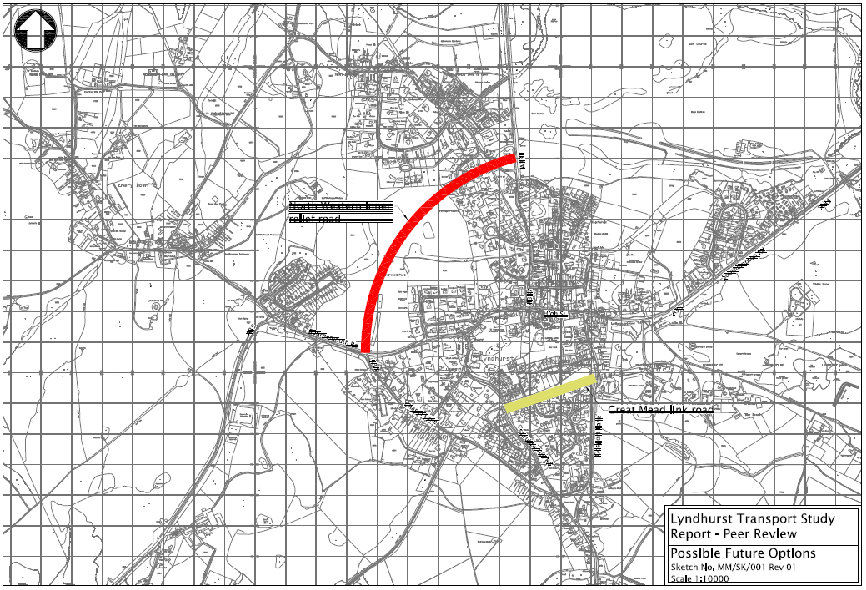
Illustration re paragraphs 3.4.1 and 3.4.2
1 Introduction
Mott MacDonald has been appointed to carry out an independent Peer Review of the Lyndhurst Transport Study Report - December 2007. In order to support the objectivity, Mott MacDonald has invited Bob Wilkins, OBE, to be part of the review team. Bob has recently retired as Director of Transport & Environment for East Sussex County Council.
The review is not a rigorous technical audit of the Study Report. It is an assessment of the methodology that has been used and the validity of the conclusions that have been reached. The brief for the review is in two parts:
· Peer Review of the Study Report, and
· Comments on the wider issues affecting Lyndhurst and the New Forest.
The review has also taken account of Hampshire County Council's Environment and Transportation Select Committee report "Report of the Lyndhurst bypass scrutiny review" (January 2008).
The full brief is included in Annex A.
2 Lyndhurst's Position in the New Forest
Lyndhurst is often referred to as the Capital of the New Forest as it is at the geographic centre of the National Park. It is also at the cross roads of its main East-West (A35) and North-South (A337) routes through the centre of the Park. These routes serve areas both within and outside the Forest, including Lyndhurst itself. They are important contributors to and drivers of the local economy. Any major changes or improvement to the transport network in and around the village are likely to have impacts well beyond the built-up area. In addition as development happens in and around the Forest, it is very likely that Lyndhurst will be affected by changing traffic demands.
The area around Lyndhurst is protected by some of the most significant environmental protection classifications in the UK and Europe. These include:
· Ramsar Site
· Special Area of Conservation (SAC)
· Site of Special Scientific Interest (SSSI)
· Site of Importance for Nature Conservation (SINC)
· Special Protection Area (SPA)
· Ancient Woodland
· Areas of Outstanding Natural Beauty (AONB)
The area including the village of Lyndhurst is within the National Park. The National Park Authority, (NPA) has specific powers and duties to protect the Park's unique environment. In addition, the Verderers of the New Forest, under the New Forest Acts, have the powers of veto over changes that affect the Park.
The level of protection that the above classifications give to this area means that if any development has an injurious environmental impact, whether direct or indirect, a case must be developed that demonstrates that there is an over-riding justification for it. This implies that the problem that the development is addressing must be unacceptable at the local, regional and national level and that all other options of addressing it have been tested and rejected for sound technical reasons. Any proposal for a bypass of Lyndhurst must be assessed on this basis if it is to have any chance of successfully completing the necessary statutory processes.
3 Review of the Report
3.1 Scope of the Lyndhurst Transport Study Report
The Lyndhurst Transport Study Report was, in the main, commissioned in response to the on-going campaign of Lyndhurst Parish Councils to alleviate congestion in the village by creating a bypass route for through traffic. That in turn is only the latest stage in a very long series of attempts over many years, most notably by Hampshire County Council, to seek and find solutions to the problems at Lyndhurst. While Lyndhurst PC had developed an outline proposal, it was important that all reasonable options were included in the assessment. If they were not, any proposal that was taken forward would fail against the test of showing that all options had been considered at the concept stage.
The amount of work that will be needed to define an individual scheme or package of measures that can be taken forward with a good prospect of being successfully taken through its statutory process is significant. This is particularly the case in an area that has the environmental restraints and protection associated with a National Park. The scope was therefore constrained to identify the options that were least damaging to the environment and had a reasonable chance of being successful at the planning stage. Further work would be required if any scheme was taken forward.
The methodology used is based on WebTAG and NATA guidance. This is guidance that has been developed by the Department of Transport. It provides a consistent approach to the assessment of highway projects. The process has been heavily influenced by the need to comply with European and national legislation on environmental issues. While this may be considered by some to be too onerous at this stage, it would be essential if any scheme were to move forward into the development stage. If this methodology had not been used, any scheme could be challenged on the basis that the options stage had not been carried out using the correct guidance. It can be virtually guaranteed that opponents to any proposal will set out to challenge process/methodology as a first line of attack. The case for following rigorously an approved methodology is therefore compelling.
The traffic data for the study was based on a cordon survey around the village of Lyndhurst. This data is very basic. It is, however, perfectly acceptable for the high level strategic assessment of bypass options envisaged in the study. If it is decided to take any of the options further, a much more detailed traffic model will need to be developed from up to date origin and destination interviews and traffic count data.
In particular, the model must be sophisticated enough to evaluate the following:
· Changes in traffic flows on all significant routes within the Park and the surrounding areas due to changes at Lyndhurst,
· Impacts of traffic management measures in and around the Park to restrain traffic growth to acceptable levels,
· Modelling that can respond to changing priorities for HGVs, private and public transport, walking and cycling, and
· Traffic data for economic assessment and business case development.
A wide range of east and west bypass options were evaluated. These included the Lyndhurst Parish Council Scheme, which was one of the outer bypass options. While there are in theory any number of possible options, we consider that a realistic view of alternative options has been taken with the exception of one further bypass option which could have been included for completeness. This is a north-western inner relief road from the A35 at the Chapel Lane area through to the A337 close to the Law Courts. This route would require compulsory purchase and demolition of a number of houses. It would, however, remove through traffic from the western High Street. It could also help to create a full northern bypass if it was built with inner route IE2 or IE1 to the east of the A337. While there are significant issues related to demolition of properties, the full northern bypass would provide the option of removing all through traffic from the High Street. This would also provide the opportunity to fully pedestrianise parts of the High Street. In any balance which has to be struck we believe that existing property should be afforded no more protection than environmentally important previously undeveloped land.
As set out in Section 3.1, the study primarily focused on bypass options in response to Lyndhurst Parish Council's wish to pursue their proposals. If it is decided to take any of the bypass proposals forward, a significant amount of work will have to be undertaken to demonstrate that non-bypass options have been fully considered and are not viable. A number of these options have been studied in section 7 of the report. The options considered in the report were traffic management changes with local junction improvements. There is one further option within the curtailage of the village that is worthy of further consideration at the strategic level. This is a previously protected corridor from Great Mead to the East. This would connect Gosport Lane to Shrubbs Hill Road. While this route is within the village, it could well provide an East-West route that removes traffic from the High Street. This could well permit pedestrianisation of a section of the High Street east of the A337.
The logic applied in the assessment follows WebTAG and NATA guidance. The conclusions that have been reached are logical based on the level of data available. It is clear that the outer bypass options, including the Lyndhurst Parish Council option, are not deliverable due to their impact on the Forest. It is also worth noting that while all inner and outer routes provided some traffic relief within the village they did not remove the majority of the traffic
The inner route through Great Mead is not a bypass route. It may, however, provide an opportunity to remove some or all of the traffic on the eastern section of the High Street. If the objective is to improve air quality in Lyndhurst without necessarily removing the traffic restraint that the village currently provides, this option is worthy of further consideration.
4 Key Issues for the New Forest
4.1 The New Forest National Park Authority
The New Forest National Park Authority is the planning authority with responsibility for both Strategic and Local Planning within the National Park area including Lyndhurst. It has wide ranging powers and Duties focussed on maintaining the quality of the whole area.
Their stated strategies include:
"To conserve and enhance the unique environment of the Forest, and in particular the special qualities of its landscape, cultural heritage and wildlife habitats."
"To support the social and economic well-being of local communities in ways which sustain the special character of the Forest."
"To encourage everyone to understand and enjoy the special qualities of the Forest, while ensuring that its character is not harmed by recreational use."
It is clear that any major development, such as a bypass of Lyndhurst, cannot go ahead without the full support of the National Park Authority (NPA). As the planning authority for Lyndhurst, it has a duty to address particular issues and problems that affect the village. It is, therefore, essential that a partnership is created with the NPA to address issues within the village.
4.2 Traffic Issues in the Forest
It is widely recognised that congestion at Lyndhurst acts as a restraint to traffic within the New Forest. The congestion, or perceived congestion, has an impact as follows:
· Overall Demand
People making decisions not to visit the Forest at peak times due to their view of traffic congestion particularly at Lyndhurst.
· Rerouting onto Non-primary Routes
Those with local knowledge of the Forest often take side roads to avoid Lyndhurst at peak times.
· Metering of Traffic
Lyndhurst can be considered as a valve that regulates flows across the Forest and through adjacent villages and settlements.(The analogy could be considered "A cork in a bottle")
Any relief of congestion in Lyndhurst will, therefore, have a wider affect on traffic within the Forest.
The New Forest National Park's Interim Management Plan recognises the impact that traffic has in the Park. Under Section 5.3 it states:
5.3.15 Wider transport proposals may well indirectly cause increased pressure on the Forest roads, for instance by making Forest routes more attractive to through traffic trying to reach major new developments of urban centres nearby. Conversely there may also be opportunities for reducing through traffic by careful transport planning at the regional level. It is therefore essential that there is co-ordinated working with the various highways authorities, regional transport planners and the Highways Agency in order to influence policies which may affect the Forest. Full integration between the various local transport strategies is also needed, particularly the Totton and Waterside Transport Strategy, to ensure the particular environmental sensitivity of the Forest is fully considered in any new proposals for these areas.
In addition, the Interim Management Plan sets out a number of proposals related to Transport. The most relevant with respect to any road improvements at Lyndhurst are:
P.5.3c Agree and put in place a clear road hierarchy which reduces the environmental impact of vehicle use in the most sensitive areas and improves the safety of non-car transport.
P.5.3d Use demand management tools to influence the pattern of vehicle use (with links to policies for managing recreation), including location and capacity of car parks, traffic calming, road closures, a quiet road network and restrictions on the use of unfenced roads by heavy commercial vehicles.
P5.3e Work closely with policy makers at the regional and local level to influence wider transport policies and proposals which may have an impact on the Forest.
It is clear that before any road improvement proposal can be taken forward within the Forest, there must be extensive discussions with the National Park Authority. It is expected that it will need to understand fully the overall impacts on the wider Forest of any improvement within Lyndhurst. We would expect these discussions to be informed by a clear understanding of changes in traffic patterns due to any road improvements or traffic management measures. In particular there must be a clear understanding of the following:
· Level of new trips if the current restraint at Lyndhurst was reduced,
· Rerouting of traffic back to the major routes due to relief of restraints at Lyndhurst, and
· Impact of traffic on adjacent villages and settlements. It is important to understand the impacts on areas such as Brockenhurst, Ashurst and Beaulieu.
It is therefore possible that the National Park Authority will not accept relief of traffic congestion at Lyndhurst without a package of measures that managed overall demand so that traffic flows were maintained at approximately the same levels as at present.
The Scrutiny Review Committee for the Lyndhurst bypass highlighted the importance of addressing air quality issues in Lyndhurst. While the bypass options would all improve air quality in the village, the report did not consider in any detail traffic management options that would primarily address air quality. It is clear that `gating' of traffic outside of the village during peak times is an option that is likely to improve air quality. This proposal would hold traffic on the approaches to the town at times of peak flow. Traffic would be released in platoons that would pass through the town in semi-free flow conditions. This would avoid long queues of idling traffic in the town and stop-start conditions which currently have a major impact on air quality. Any proposals would necessarily include appropriate signing to advise drivers why they were being held with an apparently clear road ahead. This highlights the need for a well planned and executed public participation/awareness exercise in order to carry public support.
5 Conclusions
5.1 The Lyndhurst Transport Study Report
We understand that the brief for the above report developed during the study itself. We also understand that the study was constrained by budgetary considerations. The study started life as a review of the perceived solution, i.e. Lyndhurst Parish Council's Bypass proposal. This inevitably restrained the study to consider bypass options and some traffic management solutions. As such, the study is valid and the conclusions are robust. There are a number of issues that will need further considerations before any firm proposals can be taken forward.
5.1.1 Traffic impacts on the Wider Forest
A more rigorous approach must be taken to traffic modelling. The model must be capable of providing information on the following:
· The impact of peripheral development outside the Forest,
· Traffic growth if congestion is relieved in Lyndhurst,
· Effectiveness of other traffic management proposals in and around the Forest if congestion is relieved in Lyndhurst, and
· Impacts of other management proposals that have an impact on traffic.
While this work will not be cheap, it is an essential part of understanding of the consequences of any improvements in Lyndhurst. It will therefore become a key element in the future decision making process.
The study objectives at the local level were not particularly clear and were not prioritised. If any project is to be taken forward, there must be clarity in terms of objectives and the relative importance of each element. It is clear that the Scrutiny Review considered air quality to be as equally important as traffic congestion. There are options to improve air quality that need to be developed further before any preferred option can be taken forward.
5.2 Environmental Considerations
A bypass option similar to Lyndhurst Parish Council's route was promoted in the 1980's. It failed due to its impact on the ecology and landscape of the New Forest. Since then, central government policy in relation to new roads has moved significantly. In particular policy has moved away from the principles of "predict and provide." Road building is now often seen by National Government as the option of last resort. In addition, the New Forest National Park has been established to protect the unique nature of the area. It is, therefore, difficult to believe that any bypass proposal that is similar to one that failed in the 1980's will progress even as far as the 1980's scheme.
As set out in the White Paper, The Future of Transport and Planning Policy Statement 7 there is a clear presumption against any development that affects National Parks and areas with high levels of environmental protection (ie. AONBs, SSSIs, SACs, SPAs, SINCs and Ramsar sites). If these areas are to be affected by a development it must be shown that there is an overriding national interest in the development. While the case for a bypass of Lyndhurst will be of the utmost importance to people living in the area it will be difficult to convince an Inspector at a Public Inquiry and subsequently the Secretary of State that it is of national importance.
5.3 The New Forest National Park Authority and Statutory Environmental Bodies
As the planning authority for the New Forest and Lyndhurst itself, the Park Authority will have a key role in any scheme that deals with congestion or air quality in Lyndhurst. It is difficult to believe that any project for the improvement of traffic flow in Lyndhurst can progress without the full support of the National Park Authority. We consider that a partnership approach must be developed between the County Council and the National Park Authority to address the issues in Lyndhurst and the surrounding area.
This Partnership could provide the vehicle for taking forward discussion on the best package of options for the area. Ultimately the partnership would need to find a way of drawing in views from wider interests, but the County Council and the NPA are really the major bodies with appropriate Powers and Duties to be able to address the issues. In widening the discussions it will be vital to engage with the Statutory Environmental Bodies (SEBs) including in particular the Verderers. It is quite normal for the Secretary of State for Transport to require a demonstration of this engagement as a pre-requisite of his/her continued support.
Annex A
Lyndhurst Transport Study Report - Peer Review Brief
Peer Review of the Report
The peer reviewers will review the Lyndhurst Transport Study Report. They will consider the technical content and the conclusions that have been reached. They will comment on the overall approach, methodology and status of the conclusions. They will do so with an understanding of the context set by the report of the Lyndhurst Bypass Scrutiny Review.
Wider issues affecting Lyndhurst and the New Forest
Due to the confidential nature of this review there will be no consultation with external bodies, unless separately requested by the Client. Based on their personal experience and what may be readily deduced from public positions of key influencers the reviewers will consider the wider issues that may affect any decision to take forward a bypass proposal for Lyndhurst. They may offer suggestions on the way forward for any improvements that affect Lyndhurst and the wider Forest areas.