1.0 |
Summary |
|
|
|
1.1 |
The purpose of this report is to set out the key objectives against the Strategy for the Built Estate for the 2008/09 financial year and to make proposals for the revenue maintenance, and capital repairs, which are detailed in separate reports elsewhere on the agenda. |
|
|
1.2 |
The report sets out areas of work in an annual plan for 2008/09 and beyond and actions for future reports to the panel. |
|
|
2.0 |
Recommendations: |
|
|
2.1 |
That the Buildings, Land and Procurement Panel advises the Executive Member for Policy and Resources that approval is given to: 1. Adoption of the Annual Strategy Plan for 2008/09 as set out in paragraph 4.1 2. Proposals for the Revenue and Capital financial framework for 2008/09 3. Proposals for NDS and Capital Repair Programmes 4. Further reports of the Strategic Property Review, Capital Receipts Strategy and Climate change agenda being presented to future Buildings, Land and Procurement Panel meetings
|
|
|
3.0 |
Strategy For The Built Estate. |
|
|
3.1 |
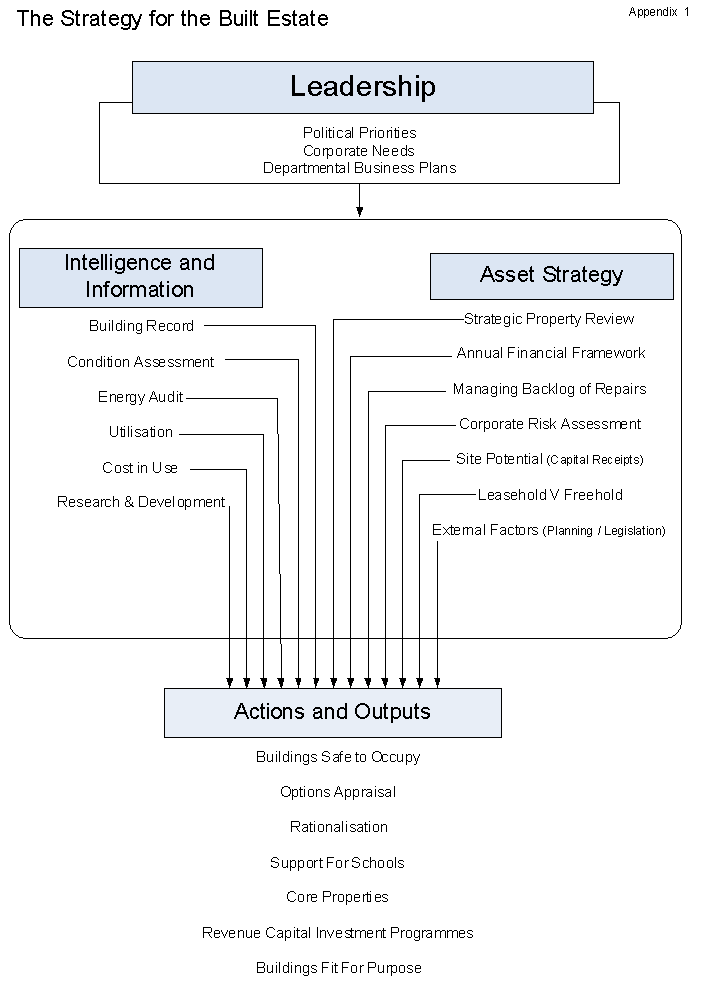
The County Council has over a number of years developed an overarching strategy for managing the built estate. Essentially the Strategy has provided a framework for making key investment decisions within the estate and to ensure buildings remain fit for purpose and safe to occupy. The estate is large, comprising some 7,000 buildings across a 1,000 sites, giving rise to a total floor area of just over 1.7 million square metres of accommodation. |
|
In summary, the key objectives of the Strategy are to: · Direct resources to the highest and most significant liabilities for core properties within the built estate. · Establish a robust Health & Safety Corporate Risk Assessment and that buildings are safe to occupy · Continue to develop long term strategies to address the backlog of repairs and maintenance liabilities. · Maximise the opportunities for planned maintenance regimes as opposed to reactive patch and mend repairs. · Ensure investment opportunities are linked to effective procurement practices that offer best value. · Ensure buildings are accessible and remain open for business · Maintain strong links with schools throughout the SLA and to ensure that schools are appointed with corporate property advice.
|
3.2 |
Managing the built estate is influenced by several factors and involves many different interactions, between internal and external stakeholders. It is therefore worth restating the main components of the overarching Strategy for the Built Estate and this is illustrated in Appendix 1. |
|
|
4.0 |
Annual Strategy Plan - 2008/09 |
|
|
4.1 |
A principle that is now well established with the Panel is to review the County Council's Strategy for the Built Estate at the start of each new financial year. The purpose of this report, therefore, is to confirm with the Panel the key objectives for managing the County Council's property assets for the year ahead in the following ten point plan. |
|
Annual Strategy Plan 2008/09 |
|
1. Confirming a financial framework with the Panel for the next twelve months and forecasting the financial climate for three years ahead. |
|
2. Managing the backlog of repairs and maintenance through the Revenue, NDS and Capital Repairs programmes.
|
|
3. Continue managing health and safety through the Corporate Risk Assessment but to manage several risks concurrently to make best use of available resources.
|
|
4. Develop opportunity for capital receipts from the County Council's land holdings, and manage a response to Government initiatives for community asset transfers
|
|
5. Developing the Strategic Property Review, particularly around office accommodation and new ways of working.
|
|
|
|
7. Procurement Strategy: To ensure best value procurement of the Landlord's capital repairs and maintenance and other capital programmes from the new Tier 1, 2 and 3 (large, medium and small enterprise) framework contracts.
|
|
8. Establish new combined term building and engineering contract arrangements for the County Council's headquarters buildings and new reactive building maintenance framework contracts for the remainder of the estate .
|
|
|
|
|
|
|
|
|
5.0 |
|
|
|
5.1 |
The reports at item 8 set out the proposed budget allocation and distribution of resources for 2007/08 and 2008/09 to 2010/11. The allocation of NDS condition funding shows a marked reduction (32%) in Government allocations between 200708 and 20010/11. This position is made more challenging because the NDS allocation is given in the form of borrowing authority as opposed to grant, which because the County Council is a "floor" authority is unable to afford to take up the full amount of borrowing authority. The DCSF has also started to claw back the additional allocation of NDS funding from last year and so it is proposed to smooth out the NDS by reprofiling part of last years additional allocation over two future years.
|
|
|
5.2 |
As with the last two financial years Government funding for schools will be via a separate grant called the Dedicated Schools Grant (DSG).
|
|
|
6.0 |
Managing the Backlog of Repairs and Maintenance Through the Revenue and Capital Repairs Investment Programmes
|
|
|
6.1 |
One of the main objectives of the Strategy for the Built Estate is to ensure buildings remain fit for purpose and safe to occupy. The Revenue budget referred to at item 10 is used to service the estate on a day to day basis, but it is the Capital Repairs programme that provides the opportunity to tackle major repairs and replacements of worn out/obsolete building and engineering components. Getting the balance of investment right between Revenue and Capital repairs in relation to the overall backlog of repairs and maintenance for the built estate is a key indicator of performance. The Panel will recall receiving a major report, "Managing The Backlog Of Repairs And Maintenance", in June 2006 which outlined the science behind this aspect of managing a large property port folio. The Panel will receive an updated report in June of this year which will start to provide a comparator of performance with the base data provided in 2006.
|
|
|
6.2 |
In the meantime a Capital Repairs programme report elsewhere on the agenda sets out the priorities for investment in the built estate in 2008/09. A central theme running through the proposed capital repairs programme is one of focusing on a smaller number of repeatable work streams that will contribute to reducing recurring maintenance costs in the future. For example SCOLA recladding and window replacement programmes create repeat work streams year on year which are now reducing the external redecorations cost by around £1,000,000 per annum.
|
|
|
6.3 |
|
|
i) A detailed report updating the panel on the backlog of repairs and maintenance will be brought to a meeting of the Panel in July.
|
7.0 |
|
|
|
7.1 |
The first Strategic Risk Register for the built estate was presented to the Panel in 1998 with the aim to reduce and manage the highest risks. Ten years on, an estimated £100 million has been invested across the built estate using the annual risk register to direct resources at the highest priorities. The investment has largely been about repair, maintenance and servicing programmes but with a specific focus on health and safety for building users.
|
|
|
7.2 |
Good progress has been achieved through focused management action and capital investment according to the rank order and published improvement agenda. Enhanced capital investment, beyond the current allocation is required to eliminate or significantly reduce risk and associated liabilities, including the chance of criminal prosecution. The annual risk review provides clear evidence that risk management is being effective in all areas and leading to positive and sustained improvement in risk handling, however it is recognised that the County Council retains significant risks and liabilities associated with the Built Estate, owing to the age profile and condition of the buildings and the engineering services. |
|
|
7.3 |
PBRS Management team has currently identified 27 strategic risks across departmental services with the highest risks associated with the Built Estate to include management of fire, fabric of buildings, asbestos, and maintenance of engineering plant. Capital resources continue to be managed to achieve the maximum strategic impact in reducing maintenance liabilities and addressing risk priorities, the detail of which is shared annually with the Panel. Performance of each strategic risk is monitored with a rigorous annual assessment to confirm actions and resources required for continuous improvement. Member recently supported a `Test and Invest' strategy, to improve use of resources, where alterative test strategies have been agreed from published industry standard, which ensure safety but provides significant funding for investment. The `Test and Invest' strategy is one of well managed risk taking and has been implemented for Electrical systems and asbestos and will be implemented across the risk register where practicable over the next few years eg testing safety valves of pressurised plant, structural inspections. |
|
|
|
|
7.4 |
The focus for risk management over the next decade will be to fully integrate risk management activity with business process across the department. This will require development of the Test and Invest strategy where integrated programmes of work will manage several risks concurrently to make best use of resources.
|
|
|
7.5 |
Action: A report will be presented to the Panel in July this year identifying detailed progress against the Corporate Risk Assessment headings.
|
|
|
8.0 |
|
|
|
8.1 |
Following the successful delivery of the extended programme of capital receipt and reinvestment projects in 2007/8 it will be important to continue this delivery into the new financial year for the major contribution which it makes to the County Council's funding and the opportunities it provides to enhance the efficiency of the use of the County Council's Property assets . By seeking planning approvals for its disposal sites in advance of their disposal the County Council has been able to consistently achieve strong land values whilst shaping the quality of the resulting development. With the increasing uncertainty in the housing market it may be necessary to review the detailed application of these policies to assist with the completion of sales on programme whilst still seeking to influence design quality
|
|
|
8.2 |
Members will be aware that the Government is keen for Local Authorities to explore the potential for enabling community empowerment through community asset transfers. It is not envisaged that there would be a wholesale transfer of such assets to community groups, but there may well be circumstances where such a transfer benefits all parties. The subject property could, for example, require major investment in terms of maintenance or conversion and the partner third sector organisation may have access to sources of funding that are not available to the County Council.
|
|
|
8.3 |
The arrangement for community asset transfers could involve either a freehold transfer or the grant of a lesser interest such as tenancy. The arrangements can be at value, involve discounted price or rent, or involve no payment. The Government has made available some funds specifically to assist community asset transfers, although they are currently very limited.
|
|
|
8.4 |
Such transfers are not new to the County Council; a variety of solutions have been pursued in the past, particularly in terms of heritage assets. There are currently eight community centres owned by the County Council and let to the Community Associations which manage the facilities. It should be noted that the initial enthusiasm from local groups is not always matched by an ongoing commitment to the proper management and maintenance of the asset, with the County Council having to step in to resolve issues that arise. Any arrangements for asset transfer will be subject to Member approval in the usual way.
|
|
|
8.5 |
Action: That a report on the implications of community property asset transfers be submitted to the July meeting of the Panel.
|
|
|
9.0 |
|
|
|
9.1 |
Members will recall that a report was presented to the Panel in February 2006 which outlined a programme for undertaking a major strategic review of the County Council's property assets. The Strategic Property Review (SPR)is now a central plank to the County Council's Strategy for the Built Estate and will influence investment decisions across the property portfolio for the rest of this decade.
|
9.2 |
Leading this new Strategy is the major refurbishment of the County Council's Ashburton Court offices, the first phase of which was occupied in January this year. This project will, on completion, enable the County Council to begin to operate its offices portfolio more efficiently and allow the release of costly leasehold accommodation. The success of the first phase occupation argues well for expansion of the principles of flexible working, and a strategy that will modernise this area of the County Council's property portfolio. The benefits to the County Council include opportunities to:
|
|
· promote and implement a new flexible working culture leading to more efficient use of space, better working practices, and improved use of the technology now available;
|
|
· divest itself of costly leasehold space, inefficient office buildings, and those with major liabilities; and
|
|
|
|
|
9.3 |
Other work streams in the SPR involve the Recreation and Heritage properties, which are currently being evaluated, and a review of Adult Services residential accommodation. Further reports in this connection will be presented to a future meeting of the Panel |
|
|
9.4 |
Action: As this work is developed future reports in connection with the SPR will be presented to the Panel. |
|
|
10.0 |
|
|
|
10.1 |
Around 75% of the functional property portfolio relates to schools. Over the past two decades, schools have, through statutory regulations, assumed significant delegated responsibilities for building and engineering matters. All revenue expenditure is delegated to schools under two funding streams; around £2.62 million under Local Management of Schools (LMS) for minor repairs and maintenance (e.g. internal redecoration, floor finishes, drain clearance etc.) and a further £8.69 million under the Fair Funding scheme of delegation for recurring maintenance (e.g. external redecoration and servicing of engineering plant etc.). The majority of schools currently return their Fair Funding allocations via a buy-back arrangement through the Repairs and Maintenance Service Level Agreement (SLA) with Property Services. The SLA currently delivers up to 35,000 servicing, repair and maintenance transactions each year. This maintains important links with schools and enables Property Services to guide the strategic investment of schools' delegated Fair Funding money.
|
|
|
10.2 |
Schools also receive further delegation via devolved capital funding from the Department for Children, Schools and Families (DCSF) for major investment identified through the Schools' Asset Management Plan (AMP). Typically, devolved capital funding amounts to over £100,000 per annum for a secondary school and up to £40,000 per year at a primary sector school. The total devolved capital to schools over the next three years is around £63 million. Property Services' SLA with schools is structured to provide support for devolved capital investment and on average delivers around 195 schools' devolved capital projects totalling some £13 million per year .
|
|
|
10.3 |
Maintaining these links with schools is an excellent opportunity to influence investment decisions in the schools estate and is a core part of the Strategy for the Built Estate.
|
|
|
10.4 |
Action: A detailed report describing the services being provided to schools and performance against the school's SLA will be presented to the Panel in the Autumn of 2008.
|
|
|
11.0 |
Procurement initiatives and New Framework Contracts for Reactive Building/Maintenance Work and New Term Engineering Contracts for the Council's Headquarters Buildings.
|
|
|
11.1 |
Achieving efficiencies through procurement remains an important goal. The Panel have received regular updates on new procurement arrangements for tier 1, 2 and 3 framework contracts, for large, medium and small scale enterprises and will continue to do so through out the year.
|
|
|
11.2 |
It is now proposed to modernise the way reactive building repairs and maintenance is organised and managed by setting up term maintenance contracts similar to that which already exists for day to day engineering servicing and breakdowns repairs. Ultimately, the next generation of term engineering and building contracts will be linked for even greater efficiency. The existing term engineering contract covering the County Council's headquarters buildings is due to expire during October this year. Work is now underway to develop a new 2 year (with an option to extend by a further 2 years) combined building and engineering term contract for these buildings in the future. The proposed contract will have an option to extend by two further years and potentially include facilities management services.
|
|
|
11.3 |
|
|
i) Regular reports updating the Panel on the use and progress for utilising the Tier 1, 2 and 3 framework contracts will be presented through out the year.
|
|
ii) A report outlining the strategy and progress for developing reactive building repairs and maintenance framework contracts will be presented to the Panel in July 2008.
|
|
|
12.0 |
|
|
|
12.1 |
At its meeting last October, the Panel was advised of work that was taking place to develop a Facilities Management (FM) work stream as part of a wider review of Support Services in the County Council. The FM work has primarily focused on the Headquarters buildings ( but potentially with a wider application in the future). The conclusion of this work is that there are three primary themes that could take the FM service to the next level of performance and would result in a better use of resources:
|
|
· Development of a more cohesive and integrated approach to the provision of "soft" FM services (storage, reprographics, reception and help desk) across all departments would result in better use of available resources.
|
|
|
|
· Development of condition based "hard" FM services for planned maintenance for building and engineering services
|
|
|
|
· Further development towards strong customer based service (cleaning, room booking and premises management/ concierge type services).
|
|
|
|
These three themes could develop into a fully integrated "hard and soft" FM model. All of the above improvements, once fully developed, will support outputs from the Strategic Property Review and future proposals for flexible working and complement the major redevelopment work for the Council's Ashburton Court offices.
|
|
|
12.2 |
It is recognised there is a need to move the FM work project forward at a pace and be robust in challenging existing arrangements in this area. It is therefore proposed to engage one of the established term engineering contractors, EMCOR who have wide scale commercial experience in integrated FM. Over the next 12 months EMCOR will work alongside in-house staff and a review performance before concluding the final model of FM provision. Such an approach is also aimed to match expectations for the completion of the major redevelopment of the Council's Ashburton offices.
|
|
|
12.3 |
Action: It is anticipated that a report outlining the progress with developing a Facilities Management Service for the County Council's headquarters building will be presented to the Panel in the Autumn of 2008.
|
|
|
13.0 |
|
|
|
13.1 |
Through its Energy White Paper and draft Climate Change Bill, the Government has declared its goal to put the UK on a path to cut CO2 emissions by at least 60% by 2050 with real progress by 2020. This is an ambitious target and this new Bill is laying the path for the Government to introduce legally binding CO2 reduction targets. Energy intensive industries already have to trade for CO2 emissions through the European Emissions Training Scheme. The Government is now proposing that large non-intensive energy users, such as the County Council, will also have to compete for CO2 emissions through a new carbon "cap and trade" scheme. The Cabinet has received a report regarding the Government's latest carbon trading proposals and further reports will be shared with the Panel in this connection later this year.
|
|
|
13.2 |
New regulations were introduced in March 2007 requiring Energy Performance Certificates (EPC) to be provided whenever a non-domestic building is constructed, sold or rented after October 2007. Public buildings over 1000m2 (of which the County Council has approximately 500) shall, by October 2008, have a Display Energy Certificate (DEC) backed by an energy advisory report containing recommendations for improvement of the energy performance of the buildings. Each DEC is valid for a period of 12 months and not only must it be prominently displayed in a public place within the building in question, it has to be registered with the Secretary of State. The advisory report associated with the DEC is valid for 7 years and it too has to be registered with the Secretary of State. It is unlikely that the above October deadline can be fully achieved as accredited energy assessors have yet to be trained and appointed to implement the new regulations. An initial estimate of the first year cost for implementing this new legislation for the County Council is up to £500,000 with annual ongoing costs of up to a £100,000.
|
|
|
13.4 |
Action: Subject to the response from the Cabinet regarding carbon trading a further report will be presented to the Panel on this matter in the summer/autumn of this year.
|
|
|
14.0 |
|
|
|
14.1 |
The annual strategic plan for 2008/09 represents an ambitious programme of development for the built estate.
|
|
|
14.2 |
The plan will set the scene for the next three to five years and will be supplemented with progress reports throughout the year ahead.
|
|
|
14.3 |
Developing the Strategic Property Review is a major focus for the Panel as will be the development of an FM service which will complement new flexible ways of working as they become introduced across the office accommodation portfolio.
|
|
|
14.4 |
Tackling climate change and meeting target reduction for energy use and carbon dioxide emissions has to be seen as a corporate priority and will occupy an increasing part of the Panel's agenda in the future.
|
The following documents discuss facts or matters on which this report, or an important part of it, is based and have been relied upon to a material extent in the preparation of this report.
1. Published works
2. Documents which disclose exempt or confidential information as defined in the Act.