
Archived decisions
Item 10
Report to the
Transport for South Hampshire Joint Committee
Date: 14 April 2008
Report by: Alison Linnell
tel: 01962 857457 email: [email protected]
Subject: Developing the Evidence Base
Purpose of the Report
Work is proceeding on assessing the transport data and analysis tools required to produce a robust evidence base for the Transport for South Hampshire strategy so that both the strategy and investment plans emanating from it will be able to secure Government support.
Recommendation
1. That the progress on assessing the transport data and analysis tools required to provide a robust evidence base for the Transport for South Hampshire strategy, so that both the strategy and schemes emanating from it can receive Government support, be approved in principle and a further report be submitted in the future.
Introduction
1. The Transport for South Hampshire strategy is being developed, its purpose being to develop a transport system which will allow the economic and development aspirations for the area to be met. It is essential that the strategy is underpinned by a robust evidence base not least because without its acceptance by Government agencies and other key partners there is little chance of investment proposals receiving the necessary approvals for funding support.
2. The evidence base needs to look at the potential to reduce demand for transport, the potential for modal shift to public transport, making the best of the existing networks and the case for investment.
3. It is necessary to be able to appraise proposed interventions individually and in combination, in a consistent and transparent way. Transport appraisal is complex and interacts at many levels with other policy areas. In its White Paper `A New Deal for Transport: Better for Everyone' (DETR, 1998) the Government set out the policy context outlining five objectives for transport schemes to achieve:
(i) integration - ensuring all decisions are taken in the context of the Government's integrated transport policy;
(ii) safety - to improve safety for all road users;
(iii) economy - supporting sustainable economic activity in appropriate locations and getting good value for money;
(iv) environmental impact - protecting the built and natural environment; and
(v) accessibility - improving access to every day facilities for those without a car and reducing community severance.
4. In addition, in 2003 the Treasury published a revised edition of its Green Book `Appraisal and Evaluation in Central Government', which is a best practice guide on carrying out appraisals. The new Green Book presents appraisals as a process beginning with the rationale for intervention, proceeding through the development of outcomes to be achieved and appraisal of a range of solutions to implementation, monitoring and evaluation. This process is well established in transport investment and, in particular, `The New Approach To Appraisal' (NATA) has recently been amended to take this approach into account.
5. The Government is just embarking on a review of its transport policies following the Eddington and Stern reports and will also be amending its appraisal methodology. The evidence base and associated models required in further developing the transport strategy for South Hampshire will need to take account of these changes so that it is compliant with future Central Government advice on appraisal, and provide a sufficiently robust evidence base to provide a convincing case for funding.
The Transport Study Process and Transport Modelling
6. The general approach that needs to be followed in developing the strategy is summarised in the chart shown below, which shows the process approach of the Green Book as applied to transport, and which is a part of published Central Government guidance.
Figure 1: The Study Process
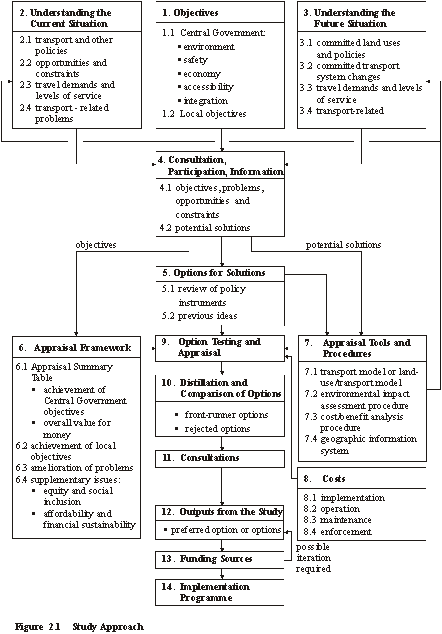
7. An essential part of this process approach is to appraise the alternative solutions generated in a consistent and transparent way, that is even-handed across modes and takes account of a wide range of effects (box 7 in figure 1). The tool for managing this aspect of appraisal is a transport modelling system that can forecast change in total travel demand and public transport patronage over time, including changes arising from alternative land-use policies and strategies. The modelling system also then needs to be able to forecast the impacts of different transport policies and strategies and also of individual transport interventions in sufficient detail.
8. Work has already been done previously in developing the Solent Strategic Model (SSM). However this model is not sufficiently detailed or sophisticated to be used to predict below sub-regional changes in demand due to different policies and strategies, nor of changes due to different land-use allocations. Similarly it cannot be used as a base for developing individual assessments for schemes, which is a pre-requisite for obtaining Government funding.
9. A client group has been set up to take the project forward towards procurement of the modelling base. The group is TfSH officers assisted by a leading independent consultant in the field (Denvil Coombe), expert advisers from the University of Southampton and Richard Powell, a local consultant who specialises in intelligent transport systems. Mr Coombe has produced an initial report on the way forward and is preparing a draft project plan for a client group meeting on 14 April. The brief is to identify the minimum cost approach to developing an evidence base that will achieve Government acceptance. He has confirmed that the existing Solent Strategic Model forms an excellent basis for the robust evidence base required by Central Government. He has also outlined a draft modelling system that would enable Government criteria to be met (Figure 2 below). Information would flow between different elements as shown.
Figure 2: An Outline Model System for South Hampshire
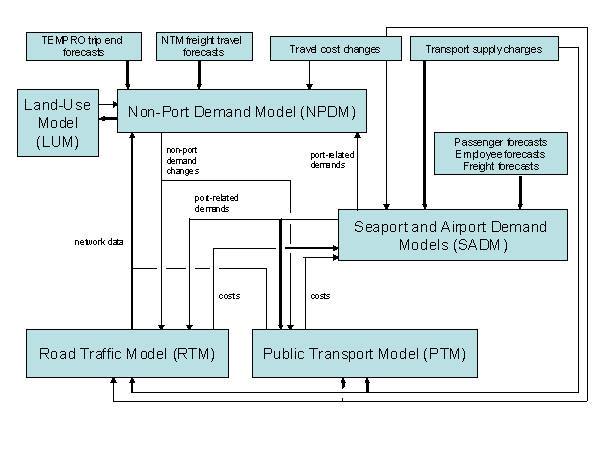
10. The existing Solent Strategic Model would form the core of the Road Traffic Model shown in Figure 2, and would contribute largely to the Public Transport Model. It would require extending geographically as well as being updated with new transport data. It will be necessary to treat transport demands for the ports and airport separately from other types of demand as these have quite different characteristics.
11. Further evaluation is now being carried out to establish the level of sophistication required in terms of the different elements and the amount of new data required, which will be substantial and a large element of the cost. Once this additional work has been completed it will be reported to the strategy group of TfSH where the national and regional Government agencies will vet the work and proposed way forward. It is essential that these partners (including GOSE, SEERA, DfT, Highways Agency and Network Rail) support the development of the evidence base. There will then be a further report to this Committee which sets out the technical requirements along with how this might be carried out, likely costs and a timetable.
Section 100 D - Local Government Act 1972 - background papers | |
The following documents disclose facts or matters on which this report, or an important part of it, is based and has been relied upon to a material extent in the preparation of this report. | |
NB the list excludes: | |
1. |
Published works. |
2. |
Documents which disclose exempt or confidential information as defined in the Act. |
TITLE |
LOCATION |
Working File |
Environment Department Transport for South Hampshire/Highways and Transport Policy Southside Offices/Sheridan House Winchester |
1620Rpt/AL