Archived decisions

Hampshire County Council Item 7a

Safe and Healthy People Select Committee

30 April 2008

Review of Accredited Community Safety Service

Report of the Acting Director of Property, Business and

Regulatory Services

Contact: Jon Whale Ext: 01962 833691 e-mail: jon.whale @hants.gov.uk

Paul Hayes Ext 01962 833694 e- mail: [email protected]

1.0

Introductory Summary

1.1

The Accredited Community Safety Service was identified in the Safe and Healthy People Select Committee work programme to monitor progress with the roll-out of the Service. In particular, the report builds on previous reports to Cabinet in November 2006 and March 2007. The views of the Committee are sought on:

· progress towards establishing county coverage of the Service since Cabinet approval in November 2006;

· recent achievements during the second phase of development of the Service (October 2006-February 2008), including:

    o the creation in 2007 of a new central team of Accredited Community Safety Officers (ACSOs) based in Winchester and covering the central area of Hampshire;

    o increased service coverage by the adoption of five Tactical Areas of Responsibility to cover the whole county;

    o the appointment of two sponsored ACSOs in Totton and of four Apprentice ACSOs, bringing total officer numbers to 49;

    o the development of formal protocol with Hampshire Constabulary in relation to the deployment of ACSOs to further enhance the already successful partnership working arrangements;

    o the introduction of the electronic recording of incidents to minimise time spent on reports and thereby maximise the time spent on patrol.

1.2

The continued development of the Service impacts on the delivery of the following Corporate Priorities:

    · Hampshire safe and more secure for all by helping to protect the vulnerable, maximising safety in the places we live, helping young people and communities to feel safe.

    · Maximising wellbeing by maintaining and improving the quality of life in local communities.

2.0

Background

2.1

Members will recall that the Community Safety Service was established in response to repeated feedback from MORI Residents Surveys and other surveys, that residents had a fear of crime and a desire for more visibility in dealing with anti-social behaviour. The Service commenced during December 2004 with officers established in four teams, covering the following `pilot' areas:

· Basingstoke & Deane Borough Council - seven officers

· Gosport Borough Council - nine officers

· Havant Borough Council - nine officers

· New Forest District Council - 11 officers (includes two officers funded by New Forest District Council (NFDC) + New Milton Town Council (NMTC)

All officers have been trained and police accredited. This has been Phase 1 of the Service.

This report builds on the report to Cabinet in March 2007. Earlier reports concluded that the Service had made a significant and visible contribution to community safety and had dealt with over 10,000 incidents during its first year. Members then agreed in principle that the Service should now proceed to Phase 2 of its development with creation of an additional team of ACSOs with the aim of greatly increased county coverage by the adoption of Tactical Areas of Responsibility (TAORs).

3.0

Progress towards County Coverage of the Service

3.1

Current staffing levels

The current staffing situation across the five teams is set out below. For the first time, these figures include the four apprentice ACSOs.

Basingstoke

Gosport

Havant

New Forest

Central Team

Vacancies

Total

Officers in post

10

9

9

14*

6

48

Current Vacancies

0

0

0

2

2

Total Vacancies

2 ·

+2

Total Establishment

8

9

9

14

8

48

* includes four ACSOs sponsored by New Forest District Council and local town councils in New Milton and Totton and Eling and two ACSOs sponsored by Hythe & Dibden Parish Council. These arrangements contribute £160,000 to the funding of the Service.

3.2

Tactical areas of responsibility

3.2.1

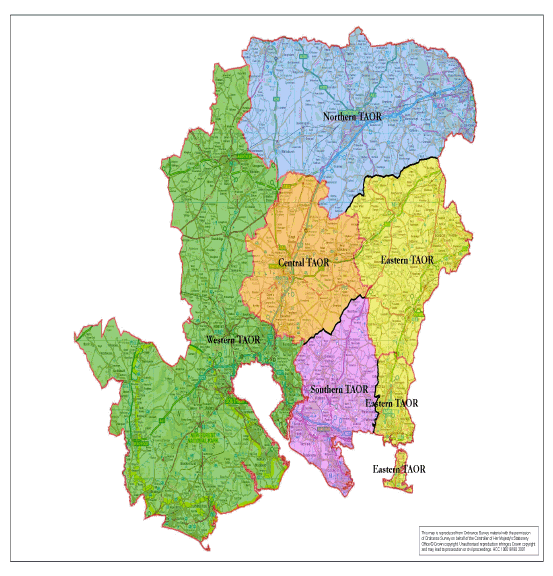
It has always been the intention that wherever possible these TAORs will facilitate partnership working by recognising district and Police Operational Command Unit (OCU) boundaries. This has proved problematic however because of the numbers involved, in that there has been no obvious way in which to divide three OCUs and 11 districts into five TAORs of a manageable size and population.

3.2.2

Detailed plans have been drawn up showing how this could operate, together with maps showing the TAORs. These are attached as Appendix 1.

3.3

Emergency communications

3.3.1

3.3.2

3.3.3

In March 2007, the Service purchased nine Airwaves handsets and training was undertaken for the ACSOs, together with colleagues in the Emergency Planning Unit, so that the system can be operated to the high standard of security required by the OFCOM licensing authority.

An evaluation of the effectiveness of the system was carried out after three months and in March 2008 a further 39 handsets were ordered to enable personal issue to all ACSOs.

Provision of these additional handsets will further improve communications with Police colleagues, including Police Community Support Officers (PCSOs), particularly in the case of high risk or urgent situations. They will also significantly enhance the County Council's ability to respond in a civil emergency when the mobile phone network is likely to be inoperative.

3.4

Apprentice ACSO role

3.4.1

3.4.2

3.4.3

These roles have now been developed and appointments made of the first four apprentice officers from over 30 applications received. Salary is in the region of £11,000, with progression by achievement during the two-year fixed contract period. These posts are, to the best of our knowledge, the first of their kind in the United Kingdom. The tasks which the apprentices can undertake have been carefully assessed, and will include joint patrols, youth and education projects, as well as some administrative duties.

Training has been identified with the GOSE funded training unit at Portsmouth, and there is no doubt that these officers will make a valuable contribution to the Service by moving us towards a position whereby young people help to "police" their own age group in our local communities.

To date, two of the apprentices have already progressed to being full ACSOs.

3.5

Protocol with Hampshire Constabulary

3.5.1

3.5.2

Progress has been made on drafting a formal protocol to facilitate the deployment of the ACSOs to maximise their impact in conjunction with the use of police resources.

The document will aim to build on the already good working relationship between the two services, as well as providing a practical guide on legal powers and tasking procedures.

3.6

Electronic recording of incidents and Crime and Disorder Information Exchange (CADDIE)

3.6.1

3.6.2

The Service currently deals with over 1,000 incidents per month. These vary from under-age drinking to youth nuisance and fly-tipping. At present a hand-written report form is completed for each type of incident. Regulatory Services have investigated the use of hand-held technology to improve this process. It has been estimated that electronic incident recording may save each officer up to 100 hours per year, thus releasing more time for patrolling.

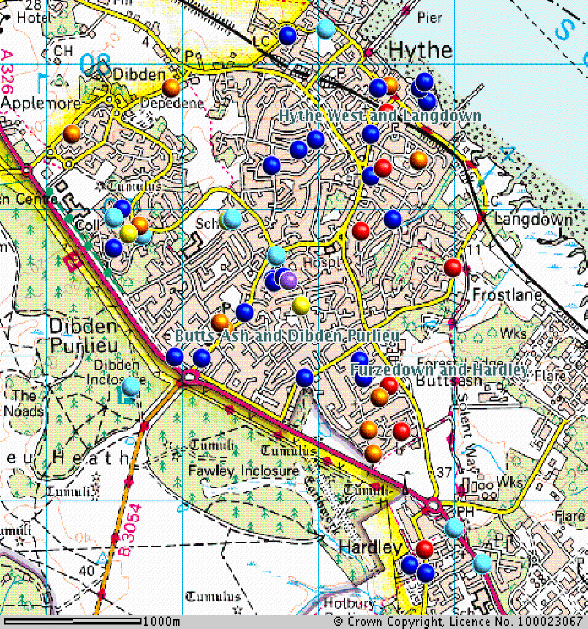
A solution has been identified using a combined Mobile Phone/PDA unit, which will record incidents in the field, calculate the exact location by means of a built-in GPS locator, and transmit the data to a secure website. The total cost will be in the region of £30,000 per annum, and is affordable within the existing budget. In addition to the efficiencies noted above, the data has significantly improved reporting times and has formed a key data set for the CADDIE database and website. In response to points raised during a recent impact assessment, the software includes information about whether the incident being recorded has any racial or equalities element. An example of ACSO data on CADDIE is set out at Appendix 2.

4.0

Achievements and developments (November 2006-February 2008)

4.1

Youth Projects

4.1.1

4.1.2

As part of the Service's dual approach of enforcement and community regeneration, teams regularly work with partners to encourage young people to get involved with local clubs, groups and sporting activities.

Where there have been identified gaps in the availability of such opportunities, we have begun to develop our own projects involving young people. Several examples are given below.

4.2

Junior Community Team

4.2.1

In May 2007 the Junior Community Team (JCT) was launched at Rowner Junior School.

4.2.2

4.2.3

The Junior Community Team comprise 15 volunteers who are in Year 6 at Rowner Junior School. They are supplied with their own uniform which includes the unique JCT logo which was designed at the launch, by a member of the team. The children participate in varied and constructive activities on three Tuesdays a month between the hours of 15.10 and 17.00. There are also sessions held in the summer holidays.

The JCT work alongside the ACSO and ACSO apprentices to help improve their local area. These community events have ranged from patrols, learning about the environment, litter picks, baking cakes for the elderly, car washing for the community, and gardening projects.

4.2.4

The main aims of the scheme are as follows:

    · To provide constructive, educational and diversionary activities for local young people that benefit the community.

    · To improve the physical environment.

    · To tackle inter-generational relationships.

    · To tackle anti-social behaviour and juvenile nuisance by encouraging young people to develop a sense of community pride in their neighbourhood.

    · To encourage good citizenship.

    · To give the children an opportunity to have an impact on issues that matter to them in their communities.

    · To create a sense of ownership of the environment in which the children live.

4.2.5

In total, 29 applications were received and 15 pupils were selected using the criteria set out in the JCT policy and procedure document. Various factors are taken into account including children who do not have access to activities, children who are showing challenging behaviour, those on the verge of being excluded from school; and children displaying low self esteem and confidence. Children were also selected, as part of the selection criteria, who would be considered to act as mentors for the group.

5.2.6

The budget for this initial stage of the project was £2,000. Following a successful evaluation, it is now being used as a model for other areas of the county, working in conjunction with colleagues in Children's Services.

5.0

Education resources for Schools

5.1

5.2

5.3

The ACSOs have always been keen to visit schools in order to speak to young people about what we do and to explain how they can help make their areas cleaner and safer. This has led to the development of a countywide resource pack so that a consistent message is delivered to all students.

This is currently being piloted, and initial feedback is positive.

Once again, we have received very good support from colleagues in Children's Services.

6.0

Performance information

6.1

The Service has a great deal of direct contact with residents, so listening to their views is crucial to the future development. Over recent months, the Service has been working with a number of local community groups and parish councils who are working with our own elected members and officers to address community issues.

6.2

The following are practical examples of the impact the Service has had:

· Alcohol -intervention in over 1,500 incidents involving the under-age consumption of alcohol. Plus co-ordinated approach with colleagues in Trading Standards Service to deal with retailers who sell alcohol to those under 18 . Coordinated delivery of advice on under age sales pack to over 900 off licences across the county

· Anti Social Behaviour:

    o court witnesses on numerous occasions to provide evidence of breaches of ASBOs

    o regular checks on people subject to evening and weekend curfew orders

    o helped eradicate almost nightly anti-social behaviour in different parts of the county

    o Submitted juvenile nuisance reports on 135+ individuals to Hampshire Constabulary for incidents ranging from anti-social behaviour to breaches of ASBOs or ABCs

    o CCTV on the vans has provided back-up evidence and greatly helps in deterring offending behaviour.

· Close Working with the Police:

    o assisted with various incidents

    o agreement with Hampshire Constabulary to adopt Airwaves radio system for ACSO's during 2007/08

    o helped to run SAFE discos for young people, thus releasing police time for more serious matters.

· Untaxed Vehicles - reported over 3,300 untaxed vehicles to the DVLA, worth an estimated £280,000 in annual duty revenue.

· Working with District, Town and Parish Council Partners - taken part in Crime Reduction and Environment Weeks (CREW). This is a multi-agency initiative designed to focus on specific localities to reduce all levels of crime. Joint tasking arrangements with local authority anti-social behaviour teams to maximise resources. Close working over key local issues such as littering, fly tipping and cycling on pavements.

7.0

Conclusion

7.1

The Service has provided the County Council with a direct means of influencing the community's perception of Hampshire as a safer place to live and work.

7.2

The Service is formalising its partnership working arrangements as it expands its coverage across the county, including the protocol with Hampshire Constabulary and Service Level Agreements with partners who sponsor officers.

7.3

The Service continues to be in demand from Members, community groups and others and is developing more efficient systems for service delivery as it seeks to cope with increasing demands.

LINK(S) TO CORPORATE STRATEGY

Yes

No

Hampshire safer and more secure for all

_

Maximising well-being

_

Enhancing our quality of place

_

This proposal does not link to the Corporate Strategy but, nevertheless, requires a decision because:

Section 100 D - Local Government Act 1972 - background papers

The following documents disclose facts or matters on which this report, or an important part of it, is based and has been relied upon to a material extent in the preparation of this report.

NB the list excludes:

1 Published works

2 Documents which disclose exempt or confidential information as defined in the Act.

      Title Location

      Architect's plans PMIS file

    Building Profile Reports TM

Appendix 1 Performance Data

Summary of Incidents from December 2004 to May 2007-Paper Records


TAOR

Northern

Southern

Eastern

Western

Central (From 12 Jan 2007

Total

Abandoned cars

114

152

195

73

3

537

Fly Tipping

1023

650

1016

525

30

3244

Litter

78

69

186

165

8

506

Abandoned Trolleys

208

82

535

151

12

988

Dog Fouling

8

15

14

14

0

51

Graffiti

113

106

67

303

26

615

Alcohol

119

161

344

452

53

1129

Alcohol Confiiscations

0

75

99

0

0

174

Intimidation/bullying

17

81

73

63

1

235

Vandalism

183

166

117

400

10

876

Arson

53

39

36

97

7

232

Drugs Related

39

66

15

72

6

198

Nuisance Behaviour

226

653

454

286

31

1650

Untaxed Vehicles

452

807

1442

508

93

3302

Cycling Pavement

8

1414

663

16

6

2107

Yellow Card

94

276

338

272

55

1035

FPN Issued

2

111

42

18

5

178

Totals

3217

5663

6324

4515

445

20164

Latest Incidents June 2007 to November 2007 via PDA's


Northern

Southern

Eastern

Western

Central

Total

Vandalism

27

26

20

196

14

283

Graffiti

8

22

37

94

49

210

Arson

8

2

4

18

5

37

Intimidtion/Bullying

8

3

20

14

2

47

Abandoned Cars

18

24

14

34

6

96

Untaxed Vehicles

28

75

92

75

88

358

Fly Tipping

110

112

69

449

43

783

Litter

13

16

32

62

9

132

Nusiance behaviour

17

21

34

83

4

159

Lighting

6

5

10

107

7

135

Pavement/Roads

5

1

13

111

17

147

Noise

1

4

0

7

2

14

Alcohol Confiscation

10

39

37

57

49

192

Crime

4

3

11

11


29

Abandoned Trolley

19

9

31

60

8

127

Dog Fouling


1

1

1

15

18

Theft


1

3

7

4

15

Cycling on Footpath

1

77

61

27

4

170

Drugs related

8

5

4

11

7

35

Other

24

23

34

249

40

370

Totals

315

469

527

1673

373

315

6 MONTHLY TOTAL:


2578

Appendix 2 Tactical Areas of Responsibility Plans
Appendix 3

Example of ACSO Data on CADDIE