Archived decisions
Hampshire County Council | |||
Pension Fund Panel |
Item | ||
23 May 2008 |
|||
Views on widening the selection of investments | |||
Report of the Investment Adviser | |||
Contact: Harvey Cole, (01962) 865930
1 Introduction
1.1 In this report, I set out my views on a number of ideas for widening the selection of types of investment available to pension funds which have been developed and promoted by fund managers in recent months.
1.2 These include:
· Commodities
· Currency
· Structured Products
· Specialist Global or Emerging Market equity funds
· 130/30 funds.
1.3 Since the autumn, I have attended several presentations on these products by fund managers, and a number of seminars, and have been able to take into account other views and opinions, as well as my own.
1.4 I shall deal briefly with the first three of these, and then at greater length the final two.
2 Recommendation
That the independent adviser's comments be used as background to the discussions of the Panel.
3 Commodities
3.1 The surge in prices of commodities of every kind in the past year or so, from oil and industrial materials to foodstuffs, has led to a proliferation of suggested ways for funds to invest in this sector as a new asset class, with a claimed high degree of non-correlation with others.
3.2 Money can be put into commodities in a number of ways. They can be held, either directly, or in the form of futures contracts; through acquiring shares of companies engaged in producing or trading them or through specialist funds set up to track price movements in the markets.
3.3 Commodities tend to be highly volatile, with prices rising and falling further and faster than can be directly explained by trends in national or international economies. This is mainly due to the inability to make swift adjustments to output so as to reflect the rise and fall in demand. Increasing production and capacity can lag behind rising demand, and stocks can accumulate rapidly when the market contracts. Nevertheless, over the medium- to long-term there is a correlation between commodity trends and the broad economy.
3.4 In practice, pension funds tend to have appreciable exposure to commodities through shareholdings in companies active in the field or mine - although opportunities tend to be confined to larger companies, and minerals are more strongly represented than food.
3.5 Investments in foreign countries, particularly the emerging markets, are also affected by trends in the materials which play a large role in the local economy, even if the holding is in a sector not itself involved in producing or trading materials.
3.6 Given the volatile price behaviour of commodities, the creation of a special asset class - and it would probably not be effective in terms of the close attention needed in this form of investment to allocate less than £100 million to it - it would seem advisable to undertake a more detailed analysis of the Fund's existing overall exposure to commodities before considering setting up a new asset class. In any event, any investment should be structured to minimise risk by means of hedging positions in the market - which would itself of course tend to reduce the level of outperformance that might be hoped for.
4 Currency
4.1 There are two options here. The Fund could invest in an actively managed operation which aims to earn steady profits by exploiting shifts and anomalies in the market rates for various currencies - including interest rate differentials. This is distinct from taking up simply speculative positions which would not seem appropriate for a pension fund in any event.
4.2 Secondly, currency operations could be used to hedge against risks and exposures arising from the Fund's existing investments and commitments to future funding of commitments already entered into. In fact, portfolio managers have in the past already been authorised to undertake a limited amount of such hedging activity in offsetting the currency risk to holdings of foreign shares, e.g., in Japan.
4.3 With increasing exposure to currency risk, particularly the US$ and the Euro, mainly from the steadily increasing commitments to private equity opportunities in the alternative assets portfolio, it would be sensible to have some hedges in place against the possibility of an adverse movement in exchange rates between the time when a commitment is entered into and when the money has to be paid out. Recent upheavals in markets mean that the interval is very likely to widen in the next few years.
4.4 If the alternative asset allocation continues to rise with the size of the Fund as a result of maintaining its 10 per cent share, we could be looking at raising around £200 million - predominantly in dollars - over the next five or six years. Hedging contracts would eliminate the risk of loss on the exchanges - while also, of course, ruling out any windfall profit.
4.5 I would suggest that advice on how best to tailor the expected outflow of cash to the prospective timescale be taken from Rathbones, but that currency should not become a separate asset class. (It is probably not worth making an allocation within the special asset class itself, although an occasional one-off investment to take up special opportunity should not be ruled out).
5 Structured products
5.1 These can be extremely complex but, in essentials, can be used to fine-tune an invested portfolio to reflect more closely the specific requirements of the Fund itself, for example, to secure a closer balance between future inflows and outflows.
5.2 Thus, by making use of so-called `swaps' the pattern of interest payments receivable on a bond portfolio can be adjusted - swapping, in effect, bonds of a particular coupon or redemption date with other parties.
5.3 A variety of other adjustments can be made and incorporated into what is in effect a tailor-made package. Alternatively, an existing fund, or combination of funds, can be used to produce a suitable result.
5.4 This again should be seen as a route to improved efficiency rather than as an opening to a separate asset allocation with risks and rewards of its own. Rathbones should be in a position to advise on a suitable `wrapper' for our particular circumstances.
6 130/30
6.1 This is undoubtedly the flavour of recent months. The concept is basically simple. It is to provide fund managers with the ability to take short positions within what remains basically a long-only portfolio.
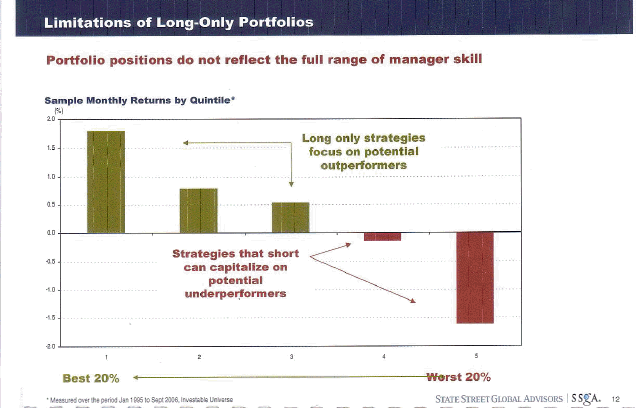
6.2 A conventional equity fund, operating against a benchmark related to a market index, can only benefit from weakness in a particular share by not holding it - or by being underweight in it. This explains the initially baffling way in which managers report positive contributions to their results from shares that they have not held. Avoiding losers in this way helps performance against a benchmark that includes them, but does not help produce positive returns.
6.3 In addition, even the scope for improving results against a benchmark is limited in practice. Of the 669 shares in the FTSE All-Share, only 33 have an individual weighting (out of 100) of more than 0.5, so that `successfully' omitting hundreds of the smallest 636 will not greatly affect the outcome.
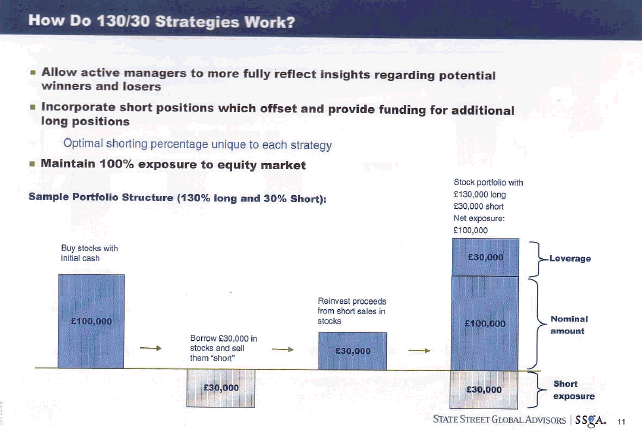
6.4 I append two pages from a recent presentation by State Street Global Advisers which illustrates how 130/30 overcomes this limitation.
6.5 The essence of the process is, first, to borrow 30 per cent of the portfolio value in stocks thought to be overvalued and then sell them short. The proceeds are then invested in adding to the long portfolio, which, as the name suggests, is then composed of 130 per cent long holdings and 30 per cent short.
6.6 The theory is that returns should be improved by the ability to secure profits from the short sales as well as from the enhanced long holdings. A variety of (still largely theoretical) studies appear to show that, on a number of projections of assumed trends in equity markets, a 130/30 should come out ahead.
6.7 I have a number of reservations about this, and it seems that they are increasingly shared.
6.8 There are certainly more opportunities to pick winners if some shares that decline can be included in the success. But, equally, there are more chances of getting individual choices wrong.
6.9 Secondly, the skills needed to select losers are different from those for picking winners, and many successful long traders do not seem to possess them.
6.10 Another important consideration is that the `holding period' for an investment on the short side is less than for a purchase. Shares can normally be borrowed for a limited time, and fees increase if that time is extended. It follows that the short side has to be relatively more active than its share of the overall portfolio implies. In turn that increases transaction costs. There will also usually be no dividend income on the borrowed shares. In any event, income on the borrowed shares will be less than the interest on the borrowing.
6.11 Most important, however, is the extra risk inherent in any short sale. A purchase can, at worst, only lose you 100 per cent of the investment. The loss on a short sale is, in theory, unlimited and, once a share more than doubles your loss begins to exceed 100 per cent. In turn that means that whereas a falling purchase accounts for a smaller proportion of the total portfolio, a short sale heading the wrong way bulks ever larger. Finally, there is the danger of being caught in a `bear squeeze' if a share becomes oversold as a result of speculation against it. This is worse than a temporary sharp fall in a share it is intended to hold for the long run.
6.12 At the moment, running a 130/30 portfolio means placing money with specialist managers, whose fees tend to be higher than those of long-only firms. Research shows that about 70 per cent of those funds participating in 130/30 finance it by reducing their other equity allocation. It follows that an appreciable degree of out performance is required to produce any net improvement in overall returns.
6.13 Recently some analysis of the performance of a number of leading 130/30 funds has been published. By and large, a period of relatively weak equity markets might be expected to provide a positive background for this type of investment, as successful shorting opportunities would be more numerous (incidentally, having to maintain a more or less steady 30 per cent short position appears potentially unfavourable when markets are advancing steadily, for the opposite reason.)
6.14 While six of the seven funds for which results have been analysed started off making small gains in their first few weeks, after starting up last autumn, they all fell sharply in the first quarter of 2008. Although some improvement has occurred since then, none is yet in positive territory, even before allowing for fees.
6.15 Although the future of 130/30 will be worth following, my conclusion is that while the jury is still out, it would be premature to get in.
7 Emerging markets
7.1 Several leading fund managers are promoting the virtues of a specific equity allocation to shares in the so-called emerging market sector within global portfolios. To go down this path would mean in effect extracting existing holdings from the portfolios of our global equity managers and creating a new asset class with, presumably a new and additional manager. (The alternative of building a portfolio up out of cashflow would not generate a critical mass of money and, in any case, would simply introduce an element of overlap with current holdings).
7.2 It is important to clarify what is meant in practice by investment in emerging markets. The normal interpretation would be that it relates to holdings of shares in companies quoted on the stock markets of the 25 countries included in the MSCI Emerging Markets index.
7.3 On the basis the managers of our three global equity mandates held, as at 31 March, £173.5 million in emerging markets, out of combined portfolios of £1,026.7 million, or just under 17 per cent. On the face of it, that appears a reasonable proportion, although none of the three had any holdings in 12 of the 25 countries and four countries had attracted only one of the three.
7.4 It also has to be remembered that there is an appreciable investment in the economies of the emerging nations indirectly, through shares of companies quoted on other markets - notably London and New York - whose business is largely carried out in emerging countries, notably oil, minerals and finance.
7.5 It is the case that our existing holdings of emerging nations' own companies tend to be mainly in larger concerns, and it may be that a specialist fund would come up with better performing business in terms of future growth prospects.
7.6 Having said that, I note that in Appendix 1 to Item 11 on the agenda for the meeting on 2 May 2008, the extent of diversification in our current global portfolios is very substantial. Of the top 30 combined holdings, only E.On is held by more than one manager. Only four of the top 30 (all held by Aberdeen) are quoted on emerging markets, but the pattern appears to be more diffused as the size of holding diminishes.
7.7 This is in sharp contrast to the situation with UK equities. Here the top 30 holdings are made up of only 21 different companies, 3 being held by all three managers and a further 9 by two of them.
7.8 Even more surprisingly, 7 out of the 10 largest holdings in SGAM's high performance portfolio are also in the top 10 of one or both of the low risk managers.
7.9 Of the 21 shares in the combined top 10's, eleven had an appreciable presence in the emerging nations (as I pointed out at the last meeting, 18 of the FTSE 100 shares, representing a third of its total market value, are producers of oil or minerals most of them operating in the 25 MSCI EM countries).
7.10 I conclude that our overall involvement in emerging markets is at least adequate, although there may be scope for focussing it more precisely.
Section 100 D - Local Government Act 1972 - background documents
The following documents discuss facts or matters on which this report, or an important part of it, is based and have been relied upon to a material extent in the preparation of this report.
NB: The list excludes:
1 |
Published works |
2 |
Documents which disclose exempt or confidential information as defined in the Act. |
None
Appendix A