
Archived decisions
Hampshire County Council Executive Member for Adult Social Care Item 2 30 May 2008 Hampshire Carers' Strategy Report of the Director of Adult Services |
Contact: Maria Milton 01962 847268 [email protected]
1. Summary
The following decisions are sought:
a) That the Executive Member receives and accepts the outcome of the consultation.
b) That the Executive Member approves the Hampshire Carers' Strategy and agrees the action plan.
c) That the Executive Member is advised of progress in 12 months.
2. Reason
2.1 There is a high level of demand for information and support for carers in Hampshire.
2.2 Additional demand for carers' support and information services is anticipated over the coming years due to demographic changes including growth in the local population and an increase in people being cared for at home and in the community.
2.3 Working together across health and social care services and wider communities will provide a more effective and coordinated response to carers' needs, support carers in their caring roles and their inclusion in society.
2.4 The Hampshire Carers' Strategy provides a policy, public action and commissioning framework. It identifies key priorities to support carers and improved partnership action over the next two years.
2.5 The Strategy will incorporate findings from the Commission on Personalisation related to carers and their role.
3. Conflicts of Interest declared by the decision maker or other Executive member consulted - none
4. Dispensation granted by the Standards Committee - none
5. Reason(s) for the matter being dealt with if urgent - not applicable
Approved by: ....................................... Date: .................................
Councillor Felicity Hindson
Executive Member for Adult Social Care
Contact: Maria Milton 01962 847268 [email protected]
Hampshire County Council Executive Member for Adult Social Care Item 2 May 30 2008 Hampshire Carers' Strategy Report of the Director of Adult Services |
1. Summary
1.1 For the last year, a range of community stakeholders have led the work on the development of a Carers' Strategy for Hampshire.
1.2 Stakeholders decided that the Strategy would benefit from a formal consultation process supported by Adult Services. In line with good practice set out in the Hampshire Compact Agreement, the draft Strategy was subject to a formal 12-week consultation period, between January 28 2008 and April 23 2008.
1.3 This report updates the Executive Member on the response to the consultation, seeks Executive Member approval of the final document and outlines the approach to be taken when implementing the Strategy. Further more detailed implementation plans will be produced following final agreement of the Strategy.
1.4 The consultation reinforced the direction of the Strategy and the key strategic priorities identified
· Availability of information
· Availability and access to respite and breaks services
· The role of Carers' Assessments
· The importance of support services
· The importance of organisations and individuals working together towards shared goals
1.5 Having taken into account all responses throughout the consultation and engagement process, it is therefore proposed that the draft Strategy be approved. A summary of the Equalities Impact Assessment is attached at Appendix 1. A report on the formal consultation is attached at Appendix 2. The Strategy is attached at Appendix 3.
1.6 The Strategy must be implemented within the envelope of resources available, and any decisions around disinvestment and reinvestment will be examined as separate but linked business cases.
2. Recommendations:
The following decisions are sought:
a) That the Executive Member receives and accepts the outcome of the consultation.
b) That the Executive Member approves the Hampshire Carers' Strategy and agrees the action plan.
c) That the Executive Member is advised of progress in 12 months.
3. Definitions
3.1 The word `carer' refers to people of all ages who provide unpaid care to a relative, friend or neighbour who is in need of support because of mental or physical illness, age or disability. It does not include people who volunteer or paid workers; they should be referred to as `care workers'.
4. Contextual information
4.1 It is estimated that there are between 113,835 to 126,000 carers in Hampshire with approximately 19,808 carers providing over 50 hours of unpaid care per week. Caring duties range from helping with shopping to giving 24 hour care. Of all carers, it is reported that 58% are women and 42% are men (National Census Data).
4.2 Increasing demand is being placed upon the caring role and an increase in demand for support and services is anticipated over the coming years due to demographic changes.
4.3 Services need to be aligned and coordinated across health, social care and voluntary sector systems in order to improve support to carers.
4.4 The development of this Strategy has been community-led through:
· The establishment of a multi-agency Stakeholder Group
· The establishment of a multi-agency Steering Group
· A consultation exercise undertaken by Carers Together in Hampshire. More than 200 carers contributed views to the first draft from 4 consultation events
· A formal, public 12-week consultation on the draft Strategy
5. The Strategy provides:
5.1 A commissioning framework for the County Council for carers' services that delivers:
· Clear, agreed statements of commissioning intentions
· A modernisation programme for all providers
· Agreed priorities for policy and action to effect change
5.2 A robust analysis of carers' needs to inform commissioning.
5.3 A whole system focus for improvement.
5.4 Cohesion with other related health and social care commissioning strategies, e.g. older people's mental health, learning disabilities and care at the end of life.
6 The overarching commissioning aims of the Strategy are:
6.1 To secure information, services and support for carers of all ages which address locally agreed priorities.
6.2 To secure services which are flexible and able to change in line with people's unique
circumstances, enabling independence and choice.
6.3 To secure equitable access to services and support across Hampshire based on
individual and population needs.
7. Hampshire County Council Adult Services' commissioning intentions:
7.1 Information and support interventions which provide identified, clear outcomes for carers linked to central contact points, for example, Hantsdirect.
7.2 An integrated service between carers of all ages that is responsive and enables choice for individuals.
7.3 A map of the total resources currently invested in carers in Hampshire, including, for example, voluntary sector services. This will identify the total resource available to support a modernisation programme, showing where there is any duplication or deficits and enabling maximisation of resources. Some services are overtly specialist though additional support is provided within a broader range of groups and organisations.
7.4 Providers to undertake modernisation programmes to deliver outcome-focused services that implement local priorities. This will involve review and/or redesign of:
· Current specialist and generic provision
· Adult and Children's Services interfaces, supporting young carers
· The balance between specialist services and access to community based and universal well-being services
8. Commissioning Approach:
8.1 We will focus on specialist and community based services. Investment plans will be balanced with disinvestment plans to demonstrate affordability within the available resources and the links between business cases will be demonstrated.
8.2 Where redesign of services is required, this will be subject to the usual scrutiny and public consultation processes.
8.3 Service level agreements will be agreed that set out the modernisation programme with identified outcomes and standards.
8.4 We will consider the implications of this Strategy for market management and will continue to proactively engage with all partners within the market.
8.5 We will learn from the outcomes and recommendations of the Commission on Personalisation and incorporate findings within our commissioning framework.
9. Consultation
9.1 In line with good practice set out in the Hampshire Compact Agreement, the draft Strategy was subject to a formal 12 week consultation period, between January 28 2008 and April 23 2008.
9.2 Responses to the consultation largely support the proposals outlined, specific concern was expressed regarding:
· The ability to deliver the priority actions identified and the level of resource available to support implementation
The community-led stakeholder group will lead on the implementation of the Strategy, this group will continue to be resourced by all partners.
The Adult Services Department has established an internal working group across the Department to progress Strategy outcomes and has re-developed three community staff posts to assist in the delivery of the Strategy at a local level.
A detailed implementation plan will be developed and regular updates from the implementation group will be disseminated by all partners through established networks.
· The availability and accessibility of services that can support carers to take a break
The Strategy signals the commissioning intentions to improve carers' support.
Partners are developing a range of support interventions and carers' support is being co-ordinated with community and well being services.
The new emergency respite care service will be operational in May 2008, further plans will be taken forward through the Carers' Reference Group including rapid respite services for carers caring for someone at the end of life.
· The role of the Carers' Assessment and the extent to which this may be affected by the roll-out of self directed support
The internal Adult Services Group is developing updated care management guidance regarding carers and the assessment process.
Business processes are being updated to support care managers.
Packages of support for carers are being reviewed - this also coinciding with the developments in self directed support.
9.3 The consultation reinforced the direction of the Strategy, in particular the key strategic priorities identified.
9.4 The Strategy will be further refined during implementation.
9.5 A range of individual responses were received, a relatively high number from carers of people with Adult Mental Health and Older Persons Mental Health. Both specialist and generic carers' support services are targeted for improvement.
9.6 An additional positive outcome of the consultation is that approximately 10% of respondents identified that they were not in contact with support or information services previously. They have been enabled to access services as a result of this process.
9.7 A report of comments received is attached in Appendix 2 and will be available on the consultation website from the end of May.
10. Approach to Implementation
10.1 The first-year action plan has been refreshed to reflect feedback from carers (Hampshire Carers' Strategy Appendix 6.1).
10.2 Further work will be undertaken to secure a wider-based partnership to ensure effective implementation. Links will be established with other partners including those from health and District Councils.
11. Governance and leadership
11.1 The community-led Steering Group that developed the Strategy has agreed to act as an implementation and monitoring group which will oversee delivery of strategic priorities against agreed project plans. This Group will report back to the Assistant Director (Commissioning and Partnerships) from Hampshire Adult Services.
11.2 A Carers' Reference Group has been established within Adult Services to deliver the improvements identified within the Department. Officers from across the Department and from Children's Services are represented.
11.3 The three Carers' Support Worker posts based within each Adult Services Area will be developed to underpin the roll-out of the Strategy. The posts will act as a specialist resource for the teams within the areas and will ensure delivery of key outcomes.
11.4 The current networks of Carers' Support Workers will be developed across care group boundaries to support implementation and encourage consistent approach.
11.5 All partners are keen to ensure that the high degree of engagement of stakeholders achieved in Strategy development thus far is continued during the implementation phase and ensuring continued representation in the governance arrangements.
12. Equalities Impact Assessment
12.1 The initial Equalities Impact Assessment undertaken as part of the Strategy development was expanded following the consultation process when further information regarding any unintended consequences or implementation issues was considered. A summary of the Equalities Impact Assessment is attached, Appendix 1.
12.2 It is reported that carers from all communities and backgrounds experience social exclusion.
12.3 Generally, access to services for black and minority ethnic carers remains a challenge. Barriers include issues of language, knowledge of what services are available, and the attitudes and practices of service providers, as well as cultural factors in the perception and understanding of a caring role. Community Development Workers have begun to address issues within communities and further work is planned as a priority to enable black and minority ethnic carers to access appropriate and responsive services.
12.4 During the consultation process, no concerns on the Strategy were expressed regarding the specific issues faced by black and minority ethnic carers and the proposed action for improvement. One respondent reported that they felt that this Strategy had the potential to improve the situation of carers from black and minority ethnic communities.
12.5 Concerns were expressed regarding potential issues of age discrimination. Several carers expressed concern that young carers continued to be considered as part of support developments. Partnership work with Children's Services remains a priority and a joint protocol for working with carers is in development.
12.6 Additionally, concerns were expressed during the consultation regarding potential issues of discrimination due to differential service availability across the county and confusion related to cross-border caring.
12.7 The clear commissioning intention in this Strategy is to positively promote carers' rights and work towards removing all discriminatory barriers.
13. Financial Implications
13.1 The Strategy will be implemented within available resources. Any decisions around disinvestment and reinvestment elsewhere must be examined as separate, but linked, business cases.
13.2 Work is being undertaken to provide more detailed financial information on carers to assist in improvements to services and future planning.
14 Legal responsibilities
14.1 The legislation has been incremental:
14.1.1 Carers (Recognition and Services) Act 1995 C(RS)A 1995
Gives the definition of a carer.
The carer may request an assessment when the cared for person is assessed.
Local Authorities are obliged to carry out a carer's assessment on request
14.1.2 Carers and Disabled Children Act 2000 CDCA 2000
Expands on the 1995 Act. A carer has a right to an assessment, whether or not the cared for person is assessed. Gives an absolute duty to assess and provision (but not duty) to provide services including direct payments.
14.1.3 Carers (Equal Opportunities) Act 2004 CEOA 2004
Amends the 1995 Act, gives an obligation to Local Authorities to inform carers of their right to an assessment, and to offer an assessment. The carer's assessment must include consideration of whether the carer works or wishes to work, and their access to leisure and training.
Restates that where the cared for person has refused an assessment, a carer's assessment must still be offered.
14.1.4 The National Framework for NHS Continuing Healthcare and NHS Funded Nursing Care 2007
Has clarified that carers do not lose their entitlement to a carer's assessment when the person they are caring for is entitled to NHS continuing care.
15. Conclusion
15.1 Hampshire County Council and its partners are committed to improving the recognition of carers providing unpaid care to a relative, friend or neighbour who is in need of support because of mental or physical illness, age, disability or frailty in the Hampshire area and in helping to develop an effective and efficient framework for information and support services.
15.2 This will be achieved through working together in partnership across community, health and social care sectors and will provide the coordinated response expected by carers.
LINK(S) TO CORPORATE STRATEGY | ||
Yes |
No | |
Hampshire safer and more secure for all |
_ |
|
Maximising well-being |
_ |
|
Enhancing our quality of place |
_ | |
Section 100 D - Local Government Act 1972 - background documents
The following documents discuss facts or matters on which this report, or an important part of it, is based and have been relied upon to a material extent in the preparation of this report.
NB: the list excludes:
1. Published works
2. Documents which disclose exempt or confidential information as defined in the Act.
NONE
Appendices
1. Equality Impact Assessment Summary
2. Report on formal consultation
3. Carers' Strategy
Department: Adult Services |
Date: April 23 2008 |
Completing Officer's Name: Maria Milton | |
Policy, Strategy, Service or Plan that was Impact Assessed: Hampshire Carers' Strategy This Strategy targets a relatively disadvantaged group with a view to promoting social inclusion and addressing barriers to accessing services and support that could potentially meet needs. Carers represent a cross section of the community though the majority of carers are aged between 45 and 54 years, with older carers providing a higher percentage of care hours. Of all carers, it is reported that 58% are women and 42% are men. (National Census Data). The Strategy is a high level document outlining the policy vision and commissioning intentions for services and the priorities. It does not give detailed implementation plans, additional Equalities Impact Assessments will need to be produced for specific service changes that result from implementation. Several Strategies have been developed in the past 12 months and the Carers' Strategy establishes links with these strategic plans: · Older Persons' Mental Health Strategy · Older People's Well-being Strategy · Care at the End of Life Strategy And the forthcoming strategic plans for Self Directed Support, Learning Disability and Mental Health. The scope of the Strategy is broad and reflects the nature of the caring role being community-based. | |
Summary of findings: Management information (activity, finance, performance) relating to carers is difficult to obtain at the moment. Improvements are planned to come online following an update of database systems before the end of the year (2008). At the moment, the majority of statutory service provision and support is subsumed within individual service user care packages. Support that is commissioned externally provides limited equality data through this has increased over the past 12 months. Considering subsets of equality data relating to further potentially disadvantaged groups is even more difficult. A broad range of engagement has been integral to development of the Strategy, including: o Establishment of a community Stakeholder Group and a community-led, multi-agency Steering Group o At least 5 consultation exercises were undertaken formally by community groups o Promotion and dissemination of the draft Strategy through community networks (at least 4,000 carers contacted). o 3 workshops were held by Adult Services o A formal 12 week consultation held on the draft Strategy Specific issues were identified in relation to the potential vulnerability of young carers and the carers of people with Mental Health needs. The commissioning intention in this Strategy is to positively promote carers' rights and work towards removing all discriminatory barriers. The key priorities agreed in the Strategy were determined by stakeholders and, following consultations, affirmed by stakeholders. | |
Summary of Recommendations: o Implementation work will address removing barriers to access. The first task of the Implementation Group is to develop an action plan to improve equality assessment.
o The Strategy gives priority to raising awareness and understanding in the general population regarding issues faced by carers from hard to reach and black and minority ethnic communities. o All linked strategies will identify the deliverables in their particular areas of work and these will be monitored at senior level. o All partners involved in the development and implementation of this Strategy aim to ensure that the high degree of engagement of stakeholders achieved in Strategy is continued. | |
The completed impact assessment needs to be published. Please send this to the relevant person in your department to ensure that it is up-loaded onto your departmental website.
Hampshire Carers' Strategy
Report on (and response to) formal consultation
"Make it happen please"
1. Introduction
1.1 During 2007 and 2008, the Carers' Strategy Group, a partnership-based stakeholder group, led on the development of a new Carers' Strategy for Hampshire. The draft Strategy was issued by Hampshire County Council Adult Services for a period of formal consultation between January 28 2008 and April 23 2008. A number of versions of the draft Strategy were produced for this consultation:
· Short easy to read copy
· Executive Summary
· Copy of the full length draft document and appendices.
People were invited to answer questions about the draft Strategy and/or to give their views. We asked:
· Does the Strategy cover the issues and areas most important to you?
· Will putting this Strategy into action improve support for carers?
· Treating people fairly is important to us - do you think anyone is likely to be treated unfairly as a result of putting this Strategy into practice?
· Have you had a Carers' Assessment?
· If you have had a Carers' Assessment, has this effected any improvements for you in your role as a carer?
· Do you access regular time off for yourself, breaks to enable you to pursue your own interests?
· Does the quality and affordability of alternative care meet your needs?
· Please tell us about any examples of services or support that that you have found particularly helpful.
1
2. Who replied to the formal consultation?
2.1 A total of 93 replies were received during the consultation period from a range of individuals, either by using the questionnaire and/or by letter and email. The majority of respondents were carers, 86 identified themselves as carers and 4 as paid workers.
2.2 Approximately 10% of respondents identified that they were not in contact with support or information services. They have been enabled to access services as a result of the process.
2.3 The Strategy was informed by a communications and engagement exercise organised by local carers' organisations with carers. During this initial phase over 200 carers were consulted.
3. What people said in the public consultation.
3.1 Themes have emerged from responses. In summary these are:
· Support for the direction of the Strategy, with a majority of respondents saying that the Strategy identified their priorities and that implementation was likely to lead to an improvement in services for carers.
· Concerns about putting the Strategy into practice, especially about sufficient resources (money, staff and training) and about the need for organisations to work collaboratively to implement the Strategy
· Low numbers of carers identifying that they received (were offered) a Carers' Assessment and uncertainty as to the impact of an Assessment where undertaken
· The importance of the availability of information
· The importance of the availability of services which support meaningful time off from the caring role
3.2 Each of these themes, plus an overview of points made and the initial responses are set out in the table on pages 4 to 7. The overview of comments received is not exhaustive.
3.3 A report of all responses to the consultation is available on request, including responses to the questionnaire and letters and comments received.
3.4 Eighty - four questionnaires were returned during the period and 9 emails/letters.
Of the questionnaires, 62% (52) felt the Strategy identified the issues and areas most important to carers and 63% (53) felt that the implementation of the Strategy would improve support.
There was a significant proportion of respondents who answered `don't know' to questions. In terms of whether or not the Strategy had identified the correct priorities 23% (19) were not sure and 29% (24) did not know if implementing the Strategy would improve support for carers. From comments provided this level of `don't know' answers relates to two main points:
· That carers did not feel they had enough information to answer
· That while they agreed with the issues identified, they were not sure if implementation would be delivered
A low proportion of respondents, 14% (12) felt that the key issues had not been identified. Four respondents, 6% (5) felt that implementation would not improve support for carers.
7% of respondents felt that the Strategy would be unfair in its implementation. Examples were given by three respondents:
· that age discrimination exists and the Strategy can't change that
· that carers of people with mental health would not be supported by the Strategy as a result of their unique needs
· that young carers need to be considered too
62% of respondents reported that they had not received (or known about) a carers' assessment. Of the 26% who had an assessment, 23% reported that there was no improvement for their caring role. It was reported that this was due to a lack of resources.
The meaning of the expression `alternate care' was not understood by all respondents. Of those that answered Question 7, 20% felt that it was available, 27% that it was not and 30% did not know (either because they had not had cause to access such services, were unsure of the availability or did not understand what was meant by the question).
3.5 There were many suggestions made about services and support that people have found particularly helpful which will inform commissioning rounds. It is important to learn from what works well and take opportunities for sharing good practice across Hampshire.
4. Conclusion
4.1 The Carers' Strategy Group and Hampshire County Council Adult Services Department have determined that the draft Strategy will be approved on the basis that the formal consultation reinforced the published policy and commissioning framework.
4.2 Responses received during the formal consultation have been welcomed. Work will continue to engage with all stakeholders in implementing the Strategy.
Theme from consultation |
Overview of additional comments |
Response |
Support for the Strategy |
The document is a very welcome and comprehensive framework within to ensure that most carers' needs are met in a more controlled, systematic and proactive manner. As such it promises a significant improvement over the current situation, at least as far as I have experienced it. I have competed the questionnaire as a carer and I especially like the structure of the visual in the Easy read papers.
Well done, it is a comprehensive and clearly compiled document with no gobbledegook! I can't see how this Strategy will improve my life - the most important thing for me is the lack of support I get. |
It is encouraging to move forward with implementing the Strategy knowing that carers who have been able to comment have (in the main) signalled their support to the direction of travel. |
Concerns about putting the Strategy into practice, especially about sufficient resources (money, staff and training) |
Need resources to back up the Strategy We need to know the detail of how this will be done |
The community-led stakeholder group will lead on the implementation of the Strategy, this group will continue to be resourced by all partners. Adult Services Department has established an internal working group across the Department to progress Strategy outcomes and has re-developed three community staff posts to assist in the delivery of the Strategy at a local level. A detailed implementation plan will be developed and regular updates from the implementation group will be disseminated by all partners through established networks.
|
Concern about health and social care organisations working collaboratively to implement the strategy. |
Priority to work together and get services into gaps Need more advice from GP's |
The Strategy was developed in consultation with partners from health, social care and community sector. Further work now needs to be undertaken with GP's, the PCT and district councils to ensure the most effective implementation. |
Do you think anyone is likely to be treated unfairly in putting this strategy into practice? (See the Equality Impact Assessment for a full response to this question.) |
Need to support carers of people with Mental Health who may not live with people they are caring for Need to include Young Carers Unfairness will always remain in society, as there are many gaps in the services. |
The Strategy has begun to develop links with carers' support frameworks across care groups and a new network of those involved in carers' support will be developed to support carers and share good practice. This Strategy aims to support carers of all ages, young carers have been considered and we will be working with the Hampshire Young Carers' Advisory Group on the forthcoming update to the Young Carers' Strategy. Addressing gaps in services is a commissioning priority. |
Low numbers of carers identifying that they received (were offered) a Carers' Assessment and uncertainty as to the impact of an Assessment where undertaken. |
Need more regular reviews of how things are going I requested a Carers' Assessment in May 2007 and am still waiting Carers' Assessment was good but nothing came from it - I was told there was no money |
The internal Adult Services Group is developing updated care management guidance regarding carers and the assessment process. Business processes are being updated to support care managers. Packages of support for carers are being reviewed - this also coinciding with the developments in self directed support. |
The importance of the availability of information |
With regards to section 6.6.1 and the list of information that should be provided to carers, I was delighted and extremely relieved to see the inclusion of the second point: "Information about the situation, illness or disability of the person they care for." We need a database of carers in Hampshire Benefits information and how caring impacts on life x 3 respondents Information needed by carers of people with Mental Health and confidentiality gets in the way |
The Strategy was informed by 6 workstreams, 1 of these was information. The Group produced a developed plan for improving the access to, and the quality of, information available to carers. This plan will be implemented through commissioning rounds to secure services for the next 2 years. |
The importance of the availability of services which support meaningful time off from the caring role. |
Sustaining the long term situation is a concern for me We do go away (respite) but it is a lot of effort More support services are needed |
Developing a range of support interventions and co-ordinating carers' support with community and well being services will be undertaken. The Strategy signals the commissioning intentions to improve carers' support. The new emergency respite care service will be operational in May 2008. |
Other issues raised. Cross border caring Multiple caring Long term sustainability of caring role National issues (the new National Carers' Strategy has been delayed. It is now expected in June 2008) |
Consideration for carers living in neighbouring areas and providing caring roles in Hampshire. Difficulties have been experienced in co-ordination of services and in funding of services. The Strategy needs to consider Carers' eligibility for support where two or more Hampshire residents are cared for by one carer. More than one respondent expressed concern about the sustainability of their caring role in the future and the (rising) costs of care services. National government funding needs improving Need to improve the carers' allowance Low income is a risk Things OK right now but future costs are worrying me |
New care management guidance will clarify cross-border caring issues and will be shared with partners in bordering authorities. Improvements can be made to in considering the caring role and the impact of this role. Current work does account for multiple roles and the Strategy and forthcoming guidance will provide further information. The review of eligibility criteria and development of self directed support will help to personalise support for individuals. Sustaining a caring role over a long time can be difficult. The review of care management guidance and the commissioning of support and information services will address this point. Hampshire carers and Adult Services have contributed to the update of the National Strategy and look forward to the implementation of the new framework. The cost of care services and the local care market is being considered as part of the Commission on Personalisation and is a priority for all partners. |
Hampshire Carers' Strategy
There is no typical carer, with average needs and wishes that can be met by off-the-shelf solution. Carers are people first. They deserve an individual response to their needs and aspirations.
1 Introduction and Background
1.1 National Context
1.2 Emerging trends
2 Carers in Hampshire
2.1 Definition of a Carer
3 Priorities
3.1 Health and Social Care (including transport and housing)
3.2 Employment and the Carers (Equal Opportunities) Act 2004
3.3 Income and benefits
3.4 Equality, respect and human rights
4 Partnership
5 Consultation and contact details
6 Appendices
6.1 Action Plan
6.2 Current Social Care Services
6.3 Commissioning
6.4 Expected Future Trends
6.5 Future Commissioning
6.6 Information for carers
6.7 Legislative and guidance framework
6.8 Local profile of carers by area and amount of care provided
Note
(1) 2.1 Definitions of a carer have been used from the Social Care Institute for Excellence and the Commission for Social Care Inspection.
Draft Hampshire Carers' Strategy
There is no typical carer, with average needs and wishes that can be met by off-the-shelf solution. Carers are people first. They deserve an individual response to their needs and aspirations.
1 Introduction and Background
Carers play a vital role in Hampshire providing unpaid care to people in the community of all ages who are vulnerable, sick, frail or disabled. Many carers need help and support to continue in their caring role.
Carers are at the forefront of changes in care services. Across the country, carers are reporting the increasing impact of service modernisation programmes including the national roll-out of self directed care schemes. Consequences for carers include the impact on their own health and wellbeing.
In recognition of the need to raise the profile and improve support for carers in Hampshire, this Carers' Strategy sets out a commitment to carers, builds on work already done and sets out the direction, shared vision and action plan for the next 2 years. It is set against a backdrop of change and will adapt as necessary to ensure that carers continue to be recognised, considered and supported as key partners.
This Strategy is the outcome of a community-led project and has been produced in partnership with key local stakeholders. Its starting point is carers themselves.
1.1 National Context
National Government has recognised that, despite progress in recent years, carers are still missing out on opportunities because of their caring role yet they contribute a huge amount to society.
In 2007 the Government announced a New Deal for Carers, a package of information, resources and support for carers. There are 4 main aspects to this:
· Updating the National Strategy for Carers
· Developing and providing emergency respite care services
· A national helpline for carers
· Training for carers
£33 million has been allocated which provides £25 million for local authorities to provide emergency support, £3 million on a national advice and information service and £5 million on a training programme for carers.
The development of the New Deal is being progressed using a cross-government approach to address difficult issues such as how carers can better juggle work and care; how they find suitable services to help them and the person they care for, and how they can maintain their own health and wellbeing. The introduction of an expert carer programme aims to demonstrate to carers that the unpaid support they provide is valued and recognised. It is also aimed at preventing deterioration in carers' health.
In addition, the progress of self directed support systems across the country will impact upon carers and the people they care for.
1.2 Emerging trends
Overall, the number of carers is expected to increase, as is the total number of hours of care provided.
Almost everyone will find themselves in a caring role. Care is part of the `social contract'; at some point in life we are all likely to give and receive care. Many more people are living into old age and the number of men and women aged 85+ is expected to increase by over 900,000 by 2025.
Life expectancy is rising, but so is the number of years we are likely to live in poor health. In the most deprived areas, average life-time years in poor health are 22 for men and 26 for women: double the figures for the least deprived areas.
Caring responsibilities can come on unexpectedly. Every year:
_ 10,000 people have a stroke
_ 36,000 people are seriously injured in a road accident
_ 27,000 children are born or diagnosed with a serious disability or rare syndrome
As part of current countrywide consultation and Carers UK research the following issues were identified as priorities:
_ one in five give recognition by professionals as their highest priority (20%)
_ income from benefits for the under 65s (16%)
_ better services for disabled/older/chronically ill people (15%)
_ income in retirement (13%)
_ carers' health (11%)
_ respite breaks (9%)
The Carers' Allowance remains the lowest benefit of its kind. Carers report difficulty with the level of this benefit and also when this comes to an end upon reaching the age of retirement.
2 Carers in Hampshire
It is estimated that there are between 113,800 to 126,000 carers in Hampshire. National census data reports that approximately 19,800 carers in Hampshire provide over 50 hours of unpaid care per week. (Further data in Appendix 6.8)
There are approximately 2,500 carers from black and minority ethnic communities in Hampshire (based on census data of 2.2% of the population and Hampshire Client Ethnicity Records). In addition to the range of issues and challenges experienced by all carers, carers from black and minority ethnic communities are likely to experience compound disadvantages.
Carers in Hampshire provide a substantial range of care including emotional, physical, medical and practical support. The total benefits of the support offered by carers is incalculable however recent Carers UK research calculates that the current cost of replacement care in Hampshire alone would be over £1.4 billion. This is an increase of 44% from the figure reported in 2002.
Carers are both partners in providing support and care and are individuals with rights and needs in their own right.
Carers require a range of accessible support and information, and flexibility in the way services and support are offered. There also needs to be trust that creative solutions can deliver the right outcomes, breaking free of rigid procedures.
2.1 Definition of a Carer
The word `carer' refers to people of all ages who provide unpaid care to a relative, friend or neighbour who is in need of support because of mental or physical illness, age or disability.
It does not include people who volunteer or paid workers; they should be referred to as `care workers'.
Caring duties range from helping with the shopping to giving 24 hour care.
It is also important to remember that some people who use Adults and Children's Services are carers themselves, for example, many people with learning disabilities care for their ageing parents. (1)
Stakeholders in Hampshire are committed to ensuring that help is available to all people who have, or are in, a caring situation irrespective of the level of involvement. This help includes the provision of information and signposting to carers' groups and advice.
Support and care for people with care needs is provided through a range of organisations and individuals.
3 Priorities
Local stakeholders have identified priority issues which are important to carers:
3.1 Health and Social Care (including transport and housing)
3.1.1 Issues
· Carers identify that there is a lack of understanding and respect for the role of a carer. Carers need to be recognised as both partners in care and individuals in their own right with needs and aspirations.
· A lack of partnership working between agencies impacts negatively on carers. It is unacceptable that carers can be left unsupported at important times whilst agencies debate roles, responsibilities and funding issues.
· Rights to statutory assessment are not widely known about: 80% of carers do not have an assessment from statutory services.
· Many carers suffer from health problems because they don't get the break they need to re-energise and respite care is not always seen as time for the carer.
3.1.2 Desired Outcomes
· Carers are respected in their roles and treated as partners in care and that all staff across relevant agencies are trained to identify, understand and support carers in their role and in their own right.
· Partnership work is undertaken and achieves improved linkages between agencies including Adult and Children's Services, Health and the Voluntary Sector.
· The rights of carers to an assessment is known and actioned irrespective of funding situations and arrangements. Response to a request for a carers' assessment is made within 28 days (urgent requests to be fast tracked with the necessary speed).
3.2 Employment and the Carers (Equal Opportunities) Act 2004
3.2.1 Issues
· Understanding and compliance with carer support and flexible working arrangements is problematic for both carer and employers and a high proportion of Hampshire employers have 7 or less staff which can act as a disincentive to supporting carers at work.
· Information relating to carers and employment issues is not widely known about. There is a shortage of affordable breaks and alternative care, especially ones that are affordable. This does not make it easy for carers or help carers to work.
· Carers do not have the same life chances as their peers. The impact for young carers on their childhood may, in turn, impact on adult life and career opportunities and life chances may be restricted. Young carers may be inappropriately directed into caring jobs because of their caring responsibilities.
3.2.2 Desired Outcomes
· All Carers are encouraged to work where this is their choice and availability of flexible breaks is increased to enable carers to keep their jobs, or return to work.
· Carers are empowered to recognise the skills that they have and are enabled to access leisure, sport, education, training and opportunities to socialise.
· Carers and employers have information provided about flexible working and options regarding support and all carers are helped to manage changes and respond to challenges in their lives and have equal opportunities in education, training, leisure and life choices.
· Hampshire County Council positions itself as a model employer for carers.
3.3 Income and benefits
3.3.1 Issues
· Choice for carers is limited by income, for example, the cost of agency care or transport. If information and services are not known about, they cannot be requested and information is not routinely available on benefits that affect carers.
· Professionals are not supporting all carers, including those who self-fund care, which restricts effectiveness of signposting and information. Finance, Assessment and Benefit (FAB) teams are not delivering the full range of benefits information required for carers.
· There is a lack of flexibility in how the Educational Maintenance Allowance is administered and made available to eligible 16 and 17 year old carers in education.
· Receiving Educational Maintenance Allowance can affect the total family income and have knock-on effects on other household benefits.
3.3.2 Desired Outcomes
· All carers have access to high quality, independent advice on benefits and support to complete application forms and the income of all carers is maximised so that they are able to take up breaks and other opportunities.
· The Education Maintenance Allowance is genuinely accessible for young carers and does not impact on other benefits coming into the household.
3.4 Equality, respect and human rights
3.4.1 Issues
· It is assumed that people will take up a caring role. Information and support is sometimes seen as being `rationed' or `limited' because public sector workers have an eye on their budgets or other constraints. `Well you didn't ask' is often the response to carers when they ask why they weren't told about something, but you don't know what you don't know.
· Information and services do not address the needs of diverse communities including people from black and ethnic communities, and travellers. Age discrimination exists in service access and delivery.
· Young carers, those from black communities and other ethnic groups, face additional issues. Children from black communities and other ethnic groups are more likely to be excluded from school and children from these groups are often expected to take responsibility for interpreting for the person they are caring for, regardless of whether or not they understand the issue or it is appropriate to their age.
· It is a human right to have a break, but the rights of the `cared for' take precedence over the carers' rights.
3.4.2 Desired Outcomes
· Caring roles are seen and supported as choices. Undertaking these roles is not to be assumed.
· Carers have easy access to a range of high quality, accurate information wherever they live in Hampshire.
· Information is made available in a variety of formats and languages.
· Information, breaks and support are accessible, affordable and flexible, focusing on the outcome for the carer, and not the process or type of provision. Carers experience increased choice.
· A minimum level of equitable services across the county is developed which is maintained at transition points between services and/or departments.
· Regular breaks for the carer are seen as part of the preventative agenda.
4 Partnership
This Strategy has been developed in partnership with carers, community and statutory groups and individuals. It is intended that carers of all ages be supported through this Strategy and that carers experience increasing benefits from joint-action.
To support this, specific actions from other key strategies which impact on carers, for example, the Young Carers' strategy, Older Persons Mental Health Strategy and the Care at the End of Life Strategy will be incorporated in this document as will information from the Self Directed Care Strategy.
6 Appendices
6.1 Action Plan
Action |
Lead |
Timeframe |
1. Use the Emergency Respite Grant (£358,400) to pilot new services. |
Hampshire Adult Services |
April 2008 |
2. Identify key policies and strategic areas to influence (including outcomes from phase 1 self directed support in Basingstoke) and implement equality framework |
Voluntary Sector |
August 2008 |
3. Publicise the estimated value of the contribution of carers in Hampshire. |
Voluntary Sector |
September 2008 |
4. Develop joint protocols between agencies & Children's Services that identify responsibilities and accountability to these children and families. |
Hampshire Adult and Children's Services Departments |
September 2008 |
5. Promote the right to say no to caring responsibilities, in policy and practice. |
Voluntary Sector |
September 2008 |
6. Identify and ensure key partners are involved in progressing the Strategy, target partners from hard to reach communities. |
Hampshire Adult and Children's Services Departments |
September 2008 |
7. Carry out an audit of existing provision for breaks. |
Hampshire Adult Services |
November 2008 |
8. Map current information provision and the number of carers centre's in Hampshire - identify from carers what support and information is most valued, identify sources, gaps and where information will usefully reach carers. |
Voluntary Sector |
March 2009 |
9. Promote the recognition of carers with professionals including GPs. |
Hampshire Adult and Children's Services Departments |
March 2009 |
10. All carers receive their own assessment of need within the 28 day outcome. |
Hampshire Adult and Children's Services Departments |
April 2009 |
11. Roll out Carer Awareness training for health, social care staff and public sector. |
Voluntary Sector |
September 2009 |
12. Ensure brokerage and commissioning in Hampshire develop markets and expand service delivery beyond health and social care providers. |
Hampshire Adult and Children's Services Departments |
September 2009 |
13. Commission high quality, independent, specialist advice services and support to access to benefits. |
Hampshire Adult and Children's Services |
September 2009 |
14. Develop a countywide accessible information resource which will facilitate the sharing of good practice for carers, professionals and employers which links to a county helpline. |
Voluntary Sector |
September 2009 |
15. Track how much money coming into Hampshire from government for carers is spent on carers. |
Hampshire Adult Services |
September 2009 |
16. Careers advisers are targeted to undertake training on carers issues and work with other agencies (including Children's Services) to support all carers into further education, training or employment. Support young carers access to Educational Maintenance Allowance. |
Voluntary Sector |
October 2009 |
17. Roll out and mainstream lessons learned from the Emergency Respite Grant - emergency places are available on demand. |
Voluntary Sector |
November 2009 |
Please note:
All actions support all priorities as they are inter-related and progress on all actions will be monitored, reviewed and updated every three months by the Carers' Strategy Project Steering Group.
6.2 Current Social Care Services
Due to the nature of caring, carers engage with and require access to a wide range of community services. Many of these generic services have developed a range of support and information for carers.
Private sector provision largely pertains to services of replacement care and practical support.
Health agencies, faith groups and Councils for Voluntary Service also offer a range of support.
6.2.1 Specialist Services
Adult Services provides carers' support and information services through 2 specialist in house posts in Aldershot and in Fareham & Gosport. Adult Services, Children's Services (formerly Social Services) and Community Mental Health Teams also undertake Carers' Assessments. Adult Mental Health Services provide specialist support to carers across Hampshire with a team of 14 Carers Support Workers in the county.
Specialist voluntary sector provision is provided mainly from 3 agencies:
Carers Together in Hampshire, The Princess Royal Trust for Carers and One Community in Eastleigh. In partnership they cover the county of Hampshire. In addition there are a range of issue-specific support groups which have now developed carers' support, for example, Rethink and the Alzheimer's Society. There is mixed availability of these groups throughout the county.
6.3 Hampshire Adult Services Commissioning
The local market can support policy and service provision developments. This will require a re-establishment of existing partnership arrangements and the development of new market management mechanisms.
The county of Hampshire experiences a mix of voluntary, private and statutory sector support for carers. The market is not consistently developed in all parts of the county. In some areas, for example in the New Forest, carers have experienced difficulties in purchasing overnight care which has not been identified as a countywide issue.
There is capacity within the existing market to expand and also potential for new providers to expand into Hampshire. Existing agencies providing care at home and respite care are developing services to meet new requirements. Those providing support and information services have the ability to expand as required. New, regional based providers of care are willing to enter the local market (evidenced by responses to tender advertisements.)
The role of the voluntary sector in service provision has been targeted for expansion. It is hoped that this will deliver more cost effective, user-led and informed services. In Hampshire the grant-making culture is still evident and the move to formal contracting not yet complete across all areas. Some voluntary sector agencies are now vulnerable to closure if grants and/or contacts are not renewed. This affects the market as these agencies provide additional (non-commissioned) services upon which people rely.
Over reliance on existing grants and contracts can result in agencies inability to respond to changes in policy direction and in the market. The incoming move to the provision of individualised care will test the capacity and flexibility of providers. As services are increasingly delivered by external providers, the potential for conflict between roles of campaigning and service provision can increase.
6.3.1 Finance and cost
To support and underpin development of carers' services, the Government developed the Carers Special Grant nationally of which Hampshire receives £3,315,759 (07/08). An additional £25 million has been allocated to Local Authorities to underpin the new Deal for Carers.
There are 2 in-house Adult Services specialist posts (Carer Support Workers) held at District level plus an area resource for the West Area. The majority of voluntary sector support is commissioned centrally. The total cost of all posts and support is in the region of £400,000.
The majority of service costs are held within individually developed care packages. Overall costing is being undertaken to support this Strategy. No charges are currently made directly to carers. Where charges for respite care are levied they are made to the community care user.
Additional contracts and grants with local organisations have varying carers' support elements. Work will be undertaken to review how much carers' support is resourced in this way assisted by the recent centralisation of the grants process as phase 1 of the Grants Review.
6.3.2 Take-up of services
Service provision is not consistent across the county with duplication of service and resource in some areas and gaps in service in others. The range of services provided includes support groups, one to one support, telephone support, email and web-based support, training and awareness and information and respite care. There is differential take up of services.
In some areas, support groups are well attended, in other areas information services are more frequently accessed. Take up is affected by many factors including established group dynamics and feelings of exclusion. Separate support groups in one area have been developed for male carers who did not benefit as much from the mixed group. Take up of services is also affected by the restrictions on carers' time. Where alternative/replacement care can be arranged, carers are more able to access support groups or information events.
Despite targeting carers from hard to reach and black and ethnic communities, there is limited evidence of take up of services. Where this is evidenced, it is located in one area.
6.3.3 Activity
Referrals for support services are increasing, though this increase has not translated into increased activity at support groups across the whole county. In the past year an additional 2 support groups have been opened in Basingstoke to meet increased demand. In other areas groups struggle to attract any regular members.
Referrals are made through Review and Assessment Teams, from partner agencies, a range of stakeholders and directly from carers. In the past 6 months referrals have increased to all providers (statutory and voluntary sector). In the Winchester & Andover areas, the rate of referrals for carer support has more than doubled in the last 6 months.
6.3.4 Assessment of quality and effectiveness of current services
There are examples of excellent practice and support from existing service providers, for example, well attended Carers Forums and support groups, however, overall quality and effectiveness of services is mixed.
The approach of individual postholders can influence the success of support group networks and interventions which leads to different experiences and levels of support for carers dependent upon where they live on the county.
There is no formal network of providers. In the absence of a partnership agreement between all providers, competition and communication issues have restricted the development of support for carers across the county.
6.3.5 Overview of other local / comparator areas
Portsmouth co-ordinates city-wide carers' services from a Carers Centre. The Carers Centre provides a shop front accessible building where carers can drop-in for information and support. The Centre is used as a base for Carers Support Workers. A range of information and support services are provided including a Carers Handbook and Newsletter. Availability of respite care is promoted and a charging policy is in place for carers.
Carers' support in Southampton is co-ordinated by a multi-agency steering group and strategy. A range of support and information services are provided in-house in partnership with a local voluntary organisation. Additionally, voluntary sector provision is commissioned for advocacy, carers' support groups, direct payments support, self directed care, training and awareness and information services.
Hertfordshire principally provides support and information through a local voluntary organisation which has 3 carers centres around the county. In addition to these services, a range of training on care issues is provided as are workshops on issues such as health.
6.4 Expected Future Trends
6.4.1 Increasing demands on carers
There are increasing demands on carers which we expect to continue. Changing health and social care arrangements, an ageing population, increasing care in the community and assistive technology have directly impacted upon carers. There are more people with care needs and more people choosing to be at home at a time when there are multiple pressures on health and social care resources.
Nationally, carers report about the impact of cuts to services or of services simply not being there at all. With an increasingly ageing population requiring more carers it is vital that there is investment in support for carers and the people they care for. It will be important to ensure the support of carers with information, care interventions and to find ways to combat isolation and exclusion.
6.4.2 The Personalisation Agenda
The 3-year plan to radically transform care services, Putting People First, includes the roll-out of personal budgets, increased scrutiny of care service quality, support for one-stop shops and calls for more coordinated collaboration between health and social care.
This impacts carers both in terms of supporting the person they care for and in receiving personal budgets in their own right. Support, information and market development will be key to the successful delivery of the plan.
6.4.3 Employment and income
Many carers experience financial hardship as a direct result of caring. One in three people providing round the clock care struggle to pay basic food and utility bills, often affecting their own health and that of the person they care for. Almost 3.9 million carers are of working age and of these carers 1.5 million combine full-time paid employment with unpaid care. Supporting carers in employment and supporting those who wish to access employment will become increasingly important.
6.4.4 Partnership and Mainstreaming
The new National Strategy for Carers will establish a 10-year plan for carers. The overarching vision is that carers cannot be best supported through health and social care alone and this led to the cross departmental approach to Strategy development. In order to be successful, future support of carers will need to be cross-sector and effective partnership working will need to underpin service initiatives.
6.5 Future Commissioning
6.5.1 Demographic trends and statistics
From the last census and the General Household Survey, it has been reported that, of all carers, 58% are women and 42% are men. The peak age for caring is 50 - 59 years and 1 in 5 people across the UK in this age range will be providing some unpaid care. Two million people are new to caring each year.
In 2001 Carers UK carried out a survey of the financial effects of caring. The report, 'Caring on the Breadline', detailed the financial impact of becoming a carer:
_ 1 in 10 carers identified that they were worse off financially since becoming a carer
_ 1 in 5 carers give up work because of caring
_ 1 in 3 carers had trouble paying for utility bills
_ 1 in 10 carers worry about their finances either a lot or all of the time
_ 1 in 10 carers said that this worry affects their health
One of the biggest expenses carers face is buying in care so they can be freed up to handle other commitments, or take a break.
In 2007, the Carer's Allowance remains the lowest benefit of its kind. It effectively stops when a carer reaches 60, leaving 1.5 million carers over 60 with no financial recognition,
6.5.2 Overall assessment of needs
Carers in Hampshire provide a substantial range of care including emotional, physical, medical and practical support. Carers are both partners in providing support and care and are individuals with needs in their own right. Key needs identified by carers in Hampshire:
_ Information
_ Communication
_ Recognition including Carers Assessments
_ Partnership approach from agencies involved
_ Practical support (respite care)
6.5.3 Gap analysis
Gaps in support and service have been identified. There are limited services based on individual needs and those targeted to carers from black and ethnic communities. Support group services predominantly reflect the needs of women carers. Information and respite services are not consistent across the county and services are not always flexible and accessible (available).
There are gaps in service provision which fall between agency contracts, for example, in the Meon Valley and in Alton and partnership work between agencies is limited.
There is no centrally established carer identification programme and guidance in Care Management is limited as is undertaking and recording Carers' Assessments.
6.5.4 Outcome-based strategic objectives for commissioning redesign
A multi agency approach and strategic framework will be established which enables the views of carers to direct service planning and commissioning (which does not place additional burdens on carers.) A countywide support service framework will be developed which meets the needs of local carers and those outlined in national legislation and policy guidance. A high quality baseline service for all carers in the county will be commissioned which will address local priorities and ensure countywide coverage for carers. Also, a mix of support interventions is required to meet individual needs of carers and to develop the range, accessibility and flexibility of respite care.
External commissioning will be supported by increasing awareness, output and outcomes for carers in relation to Carers Assessments and a review of the role, function and support of in-house specialist posts/resources.
6.5.5 Shifts in provision required
Resources will be allocated to support equitable access across all areas and will be targeted towards strategic priorities.
Acknowledging that there are excellent sources of support for carers in some areas of the county, there are also areas with little or no support including some of the more rural areas of the county. It is proposed to develop a carers' support service in each area of the county which enables carers to access the same level of key information and support no matter where they live. This service will be embedded in partnership working and tailored to meet the needs of carers with minimum quality standards.
6.5.6 Opportunities to change and reshape existing provision
Opportunities are limited within existing resources. Current contracts for service provision define service location and operation. This does not cover the entire county and negotiation with existing providers is unlikely to achieve consistent coverage without additional resource.
Work will be progressed in the short term with existing providers to examine current services in light of new priorities and ability of services to adapt. In the longer term, a tender process will be actioned to secure future service delivery.
6.5.6 Decommissioning options for future commissioning rounds
Recommending the decommissioning of all existing contracts and tendering for new county-consistent service in one round. If taken in stages, organisations will be limited in bidding options and economies of scale could be lost.
6.5.7 Risk Management
Consultation and the multi agency approach will result in a robust, shared strategic framework and agreed priorities. Following this it is anticipated that a tender process will take place to identify provider agencies for the future. Disinvestment and investment regarding specific organisations will be made at this time.
All stakeholders will be kept informed of the process through the multi-agency Stakeholder Group. The importance of the role of carers is acknowledged and carers will be fully involved, informed, encouraged, respected and valued as partners in the caring equation. Agencies will work together to plan, develop and provide appropriate services for carers which seek to be responsive to needs.
It will be necessary to ensure that existing contracts for service provision cover service delivery until any new services are embedded. Transitional planning with all providers will be undertaken as well as communicating with and involving carers.
6.5.8 Purchasing intentions
A framework that provides a countywide information and support service for carers and flexible, accessible respite care services in line with the aims expressed in `Putting People First'. To maximise economies of scale where possible and identify pockets of good practice and seek to introduce across other areas. To monitor contracts on formal basis and ensure that customer feedback is central to evaluation.
6.6 Information
As part of future services, a county-consistent approach to information for carers will be developed making best use of central resources and local networks to ensure access to relevant, quality, up to date and comprehensive information.
6.6.1 Type of Information
Information for carers is usually classified as specific information to meet the needs of carers. This supports carers to recognise their own needs and those which support them in undertaking a caring role.
Carers are people first and it is essential that any information about caring and what is available to support carers makes this acknowledgement. As individuals, each carer has a different range of needs and aspirations.
Carers often do not recognise themselves as carers so information should be couched in terms that enable people to look at it with interest and discover that they could be a carer e.g. do you look after someone? Are you the daughter of someone who needs help and support?
Information for carers should include:
_ Legal entitlements and carers rights
_ Information about the situation, illness or disability of the person they care for
_ Benefits information - all benefits including DWP, Job Centre Plus, Housing benefits and underlying entitlements
_ Services available
_ Services the carer is entitled to under legal entitlements and rights
_ Statutory (health, social care, housing, education etc)
_ Voluntary (carer specific, service user specific)
_ Community services/activities that help/support the carer as an individual
_ Emergency information - a contact point that can respond to the emergency needs of carers (what do I do?) and will not necessarily be the same as a dedicated telephone point for carers information and support. Emergencies usually need action and there is already a contact point to support this for anyone in need e.g. social services direct
_ What can be expected - e.g. can ask your GP for a longer appointment, can you have someone with you at meetings?
_ Complaints - clear access to guidelines to making complaints - how, who, when, where, at what level?
6.6.2 Carers Information Pack
Including basic information that can be used by every carer but with the ability to add local or specific information as needed by the individual:
_ Recognising yourself as a carer
_ Getting others to recognise you as a carer
_ Recognising own help or support needs
_ How to be positively directed - what do I need to do now I am a carer?
_ Personal finances
_ Legal action e.g. Lasting Powers of Attorney
_ Checklist of activities
6.6.3 Timing and availability
Feedback from carers in Hampshire is that information about services available for people in each community should be available:
_ About all different services and facilities
_ When needed
_ At a wide range of access points
_ Via a wide range of organisations
_ Coordinated - across similar boundaries and with similar needs i.e. locality based and co-terminus
_ Through GP surgeries
_ Through statutory/voluntary organisations using a common shared, source
_ In libraries
_ Non judgemental/non threatening information delivered in a professional way
_ Use all available local resources e.g. Parish Magazines
Confidentiality is a key issue for carers and can cause difficulties when dealing with health and social care professionals, for example, on discharge from hospital with the person they are caring for if medication has been changed and the carer is not aware of the new regimen.
6.6.4 Accessibility
Information needs to be accessible to all people in the community. Published information will be available:
_ By and for a wide range of individuals and groups
_ In appropriate formats
_ In appropriate languages
_ Disseminated in targeted areas and through community networks
_ In easy to read versions
Information must be independent and balanced.
6.6.5 Developing information networks
All the information that could support carers is not held by one person or organisation. To ensure information is gathered from all areas, local groups and individuals will be supported to gather locality-based information which will be collated centrally.
Use of existing resources, projects and national projects will avoid duplication of work.
6.7 National legislative and guidance framework
6.7.1 The Disabled Persons (Services, Representation and
Consultation) Act 1986
When assessing a disabled person's needs, consideration must be given as to whether a carer is able to continue caring for that person.
6.7.2 The Children Act 1989
Identifies `children in need' - some young carers are eligible for social services within this criterion.
6.7.3 NHS and Community Care Act 1990
Requires the involvement of families and carers when making plans to assist adults who are vulnerable.
6.7.4 Carers (Recognition and Services) Act 1995
Established the right for carers to have their own needs assessed (carers assessments).
`The carer may request the local authority, before they make their decision as to whether the needs of the relevant person call for the provision of any services, to carry out an assessment of his ability to provide and to continue to provide care for the relevant person; and if he makes such a request, the local authority shall carry out such an assessment and shall take into account the results of that assessment in making that decision'.
6.7.5 Human Rights Act 1998
Carers are entitled to rely on the protection of the Human Rights Act 1998, which should ensure that public bodies take account of human rights in service provision. Public services play a critical role in guaranteeing carers' human rights. They can ensure that carers have the support they need to maintain a normal life. Key articles of the Human Rights Act for carers:
_ A right to life,
_ A right to be free from inhuman or degrading treatment,
_ A right to respect for private and family life.
6.7.6 National Carers' strategy - Caring for Carers 1999
This Strategy was produced by the Department of Health and outlines a programme of improvements in services for carers. The strategy contained three main themes:
_ Information: improving carers' knowledge of services and how to access them
_ Support: involvement of carers in planning and providing services
_ Care: providing services for carers as well as those with care needs
6.7.7 Carers Special Grant 1999
The introduction of a carers resource allocated to support new services to underpin implementation of the National Strategy and the provision of supporting guidance.
6.7.8 The National Service Framework Mental Health 1999
Includes Standard 6 "Caring for Carers" which aims to ensure health and social services assess the needs of carers who provide regular and substantial care for those with severe mental illness and also provide care to meet those needs.
6.7.9 Social Inclusion: Pupil Support - Department for Education & Skills
Provides guidance about exclusion including the responsibilities of governors, head teachers, parents' rights of appeal. It also includes guidance on early intervention and promoting positive behaviour; and on the reintegration of excluded pupils.
6.7.10 Social Inclusion: Pupil Support - circular 11/99
This circular covers LEA specific issues on attendance, education out of school and re-integration of excluded pupils
6.7.11 Carers and Disabled Children's Act 2000
Extended the provision of carers' assessment:
_ To determine whether the carer is eligible for support
_ To determine the support needs of the carer
_ To see if those needs can be met by social services or other services
A carer has the right not to be described as a carer or to be assessed and should be informed the assessment can trigger services not otherwise available to the carer.
If the carer does not want an assessment, any care package to the person with care needs should still reflect the carer's need for a break, and may include additional services delivered to the person with care needs to enable the carer to take a break.
Carers have the right to have a friend/advocate present if they wish and have the right to prepare for an assessment so they can get the best out of it.
Carers are entitled to have direct payments in their own right.
The Act also supported carers rights to stay in work, or to return to work.
6.7.12 The National Service Framework Older People 2000
Promoting that carers should be identified and seen as partners in care and involved in the planning and implementation of services.
6.7.13 Race Relations (Amendment) Act 2000 - Impact Assessment
The Act placed a general duty on public authorities to:
_ Eliminate racial discrimination;
_ Ensure equality of opportunity for people from all ethnic backgrounds;
_ Promote good race relations.
Specifically, the legislation requires the Department to assess all its functions for race equality impact and to set out its plans for addressing priority areas.
The Impact Assessment Framework was developed to assess policies and services for their impact on racial equality.
There are two levels of Impact Assessment. The first level is when the proposed policy is screened for relevance to race equality. The second level forms the main part of the framework and outlines questions and practical issues that inform a full Impact Assessment.
6.7.14 Valuing People: A New Strategy For Learning Disability 2001
Setting out a programme of action for improving services to people with learning disabilities and their carers. "A toolkit" was produced in 2003, to help partnership boards carry out the valuing people objectives aimed at providing family carers of people with learning disabilities with more and improved support.
6.7.15 Fair Access to Care Services - Policy guidance 2002
Fair Access to Care (FACS) is a resource allocation systems that seeks to distribute social care resources fairly and according to needs. There are four levels:
_ Critical Band
_ Substantial Band
_ Moderate Band
_ Low Band
The highest is the Critical Band. This describes people who are most at risk and in need of urgent help. The other bands move through groups, each of whom are at lower risk, the fourth or Low Band describing people who need some help but are least at risk.
Hampshire offers advice and information to everyone but focuses support on those people who are described in the Critical and Substantial Bands.
6.7.16 Community Care (Delayed Discharges) Act 2003
Part 1 gives a carer who requests an assessment a right to be assessed and have any necessary services provided, before a patient leaves hospital. Part 2 dictates that certain community care and carers services provided through intermediate care, must be provided free of charge to the disabled older person and carer for up to six weeks.
6.7.17 Taking Responsibility 2003
An inter agency policy for supporting Young Carers and introducing quality standards.
6.7.18 The Carers (Equal Opportunities) Act 2004
Duty to ensure all carers know they are entitled to an assessment of their needs;
Placed a duty on councils to consider a carer`s outside interests (work, study or leisure) when carrying out an assessment; and promote better joint working between councils and the health service to ensure support for carers is delivered in a coherent manner.
6.7.19 Children Act 2004
Young Carers are an "at risk" group and need support.
6.7.20 School Transport Bill
Transport is often a significant issue for young carers. The Bill does not address their issues. If a child has a disability they will receive transport to school but if a child has a disabled parent they often have problems getting to school. Parents sometimes spend money that should be spent on food/clothes on taxis to take a child to school because they are unable to.
6.7.21 Mental Capacity Act 2005
The Act allows Lasting Powers of Attorney (LPAs) where people can empower an attorney to make health and welfare decisions.
6.7.22 The Work and Families Act 2007
Extending the right to request flexible working to carers of adults and parents of older children.
6.7.23 Our health, our care, our say: new direction for community services 2006 White Paper
Outlined several developments to increase individual choice, improve services and support for carers and emphasise that services and support must begin to fit in with carer's lives.
Carers and carer's issues play a central part in these plans and developments. Providing more support for carers scored highly in the consultation and listening exercises and was voted third in a series of priorities at the landmark 1,000 person Citizen Summit.
6.7.24 The New Deal for Carers 2007
Outlining a cross-departmental Government review of the National Carers' strategy supported by a large, national public consultation process.
To help relieve pressure on carers, new ways of offering support are prioritised including a new information service and helpline. It is envisaged that every area will develop short term, home based respite for carers in crisis or emergency situations and funding will be targeted to provide training for carers.
Everyone who has a long term care need and their carers will be given an information prescription providing information about medical conditions and telling carers where to get further information. This to be routinely offered by 2008.
6.7.25 Continuing Care 2007
New national guidance set out a single, national system for determining eligibility for NHS continuing healthcare. A Public Information Leaflet has been produced to answer questions about NHS continuing healthcare and NHS-funded nursing care following the changes that were introduced on 1 October 2007.
If the overall care needs show that the primary need is a health one, this qualifies for continuing healthcare. The primary health need should be assessed by looking at all of your care needs and relating them to four key indicators:
_ Nature, the type of condition/treatment required and its quality and quantity
_ Complexity, symptoms that interact, making them difficult to manage or control
_ Intensity, one or more needs which are so severe that they require regular interventions
_ Unpredictability, unexpected changes in condition that are difficult to manage and present a risk to you or to others.
The NHS will make the decision on eligibility for NHS continuing healthcare in collaboration with the local authority through a multi-disciplinary team and with the full and active involvement of people with care needs and carers.
6.8 Local profile of carers by area and amount of care provided
Incidence of carers in Adult Services areas based on Census 2001 information
Social Services Area |
Number of people who provide unpaid care: 1-19 hours a week |
Number of people who provide unpaid care: 20-49 hours a week |
Number of people who provide unpaid care: 50+ hours a week |
Total number of people who provide unpaid care |
All people in the area |
Carers as a percentage of area population |
Alton & Aldershot |
14,977 |
1,650 |
3,098 |
19,725 |
238,346 |
8.3 |
Basingstoke |
9,445 |
1,120 |
2,105 |
12,670 |
152,573 |
8.3 |
Eastleigh & Romsey |
11,448 |
1,228 |
2,542 |
15,218 |
161,446 |
9.4 |
Fareham & Gosport |
11,931 |
1,603 |
3,233 |
16,767 |
186,303 |
9 |
Havant & Petersfield |
11,611 |
1,496 |
3,405 |
16,512 |
168,459 |
9.8 |
New Forest |
12,853 |
1,582 |
3,262 |
17,697 |
169,331 |
10.5 |
Winchester & Andover |
11,847 |
1,185 |
2,214 |
15,246 |
163,645 |
9.3 |
Total or Average |
84,112 |
9,864 |
19,859 |
113,835 |
1,240,103 |
9.2 |
Number of carers by area population based on Census 2001 Information
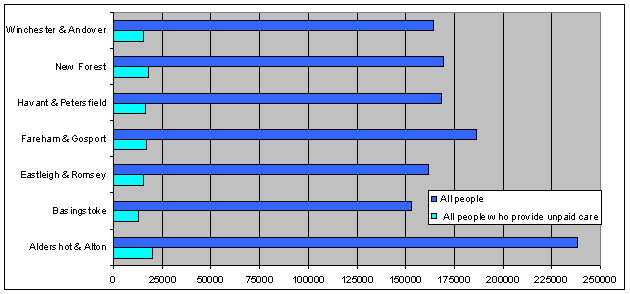
Carers as a percentage of area population based on Census 2001 information
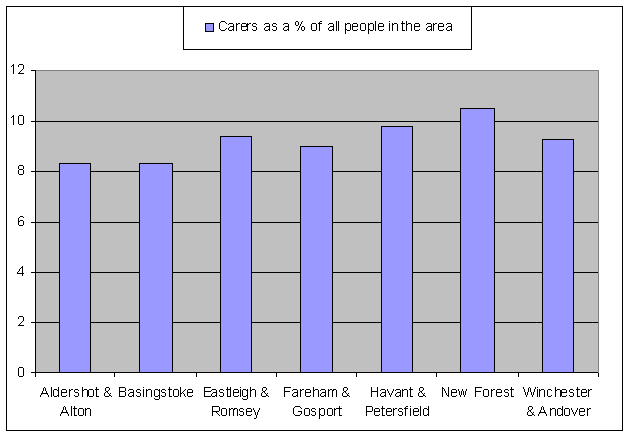
Carer profile
Carers' hours of care provided comparison by area based on Census 2001 Information
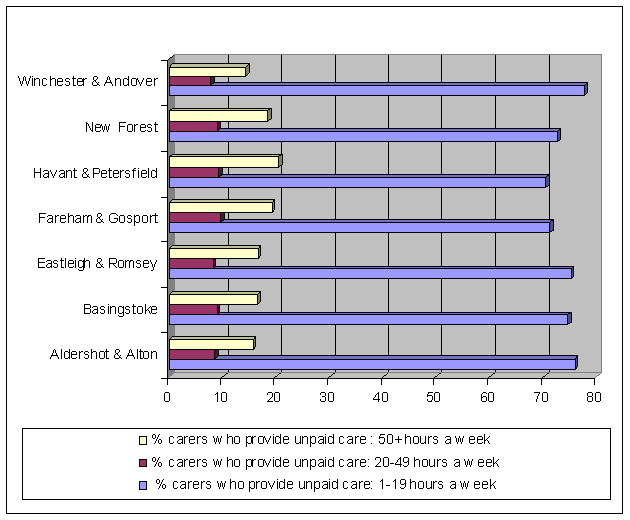
Comment:
The proportion of carers providing between 1 and 19 hours of unpaid care per week accounts for the vast majority of all carers. Overall, the percentage of carers providing between 29 and 49 hours of unpaid care per week is fairly constant between all areas.
Where carers are providing over 50 hours of unpaid care per week, the highest proportions occur in Havant & Petersfield (20.6%), Fareham & Gosport (19.3) and the New Forest (18.4%).
Carers from black and minority ethnic communities face discrimination and racial stereotyping in accessing services and information.