
Archived decisions
Hampshire County Council
Executive Member for Policy and Resources Item
18 June 2008
Affordable Housing and Key Worker Housing Strategy - Update
Report by the Acting Director of Property, Business and Regulatory Services |
Contact: Tony Davison, (01962) 846952; [email protected]
1 |
Introductory Summary | |
1.1 |
This report is to provide an update on a number of issues, including: a) progress on key objectives of the Affordable Housing and Key Worker Strategy (AH&KWS) initially approved by Cabinet in January 2006 and the subsequent update report provided to Cabinet in February 2007; b) seeks approvals to progress specific projects as part of this; c) an update on the County Council's subsequent involvement as an active member of the Hampshire Alliance for Rural Affordable Housing (HARAH) and seeks approvals relating to this; d) an update on recent research undertaken into the potential use of mobile homes as a possible affordable housing solution; and e) provides an update on how the AH&KW Strategy and HARAH membership are now contributing towards the County Council's emerging Rural Strategy. | |
1.2 |
These proposals contribute to the Corporate Priority of Maximising Wellbeing by seeking to increase the amount, choice and quality of affordable housing that is available to the people who wish to live and work in Hampshire. | |
2 |
Recommendations | |
That: | ||
a) progress to date in relation to the delivery of 500 affordable dwellings in the five-year period 2005/6 to 2009/10 from the County Council land disposals be noted and be continued to be supported; | ||
b) the Affordable Housing and Key Worker Strategy (AH&KWS) Project Team progress the Basingstoke and Aldershot pilot affordable housing exception sites and that appropriate Project Appraisals and planning applications are assembled for these and successive such exception sites; | ||
c) approval be given to releasing up to the initial £40k allocated 2008/9 funding to Community Action Hampshire to assist in the funding of the Hampshire Alliance for Rural Affordable Housing (HARAH) Rural Housing Enablers; | ||
d) any potential County Council rural exception sites within the appropriate locations investigated with the HARAH Partnership to ascertain whether they can help facilitate their development; | ||
e) further research be undertaken to ascertain whether Park Homes may be able to assist in the provision of affordable housing with Hampshire; and | ||
f) the relevant work of the AH&KWS and County Council's HARAH membership is also used to assist in the development of the housing elements of the emerging Rural Strategy. | ||
3 |
Background | |
3.1 |
Following the update report to Cabinet in February 2007 the principal objectives of the Affordable and Key Worker Strategy over the past sixteen months have concentrated upon: | |
a) |
Ensuring that the delivery of 500 affordable homes is enabled on County Council land in the five-year period 2005/6 to 2009/10. | |
b) |
Continuing emphasis upon the use and refining of planning obligation negotiations to aid the wider Strategy objectives. | |
c) |
Ongoing monitoring of where demand/need actually exists for key worker housing by County Council employees | |
d) |
Identifying and progressing potential affordable housing sites and projects for both County Council key worker and wider affordable housing purposes on County Council land in the priority areas of the County | |
e) |
To continue to explore possible partners, funding and delivery modes in order to deliver the above. | |
3.2 |
Based upon this, the various "Elements" of the Strategy have now been specifically refocused towards these objectives. | |
4 |
AH&KW Strategy "Elements" update | |
4.1 |
Enabling 500 affordable homes via County Council land disposals | |
4.1.1 |
Although the County Council is not a Housing Authority and does not develop any housing itself, using its land disposal programme as a major landowner within Hampshire, it enables the provision of a substantial proportion of both new market and affordable housing within the County. The initial total figures of affordable and key worker housing likely to be developed on existing "programmed" County Council land disposal sites over the five-year period 2005/6 to 2009/10 was originally estimated at around 380 and was reported to Cabinet in January 2006 as the initial "baseline" target. However, following further work and development by the Strategy's Affordable and Key Worker Project Team, the update report to Cabinet in February of 2007 revised this potential figure upwards to around 700 dwellings for the five-year period. However, it was agreed that the target figure itself should remain at 500 dwellings for the five years. | |
4.1.2 |
Progress to date in the first three years of the five year period against this revised figure is shown in appendix 1. This provides the following breakdown of delivery: 2005/6 30 Affordable Dwellings 2006/7 87 Affordable Dwellings 2007/8 253 Affordable Dwellings (up to December 2007) | |
4.1.3 |
Thus, to date, at least 370 affordable dwellings have been built as a consequence of County Council land disposals. Based upon current projections, and now in a declining house building market, it is anticipated that in the current "Year 4" (2008/9) between 100 and 200 further affordable dwellings could be enabled on County Council land disposals and that a similar range could be expected in the following "Year 5" (2009/10). If this were achieved, this would mean that between 570 and 770 affordable homes could have been delivered via County Council land disposals over the Strategy's five-year period. This will exceed the target of 500 affordable dwellings set as an key original objective of the Strategy. | |
4.2 |
Use of Planning Obligation Negotiations | |
4.2.1 |
The Legal Practice Property Team have now completed their work in researching how the drafting of types of agreements for local planning authority areas can help in the delivery of the 500 affordable dwellings. This is now actively helping to support and drive other elements of the project forward and speed up planning processes. These have been used in recent planning obligation negotiations on County Council land disposals throughout 2007/8 to help facilitate the above figures. | |
4.2.2 |
In addition, progress has been made through 2007 towards the appointment of the new position of a Corporate Developer Contributions Coordinator. This position will focus upon achieving planning contributions across the County from all types of appropriate planning approvals and developments towards County Council work and services. Part of this will be to explore the possibility of securing any appropriate contributions towards the Affordable and Key Worker Housing Strategy objectives. | |
4.3 |
Hampshire County Council Employees Key Worker Needs Survey | |
4.3.1 |
In order to help focus where specific projects might be undertaken to help provide Key Worker Affordable housing for the County Council's own employees, a survey of potential Hampshire County Council key worker requirements was commissioned with David Couttie Associates in late 2006. This work was finalised in 2007 and a summary of the findings of this "Hampshire County Council Employees Key Worker Survey" are attached in appendix 2. | |
4.3.2 |
The survey confirms that there is indeed a key worker housing requirement from around 10% of County Council staff. However, there are specific groups of employees where the demand rises. In particular, around 30% for Children's Services employees and on up to 40% for School specific staff have affordable housing requirements. Shared equity or shared ownership would be the preferred model of affordable housing for most employees requiring some form of supported family housing. The preferred key demand locations are Winchester and Basingstoke followed by the New Forest Borough Council areas. The key findings of the survey are now being used as a basis for the further development of the Strategy and its projects. This information will also be helpful in relation to the County Council's membership of HARAH and the development of Rural Strategy. | |
4.4 |
Exception Sites, Partnerships & Hampshire County Council Affordable Housing Project Elements | |
4.4.1 |
In early 2007, an initial 16 possible planning residential "exception" sites were identified by the Strategy Project Team. Such sites are those that may have potential for affordable and/or key worker housing but not open market private housing and thus any substantial capital receipt potential. This looked at the planning policy context of the sites and their physical potential for development along with the results of the "Hampshire County Council Employees Key Worker Survey". | |
4.4.2 |
From this an initial two sites at Grove Road in Basingstoke and York Road in Aldershot were identified for further detailed planning and architectural and development feasibility work throughout 2007 with a view to exploring with the relevant planning and highway authorities the practical potential for bringing these forward. Based upon recent discussions with the relevant authorities and possible stakeholder partners it is now proposed that planning applications are submitted on both of these sites to test the practical reality of bringing them forward for Affordable and Key Worker Housing. | |
4.4.3 |
In order to undertake this and following additional and ongoing exploratory discussions with Swaythling, Pavilion, Sentinel and Hyde Housing Associations regarding procurement options, it is proposed that the applications are worked up by both the in-house Hampshire County Council Strategy Project Team and in discussion with the above types of organisations. This will ensure that both the appropriate development is taken forward and that potential financial and procurement routes are secured. This will require the allocation of internal financial and staff resources to both of these projects for the remainder of 2008/9. | |
4.4.4 |
Further to the above, and following recent discussions with Winchester Housing Authority and the County Council's membership of the Hampshire Alliance for Rural Affordable Housing (HARAH), surplus land at Perins School, Alresford is also now being actively explored as potentially a further project. | |
5 |
County Council Membership of the Hampshire Alliance for Rural Affordable Housing (HARAH) |
5.1 |
Towards the end of 2007, external awareness of the County Council's Affordable and Key Worker Housing Strategy and its proactive approach towards housing delivery, despite not being a statutory housing authority, resulted in the County Council being invited to join the Hampshire Alliance for Rural Affordable Housing (HARAH) at both member and officer levels. Subsequently, Councillor Leversha has begun attending the member meetings and the Interim Head of Estates attends the officer meetings. HARAH (www.harah.org.uk) was founded in 2005 to address the need for affordable housing in the villages of Hampshire by the Hampshire Rural Housing Enablers, (RHEs) the Housing Corporation and six of the County's rural local authorities which are: Basingstoke and Deane, East Hampshire, Hart, New Forest, Test Valley and Winchester. |
5.2 |
These Authorities have the strategic housing responsibility to meet housing needs whilst the RHEs, based at Community Action Hampshire in Winchester, work closely with parish councils and local communities to facilitate the provision of rural affordable housing. HARAH has selected Hyde Housing Association as its partner and the Housing Corporation is the government agency responsible for investing in new affordable homes. HARAH defines rural affordable housing as affordable housing built on planning "exception sites" in settlements of a population of 3,000 people or less. Appendix 3 provides details of the Exception Site policies of the HARAH Partners. As of March 2008, the HARAH Partnership had succeeded in completing and providing over 50 new affordable dwellings, with around 35 additional dwellings currently under construction and a further 50 dwellings at feasibility stage. |
5.3 |
Since joining HARAH, the County Council has become actively involved in the organisation during 2008 via the following initiatives: |
a) Future support of up to £40k per annum, commencing in 2008/9 to help finance the Rural Housing Enabler officer positions currently employed by Community Action Hampshire. This amount has already identified and approved in principle in the County Council's Budget earlier in the year. | |
b) Contributing £1k from Estates funds towards a promotional DVD aimed at explaining the role of HARAH to the parish councils and other key stakeholders. | |
c) Presenting the County Council's own Affordable & Key Worker Strategy initiative to HARAH and now actively seeking ways that this can assist in the HARAH objectives, and the development of the County Council's own strategy in relation to rural areas and rural affordable housing delivery. | |
5.4 |
In practice, involvement in HARAH could result in the following implications for the County Council: |
a) That if any County Council land within the HARAH area of operation is identified as a potential planning rural "exception site", that this is investigated with the HARAH Partnership to ascertain if they can assess its potential to deliver rural affordable housing and help to provide the vehicle for achieving this. | |
b) That if such land is brought forward as an affordable housing scheme then the County would most likely realise around £12k per dwelling plot as a capital receipt. Whilst this is below market housing land values, this is obviously for an exception site, which would most likely be on County Farms land. In comparison, such land in the HARAH area has an agricultural land value of around £5k per acre, which is much lower than the affordable housing land value. | |
5.5 |
However, the above could provide a strong compliment to the County Council's own A&KW Strategy and provide a suitable vehicle for aspects of its further development in relation to rural areas and the County Council's own emerging Rural Strategy. Therefore, this report seeks authority for the above approach to be explored with HARAH and also seeks approval for the release of the annual funding for the Rural Housing Enabler positions to Community Action Hampshire who currently employ and mange the post holders. |
| |
6 |
The Potential use of "Park Homes" to provide Affordable Housing |
6.1 |
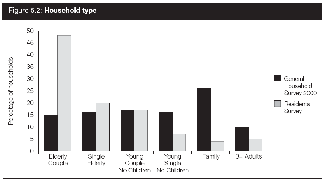
The concept of using mobile (or "Park Homes"), to provide more affordable housing is already with us in this country. There are over 2,100 such parks in England and there are some 69,000 households currently residing in park homes in England and Wales. This represents a population of approximately 114,000 adults and 2,400 Children. Nearly two thirds of the park home households live on parks in the south of England and the majority of the park homes are occupied by an elderly couple (see Figure 5.2). In looking ahead 10 or more years, the industry will become further dominated by retirement-only parks. |
6.2 |
Availability is an issue. Significant pressure on demand is projected, which without a supply response means that the costs to new purchasers will continue to rise and the potential returns to the owners of the scarce resource (licensed pitches), the operators, will rise. The expansion of existing park homes can also typically restricted by local planning policies. However, there are some planning authorities who are now actively looking at the potential of mobile homes to assist in alleviating affordable housing issues on a temporary basis. |
6.3 |
The management of park homes raises some particular issues. Park homes have a peculiar form of tenure. As such, it can be difficult to get a mortgage-type product for a park home and there are few alternative forms of funding available. This can mean that they may not be very flexible to those in housing need on a waiting list. There are some Local Authority run park homes in England in East Anglia and Norfolk but these are few and far between. There is also a Local Authority run park home in Guildford. |
6.4 |
Most residents own their park homes, which may cost anything from £10,000 to in excess of £300,000. In addition to this, there are pitch fees which average around £1,000 per annum. This has cost implications for the provision of their use for affordable housing provision. This may not fit easily with the first time buyers market. Park homes are often purchased outright from the equity released from existing home owners looking to downsize. The Park Homes Council advocate the use of park homes for affordable housing whereas the Housing Ombudsman Service do not recommend their use due to issues of management and dispute resolution. |
6.5 |
Based upon this initial research, it would appear that there may be a potential role for mobile or park homes to be able to assist in the provision of affordable housing. However, this will require further, much more detailed, research into the practicalities, policies, finance and legal basis of such a proposal. It is proposed that this research should be undertaken. |
7 |
Links into the Rural Strategy |
7.1 |
Although not a statutory housing authority, the potential of the County Council to assist in the enabling and facilitating of affordable housing in the rural heartlands of Hampshire is a real opportunity. The new County Council Rural Strategy has this as one of its aims along with exploring the potential use of County Council land to assist this. |
7.2 |
It is proposed that much of the work achieved under the Affordable and Key Worker Strategy and the future involvement with HARAH is incorporated within the emerging Rural Strategy and opportunities used to assist this important initiative. |
8 |
Consultation with Local Member |
8.1 |
This is a policy-setting report, however Councillor Mrs Leversha (who sits on HARAH) has been consulted and supports these proposals. |
9 |
Conclusion |
9.1 |
Significant progress is being made in terms of the increase in the amount of affordable homes being delivered via County Council land disposals that will mean that the target of 500 homes by 2009/10 is likely to be achieved across the County in both urban and rural areas. In addition, following its own Key Worker survey, the County has now embarked on its own first pilot projects to develop specific projects on its own exception sites in Basingstoke and Aldershot that will add to this achievement. |
9.2 |
Following its recent membership and contributions towards HARAH, the County Council will now be able to focus some more of its resources and potential to help deliver more affordable homes in the rural areas of the County and in turn contribute to the new Rural Strategy. |
9.3 |
As part of the above, initial research has indicated that the idea of using mobile homes, or Park Homes to assist in the provision of affordable housing may have some potential. However, there are some issues that remain to be explored in further detail before any conclusions can be made and proposals brought forward. |
LINK(S) TO CORPORATE STRATEGY | ||
Yes |
No | |
Hampshire safer and more secure for all |
_ | |
Maximising well-being |
_ |
|
Enhancing our quality of place |
_ | |
Section 100 D - Local Government Act 1972 - background papers
The following documents disclose facts or matters on which this report, or an important part of it, is based and has been relied upon to a material extent in the preparation of this report.
NB the list excludes:
1 Published works
2 Documents which disclose exempt or confidential information as defined in the Act
None
EM292H08-Report
TD/5-Jun-08
Appendix 1
Number of Affordable Dwellings Facilitated as part of County Council Land Disposals from 2005/6 to 2007/8
Year 1 - 2005/6 | |
Total of Affordable Dwellings 30 |
Year 2 - 2006/7 | |
Crestwood School, Eastleigh 24 Cannon Street, Lymington 15 John Hunt of Everest School, Phase I, Basingstoke 19 Worting Infant School, Basingstoke 15 Mill Lane, Brockenhurst 10 Yew Tree Cottage, Stockbridge 4 | |
Total of Affordable Dwellings 87 | |
Year 3 - 2007/8 | |
Merton Rise Phase 1b, Basingstoke 25 Winton House, Winchester 32 Greenacres School, Winchester 8 John Hunt of Everest School, Phase II, Basingstoke 37 Park House School, Havant 18 Langdown School, Waterside, New Forest 10 Alton Day Services, Alton 20 Blackfield School, Waterside, New Forest 18 Gosport Railway Station, Havant 35 Woolston Road, Havant 40 Nightingale 10 | |
Total of Affordable Dwellings (To end November 2007) 253 |
Appendix 2
Summary of the findings of the Hampshire County Council Employee Key Worker Survey
i) |
Overall the majority (86.5%) of HCC key workers living within Hampshire responding to the question on adequacy, felt their present accommodation was adequate. 13.5% felt their home was inadequate for their needs. This proportion rose to 36.8% for those who work in Children's Services and 31.6% of those who work in Schools. |
ii) |
9.9% of HCC employees within Hampshire wish to move but cannot. The proportion of households who wish to move but cannot do so rose to 39.5% of those workers in Children's Services and 32.6% of those in Schools. |
iii) |
64.3% of HCC Key Workers (189) indicating a move within Hampshire in the next 3 years expressed an interest in schemes that would help reduce the costs of housing. Interest in such schemes rose to 71.3% in Schools. 57.7% would be interested in shared equity and 36.0% in shared ownership. |
iv) |
The majority living within Hampshire require owner occupation (86.4%) in detached or semi-detached houses (73.1%) with 3 or more bedrooms (63.7%). Over a third of those moving in the next three years would prefer to move to Winchester (32.6%), followed by the New Forest (16.3%). |
v) |
Of those living outside the County only 26.0% (27) would be interested in schemes that would help reduce the cost of housing with the majority being interested in shared equity (79.3%) or shared ownership (62.1%). 61.8% of those who would be interested in such schemes would consider a move to Hampshire if they were available. The majority of these would prefer to buy (91.3%) in a detached or semi-detached house (62.9%) with two bedrooms (38.5%). The location preferences are Basingstoke & Deane (21.5%) and Winchester (21.5%). |
vi) |
The main reasons given by households who wish to move but cannot do so, were as follows: unable to afford to buy a home (74.5%) and unable to afford moving costs (48.2%), followed by lack of affordable rented housing (13.5%). Households who wish to move but cannot were interested in schemes that would help reduce the cost of housing. 88.2% expressed an interest in shared equity and a further 61.8% in shared ownership. When moving, 80.5% would prefer owner occupied paying a mortgage in a semi-detached house (44.1%) with three bedrooms (39.8%). The majority would prefer to move to Winchester (22.6%) and Basingstoke & Deane (22.6%), followed by the New Forest (16.5%). |
Appendix 3
Exception Site Planning Policies of the HARAH Partners
Basingstoke & Deane
Development adjacent to rural settlements may be appropriate on land where such development would not normally be permitted as an `exception' policy, provided there is an identified need which cannot be otherwise met. This will include small-scale affordable housing, employment and community facilities such as village halls and cemeteries.
The provision of affordable housing on rural exception sites will be permitted only where the following criteria are met:
i the housing will provide affordable accommodation and will be managed to ensure that it remains available for so long as there remains a need for it to those not otherwise able to compete in the private housing market; and
ii the site does not exceed 0.4ha except in the larger settlements of Baughurst, Bramley, Kingsclere, Oakley, Overton, Pamber Heath, Tadley and Whitchurch where, in general, a site should not exceed 0.8ha
East Hampshire
Planning permission for residential development outside settlement policy boundaries will not be permitted unless it would provide affordable housing for local people who are unable to obtain accommodation on the open market and:
a) there is a proven need for it;
b) the need cannot be met within the Settlement Policy Boundary ;
c) the development is economically viable and sound and will provide affordable housing for all time for local people in proven housing need who cannot afford to rent or buy a dwelling locally on the open housing market;
d) the development site is accessible by public transport, walking or cycling to local services and facilities sufficient to support the new residents and provide for their daily needs;
e) the development is of a high standard, is well related to the scale and character of an adjacent settlement, and will not harm the appearance of the settlement and its surroundings; and
f) its layout, design and construction incorporates measures to optimise energy efficiency.
All six pre-conditions will need to be satisfied before permission is granted. Applicants will be required to ensure that any dwellings permitted under this Policy will always be available as affordable housing for local people who cannot afford to rent or buy a home locally on the open housing market. This should be achieved through an appropriate legal agreement with the District Council.
When considering sites under Policy H12 the District Council will need to be satisfied by way of a recent relevant housing needs survey or through the Joint Housing Register and Empty Homes Register that there is a need for affordable housing in the settlement concerned. The District Council will also need to be satisfied that the people expressing a need to live in the settlement:
a) are unable to afford open market housing which is for rent or sale within
the settlement;
b) have previously been closely connected with the settlement through work or residence; or
c) have a real need to live in the settlement in order to continue their work or in order to look after/be looked after by a close relative (eg, grandparent, brother, sister, son or daughter).
Hart
HOUSING DEVELOPMENT WITHIN OR ADJACENT TO RURAL VILLAGES MAY, IN EXCEPTIONAL CIRCUMSTANCES, BE PERMITTED TO MEET LOCAL NEEDS IF THE FOLLOWING REQUIREMENTS CAN BE MET:
_ The local planning authority must be satisfied that there is a proven need for affordable housing for local people in the immediate vicinity;
_ Development should be of an appropriate size so as not to have an overbearing impact on the settlement or the countryside. A maximum of approximately 0.4 hectares (1 acre) should normally be developed on the site;
_ The site must normally be immediately adjacent to a defined settlement boundary, or form a logical extension to the existing settlement;
_ The development should not have an adverse effect on the surrounding open countryside;
_ Materials and design are appropriate to the character of the surrounding area.
The local planning authority wishes to ensure that people who are on relatively low incomes and cannot access the owner occupied sector of the housing market have the opportunity to continue to live and work in the District.
The applicant must express willingness to enter into a Section 106 Agreement, the purpose of which will include:
a) Agreement to nominate a body (normally a housing association or housing trust) to manage the occupancy and maintenance of the dwellings;
b) Agreement that occupancy shall be restricted and remain available to those who meet the criteria for local need as defined above.
The local planning authority is concerned to prevent houses approved under RUR 21 from ever coming onto the open market. The body nominated to manage such properties will be expected to retain adequate controls over the property to prevent "staircasing".
New Forest
Exceptionally, small-scale housing developments on sites in or adjoining villages may be permitted, to meet the needs of local people unable to afford to rent or purchase property on the open market, provided that:
a) the local planning authority is satisfied that the dwellings meet a particular local need that cannot be accommodated in any other way; and
b) the developers enter into a planning obligation under Section 106 of the Town and Country Planning Act (1990) to ensure that the dwellings provide for low-cost housing for local needs in perpetuity; and
c) the proposal is capable of management by an appropriate body, for example a Registered Social Landlord, New Forest District Council, or a village trust or similar accredited local organisation; and
d) there are appropriate local facilities (e.g. shops, schools and public transport). In respect of single dwellings, the habitable floor area should not exceed 100 sq.metres, or 120 square metres for dwellings permitted specifically to meet the needs of New Forest Commoners.
This policy is intended to assist people living in unsatisfactory accommodation in the locality, or with a particular reason to live there by virtue of their work or family connections, and who therefore are considered by the District Council to be in housing need. For the purposes of this policy, a local person will normally mean someone who lives or works in, or who has strong connections with the settlement or parish in which the scheme is proposed.
Test Valley
In rural areas, within or adjoining settlements development for affordable housing will be permitted provided that:
a) the proposal is accompanied by evidence which demonstrates there is an unmet need within the parish for accommodation by households unable to afford open market housing where a member of each household and has either;
i) been ordinarily resident in the parish or previously lived in the parish and has a strong family connection; or
ii) a demonstrable need to live by virtue of their employment in the village or its immediate surroundings; or
iii) a demonstrable need to live within the village either to support or be supported by a family member; and
b) it is restricted in perpetuity to occupation by households with a member in housing need; and
c) the proposed mix of housing meets the identified need
Development for housing, employment and community facilities in or adjoining settlement which contain schools, shops, community halls and access to public transport and have a population of less than 3000 would be permitted provided that;
a) the proposal is supported by evidence which demonstrates there is a need for the development to maintain and enhance the sustainability of the community;
b) the proposals demonstrate how existing community facilities will be sustained as a result of the development or how any new facilities will be provided; and
c) the proposal if it includes a residential element satisfies any existing need for affordable housing in the settlement or adjoining area
Winchester
As an exception to other policies of the Local Plan, small-scale housing schemes will be permitted on sites well related to existing defined and other settlements, to meet the needs of local people unable to afford to rent or buy property on the open market, provided that:
(i) the Local Planning Authority is satisfied that the need cannot be met within the settlement where the need exists;
(ii) the development provides affordable housing in perpetuity for local people in proven housing need, who cannot afford accommodation locally on the open market;
(iii) there is access by public transport, walking or cycling to local facilities (particularly shops and schools);
(iv) the development is well related to the scale and character of adjacent settlements;
(v) it does not intrude unduly into the countryside or harm the landscape character or setting of settlements, particularly in the East Hampshire Area of Outstanding Natural Beauty.