Archived decisions
Hampshire County Council River Hamble Harbour Management Committee 20 June 2008 Pontoon Safety Ladders Report of the Director of Recreation and Heritage |
Item 10 |
Contact: Tony Clatworthy tel 01489 576387 email: [email protected]
1. Summary
1.1 The River Hamble Harbour Authority is required to take all practicable steps to ensure that the harbour is as safe as possible for all who use it. This means that when an incident occurs, the associated risks should be reassessed and appropriate control measures taken to ensure that the risk is as low as reasonably practicable. Following a series of incidents where river users have fallen into the water and been unable to climb out again, the Harbour Board has taken a preliminary view on the matter of fitting safety ladders to mid-stream pontoons. This report invites the Management Committee to consider the matter in more detail.
2. Recommendation
2.1 That the River Hamble Management Committee considers whether the installation of safety ladders on every midstream pontoon on the River Hamble should be mandatory or optional and, if mandatory, whether they should be funded by the pontoon owner or the Harbour Authority.
3. Background
3.1 On 19th February 2008, the Harbour Patrol received a report of a person in the water following the capsize of his tender. The person had been rescued by a passing vessel but was suffering from the effects of the cold. The person was wearing a buoyancy aid and had been in the water for approximately 5 minutes and had been found clinging to a private pontoon, unable to get out of the water. After being rescued, the person was taken to Mercury Marina where full assistance was given including the use of a hot shower. Following this incident, the question of fixing safety ladders to private pontoons was raised and a preliminary risk assessment was completed (an updated version is at Appendix). The risk assessment showed that it would be appropriate to take action to manage the potential risk and that reasonable precautions should be put in place. At its meeting on 5th April 2008, the Harbour Board decided to take interim action, and resolved as follows:
"That in respect of private mooring pontoons being replaced or newly installed on the River, owners should be advised to fit a safety ladder and that owners of all other pontoons should be asked to consider fitting a safety ladder and that the Management Committee should be asked to advise whether there is a case for making the fitting of safety ladders to all pontoons mandatory."
3.2 The purpose of this report is to provide the Management Committee with sufficient data on which to base its advice.
4. Location
4.1 For practical reasons, safety ladders can only be fitted to the ends of pontoons. If every privately owned individual pontoon on the River were fitted with a ladder at one end, there would be a minimum of about 20 metres between ladders, and a maximum of several hundred metres.
4.2 The situation with continuous pontoons is rather more difficult. Some of these are more than 200 metres in length and it would be impractical to fit ladders at intervals along their length (because they would be at risk of damage from manoeuvring yachts), although ladders could easily be installed at each end.
4.3 Safety ladders are already fitted to pontoons in marinas and boatyards, where the structure is attached to the land.
5. Costs
5.1 A glass-fibre safety ladder, professionally fitted, will cost approximately £175 - £200 (including labour and VAT). There are some 190 individual pontoons on mid-stream moorings on the River and 13 separate lengths of continuous mid-stream pontoon. If each individual pontoon were fitted with a single ladder and each continuous pontoon were fitted with a ladder at each end, this would amount to some 216 ladders at an estimated total cost of between £37,800 and £43,200.
6. Safety benefits
6.1 If every pontoon on the River is fitted with a safety ladder, anyone who finds themselves in the water by accident should be able to swim (or drift on the tide) to the nearest down-tide pontoon and haul themselves out of the water, thereby reducing the risks of hypothermia and increasing their visibility and chances of rescue.
7. Disadvantages
7.1 Apart from the obvious disadvantage of additional cost, either to pontoon owners or the Harbour Authority, there is a possibility that safety ladders would become an attraction to those who choose to swim in the River for pleasure.
8. Impact Assessments
8.1 This report forms part of the safety management system required under the
Port Marine Safety Code. An Equalities Impact Assessment covering the Harbour Authority's responsibilities under the Port Marine Safety Code has been conducted and the content of this report does not alter this assessment.
9. Conclusion
9.1 There is a case for making safety ladders mandatory on mid-stream
pontoons, but there are also some disadvantages. This report recommends that the Management Committee considers these conflicting issues prior to making recommendations to the Harbour Board.
Section 100 D - Local Government Act 1972 - background papers | |
The following documents disclose facts or matters on which this report, or an important part of it, is based and has been relied upon to a material extent in the preparation of this report. | |
NB the list excludes: | |
1. |
Published works. |
2. |
Documents which disclose exempt or confidential information as defined in the Act. |
TITLE |
LOCATION |
None |
APPENDIX
RIVER HAMBLE HARBOUR AUTHORITY
DRAFT RISK ASSESSMENT AND MANAGEMENT REPORT
Date: 17 March 2008 updated 9 June 2008 Assessor: AG Clatworthy |
Risk Assessment For General Operations An assessment of the safety equipment that could be installed on mid-stream pontoons to assist persons in the water to safely recover themselves unaided |
1. Introduction
a. An incident occurred following a tender capsize when a person was in the water and unable to climb out of the water onto a pontoon. The person was in the water for approximately 5 minutes and started to feel the effects of the cold. The person was unable to use the pontoon mooring chains as a means of getting onto the pontoon or to pull himself onto the decking unassisted he was assisted and rescued by a passing vessel.
b. Following this incident it was suggested that an emergency ladder could be attached to one end of each pontoon to assist in the self-recovery of similar casualties.
c. This risk assessment looks at the facts of this incident and other incidents and gives recommendations.
2. Associated Incidents:
a. See record of incidents below.
3. Considerations/Remarks
a. In the incident recorded as serial 3 in the table below it was discovered that the casualty in question remained holding onto the painter of his tender with one hand. This could have affected his capacity in self rescue and his failed attempts to climb onto the pontoon.
b. He was unable to use the chains to assist in climbing onto the pontoon.
c. There are eight areas on the River with long continuous pontooning that would only allow safety ladders to be fitted at each end of the pontoon run.
d. When boats are moored alongside pontoons access would be only available at the ends of the pontoon.
e. A small percentage of boats have ladders or have `sugar scoop' sterns. The average height of the sugar scoop is approximately 45cms above the water - the same height of a pontoon.
f. The cost, administration and policing of requiring the fitting of safety ladders to some 190 private pontoons on the River would be substantial (in excess of £37,000).
g. There are many areas of the River that do not have any pontooning.
h. It may not be possible to fit some private midstream pontoons with a safety ladder owing to space available.
i. It may not be possible to fit some private midstream pontoons with a safety ladder because of the positioning of the mooring chains.
j. The average height of a pontoon is approximately 45 cms above the water and a person cold and possibly suffering from exhaustion would find it difficult if not impossible to recover to the pontoon without a ladder.
k. A person lying in the water amongst the warps, chains and possibly hidden by a moored boat is difficult to see.
j. Should it be decided to require the fitting of safety ladders to midstream pontoons, consideration should be given to fitting one on each pontoon i.e. fitted upstream on each pontoon. Thus, on a run of individual pontoons there would be one safety ladder between each pontoon. Some midstream pontoons are moored in isolation so it would have to be widely advertised that the safety ladder will always be at the upstream end. Further, if a boat is moored against the pontoon, the ladder might not be visible to the person in the water.
4. Comments and Remarks from Stakeholders
None received
5. Recommendations
a. That safety ladders should be available to enable self rescue at all suitable locations on the River.
Record of Persons Found in the Water Near Pontoons in the last six months
The details in the table below are from the last six months but are representative of any six month period over the last 5 years. There have also been a number of people rescued from the water in areas of the River where there are no pontoons.
Serial |
Date |
Number of persons |
Pontoon involved |
Able to climb onto pontoon |
Rescued By |
Falling from |
Time In water |
1 |
19/02/08 |
1 |
yes |
Not able to climb onto pontoon |
Passing boat |
Dinghy capsize |
5 minutes |
2 |
06/04/08 |
2 |
yes |
Climbed onto pontoon prior to rescue |
RHHA |
Dinghy capsize |
3 / 4 minutes |
3 |
02/05/08 |
1 |
yes |
Pulled onto a continuous pontoon by Patrol |
RHHA |
Attempted suicide |
5 minutes |
4 |
28/05/08 |
1 |
no |
Could not reach pontoon because of tide |
RHHA |
Yacht |
30 minutes |
Some examples of safety ladders and mooring arrangements found on the River Hamble |
|
|
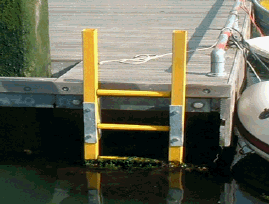
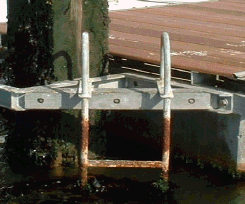
Standard Safety Ladder |
Safety ladder found on some commercial pontoons |
|
|
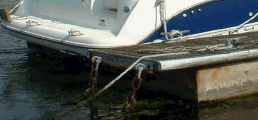
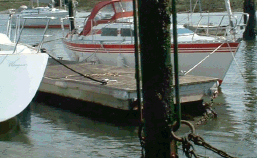
Pontoon with limited space to fit a ladder. Note height fro water |
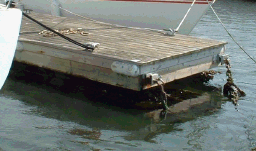
Example of pontoon fittings |
|
|
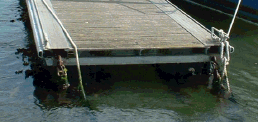
Example of mooring arrangements |
Example of pontoon fitting and height from the water |