
Archived decisions


AIMING HIGH FOR DISABLED CHILDREN:
BETTER SUPPORT FOR FAMILIES
Consultation Outcomes
Hampshire Children's Services Department together with parents and Voluntary Sector partners have undertaken a consultation process to inform the development of services for Disabled Children and their families. This paper reports the findings.
Why We Did It
Outcomes from the Parliamentary hearings clearly identified that service development was best achieved through real participation from Parents, Carers and Young People. This principle of Access and Empowerment is central to the Aiming High for Disabled Children (AHDC).
How We Did It
The consultation process included:-
· Seven workshop events across the county;
· Questionnaires to parents/carers;
· Questionnaires to parents and teachers via the special schools;
· Visits to local special needs forums and parent's groups;
· Visits to coffee mornings at schools, other venues and information to parents via their social workers.
We wanted to gain better understanding in the following areas:-
· How parents view the services provided in Hampshire?
· How the findings of national consultation compare to the experiences of families locally?
· What parents see as priorities in the planning of services. How can we work together to develop solutions to some of the problem areas?
What is in the Report
1. An analysis of 305 completed questionnaires
2. Feedback from Parents and Professionals through Workshop groups
3. Individual contributions through the consultation events newsletters
N.B. Young people's views have been sought and will be included in a separate report.
Feedback from Questionnaires
Question 1 - Services - Total of 295 responded
Question 1a: What Children's Services provision are you currently using to support Disabled Children?
The main services accessed are:
1. Special Schools
2. Speech and Language Support
3. School Holiday Play Schemes
4. Social Work Support
5. Overnight Short Breaks
6. Physiotherapy Services
What services do you think are not readily available:
· Advocacy
· Sitting Services
· Family Link Services
Question 1b: What services would you like to see expanded in the future, to support you to live an ordinary life?
In order of preference, the required services are:
1. Advocacy
2. Sitting Services
3. A range of overnight Short Breaks
4. Family Link Services
5. School holiday and weekend clubs
6. Expansion of parent partnership
Question 2 - Services
For Parents of Disabled Children between 14 - 18 years of age:
Total of 52 responded
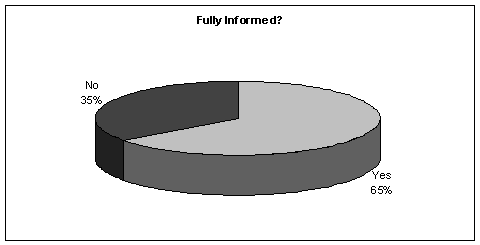
Have you been fully informed about the transition process as your child moves from Children's Services to Adult Services?
What is your experience of the Transition process?
Total of 56 responded
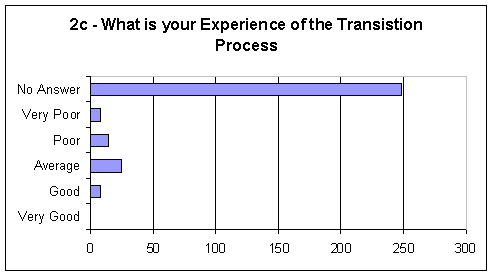
Very Good |
Good |
Average |
Poor |
Very Poor |
No Answer |
Total | |
Results |
1 |
8 |
25 |
14 |
8 |
249 |
56 |
Question 3 - Assessment and Partnership
Improving our Partnership and Co-ordination of Services:
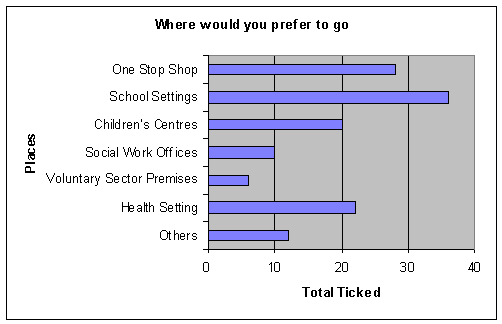
Question 3a: Where would you prefer to go to find out about, or to access services?
135 responded
Question 3b - 143 Responded
Who should be in the teams at your preferred location?
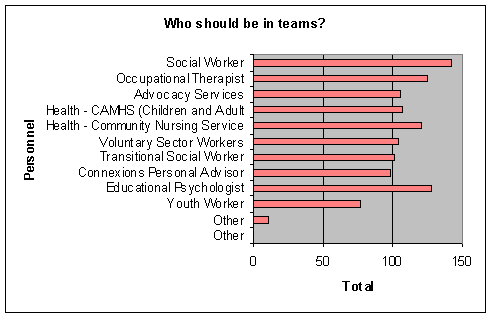
Parents clearly told us that they would like to receive services from a multidisciplinary team accessed from a School, Children's Centre or One Shop Stop setting.
Question 4 - Short Breaks - 228 Responded
Meeting the full Service Offer: Our Current Position
We asked parents to tell us about their experiences of accessing short breaks and to help us identify our priorities for development.
The following key areas for development were identified:
· Access to Short Breaks for young people with complex health needs and life limiting conditions.
· Access to Short Breaks for Older Teenagers with challenging behaviour as a result of their impairment.
· Access to services for young people with moving and handling needs.
In achieving our goal for full service offer we need to:
1. Be better at providing information on the range of short breaks available within each locality.
2. Be able to provide a transparent eligibility criteria understood by parents.
3. Show more flexibility in negotiations in short break arrangements. `User lead rather than Provider led'.
4. Be quicker at putting provision in place following assessment.
5. Provide Services without a `fight'.
6. Complete assessments in which the child's views are sought.
7. Help parents find carers easily.
Question 4b - Quality of Service
We asked parents to tell us what they thought of any other services they were receiving.
The following were rated as being outstanding:
· Portage
· Special Schools
· Early years service
Only one service was rated as being poor:
· Advocacy Services
Question 5 - Core Offer
We asked parents to rate our ability to deliver the Government's Core Offer.
Question 5a - Fairness of Access - 207 Responded
We asked parents if support for disabled children was determined on a fair and easily understood basis.
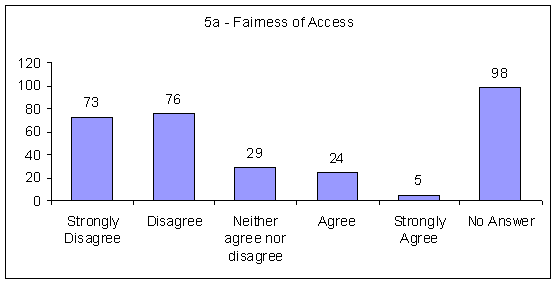
66% of parents and carers who responded think that our services are not determined on a fair and easily understood basis.
Question 5b - Listening to and involving Parents - 203 Responded
We asked if disabled young people and their families were routinely involved in making decisions about their treatment, care and support and in shaping services
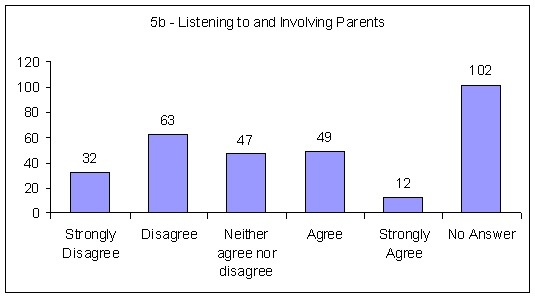
30% of parents and carers who responded think that we do this well.
31% of parents and carers who responded think that they are not routinely involved.
Question 5c - Improving Assessments - 197 Responded
Disabled children and young people receive co-ordinated, child centred services from referral, through assessment to delivery. Is this your experience?
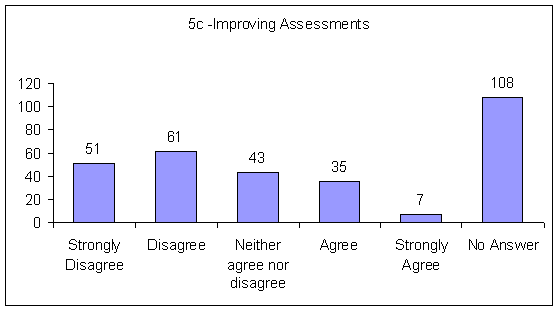
55% of parents and carers who responded think that our co-ordination from referral through assessment to delivery is poor.
21% of parents and carers who responded think we do this well.
Question 5d - Providing Information - 199 Responded
Disabled children and their families are able to access appropriate information at every stage of their child's life. Is this your experience?
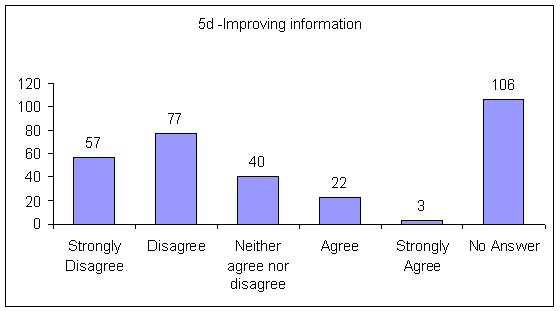
13% of parents and carers who responded think that we do this well.
67% of parents and carers who responded think we do this poorly.
Question 5e - Giving Feedback - 189 Responded
Staff involved with disabled children listen to them, ask them for their ideas, take notice of what they say and give them choices. Is this your experience?
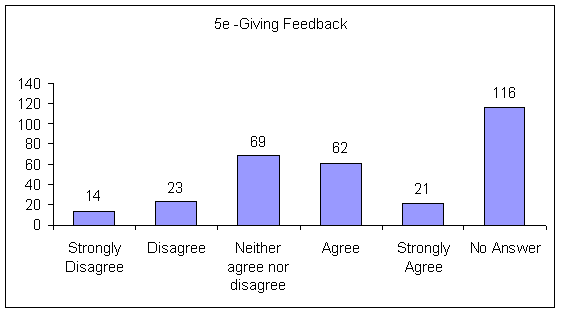
44% of parents and carers who responded think that we do this well.
19% of parents and carers who responded feel that they are not listened to or given choices.
Feedback from Workshops
The seven consultation events offered parents/carers and professionals the opportunity to express their views in workshop settings, and to consider how they would like to see services transformed. Their views are summarised below:-
1. Better Access to Universal Settings for Disabled Children
`Direct access to things like child-minding, rather than having to go through social services just to get the same service that every other parent can arrange themselves.'
(Parent: Andover Event)
`Youth Clubs, Leisure Centres, Swing parks; none of these places can really say they include disabled children.'
(Parent: Alton Event)
2. Providing better information to the Families of Disabled Children
`Information is a key issue, when you've just been told you have a disabled child you are in no state to proactively look for information. You need the information to come to you.'
(Parent: Fareham Event)
3. Supporting the Direct Payment process and access to carers
`Direct Payments are fine in theory but a lot of parents don't want to be employers and you can't find the right staff and you are left on your own to deal with any problems.'
(Parent: Lyndhurst Event)
4. Developing Family Led Participation and Support
`The parents who need short breaks the most often can't come to parent forums because they are so tired they don't have the drive to do anything about it. You need to explore new ways of communicating with the parents who feel most isolated.'
(Parent: Andover Event)
5. Transparency of Eligibility Criteria
`The criteria should be simple and understandable - not mumbo-jumbo.'
(Parent: Havant Event)
6. Inequality of access to short breaks
`I was told if I looked down trodden and cried a lot, I would probably get more respite but I looked as if I was coping!'
(Parent: Fareham Event)
7. Development of key worker system
`I wish my child had a key worker. Then maybe we wouldn't keep getting shunted from one agency to another, having to tell our very personal details over and over again.'
(Parent: Basingstoke Event)
8. Inter-Agency Partnership Working
`Education and Social Care seem to be better now at working together but Health still needs to come on board.'
(Parent: Basingstoke Event)
9. Improving Transition
`For a while it all went smoothly. Just as we got used to things. `Transition' reared it's head. Then everything fell apart.'
(Parent: Romsey Event)
10. Better trained workforce
`Even when we become eligible for a service, there were not enough carers around who could work with children with challenging behaviours.'
(Parent: Alton Event)
Conclusion And Next Steps
Throughout the whole process Parents and Carers have clearly told us that the top priorities should be:
· Providing a way of ensuring that all parents of disabled children receive quality information from a single source. Involving parents in this as a source of knowledge is essential.
· Ensuring that all universal services are able to provide equal opportunities to the disabled children and their families to participate in the whole range of growing up opportunities.
· Support, Participation and Advocacy through a Parents and Carers forums that would be available within the families locality. This could provide information and access to support for Direct Payments and self directed support.
· Ensuring there is equality of access to a Short Break service wherever a family live and there is fairness through the eligibility criteria and flexibility around the negotiation of arrangements. This may include a broader range of services such as after school clubs and holiday play schemes
· Better co-ordination support for the transition of Disabled Young People into Adult Services.
· Providing a menu of overnight breaks that incorporates
1. Support in the Home
2. Family Link Services
3. Overnight Short Breaks outside the family
· Building the capacity of Disabled Children's Teams providing services from a single point of entry.
· Reducing assessments by enabling some services to be available on a universal basis.