Archived decisions
Hampshire County Council
Buildings, Land and Procurement Panel Item 14 July 2008
Corporate Procurement Update Report by the Acting Director of Property, Business and Regulatory Services |
Contact: Neil Jones HPSN: (8 200) 6180 email: [email protected]
Shaun Le Picq HPSN: (8 345) 6967 email: [email protected]
1.0 |
Introductory Summary |
1.1 |
Progress reports on corporate procurement initiatives are made regularly to the Panel. This report provides a commentary on activity over the last six months and includes the first draft of a schedule of the cashable savings identified for 2008/09 in the area of commodity goods and services. |
1.2 |
The report also refers to the County Council's need to make new commitments for the supply of electricity for its buildings (effective from October 2008). |
1.3 |
The report has only indirect links to the delivery of the Corporate Strategy, but impacts on the management of the Council's resources and is part of the wider improvement and efficiency agenda. |
Recommendations | |
That the Buildings, Land and Procurement Panel advise the Executive Member for Policy and Resources that approval be given to: 1. The ongoing improvement programme for corporate procurement 2. The Chief Executive being authorised to conclude new contracts for the supply of electricity for quarterly-billed small sites, monthly-billed small sites and monthly-billed large sites. | |
2.0 |
National Agenda |
Policy Environment | |
2.1 |
The report to the Panel in January 2008 described some of the national initiatives and information that will impact on the efficiency agenda. One of these was the merger of the Regional Improvement Partnerships and the Regional Centres of (Procurement) Excellence. The SEIEP produced its Regional Improvement and Efficiency Strategy in March based on an assumed level of funding of almost £27 million over three years. The three overarching priorities identified in the strategy are: · ensuring improved performance · creating the conditions for achieving successful Local Area Agreements · delivering the (CSR07) efficiency targets of 3% |
e-Procurement Initiatives | |
2.2 |
Preparations for the pilot of the Government Procurement Card (GPC) in 17 schools are continuing. The selection of the card issuing bank will be made shortly following a tender process. The pilot is planned to start in late September and the main benefits of the GPC for schools are expected to be: · more efficient use of staff time · reduction in petty cash transactions and in the use of personal credit and debit cards · fewer payment disputes and earlier payment for suppliers (particularly beneficial to local and small and medium sized organisations - SMEs) · potential to identify opportunities to aggregate spend and contract with key suppliers · availability of electronic transactional information and ability to reduce off-contract purchasing |
2.3 |
It will be important to ensure that the scheme is used appropriately and that schools continue to take advantage of the existing corporate contracts which have been well-supported historically. The impact and effectiveness of the scheme will be monitored over the 6-8 month life of the pilot project, with recommendations being prepared for the Secondary and Primary Heads Resources Groups. |
2.4 |
The Domiciliary Care Invoicing Project Joint Working Party is close to reaching a conclusion after the preparation of a comprehensive business case. Some 7.7 full-time equivalents are involved in processing nearly 73,000 invoices for domiciliary care each year. This volume of invoices accounts for 11% of the total number of invoices received by the County Council (including schools) each year. The staffing cost of processing these invoices is around £155,000 a year, which is equivalent to £2.12 per invoice. The providers on the Joint Working Party estimated that the proposed electronic invoicing system could save them just under £200,000 a year through reduced costs, but the transactional cost to providers would be around £375,000. Therefore, when considering the costs and benefits for both providers and the County Council, the proposed system would be likely to generate a small net additional cost. |
2.5 |
The review process has provided a greater understanding of the County Council's own costs of processing these invoices and of providers' business process automation and administrative costs. The business case concludes that the proposed `virtual' Government Procurement Card system supported by the `Transaction Data Matching' system will not provide sufficient net cashable savings to the County Council to warrant additional investment in the system at this time. The Joint Working Party is, however, supportive of exploring the potential for the use of a pre-paid card for Self-Directed Support (SDS) and Direct Payments within Adult Social Care and is recommending that this solution be explored further once the findings of the SDS pilot in Basingstoke are known. The Joint Working Party will now consider whether to explore other options for further automation of the transactional processes involved in the procurement of domiciliary care. |
2.6 |
The County Council is developing further plans to expand the existing virtual card payment process that is currently being used for the County Council's main food supplier to a number of other food suppliers during 2008. This will remove the manual processing of approximately a further 10,000 invoices a year. |
2.7 |
The rollout of the corporate electronic tendering system is progressing well within PBRS (Corporate Procurement, County Supplies and Property Services) with 74 tenders having been processed through the system to the end of March 2008. The system reduces the administrative overhead of the tendering process and has been well received by staff and suppliers. Further work is required to improve the efficiency of the tender opening process undertaken by the Chief Executive's staff and Adult Services are reviewing whether the electronic tendering system will be adopted and rolled out within that department as a priority. |
2.8 |
The volume of purchase orders sent to external suppliers by electronic means (saving staff time, paper and postage) has increased to 9.8% (over 28,000 individual purchase orders) during 2007/08. These figures show an improvement towards the end of the financial year and it is anticipated that this will continue during 2008/09. |
2.9 |
The Corporate Procurement Team continues to be very heavily involved in the upgrade of the electronic catalogue of goods and services (EBP) within SAP. The team is ensuring that the system provides the required functionality and that enhanced performance and increased usability is delivered as appropriate. The upgrade is likely to be fully rolled out by late September 2008. |
Collaboration | |
2.10 |
The County Council continues to provide support to the HIOWLA Procurement Partnership, particularly on the funding bid submitted to Improvement and Efficiency South East (IESE) and is on the Hampshire Improvement Board and on the management of the Hampshire Marketplace system. |
2.11 |
The partnership has developed an action plan for improvement which includes the establishment of a Strategic Procurement Partnership Group of senior officers to sponsor and promote the action plan being taken forward by the HIOWLA Procurement Partnership, which itself developed from the previous HIOW Local Authority Supplies Group. The Strategic Group will report directly to the HIOW Chief Executive's Group and to the Hampshire Improvement Board as required. Havant Borough Council has taken over the Chair of the Strategic Partnership from East Hampshire with the County Council acting as Vice-Chair. The HIOWPP action plan is expected to deliver the following during 2008/09: · a HIOW-wide Strategic Procurement Strategy · the implementation of more standardised procurement processes · sustainable procurement practice in all HIOW local authorities raised to at least Level One of the 'Flexible Framework' · targeted cashable savings of £300,000. |
2.12 |
Funding for the Procurement Partnership in 2008/09 from IESE has been confirmed, but is considerably less than the amount bid for. This is disappointing bearing in mind that the Hampshire Improvement Board has been very supportive of this initiative and identified the Procurement Partnership as a key priority for HIOWLA. Further discussions are being held with IESE to determine what additional support may be available to increase capacity to ensure that the Partnership is successful. |
2.13 |
The Partnership is funding a detailed analysis of procurement expenditure over three years (2005/06, 2006/07 and 2007/08) to assist in the identification of collaborative procurement opportunities. This will also provide a useful update on the work carried out in 2003/04 and 2004/05 by the County Council for its own strategic procurement planning purposes. A summary of the results of the spend analysis is expected to be available by September and will be reported to a future meeting of the Panel. |
2.14 |
The Hampshire Marketplace (a collaborative e-procurement system) is still in pilot phase across most of the partner authorities, but has produced some benefits since the project started. Over £1.4 million of transactions have been processed through the Marketplace, with estimated savings of £100,000 across the ten partner authorities. During 2008/09, the existing partners will need to consider whether to continue to subscribe to this particular Marketplace solution as renewals become due over the coming months. |
3.0 |
Improvement Plans |
Savings and Efficiency/Corporate Contracts | |
3.1 |
Procurement Savings: Recurring cashable savings were generated for the County Council from corporate contracts for common-use goods and services in 2007/08 of around £0.6 million. Non-cashable process savings of £0.4 million were also achieved. This excludes the impact in 2007/08 of market driven savings on gas and electricity contracts over the winter. Appendix One provides a first draft of the savings schedule for 2008/09 and further details will be reported to the Panel during the course of the year. |
3.2 |
Supply of electricity: October 2008 will mark the start of a new contract year and new pricing periods for the County Council's three main contracts for the supply of electricity to buildings. Prices on two contracts were reviewed last summer (quarterly-billed small sites and monthly-billed large sites) and price reductions of roughly £0.45 million were obtained for County Council departments and schools. The third contract (monthly-billed small sites) has been the subject of a fixed price for two years. Total internal expenditure is in the region of some £6 million per annum with external customers adding a further £2.4 million to the contract value. As on previous occasions when faced with a volatile market, it will be important for the County Council to be in a position to respond quickly to the prices offered by suppliers and it is therefore proposed that the Panel should advise the Executive Member for Policy and Resources that authority should be given to the Chief Executive to conclude these arrangements. It is not possible to anticipate accurately what the results will be, but Members will be aware of the large increases being reported in energy markets and it must be expected that the new prices for electricity will erode the advantages gained last year in both electricity and in gas (an average of 28% or £1.8 million for two years for departments and schools). The assessment of offers received will be based principally on price, but other issues such as the availability and cost of `green' options and service will also be taken into consideration. |
3.3 |
Temporary workers contract: As previously reported, tenders have been recently invited for the provision of temporary workers to the County Council, West Sussex County Council, Hampshire Constabulary and other related bodies. Competition for the new contract was strong and tenders were evaluated on a `best value' basis with a quality and price assessment. The contract has been retained by Manpower UK Limited and an implementation plan for the new contract is currently being discussed with the company. Pay rates have increased after being held down in both 2006 and 2007 and legislative changes are expected to increase Working Time Directive costs from 10.17% to 12.07% from September 2008, but the initial analysis suggests that a reduction in the margin paid to the supplier has been achieved. Further work needs to be completed on this, but the provisional estimate of the full-year effect in the areas reviewed to date is £122,000. |
3.4 |
Photocopying, Office printing and IT Equipment: The County Council has for many years worked with other local authorities through its membership of the Central Buying Consortium (CBC) to establish large-scale framework contracts that offer good value and ease-of-use to corporate departments, schools and external customers. The CBC has embarked on further collaboration with other local authority based purchasing organisations, particularly the Eastern Shires Purchasing Organisation (ESPO) in Leicester, and new contracts have recently been established for photocopying, office printing and IT equipment. Positive results have been achieved in all areas with particularly good results being achieved for photocopying equipment. Price reductions for new equipment supplied after 1 April 2008 equate to an average improvement of more than 10%, which will yield an average efficiency saving of £264,000 in each of the next three years. Improvements on IT equipment include a small increase in the discount available on purchases from the Dell Computer Corporation, which would yield annual savings of around £60,000 for the County Council if recent patterns of expenditure were repeated. |
3.5 |
Library Books: The CBC also managed very successful contracts for the supply of library books and audiovisual materials which are used by thirty-eight local authorities across England (including sixteen London boroughs). The main supply contract has recently been retendered and an improvement in terms of around £1 million on turnover of some £16.5 million has been achieved with effect from 1 April 2008. This follows a similar improvement achieved in April 2007 at the point at which the previous contract was extended for 12 months. Taken together, it is clear that a very substantial increase in spending power has been delivered to library services through the CBC contract. |
Departmental Procurement Reviews | |
3.6 |
Adult Services - Cost of Residential and Nursing Care: The cost of care project continues to be undertaken in liaison with the Hampshire Care Association and the final report will be presented to Adult Services in the next few weeks. The project covers residential and nursing care for older people at a gross cost of around £65 million per annum. The report will recommend an increase in fee levels to enable sufficient market investment to secure the right level and quality of, in particular, residential and nursing care services for people with dementia in light of the forecast of increased dependency levels and demand. In return, homes will be expected to ensure that appropriate levels of quality services are maintained or developed to meet increasing levels of need and that, where possible, cost efficiencies are vigorously pursued through effective procurement practice. |
3.7 |
Adult Services - Collaborative Procurement with Independent Sector Care Homes: Although legal advice has not been finalised on how we might be able to collaboratively procure on behalf of or with the independent residential and nursing care sector, an initial benchmarking exercise is taking place with the Executive Committee of the Hampshire Care Association (HCA). This is to assess whether the care industry could reduce its costs either by buying through the County Council or through greater collaboration with each other or with other appropriate organisations, thereby potentially reducing the cost of care services purchased by the County Council. An initial basket of appropriate goods and services has been shared with the HCA. Besides price comparison, it will be interesting to compare specifications of what the County Council purchases for its own residential and nursing homes and what the independent sector generally purchases. Not surprisingly, it has already been identified that some of the procurement challenges experienced by the County Council in areas such as temporary care staff and hygiene services are also areas of concern for the independent sector. |
3.8 |
Adult Services - High Cost Learning Disability Placements : Whilst Adult Services has already achieved very substantial savings through its initiatives on high cost placements for people with a learning disability, the Corporate Procurement team is continuing to support Adult Services on negotiations with larger providers of services. The current focus of negotiations covers over £7 million of spend and with some suppliers, the County Council is leading the discussions on behalf of a number of other public sector organisations, including West Sussex and Surrey County Councils, Southampton and Portsmouth City Council, the Berkshire Unitary Authorities (via the Berkshire Procurement Shared Services Unit) and Southampton and Hampshire PCTs. |
3.9 |
Adult Services: Domiciliary Care: The follow-up project on the impact of a `patch-based' approach and care brokerage on the procurement of domiciliary care is being finalised and a report will be presented to Adult Services Management Team shortly. In summary, the draft recommendations are that the patch-based approach is providing benefit and efficiencies, but the impact is difficult to quantify as it has not been possible to establish adequate benchmarks. Therefore, the approach could be extended to an area which has not utilised this approach previously. This should enable a more effective analysis and quantification of impact. |
3.10 |
Children's Services - Home to School & Social Care `Taxi' Services: Tenders for Home to School and Social Care Transport in NE Hampshire are currently being assessed, with contracts due to be operational from 3 September. Forty-eight tenders were received, which is a good level of return. The level of savings is not yet known as this is being analysed as part of the tender assessment process, but will be reported to a future meeting of the Panel. |
3.11 |
Children's Services - Domiciliary Care: Following approval from the Children's Services Departmental Management Team of the recommendations arising from the earlier Review of the Procurement of Domiciliary Care in Children's Services (reported to the Panel in January 2008), further planning of the procurement strategy has been taking place. It has been agreed that the procurement of domiciliary care will be combined with procurement of residential respite care for children with a disability as these are complementary services which provide support to parents and carers. The Contracts Team within County Supplies will work jointly with Children's Services to tender for a Framework Contract for Domiciliary Care and Overnight Short Break Services to be effective from April 2009. This approach was approved by the Executive Member for Children and Families on 22 May 2008. |
3.12 |
Further Departmental Procurement Reviews: Planning is currently taking place with the Adult Services, Children's Services and Environment Departments on further procurement reviews. Progress has slowed somewhat in the last 12 months due to both a need to continue to provide support to departments to implement earlier recommendations and a number of key vacancies within the procurement team, to which it has proved very difficult to recruit appropriately qualified and experienced staff. It is now hoped that recruitment has finally been successful and the vacancies are expected to be filled in the next couple of months. However, several priority reviews have been identified for 2008/09 including: procurement strategy for learning disability services (£55 million per annum), procurement strategy for day care (£8 million per annum) and cost of domiciliary care (older people and adults with a physical disability) at approximately £35 million a year. |
3.13 |
Support to Departments: The Corporate Procurement team has provided support to a number of projects over the last six months including: · assisting the Supporting People team on the tender for the Host Organisation for the Local Involvement Networks (LINks) on behalf of the Chief Executive's Department and on the tender for Psychological Support Services at the Secure Unit on behalf of Children's Services. · advising South East Counties on a tender for media services · initial planning on support to be provided to the Wessex Youth Offending Team on a contract for Appropriate Adults from April 2009 · support to Recreation and Heritage on a number of requirements including e-bookings systems · advice and support to Early Years and Childcare Unit in Children's Services on SEN provision and child care provision for Children's Centres · assisting with the specification and procurement of the Contracts Management System for Supporting People and Social Care in Adult Services. |
Corporate Procurement Strategy/ Performance Improvement | |
3.14 |
Procurement Strategy: The County Council's current Corporate Procurement Strategy is effective until the end of 2008 and therefore the third Corporate Procurement Strategy to cover 2009 and 2010 will be developed by the Corporate Procurement Network over the next six months. |
3.15 |
Gateway Reviews: The County Council's Corporate Procurement Strategy identifies a requirement to implement a Gateway Review process for major contracts to improve performance and ensure corporate social responsibility objectives are considered in major procurement projects. Gateway Reviews were developed by central government (The Office of Government Commerce - OGC) to reduce the number of major government projects which overrun on time or budget or which fail to deliver their objectives and outcomes. The Gateway Review process examines a project at critical stages in its lifecycle to provide assurance that it can progress successfully to the next stage. The process is generally recognised as adding significant value and as an important enabler in the efficiency agenda. |
3.16 |
The Gateway Review process should also enable: · realistic and achievable targets to be set · deployment of relevant skills and competencies to a project · stakeholder involvement in relevant projects · increased chance of project success · identification of issues within a project and lessons learnt · compliance with contract standing orders and procurement best practice · visibility of the procurement process · provision of a comprehensive audit trail. |
3.17 |
A report is currently being prepared for the Corporate Management Team to consider a proposal for the County Council to implement a Gateway Review process for all contracts exceeding £1 million. This will be on an 18-month pilot basis from autumn 2008. Guidance on a tailored Gateway Review process is currently being finalised and briefings for relevant staff and managers across the County Council will take place. Local Gateway Reviews are already taking place for some major projects in both the Environment Department and Property Services. |
3.18 |
The standard Gateway Review process comprises six Gates as follows: Gate Stage Title 0 Strategic Assessment 1 Business Case (justification) 2 Procurement Strategy 3 Investment Decision (contract award) 4 Readiness for service (roll-out) 5 Benefits Evaluation (post project review). |
The proposed Corporate Gateway Review process will comprise: (i) 4 mandatory Gates (Gates 0 to 3) (ii) Line manager (tier 3 or above) approval of combined Gates 0 and 1 (iii) Corporate Procurement Team approval of Gate 2 (iv) Head of Litigation and Procurement approval of Gate 3. | |
3.19 |
Meet the Buyer and Business Events: The Corporate Procurement team represented the County Council at the two-day `Meet the Buyer' event at Business South at St Mary's Stadium and the one-day `Meet the Buyer' event at the Rose Bowl in March. Both events were particularly well attended by local and Small & Medium Enterprises (SME) suppliers. |
3.20 |
Corporate Threads Portal: The `Corporate Threads Portal' has recently been launched on Hantsnet and is intended to help managers deliver the County Council's key corporate initiatives through management of their services and staff. Effective procurement has been identified as one of the key initiatives and we have contributed some advice and guidance on effective procurement practice which has now been published on the Portal. |
3.21 |
Corporate Procurement Best Practice Guide: The Procurement Best Practice Guide was launched on Hantsnet at the end of June 2008 and will provide an invaluable source of advice and guidance for all levels of staff undertaking procurement across the County Council. |
New and Potential Corporate Contracts | |
3.22 |
Corporate Travel: At the Panel's meeting on 2 April 2008 Members approved a list of forthcoming contracts which included a new contract for corporate travel services. Subsequent analysis has indicated that it would prove efficient to include rail travel within this contract and most of the other local authorities in Hampshire have also expressed an interest in participation. The estimated total contract value has therefore increased to around £1 million per annum instead of the £150,000 listed in April. All spend is currently included in departmental and partner authorities' revenue budgets, and it is now proposed to tender for corporate travel services at this level. |
3.23 |
Training: Analysis and planning has been on-going with Hampshire Learning Centre to identify whether there would be any benefit in aggregation of some of the procurement of learning and development services across the County Council. This project remains at an early stage and a procurement strategy has yet to be developed. |
3.24 |
Interims and Recruitment Agencies: Initial discussions have also taken place with HR on the feasibility of aggregating requirements for `Interim Managers' and `Recruitment Agencies', although the ad-hoc and specialist nature of these services create a number of challenges in developing the most appropriate procurement strategy which will provide benefit for the County Council. |
3.25 |
Sustainable Procurement: The Corporate Procurement Network has agreed to set up a short term Sustainable Procurement Working Group to establish a set of sustainable procurement targets for 2008/09 to both increase our Aalborg score in this area and to place the County Council in a stronger position in relation to the national `Flexible Framework' for sustainable procurement performance. |
4.0 |
Key Performance Indicators |
4.1 |
A suite of key performance indicators (KPIs) has been developed which are relevant to the key procurement objectives within the County Council's current Corporate Procurement Strategy. The key performance indicators are based on the IDeA local performance indicators for procurement, but have been adapted to ensure that they fit with local priorities and take account of limitations on, and availability of, appropriate data. The indicators are explained in more detail in Appendix Two and cover each of the following areas: _ providing leadership and building capacity _ promoting collaboration and use of trading powers _ stimulating markets and achieving community benefits including efficiencies, sustainability, equality and diversity _ doing business electronically. |
Statistics | |
4.2 |
During 2007/08, 294,000 purchase orders with a value of £630 million were raised in the County Council's procurement systems. The electronic catalogue handled 31.3% by value, 28.3% went through the Core SAP IT system (including waste management) and interfaces from departmental systems accounted for 40.4%. The lowest average value for each order raised was in the core system where 176,000 orders were created (principally by schools) with an average value of around £540. |
5.0 |
Conclusions |
5.1 |
The Corporate Procurement team continues to maintain a strong focus on direct support to departments both through the programme of procurement reviews and by responding to individual requests for assistance and advice. This work continues to be well supported by departments and further projects have been identified for the remainder of 2008/09 (subject to the successful completion of current recruitment processes). |
5.2 |
Recurring cashable efficiencies were identified for departments of the County Council from corporate arrangements for common-use goods and services of around £0.6 million in 2007/08 and it seems likely at this stage that the target of £0.5 million for 2008/9 will be achieved. |
LINK(S) TO CORPORATE STRATEGY YES NO | ||
Hampshire safer and more secure for all |
X | |
Maximising well-being |
X | |
Enhancing our quality of place |
X | |
This report links only indirectly to the Corporate Strategy, but has a positive impact on the management of the Council's resources and on corporate objectives, such as sustainability and the local economy by promoting a strategic approach to procurement, through developing staff skills and improving performance management. |
Section 100 D - Local Government Act 1972 - background papers
The following documents disclose facts or matters on which this report,
or an important part of it, is based and has been relied upon to a material
extent in the preparation of this report.
NB. the list excludes:
1 Published works
2 Documents which disclose exempt or confidential information as defined in the Act:
None
APPENDIX ONE
Procurement Efficiencies and Savings Monitoring |
|||||
Jun-08 |
|
||||
Cashable Efficiency Savings 2008/09 |
|
|
|
FIRST |
DRAFT |
Description |
Contracted Value (£ p.a.) |
Total Annual Cashable Saving £ |
Corporate Share (excl. schools) |
Cashable Corporate Savings (£) |
Cashable Schools Savings (£) |
2008/09 |
2008/09 | ||||
Supply Teachers & Ancilliary School Staff: savings from new contract commencing September 07, savings to be realised approximately six months from contract start date based on 2.5% of contract value (£2 million pa) based on last 4 months of this financial year. Quality cross-check: improved service delivery to end users & rationalisation of vendors |
2,000,000 |
50,000 |
0% |
0 |
12,500 |
Document Solutions Contract: reduction in prices through CBC/ESPO collaboration (average over each of next 3 years) |
1,475,000 |
264,000 |
20% |
52,800 |
211,200 |
IT Hardware: reduction in prices through CBC/ESPO collaboration |
3,000,000 |
60,000 |
50% |
30,000 |
30,000 |
Library Books: reduced prices on CBC contract |
1,320,000 |
48,800 |
100% |
48,800 |
0 |
AV Solutions: reduced prices on CBC contract |
391,000 |
12,800 |
20% |
2,600 |
10,200 |
Temporary Agency Staff: reduced margins in new contract reflected in bill rates (part year effect) |
6,000,000 |
122,300 |
100% |
61,200 |
0 |
Non-Educational Cleaning: reduced contract price |
1,096,000 |
84,000 |
100% |
84,000 |
0 |
Vehicle Hire: min 2.5% price & 2.5% inflation saving (TBC) |
3,600,000 |
180,000 |
85% |
153,000 |
27,000 |
Catalogue Advertising: reduction in commission of 1% |
64,000 |
4,120 |
100% |
4,100 |
0 |
Use of OGC frameworks: claim method approved by NAO |
239,488 |
35,856 |
90% |
32,270 |
3,586 |
Office Papers: reduction in contracted prices |
TBA |
27,400 |
60% |
16,400 |
2,750 |
Total Savings Already Achieved for 2008/09 |
|
|
|
485,170 |
297,236 |
|
|
|
|
|
|
Items not included within summary of ongoing cashable efficiencies : |
|||||
Gas: savings achieved through new CBC contracts Nov'07. Two year fixed price (site specific prices). Quality cross-check: seamless transition to new contract and improvement costs. |
1,816,426 |
19% |
342,000 |
1,474,400 | |
Total |
|
|
|
827,170 |
1,771,636 |
GLOSSARY : CBC - Central Buying Consortium OGC - Office of Government Commerce ESPO - Eastern Shires Purchasing Organisation NAO - National Audit Office |
|||||
APPENDIX TWO
CORPORATE PROCUREMENT - KEY PERFORMANCE INDICATORS
1. |
KPIs: Providing Leadership and Building Capacity | |||||||
1.1 |
National Procurement Strategy: as previously reported to Panel, the Government expects all local authorities to meet the milestones within the National Procurement Strategy for Local Government (NPSLG). The County Council's progress against the NPSLG has been monitored since 2003 at which time, 30% of milestones had been completed. By December 2007, the County Council had completed 90% of the milestones. This is very good performance compared to the national picture. The Department for Communities and Local Government recently published a report on national progress against the NPSLG milestones which showed that 33% of milestones have been generally implemented, 56% are being actively implemented and 3% are not being implemented. Target performance is expected to be 100%. | |||||||
1.2 |
Customer Satisfaction: A survey to determine internal customers' satisfaction with the corporate procurement function and to establish overall performance was undertaken in 2006. This found that 75% of the responders (26 senior staff were surveyed and 10 replied) were either very or fairly satisfied. The data establishes a baseline against which improvements can be measured and another survey will be undertaken in the next few months to establish trends. The target satisfaction level is expected to be 100%. | |||||||
1.3 |
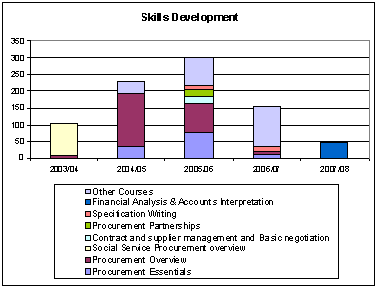
Skills Development: One of the main aims of the Corporate Procurement Strategy is to develop skills and provide support for staff involved in procurement across the County Council. The County Council has provided and commissioned a range of training courses since 2003/04 and the specification of these has changed according to the changing requirements of the County Council. In 2003/4, it was recognised that there were a lot of people involved in procurement that had no formal training to equip them to understand and implement best practice. Therefore, the first training courses were set up to give these staff an overview of effective procurement practice. Since then, the requirement for this level of training has reduced and more strategic, subject specific training courses have been commissioned. Figure 1 shows the quantity and types of training that have taken place over the last five years. Figure 1 - Quantity & Types of Procurement Training
| |||||||
1.4 |
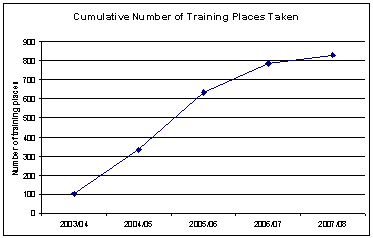
Since 2003/04, 829 training places on the corporately arranged courses have been taken up. The rate of uptake on courses has reduced over the past two years but those courses that are still being offered are well attended. The Corporate Procurement Strategy sets a target of 850 places taken by December 2008. Cumulative figures for the attendance at courses over the last five years are shown in Figure 2 and it is considered likely that the target will be achieved. Figure 2 - Cumulative Number of Procurement Training Places Taken
| |||||||
2. |
KPIs: Collaboration and Contracting | |||||||
2.1 |
Collaboration in procurement relates to both external collaboration with partner public authorities, to gain the benefits of aggregation of spend and reduce the cost of the procurement process and internal collaboration through establishment of corporate contracts for common use goods and services to leverage spend, comply with procurement regulations and minimize contracting and purchasing effort across the County Council. The KPIs therefore focus on indicators of the level of `independent' spend, average invoice values and price comparison of a basket of goods. | |||||||
2.2 |
Limitations in reporting from the corporate SAP system make it difficult to estimate the overall value of spending against formal contracts. However, analysis of purchase orders raised in the electronic catalogue of goods and services within SAP (EBP) during 2007/08 indicates that spend against ongoing contracts is in the region of 54%. This figure is believed to be an underestimate because not all departmental contracts have been recorded in EBP. | |||||||
2.3 |
Another indicator can be estimated from the number of non-contracted suppliers (those without a term contract) in the electronic catalogue of goods and services (EBP). The main purpose of EBP is to ensure that contracted and approved suppliers are readily available to staff making common use purchases across the County Council. In order to meet ad-hoc and specialist requirements, frequently used, but non-contracted vendors, which do not conflict with corporate arrangements, are also available in EBP. In April 2007, there were 3,380 of these non-contracted suppliers in the EBP catalogue, but due to efforts to reduce non-contracted spend, the number of non-contracted suppliers in EBP had reduced by April 2008 by over 800 (24%). This reduction has been achieved by new and improved corporate arrangements, capturing information about contracts and approved lists from other departments and analysis of the use of suppliers to ensure that they are removed promptly once they are no longer required. The target is of course to continue to reduce the value and volume of non-contracted spend and suppliers. | |||||||
2.4 |
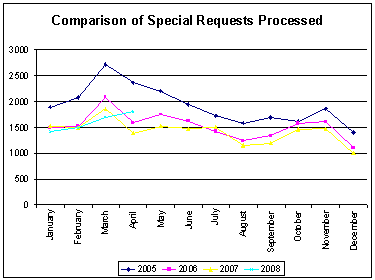
Where a supplier is not available in EBP, corporate departments must raise a `special request' in the system in order to obtain a purchase order. The majority of these requirements are assumed to be ad-hoc, specialist and therefore non-contracted. A further indicator of a reduction in non-contracted purchasing is a reduction in the number of special requests processed. A combination of improved contracts, improved data in EBP and education of requisitioners has led to a total reduction of more than 25% in the number of special requests processed (Figure 3). Figure 3 - Comparison of Special Requests Processed
| |||||||
2.5 |
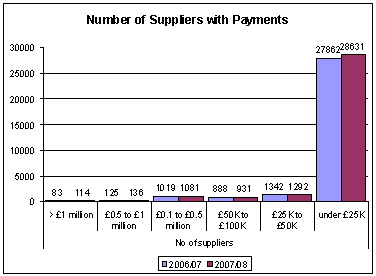
Average spend per supplier is also an indication of the level of aggregation of spend (internal collaboration) in order to secure best value. The target is therefore to increase the average spend per supplier. The average value of payments made to suppliers in 2007/08 was £29,995 compared to an average value of in 2006/07 of £27,825; an increase of 7.8% The distribution of invoice values by number of suppliers is shown in Figure 4. Figure 4 | |||||||
2.6 |
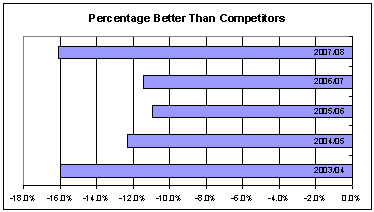
Comparison of Competitiveness on a basket of common use goods: the impact of effective aggregated contracting can be assessed through a price comparison of a basket of goods. We have used a standard set of goods which are common across organisations and, in particular, competitors of the County Supplies' warehouse. Figure 5 shows that County Supplies consistently offers lower prices than its main competitors across the basket of goods. Figure 5
| |||||||
3. |
KPIs: Stimulating Markets and Achieving Community Benefits | |||||||
3.1 |
The County Council is committed to working effectively with a wide range of suppliers and to stimulating a competitive and varied supply market and supply chain. This includes third sector, small and ethnic minority business. The satisfaction of suppliers was measured by a survey in 2006. These responses, as shown in Table 1 below, will be used as the baseline for future surveys and a second survey will be completed before the end of the calendar year. Table 1 - Survey of supplier satisfaction with authority Number of suppliers surveyed Number of responses All responders either very or fairly satisfied with the authority Ethnic Minority Business (EMB) very or fairly satisfied with the authority Small & Medium Enterprises(SME) either very or fairly satisfied with the authority Third Sector either very or fairly satisfied with the authority 2,818 822 45% 51.52% 44.75% 31.29% |
|||||||
4. |
KPIs: Doing Business Electronically | |||||||
4.1 |
Doing business electronically within the procurement process is a fundamental element of the improvement and development of procurement practice. The efficiency of the procurement process is maximized through the most effective and appropriate use of electronic procurement. The County Council's target is to increase the volume and value of the following indicators over time. | |||||||
4.2 |
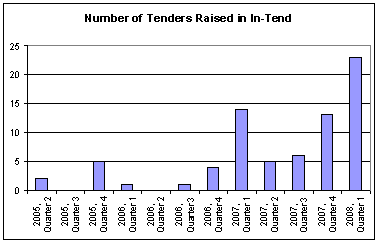
Electronic Tendering: The management of tendering electronically (e-tendering) enables more efficient administration of the collation and issuing of tenders. It can also help with the collation of information from tender responses. An e-tendering system (known as In-Tend) has now been rolled out to Corporate Procurement and County Supplies and to the majority of Property Services. The increase in the number of tenders being issued through e-tendering is illustrated in Figure 6. Figure 6
| |||||||
4.3 |
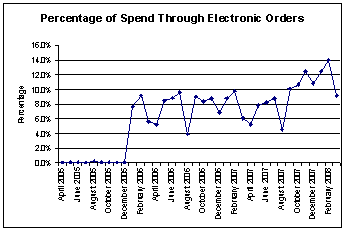
Electronic Ordering: The County Council uses a number of approaches which partially or wholly automate the transmission of purchase orders to suppliers. Purchase orders are being sent by autofax (faxing directly from SAP to the supplier without the need for a paper copy), e-mail from SAP and via the Hampshire Marketplace. The number of orders being sent by all three methods has increased over the last twelve months and this generates efficiencies in the purchasing process. | |||||||
4.4 |
Figure 7 shows how the percentage of electronic orders has increased since April 2006 with over 13% of orders being transmitted electronically (monthly fluctuations are primarily influenced by activity within schools.) Figure 7
| |||||||
4.5 |
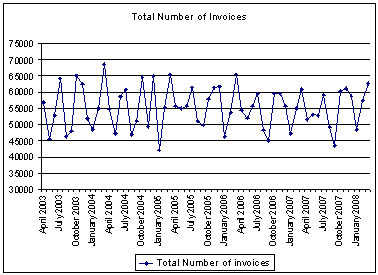
Number of Invoices Received: The County Council aims to reduce the number of invoices received and therefore reduce the transaction costs of making payments. Figure 8 shows the total number of invoices received over recent years (including schools). Figure 8
| |||||||
4.6 |
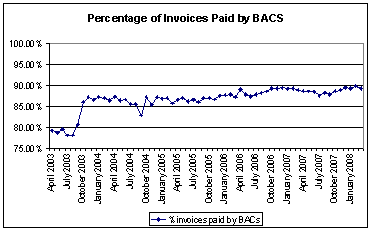
Electronic Payments: BACS payments are the most efficient and cost-effective electronic method of making payments to suppliers. Figure 9 shows that there has, generally, been a steady increase in the number of payments being made by BACS over recent years. Figure 9
| |||||||
4.7 |
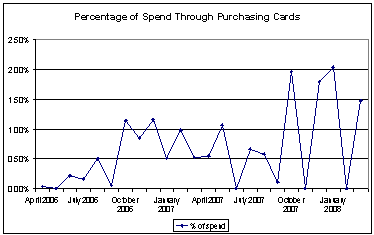
Use of Purchasing Cards: Purchasing cards can, in appropriate circumstances, be used to achieve efficiencies by reducing purchase to pay cycle times and minimising transaction costs. The graph in Figure 10 currently illustrates the activity through the current purchasing card system used for purchases made by HC3S from the County Council's main food supplier (the peaks and troughs are caused by purchasing patterns within kitchens). Payments through purchasing cards are set to increase as cards are piloted with schools. However, this is one indicator where continuous increases may not be desirable as the use of purchasing cards carries the increased risk of non-contracted purchasing and further work is required to assess the most appropriate target level of spend for purchasing cards within the County Council. Figure 10
| |||||||