
Archived decisions
Contact: Paula Crompton Ext: 5454 email [email protected]
1 |
Introductory Summary | ||||||
1.1 |
The Risk Management Strategy for the Built Estate was reviewed in November 2007 and resource allocations for strategic risk were approved by the Executive Member for Policy and Resources on 2 April 2008. This report: · confirms health and safety priorities for 2008/09 through the strategic risk management framework 2007/08 · proposes that resources are directed to the highest and most significant liabilities across the built estate · confirms performance over the past 12 months and summarises the agreed actions and resources required for continuous improvement · provides an update to the test and invest strategy · provides an update on progress on the Disability Discrimination Act Access Audits and Improvement Strategy | ||||||
1.2 |
The provision of a robust Risk Management Strategy for the Built Estate and the distribution of funding towards the highest priorities ensures that the built estate is safer and more secure for all users in support of the corporate priorities. | ||||||
Recommendations: | |||||||
That the Buildings, Land and Procurement Panel: | |||||||
a) Advises the Executive Member for Policy and Resources to approve the Implementation Plan for Property Services' Strategic Risk Register for 2007/08 as set out in Appendix 2. | |||||||
b) Notes the budget provision for 2008/09 for strategic risk assessment and the likely impact on the budget over the coming financial year. | |||||||
3. Notes the investment achieved following the implementation of a new test and invest (T & I) programme for electrical safety and development of further strategies to offer best value and well managed risk-taking. | |||||||
2 |
Resource allocation | ||||||
2.1 |
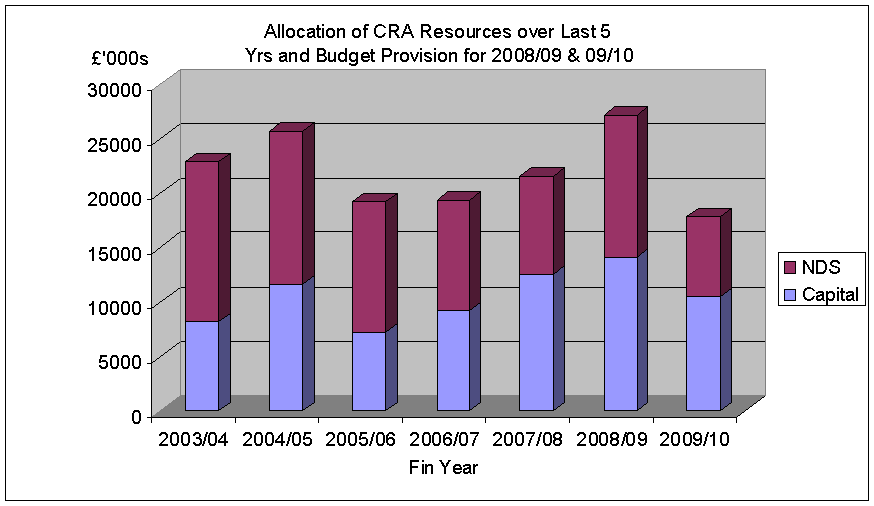
The strategic risk profile informs the allocation of resources from the landlord's repairs and maintenance budgets. Additionally strategic risk improvement programmes are supported from New Deal for Schools (NDS) Condition funding. Both of these areas of funding are reported to the Panel annually, most recently at the meeting on 2 April 2008. Over the last five years, the majority of funding has been directed towards the highest priorities relating principally to fire, condition of buildings and structural collapse, electrical safety and asbestos. The distribution of funding over the past five years is illustrated in Appendix 1. Table 1 below compares capital expenditure in 2007/08 with the proposed budget allocations for 2008/09. | ||||||
2.2 |
The original budget for 2007/08 was £12.5m and was fully committed by April 2008. In order to take advantage of new construction framework arrangements funding of £1.68m was allocated to a major programme of structural work and are due to commence in 2008/09. These works have been programmed to start in 2008/09. Approximately £4.59m (excluding fees) of funding was also committed to support landlord strategic requirements. Capital repairs resources continue to be managed to achieve the maximum strategic impact in reducing maintenance liabilities and addressing risk priorities. | ||||||
Table 1 Risk Heading Capital Expenditure 2007/08 Proposed Capital Budget 2008/09 £000 fees excluded £000 fees excluded Fire including arson 942 791 Condition of building fabric 7,070 6,333 Failure to manage contractors 0 0 Asbestos disturbance 1,063# 800 Electrical services failure 584 1,003 Swimming pool plant failure 183* 248* Detection of Legionella 49 172 Glazing and window safety 13 400 High Level access for maintenance to plant or buildings 133 160 Mechanical services failure 1,383 1,419 Structural collapse and temporary buildings 544 240 Other CRA priorities 546 823 Total 12,510 12,389 |
|||||||
* This is a revenue budget # 2007/08 Asbestos disturbance includes £450,000 for the inspection & re-survey programme. |
|||||||
2.5 |
The Capital Repairs allocation for 2008/09 will deliver the Strategy for the Built Estate which was considered by the Panel on 2 April 2008. This includes: · directing resources to the highest and most significant liabilities across the built estate · continuing to develop long term strategies (such as test and invest) to address the backlog of maintenance liabilities · maximising opportunities for planned maintenance regimes as opposed to reactive `patch and mend' programmes · ensuring that buildings are accessible and remain open for business through the Strategic Risk Assessment framework · maintaining strong links with schools through the Service level Agreement (SLA) and ensuring that schools are provided with corporate safety advice |
||||||
2.6 |
Table 1 (Para 2.2) represents the optimum position to enable compliance with statutory inspections balanced against essential maintenance programmes. It remains a challenge to deliver improvement programmes for the highest risks whilst continuing to manage and maintain performance in other lower risks. In order to free up resources, a test and invest (T&I) risk management strategy was developed last year and approved by this Panel. The T & I strategy is described in section 5 of this report and provides an example from the Corporate Business Planhttp://www3.hants.gov.uk/corporate-strategy-home/cmt-text-with-picture-right-3/corpstrat_outcometargmeasure.htm of resources following priorities. |
||||||
3 |
Risk Management Strategy 2007/08 |
||||||
3.1 |
The strategic risk assessment and performance framework for the Built Estate for 2007/08 is attached at Appendix 2, with a commentary on each risk. Members should note that the corporate programme requires the risk assessment to be subject to annual review in October each year, therefore the current strategic risk register is dated 2007/08 and is funded largely by resources available during the financial year 2008/09. |
||||||
3.2 |
Twenty strategic risks are ranked with a detailed assessment and management programme for each one. The risk headings have changed little over the past 10 years, with Fire remaining the top strategic risk. Over the past decade around £100m of Landlord's capital funding has been directed at strategic risks and when the NDS programmes are taken into account this figure would rise to well over £200m. As a result some risks have been managed, through investment programmes, reducing them from medium to low. In addition, the level of NDS investment has allowed the strategic risk for condition to move from a high to a medium risk in respect of the education estate. This is despite a large outstanding backlog of repairs and maintenance remaining at schools. |
||||||
3.3 |
Across twenty strategic risks, there are sixteen green (this represents an improvement of 3 since 2006/07) and four amber performance ratings illustrating the risk management programmes are achieving positive outcomes, with sustained improvement year on year. Key actions resourced and completed during 2007/08 are summarised in Appendix 3 (Table 1) along with the proposed programme of risk improvements for approval in 2008/09 (Table 2). |
||||||
4 |
Fire Safety Strategy |
||||||
LINK(S) TO CORPORATE STRATEGY | ||
Yes |
No | |
Hampshire safer and more secure for all |
√ |
|
Maximising well-being |
√ | |
Enhancing our quality of place |
√ | |
Section 100 D - Local Government Act 1972 - background papers
The following documents disclose facts or matters on which this report, or an important part of it, is based and has been relied upon to a material extent in the preparation of this report.
NB the list excludes:
1 Published works
2 Documents which disclose exempt or confidential information as defined in the Act
None
BL&PP0708
 Appendix 1
Property Services Strategic Risk Register 2007/08 Appendix 2
Summary of ten highest risks WITH controls in rank order also illustrating current performance using a traffic light colour coding
Level of risk |
Risk Title |
Risk description |
Traffic light to illustrate performance |
High |
Fire including arson |
Fire and arson remains the highest risk particularly in residential buildings such as older persons homes. Irrespective of the cause, malicious or otherwise, fires can present a significant business or community loss causing serious damage to buildings including schools, offices, public buildings and day centres. The estate is categorised into risk groups and subject to a comprehensive survey and joint inspection programme with Hampshire Fire and Rescue Service (HFRS). The Fire Safety Manual has been reviewed and reissued to comply with the Regulatory Reform (Fire Safety) Order 2005. A strategy for arson reduction is in place and appears to be reducing the risks in schools. |
Amber |
High |
Condition of building fabric including vandalism - non educational |
Since there are a broad range of non educational buildings in terms of age and construction, this risk associated with condition is defined as the state of repair of all components including fabric, plant and services and the risk of failure of components. Condition surveys are completed every five years and annual management partnership meetings are undertaken. |
Amber |
Medium |
High level access for maintenance of plant or building components |
This risk identifies the risk of personal injury or fatality by site staff or contractors required to access plant or parts of buildings e.g. lift rooms, ladders to water towers etc. Trespassers are also included in this risk assessment. The County Council has a database recording known hazards and these are communicated to term contractors and staff. Comprehensive risk assessments, method statements and inspections are completed for all areas. The aim is to eliminate high level access or to make the access arrangement safer. |
Green |
Medium |
Asbestos disturbance |
This risk covers the management of asbestos containing materials (ACM) within all County Council buildings through a comprehensive survey programme, database of identified materials and publication of an annual asbestos register for every site. Guidance, instruction and training has been developed and updated for property services staff, building users and monitored contractor performance. ACMs were used in construction until 1990 when legislation prevented use. This means that the majority of the County Council's buildings have asbestos material requiring comprehensive survey and planning before undertaking invasive work. |
Green |
Medium |
Condition of building fabric including vandalism - education. |
The risk associated with condition of education buildings describes the state of repair of all components including fabric, plant and services and the risk of failure of components. A Condition survey programme is in place, a helpdesk to provide reactive response, revised security contracts and annual management partnership meetings. Capital Repairs and NDS funding has benefited schools over the past 5 years increasing the quality of the buildings and reducing liability compared to non-education stock identified as a separate risk in this register. |
Green |
Medium |
Electrical services failure |
This risk covers any fixed electrical installation and equipment in all County Council premises and sites. Term contracts are in place for day to day maintenance and a five yearly or less inspection and testing regime completed by specialist contractors with high risk properties requiring more frequent inspections. An in-house database and management system record T&I inspections and are updated regularly with quarterly reports discussed at Engineering meetings. |
Green |
Medium |
Swimming pool plant failure |
This risk covers hazards associated with swimming pools including management systems and the condition of the plant, equipment etc. Many facilities are approaching 30 years old. A management review programme is being completed during the 2007-2012 SLA to review risk management and operating arrangements for pools while regular water testing is provided by Hampshire Scientific Services (HSS) to maintain water quality. Reactive maintenance arrangements are in place with term contractors where inspections and improvement are identified. Significant investment programmes are required to update pools to modern standards or alternatively demolish the pools where this is appropriate. |
Green |
Medium |
Detection of Legionella |
This risk covers the growth of Legionella bacteria with the potential to cause ill health and infection. All high and medium risk sites hold a legionella log book, checked by HSS and term contractors. Regular maintenance is developed through term contracts. The management system relies on a corporate policy, published guidance, water testing and training events for site managers. |
Green |
Medium |
Mechanical engineering service failures |
This risk covers mechanical engineering plant such as gas appliances, pressurised systems and ventilation systems associated with building services. Mechanical engineering plant is usually located within dedicated plant rooms or kitchens and have the potential for fire or explosion associated with failures. This risk also includes bottled gases, school teaching equipment, welding equipment and expansion vessels. Regular servicing via term contractors and inspection and testing are completed and recorded within a database which also records replacement of safety valves etc. The County Council has a written scheme of examination delivered by competent staff and this is monitored through quarterly meetings and monitoring of risk assessments. |
Green |
Medium |
Failure to manage contractors and supply chain. |
This risk covers poor contractor performance which could give rise to an incident or accident where the County Council is the client or client agent. The register of contractors identifies 120 general builders and 200 specialist traders approved to carry out projects. Robust selection and appointment procedures are in place with annual checks of insurance. Contractors are monitored every month and suspended for poor performance evidenced through site safety checks. |
Green |
Appendix 3
Property Services Strategic Risk Programmes 2007/08 and 2008/09
Table 1: Summary of ten highest risks confirming achievements during 2007/08
Strategic risk |
Achievements or key actions completed in 2007/08 |
Fire including arson |
· Fire Precaution Improvement Programme. · An Arson Reduction Strategy has been implemented to include arson reduction visits and actions to target vulnerable areas eg improvements to twenty secure waste stores. · Corporate launch of the revised Fire safety manual (compliant with the Fire Reform Order 2005) and associated training events for fire co-ordinators. · Risk profiling of all Schools is complete. |
Condition of building fabric including vandalism - non educational |
· A number of procurement efficiencies introduced to ensure best value is made for the available resources. · Landlord's planned capital programmes together with regular servicing regimes and revenue expenditure. |
High level access for maintenance of plant or building components |
· Database to record known hazards and communicated to term Contractors, staff etc. · Identified responsible persons in Property Services for each hazard and building. |
Asbestos disturbance |
· Implementation of risk based asbestos inspection programmes providing cashable efficiency savings of £25,000 in 2007/08. · Survey of boiler rooms to prevent exposure of asbestos by term contractors with management of remediation work where asbestos is in poor condition. Effective planning of survey programme considering current data and geographical areas has provided £30,000 saving based on original estimates. · Information, instruction and training of Property Services staff and Primary and Secondary Head teacher representatives. |
Condition of building fabric including vandalism - education. |
· Landlord's Condition Programmes concentrated on re-roofing & cladding which reduces the amount of recurring maintenance & improves thermal efficiency. · A number of procurement efficiencies have progressed which will assist in obtaining best value for the resources we have available for managing this risk. · Research in to failures of SCOLA windows to find suitable approaches to repair to prevent further failures. A reactive repair programme will be implemented during 2008/09 to reduce the risk in the education sector. |
Electrical services failure |
· Ten-yearly or less inspection & testing of fixed installations by specialist contractors. High risk properties inspected & tested more frequently i.e. gypsy sites & rooms with public entertainment licence. New T & I programme implemented Autumn 2007. · In-house database/management system recording inspections, remedial works and completion of work. |
Swimming pool plant failure |
· H & S Management Review Programme as part of the Property Services SLA 2007 - 2012. · Testing and inspection of electrical installations by specialist contractors. |
Detection of Legionella |
· For properties in the low risk category, web based assessment pro forma and web based legionella log book published. · Replacement of the wet cooling towers in Three Minsters House and Winchester Law Courts (The programme for Three Minsters House is deferred pending the outcomes of the Strategic Property Review) The project at the Law Court is now complete. |
Mechanical engineering service failures |
· Regular inspection, testing and servicing via term contracts by approved contractors. · AMP survey every 5 years for built estate to monitor condition and backlog liability/risk. · Remedial work value £50,000 to oil tanks to prevent contamination of ground and water courses. · Scalding Risk assessment from domestic hot water systems following national safety alert. |
Failure to manage contractors and supply chain |
· Approved list of competent contractors who satisfy basic health and safety, financial competence and insurance requirements. HSE enforcement monitored. · Monitoring on site of contractor performance by Project Officer and Clerks of Works and customers, proactive & reactive monitoring. Monthly site safety checks carried out, complemented by audits on longer projects or following unsatisfactory site safety check. · Successful Contractor Forum held to identify improvements in performance for the County Council and to share best practice between contractors. |
Table 2: Summary of planned actions for implementation in 2008/09
Strategic risk |
Key actions proposed for 2008/9 |
Fire including arson |
· Hampshire County Council Fire Safety Manual Revision to comply with Regulatory Review Order. Updated guidance is issued to all responsible persons on a revised intranet based document with published corporate timetable. · New strategy for landlord repair instructions and the issue actions from audits with follow up communications. |
· Condition of building fabric including vandalism - non educational |
· Development work is required on the combined external decoration, structural inspection and AMP condition survey programme as reported previously to senior managers. · Tenders require preparation for the reactive maintenance frameworks |
· High level access for maintenance of plant or building components |
· Deliver annual programme of remedial work to eliminate the highest risks identified from database and confirmed by Engineers. · Establish arrangement to record location to ensure maintenance during handover and designers/ project managers update information about location of equipment in need of annual inspection on the database. |
· Asbestos disturbance |
· Revise incident reporting arrangements to ensure that any uncontrolled asbestos disturbance is reported to Property Services Senior managers to agree remedial actions and prevention strategies. · Investigate term contractors arrangements with competent service providers to facilitate removal & repair of asbestos. · Develop a live electronic asbestos register to provide improve access to information by term contractors and building firms. |
· Condition of building fabric including vandalism - education. |
· Development work is required on the combined external decoration, structural inspection and AMP condition survey programme as reported previously to HSEG. · Deliver a programme to secure windows to SCOLA Mark II buildings to prevent windows failing and injuring people below. · Develop a strategy to engage schools in investing devolved capital funding in building and other condition items |
· Electrical services failure |
· Relocation of computer suite with improved backup arrangements to prevent loss of IT2000. · Harmonise T & I arrangements for farms and bring under the contract as for rest of estate. · Deliver the T & I Programme for the Built estate and use the funding to invest in new electrical installation and upgrading programmes eg re-lighting in schools, replacement switch panels, investigate code 2 faults. |
· Swimming pool plant failure |
· Introduce log books for each pool to provide active recording of all maintenance activities. · Identify the process and responsibilities following unsatisfactory water quality reading by HSS . |
· Detection of Legionella |
· Assess, with Adult Services, all non residential care accommodation, e.g. Day Centres to establish a high, medium and low risk register for this group of properties. · Roll out of on-line assessment to County Council Departments. |
· Mechanical engineering service failure |
· Survey and testing of fire dampers to residential properties · Replacement of safety valves more than 26 months since last inspection · Provide schematics and written schemes for permanent gas systems and LPG system |
· Failure to manage contractors & supply chain. |
· Review procurement arrangements with SME Contractors. · Improve working arrangements with Contractors |
Appendix 4
Access Audits and Improvement Strategy
1 |
Phase 1 - Access Audits & Improvements Strategy - Public Buildings |
1.1 |
In response to DDA legislation, a phased approach was taken to implement `reasonable adjustments' across the diverse built estate. Phase One included over 150 public buildings including libraries, museums, Country Parks, adult services area offices and the Castle Complex buildings. A third of audits were completed in partnership with disabled people representing local Access Groups bringing a rich dialogue and understanding of barriers for disabled people which has become a constructive, trusting and facilitative working relationship.
|
2.2 |
At 2007/08 year end, approximately 70% of all priority access improvements identified in access audits have been completed in line with available resources. With current funding (approximately £140,000 cost shared funding in 2008/09), the remaining planned accessibility improvements are estimated to take a further 2-3 years. Alongside planned improvement programmes, the Access team are considering a Review Programme for the 150 buildings delivering front-line services to the public of Hampshire. |
2 |
Phase 2 - Improving access to mainstream schools |
2.1 |
The approach to improving access to Hampshire Community Schools is threefold: 1. planned access improvement projects to school buildings via Schools Access Initiative (SAI) funding 2. property Service's advisory service delivered through the Service Level Agreement helps schools to plan strategically for access and inclusion 3. ensuring all refurbishment work to schools includes an element of access improvements as far as reasonably practicable |
2.2 |
The County Council receives an annual SAI grant allocation from Central Government to improve access for disabled pupils in mainstream schools. In 2007/8, a Capital Programme of £2.1m was delivered across approximately 30 primary and 15 secondary schools. Projects varied in complexity and scale from the major refurbishment of Amery Hill School (to provide a strategically placed accessible secondary school in the Alton area) to ramped classroom exits at a primary school to assist a specific pupil with a mobility impairment. SAI funding is allocated according to the LEA's Accessibility Strategy which sets long-term objectives to consider the geographical location of accessible schools in Hampshire. Improving access to school buildings through other funding routes ( eg Building Schools for the Future) is being considered for the next five years. |
3 |
Phase 3 - part-public buildings |
3.1 |
This concluding phase of the DDA Access Audits & Improvements Strategy covers a range of buildings where limited access is available to the public, for example older person's homes, Children's homes, Highways offices or office accommodation. The Access Team will work with the Hampshire Workstyle Programme team to ensure that the rationalisation of office accommodation integrates inclusion and accessibility in detailed planning and design. A practical example being Ashburton Court East which has significantly improved accessibility. |
4 |
Best Value Indicator 156 (BVI 156 - % accessibility of public buildings |
4.1 |
Over the last ten years or so the County Council has been required by the Audit Commission to publish the percentage of public buildings which are accessible to disabled people. Originally part of the Comprehensive Performance Assessment (CPA), this Performance Indicator was withdrawn in 2007. To maintain the excellent performance in the top quartile (in fact achieving top performing local authority one year), a suitable and meaningful local Performance Indicator is being developed to ensure continued benchmarking with other authorities. The final out turn figure for April 2008 was 82%, meeting the 2007/08 target. |