Archived decisions
Hampshire County Council Cabinet Item 5b 21 July 2008 Report on Corporate Manslaughter and Corporate Homicide Act 2007 Report of the Chief Executive |
Contact: Kevin Gardner 01962 847381 / Peter Andrews 01962 847309 E-mail: [email protected]/[email protected] |
1 |
Summary |
1.1 |
This report sets out the background to the Corporate Manslaughter and Corporate Homicide Act 2007, its main provisions and purpose and any potential implications for the County Council and its senior officers. |
1.2 |
The Act applies where fatalities occur as a result of the way in which an organisation conducts it activities or as a result of the way in which the activities of the organisation are managed or organised by its senior management. |
2 |
Recommendation |
2.1 |
That the Chief Executive be asked to carry out a further review of the existing health and safety arrangements in the County Council as part of a wider review of the County Council's risk management arrangements to ensure that they provide sufficient levels of assurance that robust systems of health and safety management are in place. |
2.2 2.3 |
That the Chief Executive be asked to prepare an initial report containing details of the findings of the review proposed under 2.1 and detailed proposals for the ongoing reporting to Members on the efficiency and effectiveness of the health and safety arrangements within the County Council for initial submission to the Risk Management Board and ultimately this Cabinet. That the Chief Executive is asked strengthen the existing assurance arrangements in advance of the review proposed under 2.1, by instigating a formal audit programme in all Departments to a standard set by the Chief Executive and based on accepted national standards, with an annual assurance report to the Governance Committee. |
3 3.1 |
Introduction and Background The Corporate Manslaughter and Corporate Homicide Act 2007 received Royal Assent on 26 July 2007 and came into effect on 6 April 2008. The implementation of the Act is a step towards more rigorous investigation of organisations for manslaughter following fatalities connected with the activities of a corporate entity - whether public or private. |
3.2 3.3 3.4 |
The Act makes provision for a new offence of corporate manslaughter and for this to apply to companies and other incorporated bodies, Government departments and similar bodies, police forces fire authorities and certain unincorporated associations. In the United Kingdom, over 40,000 people have been killed in commercially-related circumstances between 1966 and 2006 but under the common law only 34 companies have been prosecuted for homicide and only seven convictions obtained. On average about 400 people (employees, self-employed people, and members of the public) are killed in incidents through the operation of commerce each year. Long term deaths bring the figure much higher. These include circumstances where a company has been responsible for causing the contracting of a medical condition (such as asbestosis or mesothelioma) whose development takes many years to cause death. Commercially caused deaths on the roads are estimated to reach up to 1,000 each year. Public anxiety at commercial recklessness was heightened by a number of major cases such as the Southall rail crash in which seven people were killed and 151 injured, the capsize of the Herald of Free Enterprise killing 192 and the Paddington crash in 1999. |
4 4.1 4.2 |
The Current law Following a work related death, the police, with assistance from the Health and Safety Executive ("HSE"), investigate:- - whether the death resulted from an individual's gross negligence; and - whether that individual was sufficiently senior in the organisation that his guilt should equate to the company also being considered guilty of manslaughter. The majority of previous corporate manslaughter prosecutions failed due to the "identification principle" which requires that a senior level individual (in most cases a director or someone of equivalent standing who could be said to embody the company in his actions and decisions) also had to be personally guilty of manslaughter. This is often referred to as the concept of a "controlling mind". |
5 5.1 5.2 5.3 5.4 5.5 5.6 5.7 |
The New Act The new offence will be called corporate manslaughter and builds on key aspects of the common law offence of gross negligence manslaughter . However, rather than being contingent on the guilt of one or more individuals, liability for the new offence depends on a finding of gross negligence in the way in which the activities of the organisation are run. In summary, the offence is committed where, in particular circumstances, an organisation owes a duty to take reasonable care for a person's safety and the way in which activities of the organisation have been managed or organised amounts to a gross breach of that duty and causes the person's death. How the activities were managed or organised by senior management must be a substantial element of the gross breach. The elements of the new offence are: · The organisation must owe a "relevant duty of care" to the victim. · The organisation must be in breach of that duty of care as a result of the way in which the activities of the organisation were managed or organised. This test is not linked to a particular level of management but considers how an activity was managed within the organisation as a whole. Section 1(3) stipulates that an organisation cannot be convicted of the offence unless a substantial element of the breach lies in the way the senior management of the organisation managed or organised its activities. · The way in which the organisation's activities were managed or organised (referred to in this report as "the management failure") must have caused the victim's death. The usual principles of causation in the criminal law will apply to determine this question. This means that the management failure need not have been the sole cause of death; it need only be a cause (although intervening acts may break the chain of causation in certain circumstances). · The management failure must amount to a gross breach of the duty of care. The test asks whether the conduct that constitutes the breach falls far below what could reasonably have been expected. This reflects the threshold for the common law offence of gross negligence manslaughter. There is no question of liability where the management of an activity includes reasonable safeguards and a death nonetheless occurs. · A recent ruling by the Court of Appeal in a case of a pending prosecution of a director under section 37 of the Health and Safety at Work etc. Act 1974 (HASW Act 1974) relates closely to the need to monitor health and safety practices. The director concerned was responsible for an organisation where a young child was killed due to unsafe practices using forklifts. The director was also the chair of the port's Strategic Health and Safety Management Committee. The Court of Appeal overturned a previous preliminary ruling by the judge who had ruled that it was necessary to demonstrate that the individual director knew of the unsafe practices before neglect can be established. The ruling by the Court of Appeal was that it was sufficient to show that the individual either knew or ought to have known by virtue of the circumstances and had a duty to act. The term "senior management" means those persons who play a significant role in the management of the whole or a substantial part of the organisation's activities. This covers both those in the direct chain of management as well as those in, for example, strategic or regulatory compliance roles. The new offence will be triable only in the Crown Court in England and Wales and will involve proceedings before a jury. The sanction is an unlimited fine although the court will also be empowered to impose a remedial order and a publicity order on a convicted organisation. The new offence only applies in circumstances where an organisation owed a duty of care to the victim under the law of negligence. Duties of care commonly owed by organisations include · The duty owed by an employer to his employees to provide a safe system of work · The duty owed by an occupier of buildings and land to people in or on, or potentially affected by, the property · Duties arising out of the supply of goods and services including the supply of services by public sector bodies · Duties owed as a result of constructing or maintaining buildings, infrastructure or vehicles or when using plant or vehicles. This would cover for example ensuring that adequate safety precautions are taken when repairing roads or in the maintenance of vehicles · Duties arising out of the activities that are conducted by corporations on a commercial basis, such as the duty owed by transport companies to their passengers. In addition, s2(2) specifies that a duty of care will also be owed to a person because they are being held in detention or custody which includes prison, holding facilities, custody areas at a court or police station and police vehicles. It will also apply to people being transported under immigration or prison escort arrangements, placed in secure accommodation for children and young people or being detained under the Mental Health Act 1983 and related legislation. However this section will not be brought into force until a commencement order is made by the Secretary of State which is subject to the approval of both Houses of Parliament. The effect is, broadly, to include within the offence the sort of activities typically pursued by companies and other corporate bodies, whether performed by commercial organisations or by Crown or other public bodies. Many functions that are peculiarly an aspect of government are not covered by the offence because they will not fall within any of the categories of duty of care in this section. In particular, the offence will not extend to circumstances where public bodies perform activities for the benefit of the community at large but without supplying services to particular individuals. This includes wider policy-making activities on the part of central government, such as setting regulatory standards and issuing guidance to public bodies on the exercise of their functions. In many circumstances, duties of care are unlikely to be owed in respect of such activities in any event, and they will remain subject to other forms of public accountability. Sections 3 to 7 provide that the offence does not apply to the performance of specified public functions. However, whether the offence is capable of applying in any given circumstances will depend in the first place on whether a duty of care is owed to a person by an organisation, and whether the duty of care is a "relevant duty of care" . |
5.8 5.8.1 5.8.2 5.8.3 5.8.4 5.9 5.10 |
Relevant Exemptions-Public policy decisions, exclusively public functions and statutory inspections Section 3(1) of the Act provides that any duty of care owed by a public authority (Public authorities include local government bodies, as well as any other body some of whose functions are of a public nature). In respect of a decision as to matters of public policy ( including in particular the allocation of public resources or the weighing of competing public interests) taken by public authorities is not a relevant duty of care. Section 3(2) specifically provides that an organisation will not be liable for a breach of any duty of care owed in respect of things done in the exercise of "exclusively public functions", unless the organisation owes the duty in its capacity as an employer or as an occupier of premises. This test is not confined to Crown or other public bodies but also excludes any organisation (public or otherwise) performing that particular type of function. "Exclusively public functions" are defined in section 3(4). The test covers both functions falling within the prerogative of the Crown (for example, where the Government provides services in a civil emergency) and types of activity that by their nature require a statutory or prerogative basis, in other words, that cannot be independently performed by private bodies. This looks at the nature of the activity involved. It therefore would not cover an activity simply because it was one that required a licence or took place on a statutory basis. Rather, the nature of the activity involved must be one that requires a statutory or prerogative basis, for example licensing drugs. Section 3(3) provides that an organisation will not be liable in respect of any duty of care owed in connection with the carrying out of statutory inspections, unless the organisation owes the duty in its capacity as an employer or as an occupier of premises. This exemption would cover regulatory activities to ensure compliance with statutory standards: for example, inspection activities by the health and safety enforcing authorities. Child-protection Section 7 provides that the offence does not apply in relation to the exercise of specific functions to protect children from harm. The Act does not apply in relation to the exercise (or the failure to exercise) by local authorities of a number of specific statutory functions relating to decisions made to safeguard the welfare of children. It is unlikely that such bodies would owe a duty of care should a person be killed in connection with such activities (for example, if a child was not identified as being at risk and taken into care and was subsequently fatally injured). This section makes it clear that such circumstances are not covered by the offence. Local authorities will however be covered by the offence in respect of responsibilities to their employees and in respect of the safety of the premises they occupy. Individual liability Secondary liability for the new offence is specifically excluded. Secondary liability is the principle under which a person may be prosecuted for an offence if they have assisted or encouraged its commission. In general, this means that a person can be convicted for an offence if they have aided, abetted, counselled or procured it. Section 18 specifically excludes an individual being liable for the new offence on this basis. This does not though affect an individual's direct liability for offences such as gross negligence manslaughter, culpable homicide or health and safety offences, where the relevant elements of those offences are made out. |
5.11 |
Penalties |
5.11.1 5.11.2 5.11.3 |
The Courts will also be able to impose "remedial orders" requiring the organisation to put right any relevant deficiencies in their systems and procedures, within a specified period of time. Courts will also have the power to "name and shame" by requiring organisations to publicise particulars of their offence, the conviction and the penalties imposed within a specified period by the imposition of a "publicity order." The public stigma and damage to reputation attached to the offence should be of particular concern to the County Council. This provision will only be commenced once supporting sentencing guidelines are available (estimated to be Autumn 2008). |
6 6.1 7 7.1 7.2 7.3 7.4 7.5 |
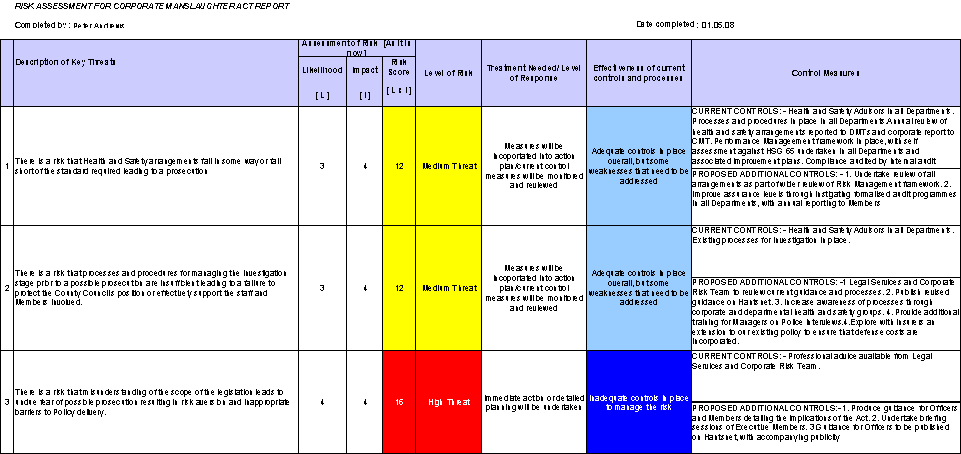
Risk Analysis The County Council faces three key possible risks arising from this legislation: · That its Health and Safety management arrangements fail in some way or fall short of the standard required leading to a prosecution. · That its processes and procedures for managing the investigation stage prior to a possible prosecution are insufficient leading to a failure to protect the County Council's position or effectively support the staff and Members involved. · Misunderstanding of the scope of the legislation leads to undue fear of possible prosecution resulting in risk aversion and inappropriate barriers to Policy delivery. A full risk assessment of these threats is appended to this report. Mitigation Actions The County Council has a duty to ensure that robust health and safety policies and procedures are in place within the organisation and that these are underpinned by a supportive culture throughout the whole organisation. It is also important that both the Members and Officers are confident that existing health and safety arrangements in the County Council are sufficiently comprehensive and robust so as to be able to undergo any scrutiny or challenge. The County Council has significant controls in place to ensure that it meets its legal requirements in respect of Health and Safety legislation. All Departments have professional health and safety advisors to a high level of competence. In addition, health and safety representatives comprising of volunteers from staff and the trades union are in place across the organisation. A full suite of relevant policies and procedures are published corporately and at departmental level. Departments review their health and safety arrangements and report their findings to their respective management teams on an annual basis. These are collated and reported to the Health and Safety Executive Group, the Risk Management Board and the Chief Officers Management Team. There is a comprehensive health and safety training programme organised by the Hampshire Learning Centre, with additional specialist training organised by Departments. Health and Safety practice in the County Council has recently been reviewed to ensure compliance with Health and Safety Guidance Note 65 (" HSG 65") but in the light of the new risk to the County Council posed by the Act it is recommended that Cabinet asks the Chief Executive to produce an interim report for submission to the Risk Management Board and ultimately a report back to this Cabinet containing an additional review of the County Council's existing health and safety arrangements with proposals for future method of reporting on the management of health and safety within the County Council. While the report should build on and compliment the review that has already undertaken the information gathered in the previous report should be looked at again with the specific risks posed by Act in mind. This should include an investigation of the health and safety arrangements of key partnerships to ensure that roles and responsibilities are clear. The Health and Safety Executive has provided organisations with specific guidance in terms of steps to be taken to protect themselves from successful prosecution by demonstrating that they have robust management systems in place. Their key recommendation is that organisations should have a robust and formal process for auditing compliance with health and safety policies. Therefore, notwithstanding the possible findings of the review, Cabinet is asked to strengthen the existing assurance arrangements by asking the Chief Executive to instigate a formal audit programme in all Departments to a standard set by the Chief Executive, based on accepted national standards, with an annual assurance report to the Governance Committee . |
Background Information | |
The following documents disclose the facts or matters on which this report, or an important part of it, is based and has been relied upon to a material extent in the preparation of the report: · Corporate Manslaughter and Corporate Homicide Act 2007 · Corporate Manslaughter and Corporate Homicide Act 2007-Guidance Notes NB: the list excludes: 1. Published works 2. Documents which disclose exempt or confidential information as defined in the Act. | |
APPENDIX A
Basic Guide the to the Corporate Manslaughter and Corporate Homicide Act 2006 as it applies in a County Council
What has to happen before a prosecution can take place?
1. A death must occur to someone owed a "duty of care" by the Council.
Note: A "duty of care" is owed to lots of people, including employees, volunteers, clients and service users, members of the public affected by Council activities, basically anyone who can sue the Council for damages.
2. That death must have been caused by a gross breach of the duty of care because of the way the Council organised and managed its activities.
3. A substantial part of the cause of the breach must be because of the way the senior managers organised and managed that part of the business of the Council.
4. For the breach to be "Gross", the conduct of the activity that lead to the death must fall far below what could reasonably be expected of the Council in the circumstances
A judge in the Crown Court will decide if a duty of care is owed. (1. above)
A jury will decide the rest (2. to 4. above)
Are there any Exclusions?
A number of exclusions are set out, including
· political decisions such as the allocation of resources by public bodies,
· inspections that are statutory functions by public bodies,
· hazardous training or preparations for active service as well as active service itself by the military
· certain policing activities
· emergency situations and life saving activities also carry some limited exemptions
· child protection and probation boards have some exemptions
Can an individual be prosecuted?
No. An individual cannot be prosecuted under this Act. Only organisations can be prosecuted using this Act. However, individuals can be prosecuted under existing Health and Safety laws or for Manslaughter under existing arrangements.
Could the actions of elected members result in a prosecution?
Very unlikely as in a County Council Members do not direct work activities or make decisions that would directly affect work activities. Decisions by Elected Members over budget allocations such as dividing up budgets between competing services are excluded specifically from this Act. However, Members may be interviewed by the Police during their investigations. The key question would be to what extent a Member was performing a direct "management" role.
Can elected members do anything to reduce the risk of a prosecution?
Yes. Elected members and portfolio holders in Cabinet can help by supporting Officers in meeting their existing health and safety obligations. They can ask for data on compliance with health and safety requirements and challenge where they think health and safety compliance should be more rigorous. Members on Corporate Governance Committee are well placed to do this.
Could the actions of Senior Officers result in a prosecution?
Yes. As one of the requirements for a prosecution is that a substantial component of the death resulted from the way senior managers had organised or managed. Senior Officers employed by the Council have a big role in ensuring standards are met. They can affect things by the decisions they make, by things they do or not do or any failure on their part to adequately monitor health and safety performance and compliance. Senior officers includes anyone who can make decisions or who are responsible for managing either the whole of or a substantial part of the activities of the Council. This includes DMT members and may well include senior managers below that level.
What can Senior Officers do to reduce the risk of prosecution under the Act?
There is nothing really new about the Act in terms of what needs to be done. Senior Officers need to understand what needs to be done to meet health and safety laws and they need to have monitoring systems in place to make sure this is happening on the ground. Where performance does not meet expectations, Senior officers need to ensure action is taken to make sufficient improvements. Senior Officers need to show leadership in health and safety by what they do, what they say, and what they think.
What would happen if someone died and the Council was involved?
The police would investigate and if work related activities or the actions of employees were involved, they could bring in the Health and Safety Executive to assist them. Council employees, including senior managers, will be interviewed and based on the investigation a decision would be made on whether any prosecution took place. This could involve a prosecution for corporate manslaughter and/or prosecution under existing health and safety law.
What would the courts be looking for?
The jury would look at evidence of whether the organisation had failed in its compliance with health and safety legislation and if so how serious the failure was and how much of a risk of death that failure posed. When considering these things the jury can take into account any matters it considers relevant, but could include any code, guidance or similar publication issued by the HSE or a local authority in its role as the enforcer of health and safety legislation. The jury can also consider evidence of the policies, systems, accepted practices and attitudes in the organisation that could have encouraged the failure to comply with health and safety law.
What happens if an organisation is found guilty of corporate manslaughter?
If found guilty an organisation can be fined. They can also be ordered to undertake work to improve the way they are organised and managed, with specific reference to the role of senior managers. They can also be ordered to publicise the case and the guilty verdict and penalties. For commercial organisations fines are being discussed that could go a high a 10% of turn over. For public organisations such as county councils a different approach is being suggested as fines could impact on the community and council tax payers. More emphasis on the publicity is being suggested rather than huge fines. Until a final decision is made on penalties the size of fines is not known for sure.
What is the County Council Doing to Ensure it Avoids Prosecution?
The County Council recognises that if it has a strong health and safety culture, backed by an effective health and safety management system it should not have worry about prosecution under the Corporate Manslaughter Act. The Council bases its health and safety management approach on the guidance set out in the Health and Safety Executive's (HSE) guidance document
"Successful health and safety management", HSG 65. Departments and the Council as a whole measure their health and safety management performance against standards in the HSE's guidance.
The Council has corporate and departmental performance improvement plans for health and safety that aim to reduce the chances of serious incidents occurring by strengthening the way health and safety is managed at all levels. The Council has corporate and departmental documentation including policies procedures and guidance setting out what needs to be done to ensure health and safety and work on improving the way performance is monitored is part of the improvement plans.
Corporate Manslaughter and Corporate Homicide Act 2007
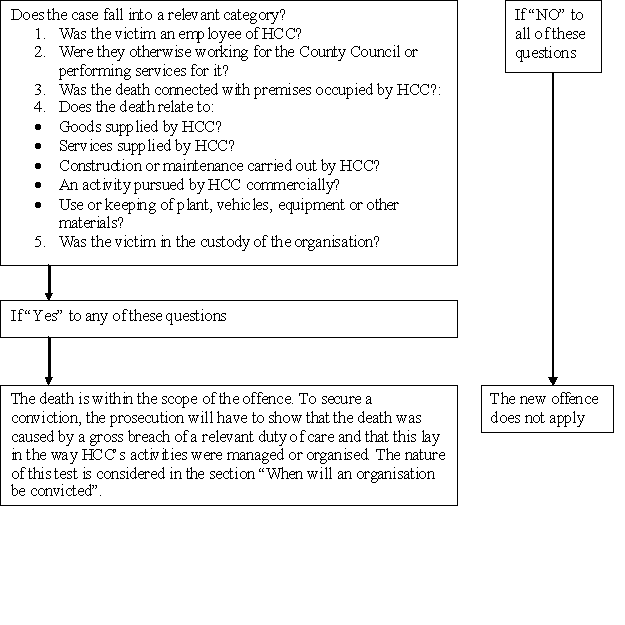
Working out if the new offence applies to a particular case: -

APPENDIX B - RISK ASSESSMENT