Archived decisions
Hampshire County Council | |||
Employment in Hampshire County Council Committee |
Item 8 | ||
23 July 2008 |
|||
European Office | |||
Report of the County Treasurer | |||
Contact: Jon Pittam, (01962) 847400; [email protected]
1 Summary
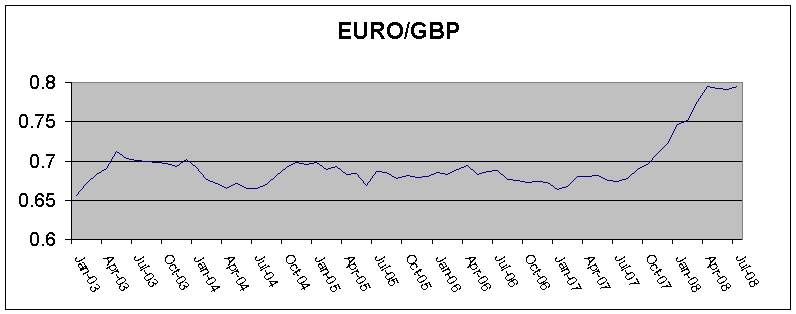
1.1 Two employees in the European Office have contracts with Hampshire County Council which are paid in Sterling. They work for Southern England Local Partners (SELP) in Brussels, which funds their costs. They both receive a Brussels office allowance of £5,000 per annum to cover any extraneous costs of living there. Since their appointment the Euro has appreciated against Sterling by about 18%.
Recommendation:
That the Brussels office living allowance be adjusted up or down each year from April 2008 in line with annual movements of the Euro against Sterling, subject to the costs being financed by SELP.
2 Background
2.1 The Committee is asked to consider whether to recognise the impact of the Euro's appreciation on the living costs of the employees working in the Brussels office.
2.2 Other options considered and not recommended include varying the salaries of the two employees, as set out in the report. The Committee may also wish to consider a more sizeable variation in the Brussels office allowance - for example raising it to £7,500 depending upon affordability for SELP.
2.3 Their contractual position is that such fluctuations in exchange rates are to be expected and may go in either direction. They are paid a £5,000 European allowance which may be taken to cover the impact of normal fluctuations as well as the specific costs of living in Brussels. However the exchange rate position now looks like a more long-term position as illustrated in the graph in Appendix1. Their salaries are worth some 18% less in spending power now in Brussels than they were when they started work. That could be reasonably be seen as an impact beyond the scope of the £5,000 allowance.
3 Options
3.1 Given that background, three options could be considered:
· Leave arrangements as they are, ie pay in Sterling with the employees accepting that fluctuations are a contractual risk. If any compensation is thought necessary due to a sustained period of adverse exchange rates, that could be achieved by adjusting the £5,000 allowance (by the same token should the Euro fall markedly in value that £5,000 allowance might be reduced).
· Pay salaries in euros, transferring the exchange rate risk to the County Council. This is awkward administratively, but could be done. It would require that the salaries be paid in sterling (amount as required to yield the Euro value) by the Council, then converted to Euros to be paid into a Belgian bank account (currently they are paid to a British bank account). The converted amount would take six days to clear. There would be a charge of some £4 per transaction (which the employees might be asked to pay). If this option was chosen, it would be necessary to fix a level at which to set the Euro for the purposes of converting existing salary into Euros. 68p would appear reasonable, as it represents both the level at the time the employees started and also a reasonable average level for the preceding years. The combined salaries and allowances of these posts with oncosts is £93,000, so to fix salaries at 68p per Euro compared with current market rates would cost SELP some £17,000 per year, funding for which would need to be identified and is likely to be unaffordable.
· Continue to pay the salaries in sterling, but vary that sterling salary according to the exchange rate. In administrative terms, that would be more straightforward than payment in Euros, simply requiring a frequency of review to be set and relevant payroll adjustments made. The cost would be the same as for paying in Euros, assuming the same starting point of adjusting to achieve the same purchasing power in Brussels as when Euros were worth 68p. However that could well raise equal pay issues.
3.2 Practice in European offices varies: East of England staff can if they choose be paid in Euros as in the second option; South West staff receive Sterling salaries on a fixed exchange rate of 1.5 Euros.
3.3 The key question, then, is who should take the risk of exchange rate fluctuations:
· the individual as with the current contracts
· or SELP (and effectively the County Council and other partners?)
3.4 if the risk is passed to the employer, how that risk should be compensated and could SELP (and its partners) afford the cost?
3.5 It is suggested that the pragmatic solution would be to adjust the European Office allowance in line with movements in the Euro on an annual basis at a rate which is affordable to SELP. That would suggest an uplift by 18% in the allowance from £5,000 to £5,900 (or rounded to £6,000) as at 1 April 2008 - with a further review in April 2009 and annually thereafter, automatically in line with the movement in the Euro against Sterling over the preceding year. The Committee could if it wishes rebase the allowance to a different figure - for example £7,500 if it was affordable to SELP, and then apply indexation from 1 April 2008.
Section 100 D - Local Government Act 1972 - background papers |
|||
The following documents disclose facts or matters on which this report, or an important part of it, is based and has been relied upon to a material extent in the preparation of this report. | |||
NB the list excludes: | |||
1. |
Published works. | ||
2. |
Documents which disclose exempt or confidential information as defined in the Act. | ||
TITLE |
LOCATION | ||
None |
|||
Appendix 1
Euro/GBP