
Archived decisions
2 |
Hampshire County Council | ||
Executive Lead Member for Children's Services (Education) |
Item 1 | ||
24 July 2008 |
|||
Budget Monitoring 2008/09 - Children's Services Department - Period 2 (May 2008) | |||
Report of the County Treasurer and the Director of Children's Services | |||
Contact: Gordon Shinn, (01962) 847545; [email protected]
1 Summary
1.1 This is the first revenue budget monitoring report for the financial year 2008/09. The report also outlines the final position for 2007/08 and the implications for 2008/09.
1.2 For 2007/08 the service underspent by £1,366,000 against the non-schools budget, compared to the balanced budget position reported in period 8 (when the 2007/08 revised budget and the 2008/09 budget were prepared). The service is allowed to carry forward 50% of this underspend to 2008/09 - £683,000.
1.3 Details of the 2007/08 variations within the two budget areas, Schools and Non-schools (Local Education Authority (LEA) and Children's Social Care), were provided in the Cabinet report on 23 June 2008 setting out the County Council's overall 2007/08 outturn.
1.4 Within the Schools Budget there is a carry forward of £6.4m of Dedicated Schools Grant (DSG), of which £2.0m relates to capital repairs, £1.8m relates to items agreed by Schools Forum and a further £2.6m relates to net underspends across various budgets.
1.5 In addition to this carry forward, the County Council has recently received notification of the final DSG allocation for 2008/09 of £671.582m. Whilst this is £719,000 lower than the DCSF estimate of the allocation, work had been done locally with up to date pupil number data such that most of the variance was anticipate in the budget figure used. As such, there is a further £82,000 of DSG available when compared with the budgeted figure used.
1.6 The final 2007/08 revenue outturn, therefore provides some flexibility for dealing with significant pressures in 2008/09. This paper examines some of these issues and how they are to be addressed.
1.7 At this stage it is too early to provide a detailed forecast outturn position for 2008/09. However, based on information received to date there are a number of areas of pressure and savings that have been highlighted. These, together with issues highlighted within the 2007/08 final accounts, and other ongoing or emerging pressures, require further analysis. Managers will prepare more detailed information as part of the June reporting cycle and the Executive Members will be informed of progress.
2 Recommendations
The Executive Lead Member for Children's Services (Education) is recommended to:
1 Note the final outturn position for 2007/08 for the department and the potential impact on 2008/09
2 Agree the current financial issues that are being addressed within the 2008/09 budget
3 Note the latest financial position of the Wessex Youth Offending Team and the CAMHS Trust
4 Approve the use of an additional £6.525m Dedicated Schools Grant in 2008/09 and 2009/10, as agreed by Schools Forum on 8 July 2008 and set out in paragraphs 3.7 and 3.8 of this report.
3 Final Accounts 2007/08
3.1 The County Council's final accounts were approved by Cabinet on 23 June 2008.
3.2 The outturn position for 2007/08 shows an underspend against non-schools budgets, as compared to the projected outturn against revised budget. The table below summarises the movement between period 8 (when forward budgets were set), period 10 (last reported figure to the Executive Lead Member) and outturn. The Cabinet report on 23 June 2008 includes an overall summary and an appendix detailing the main variations within the service. This appendix is attached for information, while the table below summarises the position:
Period 8 |
Period 10 |
Final Outturn* |
Change Period 10 to Final | |
£'000 |
£'000 |
£'000 |
£'000 | |
Schools Budget |
-1,173 |
-1,552 |
-2,584 |
-1,032 |
Non-schools |
0 |
-333 |
-1,366 |
-1,033 |
Total |
-1,173 |
-1,885 |
-3,950 |
-2,065 |
* The Schools Budget figure shows as `Nil' variance at year end in the Appendix. This is because DSG is automatically carried forward. The variances are shown for comparison purposes.
3.3 Cash limits are adjusted during the financial year to reflect adjustments to specific grants, including any allowed `carry forward' arrangements. It has been possible to carry forward specific Government grants to the value of £18.0m, made up of £6.4m of Dedicated Schools Grant (DSG) and £11.6m of other grants (primarily Standards Fund grants that carry forward automatically as they are given until the end of the following school year - see paragraph 3.13). The cash limit for 2007/08 was reduced to reflect these carry forward arrangements and, therefore, they are not shown in the accounts as underspends. These are detailed later in the report.
3.4 The County Council's policy is that 50% of any service `unplanned underspend' would normally be available to that service on a one-off basis in the following financial year. Therefore, according to the final outturn, £683,000 (being 50% of £1,366,000) has been approved by Cabinet for Children's Services to carry forward to 2008/09.
Schools Budget - Dedicated Schools Grant (DSG)
3.5 The total DSG underspend is £6.443m. This includes Children's Services and Policy and Resources elements of the Schools Budget and is made up of:
£000 | |
Capital expenditure met from Revenue |
2,019 |
Service underspend areas already identified to Schools Forum (Children's Centres (£1.531m), Combined Budget (£309,000)) |
1,840 |
Other underspends (see Appendix 1) |
2,584 |
Total |
6,443 |
3.6 The underspend on capital is as a result of a major programme of structural work relating to SCOLA (Second Consortium of Local Authorities) buildings of £1.7m plus other minor delays to be carried forward and added to the central spending limit in 2008/09.
3.7 At its meeting on 8 July 2008, Schools Forum agreed the following uses of these funds:
£000 |
£000 | |
Total available |
6,443 | |
Capital expenditure met from Revenue |
2,019 |
|
Underspends agreed by Schools Forum (Children's Centres - £1.531m, Combined Budget - agreed up to £280,000) |
1,811 |
|
3,830 | ||
Other Supply Cover (assumes repeat of 2007/08 overspend) |
200 |
|
14 - 16 Central costs |
27 |
|
227 | ||
Balance to be agreed as part of budget strategy for 2009/10 |
2,386 | |
Total |
6,443 |
3.8 In addition to this carry forward, the County Council has recently received the final DSG allocation of £671.582m for 2008/09 and this indicates there is a further £82,000 of DSG compared to the budget figure used locally. This will be added to the balance to be carried forward to be considered by Schools Forum as part of the 2009/10 budget process.
School Balances
3.9 Schools balances have increased by £5.8m overall since 31 March 2007, to £46,817,000. The detailed breakdown across sectors is summarised in the table below:
Balance |
Allocations |
Net |
Balance |
As a % of |
Change in | ||
£000 |
£000 |
£000 |
£000 |
% |
£000 | ||
Nursery |
408 |
1,417 |
1,269 |
556 |
39.24% |
148 | |
Primary |
21,133 |
315,469 |
314,376 |
22,226 |
7.05% |
1,093 | |
Secondary |
16,323 |
299,471 |
296,124 |
19,670 |
6.57% |
3,347 | |
Special |
3,119 |
31,358 |
30,112 |
4,365 |
13.92% |
1,246 | |
40,983 |
647,715 |
641,881 |
46,817 |
7.23% |
5,834 | ||
3.10 This reflects the official net book figure which will be presented in the County Council's accounts. However, due to various technical adjustments (primarily relating to `cheque book' schools where transactions cross the year end), the actual balances held in schools accounts is £47,049,000.
3.11 Despite the increases in balances,14 primary schools are in deficit (the same as at 31 March 2007, seven secondary schools (down from 11), and two special schools (up from one).
3.12 Within the Scheme for Financial Management of Schools there is a new provision for uncommitted balances above 5% in secondary and 8% in primary at the end of the financial year to be clawed back, subject to certain criteria as set out within the Scheme. This has been applied for 2007/08, with eight schools having surplus balances clawed back, at a total of just over £200,000. A separate paper on this agenda covers this in more detail.
Other grants
3.13 Other grants that have been carried forward into 2008/09 totalling £11.6m, of which £8.4m relates to Standards Funds. These have been achieved through the flexibility to spend over 17 months for Standards Fund grants, and slippage in relation to actual commitments being delayed beyond 31 March 2008.
3.14 The total carry-forward figure shown above includes various grants which were notified to the County Council very late in the financial year, and were not therefore allocated to the 2007/08 cash limit. These included:
· National Digital Infrastructure for Schools (Standards Fund) - an additional late allocation of £1.989m
· 14-19 Flexible Funding (Standards Fund) - an additional allocation of £0.07m
· Integrated Children's Services Grant - an additional allocation of £0.35m.
Impact on 2008/09 Budget
3.15 The key areas to be considered are:
· Schools Budget:
- Children's Centres and the Combined Budget, where Schools Forum has agreed carry forward of £1.8m to 2008/09.
- Out-County Placements and Statemented Pupils (SEN) budgets, where the budget has been reduced by £400,000 to provide investment in prevention and early intervention, as agreed by Schools Forum. These budget areas can be volatile, especially where dependant on tribunal decisions.
· Other Budgets:
- The carry forward of one-off funds of £683,000, being 50% of the department's 2007/08 underspend. This funding will be targeted at vulnerable groups, in accordance with the Department's key priorities. However, this will be subject to the service's overall financial position. Further details will be provided in the next report to the Executive Lead Member for Children's Services (Education).
- The ongoing impact of pressures identified at the time the 2008/09 budget was set e.g. Children in Care, in particular the achievement of the Hampshire Fostering Service investment.
- The achievability of savings targets set in the 2008/09 budget
- The monitoring and treatment of grants
- The financial impact on the Department of implementing the new `Services for Young People' strategy, following the transfer of the Connexions Service to the County Council. Notification has now been received as to the value of the Connexions grant that will be received by Hampshire for 2008/09 (£9.515m) following the further discussions outlined within the report presented to the Executive Lead Member for Children's Services (Education) on 13 March 2008
- Introduction of the `Child Trust Fund' top-ups for Children in Care with the County Council. An additional £12,800 will be received via the Area Based Grant in 2008/09 to fund these payments
- Implementation of the new `Personal Education Allowances' (PEAs) of £500 per year for every child in care at risk of not reaching the expected national standards of attainment. This requirement is funded from within the Care Matters element of the Area Based Grant.
4 Revenue Budget Monitoring Process Review
4.1 During 2007/08 a new budget monitoring process was implemented as part of a wider review of the financial framework for Children's Services. This has promoted integration, a more consistent approach across the whole department and improved reporting and forecasting.
4.2 During 2008/09 further changes will be implemented to further improve the reporting process following a corporate review of the budget monitoring process aimed at improving consistency across all departments of the County Council.
4.3 This review focused on implementing a risk based approach to budget monitoring. The intention is for quarterly default budget monitoring frequency, within the framework of the existing reporting timetable to the Executive Lead Member. More frequent budget monitoring will be determined according to a risk assessment based on five risk factors:
· Partnership/external reporting requirement
· Demand led/volatile activity
· Political priority/ reputational risk
· Major change e.g. legislative change, restructuring
· Recent/current projection is for a significant variance.
4.4 The new risk based approach to budget monitoring is being implemented across the three branches of the Department. Further work is still required to develop reporting information through Employee Self Service and the Business Improvement Management Information system, and the Department has engaged with the challenges to enhance financial skills of managers through the commitment to develop a financial training strategy for managers to support the corporate training provision developments. Progress in these areas will be reported within the next report to Executive Lead Member for Children's Services (Education) in October.
5 Revenue Budget Monitoring 2008/09 as at 31 May 2008 (Period 2)
5.1 As part of the 2008/09 budget setting process a number of growth pressures and opportunities for budget redeployment were outlined within the Revenue Budget 2008/09 to 2010/11 report to the Executive Lead Member for Children's Services (Education) on 23 January 2008. Appendix 2 summarises these.
5.2 At the time the budget for 2008/09 was agreed the grant for the transfer of the Connexions service to the County Council had not been agreed and assumptions were made about the estimated amount and the impact this would have on establishing the Services for Young People, incorporating the reconfiguration of the existing Youth Service. The actual grant announced for 2008/09 is £9.5m, in line with expectations. It is included within the Area Based Grant.
5.3 Further work continues on finalising the Services for Young People team structures within the constraints of the overall budget available for the service. However, it is currently estimated that there are between 30 and 40 vacant practitioner posts within the Consortia teams (against an estimated base figure of 200.5 fte). A county-wide recruitment campaign concentrating on Services for Young People will be undertaken by the Department during September. In view of the large number of vacancies it is anticipated that budget savings will be achieved this year. A more detailed analysis of the financial impact on the wider service will be provided in the next report.
5.4 The two most significant areas of investment in 2008/09 are on children in care and social work resources. Progress on the children in care investment is detailed below. The additional £600,000 on social work resources was dependant upon equivalent savings being achieved in relation to the setting up of the new contact centre and the associated restructuring within children's and families teams.
5.5 For 2008/09, county-wide recruitment campaigns are being run on a quarterly basis by the Department to ensure that resources are being targeted where they are most needed. The April 2008 campaign (against which 13fte social worker vacancies within field work teams were being actively recruited to), resulted in 32 applications being received and 11 of the 15 offers which were made to candidates being accepted (1 internal and 10 external appointments). Most of the appointed candidates were newly qualified social workers. During the first quarter of the year (April to June), five social workers left the employment of Hampshire County Council.
5.6 Further county-wide recruitment campaigns for field work social workers commenced in June (outcomes currently awaited), and are planned for September, December and March.
5.7 The budget growth pressures for 2008/09 were based on various assumptions around forecast activity changes in service provision. As part of the budget monitoring process activity levels will continue to be monitored to support the financial reporting, and information for the period March 2007 to the end of May 2008 is shown in Appendices 3(a) and 3(b). The current presentation of this information is currently being revised, with a view to also providing some additional performance/outcome indicators to further support the budget monitoring reporting process.
5.8 Further work is also underway to enable the Department to incorporate summarised information on staff recruitment and retention within the department (by branch).
5.9 Managers will continue to review all of the budget redeployment proposals outlined in the budget setting process, and, where necessary, alternative savings will be identified.
5.10 For period 2, detailed budget monitoring has not been prepared because:
· Some allocations of growth and savings were dependent on the final outturn for 2007/08 and more work on determining detailed allocations is underway
· The carry forward proposals on grants were also subject to approval of the final accounts and, therefore, these are not yet reflected in the 2007/08 cash limits
· The amount of corporate funding which will be provided to Children's Services for 2008/09 to fund the impact of Pay and Benefits is still to be confirmed
· Further review of Government grants will ensure that their use is maximised.
5.11 Attention has, therefore, focused around the higher risk, demand-led budget areas, in particular Home to School Transport (HTST), Special Education Needs (SEN) and Children in Care. Some early information on these areas is set out below.
5.12 On HTST there are some early indications of demand pressures and it is anticipated that the significant recent price rises, particularly on fuel, will feed through into contract prices later in the year. This will be reported in more detail in the next monitoring report.
5.13 Pressures on SEN are anticipated though not yet quantified, as the numbers of out county placements have increased. This is being closely scrutinised and will be reported on in more detail in the next report.
5.14 Children in Care budgets are being closely monitored to ensure that any potentially significant variations as a result of changes in activity levels are identified, in particular to consider the potential impact of the additional financial investment into the Hampshire Fostering Service.
5.15 The graph below shows the change in the numbers of children in full-time care over the last twelve months. During 2007/08 the number reduced to 997 (at its lowest point in September 2007), but has slowly increased over recent months (with some minor fluctuations). As at the end of May 2008 1,030 children were recorded as being in the care of the County Council.
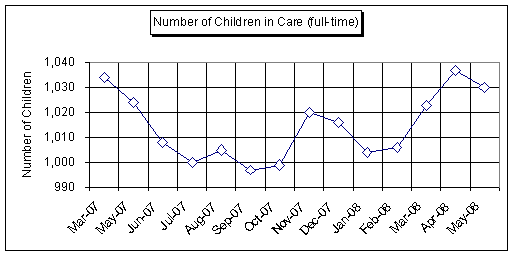
5.16 Most of this increase has resulted in an additional use of fostering placements, and the actual number of children placed with the Hampshire Fostering service increased significantly over the period January 2008 to May 2008 (from approximately 561 to 593), exceeding the anticipated growth built into the fostering investment business case for 2008/09. This is causing additional financial pressures to the service beyond that assumed within the budget setting process.
5.17 This increase has been managed through the retention of existing foster carers. Recruitment of new carers following the introduction of the new enhanced allowances and skills fees is still in its early stages, although early reports of increased numbers of enquiries is encouraging. The impact of the additional investment is not, therefore, expected to realise cashable savings against Independent Fostering Placements (IFPs) until later in the year as new carers are recruited and existing carers are retained by Hampshire, building greater capacity and placement choice.
5.18 The growth in the overall numbers of Children in Care has, therefore, resulted in the number of children placed with IFPs increasing since March 2008. As at the end of May 2008 there were 151 IFP placements, a net increase of 8 from 143 as at the end of March 2008. This change consisted of 20 new placements less 12 ended placements.
5.19 The fostering budget for 2008/09 has been set based on a number of assumptions around expected growth in activity levels and target reductions in IFPs as part of the Hampshire Fostering service investment business case. The following table shows some of the key activity areas, compared with the budgeted average activity, and the target client numbers as at March 2009 (*as per the business case assumptions):
Provision |
Client numbers at March 2007 |
Client numbers at March 2008 |
Client numbers at May 2008 |
Budgeted average activity during 2008/09 |
Target Client numbers at March 2009* |
In-house Fostering Placements |
541 |
592 |
593 |
548 |
566 |
Independent Fostering Provider (IFP) |
142 |
143 |
151 |
134 |
124 |
5.20 At the end of May the number of children placed with IFPs exceeded the March 2009 target by 27. However, the number of in-house placements to IFP placements does reveal that higher proportion of children are being placed with Hampshire Carers than more expensive IFPs, compared with the base line position against which the business case assumptions were made.
Provision |
Business Case Baseline |
Client numbers at March 2008 |
Client numbers at May 2008 |
In-house Fostering Placements |
534 |
592 |
593 |
Independent Fostering Provider (IFP) |
142 |
143 |
151 |
In-house placements : IFPs |
3.8 |
4.1 |
3.9 |
5.21 A more detailed analysis of the financial forecasts will be made at the end of June to establish the impact of these activity changes. Detailed monitoring will also be undertaken to establish the impact of the fostering investment in terms of progress being made in the recruitment and retention of foster carers following the introduction of the enhanced allowances and skills fees which are now being paid.
5.22 Currently the number of Children in Care placed within purchased residential placements (Non-County placements) has remained since March 2008 at 54 following reductions in numbers during the later months of 2007/08. This is slightly lower than budgeted for in the 2008/09 budget setting process.
5.23 As these placements are demand led, and often high in cost, these will continue to be reviewed closely as part of the overall Children in Care monitoring.
Provision |
Client numbers at March 2007 |
Client numbers at March 2008 |
Client numbers at May 2008 |
Budgeted average activity during 2008/09 |
Non-County Placements (NCP) |
||||
· Non-disability |
19 |
14 |
14 |
|
· Children With Disabilities (CWD) |
38 |
40 |
40 |
|
Total NCP |
57 |
54 |
54 |
57 |
5.24 In addition to the investment within the Hampshire Fostering Service, work continues to implement other aspects of the Department's Children in Care Commissioning Strategy'. This included the following elements:
· To increase the capacity of in-house foster care in order to be able to reduce the level of purchased care
· To review some residential care services to consider options to develop intensive community support, including those on the edge of care
· To reduce the level of purchased residential care by changing the purpose of some in-house units
· To reinvest in preventative services to those on the edge of care and to be able to better support care placements under pressure.
5.25 Budgets have been re-aligned to reflect this strategy and the decisions made (e.g. the change in use of two children's homes to the provision of intensive support services). These approaches are expected to further impact later in the year, as the services continue to develop.
5.26 An update, including a more detailed progress report on the achievements of the fostering investment, will be included in the next budget monitoring report.
6 Value for Money - Key Performance Indicators `The Story so Far'
6.1 The Comprehensive Performance Assessment (CPA) process has become increasingly focused on the management and delivery of value for money (VFM), through the Use of Resources assessment.
6.2 As part of the Corporate Performance and Efficiency Group, nine key performance indicators have been selected by the Department to be embedded within the Corporate performance reporting process. These performance indicators focus around the areas of Economy, Efficiency and Effectiveness. The nine value for money performance indicators selected focus on some of the highest spending areas within the Children's Services budget (excluding schools), and are as follows:
· Economy
- Unit cost of foster care (in-house compared to external provision)
- Unit cost of transporting a pupil to school
- Unit cost of low incidence statements (for special educational needs pupils)
· Efficiency
- Children in Care, the use of internal provision compared with external provision (foster care and residential services)
- Education and Inclusion services for children who are excluded or have a persistent absence record
- Children's Centres reaching children under five
· Effectiveness
- School Balances outstanding at year end compared with the number of pupils at that school
- Deprivation Funding v Performance of Free School Meal pupils (LAA indicator)
- Services for Young People (this will be developed over time as the new service becomes established)
6.3 Work is currently underway to determine a base line for these performance indicators for the 2007/08 financial year against which quarterly monitoring will be undertaken during 2008/09 onwards to demonstrate progress being achieved in these areas. Appendix 4 outlines the base line unit costs calculated so far.
7 Partnerships
7.1 The County Council is seeking to further develop best practice in terms of financial reporting. In part this involves ensuring significant partnerships are regularly reported. Within Children's Services there are two partnerships that fall within this category - Wessex Youth Offending Team (YOT) and the Hampshire Children's Trust.
Wessex Youth Offending Team (YOT)
7.2 The total budget for Wessex YOT as agreed by the Wessex YOT Management Board on 23 June 2008, is £9.2m in 2008/09. It is funded primarily by the Youth Justice Board and partner organisations (whose contributions may be in cash and/or contributions in kind). The Children's Services contribution for 2008/09 is £2.23m.
7.3 The Wessex YOT Management Board receives regular finance and performance reports. At its meeting on 23 June 2008 the Board also received the 2007/08 final accounts, which showed an overspend of £18,500. This reduced the surplus held in reserve to approximately £11,500.
The Comprehensive Child and Adolescent Mental Health Services (CAMHS) Trust
7.4 At its meeting on 5 June 2008 the Trust's Management Board received a report on its final financial position for 2007/08 and budget for 2008/09. In 2007/08 there was an underspend of £0.8m. Regular reports to the Trust identified potential underspends and agreed that this surplus would be carried in full to 2008/09 to meet the costs of `one-off' projects.
7.5 The Trust's total budget for 2008/09 is £3.5m. This is made up of partner contributions of £2.7m and the surplus carry forward from 2007/08 of £0.8m. The Children's Services annual contribution following the implementation of phase II of the CAMHS Trust is £1.67m.
7.6 Some other services provided by, or contracted through, the Primary Care Trust will be brought into the pooled budget later in the year.
8 Consultation
8.1 The forecast outturns are based on ongoing financial monitoring in consultation with partner organisations where appropriate e.g. Youth Offending Team, and CAMHS Trust.
9 Legal implications
9.1 None.
10 Financial implications
10.1 The financial implications are set out in the report.
11 Personnel implications
11.1 None.
12 Impact assessment
12.1 The proposals contained in this report are not considered to be discriminatory .
13 Crime prevention issues
13.1 None.
14 Views of the Local County Councillor
14.1 No specific consultations or views sought.
15 Conclusion
15.1 The 2007/08 outturn shows an underspend against the non-schools budget of £1.366m. This will provide some flexibility for dealing with significant pressures that are emerging in 2008/09. However, it is too early to provide detailed analysis. Executive Members will be kept informed of the financial position and the next formal report to the Executive Lead Member for Children's Services (Education) will be in October 2008 (based on August figures).
LINK(S) TO CORPORATE STRATEGY | ||
Yes |
No | |
Hampshire safer and more secure for all |
X |
|
Maximising well-being |
X |
|
Enhancing our quality of place |
X | |
Section 100 D - Local Government Act 1972 - background documents
The following documents discuss facts or matters on which this report, or an important part of it, is based and have been relied upon to a material extent in the preparation of this report.
NB the list excludes:
1. Published works.
2. Documents which disclose exempt or confidential information as defined in the Act. - none
TITLE
Schools Forum report to 8 July 2008 meeting
http://www3.hants.gov.uk/education/education-meetings/education-meetings-schoolsforum.htm
