
Archived decisions
APPENDIX 1 Hampshire Childcare Sufficiency Assessment Executive Summary March 2008 Written by: Tracey Messer, Strategic Manager (Childcare and Business Support) Tracey Sanders, Head of Early Education and Childcare Unit Matthew Charters, County Childcare Coordinator
|


Contents |
Page |
List of Tables (Executive Summary) |
|
Hampshire Childcare Sufficiency Assessment Executive Summary |
1 |
Hampshire Childcare Sufficiency Assessment |
11 |
Hampshire Childcare Sufficiency Assessment Methodology |
14 |
Demand Data Collection |
15 |
Results - The Hampshire Demographic Context |
17 |
The levels and location of childcare provision in: |
Section |
Basingstoke and Deane |
BD1 |
East Hampshire |
EH1 |
Eastleigh |
E1 |
Fareham |
F1 |
Gosport |
G1 |
Hart |
H1 |
Havant |
HV1 |
New Forest |
NF1 |
Rushmoor |
R1 |
Test Valley |
TV1 |
Winchester |
W1 |
Appendix 1 Provider update form |
|
Appendix 2 Parental survey letter and questionnaire |
|
Appendix 3 4Children Consultants report "A dialogue with employers that informs and stimulates demand for day care services in the Hampshire County Council area" |
List of Tables (Executive Summary)
Table 1. Childcare Sufficiency - places analysis by local district authority
Table 1a. Ratio of childcare places 2007
Table 2. Ratio of childcare places and children 0-16 years
Table 3. Hampshire ratio of childcare places - children 0-4 years
Table 4. Hampshire ratio of childcare places - children 5-16 years
Table 5. Hampshire full day care, fees per hour.
Hampshire Childcare Sufficiency Assessment Executive Summary
The Hampshire Childcare Sufficiency Assessment has been undertaken as a requirement under the new duties placed on Hampshire County Council by Section 11 of the Childcare Act 2006. The assessment measures the childcare market and tests whether the supply and childcare places are sufficient to meet the demand from parents in each locality.
Supply has been measured through an analysis of the Ofsted1 registered childcare data held on the Hampshire iCHIS2 database and supplemented by a survey of childcare providers in the Summer Term 2007 .
Demand has been assessed through a postal survey and through focus groups conducted with parents throughout Hampshire. This survey has also been completed through targeted consultation with families of children aged 0 - 3 years and families of children with additional needs undertaken by Hampshire Children and Families Forum. In addition the Teenage Pregnancy Team coordinated three focus groups of young people who had, or were about to have, a child. The Ethnic Minority Achievement Traveller Service also held events with 40 minority ethnic families to seek their views.
As a result of the survey and focus groups a total of 2,358 parental views have been considered which represents a 22% response rate from the sample group. The childcare postal survey was conducted in summer 2007 with 11,051 families whose children were entering Year R, Year 2, Year 6, Year 9. There was a 15% return rate.
The 4Children organisation was also commissioned to ascertain the needs of key employers and promote a resource pack for future use to enable further dialogue with employers.
Current childcare provision
Childcare in Hampshire, according to Ofsted's Early Years Profile confirms that Hampshire provides 3% of childcare places nationally with 2.2% of the national child population residing in Hampshire.
The table overleaf summarises the childcare stock by places and by the number of settings in Hampshire by each district council. It shows that 28% of childcare places are offered by full day care settings3, 24% by childminders4, 21% through sessional care5, 15% by out of school childcare settings6, 10% by holiday schemes7 and 2% by crèches8.
Over recent years the proportion of places provided in full day care settings has increased whereas the proportion in session day care settings has reduced both nationally and in Hampshire.
Childcare Sufficiency - places analysis
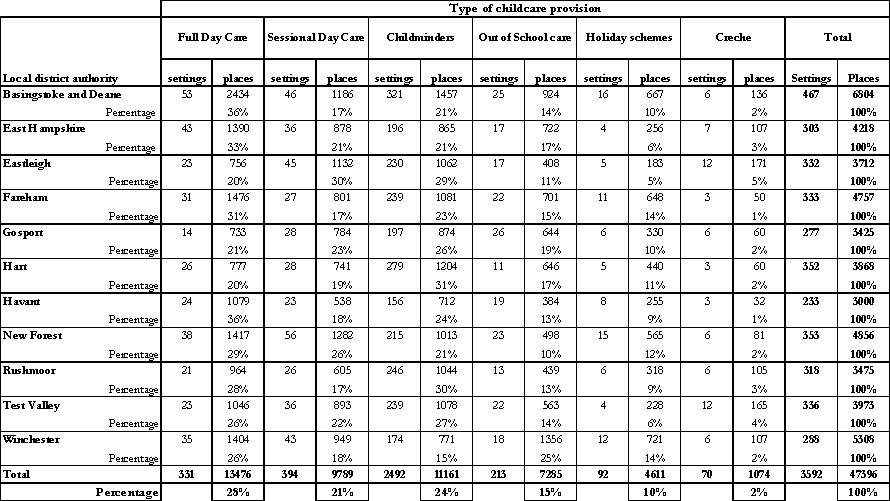
Executive Summary Table 1
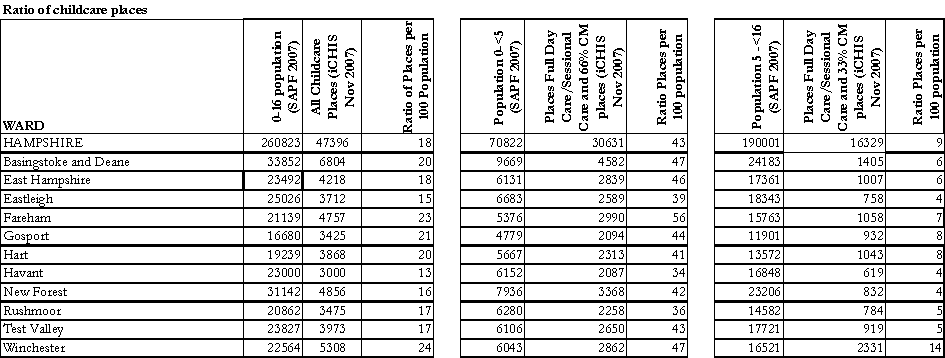
Executive Summary Table 1a.
Currently the number of childcare places available in Hampshire provides a ratio of 18 places per 100 children (0-16 years). The parental survey confirmed that approximately 32% of those responding preferred not to use formal types of childcare and used family and friends to meet their needs. Taking this into account (by removing these children from the estimated population requiring childcare) it suggests that the current stock of places would provide a ratio of 27 places per 100 population indicating that around 1:4 children could access childcare places.
Hampshire childcare places ratio - children 0 - 16 years
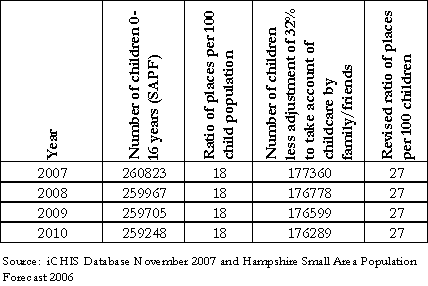
Executive Summary Table 2
However when determining places by specific age group the ratio of places per child varies significantly and also will be determinant upon the types of places available9.
Analysing the stock of childcare places by age group suggests that generally, Hampshire provides for the under 5s a ratio of 43 places per 100 children .
Hampshire childcare places ratio - children 0 - 4years
Year |
Number of children 0-4yrs (SAPF) |
Ratio of places per 100 child population |
Number of children less adjustment of 32% to take account of childcare by family/friends |
Revised ratio of places per 100 children |
2007 |
70822 |
43 |
48159 |
64 |
2008 |
71363 |
43 |
48527 |
63 |
2009 |
71797 |
43 |
48822 |
63 |
2010 |
71813 |
43 |
48833 |
63 |
Note: Childcare Places represents - two thirds (66%) childminding places plus all full day care and sessional care | ||||
Source: iCHIS Database November 2007 and Hampshire Small Area Population Forecast 2006 | ||||
Executive Summary Table 3
Within the 5 - 16 year age range the ratio falls significantly to 6 places per 100 children rising to 9 when taking account of those families using family or friends.
Hampshire childcare places ratio - children 5 - 16 years
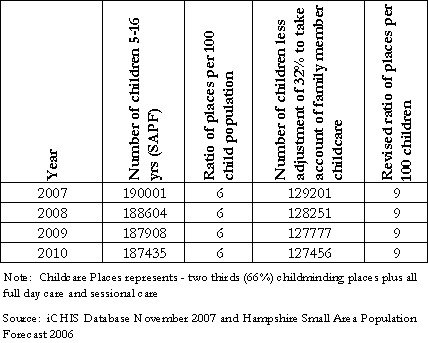 Executive Summary Table 4
Small Area Population Forecasts10 indicate that the number of children aged between 0 - 16 years is stable falling by only 1609 (0.69%) from 260,845 in 2007 to 259,236 in 2010.
However for children in the age range 0 - 4 years are forecasted to increase by about 1,000 over the next three years from 70,828 in 2007 to 71,806 in 2010 however the 2011 forecast indicates a drop by some 300 children in this age range.
The current ratio of places to children over five years suggests that further development of out of school care including holiday care is required to meet needs even when taking into account those families whose preference it is to use family and friends for childcare.
Hampshire has been, and continues to be, well provided with early years education places. In 2007, 98% of 3 and 4 years olds were accessing free early years education. Hampshire is a pilot authority for the "extended flexible entitlement"(EFE) which enables children to access 15 hours early years education over 38 weeks per year in a flexible way. This has provided a useful means to access the changes required by childcare settings to accommodate offering additional hours flexibly. It is intended that by 2010 all nursery providers will be able to offer the EFE. A recent survey of settings registered to provide early years education showed 24% are running at below capacity and nearly 12% suggested are not able to meet the demands of their locality because of inadequate capacity.
The times of day that provision is provided
The iCHIS database indicates that there is about 17% of childcare settings that open Monday to Friday between 8am and 6pm. Over a quarter (26%) are open before 8am and 11% open after 6pm. At weekends only 1% of settings are available mostly through Childminders. Out of Schools clubs offering breakfast and after school activities also help to enhance the childcare provision. As schools continue to develop their "menu of varied activities" there are likely to be many further opportunities for families seeking care for children after the school day. This will need further careful monitoring.
Overall Fees charged in Hampshire
The outcomes of the surveys conducted with Providers and Parents were remarkably similar. Both described a wide variation in the fees charged for childcare but the median average across the county was nearly equal. The table below summarises differences across localities. The county average for charges made by providers is £3.37 per hour. Parents reported a county median of £3.46 per hour.
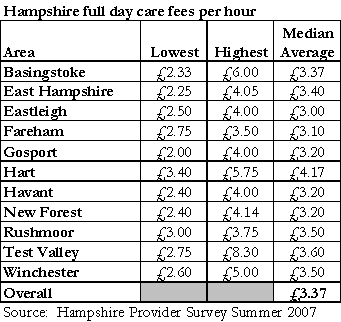
Executive Summary Table 5
Parents views: Key messages from the Parental survey and focus groups
An analysis of parental demand indicates the following areas of need:
More provision during school summer holiday: The parental survey indicated that both those who currently used childcare and those who do not, considered there to be a lack of provision throughout the Summer holidays.
More local provision: The parent survey confirmed that there is a preference for childcare to be provided within 1 to 3 miles of home. Further analysis of the needs of families in rural areas is required as there is limited provision in these areas and transport issues that often precludes childcare being used.
More out of school provision: Parents indicated that there is increased demand for this type of childcare and further development of provision is required. This will need to be done in conjunction with the extended schools programme.
More provision is required to support different times of care needs and unsociable hours: The parental survey indicated a high number of parents/carer not using childcare as it was not offered at the times it was needed. Within Hampshire there are urban areas where employment takes place over 24 hours per day such as in the health, retail and leisure industries. The parental survey indicated that where such patterns of employment occur there is a reliance on family and friends to provide the care. Further consultation with employers and those working shifts and unsociable hours would help to understand if childcare is a barrier or difficulty in retaining or securing employment.
Greater affordability: The parental survey and the provider survey indicated a high awareness of working tax credits and confirmed that families did take up childcare tax credit. Further analysis of the pricing structures of the different models of childcare needs to be conducted to assist in strategies to support both families of low income where price is a barrier and also ensure the sustainability of a high quality childcare.
Childcare for children with special needs: The parental survey and focus groups indicated that parents with children with particular needs often found it difficult to find childcare to meet their child's needs. This is despite Hampshire settings offering an inclusive model of practice. In 2007-2008 funding was made available to support families of children with SEN to access a childcare place and early evidence is suggesting this has been very successful for both the parent and the provider. The scheme is being evaluated in summer 2008 and the results will help develop services in the future.
Consultation on the assessment of childcare market
The local authority is required to consult on the findings of the assessment. A staged approach has been taken.
During February 2008, the Early Education and Childcare Unit conducted a series of presentations throughout Hampshire for childcare providers and organisations engaged in supporting childcare to receive the draft findings and gather initial comments on the results of the sufficiency assessment.
In March 2008, a copy of the childcare sufficiency assessment was made available on the Hampshire County Council website and views sought through an email consultation. Schools were made aware of the consultation process through a schools communication and invited to comment on the draft. The views of governors were sought through the Governor Services communications and attendance at Governors Forum and Extended Schools coordinators forum enabled views from this group of officers to be included.
Copies of the draft assessment and email consultation were sent to Chief Executives and Directors of Planning for each district and borough council in Hampshire for comment.
The sufficiency assessment has also been made available to the major employers in Hampshire and recognised business networks.
The next steps
This assessment will now be used to focus resources so that the supply and type of childcare places in local areas can be more closely aligned. This will be achieved by:
1. Ongoing monitoring of changes in supply:
· quarterly updates of settings that have closed or are proposing to open reported at postcode level.
2. On-going monitoring in demand:
· feedback through the Children's Information Service, particularly from the outreach team, of the types of childcare being requested and the types that are proving difficult to secure
· feedback through parental surveys from existing providers;
· feedback through associated local consultations e.g.: extended services and children's centres
· more detailed analysis of different geographical accessibility of different types of childcare.
3. Securing supply
· publicising areas of insufficient supply as business opportunities and actively promoting these locally.
4. Strengthening the provision of the childcare information
· collaboration with employers to help them understand the childcare support available to employees and the impact on childcare in recruitment and retention of staff.
Priorities for action:
The development of summer holiday provision: Summer holiday provision is a priority across the county and the Childcare Development Workers will work with Extended Schools Coordinators to determine the best way services can be provided to maintain quality and viability.
The development of provision within specific localities: The parent survey confirmed that there is a preference for childcare to be provided within one to three miles of home. The Childcare Development team needs to undertake further analysis of the needs of families in rural/isolated communities and help resolve transport issues that may be an obstacle in childcare being used.
The development of 0-3 childcare: As nursery education expands to 15 hours, the proportion of hours taken up by 3 and 4 years olds will place pressure upon under threes places and development of 0-3 places in some areas of the county is likely. The Childcare Development team will undertake further analysis of this predicted trend and enhance the distribution of the childcare places according to need.
Out of school: Parents indicated that there is an increased demand for this type of childcare and further development of provision is required. Childcare Development Workers will work with Extended Schools Coordinators to determine the best way of delivering services to maintain quality and viability.
Time of care available/unsociable hours: Further consultation with employers and those parents working shifts and unsociable hours needs to be undertaken to understand if childcare is a barrier or difficulty in retaining employment.
Costs and charges:. Business Support Officers will continue to work with settings to develop financial models of best practice which supports quality of provision and affordability. A review of a childcare subsidy and how this could be applied to assist families of low income will be undertaken.
Limits of the survey and further investigations required:
The childcare sufficiency assessment has raised topics for further research and clarification that will help increase our understanding of the childcare market in Hampshire. For example, exploring childcare needs in rural areas and the extent to which childcare presents a barrier to accessing shift work
It is important to bear in mind that the majority of respondents were employed in professional or managerial roles and further analysis of rural, low income and minority groups needs to be undertaken.
The survey data needs to be cross referenced in order to understand why parents use different types of childcare and why they use childcare more than 5 miles away from home. Additionally identifying the reasons for parents using `friends' or `family members' for their childcare provision and exploring how parents who were `unaware' of the availability of tax credits can be supported, is needed