
Archived decisions
Agenda Item: 5
MAIN REPORT
1) Purpose of the Report:
1.1. To provide an update on the implementation the Trade Waste Control measures and the findings of the Implementation and policy review.
1.2. To improve the present scheme which restricts householders who have access to both a commercial vehicle and a second vehicle and to close a potential loophole for trade waste abusers.
2) Contextual Information:
2.1. Hampshire provides a network of 24 HWRCs for its 1.2 million residents, which receive 4.5 million visits per year.
2.2. A range of measures were introduced on 14 February 2008 in order to impose controls on the amount of trade waste that was being illegally deposited via the HWRC network. These included the introduction of a permit scheme for commercial type vehicles (where that was the only vehicle available to the resident), restrictions on trailer sizes and the introduction of a formal Waste Acceptance Policy.
2.3. These measures were introduced following detailed investigations which identified that around 17% of all waste deposited at the HWRCs was from a trade waste source. The intention of these measures is to reduce the amount of trade waste entering the sites by 75% and thus saving the Waste Disposal Authorities (Hampshire County Council, Portsmouth City Council, Southampton City Council) in the region of £1 million per annum in disposal costs.
2.4. As part of the implementation programme, a review was planned. This review was undertaken to assess the implementation process and identify lessons to be learnt. It evaluated the initial impacts of the policies and has identified amendments to improve their effectiveness.
3) Key Issues:
3.1. The review concluded that:
a) the HWRC Trade Waste Controls implementation process had been successful; and
b) the initial anecdotal and quantitative data suggests that these measures are working, in terms of reducing the quantities of trade waste being received, although it is too early to draw firm conclusions.
3.2. The review also identified that:
a) the Permit Scheme and the trailer size restrictions imposed by the Vehicle Acceptance Criteria have led to a number of complaints from householders whose normal, and genuine, usage of the HWRC network has been affected;
b) this led to an early stage policy amendment to remove the larger trailer size restriction in favour of including oversized trailers in the permit scheme;
c) the other concerns centred on the restricted eligibility for a `commercial vehicle' permit and the limited number of visits that each of these permits allowed;
d) customers supported the introduction of these new measures and their perception was that they were having a positive effect on user experience; and
e) the concerns that these measures would cause a dramatic increase in flytipping incidences were, to date, unfounded.
4) Policy and Implementation Review:
4.1. The review concluded that, despite some difficulties, the Permit Scheme and original trailer size restrictions were introduced successfully. The review identifies a number of lessons that can be learned from the experience of this complex implementation process and makes recommendations for consequential adjustments to the policy.
4.2. The revised Permit Scheme could either be implemented along with the changes to winter opening hours on 1 October 2008 or delayed to allow for consultation on the proposed changes. On balance it is considered preferable to implement the change as soon as possible.
4.3. These recommendations include a change to the Permit Scheme to enable householders with a second vehicle to apply for a permit for their commercial type vehicle. Reducing the period allowed on short-term hire agreements from seven days to two to three days with officer discretion to extend is also recommended. This is to remove the potential loophole of a seven day hire agreement still being cheaper than the minimum rate for waste disposal at a transfer station.
5) Initial Data - Customer perception:
5.1. Two customer surveys have been conducted since the implementation of the trade waste control measures. These showed that 11% of those surveyed had been affected by these new measures, of which 5% were commercial vehicle users and 6% trailer users.
5.2. The survey results indicated high levels of support (up to 89%) for this type of initiative.
5.3. It was perceived by 35% of site users that there were fewer vans on sites than before the measures were introduced.
5.4. Only 7% of site users reported having queued for more than 15 minutes to enter a site, compared with 19% in a 2007 survey.
6) Initial Data - Quantitative:
6.1. As the Permit Scheme has only been in operation since 14 February 2008, with enforcement from the end of March 2008, it is not yet appropriate to fully evaluate whether the scheme will achieve the stated targets of:
a) 75% reduction in delivered trade waste entering the sites; and
b) equivalent cost savings resulting from tonnage reduction.
6.2. It was forecast that up to 20,000 permits would be issued within the first year of the scheme. Hantsdirect has handled over 19,000 waste related calls and emails (from the online application system) since the permit applications were launched at the beginning of January 2008. Of these contacts, 65% resulted in a permit being issued (over 12,000 permits).
6.3. Early indications, using the four months of data available, are that these measures are having a positive effect on controlling the trade waste entering the sites. Overall tonnage is down 12.92%, with amenity waste (material normally landfilled) down by 21.64%. The delivery of green waste has not been impacted as inputs of this material have grown by 1.98%.
Summary from the Introduction of HWRC Trade Waste Controls - March to June 2008
|
Base Forecast |
Actual Performance |
% deviation |
|
Tonnes |
Tonnes |
|
|
|
|
|
Garden Waste |
24,837.20 |
25,328.70 |
1.98% |
Amenity Waste |
37,438.04 |
29,334.59 |
-21.64% |
Asbestos |
191.83 |
122.18 |
-36.31% |
Rubble |
15,426.61 |
13,010.34 |
-15.66% |
Wood |
4,994.85 |
4,379.66 |
-12.32% |
|
|
|
|
Total |
82,888.53 |
72,175.47 |
-12.92% |
|
|
|
|
Overall tonnage reduction |
|
10,713.06 |
|
|
|
|
|
% reduction |
|
12.92% |
|
6.4. These initial figures, based on the first four months' data, indicate the positive effects of the scheme to date. However, other factors such as the early timing of Easter and the unsettled spring weather, may have influenced user behaviour so it would be premature to finalise the assessment now. The overall effectiveness of these new measures will be reviewed and reported on once a full 12 month data set is available.
7) Flytipping:
7.1. The prospect of an increase in flytipping incidences was raised as a concern by Members and district authorities prior to the launch of these measures, and subsequently by residents.
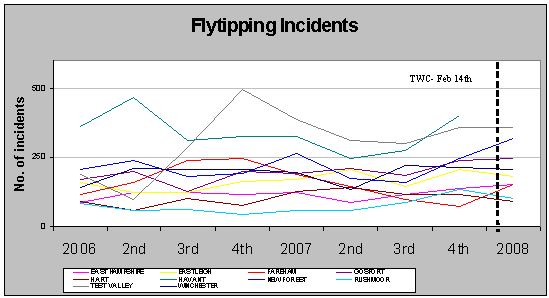
7.2. Formal reviews and data analysis involving the district authorities undertaken since the introduction of these measures suggest that these increases have not materialised to date.
7.3. Evaluation of the Environment Agency's FlyCapture data confirms a steady increase over time but with no overall pattern of increase since the Trade Waste Control measures were introduced.
7.4. Waste and Resource Management officers will be working with enforcement agencies, such as the Police, the Environment Agency and the Vehicle and Operator Services Agency, in order to tackle incidences of flytipping and other misuses of the HWRC network.
8) Customer Complaints:
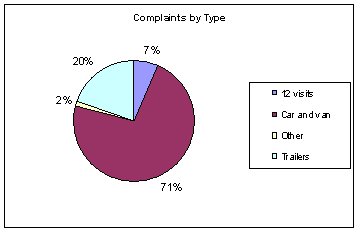
7.5. Over 1,000 enquiries had been received by 30 July 2008 regarding the introduction of these Trade Waste Control measures, of which 316 were formal complaints. Of these, 71% related to the non-issuance of a permit where there was a second vehicle in the household and 7% regarding the limitation of the number of visits per permit. 20% concerned the use of oversized trailers but these have reduced to virtually zero since they were included in the permit scheme in early May.
9) Legal Advice
9.1 Internal legal advice was obtained during the development of the Trade Waste Control policy. In reviewing the scheme Counsel's advice was also sought, particularly in relation to some detailed points raised.
9.2 This advice broadly supported the Authority's right to address the issue of trade waste as long as it did not impact on the ability of genuine householders to use the sites.
9.3 It was recognised that it was important to retain flexibility in the operation of the scheme to deal with special circumstances.
10) Outline of Options:
The Trade Waste Controls review identified that the current policy has inadvertently impacted on a section of genuine HWRC users, ie commercial vehicle owners with a second vehicle who are not currently allowed a permit. Except in very limited circumstances, the policy takes no account of the alternative vehicle type or its ability or suitability for carrying waste. Therefore the following options were evaluated as potential amendments to the Permit Scheme policy.
10.1 Option 1: No Change
a) This option would leave the current policy unchanged and subject to future review once a full year's worth of data was available.
10.2 Option 2: Limited permit for two vehicle households
b) This option could see the introduction of a new permit that residents from multiple vehicle households could apply for. This permit could allow a fewer number of visits than the existing permit; for example six per year.
10.3 Option 3: Only accepting recyclable materials in commercial vehicles
c) This option would see the removal of the Permit Scheme and the introduction of a "recyclables only" policy for material brought to the site in commercial vehicles.
10.4 Option 4: Exclusion of sign written vans
d) This option would see the complete banning from HWRCs of any sign written commercial vehicles.
10.5 Option 5: Expansion of existing scheme to one permit (12 visits) for one commercial-type vehicle per household
e) This option would expand the current permit scheme to enable all households with a commercial type vehicle to apply for a permit. Only one permit would be issued for each household that applied. Re-application would be required upon completion of the permit enabling monitoring of usage.
11) Option Analysis / Comparison:
11.1 The review process has highlighted the need of householders to deliver their garden waste or bulky household items in the most expedient manner available to them. For those with a commercial- type vehicle, this is generally the vehicle of choice for carrying such materials. Many of the comments made about the scheme have concerned the removal of this choice and the fact that additional trips would be required to deliver the same quantities in an alternative vehicle costing householders both time and money. Concerns regarding increasing their carbon footprint have also been raised.
11.2 Having identified that there is a section of householders disadvantaged by the existing scheme it is not considered appropriate that Option 1 - No Change be pursued.
11.3 Option 2 - the issuing of more limited permit to households with two vehicles would go some way to resolving this problem. However, it could be argued that it is still inequitable to these two vehicle households when compared to residents with larger trailers who can obtain the full 12 visit permit. Additionally, this would require a more complicated permit application procedure with the development of a two-stream system at Hantsdirect and for batch printing of the two different type of permits. There would be a cost implication to this.
11.4 Option 3 is not considered to be practicably workable on the grounds that it would not be realistic to expect site staff to monitor all waste coming out from all commercial vehicles and would almost inevitably lead to increased contamination in the recyclable containers. This option also does not make any allowance for the delivery of bulky non-recyclable items, such as sofas, mattresses, etc, and is likely to allow unlicensed trade waste back into sites if it could be argued that the deposited material was recyclable.
11.5 As with Option 3, Option 4 is not considered to be a workable alternative as it would lead to greater customer confusion and difficulties for the site staff. It is likely to impact on users who already have a valid permit and who would then find themselves in the same position as the two vehicle households are now, ie unable to use the vehicle of their choice to access this public amenity. It would also impact on many residents who hire a vehicle for one-off transport of bulky items as many of these are sign written.
11.6 Option 5 offers the most flexible solution that removes the current restriction for two vehicle households. This option enables a standardising of the permit process so that all householders requiring a permit are receiving the same level of site access, be it for a commercial-type vehicle or a larger trailer. This would also enable the implementation of a system whereby control is retained by the limitation of 12 visits per permit, but where those who can demonstrate a genuine need for additional permits to deposit their household waste (eg those with extensive gardens) can be accommodated. This option will simultaneously enable a simplified and streamlined application process to be introduced. The additional administration in fulfilling the permit requests will be offset by the reduced duration of application calls, currently averaging six minutes per call, by removing the need to explain, in those cases where a permit is denied, the reasons why.
11.7 It should be stressed that the permit only serves as a gate pass and does not grant the right to tip, so should not be used exclusively by itself as a means of controlling trade waste. The onus to refuse permission to deposit waste remains with the site staff but a simple and clear permit system will enable more effective enforcement on sites than is currently the case.
12) Conclusions:
12.1 The review concludes that the Trade Waste Control policy has been successfully implemented. Whilst it is not appropriate to draw any final conclusion as to its effectiveness in delivering the targeted tonnage reductions and associated savings until after the anniversary of its introduction, early indications are that reductions in tonnage throughput are being seen and that the overall user experience of the HWRC service has been enhanced.
12.2 The overall effectiveness of the Trade Waste Control measures will be reviewed and reported on once a full 12 month data set is available.
12.3 The review also concludes that, despite the best endeavours in developing the policies prior to implementation to ensure fairness and equity to all residents, the Permit Scheme, as it stands, prevents an element of genuine householders from taking their household waste to their local HWRC in their `commercial-type' vehicle where they have an alternative means of transport.
13) Summary Recommendations:
13.1 That the Trade Waste Controls Permit Scheme be amended to enable owners of commercial type vehicles to apply for and obtain a permit to enter a household waste recycling centre to deposit their own household waste.
13.2 That each permit allows for a maximum of 12 visits per annum and that once the permit has expired the resident could reapply for an additional permit, which will not unreasonably be declined.
13.3 That the acceptable period for short-term hire agreements not requiring a permit be reduced from seven days to two to three days with officer discretion to extend under special circumstances.
13.4 That these recommendations be introduced from 1 October 2008, coinciding with the introduction of winter opening hours.
CORPORATE OR LEGAL INFORMATION:
LINKS TO THE CORPORATE STRATEGY (to be completed) | ||||
Yes |
No | |||
Hampshire safer and more secure for all |
||||
Corporate Business plan link no (if appropriate) |
||||
Maximising well-being |
||||
Corporate Business plan link no (if appropriate) |
||||
Enhancing our quality of place |
||||
Corporate Business plan link no (if appropriate) |
||||
OTHER SIGNIFICANT LINKS: | ||
Links to Previous member decisions: | ||
Title |
Ref |
Date |
Direct Links to Specific Legislation or Government Directives | ||
Title |
Date | |
Section 100 D - Local Government Act 1972 - background documents | |
The following documents discuss facts or matters on which this report, or an important part of it, is based and have been relied upon to a material extent in the preparation of this report. (NB: the list excludes published works and any documents which disclose exempt or confidential information as defined in the Act.) | |
Document |
Location |
None |
|
1761Rpt/230/JP
COMPREHENSIVE RISK & IMPACT ASSESSMENT:
Assessment of the Race Relations (Amendment) Act has been considered in this review but no adverse impact has been identified.