
Archived decisions
Hampshire County CouncilHealth Overview and Scrutiny Committee Item 5 23 September 2008 Inquiries Received and Action Taken Report of the Chief Executive |
Contact: Denise Holden ext. 7338
e-mail: [email protected]
1. Summary and Purpose
1.1. This report provides Members with information about the issues brought to the attention of the Committee and the response to these referrals. It sets out the inquiries received, the source of this inquiry and any action taken. Where appropriate comments have been included and copies of briefings or other information attached.
1.2. The approach adopted provides the route through which Local Involvement Networks (LINks) and other partner organisations (Hampshire district councils, NHS organisations, voluntary and independent sector providers and organisations that are representative of social care service users and carers) can raise issues with the Committee.
1.3. Where inquiries raised with the Committee are already subject to monitoring or other performance management activities the action taken will be focused on the local resolution of inquiries through appropriate sign-posting to the agency best placed to respond.
1.4. Where an issue cannot be satisfactorily resolved between the parties concerned then the Committee can consider options for further action.
1.5. New issues raised with the Committee, and those that are subject to on-going reporting are set out in Table One of this report.
1.6. The recommendations included in this report support the Corporate Strategy aim of maximising wellbeing through the overview and scrutiny of health services in the Hampshire County Council area.
Table One: Inquiries Received and Action Taken
Topic/inquiry |
Source |
Action Taken |
Comment |
South East Capacity Plan |
HOSC Members |
Further to the discussion at the last meeting the Chairman has written to the PCT (Appendix One) asking that members are provided with a detailed briefing on the south east capacity plan at on 25 November. This will include the changes that will take place once the redevelopment at the Queen Alexandra Hospital is complete. |
|
Recommendation: Any additional issues that need to be addressed by the PCT in November are highlighted by members. | |||
Oak Park Hospital |
HOSC Member |
Members will receive a briefing (Appendix Two)on the proposals to redevelop the Oak Park site and the anticipated configuration of services. |
|
Recommendation: Members confirm if they are satisfied a)with the engagement with key stakeholders about the content of Oak Park Community Hospital b) the proposed configuration of services at Oak Park. | |||
Mental health services at Andover War Memorial Hospital |
HCC members |
A verbal update on this issue will be provided by lead members. |
|
Recommendation: Lead members continue to act a the link with Hampshire Partnership in taking this work forward. | |||
Milford on Sea War Memorial Hospital |
HOSC Chairman |
An update on the services currently provided at Milford War Memorial Hospital is included at Appendix Three |
|
Recommendation: Members receive any additional information requested | |||
Road Closures and Ambulance Services |
HOSC members |
Further to the concerns expressed at the HOSC in February an update has been arranged from South Central Ambulance and the Highway Authority. A summary paper and an updated briefing for members is attached at Appendix Four. |
|
Recommendation: members confirm any additional information required from SCAS or the Highway Authority. | |||
Access to short breaks for children with life threatening conditions |
Chairman Children and Young People Select Committee |
The response of the PCT to the CYP Select Committee recommendations are set out in Appendix Five |
|
Recommendation: any additional action to follow-up this work is agreed with the CYP Select Committee. | |||
Access to Services for People who are Homeless |
HOSC member |
The PCT will provide a verbal up-date on progress with this work. |
|
Recommendation: any additional information required from the PCT is provided at the November meeting. | |||
Healthy Horizons |
Hampshire PCT |
The PCT will provide a short presentation setting out how its long term strategy has been up-dated. A short briefing note supporting this is attached at Appendix Six |
|
Recommendation: any additional information requested by members is provided by the PCT | |||
Community Services Strategy |
HOSC Chairman |
The PCT is currently developing proposals to separate primary and community service provision from its role as a commissioner of services. The Plans and principles underpinning this process are set out at Appendix Seven and will be discussed further at the meeting. |
|
Recommendation: any further information required from the PCT and the timing of an update on progress with this initiative is agreed. | |||
Potential changes to GP dispensing |
Executive Member |
These proposals are currently out for consultation and may not be enacted. A briefing on the key points is attached at Appendix Eight |
|
Recommendation: Members are alerted if these changes are agreed following consultation. | |||
Unscheduled care project |
Hampshire PCT |
The PCT has alerted the HOSC to a draft proposal to look at the provision of unscheduled care in the Winchester area. The local health and social care economy Winchester has agreed to redesign the unscheduled care system to ensure that it is patient focused - providing the right care, in the right place, at the right time. |
This work has strong links with OOH care, which will be discussed at the next HOSC on 25 November |
Recommendation: Members agree how they wish to be kept apprised of progress with this work | |||
Section 100 D - Local Government Act 1972 - background papers
The following documents disclose facts or matters on which this report, or an important part of it, is based and has been relied upon to a material extent in the preparation of this report.
NB the list excludes:
1. Published works
2. Documents that disclose exempt or confidential information as defined in the Act.
Health Overview and Scrutiny Committee 23 September 2008. South East Hampshire Capacity Plan Refresh: Letter to Hampshire PCT-12 August 2008
Dear Gareth
South East Hampshire Capacity Plan refresh
I am writing further to our meeting on 22 July to confirm the range of information that it would be helpful to cover in relation to the south east capacity plan when this is discussed at our HOSC on 25 November 2008. I am sure that the officers that were present at our last meeting will have already apprised you of the continuing concerns that members have about the plans for reconfiguring services in south east Hampshire when the redevelopment of the Queen Alexandra site is completed next summer.
Specific anxieties remain about the pattern of services on the Gosport peninsula. Members report that staff based at Haslar are not aware of where the services will be moving in the future and the increasing difficulty of accessing some sites, such as Gosport War Memorial Hospital. Local people are also raising concerns about the provision of some services, such as oncology and dermatology, currently provided at Haslar Hospital. Given the imminence of relocation for a number of services it is important that there is clarity about where different services will be based and confidence that these changes do not compromise ease of access.
It would be helpful therefore if these issues could be discussed in some detail at our November meeting and the following points specifically covered:
_ The current and predicted patient flows to different care settings from the centres of population in the area
_ The current and future location of services currently provided on the Gosport peninsula (including pain clinics, oncology and dermatology services)
_ The plans in place to ensure that services remain easily accessible
Plans for Oak Park have been scheduled to be covered in more depth at our September meeting. If members have any continuing concerns following this we will need these to be dealt with in the overall context of the capacity plan.
Please do contact me if you feel it would not be possible to address these issues as outlined above. I would be very happy to discuss this in more depth when we meet on the 27 August.
Anna McNair Scott
Chairman, Health Overview and Scrutiny Committee
Health Overview and Scrutiny Committee. 23 September 2008.
THE DEVELOPMENT OF OAK PARK COMMUNITY HOSPITAL, HAVANT
1. INTRODUCTION
1.1. The Hampshire County Council Health Overview and Scrutiny Committee [HOSC] has previously received reports1 on the proposed development of a new community hospital for the residents of Havant and the surrounding areas, located on the Oak Park site. At the meeting on 23 September 2008, the Hampshire Primary Care Trust [PCT] will provide the HOSC with a presentation that it believes will present a compelling case for the Oak Park scheme to proceed without further delay. This paper provides members with a brief summary of the background to the development of the facility and proposes a way forward that ensures that this long-planned and much needed facility progresses as swiftly as possible.
2. BACKGROUND
2.1. The proposal to develop a community hospital facility serving the southern part of the population of East Hampshire has been long in development. The proposal was first identified in 1983 as part of the NHS' strategy for local health services, which received support from local stakeholders including the Portsmouth and South East Hampshire Community health Council [CHC].
2.2. Subsequent to this, the NHS acquired the Oak Park site in Havant in the early 1990s as the site for a Community Hospital, an option appraisal at the time having demonstrated this was the best site. As part of this development, it was always made explicit that the two existing hospital sites in Havant and Emsworth would close as they were too small and no longer fit for purpose to accommodate modern community hospital services.
2.3. Further reviews of service configuration and funding pressures combined during the latter part of the 1990's such that firm proposals for new hospital facilities in Havant were not developed. However, in 2001 with the creation of East Hampshire Primary Care Trust [EHPCT] a decision was taken to pursue the development of a new community hospital through participation in a Department of Health initiative `Local Improvement Finance Trusts' (LIFT).
2.4. In January 2003 the EHPCT went out to formal consultation with local people, proposing the creation of a new community hospital facility in Havant. The consultation proposed the following range of services:
· minor injuries and GP Out of Hours centre to include a pharmacy;
· out patients clinics;
· diagnostic imaging;
· endoscopy;
· inpatient beds primarily for older people;
· day hospital for older people;
· rehabilitation services.
2.5. The outcome of this consultation was a decision to move ahead with the procurement of a new community Hospital. There was also a view that the original inpatient bed assumptions were, at that time, insufficient and so additional inpatient capacity was planned to deliver post-acute care for older people (see table 1 below).
2.6. Over the course of the subsequent five years there have been a number of iterations to the range of services proposed for the Oak Park site. These have occurred because:
· in the intervening period, services originally intended for the Oak Park site have had to be developed elsewhere in the local area. For example, in 2007 older people's mental health day services were developed in Petersfield and Havant, negating the need to accommodate them in the new Hospital.
· the opportunity to deliver a wider range of diagnostics, including mobile MRI scans, presented itself;
· the PCT was able to take advantage of an opportunity to broaden the range of inpatient services provided from the site, by incorporating plans for 24 older people's mental health assessment and treatment beds on the site;
· there have, and continue to be, developments in models of care delivery and pathways of care that have an impact on capacity requirements. For example, changes to the way in which older people's medical day services are provided in Havant (similar to the models in operation in Petersfield and Gosport) will focus on assessment, treatment and rehabilitation: a model of care proven to reduce the need for in-patient stay. Such a development has been mapped, alongside other changes in community care provision, by the local health system, initially in 2006 and annually thereafter. The results of this assessment has shown that whilst additional capacity has been required (and procured by the local health system) it was less than was originally predicted in 2003. This assessment has been borne out by actual demands on services;
· existing services have proven to be sufficient for the local community needs. For example, original proposals to locate a GP out of hours service at the new hospital have been shown to be unnecessary as the local population's demand for such a service is satisfactorily met by the centre at Drayton.
· the affordability of the scheme has to be maintained. Although the revenue costs associated with the Oak Park development will be partly met through the closure of Emsworth Victoria Cottage Hospital and Havant War Memorial Hospital, additional investment has always been required. When the then Hampshire and Isle of Wight Strategic Health Authority reviewed the outline proposals for a new hospital in 2006, it expressed significant concerns about the risk of duplication of capacity and affordability. This resulted in the 2006 capacity review and the development of outline proposals for the hospital that were both fit for purpose, joined-up and affordable.
2.7. Presented in the table below is a summary of original proposals and the current range of services proposed.
Services |
2003 Consultation |
Post 2003 Consultation |
2008 Plans |
Havant location |
_ |
_ |
_ |
Minor injuries |
_ |
_ |
_ |
GP Out of Hours centre |
_ |
_ |
} GP Out of Hours centre at Drayton sufficient for local pop needs |
Pharmacy |
Potentially (subject to control of entry regulations) |
Potentially (subject to control of entry regulations) |
Potentially (subject to control of entry regulations) |
Out patients clinics |
_ |
_ |
_ |
Diagnostic imaging |
_ |
_ |
_ |
Endoscopy |
_ |
_ |
_ |
Inpatient beds primarily for older people |
_ [40 GP-led beds] |
_ [91 beds: GP led & post acute care] |
_ [25 beds: 14 rehabilitation & 11 beds step up (GP/shared care led] |
Older people's mental health inpatient beds |
} |
} |
_ [24 beds] |
Rehabilitation services including therapies |
_ |
_ |
_ |
Day Hospital |
_ |
_ |
_ |
3. CONCLUSIONS
3.1. There have undoubtedly been some variations in the services planned for the Oak Park site, including a variation in the anticipated number of inpatient beds. As has been identified, these changes have occurred for a number of reasons, including the PCT seeking to be flexible and responsive to changing circumstances.
3.2. However, it would be unusual for a new NHS capital scheme, seven years in development, not to be subject to some variation in order to ensure it is fit for purpose at the point it becomes operational. Moreover, it would be disingenuous to suggest that variations and developments to the nature and range of service proposed to be delivered from the Oak Park site will not need to change in the future in order to ensure that services and estate remains fit for purpose. The design of the building is testament to the need for future-proofing: from the retention of surplus land adjacent to the new hospital through to the use of standard sized rooms allowing flexibility of use.
3.3. The PCT recognizes this, and consequently the PCT has not, nor will it in the future, stop talking and engaging with local residents and staff to hear their views and shape plans accordingly.
3.4. What has remained unwavering throughout this process has been the PCT's commitment to invest in a much needed and exciting new community hospital for the Havant population. Moreover, it is the belief of the PCT, as evidenced in Table 1, that the broad range of services planned for the site has remained constant over the last five years, preserving the integrity of the involvement and consultation process.
3.5. The PCT wishes to press ahead with development, going out for planning consent in October 2008. However, any delay at this stage could jeopardize the delivery of the Oak Park Community Hospital scheme, without any foreseeable gain for local people. The scheme is already two years over schedule for completion and, even if the PCT commenced the next stage of capital procurement now, it would not be operational until May 2011.
3.6. Further delays to the scheme would simply serve to load even greater risk and cost to the system, brought about by the complexity of capital procurement programmes, the volatility of NHS funding streams and ever-changing models of clinical practice.
3.7. The PCT would therefore encourage the HOSC to support the PCT in its attempts to procure a new community Hospital for the local people of Havant as swiftly as is possible.
Update on Services at Milford on Sea War Memorial Hospital
May 2008
Staffing and Accommodation
· The treatment area environment has been completely reorganised and looks spacious and professional.
· The team have met priority mandatory training requirements
· Appraisals have taken place for all staff due to inform PDP and service development needs
· Annual leave has been accommodated and none carried over
· 2 teambuilding sessions have taken place to support integration of services
Rehabilitation Unit Successes
· New referrals to rehab Jan-April 07 = 184 -Patients seen within 5 days of referral
· New referrals to rehab Jan-April 08 = 364 -Patients seen within 6 weeks of referral
This is a 99% increase from April 07
· On receipt of referral, patients are assessed in the most appropriate environment for the patient and given choice to attend the rehab unit if able. We are able to use funded patient transport (ambulance service) to bring patients in.
· Waiting list at end April = 58 approx, equating to 8 weeks for routine assessment and intervention
· Since opening unit mid Jan 65 new patients have been seen in the unit for complex intervention (capacity 4 per session for 1 hour holistic assessment)
· There have been 220 follow up treatment sessions in the unit after the initial assessment
· All other 299 patients have been assessed and treated in their own homes
· There has been 1 complete 12 week `Falling patients' group programme on a Friday for 7 patients supported by volunteers
· The next programme is 4 weeks into the programme.
· An additional `Falling patients' group programme has been introduced on a Tuesday. This is 6 weeks into the programme and we are the only locality in West Hants to be running 2 groups each week.
· The consultant geriatrician who joined the team has supported services for one session each week either in the community or in the unit as required
· A Bathing service as an added extra is offered to patients attending. Take up is limited but we offer this as choice and cannot make them use this service!
· Splinting for Spasticity management offers patient choice to attend or not. Housebound patients are seen at home.
· Amputees are seen in the Hospital location of their choice nearest to their home-the present caseload do not live in SW locality
· The Alzheimer's disease society will be moving in when the environment has been modified to meet their needs and offering community support services for the locality
· The Dialysis unit is open and running to service agreement
· Outpatient clinics regularly take place for
o Stroke review
o Parkinson's Disease
o Diabetes
o Heart disease
o Mental health
o Urology
o ENT
o Gynaecology
o Orthopaedics
o Orthopaedic choice
o Musculo - skeletal physiotherapy
The falls outpatient services (consultant led) will be moving to Milford during the summer.
Service development plans
· Parkinson's Disease 4 week programme for PD patients starts in June. Evidence based and at the request of the PD nurse specialist to meet the needs of her patients in the community
· Planning and training of staff is under way for Well Leg and Leg Ulcer clinics. The policy and guidelines have just been released. A nurse lead from our community nursing staff will support me to get these underway. No other localities in the New Forest have these clinics in operation.
· Planning and training for IV medication intervention in the unit is underway. Paula Hull is leading a project group to support me and agree a community nurse lead to get this initiated. Again no other locality is able to offer this service at the moment
Outstanding issues
The diagnostics suite that was going to be used by ATOS remains un-used and we would like to see it occupied by a relevant service for the area.
We are keen to expand the range of day services, and we will have more scope to do this once the IV training has been completed.
Health Overview and Scrutiny Committee. 23 September 2008.
Routing of Emergency Vehicles and Road Closures
1 Introduction
1.1 In November 2007 a concern was raised at the Committee concerning the routing of ambulances following an occasion where a vehicle responding to a 999 call encountered a closed road.
1.2 In February the Committee heard from South Central Ambulance Service who indicated that new performance standards were due to come into effect in April 2008 and that work was being undertaken to establish new procedures.
1.3 Supporting this presentation was a paper detailing in outline how information about road closures is managed and communicated up to the point at which Ambulance Service processes take over. Legislative changes were also to come into effect with respect to the Highway Authority also. An updated version of this paper is attached as Annex One.
1.4 Members expressed concern that:
· The processes as outlined in the paper about communicating information about road closures appear to be complex and potentially prone to error or failure
· There seems to be a lack of consistency, as illustrated by districts having the ability to opt out of the process, such as East Hampshire
· The systems and processes within South Central Ambulance have not been communicated or properly explained to the Committee.
1.5 The Hampshire Divisional Director of South Central Ambulance Service agreed that Members should be provided with further information in September 2008.
Annex One: Updated Communication of Road Closure Processes Overview
1. Introduction
1.1 At a recent meeting of the Health Overview and Scrutiny Committee a Member cited an instance of where an ambulance crew had encountered a closed road whilst on route to an emergency call. Subsequently, the Committee agreed that more information should be sought about the process involved from the point at which road works or a road closure is deemed necessary to the point at which an emergency service may be despatched to a call that would normally include the road affected by the closure. It must, however, be acknowledged that it is believed that overall, the system or systems in place, by and large, work.
1.2 This paper presents the results of a preliminary investigation into the current communication process or processes involved - in principle. On the basis of this early research an indicative SWOT analysis of the situation suggests areas of strength, weakness, opportunity and threat. It is recognised that further evidence would be required in order to be sure that robust processes exist end to end, and that the risk of communication failure is as low as it can be made.
1.3 The diagram below summarises the basic process to the point where emergency services gain the information about road closures. In practice each emergency service has its own processes and a number of local interfaces for getting the information, and then for distributing appropriately to vehicle crews. The logical flow in the diagram starts at the top and moves downwards, but it does not indicate the necessary iteration, updates and dialogue between the Street Authority as co-ordinator, and undertakers and the Highway Authority in order to co-ordinate works effectively. It should be noted that the Highway Authority and Street Authority are both ultimately functions of the County Council.
1.4 Note that Hampshire County Council has several functions with respect to roads. In simple terms, for the purposes of this paper, Hampshire is the:
· Highway Authority which is responsible for planning and maintenance of roads;
· Traffic Authority which is responsible for managing the road network to secure expeditious movement of traffic;
· Street Authority which, amongst other things, is responsible for registering and managing the co-ordination of road works.
(trunk and private roads are excluded)
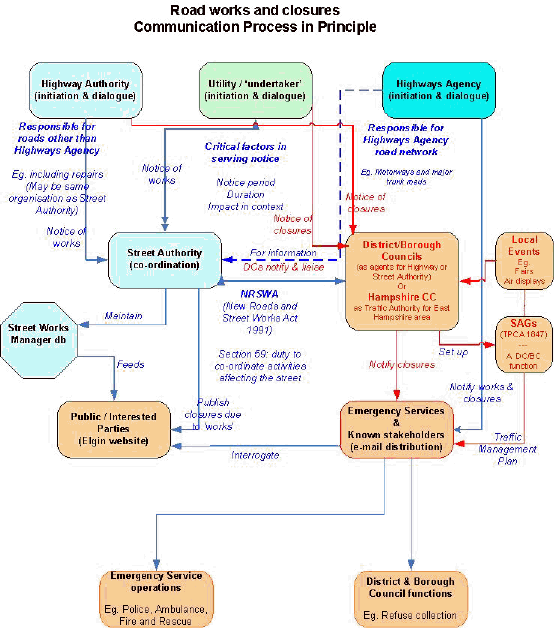
Note: road closures are of several types, each of which is associated with different requirements and processes for notification. For the purposes of this report, the most common and relevant type of closure is a `temporary' closure. The issue and notification of temporary notices is the responsibility of the Traffic Authority. In the 1992 Road Traffic Procedure Regulations, the authority is required to ".. notify the police, the fire authority...and any other traffic authority", whilst in the Code of Practice for the Co-ordination of Street Works, the authority is told they "...must give notice, on or before the day the notice is issued, to the emergency services,..." The standard practice in Hampshire is for the Street Authority to notify the police, fire and ambulance services of temporary road closures.
2. Annotations for Communication Process Diagram
2.1 Highway Authority(HA)
· In Hampshire, the County Council is the Highway Authority.
· The county is divided into four administrative/operational areas: north; south; east and west.
· The Highway Authority does not have to `serve notice' to the Street
· Authority, but the New Roads & Street Works Act 1991 and Traffic
· Management Act 2004, Statutory Code of Practice for co-ordination of street works, advises that street authorities should "seek to operate under the same principles" (Section 2.2.1) as utility undertakers proposing street works. Currently the Highway Authority has to 'register' it's works, which is, more or less, the same thing, however it might require extra resources for the Highway Authority.
2.2 Utilities / Undertakers
· Undertakers, i.e. someone or body that is licensed to undertake road work, such as a public utility company or their licensed agent.
· Should follow the Highways Authority and Utilities Committee (HAUC) Code of Practice in complying with minimum notice periods for road works.
· Appropriate recommended notice periods are primarily based on criteria related to the potential disruption that may be caused by the work. The guidelines also include notice periods or exclusions for emergency work, depending upon circumstances.
2.3 Highways Agency
· Highways arm of the Department of Transport
· Responsible for motorways and primary/trunk routes
· Hampshire comes within Area 3 of the Agency's network.
· Notifies Street Authority for information only.
· Notifies emergency services and other stakeholders via an e-mail `diary'.
2.4 Local Events
· Primarily a district function under the Town Police Clauses Act 1847 (TPCA 1847)
· Many district councils hold Safety Advisory Groups (SAGs) to discuss events with organisers. If traffic is affected, the organiser writes a Traffic Management Plan and applies for any closures. The group may typically include: the organiser; a Traffic Authority co-ordinator; the Police and representatives from the Ambulance and Fire Services. Emergency Services get copies of the Traffic Management Plans and closure orders from the district council. No notice goes onto the Elgin system because Elgin shows only closures relating to `works'.
· Minor local events may not warrant forming a SAG. The district council may then agree a TPCA 1847 closure with the Highways Authority and send copies of closure orders to all emergency services.
· Can be ad hoc, there is currently no legal requirement to notify road closures due to events, but the Street Authority plans to look at this issue. It might be possible for local events, such as road closures due to the Farnborough Air Show to be loaded onto the Street Works Manager database.
2.5 Street Authority
· Distinct function from Highway Authority and Traffic Authority.
· Has a general duty to co-ordinate works.
· In Hampshire the street authority has co-ordinators in each Highway Authority area to liaise with local authorities as agents for the HA.
· The Street Authority receives Notice from undertakers about road works. They also receive information from the Highway Authority about HCC works; all of this goes onto Street Works Manager. The Authority is also consulted about closures and diversion routes for works and events from district councils. (note: a Notice is a legal document; only undertakers actually serve Notices)
· Actively manages and liaises with councils and undertakers to ensure effective and efficient co-ordination, also minimal disruption to traffic and the public.
· Maintains, as a duty, a register of all activities within Hampshire and publishes this information on the Elgin website.
· Receives information from the Highways Agency of works and closures that have potential to impact traffic on other roads in the county
· The Street Authority also receives information about any licences issued by its local offices to undertake works on the highway (e.g., skips, scaffold etc). This information is automatically loaded onto Street Works Manager. They have plans to load other licensed activities onto Street Works Manager as well. (everything loaded onto Street Works Manager goes onto Elgin)
2.6 Traffic Authority
· Distinct function from Street Authority and Highway Authority.
· Has a general duty to facilitate the expeditious movement of traffic on road networks.
· In Hampshire the Council is the Traffic Authority, however the district or borough councils act as agents, except for East Hampshire, in which case the role falls to a central unit at the County.
· Must be informed by works undertakers as soon as practicable in the case of temporary works that may require a road closure or traffic restriction.
· Has a duty to notify the police, other emergency services and any other affected traffic authorities.
2.7 District/Borough Councils
· Act as agents for the Traffic Authority with respect to road closures, with the exception of East Hampshire. In this latter case road closures are handled by the County Council in the Democratic Services section!
· Receive notice of road closures from the Traffic Authority and undertakers; negotiation around the works/closures may occur between the Street Authority and undertakers in order to maximise co-ordination.
· Receive information concerning events from event organisers, and provide notice to the Street Authority of road closures due to local `events'.
· Notify emergency services and other stakeholders of pending closures.
2.8 Street Works Manager database
· A robust and effective database or register of works and closures, maintained by the Street Authority to facilitate management and co-ordination of works.
· Used to feed the Elgin website which is available to emergency services, other stakeholders and the public.
· If the Elgin website is to be used or interrogated by emergency services to obtain road works and road closures information, then the system should be tested by stakeholder users, with a view to potentially modify/augment if necessary. This would have to be done after 1 April using a standard testing regime. Current legislation makes provision of closure information via the works Notice as `optional'. The TMA 2004 amendments to the Co-ordination Code make this information `mandatory'. So, as of 1 April 2008 Elgin should list all road works, skips, undertaker works and closures associated with works. (The only closures missing should be the closures for events or incidents).
2.9 Emergency Services
· Emergency services would require processes such as for:
o Obtaining information about road closures.
o Obtaining information about re-routing around road closures. This should be on the information passed to them from the district councils. For major works the Street Authority meets with all emergency services to discuss the problems and the routes. Diversionary routes are not available on Elgin, only the closure itself. To put diversion routes on Elgin would be a significant IT project.
o Disseminating the information to all relevant crews.
o Ensuring that all crews are aware of road closures and of re-routing options.
o Ensuring that conflict is avoided between GPS routing technology cannot and information received about closed roads.
o Ensuring that road opening information is obtained from the Highways Agency and District Councils.
o Ensuring that road opening information is communicated to all crews.
o Ensuring that operational management provides training programmes for the use of Elgin, and potentially provide input into its usability, such as being able to identify latest updates for a given area.
· Currently the processes used by each emergency service are `black boxes', i.e. they are not understood in this preliminary research. Information provided, indicates that the Ambulance Service is currently reviewing its processes.
3. SWOT (Strengths, Weaknesses, Opportunities and Threats) Analysis
3.1 Preliminary work suggests that the current ways of working, whilst normally effective, may benefit from a structured evaluation based on a SWOT analysis. It is probably more valuable to focus more on the strengths and weaknesses of the system than on organisations, per se.
Strengths
3.2 The following documents provide a framework and guidance, including the definition of responsibilities of parties and stakeholders. They also include detailed codes of practice which provide additional incentives to improve systems :
· Highways Act 1980
· New Roads and Street Works Act 1991 and Traffic Management Act 2004: Code of Practice for the Co-ordination of Street Works and Works for Road Purposes and Related Matters - Volume 1 Notice Procedures and Guidance, April 2001. A revised version, dated July 2007, incorporating the changes from the TMA 2004, will come into force in April 1st 2008.
· Best practice in street works and highway works, DETR/HAUC 2001
· Road Traffic Regulations Act 1984 (as amended) and accompanying statutory instruments
· 1992 Regulations on temporary closures and procedures
· 1996 Regulations on permanent closures and procedures
· Town Police Clauses Act 1847
3.3 There are supporting operational computer systems on which information about road works and road closures are registered. These systems are a strength because important information is consolidated on them thus reducing interfaces and risks in the communication chain. The also provide a potentially very powerful roll in the communication and sharing of timely, critical information on the current and planned state of Hampshire's roads:
· Elgin is a web-based system that can be accessed by the public and stakeholders, including emergency services. The Elgin website provides an up-to-date map of current and planned road works for a large area of the UK. Elgin is operated by Jacobs on behalf of participating local authorities. The website can be accessed at http://hants.elgin.gov.uk/ Elgin shows notified, planned road works.
· Street Works Manager (Exor), a system used in the management, registering and tracking of all road works and closures that have been submitted to the County as Street Authority. Notice of road works comes from utility undertakers, the Highway Authority and road closures from district/borough councils. The Highways agency also informs the street authority of any known works or closures on their network (Areas 3) that may affect Hampshire. Street Works provides the information made available on Elgin. Input on traffic/road issues from residents and stakeholders in Hampshire can be provided via feedback forms on Hantsnet at www3.hants.gov.uk/roads/online-facilities/all-forms.htm
Weaknesses
3.4 It has been commented by an operational officer in one emergency organisation that whilst the processes work overall, it is something of a `belt and braces' situation. Communication across individual points of contact have an element of risk attached, however the risk of failure increases with each additional communication.
3.5 The key processes depend upon many and various interfaces for the transmission of information, sometimes the same organisations have a number of points of contact between them, clearly it could be simpler and safer to reduce interfaces across which information passes to the minimum. This increases complexity, and almost certainly introduces redundancy. The redundancy may at times be useful if some contacts fail, however it also introduces uncertainty and inefficiency.
3.6 Much of the communication depends upon local contacts and can lead to information being trapped in pockets.
3.7 Communication tends to rely on e-mail distribution lists, sometimes faxes, or telex. These can be vulnerable to communications failure since at the least, non delivery of information for whatever reason may not be noticed.
3.8 There may be an assumption that some information has to be `pulled' by organisations, such as from the Elgin website. But there should be no assumptions made as to who is responsible for actively providing or actively seeking information, else communication may fail.
3.9 Some organisations are large and complex, and one part of an organisation may not know or understand roles and responsibilities undertaken by other parts of the organisation, thus introducing potential for redundancy. There could therefore be a lack of coherence that increases complexity and the chances of poor or inconsistent communication.
Opportunities
3.10 Consolidation of information about road works and closures in the Street Works Manager system should provide opportunity to simplify processes, reduce the number of interfaces and create a single, timely source of information for stakeholders and in particular, emergency services. It should be noted, however, that this could have resource implications if the scope of present roles and responsibilities at the Street Authority are increased. The Street Authority is considering the inclusion of closures due to events on the database at some point in the future.
3.11 There may be opportunities within emergency services to review their approaches to obtaining, managing and distributing information about road closures and detours as a result of changes in the use and development of systems by the Street Authority.
3.12 The third edition of the code of practice comes into force on 1 April 2008. This code is intended to help street authorities carry out their duty to coordinate works in the highway, under section 59 of the New Roads and Street Works Act 1991. The code strengthens the requirement for effective co-ordination and central consolidation of information about road works, including the timely dissemination of that information to stakeholders. This represents an opportunity to review processes and build upon the framework and technical foundations required by the Act. It is understood that such a review is already planned, however the timing of it is likely to follow the bedding in of changes required by the Act for April 2008.
Threats
3.13 Re-organisation within organisations may interfere with the effectiveness of interfaces and loss of contact points.
3.14 The range of contact points between organisations may result in inconsistent information being live in the system if updates do not get communicated via some contact points (or routes through the system).
3.15 Reliance on habitual or traditional lines of communication rather than learning to take advantage of developing centralised resources in developing consistent, robust systems.
3.16 Over-reliance on GPS routing systems that cannot currently be updated to accommodate road closure information.
3.17 Failure to recognise and address possible anomalies in organisations that may work against the development of simpler, more logical systems (e.g. Democratic Services staff currently act in lieu of East Hampshire DC which is the only district council that does not act as an agent of the Traffic Authority with respect to handling road closures. This appears to be an exceptional use of the Chief Executive's department, however it may be because it has various legal functions, but it also raises the question as to why East Hampshire is an exception among Hampshire's district councils, or why the County as Traffic Authority needs locality agents?.
3.18 Over-reliance on IT. IT systems can fail and are reliant on accuracy of data from third parties and user error. It is important to note that the TMA 2004 changes to the Co-ordination Code require significant changes to the Street Authority's IT architecture. There is a high risk of systems not being fully in place for the TMA 2004 changes on 1st April 2008 owing to the Government's short timescales and the need for it to produce a robust technical specification.
4. Conclusion
4.1 The legislative framework provided by the Department of Transport in its New Roads and Street Works Act 1991 and Traffic Management Act 2004 in the latest revision of July 2007 underlies the drive to improve and strengthen the tools and processes around managing the co-ordination of road works by 1 April 2008. The changes in how and what is co-ordinated, managed and reported by the Street Authority has required adjustments to ways of working following the changes implemented in April 2008.
4.2 The increasing consolidation of information on the Street Works Manager system, and therefore also on the Elgin website, should be of value to emergency services, although notification of road closures will still be reported through district councils (except East Hampshire) acting as agents of the Traffic Authority. Because the emergency services processes for obtaining and using information about road closures or road works are based in traditional ways of working, it would suggest that a review of such processes following the impending changes would be an appropriate response to the new situation.
4.3 Whilst over-reliance on computer-based systems is a possible danger, nevertheless the full use of robust, consistent, supporting systems must be key to eliminating reliance on some of the acknowledged risk prone processes that rely on communicating via multiple instances of contact.
4.4 It will also be necessary for emergency services to ensure that procedures are in place to reduce the possibility of information provided by standard GIS-based routing systems conflicting with information about road works and road closures. Later in 2008 may be an opportune time for a comprehensive end-to-end review of the avoidance of road closures or major road works by emergency services.
4.5 Co-ordination meetings are held each quarter, initiated by the Street Authority (i.e. the County Council in that role). It has been reported that police representation at meetings in the West and North of the County tends to be intermittent, it is also not known whether other emergency services attend. Clearly for the system to work effectively, communication by whatever means would require robustness and consistency. The Code of Practice for the Co-ordination of Street Works makes these meetings the responsibility of the Traffic Manager of the Street Authority (New Roads and Street Works Act 1991: Code of Practice for the Co-ordination of Street Works...Third Edition (Consultation Version 8: Sections 5.3.2, 5.3.3).
The CYP Select Committee has referred the following actions to the HOSC for follow-up with Hampshire PCT.
i. That the HCC Health Scrutiny Committee clarifies with the Hampshire PCT how decisions regarding the spending of non-ringfenced money from Government targeted at supporting short break services will be made locally.
ii. That the HCC Health Scrutiny Committee investigates what benefits could be achieved through the Hampshire PCT's signing of the Every Disabled Child Matters Charter.
The response from the PCT to these enquires is set out below.
`Hampshire PCT is working closely with Hampshire County Council to improve services for disabled children and in this year we have committed an additional £61k to the Joint Equipment Store. We are also working in partnership with Hampshire County Council to undertake a needs assessment and to develop a joint commissioning strategy for services for children with disabilities including a short break plan. In addition we have just completed an initial therapy paediatric therapy review in order to plan service and resource requirements for future years, which will inform these plans.
These joint plans will be discussed at the PCT Management Board in October 2008 and agreed resource requirements will be submitted into the PCT financial bidding process which will underpin the 2009/10 PCT operating plan. We have already highlighted the national and local imperative around this area.
At the Management Board meeting in October we will also consider potential benefits to signing the Every Disabled Child Matters Charter.'
Health Overview and Scrutiny Committee. 23 September 2008.
`Healthy Horizons'- Hampshire PCT Up-date
Strategy Refresh - Briefing Note
1) Introduction
Hampshire Primary Care Trust's strategy, Healthy Horizons, was published in November 2007 and a commitment was made by the PCT to carry out an annual refresh. The purpose of the refresh is to ensure the strategy takes account of updated information such as the Joint Strategic Needs Assessment, due to be published this autumn and remains current.
The Department of Health's World Class Commissioning Programme sets out new guidance on the expectations of a strategic plan and the PCT is taking the opportunity to ensure Healthy Horizons complies by expanding sections on goals, initiatives and their impact and by including a new section on delivery. As outlined above, the baseline information will be updated where available.
The intention is for the refreshed Healthy Horizons to tell an end to end story about how the PCT will move from assessing the needs of its population to delivering services that will drive improvements in health outcomes. One area that the PCT felt would benefit from was a clearer articulation of vision, aims and strategic goals - see below.
2) Vision & aims
_ To improve health and healthcare for the benefit of patients and public in Hampshire
_ BY
_ Focusing on prevention, early intervention, and partnership working.
_ Commissioning a comprehensive range of needs based, high quality, efficient and effective services within the resources available.
_ Improving access to healthcare by developing more integrated patient centred care closer to home.
_ Improving the experience of Hampshire patients using health services.
_ Improving the way patients, clinicians, and the public participate and shape local health services.
_ Ensuring the delivery of key targets within the overall resources
3) Strategic Goals (3-5 years)
_ SG1
To improve health and reduce health inequalities focusing on vulnerable groups and
areas of deprivation in Hampshire.
Drivers: Lifestyle issues, ageing population, increases in some chronic disease, tackling
major causes of death, reducing health inequalities in specific areas e.g. Gosport
Outcome measures:
Life expectancy, CVD and Cancer mortality rates, breast feeding rates at six weeks,
immunisation rates for children in care, childhood obesity rates, uptake of screening
programmes, smoking prevalence, and prison health indicators.
_ SG 2
Transform stroke, dementia, end of life, cancer, cardiovascular, child and adolescent
services, and services for children with disabilities in the next five years to improve health
Drivers: Ageing population, development in clinical practice and technology, national and
local priorities
Outcome measures:
Stroke deaths within 30 days, % of stroke admissions within 24hrs, % of patients on
dedicated stroke units, Cancer waiting times, cancer and CHD mortality rates, % of patients
who die in place of choice, % spend of CAMHs tier 3 and 4 services.
_ SG3
Improve the management of long term conditions by developing integrated care pathways,
out of hospital services and promoting self care
Drivers: ageing population, national and local priorities, making more efficient use of
resources
Outcome measures:
Reduction in emergency bed days, reduction in frequent emergency attenders, number of
community matrons and case managers, number of patients receiving self care, QoF
scores, Diabetic retinopathy.
_ SG4
Improve access to health services by ensuring that patients are treated in the most
appropriate setting. We therefore expect to move services out of the acute setting
and build up provision in the community/primary care setting
Drivers: development in clinical practice and technology, national and local priorities,
making more use of efficient resources, improving the pathway of care for patients
Outcome measures:
Excess bed days, variation in access to treatment in acute care, access to talking therapies
Increase number of tier 2 services
_ SG 5
Deliver year on year financial efficiencies by making improvements in the way healthcare
resources are used in Hampshire to enable further investment in the changes needed to
deliver improvements in the key priority areas.
Drivers: Ageing population, growth in demand driven by public expectations, technological
and medical innovations, lifestyle issues
Outcome measures:
Upper decile standardised admission rates, readmission rates acute and mental health,
zero length of stay, financial balance.
_ SG 6
Deliver a year on year improvements in the experience of Hampshire patients using
healthcare and the environmental safety of services delivered to patients
Drivers: patient expectations, efficient use of resources.
Outcome measures:
Self reported experience of patients, MRSA and CDif rates, annual patient survey, GP
access survey
4) Engagement process
Community focus groups - Ipsos MORI are working with us to organise 3 focus groups in Hampshire covering different regions, age groups, social grades and ethnic groups. These will take place in September and results will be fed back at our next public Board meeting on 25 September.
Voluntary sector - the strategy refresh process was discussed at the Voluntary Sector Consortium meeting on 5 September and information handed out. This information with questions for people to feedback on the strategic goals and communication and engagement process will be sent out electronically for the councils of voluntary services to send round regionally.
Forthcoming meetings - the questions which have been handed out to the voluntary sector will be circulated within Hampshire PCT and colleagues asked to discuss at any meetings until the end of October.
Wider promotion - information about the strategy refresh and how people can feed into the process will be loaded on to Hampshire PCT's website week commencing 8 September. The link to the website will be promoted widely through various communications routes.
Health Overview and Scrutiny Committee. 23 September 2008:
Pharmacy White Paper - update: Implications for Dispensing GPs
The White Paper proposals with regard to dispensing GP practices are to change current eligibility criteria from the existing stipulation that a patient in a designated rural ('controlled') area must reside more than 1.6km away from a community pharmacy (irrespective of how far it is to the GP surgery), to a new stipulation that the GP surgery itself must be more than 1.6km distant from a community pharmacy (irrespective of where the patient lives).
In addition dispensing GPs are to be allowed to sell OTC medicines on the same basis as community pharmacies.
Full text is available at the link below. Paras. 8.67 onwards refer:
A digest of main points is available at:
http://www.hampshirelpc.org.uk/uploads/LPC%20BN080401%20Pharmacy%20White%20Paper.pdf
To date, the proposed change in rural dispensing entitlements for GPs has met with considerable opposition from practices which dispense directly to their patients, as most calculate this would entail a substantial loss of practice income. However, as the Paper indicates, the present arrangements have inconsistencies, are unfair to patients and involve considerable PCT expenditure that is hard to defend.
We are happy to undertake a local impact assessment on specified practices if that would be thought helpful.
Pharmacy White Paper Summary of the Proposals
Broadly, there are two main areas relating to dispensing that the White Paper is seeking to address, especially in the short to medium term: improving Access to 'over-the-counter' (OTC) medicines, and reforming the 'control of entry' rules for dispensing practices.
Dispensing doctors provide services for patients where a pharmacy may be unavailable. However while this addresses people's needs in relation to prescribed medicines, it can leave some people - especially in rural communities travelling substantial distances to access OTC medicines. GPs are prevented from selling OTC medicines to patients through conditions placed in their NHS primary medical services contracts. This is seen as a barrier to self care, which can lead to an increase in GP appointments.
The Government believes that relaxing this restriction would provide better services for patients and there are sufficient grounds to reform arrangements for selling OTC medicines, where the GP practice has consent to dispense.
There are also concerns about dispensing arrangements for doctors, which the Government is seeking to address:
(i) Currently, eligibility to receive dispensing services from a GP is based on the distance between the person's home and the nearest community pharmacy. This can lead to inequity and may also fail to identify the actual distance a person has to travel when going from home to the GP and then on to the nearest pharmacy - for example, if they are in opposite directions, the distance may exceed the 1.6 km stipulated in the regulations.
(ii) The proximity of dispensing practices to community pharmacies - some people who receive dispensing services from their GP pass a community pharmacy on their way to and from the surgery.
Both issues could be resolved by considering new ' control of entry' equivalent rules for dispensing practices. An example provided in the White Paper is that there could be a single condition relating to the distance between the surgery and the nearest pharmacy.
Discussion Points
As noted above, the White Paper is intended to improve the range, quality and accessibility of services that are available through pharmacies. It is important, therefore, to emphasise the positive actions that should emerge rather than focusing on what could be relatively minor reforms of dispensing arrangements with few, if any, negative consequences. However, there is already member interest in this particular issue, and comparisons have been made with the recent closure of rural post offices. We will need to be sensitive to concerns about the erosion of rural services.
Until the consultation is published, setting out detailed proposals for new dispensing arrangements, the full implications of any changes cannot be assessed. However, a system based on the distance between GP practices and the nearest pharmacy - as suggested in the White Paper - is likely to be one of the options.
The main advantage of this system would be allowing dispensing practices to dispense to all their patients. This would be more transparent and facilitate other changes, such as enabling patients to buy over-the-counter medicines (which would be unmanageable if only a proportion of patients could receive dispensing services). Practices meeting the new criteria could find that they dispense to more people, who might also benefit from more convenient access to OTC medicines.
However, this system would see practices that do not meet the conditions lose their right to dispense, which could have a financial impact on those practices and may cause concern in their local communities. It is most likely to have a negative effect on people who live some distance from t heir GP and then have to travel further to the pharmacy. Even though this should only be a fairly short distance, an additional journey might be difficult for people in rural areas especially if they have mobility problems and/or use public transport.
Although the White Paper states that consideration should continue to be given to patients with travel difficulties, where there is no home delivery service available, this would need to be carefully monitored to ensure vulnerable people do not suffer. It is suggested that PCTs might commission home delivery, but there is currently no requirement to do so and this is likely to be determined by PCTs on an individual basis.