
Archived decisions
Agenda Item 9
Report to the
Transport for South Hampshire Joint Committee
Date: 17 October 2008
Report by: Alison Linnell
tel: 01962 857458 email:[email protected]
Subject: Modelling, Evidence Base
Purpose of the Report
This report outlines the latest progress in developing the evidence base required to support proposed transport interventions, including managing the existing network and targeted investment in public transport and new infrastructure where appropriate. It goes on to consider the benefits of adopting a partnership approach with other public and private sector partners in development of the evidence base, including sharing relevant data where this would be appropriate.
Recommendations
1. That data collection for work to develop the evidence base required to assess the transport impacts of proposed major development sites in South Hampshire be prioritised within the available resources earmarked in the 2008/9 budget to support the full assessment of such proposals, and identify transport infrastructure requirements.
2. That a partnership approach, including sharing of appropriate data, with other public and private sector organisations to minimise duplication of work be approved.
Introduction
1. At its meeting on 14 April, the Joint Committee gave approval in principle to progressing the analysis of data and analysis tools required to provide a robust evidence base, so that both the Transport for South Hampshire strategy and schemes emanating from it can receive Government support.
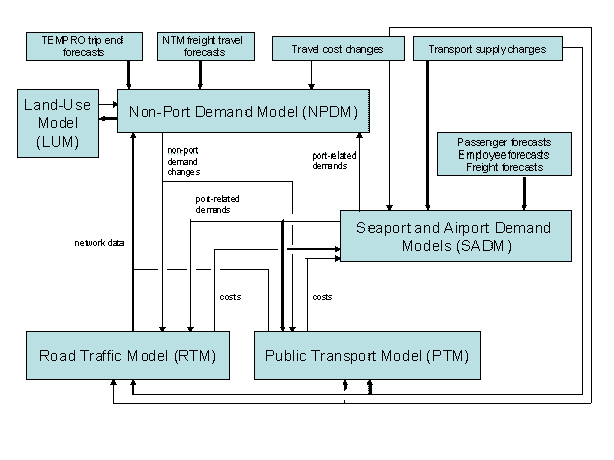
2. At that time work completed by a leading independent consultant (Denvil Coombe) and reviewed by officers with expert advisers from the University of Southampton and local consultant Richard Powell provided an outline modelling system for a robust evidence based which is reproduced in Figure 1 below.
3. The suggested modelling system made maximum use of the existing Solent Strategic Transport model, which would form the core of the Road Traffic Model shown in Figure 1, and contribute largely to the Public Transport Model. However, it needed to be extended geographically as well as being updated with new transport data.
4. Since that meeting a more detailed examination has been made of the amount of new data required. The latter is substantial and comprises a large element of the overall cost of providing the evidence base needed.
Figure 1: An Outline Model System for South Hampshire
5. Work on behalf of the Department for Transport (DfT) is also currently underway, looking at the engineering feasibility only, of possible Active Traffic Management systems and/or hard shoulder running on the M3 and M27. Given the impact that any possible future interventions on the motorway network by the DfT would have within the sub-region it is important that the evidence base is able to accommodate any future scenarios.
6. In addition the private sector is moving forward with initial investigation related to the Strategic Development Areas within the South East Plan. There are clear areas of overlap in terms of data collection requirements, analysis and transport modelling between the private and public sectors in this respect. Taking a partnership approach in terms of both data collection and analysis tools would potentially greatly reduce disruption for the travelling public and reduce overall costs to the benefit of all parties.
7. This report summarises the current position in terms of progressing the evidence base as soon as practicable and seeks endorsement of the adoption of partnership working with other public and private sector organisations to take advantage of natural synergies.
Data collection
8. Further work looking into data collection needs has identified a total of 12 separate screen lines and/or cordons where data collection is required, each one comprising a number of individual roadside interview sites. In addition a series of sites related specifically to the motorway system was also identified.
9. There are many practical issues related to carrying out the scale of work that would be required, both in terms of practical organisation, costs and also the level of disruption likely to arise. However the data that would be collected is essential to inform the evidence base.
10. Discussions are currently underway with the Police and others with a view to completing an initial tranche of roadside interviews at 26 sites over the Autumn months this year. It is clear that survey work will need to be carried out as a part of a rolling programme over a number of years, and therefore it is necessary to prioritise needs in terms of geographic locations and quality of the existing data held.
11. Additional consideration is being given to the initial screen lines and cordons identified, particularly those associated with the motorways, in view of the current DfT studies. It may well be that this is an area where collaboration and review of overall needs may assist in reducing overall costs and disruption. Similarly informal exploratory discussions with the private sector suggest clear areas of overlap in terms of data needs.
12. In collecting the data at the roadside interview sites it is important that as few drivers as possible alter their route in order to avoid taking part in surveys, which would potentially invalidate the results. Police assistance is invaluable in minimising the delays to drivers on the day of interviews, but there will be inevitable disruption to journeys. However this short-term disruption must be weighed against the need to support the TfSH strategies and schemes which seek to enhance economic vitality and growth in the sub-region without unacceptable environmental impacts.
Transport Modelling
13. The initial outline model system shown in Figure 1 provides the basic elements required to produce a robust evidence base. As well as data collection there is a need to begin developing the various component parts of this system. Work is currently proceeding to identify whether the suggested geographical extent and associated level of sophistication in terms of detail can be somewhat simplified whilst still providing a suitably robust model.
14. Similarly, as with data collection, there may well be opportunities to work in collaboration with the private sector to jointly agree an overall modelling system that could then form the basis of any more detailed work for individual business cases. This would provide clear benefits if practicable, however given the range of analysis tools available it may not be possible to achieve in practice. Nonetheless given the level of potential benefits that might accrue it is a fruitful area for further exploration.
15. It is essential that partners in regional and national Government agencies (including GOSE, SEERA, DfT, Highways Agency and Network Rail) support the further development of the evidence base and the form of the various elements within it. There will be a further report to the Committee which sets out the technical requirements agreed in the light of recent developments and the outcome of any collaborative discussions with private sector organisations, along with how the various elements of data collection and the modelling system might be carried out along with likely costs and timetable.
Section 100 D - Local Government Act 1972 - background papers | |
The following documents disclose facts or matters on which this report, or an important part of it, is based and has been relied upon to a material extent in the preparation of this report. | |
NB the list excludes: | |
1. |
Published works. |
2. |
Documents which disclose exempt or confidential information as defined in the Act. |
TITLE |
LOCATION |
None |
1813Rpt/AL