
Archived decisions
Hampshire County Council
River Hamble Harbour Management Committee Item 9
24 October 2008
Navigation Channel Improvements
Report of the Director of Recreation and Heritage
Contact: Tony Clatworthy tel: 01489 576387 e-mail: [email protected]
1. Summary
1.1 The Harbour Authority is required to take all reasonable steps to ensure that the harbour is as safe as possible for all who use it. This report provides the details of two projects which aim to improve navigational safety within the main channels in the harbour.
2. Recommendations:
2.1 That the River Hamble Harbour Management Committee recommends that the River Hamble Harbour Board grant consent for the following funds to be allocated:
a. £16,500 from the revenue reserve fund to enable the replacement of Crableck and Swanwick Beacons. Each wooden beacon to be replaced with metal piles, each with navigation light, starboard hand mark and a tidal gauge.
b. £2,900 to realign the remaining three mooring sites and to purchase redundant tackle from the five displaced moorings.
3. Introduction:
3.1 The river bed of the River Hamble is owned by The Crown Estate and leased to the Harbour Authority. The mooring sites are owned by The Crown Estate and managed by the Harbour Authority on behalf of The Crown Estate in accordance with the terms of the Management Agreement dated 9th April 2008.
3.2 Swanwick Bend: The available navigable water on the bend in the main channel at Swanwick has steadily been reduced over the years as more swinging moorings have been established. Most of the swinging moorings are located in the deepest water which is in the centre of the main channel. These arrangements allow little room for traffic wishing to transit the area safely. The slow silting of the western side of the channel has also reduced the available navigable water and forced the Harbour Authority to move the port hand marker beacon further towards the deep water. The situation becomes more dangerous during the hours of darkness. The proposed scheme will reduce the moorings on the bend with the aim of making the main channel easier to identify and safer to use. To further improve navigational safety, the Swanwick starboard hand beacon may need to be moved and a light added to the beacon forming a gateway with the port beacon. This cannot be done until the moorings in the main channel have been removed. A risk assessment investigating the possible risks associated with Swanwick Bend has been completed and is attached to this report at Annex A.
3.3 Crableck Bend: Withdrawing the Crableck Beacon and driving a new pile approximately 12 metres north west of the original location will ensure the main channel becomes easier to identify. The proposed new location of the beacon will also protect the moorings that sit on the bend, making it safer for traffic transiting the area.
3.4 C5 Policy 3 of the Estuary Management Plan states:
"The River Hamble Harbour Authority is to maintain navigable depth by moving moorings and navigational marks in order to realign river layout to minimise requirement of dredging."
3.5 If approved, the scheme will be completed by 1 April 2009. Attached at Annex B are two charts showing the current plan and the area as it would appear once the proposed works are completed.
4. Swanwick Bend
4.1 The following moorings are required to be removed from Swanwick bend:
a. Crown Estate Moorings: HD70 16 and 18
b. Premier Marina Moorings: HD56, 58 and 60
4.2 The following moorings have already been withdrawn from the bend:
a. Crown Estate Moorings: HD 34 and 68
b. Deacons Boatyard: HD49 and HD49a
4.3 The Crown Estate moorings HD10, 12, and 14 will remain but will require realignment.
5. Crableck Bend
5.1 Withdraw Crableck Beacon and drive a new pile approximately 12 metres north west of the present location. No existing moorings will be moved, but the effect of moving the beacon will be to place a number of existing moorings outside the main channel, making it safer for traffic transiting the area.
6. Costs
6.1 The cost of the work required will fall to the Harbour Authority
6.2 The cost of withdrawing and replacing the two piles at Crableck and Swanwick Bends, each fitted with a light, starboard hand top-mark and fittings for tidal gauges will be in the region of £16,500. This work can be completed by 1 April 2009.
6.3 In order to ensure that the mooring holders affected are not disadvantaged by the removal of their moorings, the following arrangements are proposed.
a. It is recommended that the Harbour Authority purchase the redundant tackle (at £400 for each of the three moorings) from the three mooring holders who will be displaced from their mooring sites HD16,18 and 70 and that a further £1,200 be paid to Premier Marinas for the redundant tackle belonging to the three moorings HD56, 58 and 60.
b. The Harbour Authority will re-lay the mooring ground tackle for moorings HD 10, 12 and 14 (approx £500).
c. The Crown Estate have agreed that those displaced from the three moorings will be offered a pile mooring at the same price as a swinging mooring for the first 12 months. Thereafter, they will receive a 50% discount on the difference for the second year and pay the full cost of any enhancement in mooring type in the third year. A high priority will be given to finding alternative buoy moorings for these boats as soon as possible and it is anticipated that the three affected boats will be offered alternative buoy moorings at similar cost to their present moorings within 12 months.
6.4 The total cost of the operation will be in the region of £2,900.
7. Consultation
7.1 The initial consultation for this project took place during the Navigational Safety Audit carried out in 2006. The risks in both areas covered by this report were highlighted in that report. Before major changes were considered, such as set out in this report, other improvements were tried in an attempt to reduce the identified risks at the two locations. These improvements failed to reduce the risks as far as reasonably practicable so the proposals set out in this report are now being recommended. A key consideration, in addition to improving navigational safety, is to ensure that none of the existing mooring holders are disadvantaged by the proposed improvements - hence the financial arrangements set out in paragraph 6.3 above..
7.2 Following consultation with Premier Marinas, the three moorings affected by this proposal have been withdrawn and will be the subject of a separate arrangement between the company and The Crown Estate.
7.3 Action taken to ensure those involved had an opportunity to comment on the project were:
a. Each mooring holder and the River Hamble Mooring Holders' Association were contacted on 13th August 2008 with the full details of the proposal. They were also informed of the actions and financial arrangements that have been proposed to ensure they are not disadvantaged.
b. Each mooring holder was given reassurance that their interests would be looked after by ensuring they would be allocated another mooring of their choice as a priority. They would get first choice of all moorings available during the 2009 allocation period.(November to December 2008).
c. Following other communications from the mooring holders concerned, further explanations were given to the mooring holders regarding the timetable of the Management Committee and Harbour Board meetings. The mooring holders were also given information regarding how they would be able to address the meetings if they so wished.
8. Impact Assessment
8.1 An Equalities Impact Assessment covering the Harbour Authority's responsibilities under the Port Marine Safety Code has been conducted and the content of this report does not alter this assessment.
Section 100 D - Local Government Act 1972 - background documents | |
The following documents discuss facts or matters on which this report, or an important part of it, is based and have been relied upon to a material extent in the preparation of this report. (NB: the list excludes published works and any documents which disclose exempt or confidential information as defined in the Act.) | |
Document |
Location |
None |
|

RIVER HAMBLE HARBOUR AUTHORITY
PORT MARINE SAFETY CODE
RISK ASSESSMENT REPORT
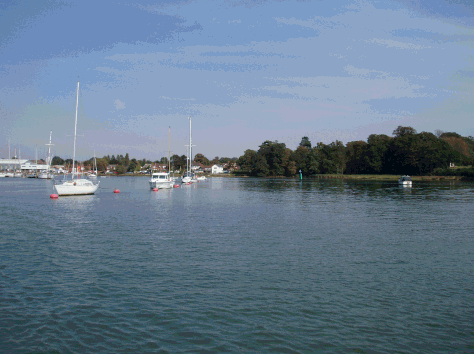
NAVIGATION CHANNEL
SWANWICK BEND
July 2008
1. INTRODUCTION
The Government looks to all Harbour Authorities to implement the requirements of the Port Marine Safety Code (the Code). The Code is intended to apply to all Harbour Authorities to the extent that they have duties and powers relating to marine safety.
It is particularly directed at Harbour Authorities and to members of the boards of such Harbour Authorities. The Code is not optional it applies to ports of all sizes, irrespective of resources or levels of traffic.
The Code represents the national standard against which policies, procedures and performance of Harbour Authorities may be measured. It is obligatory for the purpose of meeting the standard in the Code that measures are taken to reduce all risks associated with port marine operations to As Low As Reasonably Practical (ALARP).
2. SCOPE
The Code does not apply to duties and powers other than those related to marine operations. Marine operations are those that facilitate the safe use of a harbour by vessels. They include the direction of shipping and the regulation of safety of navigation in a harbour and the maintenance of aids to navigation within the jurisdiction of a harbour.
3. BACKGROUND
The five moorings owned by The Crown Estate and the three moorings owned by Premier Marinas at Swanwick Bend lay in the centre of the main channel. Their location restricts access to the main channel and obscures navigation day marks and navigation lights. The moorings also remove the possibility of establishing clearer and safer navigation lights to guide vessels through the channel. This risk assessment sets out the factors effecting the area.
4. RISK ASSESSMENT
The Code requires that each Harbour Authority assess risks associated with marine operations and manages those risks to reduce them to As Low As Reasonably Practicable (ALARP). Risk assessment is an ongoing process to this end the risk assessment has been carried out by the Harbour Master to consider the risks associated within the main channel at Swanwick Bend.
5. DEFINITIONS
For the purpose of this report the following definitions will apply:
A hazard is anything that can cause harm to a person, property or the environment;
A risk is the chance, high or low, that a person, property or the environment will be harmed by the hazard.
6. METHODOLOGY
To assess risks in The River Hamble 4 steps are followed:
1. Hazards are identified;
2. The consequence of the hazard materialised are assessed;
3. The risk and existing precautions are evaluated;
4. The findings are recorded.
It is also recognised that provision must be made to review and revise this assessment as necessary.
The aim of the risk assessment is to ensure that all of the significant hazards (potential accidents) associated with marine operations are identified and quantified in terms of risk to people, property and/or the environment.
This information provides an essential input to the continual development of The River Hamble Harbour Authority Safety Management System and will be used by the Harbour Authority as a rational basis on which to decide priorities and to set objectives for eliminating hazards and or reducing risks to As Low As Reasonably Practical.
The risk assessment identifies each hazard and then categorises them as either a collision, contact, grounding or a swamping hazard:
Collision: Collision between two or more vessels which are underway, regardless of whether the vessel(s) are not under command or disabled in any way but excluding wrecks.
Contact: A vessel striking, or being struck by, an external object or a vessel that is not underway (e.g. anchored or moored), excluding the sea bed.
Grounding: A vessel coming to rest on, or riding across, underwater features or objects.
Swamping: The excessive ingress of water over the gunwale of a vessel such that it becomes waterlogged and may sink.
An estimated degree of risk is assigned to each identified hazard to provide a relative rating between risks. The following scoring system has been applied:
LIKELIHOOD OF OCCURRENCE
SCORE: | |
Very Likely |
5 |
Probable |
4 |
Possible |
3 |
Remote |
2 |
Improbable |
1 |
CONSEQUENCE
To People: |
To Property: |
To Environment: |
Score: |
Fatal |
Catastrophic |
Major |
5 |
Major Injury |
Major damage |
Serious |
4 |
3 day + injury |
Severe damage |
Moderate |
3 |
Minor injury |
Minor damage |
Minor |
2 |
Accident/incident |
Negligible |
Negligible |
1 |
Each hazard has been assigned a score of 1 to 5 for the "likelihood of occurrence" and a score of 1 to 5 for "consequence". The "risk rating" has then been obtained by multiplying the two scores together giving a maximum rating of 25. The higher the rating the more serious the potential consequences. Rating risks help to give an indication of their significance.
As a guide it is considered that any "risk rating" of 12 and above, is not ALARP and therefore additional precautions should be implemented to ensure compliance with the Code. The figure 12 has been set as a bench mark for Hamble Harbour indicating action is required, nevertheless all risks should be reduced to ALARP regardless of rating.
7. History
a. The five even numbered moorings owned by The Crown Estate (HD10 to HD 18) were established by the Harbour Authority over ten years ago as a new venture. The Harbour Authority bought and established the mooring tackle and sublet the moorings to The Crown Estate licensees. Approximately six years ago (2002), a cost benefit analysis was carried out by the Harbour Authority and it was discovered that the cost of maintaining the moorings was more than the revenue collected. It was then decided to give the mooring tackle to the mooring holders. The maintenance of the mooring tackle would then become the responsibility of the mooring holder.
b. The three moorings owned by Premier Marinas were established at the same time as HD10 to HD18. Following consultation, Premier Marinas have agreed to withdraw the three moorings in order to free up the main channel in the area of the bend.
8. Navigational Safety
1. During the consultation process that was completed as part of the three yearly Navigational Safety Report (Harbour Board 14 July 2006) a number of points were raised by stakeholders, these were:
1. The moorings close to the main channel should be moved as they are a danger.
2. These moorings should go as they are dangerous especially to those not familiar with the River.
3. Some of these moorings do drift, or are forced out by the tide, into the main channel. This is dangerous and these should be moved away from the main channel.
4. Some fore and aft moorings seem very close to the main channel.
5. The traffic will just about accept the present state of affairs, but it should be watched.
6. Is Bursledon Bend (later established as meaning Swanwick Bend) marked and lit clear enough on the approach.
2. The three yearly navigational safety report to the Harbour Board noted:
1. Swanwick Bend is the most dynamic part of the River with regard to tidal flow. Skippers proceeding upstream from the Universal Channel, passing L32 and J27, have difficulty in identifying the port hand mark and light at Bursledon Bend (again, this actually refers to Swanwick Bend). On some gloomy days the red pile is difficult to identify and therefore on occasions those not familiar with the river have experienced difficulties in picking out the correct channel. The red pile blends into the background and is not easily identified.
2. To overcome the problem a top mark has been established on the port hand beacon and the light changed as recommended in the report. Completing these actions was thought at the time to be sufficient to overcome the difficulties in navigating through the bend.
3. Hydrography
1. Lands End spit and the main channel at Swanwick Bend show a tendency to migrate slowly eastwards. This is not dramatic but must be taken into account owing to the lack of navigable water to the west of the channel. The replacement port hand beacon had to be moved 2 metres eastwards six years ago to ensure that the channel was indicated correctly.
RISK ASSESSMENT FOR THE IMMEDIATE AREA AROUND SWANWICK BEND
Serial |
Hazard |
Likelihood |
Consequences |
Highest Risk Rating | ||||
People |
Property |
Environment |
||||||
1 |
Risk of Collision with a moving vessel in daylight |
3 |
3 |
3 |
2 |
9 | ||
2 |
Risk of collision with a moving vessel in darkness |
4 |
3 |
3 |
2 |
12 | ||
3 |
Risk of collision with a moored vessel in daylight |
3 |
3 |
3 |
2 |
9 | ||
4 |
Risk of running aground in daylight |
3 |
3 |
2 |
2 |
9 | ||
5 |
Risk of running aground in darkness |
4 |
3 |
3 |
2 |
12 | ||
6 |
Risk of swamping to small tenders and other small vessels with low freeboard |
3 |
3 |
3 |
2 |
9 | ||
7 |
Risk of collision with sailing (yachts) vessels under sail |
2 |
2 |
2 |
1 |
4 | ||
8 |
Risk of collision with commercial craft to include barges, hoppers and large leisure commercial craft in daylight. |
3 |
3 |
3 |
2 |
9 | ||
9 |
Risk of collision with commercial craft to include barges, hoppers and large leisure commercial craft in darkness. |
3 |
4 |
3 |
2 |
12 | ||
9. RESULT OF RISK ASSESSMENT AND RISK MANAGEMENT
Of the 9 identified hazards 3 obtained risk ratings that would indicate that they would not at present be ALARP (12 and above). Risks rated as 12 and those rated at 9 would be reduced significantly if the recommended measures are adopted.
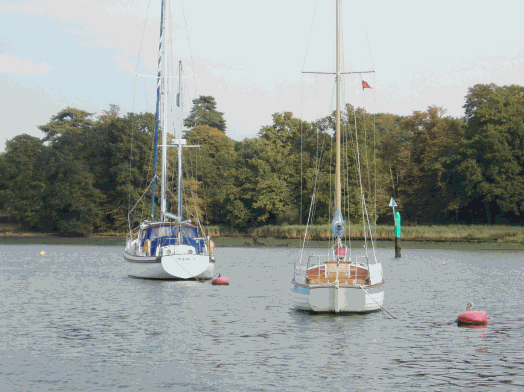
The photograph shows the two moored vessels on HD16 and HD 18 as seen from a vessel entering Swanwick Bend from the Universal channel. It will be noted that the starboard hand mark is beyond the moored vessels and could be obscured by them. This could lead a vessel into danger if the pile showed a navigation light and the moored vessels are unlit. These two moorings are located in the deepest part of the main channel.
10. HARBOUR MASTERS RECOMMENDATIONS
The risk assessment indicates that there is a risk that is currently not considered As Low As Reasonably Practical. Precautions were introduced to help manage the risks identified in the 2006 report (up-rating the navigation light and fitting a port hand day mark to the Swanwick port hand beacon) but this assessment shows that these actions have not reduced the risk sufficiently to be ALARP.
Having carefully considered this risk assessment the Harbour Master recommends that further action is required to improve the navigational safety at Swanwick Bend. The Harbour Master therefore recommends the following actions;
i. A `gateway' should be established between the port and starboard hand beacons at Swanwick bend. The gateway should be indicated with navigation lights as well as showing clear port and starboard hand day marks. Such a gateway would give a clear indication of the line of the main deep water channel to masters approaching from either direction. Such an arrangement is currently not available owing to the moorings located in the main channel, obscuring the starboard beacon.
ii. The moorings HD16 and HD18 restrict the manoeuvrability of vessels using the main channel. During easterly winds and on an ebb tide the moored vessels tend to drift further across the main channel restricting manoeuvring space even more.
iii. Vessels negotiating the bend find themselves in shallow water and restricted by the moored vessels.
iv. The yards and marinas upstream of Swanwick bend serve vessels over 20 metres LOA and more than 2 metres draft. Currently the deep water of the main channel is not available to them because of the moorings located in the deepest water.
v. To improve navigational safety, the two moorings HD 16 and HD 18 should be removed and the remaining three moorings (HD10 - HD 14) realigned.
11. CONCLUSION
Hamble Harbour is a busy leisure port serving a variety of craft. The seven yards, marinas and midstream Crown Estate moorings upstream of Swanwick bend account for just under 900 moorings. A significant percentage of these berths and moorings serve large vessels of 15 to 20 metres or more. The yards and marinas attract a number of visitors to that section of the harbour. Such visitors find themselves navigating in unfamiliar waters, sometimes in the dark, and finding moored vessels in the centre of the main channel that is not properly lit. To ensure that the risks at Swanwick Bend remain within ALARP the following actions are recommended:
a. Remove the 6 moorings that are currently located in the centre of the main channel. (3 x Premier Marinas and 3 x The Crown Estate)
b. Realign the remaining three moorings to a safe location outside the main channel.
c. Establish a gateway with port and starboard hand beacons with day-marks and navigation lights.
ONGOING RISK ASSESSMENTS
The assessments of risks is an ongoing process. This risk assessment will be regularly reviewed and updated and/or amended as appropriate. New risks that emerge as conditions or the use of the harbour change will be given immediate attention.
Risk assessment and the management of risks is a continual process.
AG Clatworthy
Harbour Master
July 2008