
Archived decisions
HAMPSHIRE COUNTY COUNCIL
Decision Report :
Decision Maker: |
Cabinet | ||||
Date of Decision: |
27 October 2008 | ||||
Decision Title: |
Medium Term Financial Strategy 2008/09 to 2010/11 | ||||
Decision Reference: |
257 | ||||
Report From: |
Jon Pittam, County Treasurer | ||||
Contact name: |
Nick Gibbins | ||||
Tel: |
09162 847544 |
Email: |
|||
EXECUTIVE SUMMARY
1) Summary of Decision Area:
1.1. This report brings together the various elements of the County Council's current medium term financial strategy within a single document. The core of the strategy is reflected in the three year provisional budget and capital programme approved by the County Council in February, and which has been subject to consultation with the Citizens' Panel. The financial management policies which underpin the framework for resource allocation decisions have also been reviewed. The proposed strategy reflects the outcome of these reviews.
1.2. Further work will be required during the autumn to assess budget pressures and options more fully, particularly in respect of 2009/10, to reflect the priorities of the corporate business plan and the impact of subsequent events affecting the assumptions in the strategy. Provisional budget guidelines also need to be set for 2011/12, to maintain a rolling three year financial plan.
2) Issues Covered in Report:
2.1. The production of a rolling medium term financial strategy provides a framework for financial decision-making and for communicating the County Council's financial plans.
2.2. To agree the amendment to the Financial Management Policies contained in Annex 5 of the strategy.
2.3. To agree the basis for setting provisional budget guidelines for 2011/12 and for setting provisional capital programme limits for 2009/10 to 2011/12.
3) Recommendations:
3.1. To agree the amendment to the Financial Management Policies contained in Annex 5 of the strategy (paragraphs 3.5 to 3.9)
3.2. To agree the basis for setting provisional budget guidelines for 2011/12 and for setting provisional capital programme limits for 2009/10 to 2011/12, as set out in paragraphs 3.19 to 3.24.
3.3. To approve the Medium Term Financial Strategy for 2008/09 to 2010/11.
MAIN REPORT
1) Purpose of the Report:
1.1. The purpose of this report is to approve a medium term financial strategy for 2008/09 and 2010/11, following consultation on elements of the strategy.
2) Contextual Information:
2.1. Attached as an Appendix C to this report is a Medium -Term Financial Strategy, for approval by the Cabinet. The main elements of the strategy were approved by the Cabinet in February 2008 at the time of the approval of the 2008/09 budget. However approval of a medium term financial strategy was deferred to provide an opportunity for public consultation, which had not been possible within the tight timescale between the publication of the 2007 Comprehensive Spending Review (CSR 07), the announcement of the three year grant settlement, and the deadline for setting a budget and council tax for 2008/09.
2.2. A review has also been undertaken of the County Council's financial management policies, which provide the framework within which resource allocation decisions are made. The strategy also highlights the interaction with the County Council's partners in the setting of the budget at both an operational and strategic level.
2.3. Since the three year revenue budget and capital programme plans were approved provisionally in February, events have moved on, particularly in relation to the short to medium term prospects for the UK economy, and their effect on the assumptions underlying the three year plan need to be reviewed.
2.4. This review rolls forward the medium term financial strategy to include 2011/12, in order to maintain a three year plan. Because the current Government spending review only covers the period to 2010/11 and the next spending review will not be until 2009 at the earliest, forecasting the County Council's income in 2011/12 is more uncertain than for the current three year period, which is covered by a three year grant settlement. This report considers the basis for setting provisional budget limits for 2011/12 for planning purposes, so that budget planning for 2009/10 can be developed within a three year financial framework.
2.5. A more integrated approach to service and financial planning is being developed this year which will inform the consideration of budget options by chief officers, executive members and the Leader during the autumn, prior to the presentation of budget proposals for consideration by Select Committees and Executive members in January 2009.
3) Key Issues:
Public consultation on three year budget plan
3.1. The Cabinet agreed a three year budget plan for 2008/09 to 2010/11 in February 2008. The key features of the plan are as follows:
· it makes allowance for increased demand for social care services and for the projected higher costs of the waste management contract, but otherwise contains no provision for growth in service budgets
· all service budgets are uplifted for inflation based on the assumption that increases in pay and prices would be contained within an average increase of 2.5% per annum
· it assumes that efficiency savings will be achieved to finance any proposed service developments, unfunded demand pressures or to cover excess inflation within the context of the Government's target for local government of annual efficiency savings of 3% per annum
· based on planned spending increases of 3.2% in 2009/10 and 3.5% in 2010/11, Band D council tax increases of 3.5% were projected in both years. Following the decision on closure of the 2007/08 accounts to utilize the underspending from higher interest on balances to reduce the council tax increase in 2009/10 and 2010/11, the projected increase in council tax has been reduced to 3% in both 2009/10 and 2010/11
· the annual rate of increase in the retail price index in September is 5.%, so the council tax rise in 2009/10 will be well within this amount and the capping limit of 5% set for 2008/09.
3.2. A questionnaire was sent to the County Council's Citizens' Panel seeking views on service spending priorities and on potential spending levels of either £2.5m per annum or £5m per annum above the levels contained in the provisional budget for 2009/10 and 2010/11, to finance additional spending on new service developments. This would require council tax increases of 3.5% and 4.0% per annum respectively. The questionnaire was sent to 1,072 panel members of which 411 responded (a 38% response rate). This is not a particularly high response rate for a Citizens Panel questionnaire, so that results could be argued to be a useful sounding board of opinion, rather than robust research.
3.3. Annex 1 to the medium term financial strategy summarizes the responses to the questionnaire relating to spending priorities and the spending options outlined in paragraph 3.2 above. The responses revealed that support for additional spending is highest in relation to youth clubs, outdoor centres and other facilities for young people, care for the elderly and road and footway surface maintenance. 54% of respondents supported spending of £2.5m per annum higher than currently planned (36%) or £5m per annum higher (18%) compared with 26% who supported the planned level of spending and 20% who favoured an alternative option or did not express a view. Though this response needs to be interpreted with care, it supports previous research indicating that despite public concerns about the sustainability of council tax increases there remains support in Hampshire for further development of a range of local authority services.
Financial management policies
3.4. In addition to the public consultation on spending options and priorities, an internal officer consultation has also been undertaken on the County Council's financial management policies, which form the framework within which the three year budget plan and capital programme are set and managed. These are set out in Annex 5 of the strategy.
3.5. The policies have developed year on year to reflect corporate priorities and external factors affecting the County Council's finances, but in addition there are a number of core policies which have been the focus for this review, and are based on the following principles:
· seeking to maximize in-year financial stability by maximising the allocations made to services at the beginning of the year, within the context of the overall budget
· encouraging services to generate additional external funding from specific grants and other sources
· providing an incentive to services to release surplus assets and facilitating service improvements from the rationalisation of assets
· incorporating a continuing pressure to achieve cashable efficiency improvements within the base budget framework
· encouraging services to manage inflationary pressures by cash limiting increases for pay and prices and assuming the level of fees and charges increases in line with inflation assumptions
· seeking to maximise the recycling of existing resources to meet one-off budget pressures and to match priorities
· making use of prudential borrowing to facilitate invest to save proposals to increase value for money and to bridge the gap between capital expenditure and related capital receipts
· having a framework of financial management policies which are consistently applied so that departments can plan with certainty, over the three year period.
3.6. The main issue arising from the consultation for consideration in reviewing the policies in this budget cycle is the extent to which a more targeted directive approach to issues such as the achievement of efficiency savings, rationalisation of assets, the treatment of inflation or the setting of fees and charges should replace or complement the current policies, which are designed to provide a framework which applies across the board to all services.
3.7. One policy change is proposed to clarify the position relating to the area based grant which was introduced in 2008/09 for the first time. Though the Cabinet agreed to recognise the various service components of the grant in setting the budget for 2008/09 and provisional budgets for 2009/10 and 2010/11, as if the grant continued to be a series of specific grants, it is in fact an unringfenced grant which will need to be accounted for in full in the year of receipt.
3.8. It is now proposed to amend policy 18 relating to the carry forward of over and underspendings to clarify that it also apples to spending financed by area based grant, subject to specific consideration being given to the carry forward of underspendings relating to the supporting people programme. Some other minor wording amendments have also been incorporated and the related targets and outcomes have been updated.
3.9. The Strategic Crime and Disorder Reduction Partnership (CDRP) has commissioned a review of expenditure on community safety which will impact on the distribution of the area based grant and capital allocations from 2009/10 onwards. A report on the proposed distribution will be made later in the year. Resources may need to be directed to any strategic objectives that come out of the review.
Role of partnerships
3.10. The County Council's three year budget plan reflects the joint plans agreed with its partners and stakeholders in two main respects. Joint planning with its strategic partners is reflected in the priorities agreed within the local area agreement and reflected in the County Council's corporate strategy. Annex 2 of the medium term financial strategy reflects the links between the growth and redeployment proposals in the budget and the corporate strategy, as reflected in the report presented to Cabinet in February 2008 at the time the three year budget plan was approved provisionally.
3.11. Partnership arrangements are also critical at an operational level and the medium term financial strategy identifies the main partnerships for which joint budgeting arrangements are in place and which require co-ordination of the financial plans of the partners. The implications of partnership co-ordination are taken into account in formulating service budget proposals within the framework of the three year budget plan and capital programme.
3.12. The Cabinet has also spent considerable time developing with partners the key themes and indicators for the local area agreement (LAA). It will be important to ensure that resources follow priorities in the 2008/09 budget to align with the key themes in the LAA, reflecting their importance to the community and performance.
Impact of changes since approval of three year budget plan
3.13. Since the provisional budget was approved in February, changes have occurred which will affect the various assumptions made in forecasting expenditure and income levels over the three year period. These changes will need to be accommodated in formulating a detailed budget for 2009/10, in reviewing the provisional budget for 2010/11 and in setting a provisional budget for 2011/12, over the next few months.
3.14. The most significant changes however relate to the short to medium term prospects for the UK economy, which have become much more uncertain since the Spring following a period of continuous economic growth, accompanied by relatively low inflation since 1992. The effects of the credit crunch on global financial markets and of increased world commodity prices, particularly affecting food and energy, have resulted in UK economic growth stalling, both the retail and consumer price indices increasing well above target levels, and a very significant weakening in the housing market, against a background of global recession in early 2009.
Inflation
3.15. It remains unclear whether a new period of continuing higher increases in commodity prices has begun or whether the increases in the last few months represent more of short and sharp adjustment. For the County Council, perhaps more important is the impact of the current higher level of inflation on future inflationary expectations and in particular whether the Government and local government employers are able to hold the current line on pay awards at levels not exceeding 2.5%, the level assumed in the three year budget plan. The decision on the 2008 local government pay award has now been referred to ACAS to act as arbitrator. Given the current level of inflation there is clearly a greater risk that pay and price changes may significantly exceed 2.5% than when the three year budget plan was agreed in February.
Capital receipts
3.16. The County Council's programme of disposals of surplus assets is critical to the financing of the capital programme, both in supporting the level of the locally resourced capital programme and in enabling rationalisation projects to proceed where they are wholly or in part financed by the sale of associated redundant assets. The current three year capital programme assumes capital receipts of £46.6m in 2008/09, £44.2m in 2009/10 and £17.3m in 2010/11. Following a record year for capital receipts in 2007/08, when land disposals valued at £63m were achieved, the demand for new residential sites has sharply declined, and most of the proposed sales of residential land are unlikely to proceed at values that could be recommended. The Acting Director of Property, Business and Regulatory Services' latest forecast is that capital receipts in 2008/09 are unlikely to exceed £6.5m.
3.17. There are two potential impacts on capital receipts from the slowdown in the housing market:
· it may not be appropriate to seek to dispose of some surplus assets until the market becomes more fluid again, resulting in delayed capital receipts
· land values are likely to be weaker.
3.18. Though the fundamentals of the housing market in the South East may remain strong as long as employment levels remain high, the attraction of buy to let housing as an investment is likely to be adversely affected by recent market experience and lenders are likely to continue to be more cautious. Whereas the County Council could use temporary prudential borrowing to compensate for delayed capital receipts, lower land values would either require a slowing down of the capital programme or require higher priority to be given to revenue contributions to capital in setting the revenue budget.
3.19. As the basis for budget planning, it is proposed that the provisional locally resourced capital programme for 2009/10 and 2010/11 be spread over the three year period 2009/10 to 2011/12.
3.20. Additional prudential borrowing costs will be incurred as a result of delay in the repayment of temporary prudential borrowing pending capital receipts or developer contributions, which for projects approved since 2006/07 will need to be covered in service revenue budgets or capital programmes. Any net short-term impact on the cost of prudential borrowing could be met by reducing revenue contributions to capital in line with anticipated or planned slippage in capital payments.
3.21. One other possible implication of the slowdown in the housing market is on the council taxbase assumptions contained in the three year budget, though the effect is likely to be subject to time lags and the assumed growth of 0.5% per annum is lower than experienced in recent years.
3.22. This and other potential impacts from an economic downturn suggest that the risk assessed level of the County Council's balances will need to remain at a higher level than historically.
Financial crisis
3.23. The credit crunch has not only produced a financial crisis in the banking system but is also leading to a global recession. This may have an impact on future grant settlements (although these currently remain fixed in CSR07 for 2008/09 to 2010/11), and on the local economy.
3.24. There is no immediate impact on the current year's budget or the budget guidelines for 2009/10.
3.25. The County Council has not been exposed to any cash investment in Icelandic banks and its deposits are now more secure following the Government's decision to provide additional capital to support the UK clearing banks and building societies.
3.26. The collapse in equity and property markets will reduce the value of the investments in the Hampshire Pension Fund, but there will be no impact on employers' contribution rates, or council tax, until after the next actuarial valuation of the Fund on 31 March 2010. By then the circumstances may be completely different again and there is no need for any budget or council tax changes at this stage. Benefits to pensioners remain unaffected by movements in investment value.
2011/12 guidelines
3.27. In order to maintain a three year financial plan, budget planning for 2009/10 should be set in the context of provisional budgets for 2010/11 and 2011/12. That requires consideration to be given to setting provisional guidelines for the final year 2011/12.
3.28. The Government's current approach to setting three year grant settlements is linked to the timing of its spending reviews, the next one which at the earliest will be 2009. Provisional guidelines for 2011/12 cannot therefore be set with as much certainty about Government grant levels as the current three year budget plan. The only indication available currently about the Government's spending plans beyond 2010/11 is that the overall planning assumption announced in the 2008 budget is for current expenditure overall to increase by an average of 1.9% in real terms in 2011/12 and 2012/13, lower than the equivalent increase of 2.2% for the period 2008/09 to 2010/11. It would therefore be realistic to assume that the rate of increase in Government grants to local authorities will be further squeezed beyond 2010/11.
3.29. Hampshire remains £20.7m below the grant floor in 2010/11 and therefore is likely to remain a floor authority receiving the minimum level of grant increase for a number of further years beyond 2010/11. The current minimum grant increase for County Councils below the grant floor is 2% in 2008/09, tapering off to 1.75% in 2009/10 and 1.5% in 2010/11. It is suggested therefore that 1.25% be assumed for planning purposes, but that the alternative scenarios of a 1% increase or 1.5% also be considered. It has also been assumed that specific and area based non-schools grants will also increase by 1.25%.
3.30. Unless it becomes necessary to review the inflation assumptions for 2009/10 and 2010/11, it is proposed that the current assumed average increase in prices of 2.5% be retained for 2011/12. Given the potential for labour market conditions to change over the next two years and for inflation to return to lower levels, pay awards are assumed to average 2%.
3.31. It has also been assumed that the automatic take up of supported borrowing in the base budget in 2011/12 will be limited to a level that will restrict the increase in the capital financing requirement to 2.5%. The implications for the non-take up of supported borrowing will depend upon the level of supported borrowing approved by the Government for Hampshire in 2011/12 in due course.
3.32. An assessment has been made of the potential increase in waste management contract costs in 2011/12 on the assumption that the rate of land fill tax from household waste continues to rise by £8 per tonne each year to £56 per tonne in 2011/12.
3.33. The current budget guidelines also recognise the impact of demographic and other pressures on the demand for social care, and the provisional guideline for 2011/12 assumes that an increase of 1% in spending in real terms will be required.
3.34. No allowance has been made for any other service developments in the budget on the basis these will need to be funded by efficiency savings.
3.35. The current projected council tax increases of 3% in 2009/10 and 2010/11 partly reflect the return to council taxpayers over two financial years of higher interest on balances in 2007/08, reducing the underlying rate of increase of 3.5% per annum by 1% over two years.
3.36. A lower anticipated increase in Government grant in 2011/12 than in 2010/11 and a potential lower rate of increase in the council taxbase could increase the council tax increase required to finance a budget based on the assumptions outlined above, to between 3.7% and 3.9%in 2011/12 dependent on the Government grant assumption.
3.37. Given the uncertainties associated with the period beyond current Government spending plans, it is proposed that for planning purposes provisional guidelines be set based on the spending assumptions outlined, subject to review following the 2009 Spending Review.
3.38. The proposed provisional service guidelines for 2011/12 based on the assumptions outlined above are as follows:
£m | |
Adult Services |
317.4 |
Children's Services (excluding schools) |
163.4 |
Environment |
116.4 |
Policy and Resources |
56.2 |
Recreation and Heritage |
35.6 |
689.0 |
3.39. Provisional capital guidelines for the locally resourced capital programmes in 2009/10 to 2011/12 based on spreading the current 2009/10 and 2010/11 programmes over three years are as follows:
£m | |
Adult Services |
0.5 |
Children's Services |
0.1 |
Environment |
10.1 |
Policy and Resources |
6.3 |
Recreation and Heritage |
0.4 |
17.4 |
4) Conclusion
4.1. Public consultation on the spending and council tax options reflected in the provisional three year budget plan provide evidence of support for the current strategy of seeking to avoid service cuts by increased efficiency and suggest significant support for the development of some County Council services.
4.2. The Council's financial management policies will be further amended to reflect policy decisions taken in rolling forward the medium term financial strategy, but an immediate change is proposed to clarify the position relating to spending financed by area based grant.
4.3. The short to medium term economic prospects are now less favourable than when the current three year budget was set in February.
4.4. Revised locally resourced capital programme guidelines are proposed in response to lower capital receipt projections.
4.5. Provisional budget guidelines are proposed for 2011/12, subject to review in the light of the outcome of the 2009 Spending Review.
5) Recommendations:
5.1. To agree the amended Financial Management Policies contained in Annex 5 of the strategy.
5.2. To agree the basis for setting provisional budget guidelines for 2011/12 and for setting provisional capital programme limits for 2009/10 to 2011/12, as set out in paragraphs 3.38 and 3.39.
5.3. To approve the Medium Term Financial Strategy for 2008/09 to 2010/11.
CORPORATE OR LEGAL INFORMATION:
LINKS TO THE CORPORATE STRATEGY | ||||
Yes |
No | |||
Hampshire safer and more secure for all |
||||
Corporate Business plan link no (if appropriate) |
||||
Maximising well-being |
||||
Corporate Business plan link no (if appropriate) |
||||
Enhancing our quality of place |
||||
Corporate Business plan link no (if appropriate) |
||||
OTHER SIGNIFICANT LINKS: | ||
Links to Previous member decisions: | ||
Title |
Ref |
Date |
Direct Links to Specific Legislation or Government Directives | ||
Title |
Date | |
Section 100 D - Local Government Act 1972 - background documents | |
The following documents discuss facts or matters on which this report, or an important part of it, is based and have been relied upon to a material extent in the preparation of this report. (NB: the list excludes published works and any documents which disclose exempt or confidential information as defined in the Act.) | |
Document |
Location |
None |
|
COMPREHENSIVE RISK & IMPACT ASSESSMENT:
Race and Equality impact assessment
Race and equality objectives are not considered to be adversely affected by the proposals of this report.
Crime Prevention
The County Council has a legal obligation under Section 17 of the Crime and Disorder Act 1988 to consider the impact of all the decisions it makes on the prevention of crime. The proposals in this report are not considered to have an impact on the prevention of crime.
Medium Term Financial Strategy 2008/09 - 2010/11
1) Introduction
1.1. The County Council's medium term financial strategy brings together in a single document all the elements of the County Council's financial strategy for the next three years.
1.2. The strategy incorporates
· the three year budget plan, comprising the 2008/09 budget and the provisional budget for 2009/10 and 2010/11
· the capital programme for 2008/09 to 2010/11, also included in the County Council's budget book
· a number of underpinning policy statements and strategies
- financial management policies
- value for money strategy and efficiency plan
- treasury management and investment strategies, prudential and financial health indicators
- the capital strategy
2) Links to the corporate strategy
2.1. The central purpose of the County Council's medium term financial strategy is to promote the achievement of the objectives of the corporate strategy, within the context of the County Council's financial management policies. The resource allocation decisions within the strategy, which are reflected in the three year budget plan and capital programme are based on the factors highlighted in the financial context to the corporate strategy, the outcomes contained in the corporate business plan and the financial management policies which determine the framework for the base budget, the starting point from which budget decisions are made.
2.2. The Corporate Strategy and the Corporate Business Plan set the overall direction for the Medium Term Financial Strategy and the budget. This strategy is closely linked to the business plan to ensure that priorities are affordable and provide value for money, and that resources follow priorities. There is a two way relationship with the corporate business plan as the business plan priorities are tempered by resource constraints as well as resources being linked to priorities in the business plan.
2.3. Since the three year budget plan and capital programme were approved in February, the County Council has approved a Hampshire Sustainable Community Strategy and a new Local Area Agreement for 2008/11, which contains the priorities and targets underpinning the ambitions of the Sustainable Community Strategy. The new LAA closely reflects the priorities of the Corporate Business Plan, though for the majority of LAA targets, the measures of performance derived in the main from the national indicator set differ in some way from the Corporate Business plan performance measures. The Corporate Business Plan is currently being reviewed and a revised draft plan is due to be submitted to the Cabinet during the autumn.
2.4. The priorities in the Corporate Strategy are heavily influenced by joint working with County Council's strategic partners eg. in respect of Children and Young People and Health and Well-being, and the inclusion in the corporate strategy of outcomes that effect the priorities of the County Council's strategic partnerships forms the basis on which joint plans are developed on a partnership basis.
Financial context
2.5. The key elements to the financial context to the corporate strategy as they effect the period 2008/09 to 2010/11 are:
· the County Council's grant entitlement under the current formula is well below the grant floor which results in only the minimum increase in Government grant
· budget pressures which are caused by significant demographic and legislative issues
- an aging population and an increasing number of young people with complex disabilities living into adulthood and adding progressively to the demand for care
- waste disposal costs continuing to rise at above the level of inflation as a result of national policies to reduce reliance on landfill by increasing taxes in order to make more expensive alternatives competitive with landfill
- increased numbers of vulnerable children required to be looked after by the County Council, despite a declining child population
· the impact of major change programmes underway in the County Council
- the development of a contact centre (Hantsdirect) to deliver improved and more efficient call handling across all services
- the Pay and Benefits programme to address equal pay issues and modernise the County Council's pay framework
· successful action being taken to address spending pressures, with a strong focus on review programmes to find better ways of doing things, and an established value for money strategy, which has delivered annual efficiency improvements in excess of the Government's target of 2.5% per annum.
Corporate business plan outcomes
2.6. The corporate business plan identifies the key actions and performance indicators which will deliver the priorities in the corporate strategy:
· Hampshire safer and more secure for all
· maximising well-being
· enhancing our quality of place
2.7. It defines the priorities by means of a series of outcomes and in addition includes a corporate management plan which focuses on the outcomes designed to ensure that the County Council remains a well-run organisation, associated with value for money, ensuring resources follow priorities and with developing capacity.
Financial management policies
2.8. Resource allocation decisions in the budget are also influenced by the financial management policies, which define the framework for setting the base budget, the starting point from which budget decisions are made. The core policies are designed to encourage services to maximise their sources of income and to contain cost increases. Key policies in this respect relate to :
· the cash-limiting of budgets based on the inflation assumptions approved in the previous year's budget, requiring any excess inflation to be absorbed from savings elsewhere in the budget.
· the assumption that fees and charges for services will be increased in line with the cost increases relevant to that particular service
· allowing for service cash limits to be adjusted upwards or downwards to reflect changes in the level of specific grants.
2.9. The policies are subject to review in each budget cycle, but this year an officer consultation has been carried out on the core policies which underpin the Council's approach to budgeting. An amended policy is proposed to recognise the implications of the area based grant being a general unringfenced source of funding, rather than a specific grant.
2.10. Annex 2 contains a summary of the growth and redeployment proposals in the 2008/09 to 2010/11 three year budget plan, showing how these are linked to the financial context of the corporate strategy, to the outcomes of the corporate business plan and to the Council's financial management policies.
3) The national context
3.1. The County Council's medium term financial strategy is set within the context of national economic and public expenditure plans, national priorities influencing the distribution of Government grant between local authorities and national legislation defining the scope for the County Council to raise income from council tax and to borrow
National economic and public expenditure plans
3.2. The three year period of the current strategy covers the period of the Government's current spending plans for 2008/09 to 2010/11, contained in the 2007 Comprehensive Spending Review (CSR07). The Government has also for the first time agreed a three year local authority grant settlement, setting local authority entitlements to formula grant, area based grant and most specific grants for the three year period. The three grant settlement is intended to enable local authorities to plan ahead over this period with certainty about the level of grant income.
3.3. The main features of the three year grant settlement are:
· headline increases in formula grant nationally of 3.5%, 2.8% and 2.6% for 2008/09, 2009/10 and 2010/11 after adjusting for function changes
· increases in the ring-fenced Dedicated Schools Grant for schools of 3.9%, 3.3% and 4.1% over the three year period
· continued use of floors to limit formula grant losses - allowing minimum grant increases for upper tier authorities of 2.0%, 1.75% and 1.5% in 2008/09, 2009/10 and 2010/11 respectively
· the introduction of `area based grant' as a new form of unringfenced revenue grant, in place of the majority of non-schools specific grant.
3.4. The Government also announced capital approvals, either in the form of supported borrowing or capital grants for the same three year period in December 2007. The announcement covered the majority of capital approvals for 2008/09 to 2010/11, on the basis that where it has not been possible or it would not be appropriate to plan on a three year basis, any subsequent approvals will be in the form of capital grant. Because of the significant scale of damping currently applied to the allocation of formula grant, the mechanism that provides a local authority with additional grant if it receives a bigger share of supported borrowing approvals does not currently operate effectively. Consequently the County Council had made representations to the Government to provide capital approvals in the form of capital grant. Unfortunately quite the reverse applied with an increased proportion of capital approvals in 2008/09 being allocated in the form of supported borrowing rather than capital grant.
3.5. The other main feature of CSR07 is the more stringent efficiency savings target for local government set for the three year period covered by the review. The efficiency target in SR2004 covering 2005/06 to 2007/08 required local authorities to achieve efficiencies of at least 2.5% per annum of which at least 1.25% had to be in a cashable form. The local authority target in CSR07 is to achieve cashable savings of at least 3% per annum, 1.75% per annum more than the minimum cashable savings required in the SR2004 period. This represents the means by which local authorities are expected to continue to improve the quality of their services, despite lower increases in government grant and the expectation that council tax increases will be substantially below 5%.
Local authority grant distribution
3.6. The changes made to the grant distribution formulae in 2006/07 and to the spending level at which resource equalisation occurs so adversely affected the County Council and the majority of other South East county councils that their grant entitlement under the new formula was well below the minimum floor level set for damping purposes. The prospect for the County Council was therefore of receiving a minimum grant increase based on the floor entitlement for the foreseeable future. In 2007/08, including the secondary damping arrangements for the Social Care formula the County Council received formula grant of £122.7m, £37.8m of which (30.8%) was derived from the setting of a floor grant for damping purposes.
3.7. A further review of the grant distribution formula for 2008/09 to 2010/11 was undertaken in the autumn of 2007 following the formula freeze in 2007/08. The changes made in 2008/09 were not as far reaching as those in 2006/07 and have had a fairly limited distributional impact on the County Council, which remains the County Council with the fourth highest level of damping protection. This means that if the current formulae remain in place, the County Council can expect its funding position relative to other County Councils to deteriorate more than all but three other County Councils. For the period 2008/09 to 2010/11, the County Council's formula grant increase is determined by the criteria for setting the floor for upper tier authorities, with a tapering rate of grant increase of 2% in 2008/09, 1.75% in 2009/10 and 1.5% in 2010/11. The table below summarizes the County Council's formula grant for the three year period and illustrates the impact of the grant floor. The lower than average increase in the County Council's grant gradually moves the County Council's actual grant entitlement closer to the floor level.
2008/09 |
2009/10 |
2010/11 | ||||
Formula grant |
£m |
% of total |
£m |
% of total |
£m |
% of total |
Formula entitlement |
113.7 |
79.7 |
120.2 |
83.0 |
126.1 |
85.9 |
Floor entitlement |
29.0 |
20.3 |
24.6 |
17.0 |
20.7 |
14.1 |
142.7 |
100.0 |
144.8 |
100.0 |
146.8 |
100.0 | |
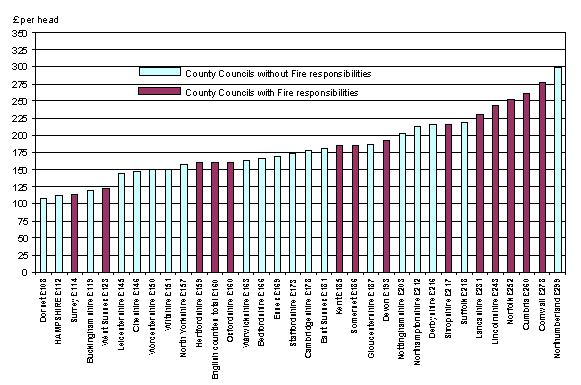
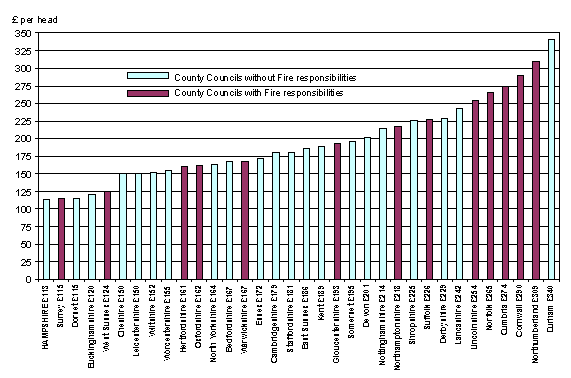
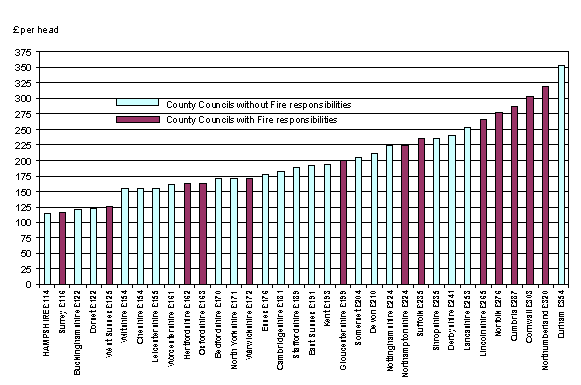
3.8. The graphs below illustrate the comparative position of the County Council relative to other county councils over the three year period. The County Council receives the lowest but one level of Government grant per head in 2008/09 amongst comparable County Councils and by 2009/10 will have the lowest, and yet still has more potential than any other County Council apart from Surrey, Buckinghamshire and Hertfordshire to see its relative funding position fall further after 2010/11 against other County Councils. This represents a very challenging Government funding position against which the County Council has had to develop its medium term financial strategy.
County Councils' Formula Grant 2008/09 per head - after floor damping
County Councils' Formula Grant increases 2008/09 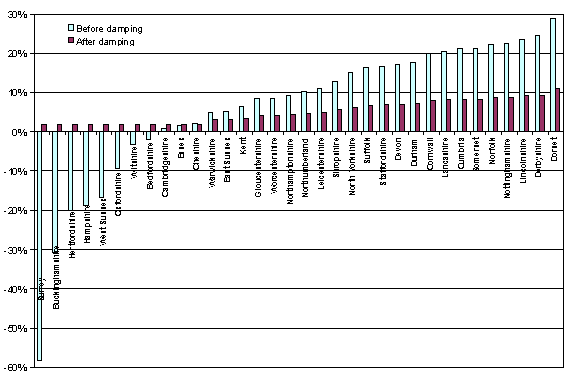
County councils' average: before floor damping +7.3%, after floor damping +5.3%.
County Councils' Formula Grant 2009/10 per head - after floor damping
County Councils' Formula Grant increases 2009/10
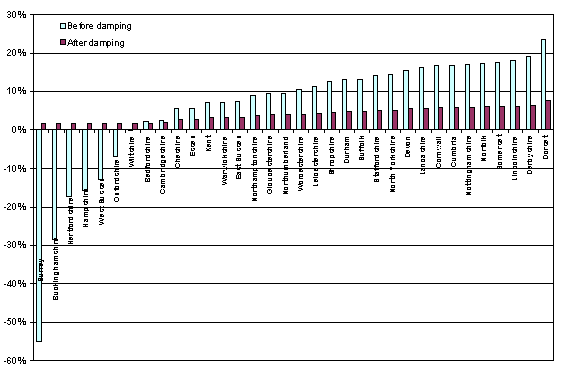
County councils' average: before floor damping +6.8%, after floor damping +4.2%.
County Councils' Formula Grant 2010/11 per head - after floor damping
County Councils' Formula Grant increases 2010/11
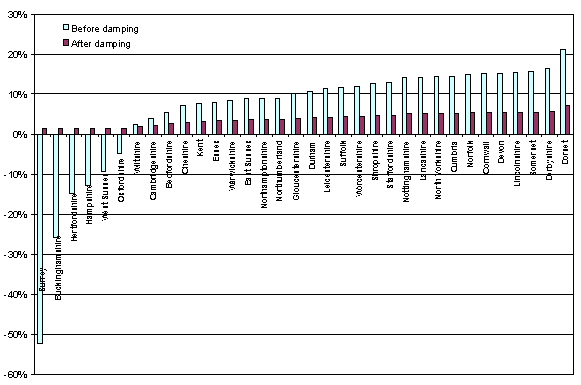
County councils' average: before floor damping +6.9%, after floor damping +4.0%
Council tax and borrowing
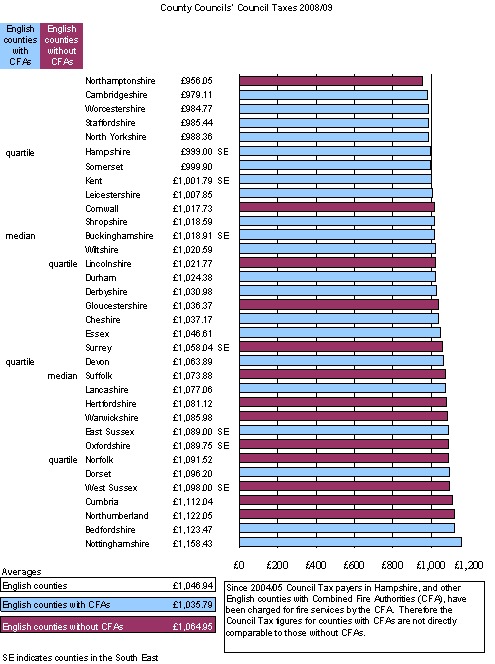
3.9. The Government abolished the practice of pre-announcing capping limits for local authority council tax as from 1999/00, (referred to as `crude and universal capping') but retained reserve powers in the 1999 Local Government Act both to cap the current year's council tax, requiring a rebilling; or to `nominate' the authority for possible capping in the following year. In recent years, although there has been no return to the formal pre-announcement of capping limits that were a feature of the pre-1999 system, the Secretary of State has given fairly clear indications of his intention on the use of the reserve capping powers before local authorities have set their budgets. For 2008/09 the Local Government Minister announced in December 2007 that the Government expected to see average council tax increases of substantially less than 5% and would use the reserve capping powers to deal with excessive increases. Hampshire's council tax increase of 4.5% in 2008/09 was above the County Council average of 4% but enabled the County Council to maintain its position of setting a Band D council tax in the lower quartile of comparable County Councils .
3.10. Part 1 of the Local Government Act 2003 introduced a new approach to the control of local authority borrowing to finance capital expenditure, replacing a system of Government borrowing approvals with the requirement to comply with a Code of Practice, the Prudential Code for Capital Finance in Local Authorities, designed to allow local authorities to determine their own capital investment plans, subject to them being affordable, prudent and sustainable. Government has continued to provide support through the grant system for implementing projects/programmes it has approved though this has been rendered ineffective by the extensive damping of formula grant since 2006/07. However local authorities are now able to incur additional unsupported borrowing subject to the requirements of the code and the County Council has established a policy on unsupported borrowing that has enabled the capital programme to be extended to support projects which will generate a financial return to the County Council either in the form of additional operating income or lower operational expenditure or in the form of capital income from land disposals and developer contributions.
4) Three year budget plan 2008/09 to 2010/11
4.1. The three year budget plan for 2008/09 to 2010/11 has been set within the context of the County Council's corporate strategy, outlined in Section 2 and of the national policies outlined in Section 3.
Provisional budget guidelines
4.2. Provisional budget guidelines for 2008/09 to 2010/11 were set in October 2007 immediately following the outcome of CSR07 and were confirmed in December 2007 following the announcement of the three year grant settlement. The announcement of a three year grant settlement enabled firm assumptions to be made about grant income for the next three years, but assumptions had to be made about other resources, and those were based on the assumption that the Council tax increase might be as high as 4.9% in each of the three years, that the Council tax base would continue to increase by an assumed 0.5% per annum and that annual collection fund surpluses would continue at an estimated £1.5m per annum.
4.3. The spending assumptions underpinning the three year budget plan were largely based on the 2008/09 and 2009/10 assumptions contained in the 2007/08 to 2009/10 medium term financial strategy and can be summarised as follows:
· pay and price increases to average 2.5% per annum together with provision for a phased increase in the employer's pension contribution, based on the 2007 actuarial review
· that supported borrowing would not be taken up in full and that corporate support for new borrowing would be limited to a level consistent with a 2.5% increase in the capital financing requirement
· allowance was made for above inflation increases in adults and children's social care totalling £7.7m in 2008/09, £7.9m in 2009/10 and £8.3m in 2010/11 in recognition of demographic and legislative pressures and to support the safety and security of vulnerable members of the community
· additional contingency provision made for the anticipated impact of increased landfill tax, higher waste volumes, and inflation affecting the waste management contract
· for all other services, that any new service developments or increased service demands would have to be met by efficiency savings or from redeploying resources from lower priority services
4.4. Chief officers produced a detailed budget for 2008/09 and outline provisional budgets for 2009/10 and 2010/11 within these guidelines, for approval by Executive members.
Partnerships
4.5. One of the key considerations in drawing up service budget proposals is the need to link the County Council's decisions on resource allocation with its responsibilities to operational partnerships, those partnerships where there is either a formal or informal pooling of budgets in seeking to secure agreed common priorities. These partnerships are numerous and affect the majority of services eg. Supporting People, Children's and Adolescent Mental Health, Safer Roads, Transport for South Hampshire, Partnership for Urban South Hampshire, Project Integra, Wessex Youth Offending Team, Joint Exception Needs Initiative, Integrated Community Equipment Service, Safeguarding Children's Board, Basingstoke Canal and Sir George Staunton Country Park. In some cases there are dedicated partnership funding streams, but in most instances partners are required to co-ordinate their decisions on budget contributions within the context of the authority's budget strategy.
Risk Management
4.6. The approach to risk management in formulating the three year budget was related to the corporate risk assessment process and adopted a number of different approaches to the management of those risks. The most significant of the risks, associated with equal pay claims, is being addressed by means of an earmarked reserve and subject to Government approval the impact may also be spread over up to 20 years by capitalisation. IT risks associated with business continuity are being addressed by establishing back up arrangements for critical systems. The financial impact of arson is addressed through the insurance reserve and by the allocation of resources arising from the risk assessment of the built estate. Other risks and uncertainties are addressed either by specific earmarked reserves, contingency provisions in the budget or as part of the risk assessment of general balances, carried out in conjunction with the S25 report to the Council on the robustness of the estimates in the budget and adequacy of financial reserves.
Alternative scenarios
4.7. Though the three year grant settlement provides certainty to the estimates of grant income in the three year budget plan, assumptions have had to be made over the three year period about levels of spending, other income levels, council tax base, and the level of the Band D council tax. The principal means of addressing those uncertainties is through the level of general balances, the risk assessment taking account of the assessed level of risk associated with the estimates in the budget. The table below summarises the impact upon spending or the level of council tax of some alternative scenarios before allowing for the possible use of general balances.
Impact on level of net expenditure or council tax requirement | |
£m | |
1% increase in spending |
8.6 |
1% reduction in income |
2.4 |
Nil increase in tax base |
2.4 |
No collection fund surplus |
1.5 |
1% lower council tax increase |
5.0 |
4.8. The Council's policy is to set challenging but realistic budget assumptions, but risk assesses its general level of balances accordingly. Given targeted balances of £15m in 2008/09, the level of earmarked reserves and the scope to vary future provisional budgets if essential, the potential impact upon spending on council tax levels of the alternative scenarios outlined in paragraph 4.7, is considered to be containable.
Final decisions in setting three year budget plan
4.9. The three year grant settlement agreed in December 2007 was less severe than had been anticipated in the previous medium term financial strategy. In addition final tax base and collection fund decisions by the district councils for 2008/09 were more favourable than had been assumed. Updated waste management contract and capital financing estimates were also lower than had been forecast. This provided the opportunity, having assessed the risks contained in the budget, to include some additional recurring expenditure in the budget for invest to save proposals and to support a lower non-take up of supported borrowing on transport and schools capital investment. Provision was also made for some additional non-recurring expenditure in 2008/09, principally to support the locally resourced capital programme.
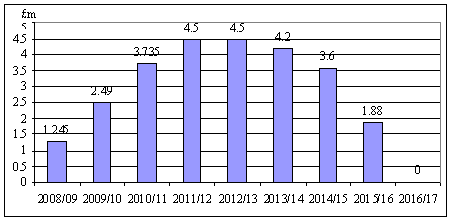
4.10. A decision was also taken to begin the release of the grant equalisation reserve in 2008/09 in order to complement the Government's damping arrangements in easing the impact of grant loss over the next 6 to 8 years, the period over which the County council's annual grant increase is likely to continue to be limited to the minimum floor increase. The proposed profile set out in the graph below offsets potential council tax increases of about 0.3% per annum over the period 2008/09 and 2010/11, reaches a peak of £4.5m in 2011/12, and then tapers off over the period to 2016/17.
4.11. The proposed three year budget increases are summarised in the table below. The increases quoted represent the underlying impact on the increase in the budget requirement made by each service, and are adjusted for transfers between services, capital/revenue transfers and the use of reserves and specific grants.
2008/09 increase |
2009/10 increase |
2010/11 increase | ||||
£m |
% |
£m |
% |
£m |
% | |
Adult Services |
12.6 |
5.7 |
12.5 |
5.4 |
13.3 |
5.4 |
Children's Services |
6.3 |
5.0 |
3.2 |
2.4 |
3.4 |
2.5 |
Environment |
4.0 |
3.7 |
5.5 |
4.9 |
5.5 |
4.7 |
Policy and Resources |
1.3 |
2.4 |
2.0 |
3.8 |
0.6 |
1.2 |
Recreation and Heritage |
1.4 |
4.5 |
0.6 |
1.8 |
0.8 |
2.3 |
25.6 |
4.7 |
23.8 |
4.2 |
23.6 |
4.0 | |
Other budgets |
1.7 |
2.3 |
-3.0 |
-3.7 |
-0.5 |
-0.6 |
Budget requirement |
27.3 |
4.4 |
20.8 |
3.2 |
23.1 |
3.5 |
Formula Grant |
2.8 |
2.0 |
2.5 |
1.75 |
2.2 |
1.5 |
Council Tax requirement |
24.5 |
5.2 |
18.3 |
3.7 |
20.9 |
4.0 |
27.3 |
4.4 |
20.8 |
3.2 |
23.1 |
3.5 | |
Council tax at Band D |
£999.00 |
4.5 |
£1033.47 |
3.5 |
£1070.01 |
3.5 |
4.12. Since the approval of the three year budget plan, a decision was taken by the Cabinet to utilise interest savings arising in 2007/08's outturn to reduce the Council tax increase required to support the proposed budget to 3% in both 2009/10 and 2010/11. The County Council's 2008/09 Council Tax at Band D achieved the corporate strategy objective of being within the lower quartile of comparable County Council council taxes, though this will be more difficult to achieve in future as the number of County Councils reduce following the planned 2009 reorganisation. The County Council's budget requirement per head is also in the lower quartile. The following graphs demonstrate the County Council's comparative position in relation to both Council tax and budget requirement.
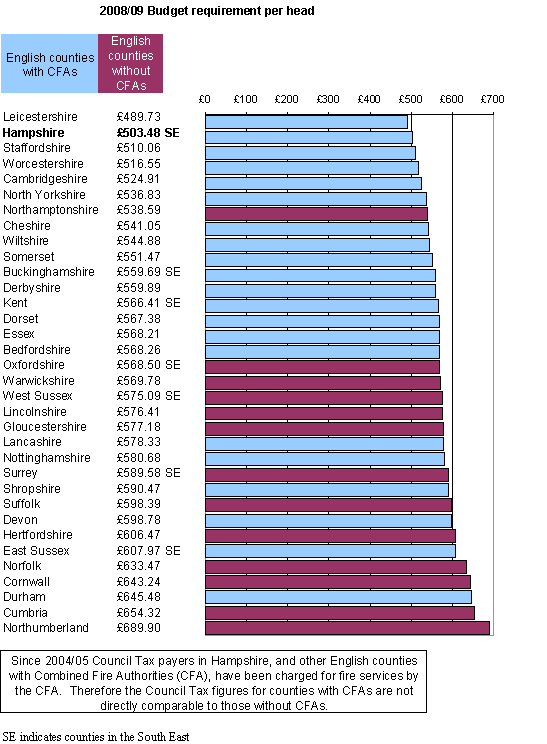
4.13. Annex 3 contains some further analysis of the three year budget in graphical form and a summary of the projected balance sheet for the period, differentiating between spending funded from taxation, including schools and other spending financed by specific grant, and spending which forms part of the budget requirement funded by formula grant and council tax, which the County Council has the responsibility for determining.
5) Capital Programme 2008/09 to 2010/11
5.1. The County Council approved a capital programme for 2008/09 to 2010/11 at its meeting in February 2008. The capital programme is integrated within the medium term financial strategy in a number of respects.
· it reflects the capital strategy approved by the Cabinet in July 2007 (and subsequently reviewed in July 2008), and the priorities of the corporate strategy
· the programme is drawn up in accordance with the capital programme policies included within the County Council's financial management policies
· decisions on the level of revenue contributions to capital and on the affordability of supported borrowing have been taken in conjunction with the decisions taken in agreeing the three year budget plan
· the use of unsupported borrowing is determined in conjunction with the setting of the prudential indicators, approved by the County Council in accordance with the prudential code of practice
· the treasury management strategy incorporates the strategy for making borrowing decisions.
5.2. Alongside decisions on the three year budget plan, guidelines for the preparation of the capital programme for 2008/09 to 2010/11 were provisionally set by the Cabinet in October 2007 and confirmed in December 2007. The guidelines comprise three elements:
· a locally resourced capital programme - supported by revenue contributions to capital, capital receipts and the non-transport and non - education elements of the single capital pot. Guidelines were set based on the previously approved 2007/08 to 2010/11 programme adjusted for inflation
· a programme of projects supported by Government grants and scheme or programme specific supported borrowing allocations allocated over the three years, subject to limits on the take up of supported borrowing allocations designed to restrict the increase in the capital financing requirement to 2.5% per annum
· the use of unsupported borrowing in accordance with the County Council's policy on prudential borrowing, which concentrates its use on supporting projects which yield a financial return and which are therefore self-sustaining in the medium and longer term. Unsupported borrowing is also used in the short-term to deal with any slippage which may arise in the generation of capital receipts to support the capital programme guidelines
5.3. Based on these three elements, the capital programme for 2008/09 to 2010/11 totalled £444.4m made up as follows:
Locally resourced |
Government approvals |
Unsupported borrowing |
Total | |
£000 |
£000 |
£000 |
£000 | |
2008/09 |
40,674 |
100,310 |
14,468 |
155,452 |
2009/10 |
25,460 |
109,003 |
10,883 |
145,346 |
2010/11 |
24,393 |
111,814 |
7,400 |
143,607 |
90,527 |
321,127 |
32,751 |
444,405 |
5.4. This programme comprises a mixture of start values, mainly for larger specific projects, and planned expenditure in the year, mainly for capital repairs and other block sum approvals. Annex 4 summarises graphically the overall programme for the three years over services.
6) Underpinning policy statements and strategies
Financial management policies
6.1. The County Council's financial management polices relating to financial planning are set out in Annex 5, covering overall financial planning and budget strategy, capital programmes and value for money. These policies form the framework within which the three year budget plan and the capital programme are set, and within which the other policies and strategies included in this section are framed. An amendment to the financial management policies to deal with the introduction of area based grant is being proposed.
Value for money strategy
6.2. The value for money strategy develops further the financial management policies relating to value for money. It defines value for money in terms of achieving the optimum balance between economy, efficiency and effectiveness. It also explains how efficiency improvements as defined for Government efficiency planning purposes fits into value for money and the distinction between cashable efficiency improvements for efficiency planning purposes and cashable efficiency savings for budget strategy purposes. The strategy also defines how the County Council seeks to measure value for money, some of the approaches adopted to achieve value for money improvements and how value for money is built into the management process
.
Efficiency plan
6.3. The efficiency plan forms the basis on which the County Council plans and monitor the efficiency savings required to meet the target set by the Government, reflected in the value for money strategy and to achieve the efficiency savings required to enable inescapable demand pressures and high priority service developments to be accommodated within budget limits. From 2008/09 it will no longer be necessary to submit an Annual Efficiency Statement to the Government and instead an efficiency indicator has been included within the national indicator set, which will need to be published twice yearly. The Government is also consulting on proposals to require the inclusion of comparative information about efficiency on council tax bills and leaflets.
Treasury management and investment strategies, prudential and financial health indicators
6.4. These strategies provide the framework within which authority is delegated to the County Treasurer to make decisions on the management of the County Council's debt and the investment of the County Council's surplus funds. The County Council is authorised to borrow on a long-term basis to finance capital expenditure and short-term to deal with cash flow fluctuations pending the receipt of revenues.
6.5. The starting point for the development of the treasury management strategy for the period 2008/09 to 2010/11 is the assessment of changes in the long-term borrowing position which is dictated by changes in the capital financing requirement, even though in the short-term the need to borrow may be offset by surplus funds derived from holding reserves and balances and from creditors exceeding debtors. The main determinants of the change in the capital financing requirement are:
· the level of new borrowing approved in setting the capital programme, taking into account new unsupported borrowing approved in accordance with the County Council's financial management policy and the repayment of any temporary unsupported borrowing
· the annual repayments charged to the revenue account or to external bodies in respect of transferred services, based on the requirement to make a minimum revenue provision for the repayment of debt within the revenue budget on a prudent basis.
6.6. The capital financing requirement for the period 2008/09 to 2010/11 is estimated as follows:
2008/09 |
2009/10 |
2010/11 | |
£m |
£m |
£m | |
Capital financing requirement at 1 April |
587.5 |
615.9 |
622.0 |
New borrowing net of repayments of temporary unsupported borrowing |
52.1 |
30.9 |
43.8 |
Repayments charged to revenue account and external bodies |
-23.7 |
-24.8 |
-25.1 |
Capital financing requirement at 31 March |
615.9 |
622.0 |
640.7 |
6.7. The other key consideration in setting the treasury management strategy is the assessment of interest rate trends and the balance struck between the certainty and stability of longer term fixed rate borrowing and the flexibility of short-term borrowing at variable rates. Lender's option/borrower's option's loans (LOBOs) provide an opportunity for variable rate borrowing over longer term periods as an alternative component of the strategy.
6.8. The treasury management strategy for 2008/09 to 2010/11 set a target variable/fixed ratio of 55%/45%, including allowance of 15% within the variable rate proportion for LOBOs. Based on this ratio annual guideline targets of up to £15m and £7m were set for 2008/09 to 2010/11 for long-term fixed rate and LOBO's respectively, subject to interest rate conditions being appropriate. In considering whether contributions are appropriate for further long-term fixed borrowing, the strategy proposes a trigger rate of 4.5% at which rate and below further long-term borrowing would be considered, unless clear signs of a rising trend in rates occur, in which case it might also be appropriate to borrow at higher rates. Raising new LOBOs would be considered in circumstances when their primary rates and indicative rates for their remaining periods are no higher than the 4.5% trigger rate used for fixed-rate long term borrowing.
6.9. The strategy also authorised the County Treasurer to consider the scope for further restructuring of long term loans in view of the changes in regulations for accounting for the amortisation of premiums incurred from debt restructuring, for the purposes of setting council tax. Due regard would be paid to the need to avoid a heavily skewed maturity profile as a result of any restructuring, and to the Public Works Loan Board's policy on the calculation of premature repayment premiums, which changed adversely during 2007/08.
6.10. The County Council's investment strategy treats security and liquidity as paramount in investing surplus funds and such funds are invested solely in what are defined by the Government as `specified investments'. Surplus funds are invested in:
· fixed term deposits for periods up to 1 year with local authorities, the Government's Debt Management Office, or banks and building societies rated at least A2 by Moody's, a credit rating agency
· call deposits with the Bank of Scotland (rated AA2) and Natwest Bank (rated AAA), and three managed AAA - rated money market funds
The lending list is reviewed monthly using Moody's ratings, and limits are placed on the levels of total deposits made with individual institutions. An overall review of the lending list and the investment limits is undertaken annually, subject to the approval of the County Treasurer.
Prudential indicators
6.11. The Prudential Code for Capital Finance incorporates a series of indicators requiring annual approval by the County Council, designed to ensure that:
· capital programmes are affordable
· external borrowing and other long-term liabilities are within prudent and sustainable levels
· treasury management decisions are taken in line with professional good practice.
6.12. The key indicators are incorporated within the financial health indicators discussed in paragraph 6.13 of this strategy. The single most important indicator is the capital financing requirement, and in particular the component within it relating to unsupported borrowing, as this is the most important measure of the affordability of the capital programme and of the prudence and sustainability of borrowing levels. The Council's policy on the use of unsupported borrowing is set out in financial management policy 32 (as set out in Annex 5).
Financial Health indicators
6.13. Annex 6 sets out a series of financial health indicators which form the basis for the regular monitoring of the strategy as part of the quarterly budget monitoring report to Cabinet. These cover budget variances, the management of the capital programme, the prudential indicators and income collection.
Capital strategy
6.14. The capital strategy 2008 was approved by the Cabinet in July 2008 and brings together the Council's key policies for managing all its capital assets, including land, buildings and roads. Together with the appropriate financial management policies it provides the strategic framework for the preparation of the capital programme. Among the key policies in the 2008 strategy are:
· to focus attention on the most effective and efficient use of the Council's capital assets
· to link directly to the Council's corporate strategy, to the Hampshire Sustainable Community Strategy and to the priorities in the Hampshire Local Area Agreement
· to improve the management, utilisation and efficiency of the use of capital assets alongside the Council's policy and service objectives
· to develop a procurement strategy and to create long-term relationships to ensure value for money and continuous improvement
Public Consultation
Section 3: Future spending priorities |
The County Council wants your views on how they should plan for future spending over the next three years. The Council has already identified additional funds of £3 million in 2008/09, created through savings, to allocate to highway maintenance, and for renovating residential homes for the elderly. The Council has to make decisions both about the priority given to spending on individual services and about the overall level of spending and council tax. To help make these decisions it would like to hear your views.
Q10 |
Of the County Council services below, which do you think the County Council should spend more money, spend less money on, or keep spending the same amount on? PLEASE TICK _ UP TO FOUR BOXES IN EACH COLUMN |
SERVICE: |
MORE (UP TO FOUR) |
LESS (UP TO FOUR) |
KEEP SAME (UP TO FOUR) | |
% |
% |
% | ||
Improvements to support services for schools |
21 |
10 |
39 | |
Youth clubs, outdoor centres and other facilities for young people |
45 |
7 |
21 | |
Support/care for the elderly |
54 |
2 |
23 | |
Support/care for vulnerable adults such as people with disabilities and mental health problems |
28 |
4 |
30 | |
Support/care for vulnerable children |
30 |
2 |
25 | |
Community Safety |
33 |
8 |
21 | |
Public transport subsidies |
28 |
18 |
25 | |
Traffic congestion |
31 |
18 |
14 | |
Road and footway surface maintenance |
51 |
3 |
19 | |
Other road maintenance (including lighting and signs) |
11 |
17 |
23 | |
Libraries |
6 |
16 |
38 | |
Trading standards |
4 |
20 |
19 | |
Planning |
3 |
30 |
17 | |
Countryside services such as footpaths & rights of way |
16 |
16 |
21 | |
Household Waste Recycling Centres (dumps/recycling centres) |
27 |
5 |
30 | |
Waste disposal |
25 |
6 |
21 | |
Museums and archives |
4 |
31 |
24 |
Section 4: Spending options |
To maintain current levels of service, the County Council plans to raise average Council Tax by 3.0% (less than retail price index inflation) in 2009/10 and 2010/11. The Council will also continue to innovate and modernise services to increase efficiency.
This provides increased funding (in excess of inflation costs) for:
· Adult and Children's Social Care, (an additional £7 million and £1 million respectively in recognition of increased numbers requiring care and greater complexity of needs); and
· Waste management (£2 million to reduce landfill and avoid increased landfill tax).
To finance any additional spending on new service developments; to fund the priorities you identified in Q10; or in order to fund extra demand for certain services, an increase in Council Tax of 4.0% will be needed. This would provide an additional £5 million for improvements in services. Alternatively a smaller increase in Council Tax of 3.5% would provide an additional £2.5 million for improvements in services.
Q11 |
Which option of the following three options would you most support for the Council over the next three years? |
· |
· |
% |
|
· |
· OPTION 1- Council tax increase of 4.0% which would mean: · Extra funding for priority areas (such as those chosen at Q10) · Increased funding as detailed above |
18 |
|
· |
· OPTION 2 - Council tax increase of 3.5% which would mean: · Smaller increase in funding for priority areas (such as those chosen at Q10) · Increased funding as detailed above |
36 |
|
· |
· OPTION 3 - Council tax increase of 3.0% which would mean: · No additional funding for priority areas (such as those chosen at Q10) · Increased funding as detailed above |
26 |
|
ANOTHER OPTION |
15 |
||
Don't know |
5 |
Q12. |
Which District Council do you or your household pay council tax to? PLEASE TICK ONE BOX ONLY |
% |
||||
Basingstoke and Deane |
9 |
|||
East Hampshire |
10 |
|||
Eastleigh |
13 |
|||
Fareham |
10 |
|||
Gosport |
7 |
|||
Hart |
10 |
|||
Havant |
8 |
|||
New Forest |
11 |
|||
Rushmoor |
7 |
|||
Test Valley |
8 |
|||
Winchester |
8 |
|||
None of these |
0 |
|||
Don't know |
0 |
Service proposals for growth and redeployment 2008/09 to 2010/11 - links to corporate strategy and financial management policy
Linking Spending and Savings Proposals to the Corporate Strategy
- Key to references in annex 2a to 2e
A. Corporate strategy outcomes
1 Hampshire safer and more secure for all
1.1 There is a reassuring, visible, uniformed presence.
1.2 The users of Hampshire's roads are safer.
1.3 Children stay safe and feel secure.
1.4 Vulnerable adults and older people are protected.
1.5 Independent living is promoted through community safety initiatives.
1.6 Hampshire County Council is prepared in the event of a major emergency and has adequate contingency arrangements to ensure the continued delivery of vital services.
1.7 Hampshire contributes to the mitigation of and adaptation to climate change.
2 Maximising wellbeing
2.1 Vulnerable adults and older people are treated in a way which maximises wellbeing, independence and inclusion.
2.2 Right care in the right place at the right time for adults and older people.
2.3 All children and young people enjoy learning and achieve to their full potential.
2.4 Children in our care have the best possible chances in life and are supported to achieve their full potential.
2.5 People have fair and equal access to services and information.
2.6 All local people, including children and young people and their families, can influence decision making and the ways in which services are designed and delivered.
2.7 Hampshire is a strong, active and diverse community.
2.8 People in Hampshire are healthy and enjoy wellbeing.
2.9 Disparities in income across Hampshire are reduced and there is general economic prosperity.
3 Enhancing our quality of place
3.1 The majority of waste is diverted from landfill.
3.2 The roads and pavements of Hampshire are in a good condition.
3.3 Traffic impacts are kept to a minimum.
3.4 Hampshire is a sustainable community.
3.5 The County Council owned and managed estate and heritage assets benefit Hampshire's quality of place.
Management Plan
MP1 Council services offer value for money.
MP2 Resources follow priorities.
MP3 Hampshire County Council develops capacity to support its priorities and behaviours to support its organisational values.
B. Financial context to the corporate strategy
FC1 Demographic and legislative pressures:
- aging population and increased number of young people with complex disabilities living into adulthood
- higher waste disposal costs due to national policies linked to landfill and hazardous waste directives
- increased numbers of vulnerable children being identified
FC2 Major change programmes:
- development of Hantsdirect
- pay and benefits programme
FC3 Review programmes to enable spending pressures to be accommodated and to achieve targeted efficiency savings.
C. Financial management policies
FM16 In order to allow services to operate within firm cash limits, allocate provision for inflation to services at the start of the financial year and require excess inflation to be absorbed.
FM17 Services expected to contain spending within the approved cash limit with no supplementary allocations being available other than in exceptional circumstances unless a specific contingency provision made within the budget.
FM18 Services expected to carry forward 100% of any overspending against the overall service cash limit, but are allowed to retain up to 100% of any planned underspending identified prior to the approval of the following year's budget. 50% of any unplanned underspending can automatically be carried forward.
FM21 Encourage chief officers to submit applications for specific grant/partnership funding designed to maximise the resources available to the County Council, by allowing capital and revenue cash limits to be adjusted to reflect changes in grant levels.
FM23 Require services to review the level of fees and charges at least annually and set budget limits on the assumption that the level of charges will be increased in line with assumed inflation on gross expenditure.
Service proposals for growth and redeployment 2008/09 to 2010/11 - links to corporate strategy and financial management policy
Adult Services
Proposals for growth, and redeployment 2008/09 to 2010/11
Proposals are shown at outturn prices for the relevant year.
Agreed proposals will be incorporated into future year's base budgets and so on-going costs are shown in the first year only. One-off costs are shown in the first year and subtracted from the following year.
Staffing (FTEs) |
Link to Corporate Strategy | ||||||
2008/ 09 |
2009/ 10 |
2010/ 11 |
2008/ 09 |
2009/ 10 |
2010/ 11 |
||
£'000 |
£'000 |
£'000 |
|||||
Growth proposals and unavoidable service pressures: |
|||||||
Dependency & Demographic Pressures |
5,699 |
5,126 |
5,049 |
- |
- |
- |
FC1 |
Commissioning /inflation |
1,780 |
100 |
100 |
- |
- |
- |
FM16 |
Modernisation Programme |
3,155 |
-170 |
416 |
17 |
-1 |
FC2 | |
Safeguarding clients |
470 |
- |
- |
16 |
- |
- |
1.4 |
Supporting People |
940 |
- |
- |
- |
- |
- |
FM21 |
Promoting Independence |
442 |
- |
-85 |
3 |
- |
-1 |
2.1 |
Other Operational Pressures |
3,090 |
2,320 |
- |
15 |
- |
- |
2.2 |
Sub-total |
15,576 |
7,376 |
5,480 |
51 |
- |
-2 |
|
Unallocated balance - to meet un-identified growth & pressures in future years |
- |
- |
3,332 |
- |
- |
- |
|
Total increase |
15,576 |
7,376 |
8,812 |
51 |
- |
-2 |
|
Redeployment and savings proposals |
|||||||
Dependency & Demographics efficiencies |
-665 |
-75 |
-75 |
- |
- |
- |
MP1 |
Commissioning/ inflation efficiencies |
-2,032 |
- |
- |
- |
- |
- |
MP1 |
Modernisation Programme efficiencies |
-2,011 |
-805 |
-1,397 |
-86 |
-5- |
- |
MP1 |
Promoting independence efficiencies |
-660 |
-310 |
-190 |
- |
- |
- |
MP1 |
Other Operational efficiencies |
-931 |
-66 |
-150 |
-4 |
- |
- |
MP1 |
Efficiencies subtotal |
-6,299 |
-1,256 |
-1,812 |
-90 |
-5 |
- |
|
*Scope for increased income |
-400 |
- |
- |
- |
- |
- |
FM23 |
Scope to Reduce Services |
-57 |
- |
- |
- |
- |
- |
MP2 |
Carry forward of 2007/08 underspending |
-800 |
800 |
- |
FM18 | |||
Use of Winter pressure contingency |
-1520 |
- |
- |
FM17 | |||
Unallocated savings |
- |
-220 |
- |
||||
Total redeployment proposals |
-6,756 |
-1,256 |
-1,812 |
-90 |
-5 |
- |
|
Total increase allowed in budget guidelines |
6,500 |
6,700 |
7,000 |
-39 |
-5 |
-2 |
|
Additional saving for Pay & Benefits |
-500 |
- |
- |
- |
- |
- |
|
*£0.1m cashable relates to improved FAB referrals
£0.3m relates to non cashable efficiencies following the introduction of a single rate RNCC (registered nursing care contribution)
Children's Services
2. Proposals for growth and redeployment 2008/09 to 2010/11 - Non Schools |
Staffing (FTEs) |
Link to Corporate Strategy | ||||||
2008/ 09 |
2009/ 10 |
2010/ 11 |
2008/ 09 |
2009/ 10 |
2010/ 11 |
||
£'000 |
£'000 |
£'000 |
|||||
Growth proposals: |
|||||||
Training |
120 |
0 |
0 |
0 |
0 |
0 |
MP3 |
Data and Information for Vulnerable Children |
200 |
0 |
0 |
5 |
0 |
0 |
1.3 |
Home to School Transport |
200 |
0 |
0 |
0 |
0 |
0 |
FC1 |
Right Respect and Responsibilities |
50 |
0 |
0 |
1 |
0 |
0 |
1.3 |
Voluntary Sector Alliance |
50 |
0 |
0 |
0 |
0 |
0 |
2.7 |
Building Schools for the Future |
200 |
200 |
100 |
3 |
3 |
2 |
2.3 |
Children Looked After/Edge of Care Strategy |
400 |
0 |
0 |
2.4 | |||
Foster Care (allowances, skills fees and support) |
1,800 |
600 |
550 |
8 |
0 |
0 |
2.4 |
Social Work Resources |
600 |
0 |
0 |
16 |
0 |
0 |
2.4 |
Permanence and Adoption |
40 |
0 |
0 |
FC1 | |||
Family Group Conferences |
150 |
50 |
50 |
FC1 | |||
Wessex Youth Offending Team |
100 |
25 |
0 |
4 |
1 |
0 |
1.3 |
Direct Payments |
125 |
0 |
0 |
2.4 | |||
Training of Educational Psychologists |
120 |
0 |
0 |
MP3 | |||
Total Growth proposals |
4,155 |
875 |
700 |
37 |
4 |
2 |
|
Redeployment proposals: |
|||||||
Core Funding (Study Centres) |
-145 |
0 |
0 |
0 |
0 |
0 |
MP2 |
Denominational transport |
-25 |
-25 |
0 |
MP2 | |||
Printers in Ashburton Court |
-35 |
0 |
0 |
0 |
0 |
0 |
MP1 |
Reduction in Independent Fostering Placements |
-400 |
-900 |
-800 |
MP1 | |||
Residential Service savings |
-80 |
0 |
0 |
MP2 | |||
Education Psychology savings |
-120 |
MP2 | |||||
Home Care |
-125 |
0 |
0 |
MP2 | |||
Other savings |
-23 |
||||||
Use of Grant Flexibility |
-602 |
-150 |
-40 |
||||
Total redeployment proposals |
-1,555 |
-1,075 |
-840 |
0 |
0 |
0 |
|
Net growth and redeployment proposals |
2,600 |
-200 |
-140 |
37 |
4 |
2 |
|
Further savings to be identified |
-1,400 |
0 |
0 |
0 |
0 |
0 |
|
Growth to be allocated |
0 |
1,400 |
1,400 |
0 |
0 |
0 |
|
Total increase allowed in the budget guidelines |
1,200 |
1,200 |
1,260 |
37 |
4 |
2 |
|
Service proposals for growth and redeployment 2008/09 to 2010/11 - links to corporate strategy and financial management policy
Environment
Proposals for growth and redeployment 2008/09 to 2010/11
Proposals are shown at outturn prices for the relevant year.
Agreed proposals will be incorporated into future year's base budgets and so on-going costs are shown in the first year only. One-off costs are shown in the first year and subtracted from the following year.
Staffing (FTEs) |
Link to Corporate Strategy | |||||||
2008 /09 |
2009 /10 |
2010 /11 |
2008 /09 |
2009 /10 |
2010 /11 |
|||
£'000 |
£'000 |
£'000 |
||||||
Growth proposals and unavoidable service pressures: |
||||||||
1 |
Highways maintenance |
|||||||
Street lighting |
||||||||
1.1 |
Estimated increase in energy costs from new supply contract and from PFI (increase of £0.25m per annum until 2014) |
300 |
- |
250 |
- |
- |
- |
FM16 |
1.2 |
Private Finance Initiative (PFI) - project team and development related expenditure |
360 |
-460 |
-100 |
- |
- |
- |
1.2 |
1.3 |
Extension of existing maintenance contract |
- |
50 |
-50 |
- |
- |
- |
1.2 |
1.4 |
Unitary charge under PFI or alternative arrangements if PFI does not proceed |
- |
300 |
300 |
- |
- |
- |
1.2 |
Total highways maintenance |
660 |
-110 |
400 |
- |
- |
- |
||
2 |
Road safety education |
|||||||
2.1 |
Pass Plus - continued support for young drivers currently funded from one-off LPSA reward grant |
75 |
- |
- |
- |
- |
- |
1.2 |
Total road safety education |
75 |
- |
- |
- |
- |
- |
||
3 |
Public transport |
|||||||
3.1 |
Bus subsidies - anticipated above inflation increases arising from ongoing programme of contract re-tendering |
258 |
225 |
362 |
- |
- |
- |
FM16 |
3.2 |
Fall out of existing Government funding (including Bus Challenge) - currently being used in support of Cango services and other transport initiatives |
225 |
36 |
98 |
- |
- |
- |
FM21 |
3.3 |
Community transport provision in rural areas - including Hampshire rural transport pilots and risk of transfer of community transport provision from SLA to contract |
190 |
-70 |
-120 |
- |
- |
- |
2.5 |
Total public transport |
673 |
191 |
340 |
- |
- |
- |
||
4 |
Highways and transportation staffing and support costs |
|||||||
4.1 |
Major scheme development - contribution towards scheme preparation and design for future major projects |
300 |
- |
100 |
- |
- |
- |
3.3 |
4.2 |
Sub regional development of transport evidence |
380 |
-130 |
-50 |
- |
- |
- |
3.3 |
4.3 |
Asset management - development of asset management approach to highways maintenance |
100 |
- |
- |
- |
- |
- |
3.2 |
4.4 |
Highways claims - provision for additional support under legal SLA |
50 |
- |
- |
- |
- |
- |
FC1 |
4.5 |
Searches, Status and Development Control - additional resources to cover transfer of work from district councils |
85 |
- |
- |
3 |
- |
- |
Funded by fee income |
4.6 |
IT support - contributions towards corporate system developments, flexible working and line upgrades for external offices |
98 |
200 |
40 |
- |
- |
- |
MP2 |
Total highways and transportation staffing and support costs |
1,013 |
70 |
90 |
3 |
- |
- |
||
5 |
Planning and development |
|||||||
Spatial strategy |
||||||||
5.1 |
Partnership for Urban South Hampshire (PUSH) - annual contribution to partnership |
90 |
- |
- |
- |
- |
3.4 | |
Total planning and development |
90 |
- |
- |
- |
- |
- | ||
Total growth and unavoidable service pressures |
2,511 |
151 |
830 |
3 |
- |
- | ||
Redeployment and savings proposals |
||||||||
6 |
Highways maintenance |
|||||||
6.1 |
Street lighting: |
|||||||
- planned carry forward from 2007/08 revenue underspending on PFI project |
-260 |
260 |
- |
- |
- |
- |
FM18 | |
- energy and PFI related costs to be accommodated within street lighting revenue budget |
-400 |
-150 |
-400 |
- |
- |
- |
MP2 | |
6.2 |
Asset management and legal support - transfer to staffing and support costs budget |
-150 |
- |
- |
- |
- |
- |
MP2 |
Total highways maintenance |
-810 |
110 |
-400 |
- |
- |
- |
||
7 |
Road safety education |
|||||||
7.1 |
Pass Plus training - alternative sources of funding being developed |
-75 |
- |
- |
- |
- |
- |
MP2 |
Total road safety education |
-75 |
- |
- |
- |
- |
- |
||
8 |
Public transport |
|||||||
8.1 |
Bus services - savings and other lower cost solutions to be implemented to contain costs within available budget |
-673 |
-191 |
-340 |
- |
- |
- |
MP2 |
Total public transport |
-673 |
-191 |
-340 |
- |
- |
- |
||
9 |
Highways management and support services |
|||||||
9.1 |
Sub regional development of transport evidence: |
|||||||
- planned carry forward from 2007/08 revenue underspending |
-380 |
380 |
- |
- |
- |
- |
FM18 | |
- options for longer term funding to be developed |
- |
-250 |
50 |
- |
- |
- |
||
9.2 |
Major scheme development - redeployment of resources from capital programme |
-300 |
- |
-100 |
- |
- |
- |
MP2 |
9.3 |
Searches, Status and Development Control - additional resources to be funded from fee income |
-85 |
- |
- |
- |
- |
- |
Funding for transferred service |
9.4 |
IT support: |
MP1 | ||||||
- efficiency savings from within existing budget |
-98 |
- |
- |
- |
- |
- |
||
- funding to cover longer term pressures to be identified |
- |
-200 |
-40 |
- |
- |
- |
||
Total highways management and support services |
-863 |
-70 |
-90 |
- |
- |
- |
||
10 |
Planning and development |
|||||||
10.1 |
Partnership for Urban South Hampshire (PUSH) contribution: |
|||||||
- planned carry forward from 2007/08 revenue underspending |
-90 |
90 |
- |
- |
- |
- |
FM18 | |
- options for longer term funding to be developed |
- |
-90 |
- |
- |
- |
- |
||
Total planning and development |
-90 |
- |
- |
- |
- |
- |
||
Total redeployment and saving proposals to meet growth proposals and unavoidable service pressures |
-2,511 |
-151 |
-830 |
- |
- |
- |
||
Service proposals for growth and redeployment 2008/09 to 2010/11 - links to corporate strategy and financial management policy
Policy and Resources
Proposals for growth and redeployment 2008/09 to 2010/11
Proposals are shown at outturn prices for the relevant year.
Agreed proposals will be incorporated into future year's base budgets and so on-going costs are shown in the first year only. One-off costs are shown in the first year and subtracted from the following year.
Staffing (FTEs) |
Link to Corporate Strategy | |||||||
2008 /09 |
2009 /10 |
2010 /11 |
2008 /09 |
2009 /10 |
2010 /11 |
|||
£'000 |
£'000 |
£'000 |
||||||
Redeployment proposals: |
||||||||
Chief Executive: |
||||||||
Employment Law team - equal pay litigation |
+30 |
-30 |
- |
- |
- |
- |
FC2 | |
HR Service Centre deferred SAP benefit realisation savings |
+60 |
-60 |
- |
- |
- |
- |
FC2 | |
P&B team funding |
+438 |
-438 |
- |
- |
- |
- |
FC2 | |
Property, Business and Regulatory Services: |
||||||||
Invest to save - capital receipts |
+200 |
+110 |
- |
- |
- |
- |
MP2 | |
County Treasurer: |
||||||||
- |
Pay and benefits project implementation costs |
+60 |
-60 |
- |
- |
- |
FC2 | |
- |
Equal pay claims |
+40 |
-40 |
- |
- |
- |
- |
FC2 |
Total |
+828 |
-518 |
- |
- |
- |
|||
Pay and Benefits reserve |
-568 |
+568 |
- |
- |
- |
- |
||
Revenue contributions to capital |
-260 |
-50 |
- |
- |
- |
- |
||
Total |
-828 |
+518 |
- |
- |
- |
- |
||
Service proposals for growth and redeployment 2008/09 to 2010/11 - links to corporate strategy and financial management policy
Recreation and Heritage Service
Proposals for growth and redeployment 2008/09 to 2010/11
Proposals are shown at outturn prices for the relevant year.
Agreed proposals will be incorporated into future year's base budgets and so on-going costs are shown in the first year only. One-off costs are shown in the first year and subtracted from the following year.
Staffing (FTEs) |
Link to Corporate Strategy | |||||||
2008 /09 |
2009 /10 |
2010 /11 |
2008 /09 |
2009 /10 |
2010 /11 |
|||
£'000 |
£'000 |
£'000 |
||||||
Growth proposals: |
||||||||
Winchester Discovery Centre - operating costs |
200 |
- |
- |
+4 |
- |
- |
MP2 | |
Library re-structure: Pension costs |
250 |
- |
-150 |
|||||
Peoples network - replacement programme |
20 |
20 |
20 |
FC1 | ||||
Travel / transport |
-20 |
- |
- |
MP1 | ||||
Countryside - increasing access |
150 |
- |
- |
2.7 | ||||
Relocation of staff from North Walls |
50 |
- |
- |
MP2 | ||||
IT staffing |
30 |
- |
- |
+1 |
- |
- |
MP3 | |
Service Development |
106 |
94 |
200 |
MP2 | ||||
Total growth proposals |
786 |
114 |
70 |
+5 |
- |
- |
||
Redeployment proposals: |
||||||||
Museums and Archives - income, staffing and local allocations |
-95 |
-13 |
-8 |
MP1 | ||||
Arts, Tourism marketing and Design - Arts review, income |
-74 |
-10 |
-6 |
MP1 | ||||
Libraries and Information - mainly vacancy management |
-478 |
-63 |
-39 |
MP1 | ||||
Countryside - review of charges, staffing |
-120 |
-16 |
-10 |
MP1 | ||||
Sports and Community - staffing and funding of eternal bodies |
-60 |
-8 |
-5 |
MP1 | ||||
Policy Fund and headquarters - service innovation |
-25 |
-3 |
-2 |
MP1 | ||||
Other savings |
-8 |
-1 |
- |
MP1 | ||||
-860 |
-114 |
-70 |
||||||
To offset base budget pressures |
+74 |
- |
- |
|||||
Total redeployment proposals |
-786 |
-114 |
-70 |
-14 |
- |
- |
||
Net variation |
- |
- |
- |
-9 |
- |
- |
||
Three year budget plan
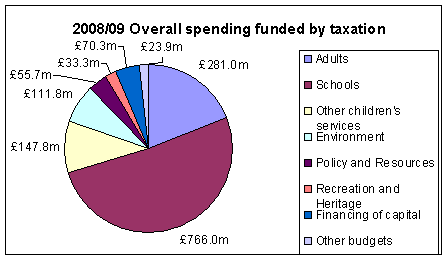
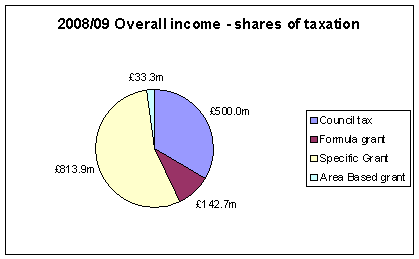
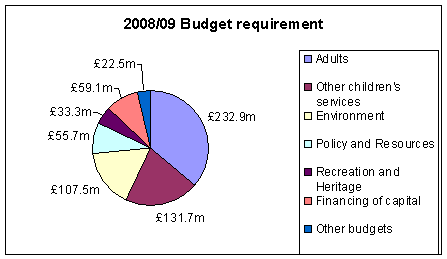
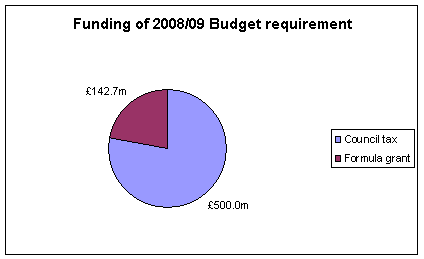
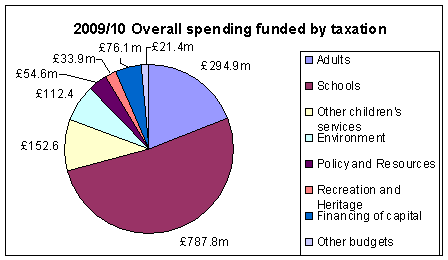
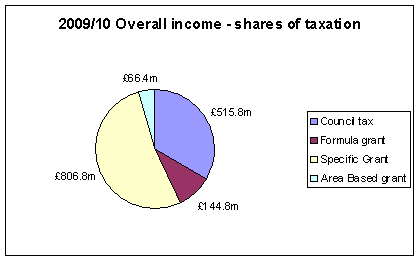
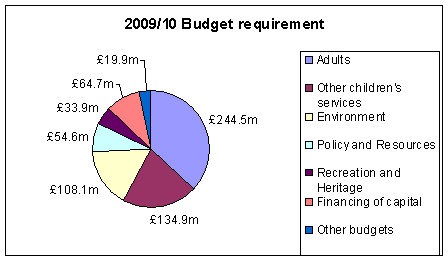
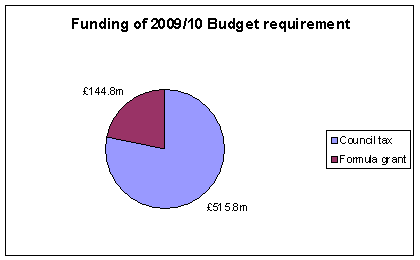
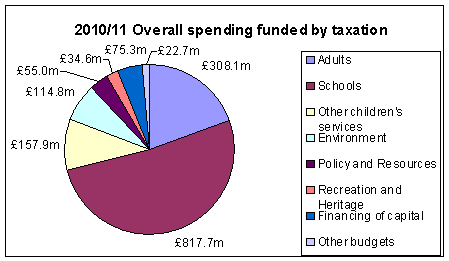
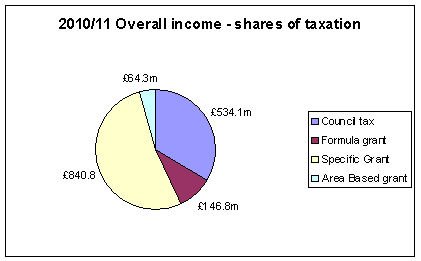
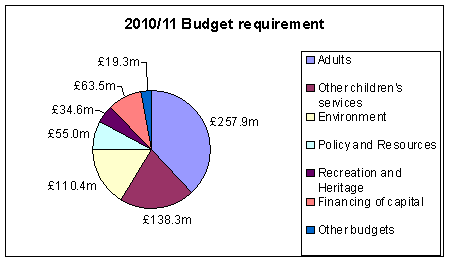
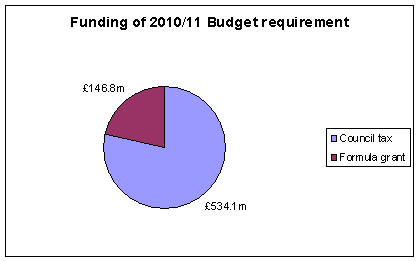
Projected Balance Sheet |
||||
Actual |
Estimated | |||
31.3.08 |
31.3.09 |
31.3.10 |
31.3.11 | |
£000 |
£000 |
£000 |
£000 | |
Net Assets |
||||
Fixed Assets |
3,660,625 |
3,888,308 |
4,091,141 |
4,285,571 |
Long-term debtors |
42,798 |
41,028 |
39,322 |
37,676 |
Current Assets |
241,945 |
226,669 |
225,577 |
226,140 |
Current Liabilities |
-285,617 |
-321,181 |
-325,876 |
-351,329 |
Long-term borrowing |
-324,782 |
-345,782 |
-366,782 |
-387,782 |
Deferred contributions and Government Grants |
-428,652 |
-484,077 |
-533,481 |
-585,140 |
Developer contributions |
-31,599 |
-33,601 |
-34,266 |
-30,383 |
Provisions |
-4,525 |
-4,525 |
-4,525 |
-4,525 |
Pension fund Liability |
-438,860 |
-438,860 |
-438,860 |
-438,860 |
Total Net Assets |
2,431,333 |
2,527,979 |
2,652,250 |
2,751,368 |
Net worth |
||||
Fixed asset/capital adjustment accounts |
-2,687,071 |
-2,806,000 |
-2,929,269 |
-3,026,592 |
Unapplied capital receipts |
-5,724 |
- |
- |
- |
Pension reserve |
438,860 |
438,860 |
438,860 |
438,860 |
Earmarked reserves |
-154,098 |
-140,684 |
-143,267 |
-146,688 |
Revenue account |
-23,300 |
-20,155 |
-18,574 |
-16,948 |
Total net worth |
-2,431,333 |
-2,527,979 |
-2,652,250 |
-2,751,368 |
2008/09 to 2010/11 Capital Programme
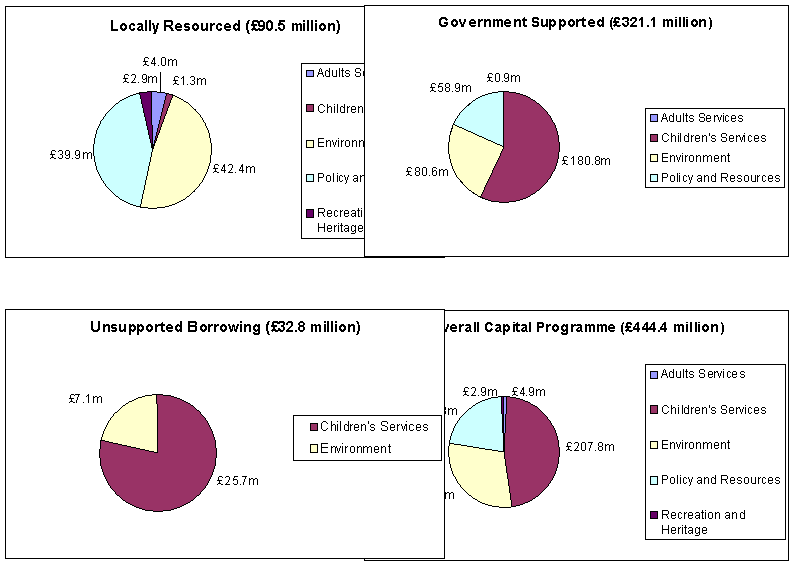
Financial Management Policies 2008/09 to 2010/11
Policy |
Related targets/outcomes | ||
Overall financial planning and budget strategy |
|||
1 |
Budget strategy related to corporate priorities, as reflected in corporate business plan with links to the Local Area Agreement. |
Linkage to Corporate Strategy made explicit in budget proposals and in preparation of business cases requiring approval prior to the release of increased sums in the budget, or in developing savings plans. | |
2 |
Consult on a cyclic basis with interested stakeholders (eg. the public, private sector and staff) on budgetary priorities. |
Stakeholder meetings held in the autumn 2007 during the development of the 2008/09 budget and a consultation with Citizens Panel on spending priorities in July 2008. | |
3 |
Growth and saving plans to be submitted to the appropriate executive member or to the Cabinet, identifying planned outcomes and performance improvements for budget growth and mechanisms for achieving any significant savings. |
Savings plans monitored by the Cabinet on a quarterly basis. | |
4 |
Ensure that the long-term level of revenue commitments does not exceed long-term funding likely to be available including forecast levels of future grant settlement and council tax. |
Revenue commitments to be assessed based on the three year grant settlement and Council tax assumptions built into the three year budget plan | |
5 |
Ensure integration of medium term financial and service planning. |
Framework developed by Corporate Performance and Efficiency group, focussing on the Corporate Business Plan. | |
6 |
Incorporate in the medium term financial strategy the impact of joint plans agreed with partners. |
Medium term financial strategy sets out how the County Council incorporates partnership arrangements within the budget process. | |
7 |
Maintain three year budget projections in order to support medium term financial planning, subject to fine tuning of resource allocation decisions on an annual basis. |
A budget for 2008/09 and a provisional budget for 2009/10 and 2010/11 was agreed by the Cabinet and County Council in February 2008, prior to consultation on a revised medium term financial strategy following CSR 07 and the three year grant settlement. | |
8 |
Minimise levels of non-earmarked reserves, at a level determined by risk assessment, in order to maximise use of available funds on service provision. |
Risk assessment incorporated in budget proposals submitted to the Cabinet in February 2008, with a target of 2.3% proposed in 2008/09 as a result of the assessment. | |
9 |
Review the rationale and adequacy of earmarked reserves on at least an annual basis. |
Protocol reviewed twice yearly, in conjunction with approval of the budget and final accounts by the Cabinet. | |
10 |
Build up an earmarked reserve in recognition of the transitional costs of implementing Pay and Benefits proposals associated with equal pay compensation. |
Further contributions made to the reserve in 2007/08 to bring the level of the reserve to £36.4m at 31 March 2008. | |
11 |
Seek to minimise the degree of instability in the employers' contribution to the Hampshire Pension Fund, subject to objective of securing 100% funding in the long-term. |
Smaller increase of 0.5% per annum over the next three years has resulted from the March 2007 actuarial review. | |
12 |
Continue policy of increasing budgets for Children's Social Care in line with increases in national spending plans. |
Increases no longer transparent in national spending plans, but increases at a similar level to the later years of SR 2004 included in 2008/09 to 2010/11 budget plans. | |
13 |
Set service budget guidelines to provide an annual increase of at least 4.3% in the Adult Services guideline from 2008/09 to 2010/11. |
Inclusive of specific and area grants spending on Adult Services is budgeted to increase by 5.3% in 2008/09, 5.4% in 2009/10 and 4.5% in 2010/11. | |
14 |
Set a schools budget in consultation with the Schools Forum based on specific grants allocated by the Government. |
2008/09 budget set at a level equal to estimated specific grants, plus a County Council contribution of £128,000 to reflect further delegation of functions to schools since 2006/07. | |
15 |
Manage the application of the grant equalisation reserve in order to protect services from future grant loss from the 2006/07 and 2008/09 revised formulae. |
2008/09 to 2010/11 budgets allow for use of the grant equalisation reserve over an 8 year period to phase in the impact of loss of grant. | |
16 |
In order to allow services to operate within firm cash limits, allocate provision for inflation to services at the start of the financial year and require excess inflation to be absorbed. |
Inflation allocations for 2008/09 to 2010/11 agreed in setting a three year budget plan. | |
17 |
Services expected to contain spending within the approved cash limit, with no supplementary allocations being available other than in exceptional circumstances unless a specific contingency provision made within the budget. |
Adult Services finance recovery plan completed in 2007/08, with no supplementary allocations in 2007/08 apart from allocations from Pay and Benefits contingency. | |
18 |
Services expected to carry forward 100% of any overspending against the overall service cash limit, but are allowed to retain up to 100% of any planned underspendings identified prior to the approval of the following year's budget. 50% of any unplanned underspendings can automatically be carried forward. The policy applies to spending financed by Area Based Grant, subject to specific consideration of the Supporting People programme. |
Policy applied in dealing with under and overspendings in 2007/08's final accounts. | |
19 |
Require the continuing absorption of cost increases by expecting services to absorb any net cost arising from the annual cost of salary increments. |
Increments of £1.7m to be absorbed in 2008/09 budget. | |
20 |
Seek to deliver efficiency gains in line with the Government target of 3% annually. |
Summary of planned efficiencies from 2007/08 to 2010/11 included in 2008/09 budget report. Initial estimate for 2008/09 equivalent to about 2.3%. | |
21 |
Encourage service chief officers to submit applications for specific grants/partnership funding designed to maximise the resources available to the County Council, by allowing capital and revenue cash limits to be adjusted to reflect changes in grant levels. |
Applied in 2008/09 to 2010/11 budget process. | |
22 |
Assist in developing the third sector's capacity by setting financial assistance within clear frameworks and on a three year basis where possible. |
Existing practices to be reviewed in context of three year grant settlement. | |
23 |
Require services to review the level of fees and charges at least annually and set budget limits on the assumption that the level of charges will be increased in line with assumed inflation on gross expenditure. |
Reflected in 2008/09 budget strategy. | |
24 |
Seek best value in spending, bearing in mind that considerations of quality, risk, sustainability, environmental impact, local economic development and equalities may all be relevant in addition to price. |
Reflected in Best Value, Local PSA and LAA outcomes and CPA 3 star Use of Resources assessment for value for money. | |
25 |
Seek to retain relatively low council taxes in Hampshire, with the aim of setting a tax in the lowest quartile of County Council council taxes. |
2008/09 council tax within the lower quartile of County Council's without fire funding responsibilities. | |
Capital programming |
|||
26 |
Review capital strategy on an annual basis and prepare three year capital programme (consistent with CSR periods) in accordance with the strategy. |
Revised strategy approved by the Cabinet in July 2008. | |
27 |
Seek to maintain the level of the locally-resourced capital programme by continued recycling of surplus assets to generate capital receipts. |
Programme for 2008/09 to 2010/11 underpinned by projected capital receipts of £155m over the period 2007/08 to 2009/10. | |
28 |
Allow services to retain at least 25% of the value of their capital receipts and where necessary to finance investment in replacement assets, up to 100%. |
Services authorised to retain £36.6m of 2007/08's capital receipts. | |
29 |
Adopt a Public Private Partnership (PPP) approach, including the use of the Private Finance Initiative (PFI), where this provides best value for the Council. |
Full business case submitted for a street lighting column replacement project in partnership with West Sussex County Council and Southampton City Council. The Government's Building Schools for the Future programme for investment in secondary schools envisages new schools being procured by means of PFI. | |
30 |
Make full use of Government-supported borrowing, subject to the affordability of the additional capital financing costs generated. |
2008/09 to 2010/11 capital programme guidelines based on limiting the take up of supported borrowing to a level consistent with a 2.5% annual increase in the capital financing requirement from supported borrowing, in view of the implications of being an authority well below the grant floor. In finalising the budget additional borrowing above this level was agreed for 2008/09 and 2009/10. | |
31 |
Seek to maximise capital resources by developing capital schemes in conjunction with external partners where appropriate. |
Funding of £34.5m by external partners, incorporated in 2008/09 and 2010/11's estimated capital payments. | |
32 |
Approve the use of unsupported borrowing within the framework of the County Council's prudential code - business unit investment where the financing costs will be funded by charges made to customers - `invest to save' projects generating savings which will enable the financing costs to be funded, capital receipts or developer contributions which will enable borrowing to be repaid, or alternative costs to be avoided. - Temporary borrowing to cover short-term shortfalls in capital financing resources. |
Proposals have either been approved or are being submitted in the 2008/09 to 2010/11 capital programme which involve in aggregate potential unsupported borrowing of £53.7m by the end of 2010/11 after peaking at £67.5m at the end of 2008/09, in accordance with County Council's code. A revision to the policy was introduced in 2006/07 to require services to absorb the revenue cost of temporary unsupported borrowing rather than recovering these costs in arrear when the capital receipt / external contribution is received. | |
Financial Health Indicators
Actual 2007/08 |
Target 2008/09 |
Target 2009/10 |
Target 2010/11 | |
Variance from budget |
||||
Net service spending (%) |
+0.3 |
+ or - 1.0 |
+ or - 1.0 |
+ or - 1.0 |
Overall spending met from formula grant, council tax and balances (%) |
+1.4 |
+ or - 2.0 |
+ or - 2.0 |
+ or - 2.0 |
Balances as % of budget requirement |
3.9 |
3.1 |
2.7 |
2.3 |
Capital programme management |
||||
Carry forward of schemes (% by value) |
29.0 |
20.0 |
20.0 |
20.0 |
Actual Capital Expenditure compared with estimate (% variation) |
-6.3 |
+ or - 10.0 |
+ or - 10.0 |
+ or - 10.0 |
Capital receipts and other third party contributions (% variation on financing plan) |
-0.2 |
+ or - 10.0 |
+ or - 10.0 |
+ or - 10.0 |
Prudential indicators |
||||
Capital financing requirement |
586.3 |
615.9 |
622.0 |
640.7 |
Maximum level of external debt: |
||||
£m |
455.0 |
620.0 |
620.0 |
640.0 |
As % of authorised limit |
77.1 |
100.0 |
100.0 |
100.0 |
Upper limit on: |
||||
Fixed rate borrowing (£m) |
256.0 |
300.0 |
330.0 |
360.0 |
Variable rate borrowing (£m) |
202.0 |
370.0 |
380.0 |
390.0 |
Ratio of financing costs to net revenue stream (%) |
5.35 |
6.74 |
6.92 |
6.49 |
Income collection |
||||
% of outstanding debt more than 12 months old |
16.1 |
17.5 |
17.5 |
17.5 |
% of outstanding debt more than 6 months old |
24.7 |
20.0 |
20.0 |
20.0 |
% of outstanding debt more than 60 days old |
63.2 |
60.0 |
60.0 |
60.0 |
% of debt written off to debt raised |
0.2 |
<1.0 |
<1.0 |
<1.0 |