Archived decisions

DRIVING SUCCESS
Hampshire County Council's Performance Management Framework

November 2008
Driving Success:
Hampshire County Council's Performance Management Framework
1.0 Summary
1.1 The County Council is focussed on building on its already high base to ensure that the right improvement infrastructure is in place to drive forward innovation, value for money and improved community outcomes. The Council believes it is improving strongly and wants to ensure appropriate arrangements are in place to sustain this through the challenges ahead.
1.2 This report concentrates on two main aspects of the corporate infrastructure to drive improvement. It outlines a refreshed corporate Performance Management Framework for the authority and it sets out a new Corporate Improvement Plan. Taken together these establish the infrastructure to monitor and manage service improvement and risk, whilst focussing on those key issues that need to be addressed over the months ahead.
1.3 The proposals set out in this report need to add value and support the Council. This report outlines the first template for both the management framework and the improvement plan.
1.4 The revised corporate Performance Management Framework and new Corporate Improvement Plan will be embedded in the Political and managerial infrastructure of the Council.
2.0 Background
2.1 The Leader, Executive Member for Efficiency, Performance and Rural Policy and the Chief Executive have set high ambitions for the Council with a renewed focus on driving value for money and outcome improvements. There is a palpable appetite to move further beyond simply corporate performance monitoring to stronger and more proactive performance management. Building on the strength of the existing arrangements creates a unique opportunity for exceptional relative improvement.
2.2 Alongside this, the national performance framework is changing with a shift from BVPIs1 to the NIS2 and CAA3 replacing CPA4. CAA is intended to measure the local `area', focussing on outcomes as felt by local residents rather than services as delivered by local government and their partners.
2.3 Given these changes and the financial, demographic and public expectation challenges, there has never been a greater need for the organisation's corporate planning and management to be effective and robust. The proposals in this report seek to build from an already high base to strengthen these. Two senior level workshops and discussions with Members, CMT, DMTs and various key stakeholders have been held to inform this paper.
3.0 Underpinning Principles
3.1 There are four key underpinning principles to the revised performance framework and the new Corporate Improvement Plan. First, keep it simple. Second, honesty should be central. Third, concentrate on the critical issues that matter most locally and not everything. Fourth, do something about performance and improvement when action is required.
3.2 Chief Officers, with their Executive Member, quite rightly need to own and lead performance management for their department but there needs to be corporate visibility of this, particularly any areas of risk or weakness. Self-awareness and mechanisms to enable corporate discussions about areas for improvement - in the spirit of collective responsibility - need to be further strengthened.
3.3 The role of the Leader and Cabinet are central to the whole framework, providing leadership and oversight.
3.4 In a nutshell:
· Each Chief Officer, with their Executive Member, is responsible for managing performance and improvement in their departments.
· The Chief Executive, with the Head of Improvement, is responsible for advising the Leader and Cabinet on the Council's overall performance and improvement and for identifying ongoing areas of concern.
· CMT will act as a `clearing house' on performance reporting.
· The Leader and Cabinet will set the overall ambition for the Council.
3.5 These principles are complementary and mutually reinforcing.
3.6 These proposals help to maintain the focus on internally driving improvement proactively on the things that matter to the Council and local residents and not relying on externally driven performance management via inspection.
3.7 With an emphasis on reducing the data burden, the proposals draw on the existing arrangements with the intention to phase out duplicate or outdated processes over time.
3.8 The framework and plan have the sole purpose of driving increased performance and outcome improvements. If this is not happening, they are not working.
4.0 Corporate Performance Management Framework
4.1 The County Council's corporate Performance Management Framework, that is the Council's planning, monitoring and performance management processes, has undergone a significant review over the last couple of months. The intention has been to move the Council's corporate performance reporting further away from data chasing to more information management; away from an emphasis on the `RAG5 status' of red performance indicators to richer analysis; and away from corporate performance monitoring to even more proactive performance management. This will build upon good practice already present across departments.
4.2 In the past, there has been little distinction made corporately between performance monitoring and performance management with corporate reports attempting to provide the information for both in a single report. No distinction was made between the relative importance to the Council of the corporate performance information being reported and there was little focus on the real areas of concern locally.
4.3 By recognising the distinction and the different levels of information needed for each, the Council is positioned well to maximise the already extremely strong performance improvements across the Council.
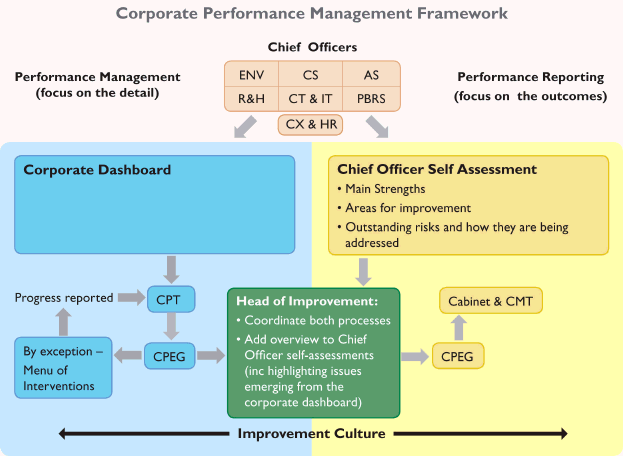
4.4 The corporate performance framework will be made simpler and more streamlined with a recognition of the different outputs needed for strategic performance monitoring (with a focus on outcomes) as opposed to more regular and active performance management (with a focus on the detail and mechanics).
4.5 Central to the revised framework is that there is a corporate expectation of action following an area for improvement, risk or `Red' being reported corporately. CPEG6 has this lead role, on behalf of Cabinet and CMT, to manage strategic performance across the authority and to ensure issues raised are being adequately addressed. Wherever this is not happening or in more complex cross-cutting areas CPEG should take action.
4.6 The revised framework establishes a variety of tools to manage performance and drive improvement:
1. Corporate Improvement Plan - whilst all departments have their own improvement priorities this plan contains the key corporate improvement areas for the organisation7.
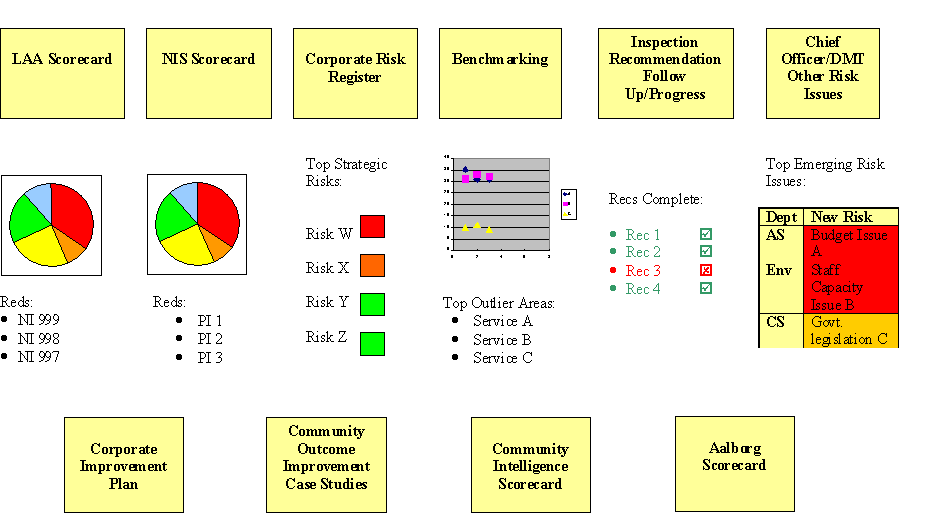
2. Corporate Dashboard - this provides an at-a-glance overview of the Council's performance from a range of sources including the LAA, benchmarking, value for money scorecards and inspection8.
3. Menu of interventions - this tool sets out a range of action options to address and support an area for improvement - experience to date suggests there will rarely be any need for `heavy' corporate intervention, but it is important to have a clear framework. CPEG will be expected to ensure issues are being adequately addressed; providing challenge and identifying an intervention(s) for any outstanding areas of concern9.
4.7 The diagram below sets out the revised corporate Performance Management Framework, making the distinction between the corporate performance management process (on the left) and the corporate performance reporting process (on the right). It also introduces the two new concepts of the Corporate Dashboard and the Chief Officer Self Assessment. The respective roles and responsibilities of the key players can be found in appendix one:
4.8 Good quality performance data is absolutely key and will underpin the entire framework. Chief Officers will be responsible for ensuring the appropriate systems or structures exist in their respective departments to provide timely data (quantitative and qualitative). Consideration will need to be given to the appropriateness of existing departmental and corporate IT systems - this may have resource implications.
4.9 Additional tools, such as the Corporate Dashboard, have been developed to provide different lenses to view performance and greater external challenge such as membership of the PricewaterhouseCoopers County Council Benchmarking Club and regular reviews with the District Auditor and others.
4.10 Integrated planning of services, finance and workforce is an important element of driving performance and value for money. Eventually, these links will need to be made more explicit at this level with resource allocation and diversion playing a role in delivering improved outcomes.
4.11 The importance of a self-aware culture which is honest and hungry for improvement with a `can do' attitude cannot be over emphasised. Ways to foster this outlook will need to be pursued alongside this framework for it to have maximum impact. Improvement activity needs be thought of in a `change management' context, recognising that it is often cultural issues that stand in the way of better performance and outcomes.
Performance management
4.12 Chief Officers in conjunction with Executive Members lead performance management in their respective areas. The framework proposed here strengthens the corporate aspects and is complementary to the departmental arrangements which have served the Council well.
4.13 CPEG, on behalf of the Council, have the lead role for performance management corporately and whilst departments rightly manage their own performance there needs to be corporately visibility of this. Any areas of weaker performance and risk need to be reported to CPEG for corporate consideration of the implications and how, collectively, these can be addressed.
4.14 The Corporate Dashboard will provide an at-a-glance overview of the Council `vehicle', gauging and highlighting areas of concern. These will relate to the Corporate Improvement Plan, corporate benchmarking, the LAA, the NIS, value for money scorecards, strategic inspections, intelligence from inspectorates, Aalborg, community intelligence and community outcome case studies. See appendix three for an indicative example10.
4.15 Central to this is the expectation of action following an area for improvement, risk or `Red' being reported corporately. The perquisite before action is taken is, of course, that it is an area that is important locally.
4.16 The Menu of Interventions will be a useful tool to tackle these areas of outstanding concern. The menu covers a range of interventions to support and drive improvement with a varying level of scale which may be used individually or in combination. The range of actions include `request a strategic improvement plan', `commission the Head of Improvement to review', `visit councils performing better', `refer to Member Overview and Scrutiny', `establish a CPEG sub-group Board' and others all with a set frequency to report progress back to CPEG. See appendix two for an indicative menu.
Internal performance reporting
4.17 Internal performance reporting needs to focus on the areas which are prioritised by the Council and important to the local community. Chief Officers should take a direct role in this, producing a regular short personal self-assessment of their departments performance - three or four times a year. This should be a short statement about performance, inspection, risks and action and would be informed by/done in conjunction with Executive Members.
4.18 This self-assessment should be an honest appraisal of the situation, covering the main strengths, areas for improvement, outstanding risks and how these are being addressed. This represents a move away from blindly reporting all performance indicators with no value judgement or weighting to reflect their relative importance to the Council. Instead, Chief Officers through their self-assessments will be able to draw attention to the areas that matter most, provide the context and highlight the appropriate `trade-offs' they have made to balance their budgets and maximise improvement to deliver value for money.
4.19 These self-assessments should be directed to the Head of Improvement who will collate them and add an overview which will highlight any key issues or common themes. It will be important that this highlights cross-cutting issues and provides challenge when appropriate. This overview should also cover, by exception, any specific areas of concern falling out of CPEG's performance management work around the Corporate Dashboard.
4.20 The collated self-assessments with the Head of Improvement's overview will directly form the corporate performance report which will be considered by CMT, the Executive Member for Efficiency, Performance and Rural Policy and ultimately Cabinet. Chief Officers will be accountable for these self-assessments and should be on hand to answer relevant questions.
4.21 This will be less onerous than previous arrangements. It will also inherently focus on the areas that are priorities locally and the most significant to service delivery.
National performance reporting & assessment
4.22 Fulfilling statutory performance reporting and assessment requirements should be a by-product of the Council's Performance Management Framework and not the focus.
4.23 There are NIS Service Managers within the Council identified as responsible for every one of the 196 NIs11 - this covers both performance and data quality. Service Managers are charged with developing appropriate relationships with partners and working to improve performance, escalating any areas of concern or disempowerment.
4.24 Performance against these NIS will be entered onto the national Data Hub by Government Departments with the exception of 1612 indicators which the Council and local partners are responsible for submitting directly. Arrangements are in place for the 16 NIs via the relevant Service Managers.
4.25 Separate to the national performance reporting, the Council is collating locally performance against the NIS directly and at more frequent intervals as it is not anticipated that the Data Hub will meet local expectations or requirements for timely in-year data to allow intervention action to be taken to address areas of poorer performance.
4.26 Particular attention will be focussed on LAA performance and progress against targets via the LAA Executive and Hampshire Senate as well as internally within the County Council.
4.27 It is intended that evidence for CAA, which starts in 2009, will fall out of the corporate Performance Management Framework outlined above although some additional information and interviews may be required. This reflects a shift from previous years when work to respond to CPA has been in danger of becoming the preoccupation in itself rather than the service improvements it was supposed to be encouraging.
5.0 Corporate Improvement Plan
5.1 All Departments undertake a multitude of activities and services which, in many ways, contribute to the three political priorities contained within the Council's Corporate Strategy. Each Department has Service and Improvement Plans which prioritise innovations and improvements to make progress against these Corporate Strategy priorities. The Corporate Improvement Plan is a tool to prioritise and manage the areas the Council knows it needs to improve corporately - focussing on those areas which are the most important areas emerging from the Corporate Dashboard.
5.2 The plan picks up on areas emerging from benchmarking, inspection, audit and local importance.
5.3 The Corporate Improvement Plan replaces the existing Corporate Business Plan. It will be more focussed on the corporate key areas for improvement with an emphasis on clear targets and accountabilities. This streamlined plan will allow a greater focus on the key emerging areas of risk so that action to address these can be taken in-year.
5.4 The County Council's Corporate Improvement Plan is central to an updated and strengthened corporate Performance Management Framework. The plan will be a mechanism `owned by CMT', and ultimately Cabinet, to drive improvement and respond to assessment. It will be used by CPEG to focus on managing performance and risk on an improved evidential basis.
5.5 The plan has been informed by two senior officer workshops and discussions with the Leader, Cllr Ellis, Chief Officers, DMTs, cross-cutting theme leads and other key stakeholders.
5.6 The Corporate Improvement Plan is a three year plan from 2008-201113 with a focus on the next 12 months. It is intended that the plan will be refreshed annually and reviewed fully in 2011 - how well it is working will be considered in the first six months of operation.
5.7 The emerging Corporate Improvement Plan is shown below. This will need refinement to develop further and to reflect views from Cabinet as well as to ensure there is clear accountability against the areas identified. These areas will then need to be picked up in department and service plans to outline the detail of implementation.
5.8 Cabinet will recognise much of the content of the Corporate Improvement Plan which reflects known areas of interest and local political priorities. This list may need to be updated from time to time to reflect changing priorities or areas of importance:
1.
2. Increasing Customer/Community Focus - What People Want
· Community safety: Work in partnership to tackle violent crime & assault with injury
· Personalisation: Roll out the personalisation agenda (inc work with partners)
· Road maintenance: Improve the condition of the most highly trafficked roads (principal & non principal) & reprioritise spending to prevent pot hole formation & flood risk
· Road Safety: Reduce road accidents (KSI) & local traffic calming (eg Village 30)
· Schools: Maintain & continue to improve general school attainment
· Culture & recreation:
o Widen services to older people, including access, wellbeing & adult learning
o Grow offer to young people universally to improve wellbeing (in addition to intervention services)
· Extra Care: Increase the level of extra care housing options
· Care Services: Improve acceptable waiting times for care packages & equipment
· Waste: Increase recycling & further reduce landfill
· Community intelligence & engagement: Strengthen understanding & influence of the local community, particularly hard to reach groups
· Service channels: Continue to exploit Hants Direct & new avenues for access
· Locality working: Develop locality working
3. Reducing Inequalities
· Rural: Tackle inequalities of access to local services in rural areas, particularly for older & younger people, and strengthen rural sustainability
· Inequalities: Address inequalities, particularly health & economic
· Children in Care: Improve placement stability & educational attainment
· Safeguarding: Secure child safeguarding, specifically repeat child protection plans
· Vulnerable groups: Narrow the attainment & life chances gap
· Children with disabilities: Extend respite & leisure opportunities
· Health services: Improve health services for children, specifically CAMHS, teenage conceptions & obesity
· NEET: Reduce young people not in employment, education or training
· Permanently excluded from school: Reduce the number & strengthen alternative educational provision
· Safeguarding: Improve the number of adults referred & Board membership
· Quality of life: Increase telecare take-up, integrated single assessments & direct payments
· Learning disabilities: Help adults with a learning disability to live at home
· Deprived communities: Grow aspirations, community development & cohesion
4. Improving Capacity to Deliver
· Value for money: Deliver the efficiency programme, corporate & central services review & Hantsworkstyle
· Strategic HR: Strengthen workforce planning & organisational development
· VCS: Increase engagement & develop capacity in the voluntary & community sector
· Joint working with health: Increase learning disability clients living in NHS campuses, continuing healthcare, joint budgets & co-production
· Sustainability & climate change: Foster & encourage sustainability & build resilience to climate change
· Growth: Manage growth, including transport, planning, housing & utilities
· Street lighting PFI: Manage the risks & implementation
6.0 Conclusion & Recommendations
6.1 The strengthened corporate Performance Management Framework and Corporate Improvement Plan for the Council are critical to sustain the strong improvement in value for money and community outcomes currently achieved.
6.2 The Council is strengthening the corporate improvement infrastructure and building the appropriate links into:

Its three year Medium Term Financial Strategy

 Its three year Efficiency Programme
Its annual improvement and performance assessment

Its organisational strength of management and political
leadership
6.3 The Council needs to be convinced that the proposals in this paper represent a significant step-change in how performance is managed corporately. The Council needs to be confident that these proposals will position the authority well to face the challenges ahead.
6.4 Cabinet are asked to share their thoughts and specifically to:
1. Endorse the corporate Performance Management Framework and underpinning principles as set out above.
2. Endorse the emerging Corporate Improvement Plan; indicate any further areas for inclusion; and request the Head of Improvement to finalise the plan with the Leader and Chief Executive.
Appendix One: Performance Main Roles & Responsibilities
Role |
Responsibility | |
Chief Officers |
Leading and managing service delivery and driving continuous improvement, reporting weaker performance and risk corporately |
Personally produce three/ four times a year a one side of A4 self-assessment of key strengths, areas for improvement, outstanding risks and how these are being addressed to the Head of Improvement |
Executive Members |
Keeping a watching brief of the performance of services in their portfolio, particularly areas of poorer performance and risk, as well as setting ambition in areas of best practice and innovation |
Working with and challenging Chief Officers to drive continuous improvement - escalating issues to the Leader and Cabinet, as appropriate |
Head of Improvement |
Keeping a watching brief of the Council's overall performance position, acting as a catalyst to drive improvement and reporting areas of risk |
Collate Chief Officers' self-assessments, add an overview and analysis of other areas of concern and report this to CPEG, CMT and Cabinet, as appropriate |
CPEG |
Considering the Council's corporate position and significant outstanding areas of concern in order to agree or commission action to address as well as ensuring the Council is being ambitious enough |
CPEG will agree action on behalf of CMT in response to outstanding areas of concern. The Head of Improvement will liaise with CPEG to prepare reports to CMT (and ultimately Cabinet) twice a year, or by exception |
Chief Executive |
Ensuring action is being taken to address areas of poorer performance and risk as well as develop areas of best practice and innovation |
Taking action to address or escalating issues, as appropriate, to CMT, Cabinet and the Leader |
Executive Member for Efficiency, Performance & Rural Policy |
Keeping a watching brief of the Council's overall performance position, particularly areas of poorer performance and risk as well as areas of best practice and innovation |
Advising, alerting and challenging Cabinet and Executive Members to issues |
CMT, Cabinet & Leader |
Setting the overall level of ambition for the authority |
Challenging areas to improve and of risk |
Appendix Two: Indicative Menu of Supportive Interventions
Menu of Interventions | |
1 |
Category one - report back to CPEG within six months |
2 |
Category two - report back to CPEG within three months |
3 |
Category three - report back to CPEG within two months |
4 |
Category four - report back to CPEG within one month |
5 |
Strategic action plan - request the relevant Service Manager to produce a strategic action plan for CPEG |
6 |
Council visits - request the relevant Service Manager to visit better performing Councils and report back |
7 |
Strategic review - request a department led strategic review |
8 |
Mystery shopping - commission mystery shopping to assess the extent of the issue or to check on progress |
9 |
Corporate support one - request the Corporate Performance Team to support/follow up |
10 |
Corporate support two - commission the Head of Improvement to support/follow up |
11 |
Corporate support three - establish a CPEG sub-group board to oversee |
12 |
Corporate support four - commission the Leader's Futures Group, Hampshire's Own Grown or County Treasurer's Consultancy |
13 |
CMT support - escalate to CMT |
14 |
Executive Member support - refer to the Executive Member for Efficiency, Performance and Rural Policy |
15 |
Cabinet support - escalate to Cabinet |
16 |
Member support - establish a Member and senior officer review (Best Value style) |
17 |
Overview & scrutiny - refer to Member Overview and Scrutiny Select Committee |
18 |
External support - commission external consultants, the Audit Commission, IDeA, RIEP or other |
19 |
Peer review - commission an external peer review |
20 |
Resources - divert departmental and/or corporate resources |
Appendix Three: Indicative Corporate Dashboard