
Archived decisions
HAMPSHIRE COUNTY COUNCIL
Decision Report :
Decision Maker: |
Cabinet | ||||
Date of Decision: |
22 December 2008 | ||||
Decision Title: |
2008/09 Budget monitoring and workforce update - half-yearly report | ||||
Decision Reference: |
466 | ||||
Report From: |
County Treasurer and Director of Human Resources | ||||
Contact name: |
Nick Gibbins | ||||
Tel: |
01962 847544 |
Email: |
|||
EXECUTIVE SUMMARY
1) Summary of Decision Area:
1.1. This report reviews the latest budget monitoring reports for 2008/09 submitted to Executive Members, which deal with progress in achieving budgeted savings and accommodating budget pressures. The report also reviews the first half-year's monitoring of high risk / demand led budgets, overall employee budgets, savings plans and financial health indicators to provide an overall corporate context to budget monitoring, as well as reviewing corporate workforce trends.
2) Issues Covered in Report:
2.1. The report considers whether any action is required in response to budget monitoring in the first half of 2008/09.
3) Recommendations:
It is recommended that:
3.1. To welcome the action being taken by all services to contain budget pressures within cash limits and to review the position again in February when revised budgets for 2008/09 are submitted.
MAIN REPORT
1) Purpose of the report:
1.1. The purpose of the report is to review the implications of budget and workforce monitoring in the first half of 2008/09 both at service and corporate level, in conjunction with the review of the County Council's performance.
2) Contextual Information:
2.1. Budget monitoring reports were submitted to each of the relevant Executive Members in either October or November. The position on non-cash limited budgets has also been assessed. In addition a corporate review has been undertaken of high risk demand led budgets, overall employee budgets, plans to achieve budgeted savings and the Council's financial health indicators. This provides the context for determining whether spending is likely to be contained within the approved budget and whether any additional action is required in response to the trends revealed by the monitoring information. The report also reviews corporate workforce trends.
3) Key Issues:
Service cash-limited budgets:
Adult Services:
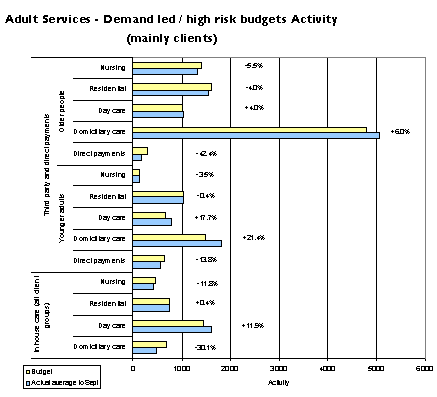
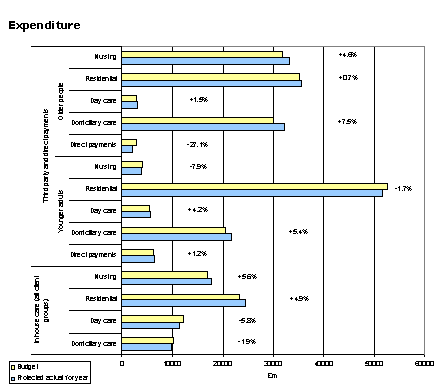
3.1. The monitoring report submitted to the Executive Member in November indicated that an underspending of £2.3m against the cash limit was projected based on information to the end of September and that further underspending would be sought on a planned basis to be carried forward to 2009/10, producing an overall estimated underspend of £3.9m. This overall position is being achieved despite a projected overspend of £4.6m on demand led care budgets, as a result of higher income, anticipated unallocated contingency provision, and savings on management and support and assessment and care management budgets.
Children's Services:
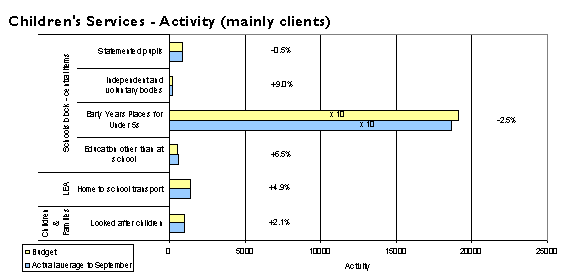
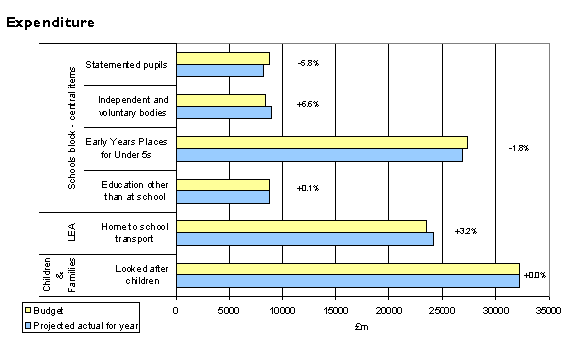
3.2. The monitoring report to the Executive Lead Member for Children's Services (Education) in October based on information to the end of August identified a small projected overspend of £0.7m on the non-schools budget, but indicated that it was anticipated that a balanced budget provision would be achieved at the year end. Further monitoring based on end of September data also supports this view.
Environment:
3.3. The outcome of the second quarter's budget monitoring review indicates that the anticipated outturn will be in line with the approved cash limit. Though the planned additional income from land search fees will not be achieved as a result of the downturn in the housing market, good progress has been made in achieving the remaining planned savings included in the budget.
Policy and Resources:
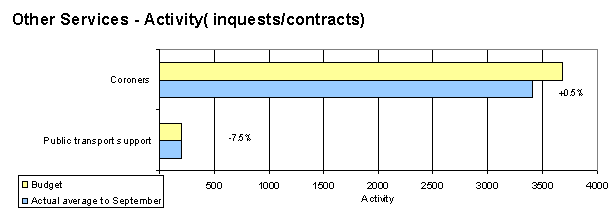
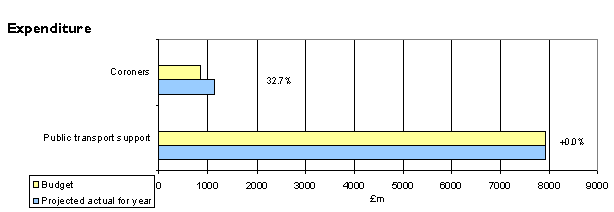
3.4. There are ongoing budget pressures relating to corporately held land and the gypsy and traveller service, which have been exacerbated by the economic downturn. The higher cost of the Coroner's Service in 2007/08 has also continued into 2008/09, for which some provision has been made in the central contingency. Action is being taken to manage these budget pressures within the overall Policy and Resources budget.
Recreation and Heritage:
3.5. The attention of the Cabinet was drawn in the previous monitoring report to legal costs of £220,000 on a Rights of Way case which have been charged to the Countyside Service, but for which no budgetary provision had been made. Higher costs than anticipated of upgrading the library management system, higher energy costs and a continued reduction in library income have adversely affected the Library and Information Service in 2008/09. Excluding the impact of the Rights of Way legal costs, an overspending of £225,000 is projected, but management action is being taken to contain these trends within the overall Recreation and Heritage budget. Despite the pressures on the 2008/09 budget, there is evidence of an improvement in performance on a number of key indicators, including the number of library visits.
Corporate budget monitoring:
3.6. In addition to service budget monitoring, a corporate monitoring process is undertaken across all services on a quarterly basis, focusing on high risk/demand led budgets, overall employment trends, the achievement of budget savings and the monitoring of financial health indicators.
High Risk / Demand led budgets:
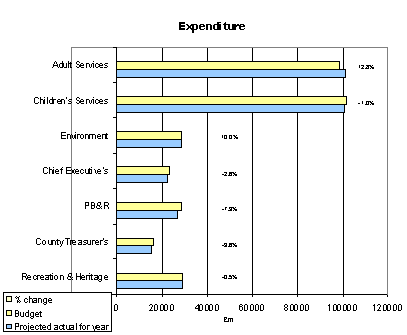
3.7. Appendix C summarises the first quarter's monitoring of spending and activity on high risk/demand led budgets which are mainly focused on Adult's and Children's Services. These continue to represent the majority of areas within the budget which are subject to the greatest pressure. At the end of September 2008, spending on these budgets is projected to be £5.2m (1.4%) higher than budgeted, compared with £5.5m at the end of the first quarter, and is primarily the result of higher spending on Adult Services care packages. Nonetheless as indicated in paragraph 3.1, these higher costs can be accommodated within the 2008/09 Adult Services budget and the strategy is to seek to achieve a planned underspending in 2008/09.
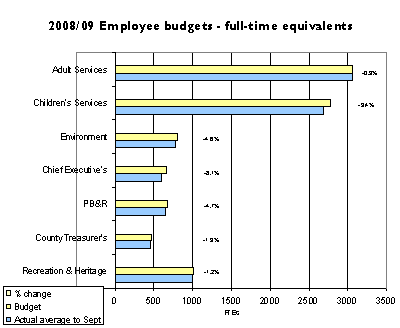
Employee Budgets:
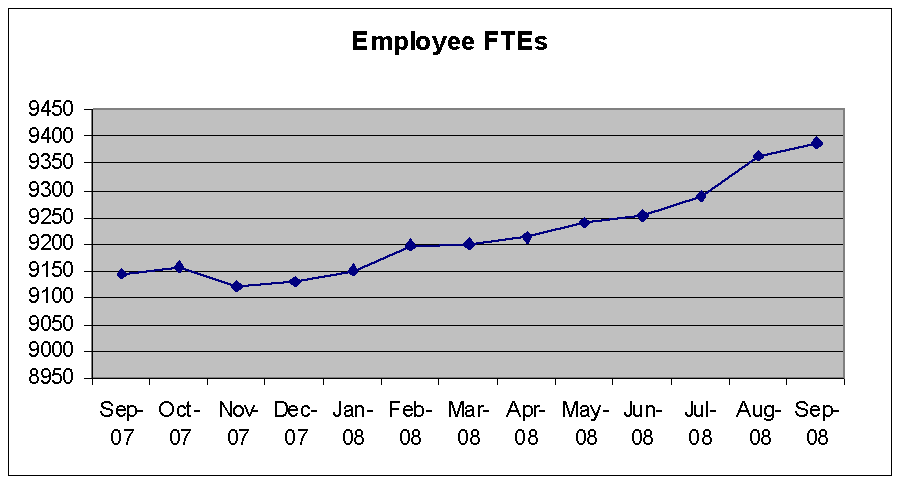
3.8. Overall spending on employee budgets is projected to be £1.7m (0.5%) lower than the budget, after allowing for the provisional pay and benefits allocations agreed by the Cabinet in September. Actual employee members in the second quarter averaged 9348, FTEs, (excluding schools and business units), about 263 FTEs higher than at the end of the first quarter. This is principally because staff transferring to the County Council from Connexions were excluded from the number in the first quarter, accounting for about 225 additional FTEs. Appendix D summarises the data, adjusted for the transfer of former Connexions staff.
Savings Plans:
3.9. The 2008/09 budget included planned savings of £14.5m to finance one-off and recurring budget pressures in 2008/09, that could not be accommodated within the budget guideline. After allowing for savings achieved by means of carry forward of underspending, the use of reserves or transfer from capital, savings of £11.4m needed to be planned and monitored in 2008/09. Savings of £7.8m are assessed as having already been achieved and the remaining savings are expected to be achieved in most cases in accordance with the original plan or if not from an alternative source.
Financial Health Indicators:
3.10. A set of Financial Health Indicators were incorporated in the budget proposals approved by Cabinet in February 2008. They are designed to provide an early warning of when action may be required to protect the County Council's financial health. Appendix E contains a summary of the targets for 2007/08 and either the latest full-year projections or data for the first quarter.
3.11. The majority of the indicators are within the target range or have acceptable variances. The main exception is in relation to the financing of the capital programme, where as a result of the deterioration of the housing market the level of capital receipts in 2008/09 will be substantially lower than forecast, and this will require a revision to the capital financing plan for 2008/09 and has been taken into account in setting provisional capital guidelines for 2009/10 to 2011/12.
Workforce Trends Headcount:
3.12. The headcount for the authority (excluding schools) at the 30th September was 14006, which is an increase of 434 (or 3.2%) staff since the end of the last financial year. The bulk of the increase in staff comes from Children's Services (with the statutory transfer of South Central Connexions Service into the County Council, form April 2008). Treasurers and Environment have both seen small reductions in staff in the period. It should be noted that headcount reporting is based on the actual number of `heads' in SAP at the reporting date and does not take into account the vacancies that are being either held empty or actively being recruited at that time. Whilst the number of vacancies is generally felt to be relatively static, variation in the number at the time of reporting may affect the head count figures.
Staff Turnover:
3.13. Staff turnover for the first six months of the financial year stands at 8.15% with a projection for the end of the year of around 16.3%. This is comparable with last year's turnover figure. This performance, however, exceeds the upper quartile for turnover based on benchmarked results for other county councils where the figure is on average 11.5%.
3.14. The figure includes staff who are promoted within the authority which would account for the higher than desirable figures. Business processes with SAP are being reviewed to change the recording criteria and ensure that promotion data is clearly visible.
3.15. A turnover figure of 10% is often quoted as an acceptable level taking into account the introduction of staff bringing new knowledge and skills and the overall cost of recruitment. However benchmarking with other councils suggests that some agree a figure of closer to 15% is more realistic.
Sickness Absence:
3.16. Sickness across the organisation excluding schools data stands at 4.6 days per FTE for the half year, this is a cumulative figure with the full year estimate to be 10.1 days. This suggests slight improvement on last years comparative figures if the performance for the second half of the year conforms to normal patterns.
3.17. This performance compares favourably with the benchmark average of 10.9 FTE days lost in non district councils.
3.18. Significant work has been and is still taking place across departments following the rollout of the Managers Toolkit and it is expected this will be reflected in future absence reporting with a likely reduction in sickness absence arising from management control in the longer term.
Staff Profile:
3.19. Over 60's: The age range for the Council is consistent with the last few years and shows that 1586 staff or 11.3% of the workforce are aged 60 or over. The age/headcount pattern is similar to that for other county councils. The Council has been successful in attracting younger workers but there are a number of senior managers who will be reaching retirement age in the next few years with potential loss of experience.
3.20. Disabled staff: The number of staff within the workforce who declare a disability, 1.3%, is about the same as last year whilst the percentage in the top 5% earners has fallen due to one person leaving. These numbers do not reflect the changing abilities of the workforce and in reality the number of people who are disabled but have not declared themselves as such, could be much higher.
3.21. Black and ethnic minorities: The percentage of staff within the workforce (excluding schools) who are from black and minority ethnic groups is 3.8% against a local area figure of 2.3% as at the 2000 census. Calculation of this figure including schools will reduce it to about 2.1%.
Non cash-Limited Budgets:
Capital financing / interest on balances:
3.22. Capital financing budgets for 2008/09 were based on short-term interest rates of 5.5%. As the financial crisis has developed base rate has been reduced sharply to 2% by the beginning of December. However for most of the period money market rates have remained significantly above official rates as a result of the reluctance of banks to lend and this makes forecasting interest costs particularly difficult in current circumstances. It is possible that further reductions in short term interest rates will occur despite base rate being currently at its lowest level since the 1950's. The impact of lower short term rates on the County Council's financial position, under current circumstances, will in the long run result in more income lost than borrowing costs saved. Nonetheless the level of revenue balances should be higher than budgeted so that higher interest on balances should continue into 2008/09, though the level is uncertain.
Waste Management Contract:
3.23. A contingency of £4.4m was included in the 2008/09 budget to cover potential increases in the waste management contract arising from inflation, increased land fill tax, higher waste volumes and more stringent regulatory requirements. During the first six months of the year waste volumes have been 5.1% lower than in the equivalent period in 2007/08, mainly as a result of lower volumes of non-recycled waste at household waste recycling centres. The allocation from the contingency to cover the first half year has been only £1.2m though the inflation increase from January 2009 will be above average because of the current trend in the retail price index and this will affect the second half year's allocation.
Pay Awards:
3.24. Since the previous monitoring report, despite the 2008 Local Government Pay Settlement having been referred to arbitration, agreement was reached on paying the increase offered by the employers on an interim basis. This is estimated to cost 2.5%, involving increases of 2.45% for most employees and an additional £100 on the lowest three points of the national scale. It matches the provision made in the 2008/09 budget for the cost of the award.
4) Conclusions:
4.1. The economic situation has changed significantly since the last monitoring report. Though both the RPI and CPI are currently well above the target level for monetary policy, the expectation is that inflation will fall significantly in the next few months and that the greater risks are associated with the length and depth of the economic recession. Apart from the impact of the slowdown in the housing market on the level of capital receipts, the main recessionary impacts on the demand for services and on income levels have yet to come through. In the short term the impact of higher energy prices and of the current inflation indices on contract payments are of a greater concern, though these effects could expect to be reversed during 2009.
4.2. Monitoring of service budgets in the first half year suggests that inflationary impacts and unforeseen service spending pressures are generally being managed effectively within cash limits and the position can be reviewed again in February when revised budgets for 2008/09 will be considered by the Cabinet alongside the budget for 2009/10 to 2011/12.
CORPORATE OR LEGAL INFORMATION:
LINKS TO THE CORPORATE STRATEGY | ||||
Yes |
No | |||
Hampshire safer and more secure for all |
||||
Corporate Business plan link no (if appropriate) |
||||
Maximising well-being |
||||
Corporate Business plan link no (if appropriate) |
||||
Enhancing our quality of place |
||||
Corporate Business plan link no (if appropriate) |
||||
OR |
||||
This proposal does not link to the Corporate Strategy but, nevertheless, requires a decision because budgets must be monitored against cash limits to enable services to be provided in accordance with the three corporate aims. | ||||
OTHER SIGNIFICANT LINKS: | ||
Links to Previous member decisions: | ||
Title |
Ref |
Date |
Direct Links to Specific Legislation or Government Directives | ||
Title |
Date | |
Section 100 D - Local Government Act 1972 - background documents | |
The following documents discuss facts or matters on which this report, or an important part of it, is based and have been relied upon to a material extent in the preparation of this report. (NB: the list excludes published works and any documents which disclose exempt or confidential information as defined in the Act.) | |
Document |
Location |
IMPACT ASSESSMENTS:
1. Equalities Impact Assessment:
a) Race and equality objectives are not considered to be adversely affected by the proposals in this report.
2. Impact on Crime and Disorder:
a) The County Council has a legal obligation under Section 17 of the Crime and Disorder Act 1998 to consider the impact of all the decisions it makes on the prevention of crime. The proposals in this report are not considered to have an impact on the prevention of crime.
3. Climate Change:
a) How does what is being proposed impact on our carbon footprint / energy consumption?
b) How does what is being proposed consider the need to adapt to climate change, and be resilient to its longer term impacts?
There are no proposals in this report which directly affect energy consumption or adaptation to climate change.
Adult Services
Children's Services
Other Services
Employee Budgets
Financial Health Indicators
2008/09 Target |
2008/09 Projection |
||
Variance from budget |
|||
Net Service Spending (%) |
+ or -1.0 |
-0.7 |
|
Overall spending met from formula grant, council tax and balances |
+ or -2.0 |
-0.6 |
|
Balances as % of budget requirement |
2.3 |
3.1 |
|
Capital programme management |
|||
Carry forward of capital schemes (% by value) |
20.0 |
Above 20.0 |
|
Actual Capital expenditure compared with estimate (% variation) |
+ or -10.0 |
-0.7 |
|
Capital receipts and other third party contributions (% variation on financing plan) |
+ or -10.0 |
-70.0 |
|
Prudential indicators relating to borrowing |
|||
Capital financing requirement at 31 March 2009 |
615.9 |
615.9 |
|
Maximum level of external debt: £m As % of authorised limit |
620.0 100.0 |
437.0 70.5 |
Half year Half year |
Upper limit on: Fixed rate borrowing (£m) Variable rate borrowing (£m) |
300.0 370.0 |
258.0 181.0 |
Half year Half year |
Ratio of financing costs to net revenue stream (%) |
6.74 |
6.20 |
|
Income collection |
|||
% of outstanding debt more than 12 months old |
17.5 |
14.4 |
First half year |
% of outstanding debt more than 6 months old |
20.0 |
23.7 |
First half year |
% of outstanding debt under 60 days old |
60.0 |
56.7 |
First half year |