
Archived decisions
Agenda Item: 4
HAMPSHIRE COUNTY COUNCIL
Report for Information
Title: |
Pension administration strategy |
||||
Presented to: |
Pension Fund Panel | ||||
Presented by: |
County Treasurer | ||||
Date: |
22 December 2008 | ||||
Distributed to: |
(i.e. All Members) | ||||
Method: |
(e.g. Email and copies in Members' Rooms) | ||||
Date: |
|||||
Contact name: |
Nick Weaver | ||||
Tel: 01962 847587 |
Email: |
||||
1) Purpose of the Report
1.1. The purpose of this report is to raise the resourcing requirements to improve:
· data quality for the 2010 pension fund valuation
· turnaround deadlines on pensions administration
· the monitoring of the investment managers' performance.
2) Contextual Information
2.1. Pensions Services are responsible for the administration of the LGPS for the Hampshire Pension Fund.
2.2. The section is part of the County Treasurer's Department and employs 33 full time equivalent staff on LGPS administration.
2.3. The investment management section consists of two staff in the County Treasurer's department who work full time on investment management and treasury management functions.
3) Situation prior to 2004
3.1. Pension Services administer the Hampshire Pension Fund using Axise, a pensions administration system used by over 90% of LGPS administrators. Pension Services moved to Axise from a proprietary system in 2000. Pensioner payroll is run on the County's payroll system and therefore moved to SAP in 2001.
3.2. Pension Services has always provided the administration of the LGPS for a relatively low cost per member. Prior to 2004, because of the steady volumes of work and fairly low profile of pensions in general, the section had been able to offer members a high quality service on an individual basis.
4) Changes in 2004
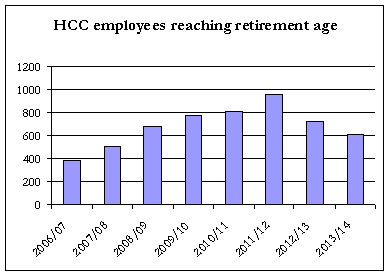
4.1. Since 2004, the numbers of retirements have increased significantly as the post war baby boomers reached age 60. A projection of future retirements (based on Hampshire County Council data) shows that these volumes will continue to increase until at least 2012.
4.2. In April 2004, LGPS regulations reduced the length of time members could request a refund of contributions from 2 years to 3 months. After 3 months of membership, members now receive deferred benefits if they leave the scheme prior to retirement.
4.3. Deferred benefits take significantly longer to process than refunds, as well as requiring on-going administration throughout the member's working life (e.g. production of annual statement).
4.4. There are around 600 people each month who leave the Fund with deferred benefits - approximately half of whom would have previously been entitled to a refund of contributions.
4.5. The changes in scheme rules also had a knock on effect on the number of notional transfers (transfers between employers within the Hampshire Pension Fund) that need to be processed each month. Many members with these small periods of service later start new jobs within the Fund and opt to join them together.
4.6. As part of the 2004 valuation, a comparison was made between the pensioner data held in Axise and that paid out from SAP. A significant difference was identified between the two systems
- a result of past data migration from legacy systems and inefficient processes created by duplicate input into two separate systems. Improved processes and reconciliation procedures are required.
5) Actions taken in 2005
5.1. In response to these growing pressures, a project team was created to review how the section could adapt and continue to offer a quality service to members.
5.2. Part of the solution was to make use of available technology and implement the document imaging module of the pension administration system. This allowed Pension Services to operate more efficiently and consequently offer a better service to members.
5.3. However, a more fundamental change was required to enable the section to cope with the increasing volumes and complexity of the scheme as well as to tackle the data integrity issues.
5.4. In 2005, Treasurer's Consultancy led a review of Pension Services, the outcome of which was to establish principles for administration:
· employee data is owned by the employer
· consistent processes for all employers
· data checks made at point of entry, other checking according to risk
· technology used to enable processes where appropriate
6) Fundamental changes taken in 2006
6.1. An organisational structure to support these principles was put in place from October 2006 and progress was also made on other recommended improvements.
6.2. The 2005 review created a separate team to manage and improve pension communications. In addition, a team was created to provide the first point of contact for all incoming queries. Over 80% of queries are now answered by this team, without the need to refer them through to the rest of the section.
6.3. In 2006, a further module was purchased that allowed employers to connect to Axise via the internet to view and amend their employee data. Following a successful pilot with two employers, it has now been rolled out to 15 other employers and now is used for over 75% of non Hampshire County Council member data.
7) Further improvements since 2007
7.1. During 2007, the pension processes for retirements, estimates and deferred benefits were simplified and streamlined. The section is now able to prioritise workloads through the use of time driven performance indicators.
7.2. For example, retirements used to be processed in the order that they were due for payment. This meant that those employers and members who did not promptly provide data were given priority over those who did.
7.3. Retirements are now processed in the order in which the data is received - this has encouraged employers to provide timely, accurate data and has enabled the section to meet service standards.
7.4. In 2008, a new membership pack was produced to simplify and improve the information members are given when they join the pension scheme. As part of this a new notional process was created that allowed members to opt to join old service at the point of starting a new job, streamlining the process.
8) Impact of changes
8.1. The 2005 review had allowed the section to change and adapt but the complexity and profile of pensions continued to increase following HMRC pension `simplification' on 6 April 2006 (A Day).
8.2. A Day introduced further requirements on all registered pension schemes and has been estimated to have doubled the time each retirement takes to process.
8.3. The 2006/07 CIPFA benchmarking showed that Pension Services were still operating on a very low cost per member, in comparison with other LGPS administrators. For the first time, the benchmarking also looked at performance against service standards. Pension Services were not able to meet all the CIPFA requirements.
8.4. The organisation changes and process improvements made by Pension Services since 2004 have allowed the section to achieve service standards when focus is given to a particular area.
8.5. However, because of the growing volumes of work the section has reached a point where there is not sufficient resource to keep up with workloads in all areas. In addition, little progress has been made in tackling backlogs that have built up in lower priority casework such as deferred benefits and notional transfers.
8.6. Pension Services therefore needs to continue to make changes to tackle data integrity and achieve service standards in the face of growing volumes and increased complexity.
8.7. A five year resourcing plan has been developed to address these issues. This is detailed below in section 10.
8.8. In addition, there are a number of different projects already in progress which will contribute to tackling these areas:
· Treasurer's Consultancy are leading projects to review pensioner payroll and to look at how the Fund ensures that it receives all the contributions due
· Improving the electronic interfaces between SAP and Axise for the County Council's membership data
· the rollout of Axise to employers is continuing
· document imaging is going to be extended to pensioner files
· the department is working with IT Services to ensure that the section has a robust, reliable IT system in place
· work is continuing to improve processes and explore different ways of working with employers and communicating with members.
9) Good record keeping the LGPS
9.1. In September 2008, The Pensions Regulator (TPR) issued a document highlighting the importance of good record keeping in the governance of pension schemes.
9.2. TPR recognises that although historically, administration and record keeping have been given a low priority by trustees, the quality of these has a huge impact on pension schemes. This can even lead to additional costs:
· increased funding costs due to more conservative actuarial assumptions about data
· inaccurate FRS17 liability
· more data checking and queries by actuaries.
9.3. The document recommends that the TPR work with trustees to raise awareness of the importance of good record keeping and enable them to achieve this. It also encourages administrators to measure and report data quality to trustees and draw up an improvement plan.
9.4. Whilst TPR has no immediate plans to enforce these changes, this position will be reviewed in 2009.
9.5. The changes already made in Pension Services, together with the projects underway and the proposed resourcing plan, will ensure good record keeping will be achieved for the Fund.
10) Resourcing plan
10.1. The Pension Services Service Plan 2008/09 identified the gaps that must be bridged in order for Pension Services to deliver a consistent service, to achieve service standards across all processes:
· tackling the underlying resource constraint and addressing the need to retain and reward skilled and developed staff
· ensuring staff are fully trained and simplified processes are applied consistently across the section
· continuing to improve employer and member communications - and ensuring that Operations can deliver to the resulting expectations.
10.2. Of these, the resource constraint was identified as the greatest risk to achieving service standards. Consequently a resourcing plan was developed which identified key areas for investment over the next 5 years in order to address this risk:
· capacity and skills mix
· retention and staff development
· succession planning
· backlogs
· data integrity
11) Capacity and skills mix
11.1. CIPFA benchmarking data shows that Pension Services has a low number of staff for a fund of its size. Recent legislative changes have also increased the complexity of pension work, meaning that cases take much longer to process.
11.2. An analysis of workloads shows that because of the increased complexity of the scheme, there are fewer processes that can be run by staff with little pension experience. It also showed that bottlenecks occur at the checking stage of calculations because there are not sufficient people able to perform these checks.
11.3. Pension Services need to invest in total full time equivalent (FTE) people employed in the section in order that existing workloads can be managed and to change the skills mix to employ a larger number of more experienced staff.
12) Retention and staff development
12.1. Pensions regulations are complex and new legislation usually applies in addition to the rules already in existence. This means that it takes a long time to develop a knowledge and understanding of the regulations.
12.2. It takes approximately 12 to 18 months for a new starter to have enough training to run retirement and estimate calculations. In the last 2 years, Pension Services have had 15 new starters, 7 of whom have now left - with an average of 15 months experience. Pension Services need to find ways to retain staff beyond this point in order to gain a return from the investment in training.
12.3. It is proposed to address this through expanding the Service Development team so they are resourced to develop and deliver a structured internal training plan. There is a need to enable staff to progress, through a new career grade, when they have gained the necessary skills, knowledge and competencies.
12.4. The staff would also be given the opportunity to study for a recognised, professional pension qualification.
13) Succession planning
13.1. Developing skilled staff is also vital due to the retirement of two key staff, with a combined LGPS experience of over 70 years. This experience cannot be replaced but there is a need to ensure that there is sufficient knowledge in the section to manage this loss.
13.2. A technical team within Service Development will be created to provide a central resource for the section. It is proposed that the structure of the section will be altered to include a level of Senior Team Manager positions who will be expected to have a high level of technical expertise. This will be achieved before the key retirements to allow a planned transfer. The expectation is that the Assistant Heads posts will not be replaced directly upon their retirement, with the Senior Team Manager posts creating a clearer career path and more opportunities.
14) Backlogs
14.1. Pension Services have a backlog of work representing over 5 months work for the entire section.
14.2. Deferred benefits and notional transfers form the majority of this backlog. Some of these cases are old and can be complex, needing significant LGPS pension experience to process them.
14.3. Pension Services have been unable to identify any organisation with the capacity and ability to perform this work. The proposal therefore includes provision to grow this experience internally and reduce the backlog over a three year period.
15) Data integrity
15.1. Pension Services use Axise for administration and SAP for pensioner payroll. There are no automatic interfaces between these systems and historic migration and manual duplicate input have led to significant differences between them.
15.2. The data for valuation is supplied from Axise therefore the data needs to be cleansed before the 2010 valuation.
15.3. As with the backlogs, this cleanse requires significant experience of the two systems. The plan is to backfill the day to day work of some of the payroll team with two FTE so that experienced staff can lead the data cleanse.
16) Costs
16.1. These key areas will be addressed over a five year period. An increase in the charge to the Pension Fund will be necessary to achieve this.
16.2. Pension Services are currently the second lowest cost administrator in the LGPS (CIPFA benchmarking data). The average cost per member is £22 - Pension Services currently spends £13.43 per member on LGPS work. The bottom quartile cost for LGPS schemes is £17 per member.
16.3. The table below shows the incremental cost of the plan over the next 5 years and the estimated impact on the cost per member.
2009/10 |
2010/11 |
2011/12 |
2012/13 |
2013/14 | |
Capacity |
£58,113 |
£173,698 |
£235,396 |
£240,224 |
£240,224 |
Retention |
£0 |
£66,385 |
£95,353 |
£95,353 |
£95,353 |
Succession planning |
£28,761 |
£114,429 |
£114,429 |
£114,429 |
£114,429 |
Backlogs |
£32,357 |
£122,184 |
£133,876 |
£133,876 |
(£7,242) |
Data integrity |
£20,364 |
£40,728 |
£2,414 |
£2,414 |
£2,414 |
HCC Employer |
(£2,923) |
(£5,846) |
(£14,978) |
(£14,978) |
(£14,978) |
Total cost |
£136,672 |
£511,578 |
£566,490 |
£571,318 |
£430,200 |
Change in FTE |
13.50 |
6.00 |
0.00 |
0.00 |
(6.00) |
16.4. All posts have been costed at the the mid-point of the highest grade within the range. The costs include changes to the Hampshire County Council Employer team as a result of technical expertise migrating to Service Development as well as the resolution of some specific Hampshire County Council issues.
16.5. The table below shows the changes by grade.
Current |
2009/10 |
2010/11 |
2011/12 |
2012/13 |
2013/14 | |
Head of Pensions |
1 |
1 |
1 |
1 |
1 |
1 |
Assistant head |
4 |
4 |
3 |
2 |
2 |
2 |
Senior TM |
0 |
3 |
5 |
6 |
6 |
6 |
Team manager |
10 |
9 |
8 |
14 |
14 |
12 |
Revenue technician |
12 |
14 |
14 |
16 |
16 |
15 |
B/C/D |
0 |
27.5 |
33.5 |
27.5 |
27.5 |
24.5 |
Senior admin assist |
21 |
3 |
3 |
1 |
1 |
1 |
Total FTE |
48 |
61.5 |
67.5 |
67.5 |
67.5 |
61.5 |
16.6. The table below shows the estimated impact on the cost per member of the resourcing plan over the next five years and the total cost of administration.
2009/10 |
2010/11 |
2011/12 |
2012/13 |
2013/14 | |
LGPS cost per member |
£15.24 |
£18.38 |
£18.63 |
£18.67 |
£17.39 |
Administration Cost |
£1.53m |
£1.90m |
£1.96m |
£1.96m |
£1.82m |
16.7. Good practice suggests that total administration costs should be around 0.3% of the total payroll for the Fund. The 2007 valuation data gives the figure of £775m (after inflation) for the Hampshire Pension Fund, resulting in a suggested administration cost of £2.32m.
16.8. The Panel is asked to note these increased workload pressures. This will require increased staffing resources both on a temporary basis during 2009/10 to 2010/11 to reduce backlogs, and on a continuing basis. Improvements in practice have been and will continue to be sought (for example the use of the internet for employers' and employees' self service) but more staff are now necessary. Costs will remain in the lower quartile, but service improvements should result. The changes will be part of the workforce plan considered by the Executive Member for Policy and Resources with the costs being met by an increased administration charge to the Pension Fund.
17) Pension administration strategy
17.1. The Local Government Pension Scheme (Administration) Regulations 2008 allow administering authorities to prepare a pension administration strategy in relation to their administering authority responsibilities. The strategy can include:
· procedures for liaison and communication with employing authorities
· establishment of levels of performance for both the administering and employing authorities
· procedures to ensure compliance with statutory requirements
· the circumstances in which employing authorities may be charged for extra costs arising because of the employing authority's performance
· publication of annual reports detailing performance
· any other issues considered appropriate
17.2. This strategy is not compulsory, but where one is produced it must be published and regularly reviewed.
17.3. The administration strategy focuses on ways in which the administering authority liaises with employers and its performance against defined service standards.
17.4. In a report to the Panel meeting in May, it was recommended that an administration strategy was not produced immediately and that an update report was provided to the next Panel meeting.
17.5. It is the intention to consult all the Fund employers on the content of an administration strategy during 2009/10, with the aim of having it in place from 1 April 2010 (which will support the 2010 valuation).
18) Investment management
18.1. The decision to appoint specialist managers and diversify the investment strategy has put pressure on the small team which administers and monitors the investment managers.
18.2. The appointment of an alternative investment manager as an advisory, rather than a discretionary manager, was expected to increase workloads during the initial roll out of the investment programme. This has proved to be a longer term increase than expected.
18.3. The appointment of a global custodian was expected to produce some potential process improvements to help offset having more managers to monitor. However recent events show that more time is required to monitor managers' investment policies and decisions than expected.
18.4. The same team deal with cash flow and treasury management and it is clear that the higher profile associated with this, coupled with the more frequent risk assessments and decisions required, is putting further pressure on the team.
18.5. More due diligence and time spent on processing alternative investments have substantially increased workloads.
18.6. For all these reasons the team has not had the capacity to review business process improvements or adequately scrutinise managers' investment decisions. It is therefore proposed to add one new post to balance workloads on a sustainable basis for the future, and this will again feature in the workload and budget decisions to be considered by the Executive Member for Policy and Resources. The cost will be very small in relation to the increased management fees resulting from the changes to specialist management.
19) Conclusions:
19.1. This report identifies the resourcing requirements to improve:
· data quality for the 2010 pension fund valuation
· turnaround deadlines on pensions administration
· the monitoring of the investment managers' performance.
Section 100 D - Local Government Act 1972 - background documents | |
The following documents discuss facts or matters on which this report, or an important part of it, is based and have been relied upon to a material extent in the preparation of this report. (NB: the list excludes published works and any documents which disclose exempt or confidential information as defined in the Act.) | |
Document |
Location |