Archived decisions
HAMPSHIRE COUNTY COUNCIL
Decision Report
Decision Maker: |
Hampshire County Council Regulatory Committee A | |||
Date of Decision: |
14th January 2009 | |||
Decision Title: |
Application for a Public Path Diversion Order for part of Footpath No.12 in the Parish of Long Sutton | |||
Decision Reference: |
||||
Report From: |
Director of Recreation and Heritage | |||
Contact name: |
Andrew Jones | |||
Tel: |
01962 846891 |
Email: |
||
EXECUTIVE SUMMARY | ||||
1) Summary of Decision Area: | ||||
1.1. The definitive alignment of Long Sutton Footpath No.12 runs through the centre of a coeducational residential college and it is therefore difficult for staff to ensure the safety of students in their care. An application has been received from the Bursar of Lord Wandsworth College for the footpath to be diverted across farm land to the east of the campus. 1.2. At their meeting on 26th November 2008, Members deferred a decision on 1.3. Members are therefore requested to approve the revised recommendation that an Order should be made for the permanent diversion of part of Long Sutton Footpath No.12. | ||||
2) Legal Framework for the Decision: | ||||
Orders for the Diversion of Footpaths and Bridleways may be made under Section 119 of the Highways Act 1980, as amended by the Wildlife and Countryside Act 1981, in the following circumstances:- "Where it appears to a council as respects a footpath or bridleway in their area (other than one that is a trunk road or a special road) that, in the interests of the owner, lessee or occupier of land crossed by the path or way or of the public, it is expedient that the line of the path or way, or part of that line, should be diverted (whether on to land of the same or of another owner, lessee or occupier), the council may, subject to subsection (2) below, by order made by them and submitted to and confirmed by the Secretary of State, or confirmed as an unopposed order,: (a) create, as from such date as may be specified in the order, any such new footpath or bridleway as appears to the council requisite for effecting the diversion; and (b) extinguish, as from such date as may be so specified in accordance with the provisions of subsection (3) below, the public right of way over so much of the path or way as appears to the council requisite as aforesaid. An order under this section is referred to in this Act as a 'public path diversion order'." Members must be satisfied that the diverted route will not be substantially less convenient to the public, and must have regard to the effect that a diversion will have on the enjoyment of the path as a whole. | ||||
3) Summary of Issues to be Decided: | ||||
3.1. Officers believe that it is expedient to divert the footpath in the interests of the landowner. The proposed alignment will be no less convenient or enjoyable than the current route, and members are therefore requested to authorise the making of an Order under s119 of the Highways Act 1980 for the diversion of this public right of way. | ||||
4) Recommendations: | ||||
4.1. It is recommended that an Order be made for the diversion of Footpath No.12 | ||||
MAIN REPORT:
1) Purpose of Report: |
1.1. Hampshire County Council has received an application to divert part of Footpath No.12 in the Parish of Long Sutton, as shown on the attached large scale plan. |
1.2. It is proposed that the application for diversion of Long Sutton Footpath No.12 be approved under Section 119 of the Highways Act 1980, as amended by the Wildlife and Countryside Act 1981, on the grounds that the diversion is in the interests of the landowner and that it is expedient that the line of the path should be diverted. |
2) Applicant: |
2.1. The Bursar, Lord Wandsworth College, Long Sutton, Hook, |
3) Landowners: Lord Wandsworth Foundation, acting for Lord Wandsworth College Long Sutton Hook Hampshire RG29 1TB |
4) Description of the Routes (please refer to the map attached to this report): |
4.1. Current Route |
Long Sutton Footpath No.12 commences at Point A (GR 474852 147060), at a junction with the C92 White Hill Road, and proceeds in a generally southerly direction along the college main driveway to Point B (GR 474934 146732). It then continues to the west, following a private access road, to Point C (GR 474778 146738). The route then continues along a footpath leading south to Point D (GR 474800 146360) and thence across fields to reach Point E (GR 474962 145906), at a junction with Long Sutton BOAT No.9 (T246 Frog Lane). The length of the current route of Long Sutton Footpath No.12 between Points A and E is approximately 1412 metres. |
4.2. Proposed Route |
The diverted route of Long Sutton Footpath No.12 will commence at a new set of steps on the C92 White Hill Road at Point L (GR 474884 147060), opposite Footpath No.8, and will then proceed in a generally easterly direction along the top of the bank on the south side of the C92 White Hill Road, across the driveway leading to Shepewood House at Point M The path will then turn south to skirt the main college buildings through Points G (GR 475096 146732) and H (GR 475090 146586) before continuing across fields through Points J (GR 475050 146550) and The length of the diverted route of Long Sutton Footpath No.12 between Points L and E will be approximately 1330 metres. The proposed footpath will have a width of 1.8 metres between Points L and N and 2.0 metres for the remainder of its length. In general, no structures or barriers will be required on the diverted route, with the exception of: 1. Point L where a short set of steps will bridge the difference in height between the C92 White Hill Road and the top of the bank, allowing walkers to make the transition from road to path in safety. 2. A short ramp or low steps at Point M, either side of the private drive leading to Shepewood House. The Rights of Way Area Officer (North East) has prepared a revised Schedule of Works detailing the improvements that will be necessary to bring the new route up to the standard required for use by the public, and the College has confirmed that they will fund the necessary works. |
4.3. The cost of making and advertising the Diversion Order will be met by the applicant. The County Council is required to bear the costs associated with confirmation of the order (other than those directly attributable to the placing of an advertisement in the local press). |
4.4. Both the original route and the diverted route of Long Sutton Footpath No.12 are entirely within the estate of Lord Wandsworth College. |
5) Benefits to the Applicant |
5.1. Lord Wandsworth College is a coeducational boarding establishment, |
6) Adherence to Diversion Guidelines |
6.1. The diverted route (1330m) is slightly shorter than the current footpath (1412m) and sharp changes in direction around buildings have been eliminated. This will make the new route easier to waymark and more obvious to walkers on the ground. |
6.2. The diverted route will provide a more `rural' experience, with a woodland walk on the northern section and improved views across fields to the east and south. |
6.3. Those structures that are necessary at Points L and M will be constructed to a specification approved by the Rights of Way Area Officer and designed to maximise access for those walkers with limited mobility. |
7) Consultations with Other Bodies: |
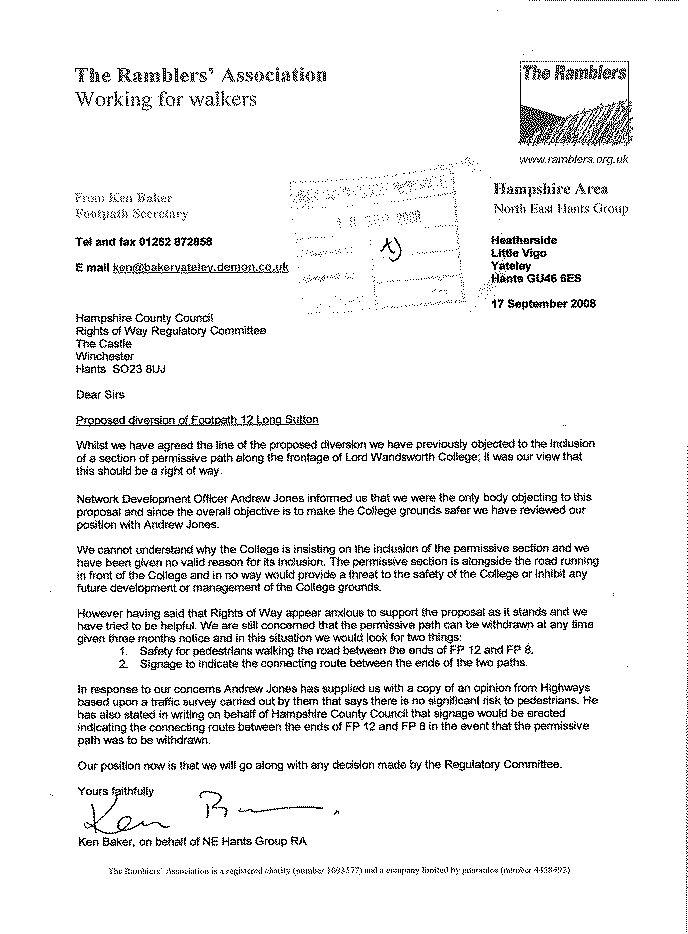
Statutory consultation was undertaken in July 2008 on the original proposal that included a length of permissive footpath between Points L and N, and this element attracted some adverse comment, although no outright objections. The revised proposal includes a dedicated right of way between these points and as it is an improvement upon the original proposal it was not considered necessary to |
7.1. Local Member - Councillor Jonathan Glen |
7.2. Hart District Council |
7.3. Long Sutton and Well Parish Council |
7.4. Rights of Way Area Officer |
7.5. HCC - Highways Management |
7.6. HCC - Environment Department |
7.7. Hampshire County Archivist |
7.8. The Ramblers' Association |
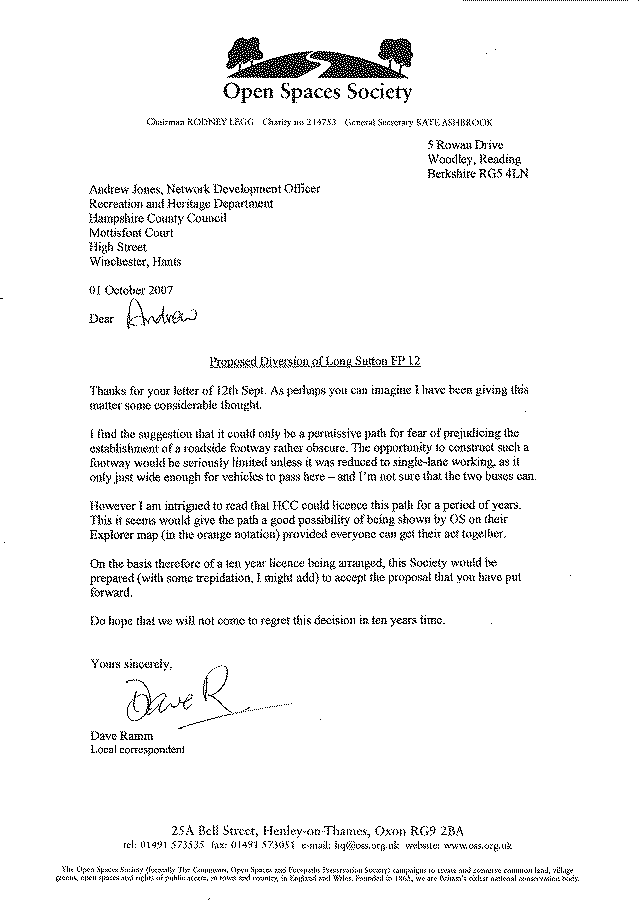
7.9. The Open Spaces Society |
7.10. Land Access & Recreation Association (LARA) |
7.11. National Farmers Union |
7.12. Cyclists Touring Club |
8) Comments on Consultation Replies |
8.1. Of the responses received from the consultation exercise, all are now either in favour of the proposal, or have no objection to it. 8.2. The Parish Council, the Ramblers' Association and the Open Spaces Society all initially objected to the inclusion of a Permissive Path as a link between the existing sections of the Rights of Way Network and the diverted route, on the grounds that this right could be withdrawn by the College at any time. 8.3. The subsequent dedication by Lord Wandsworth College of a new public right of way between Points L and N has addressed the root cause of their reservations. |
9) Criteria for Assessment of the Proposal |
9.1. The Council, as a Highway Authority, has the power to make a Public Path Diversion Order, if it is considered expedient to do so in a particular case. 9.2. Section 119(2) of the Highways Act 1980 requires that a Diversion Order should not be made unless the new termination point is substantially as convenient to the public as the existing termination point. 9.3. Section 119(6) of the Highways Act 1980 requires that a Diversion Order should not be confirmed unless the new path or way will not be substantially less convenient to the public in consequence of the diversion and that it is expedient to confirm the order having regard to the effect which: a) the diversion would have on public enjoyment of the path or way as a whole; b) the coming into operation of the order would have as respects other land served by the existing public right of way; and c) any new public right of way created by the order would have as respects the land over which the right is so created and any land held with it. 9.4. Section 29 of the Highways Act 1980 requires the County to have due regard to the needs of agriculture, forestry and nature conservation when considering the making of public path creation agreements. Officers confirm that there are no adverse effects on these activities associated with the making of this Order. 9.5. Section 69 of the Countryside and Rights of Way Act 2000 requires the County to have due regard to the needs of persons with mobility problems. This is further reinforced by the requirements of the Disability Discrimination Act 2005, as interpreted by the Countryside Agency's publication `By All Reasonable Means'. Officers confirm that the requirements of those with limited mobility have been taken into account when developing the Schedule of Works for structures, signage and conditions under foot on the new route. This will include a short set of steps at the northern end of the path, where the diverted route exits onto White Hill Road, as there is insufficient space to create a ramp at this point with an acceptable gradient. 9.6. In view of the rural nature of the footpaths in this area, it is considered that the inclusion of steps on the diverted route is unlikely to lead to a reduction in the number of walkers that would otherwise use this route. 9.7. The Rights of Way Office of Hampshire County Council has published Guidance Notes for landowners who are considering an application for diversion (http://www3.hants.gov.uk/making-changes/diversions.htm), |
10) Conclusions: |
Officers are of the opinion that the proposed diversion satisfies the criteria required by section 119 of the Highways Act 1980 and that it is expedient for the Council to make an order in that: |
10.1. The proposed diversion will improve the safety of students living and studying on campus. |
10.2. The proposed diversion will not be substantially less convenient than the existing route, in that the diverted section L-M-N-G-H-J-K-L-E (1330 metres in total) is slightly shorter than the equivalent section of the current route A-B-C-D-E (1412 metres). |
10.3. The proposed diversion will not affect the enjoyment of the path as a whole, as it will remove a perceived sense of invasion of privacy and provide a clear, level path which can be effectively signed. |
10.4. It is unlikely that there will be any significant increase in the cost of maintaining the route at public expense. |
11) Recommendations |
11.1. It is recommended that an Order be made for the diversion of Footpath No.12 in the Parish of Long Sutton from the current definitive alignment |
CORPORATE AND LEGAL INFORMATION ABOUT THIS DECISION:
Links to the Corporate Strategy | ||
Yes |
No | |
Hampshire safer and more secure for all |
_ |
|
Maximising well-being |
_ |
|
Enhancing our quality of place |
_ |
|
OR |
||
This proposal does not link to the Corporate Strategy but, nevertheless, requires a decision because: | ||
Section 100 D - Local Government Act 1972 - background documents | |
The following documents discuss facts or matters on which this report, or an important part of it, is based and have been relied upon to a material extent in the preparation of this report. | |
(NB: the list excludes published works and any documents which disclose exempt or confidential information as defined in the Act.) | |
(Quote list of documents here: e.g. list the relevant letters, memos, etc. and their location) | |
Document |
Location |
General Correspondence |
I:\Recreation and Heritage\Countryside Service\ |
Proposal File |
ATJ/Div/Long Sutton Fp 12 |
IMPACT ASSESSMENTS:
This decision has been assessed to see what impact it may have in the following areas. If it has been identified that there are possible implications which may have a negative impact this grid should identify the part of the report which covers the recommendation about how those potential negative impacts are managed or avoided.
Impact Level: S= Significant Impact L = Low Impact None = No impact
IMPACT AREA |
IMPACT LEVEL |
COMMENTS |
WHERE COVERED IN REPORT (Where there are details of how impact could be managed) |
Equality & Diversity Impact |
None |
||
Crime Prevention (under Section 17) |
Significant |
College Security and Student Safety will be improved |